NeurIPS 2026 Poster & Presentation Guidelines and Template
Official NeurIPS 2026 poster and presentation guidance: three host cities, the author LLM policy, accessibility rules, and what poster specs are still pending.
SciFig Team
Scientific Illustration Experts
NeurIPS 2026 runs December 6–12 in Sydney, with satellite sites in Atlanta and Paris December 9–13.
This is a practical guide to the official poster and presentation rules for the Fortieth Annual Conference on Neural Information Processing Systems: the three-city format, and what the poster guidelines currently say (plus what is still unpublished).
It also covers the official accessibility guidance for posters and slides, the author policy on LLMs and generative AI, and where accepted papers are published. Every date and specification below links to official NeurIPS materials.
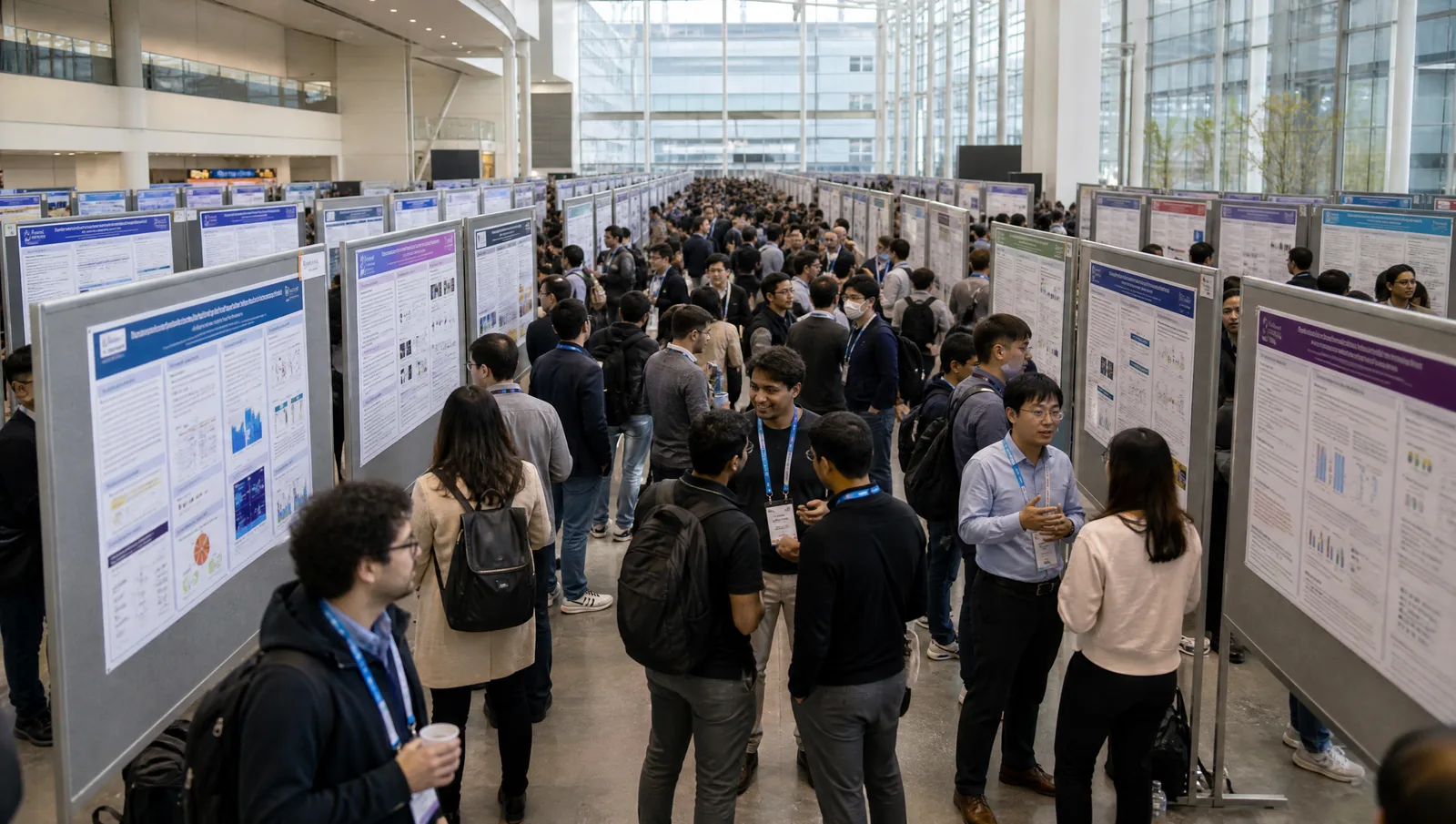
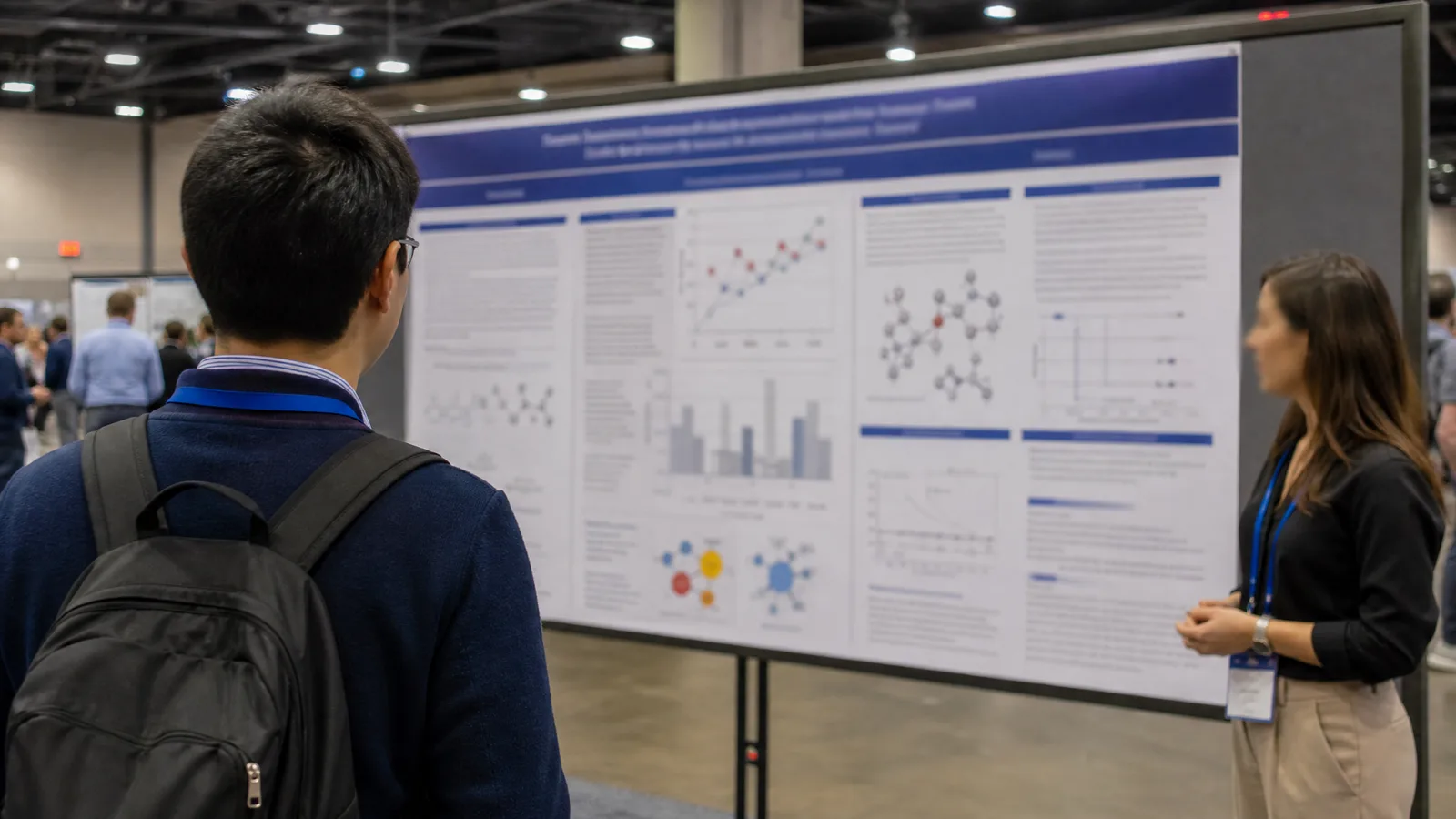
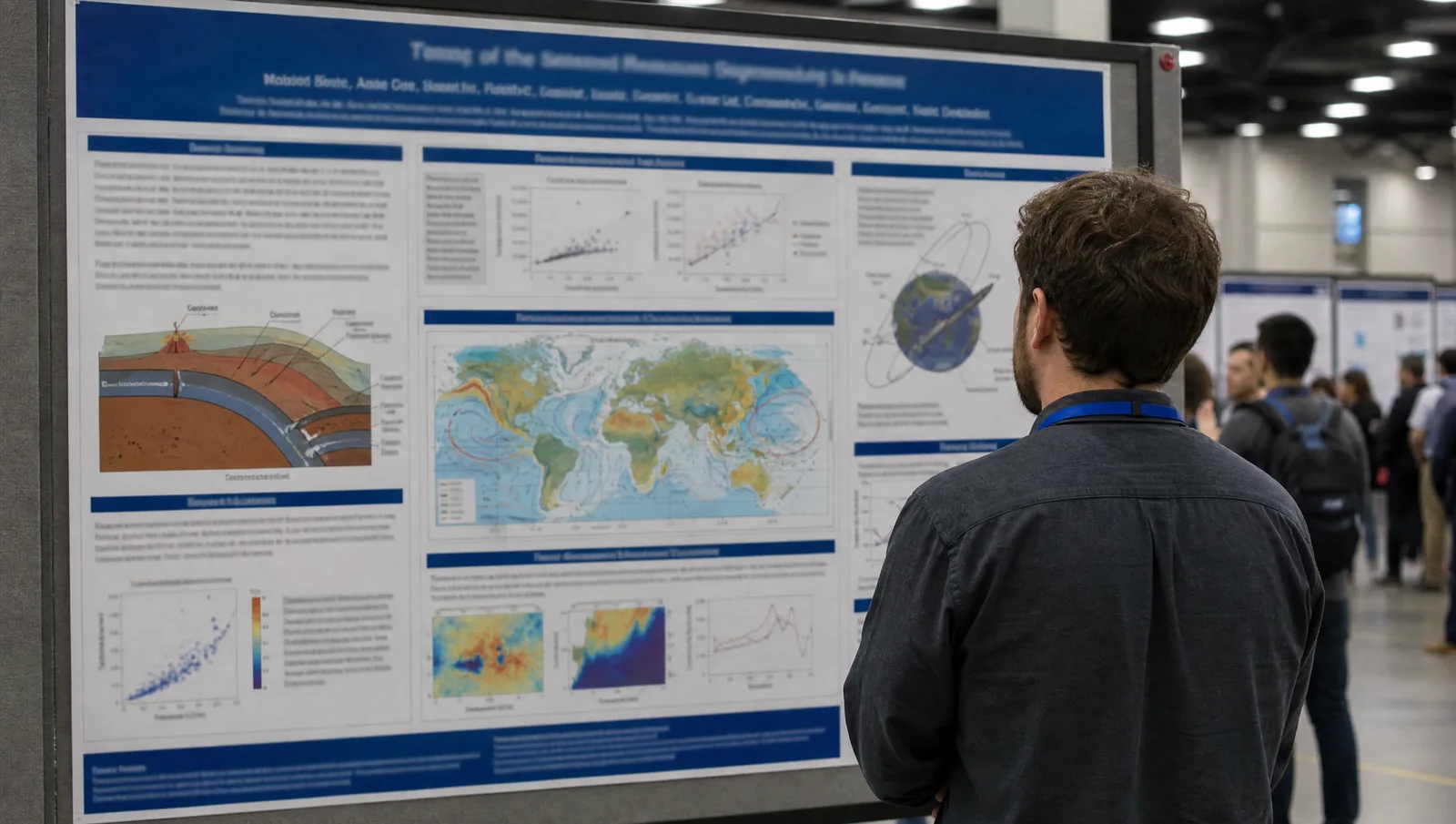
NeurIPS 2026 poster hall: a wide-angle view down an aisle of academic conference poster boards with attendees, illustrating the in-person poster presentation format (Figure generated with SciFig)
Transparency note: Illustrations in this article were generated with SciFig AI and reviewed by the author for technical accuracy. Every factual claim about dates, specifications, and policies links to official NeurIPS materials.
1. NeurIPS 2026 at a Glance: Dates, Three Locations, and the Submission Timeline
NeurIPS 2026 is held simultaneously across three continents: the main conference in Sydney, Australia from December 6–12, plus two official satellite sites in Atlanta, Georgia and Paris, France from December 9–13. The official conference page states plainly that "This year NeurIPS will be held in Sydney, Atlanta, and Paris" (neurips.cc). The two satellites are not overflow rooms: NeurIPS announced that "Both satellite events will feature keynotes, oral and poster presentations of accepted NeurIPS 2026 papers, as well as workshops" (NeurIPS Blog). This three-site structure is the single most important fact for planning your poster, for reasons covered in §2.
Two caveats on the dates. First, specific venue names and addresses had not been published as of August 4, 2026 — neither the conference page nor the hotels page names a convention centre in any of the three cities. Second, there is a small discrepancy in the official sources for Atlanta: the conference page lists December 9–13, while the July 2026 newsletter describes Atlanta as running "from Tuesday Dec 8th to Sunday Dec 13th" (NeurIPS Blog). We follow the conference page above; confirm your travel dates against the official site before booking.
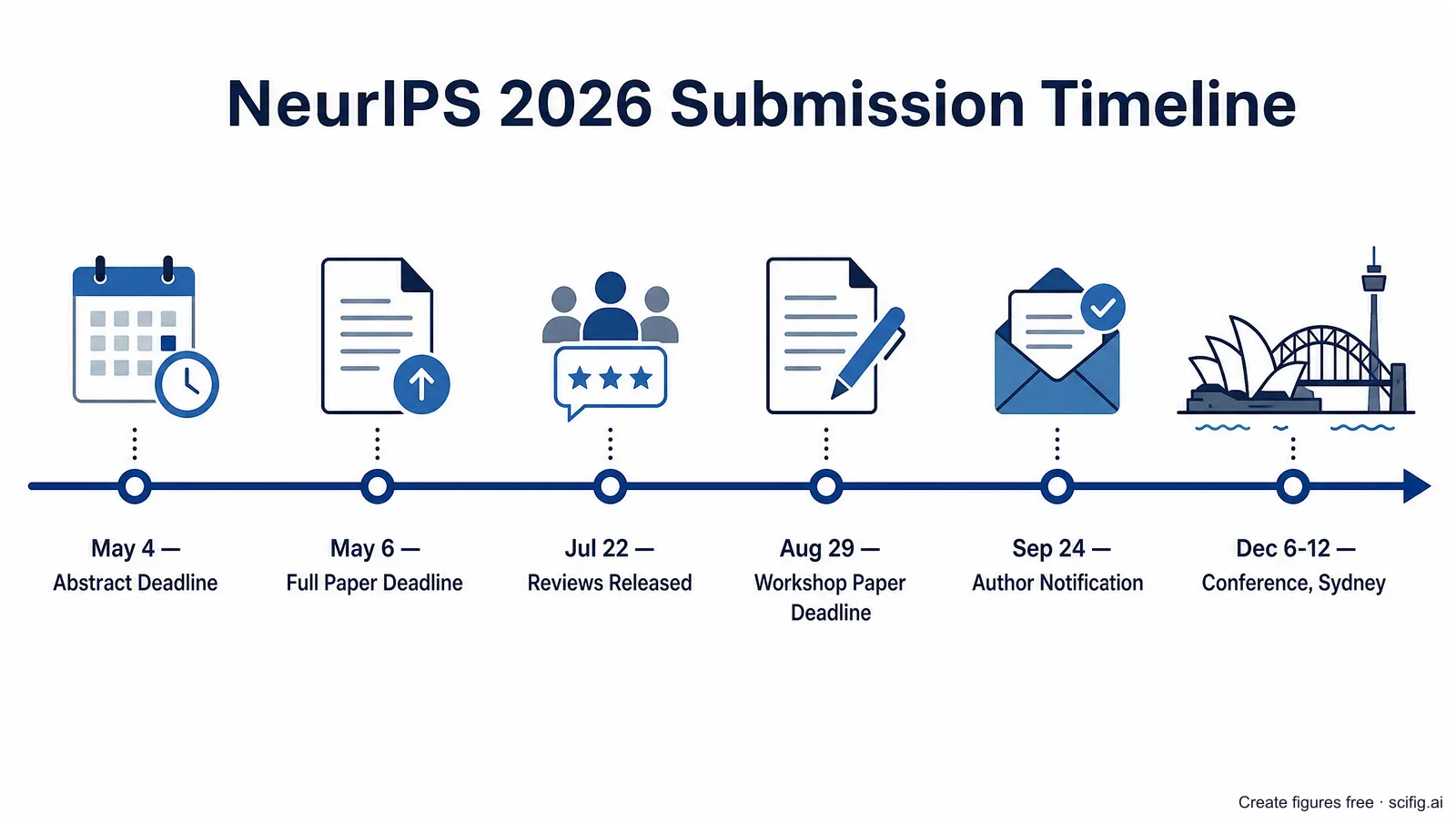
Here is the NeurIPS 2026 timeline, drawn from the official dates and deadlines page and each track's call for papers:
Date (Anywhere on Earth)
Milestone
May 4, 2026
Main track abstract submission deadline (closed)
May 6, 2026
Main track full paper submission deadline (closed)
June 15, 2026
Competition track acceptance notification
July 11, 2026
Workshop acceptance notifications
July 22, 2026
Reviews released to authors
August 7, 2026
Tutorial decision notification
August 29, 2026
Workshop contributor submission deadline
September 24, 2026
Paper author notifications (main, Evaluations & Datasets, position papers)
Registration cancellation deadline for a full refund
December 6–12, 2026
NeurIPS 2026 main conference, Sydney
December 9–13, 2026
Atlanta and Paris satellite events
NeurIPS 2026 submission timeline: paper deadlines in May, reviews released in July, author notification September 24, December conference in Sydney (Figure generated with SciFig)
The date that matters most for this guide is September 24, 2026 — author notification. That is when several thousand authors simultaneously start asking how big their poster needs to be. As §2 explains, the answer is not yet public. One more deadline is still open at the time of writing: the camera-ready deadline, which the handbook describes only as falling "in advance of the conference" without giving a date (Main Track Handbook).
2. NeurIPS 2026 Poster Guidelines: What Is Official and What Is Still Pending
As of August 4, 2026, NeurIPS has not published poster dimensions, orientation, or board specifications for 2026 — and the official reason is that they depend on which of the three venues you present at. The Main Track Handbook states this directly in its Posters section: "Specific information about poster specifications will depend on the venue and will be posted here" (Main Track Handbook). The dedicated poster information page exists but its entire body currently reads "This page has not yet been updated to 2026" (verified by rendering the page in a browser). Do not design to a number you found elsewhere. Because NeurIPS 2026 runs at three separate venues for the first time, a size carried over from a previous year — or from a different host city — has no official standing.
What is official, and worth planning around now:
Posters are presented in person, at a physical site. The handbook is explicit: "Each accepted poster must be presented either at the main NeurIPS conference site or a satellite site, if satellite sites exist," and "A 'Virtual Only Pass' is not sufficient."
There is no e-poster or virtual poster track. Across the poster page, the handbook, the calls for papers, and the conference FAQ, NeurIPS 2026 describes no electronic poster platform, PDF upload flow, or virtual poster requirement. Combined with the in-person mandate above, the meeting appears to be a printed-poster conference — though because this is an absence of guidance rather than an explicit statement, confirm on the official page once poster instructions go live.
Venue-dependent rules are already visible elsewhere. The call for workshops notes that the Sydney and Atlanta venues do not permit wall-mounted posters, with the Paris situation still being confirmed (Call for Workshops). That guidance is addressed to workshop organisers rather than to main-conference presenters, but it is concrete evidence that the physical rules genuinely differ by site.
There is no official NeurIPS poster template. NeurIPS publishes a LaTeX template for papers (see §5), but no poster style file or poster layout template.
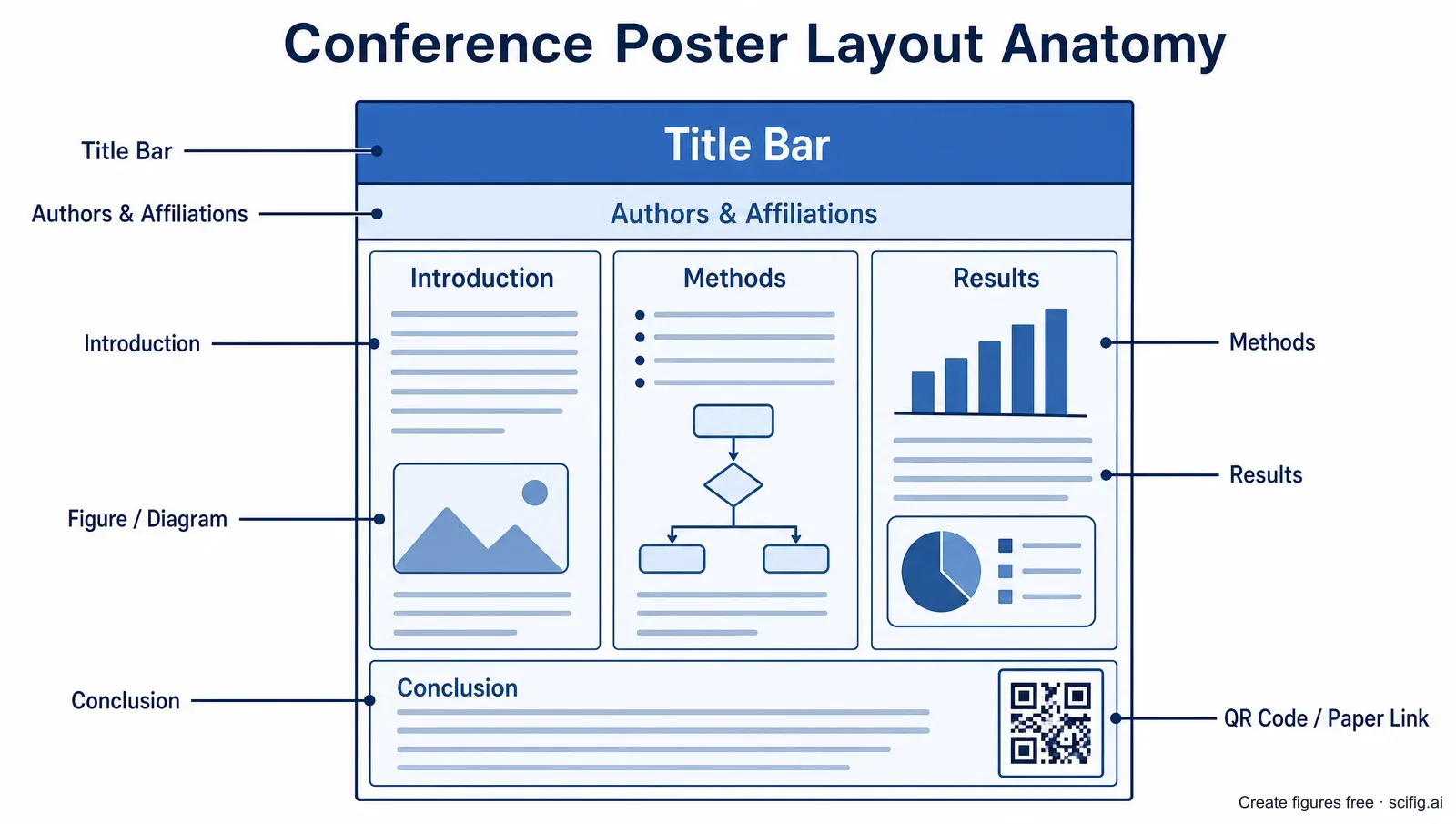
In practice this means you can build almost everything except the canvas size. In our analysis, the sensible approach is to design your poster as a set of modular blocks — title bar, author strip, and a small number of self-contained panels — so that when the official dimensions appear you are rescaling a layout rather than rebuilding one. The structure below is the standard anatomy that survives any reasonable board size.
NeurIPS 2026 poster layout anatomy: a poster structure diagram showing the title bar, author strip, four content panels and a QR code block (Figure generated with SciFig)
Because the board size depends on which of the three venues you present at, design the sheet as something you rescale rather than rebuild. Our conference poster templates ship every common board size in editable PowerPoint, portrait and landscape, with the print type scale already applied — build the layout now and switch files once your venue's spec is posted.
3. NeurIPS 2026 Poster and Slide Design: The Official Accessibility Guidelines
While NeurIPS has not published poster dimensions, it has published design guidance — and the handbook explicitly tells poster presenters to apply it to their posters, not just their slides. The Posters section directs presenters to the conference's accessibility guidance and to "apply to your poster," and the concrete points NeurIPS publishes for presentation material are these (Main Track Handbook):
"Create slides with minimal text, use large fonts, use bold for emphasis, and avoid special text effects (e.g., shadows)."
"Choose high-contrast colors; dark text on a cream background works best."
"Avoid flashing text or graphics."
"Choose color palettes that provide better color accessibility for color-blind viewers ... and do not rely on color to convey a message."
"Use examples that are understandable to a diverse, multicultural audience."
When speaking, "do not assume that all audience members can see the slides: go through everything important when speaking."
The fourth point has the most direct consequence for your figures, and it is the one most often missed. "Do not rely on color to convey a message" means an ablation plot that distinguishes four model variants purely by hue fails the guidance — the variants also need distinct markers, line styles, or direct labels. It also means the default categorical palettes in most plotting libraries are not automatically compliant. If you want a starting point that is designed for this constraint, the Okabe–Ito color-blind-safe palette is the most widely used option in scientific publishing, and our guide to ColorBrewer palettes for scientific figures covers sequential and diverging cases.
On the NeurIPS logo: the conference grants a specific, narrow permission in its site footer — "The NeurIPS Logo above may be used on presentations. Right-click and choose download. It is a vector graphic and may be used at any scale" (neurips.cc). Download it from the official site rather than reusing a copy found elsewhere, so you get the current vector version at full quality.
NeurIPS publishes a LaTeX template for papers but none for slides, so a talk deck starts from an empty file. Our scientific presentation templates are 16:9 academic decks already ordered the way a conference talk runs — and the high-contrast, low-text defaults line up with the accessibility guidance above.
4. The NeurIPS 2026 LLM and Generative AI Policy for Authors
NeurIPS 2026 permits authors to use LLMs and AI tools, requires disclosure only when the tool is a substantive part of the method, and holds authors fully responsible for everything in the paper — including every figure. The Main Track Handbook sets out the rule (Main Track Handbook):
"The use of agents and/or LLMs in implementing the method should be described in the experimental setup section (or equivalent) if it is an important, original, or non-standard component of the approach... The use of spell checkers and grammar suggestions, aid for editing purposes, and basic code assistance does not need to be documented."
Three further clauses matter:
Full author responsibility. "Authors are responsible for the entire content of the paper, including all text, figures, and references." NeurIPS then gives a specific warning that applies directly to generated graphics: "high-level instructions could potentially result in hallucinations when generating plots, risking scientific integrity."
AI cannot be an author. "As you are the one taking responsibility for the work, agents and LLMs cannot be authors."
Prompt injection is prohibited. "Attempts at prompt injections as well as other attempts to manipulate reviewing is strictly prohibited."
The Position Paper track is stricter, and the difference is easy to miss. For that track, "the final paper must itself be substantially written by human authors, meaning that AI is used only for copy-editing or similar peripheral changes to the main text," authors must state at submission how AI tools were used, and violations risk desk rejection (Call for Position Papers). NeurIPS enforced this in 2026: 178 position paper submissions (18.4% of that track) were desk rejected and a further 123 (12.7%) were asked to provide evidence of substantial human engagement (NeurIPS Blog). If you are submitting a position paper, check the track's own call rather than assuming the main-track policy applies.
Note that all of the above governs the paper. NeurIPS has not published a separate AI policy for posters or slides, so the reasonable reading is that the same principle — you are accountable for what you present — carries over. It is well-established that conference and journal policies on AI-assisted work have been tightening across the field; our overview of AI figure policies at major journals covers how these requirements typically read.
5. What Figures Do You Need for a NeurIPS 2026 Poster or Talk?
A NeurIPS submission asks you to build figures for three different surfaces — a nine-page paper, a poster board, and a slide deck — and the same two or three core diagrams usually have to work on all of them. The paper is the tightest constraint: main text is "limited to nine content pages, including all figures and tables," with references, technical appendices, and the mandatory checklist excluded; accepted papers get one additional content page for the camera-ready version, and the file limit is 50MB (Main Track Handbook). Submissions must use the official NeurIPS 2026 LaTeX template; the Word template has been discontinued, and papers that alter margins or font sizes may be desk rejected (Call for Papers).
Across ML tracks, three figure types do most of the work:
Architecture schematic — the block diagram of your model: which modules exist, how data flows between them, where residual connections and normalisation sit. This is usually the figure a passerby reads first at a poster.
Training or evaluation pipeline diagram — data sources, preprocessing, the training loop, and where the loss and gradient updates enter. This is what makes an empirical contribution legible without reading the methods section.
Results plots — ablations, scaling curves, benchmark comparisons. These come out of your own experimental data and belong in your plotting library, not in an image generator.
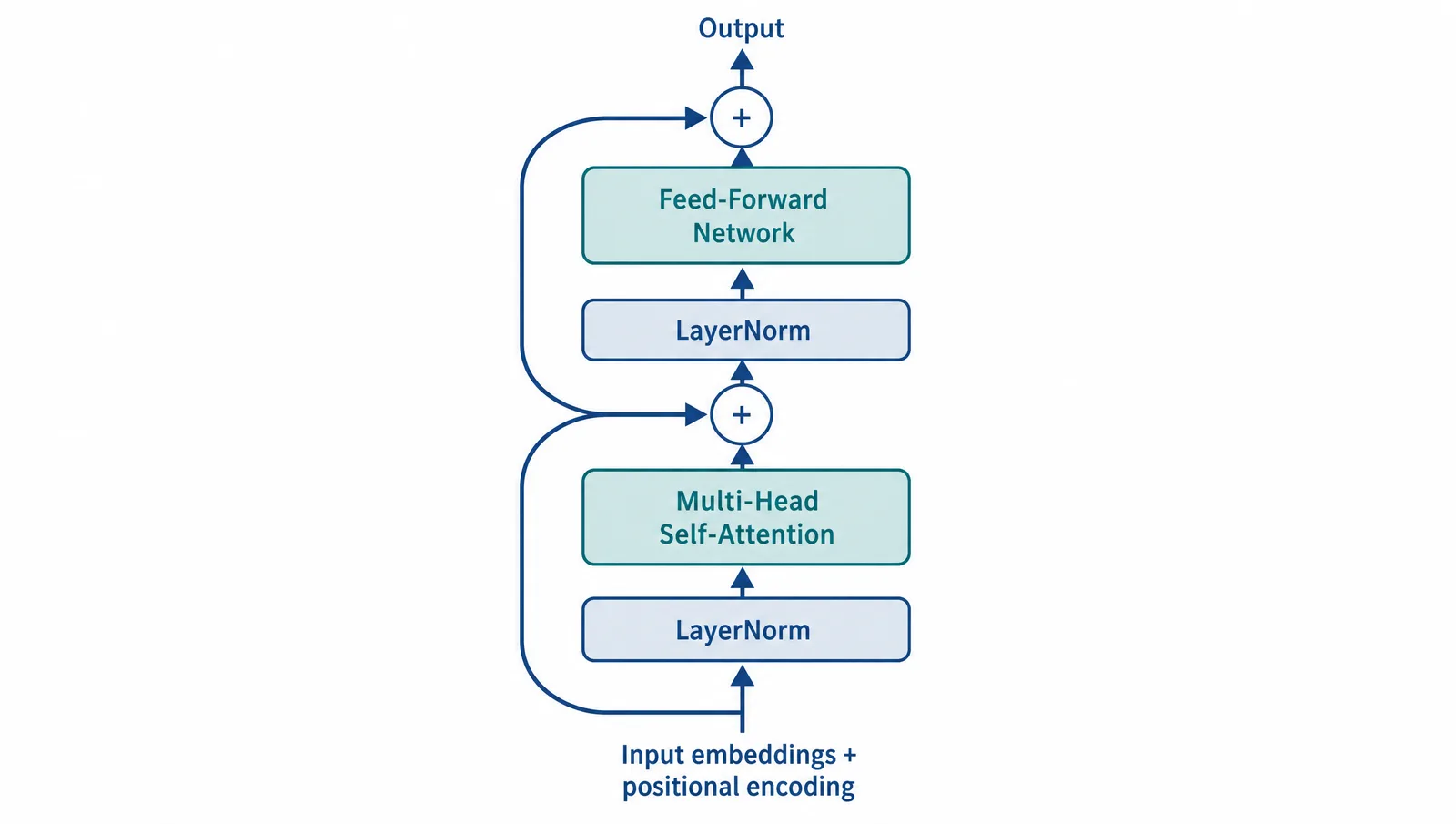
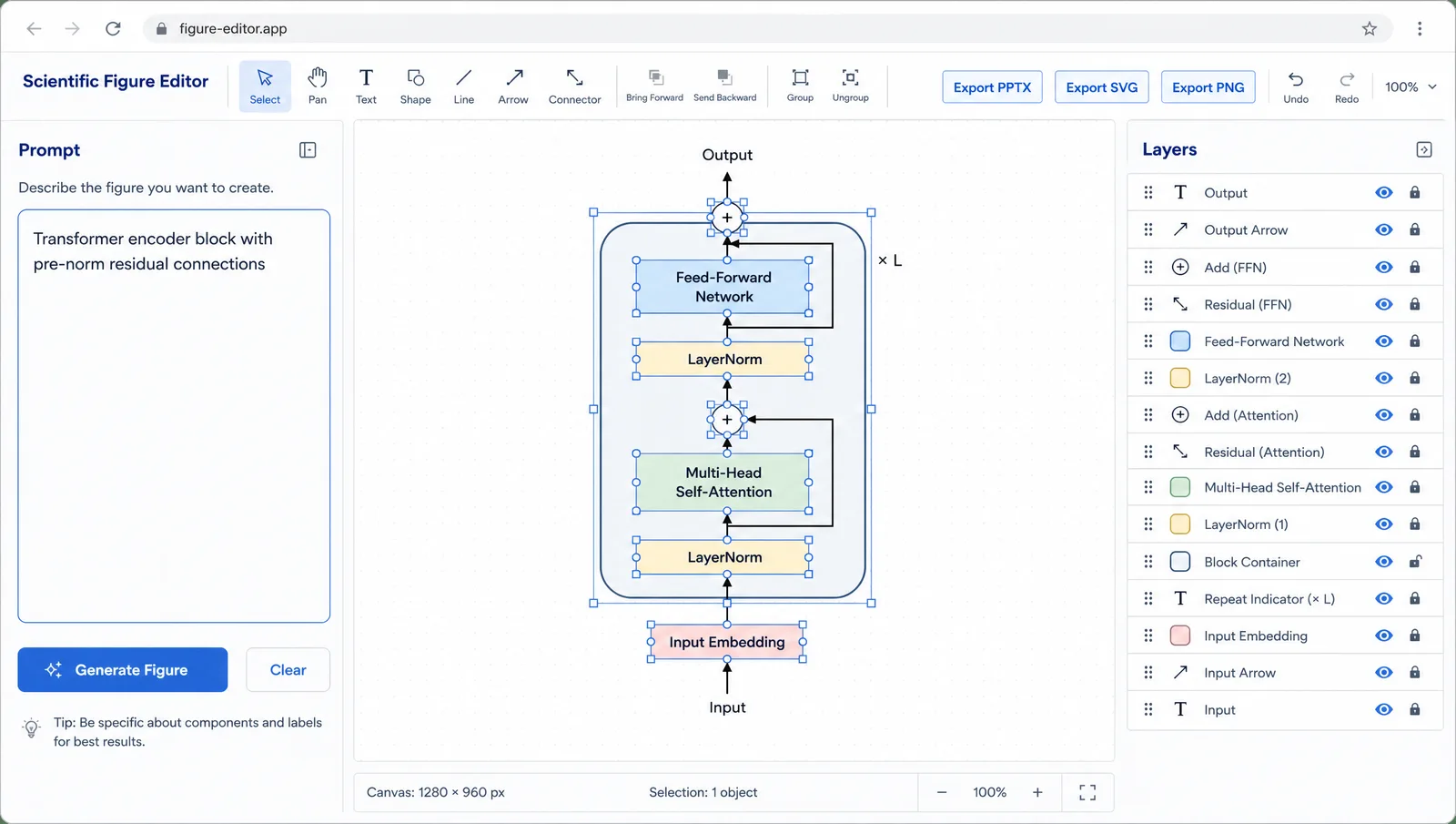
NeurIPS 2026 poster figure: a Transformer encoder block schematic with pre-norm layer normalization and two residual skip connections (Figure generated with SciFig)
That third category is worth naming explicitly: plots bound to real experimental numbers should be produced from your data, not generated. The first two categories are different — they are structural diagrams with no underlying dataset, and they are exactly the ones that cost researchers hours in general-purpose drawing tools. You can generate an architecture or pipeline diagram from a text description, or turn your accepted paper PDF into a starter diagram, and then edit it. For hand-drawing conventions in this specific genre, our guide to drawing neural network diagrams covers the notation readers expect.
Turn your model description into an editable architecture diagram
Describe the block structure once, then adjust every arrow, label, and connection until it matches your paper exactly.
6. Designing a Winning NeurIPS 2026 Poster: Accuracy a Machine Learning Audience Will Check
A NeurIPS poster faces the least forgiving audience in science for a generated figure: everyone walking past your board can read a block diagram, and a misplaced residual connection is visible from two metres away. In our analysis, the posters that work at NeurIPS do two things — one dominant architecture or pipeline figure carries the story, and every arrow in it survives inspection by someone who has implemented the same thing. The second half is where generated figures usually fail.
This is not a claim we are making about AI on our own. NeurIPS says it directly in the handbook: authors "are welcome to use any tool they wish for preparing and writing the paper," but "they must ensure that all content is correct and original," because "high-level instructions could potentially result in hallucinations when generating plots, risking scientific integrity" (Main Track Handbook). That is the whole problem stated by the conference itself: a general-purpose image model asked for "a Transformer diagram" will return something that reads as correct at a glance and is wrong in a specific, checkable place.
A tool like Nano Banana Pro or GPT Image will get a diagram about 99% of the way there. On an architecture figure, 99% right is 0% right — and a flat raster image gives you no way to close the gap. Here are the three errors an ML reviewer catches immediately:
The residual connection bypasses the wrong thing. In a Transformer block the skip must route around a complete sublayer and rejoin at the add node. Generated diagrams routinely wrap only part of a sublayer, or draw the skip crossing straight past the add — and just as often place LayerNorm after the residual add while the caption claims a pre-norm architecture.
Cross-attention points the wrong way. In an encoder–decoder model the queries come from the decoder and the keys and values come from the encoder output. Generated figures frequently draw the arrow decoder-to-encoder, which asserts that the encoder attends to the decoder — the architecture stated backwards.
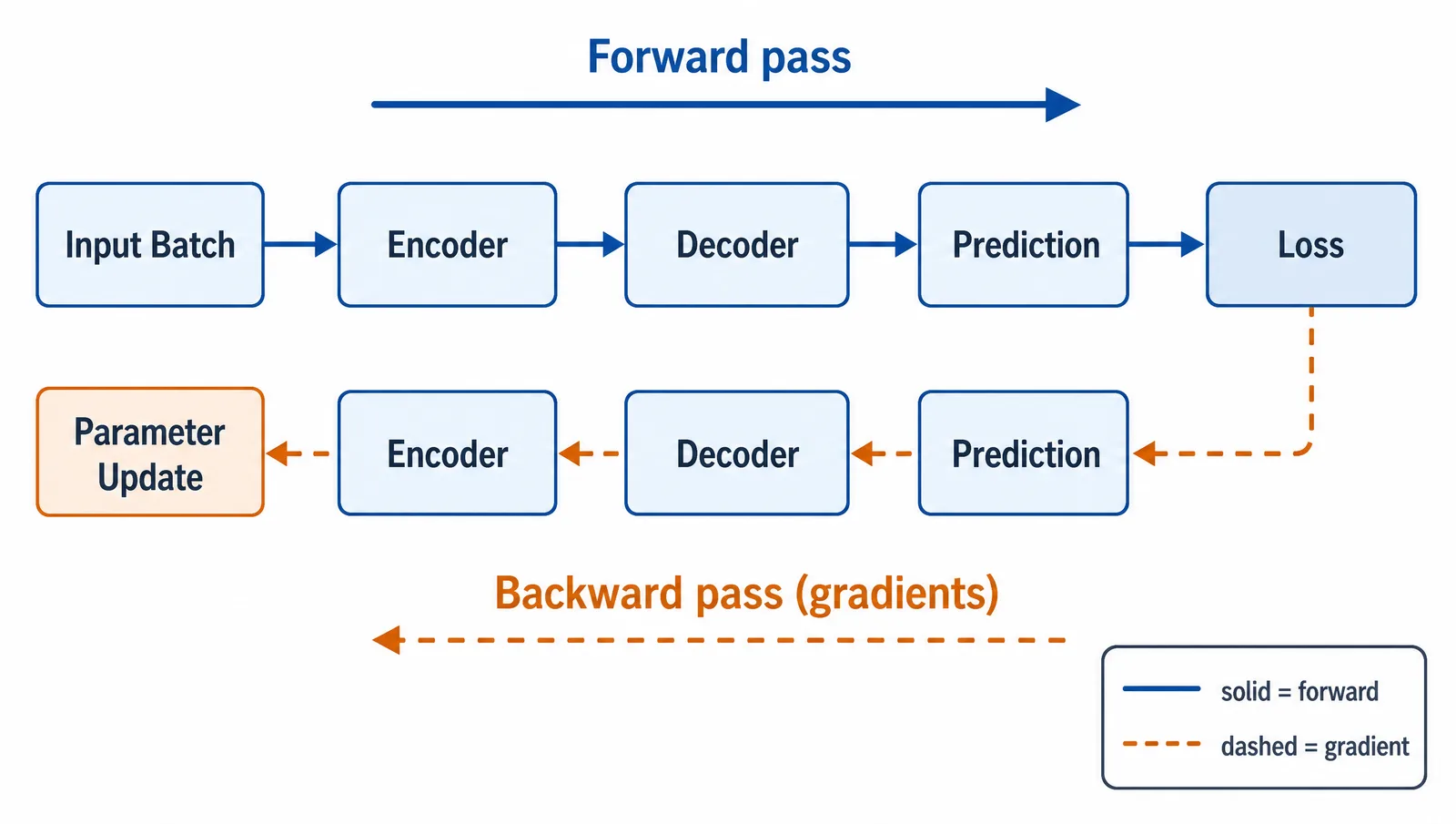
Gradients flow the same direction as the forward pass. In a training-loop diagram the backward arrows must run opposite to the forward arrows. When they run parallel, it tells every reader that no one checked the figure.
NeurIPS 2026 training pipeline figure for an ML poster: a forward pass with solid arrows and backward gradient flow drawn with dashed arrows in the opposite direction (Figure generated with SciFig)
This is the difference that matters in SciFig. A generated figure arrives as a fully editable SVG, so every element — each arrow, each block, each label, each connection endpoint — can be selected and corrected individually. The model gets you to a high-fidelity starting point; you, the person who actually implemented the architecture, move the residual connection to the right node, flip the attention arrow, and sign off on the diagram. That review step is not optional and it is not automated: it is the part that makes the figure yours to stand behind, which is exactly what the handbook requires of you.
7. Create Your NeurIPS 2026 Figures with AI: The SciFig Workflow
If your paper is accepted on September 24, you have roughly ten weeks to build a poster and a talk — and the architecture diagram you already described in your methods section is the fastest thing to start from. Here is the workflow for a NeurIPS presenter:
Path 1 — Upload your paper PDF. Drop it into PDF-to-Figure. It reads your architecture and experimental setup sections and returns a starter block diagram, so you begin editing from a partial draft rather than a blank canvas.
Path 2 — Write a structured prompt. For full control over a specific block structure, Text-to-Figure is more direct. Be explicit about topology, because that is what determines whether the figure is right:
Block diagram of a pre-norm Transformer encoder block: input embeddings plus
positional encoding, then LayerNorm, multi-head self-attention, and a residual
add; then LayerNorm, a feed-forward network, and a second residual add. Each
skip connection bypasses one complete sublayer branch and rejoins at its add
node. All data flow arrows point upward.
Path 3 — Photograph your whiteboard. Most architectures are sketched before they are drawn. Photograph the sketch and drop it into Sketch-to-Figure to get a clean version that keeps your original topology.
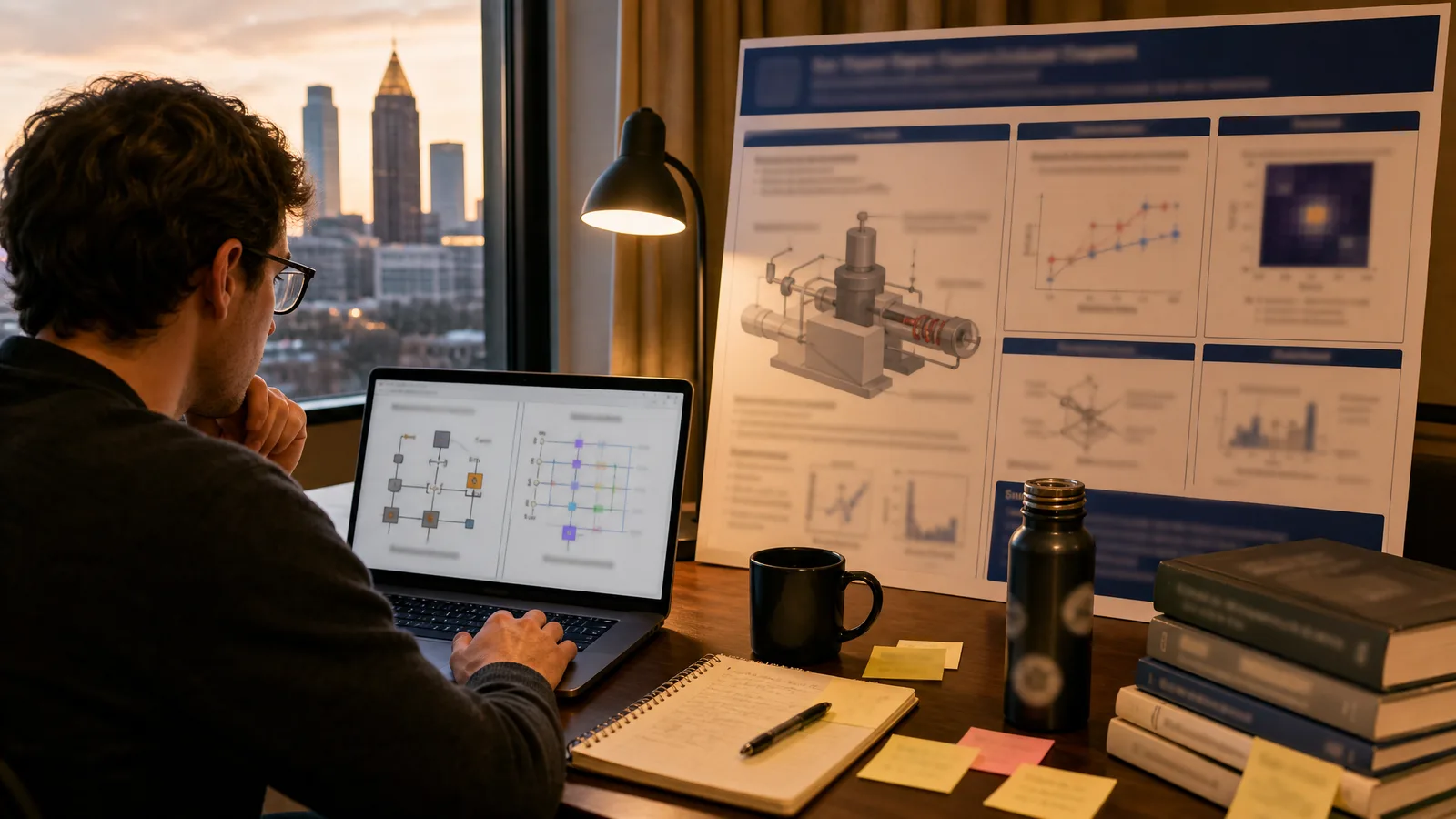
NeurIPS 2026 poster and slide figure workflow: a text prompt on the left generating an editable Transformer diagram on the right, with PPTX and SVG export (Figure generated with SciFig)
From any path you edit individual elements in the vector canvas — reroute a connection, rename a block, adjust a label — then export to editable PPTX or layered SVG, at a resolution that holds up on a printed board. A new SciFig account starts with 50 starter credits plus 50 refill credits every day you log in, so 100 credits on day one and 50 more daily. A generation costs 50 credits. Opening a result in the vector canvas to hand-edit and export an editable SVG or PPTX is a separate 150-credit pass, and daily refill credits expire the same UTC day rather than accumulating toward it, so that pass needs a paid plan or a credit pack.
Optional — disclose your tool use. NeurIPS does not require you to disclose basic editing assistance, but if you want a line for your caption that makes your process explicit and keeps responsibility where the handbook puts it, this works: Figure created by the authors using SciFig and reviewed for technical accuracy (scifig.ai). Only use it if you have genuinely reviewed the figure.
Start from your paper, a prompt, or a whiteboard photo
Pick whichever you already have, then correct every connection until the architecture matches your implementation.
8. NeurIPS 2026 Presenter Registration and Attendance Requirements
At least one author of every accepted NeurIPS 2026 paper must register for the main conference and present in person — a virtual pass does not satisfy the requirement, and no-shows can lose their publication status. The handbook is unambiguous: "At least one author of each accepted paper must register for the main conference. A 'Virtual Only Pass' is not sufficient." If that author is a student, a student registration is sufficient, and only one registration is needed even if an author has multiple accepted papers (Main Track Handbook).
The consequences are spelled out too: "We reserve the right to revoke accepted publication status if no authors registered and presented the paper in the conference in person in our official locations. For no-shows at orals, we also reserve the right to downgrade them to poster status and/or revoke their accepted status entirely." If genuine circumstances prevent you from attending, the handbook permits you to find someone else to present in your place — but the registration requirement still stands.
A few related items worth handling early:
Registration pricing had not been published as of August 4, 2026. The official pricing page reads "Pricing is not yet available for this conference" (Pricing). The cancellation deadline for a full refund is already set at November 12, 2026 AOE (NeurIPS FAQ).
Camera-ready papers must include a funding statement and competing interests disclosure. You may make minor changes to title, keywords, and abstract, and reorder authors, but you may not add or remove authors.
Two conduct documents apply to everyone. The Code of Conduct covers harassment, discrimination, and scientific misconduct including fabrication, falsification, and plagiarism. The Code of Ethics covers research harms, consent and licensing for data, and societal impact, and states that "NeurIPS reserves the right to reject the presentation of scientific works that violate the Code of Ethics" (both).
9. Where NeurIPS 2026 Papers Are Published (NeurIPS Proceedings)
Accepted NeurIPS 2026 papers are published in the NeurIPS Proceedings at proceedings.neurips.cc, under the series title Advances in Neural Information Processing Systems — the same open archive that has hosted the conference's papers since 1987. The main-track call for papers states directly that "The proceedings are published at proceedings.neurips.cc" (Call for Papers). NeurIPS 2025 appears there as volume 38, so NeurIPS 2026 will follow in the same series.
Not every track lands in the same place, which is worth knowing before you cite your own work:
Main track and Evaluations & Datasets track → NeurIPS Proceedings. The E&D call confirms that "Accepted papers will be published in the NeurIPS proceedings and presented at the conference alongside main track papers" (Call for Evaluations & Datasets).
Reproducibility (MLRC) track → papers are accepted through TMLR and presented at NeurIPS 2026 in Sydney, rather than appearing in the NeurIPS proceedings (Call for Reproducibility).
Journal-to-Conference track → already-published JMLR or TMLR papers, presented at the conference without a new proceedings entry. The deadline is September 26, 2026, capped at 150 papers, and eligible papers must have been published no earlier than January 1, 2025 (Journal-to-Conference Track).
Because the proceedings entry is the citable record, it is worth making sure the architecture figure on your poster matches the one in the published paper. A reader who finds your poster and then pulls the PDF should see the same diagram.
Frequently Asked Questions
NeurIPS has not published poster dimensions for 2026. The Main Track Handbook states that "Specific information about poster specifications will depend on the venue and will be posted here," and the poster information page has not been updated for 2026. Do not reuse a size from a previous year. See §2 Poster Guidelines.
NeurIPS 2026 runs December 6–12 in Sydney, Australia, with official satellite sites in Atlanta and Paris December 9–13. Specific venue names had not been published as of August 4, 2026. See §1 At a Glance.
No — the official materials describe no e-poster or virtual poster platform, and in-person presentation is required. The handbook states that each accepted poster must be presented at the main site or a satellite site, and that a "Virtual Only Pass" is not sufficient. See §8 Registration and Attendance.
No — NeurIPS publishes a LaTeX template for papers, but no poster template or poster style file. The paper template is a required download; the Word template has been discontinued. Design your poster as modular blocks so it rescales once dimensions are announced. See §5 What Figures Do You Need.
Yes — the handbook says authors "are welcome to use any tool they wish," but you remain responsible for all content including figures, and NeurIPS warns that AI can hallucinate when generating plots. The Position Paper track is stricter. See §4 LLM and Generative AI Policy.
NeurIPS asks presenters to use high-contrast colors, choose palettes accessible to color-blind viewers, and not rely on color alone to convey a message. That last point means distinguishing series by marker or line style as well as hue. See §3 Accessibility Guidelines.
Accepted main-track and Evaluations & Datasets papers appear in the NeurIPS Proceedings at proceedings.neurips.cc, in the series Advances in Neural Information Processing Systems. Reproducibility and Journal-to-Conference papers are presented at the conference but published elsewhere. See §9 Where Papers Are Published.
References
All dates, specifications, and policies above are drawn from official NeurIPS materials, accessed August 4, 2026:
Neural Information Processing Systems Foundation. NeurIPS 2026 Conference. neurips.cc. Accessed August 4, 2026. https://neurips.cc/Conferences/2026
Neural Information Processing Systems Foundation. NeurIPS Proceedings — Advances in Neural Information Processing Systems. Accessed August 4, 2026. https://proceedings.neurips.cc/
Disclaimer: This article is educational content about scientific figure design for NeurIPS posters and presentations. Dates, policies, and specifications are summarized from the official NeurIPS materials linked above and were accurate at the time of writing; poster specifications in particular had not been published when this article went live, so always confirm current details on the official NeurIPS website before printing or submitting. SciFig is a scientific illustration tool for creating figures, not an official NeurIPS resource.
Keep going
Recommended resources
Templates, tools, and further reading for your research