Official BPS 2027 poster guidance: 6 × 4 ft board size, the October 1, 2026 abstract deadline, 16:9 speaker slides, session times, and publication details.
SciFig Team
Scientific Illustration Experts
BPS 2027 runs February 20–24, 2027, at the Pennsylvania Convention Center in Philadelphia.
This practical guide covers the official poster and presentation rules for the Biophysical Society 71st Annual Meeting: the 6 × 4 ft poster board, mounting and presentation times, and 16:9 speaker slides.
It also covers the presentation formats, the October 1, 2026 abstract deadline, and abstract publication. Every date and specification below links to official BPS materials.
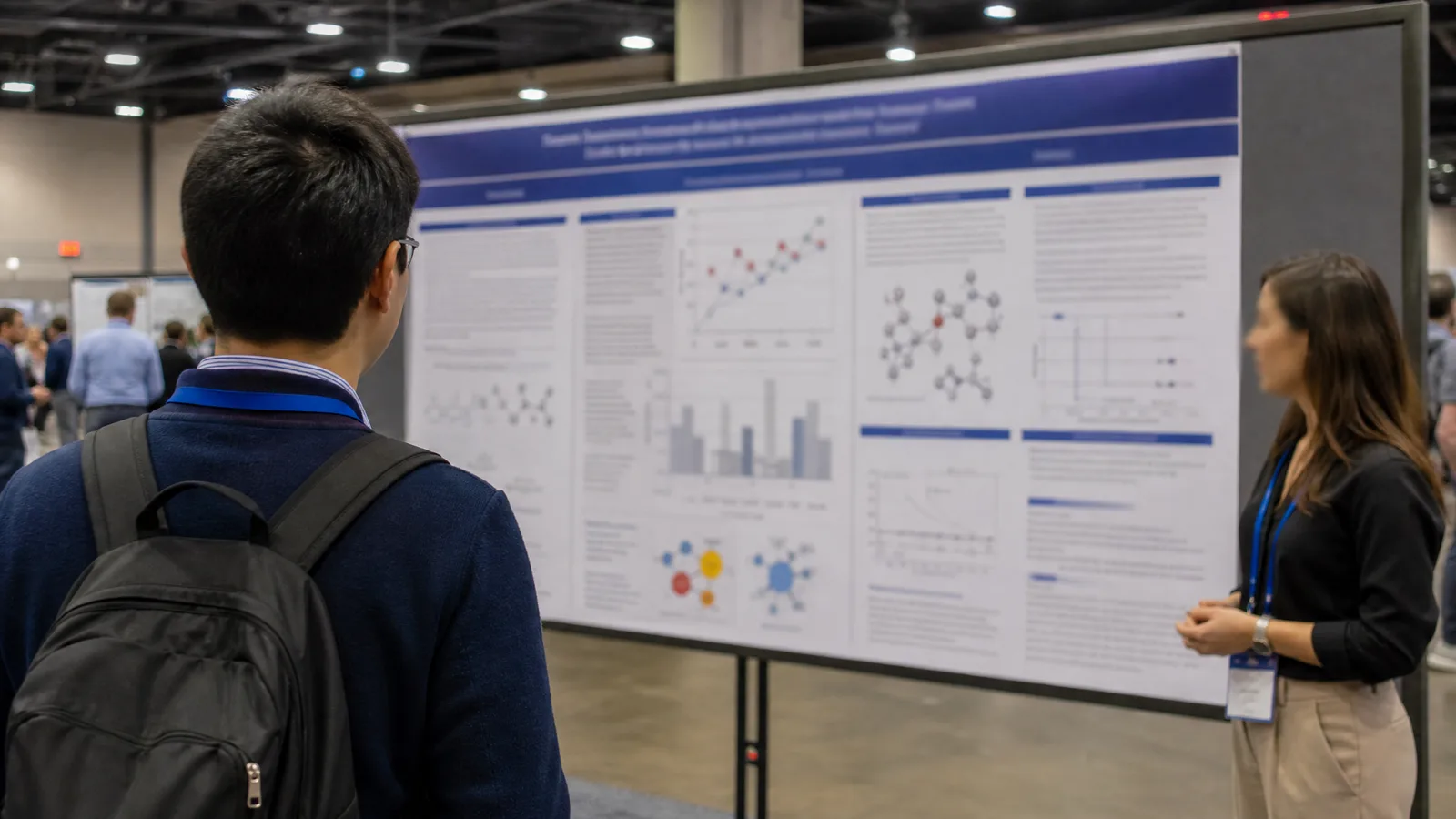
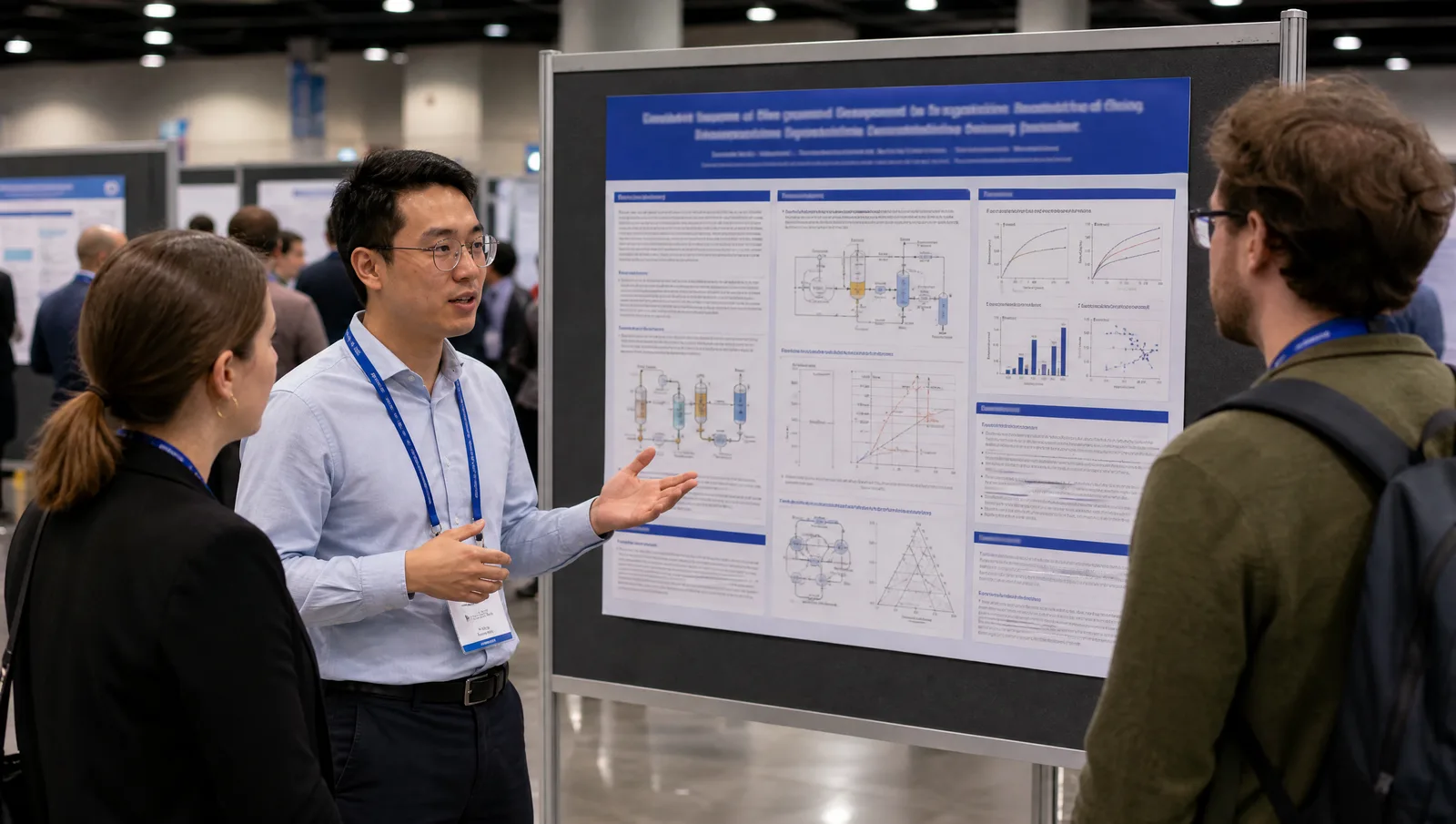
BPS 2027 poster guidelines cover showing a complete biophysics poster in a physical conference hall (Figure generated with SciFig)
1. BPS 2027 Abstract Deadline, Dates, and Venue
BPS 2027 takes place February 20–24, 2027, at the Pennsylvania Convention Center in Philadelphia, and the early abstract deadline is October 1, 2026, at 11:59 p.m. USA Eastern. The late-abstract site opens October 7, 2026, and closes January 5, 2027, at 11:59 p.m. USA Eastern. That October date is an abstract-submission deadline, not a poster-upload deadline: the available BPS presenter instructions described a physical board and did not publish a separate required poster or slide upload deadline. Check the official BPS speaker guidelines when a later upload instruction is issued.
Late abstract submission and early registration close
January 2027
Late-abstract programming notice; the FAQ says mid-January, while the submission instructions say late January
February 20–24, 2027
BPS 2027 in Philadelphia
Because the two official pages differ on the late-notice window, treat January as the reliable planning range and use the presenting-author email for the operative assignment. Abstract submission does not register the presenter for the meeting; registration is a separate step.
2. BPS 2027 Poster Size, Dimensions, and Template
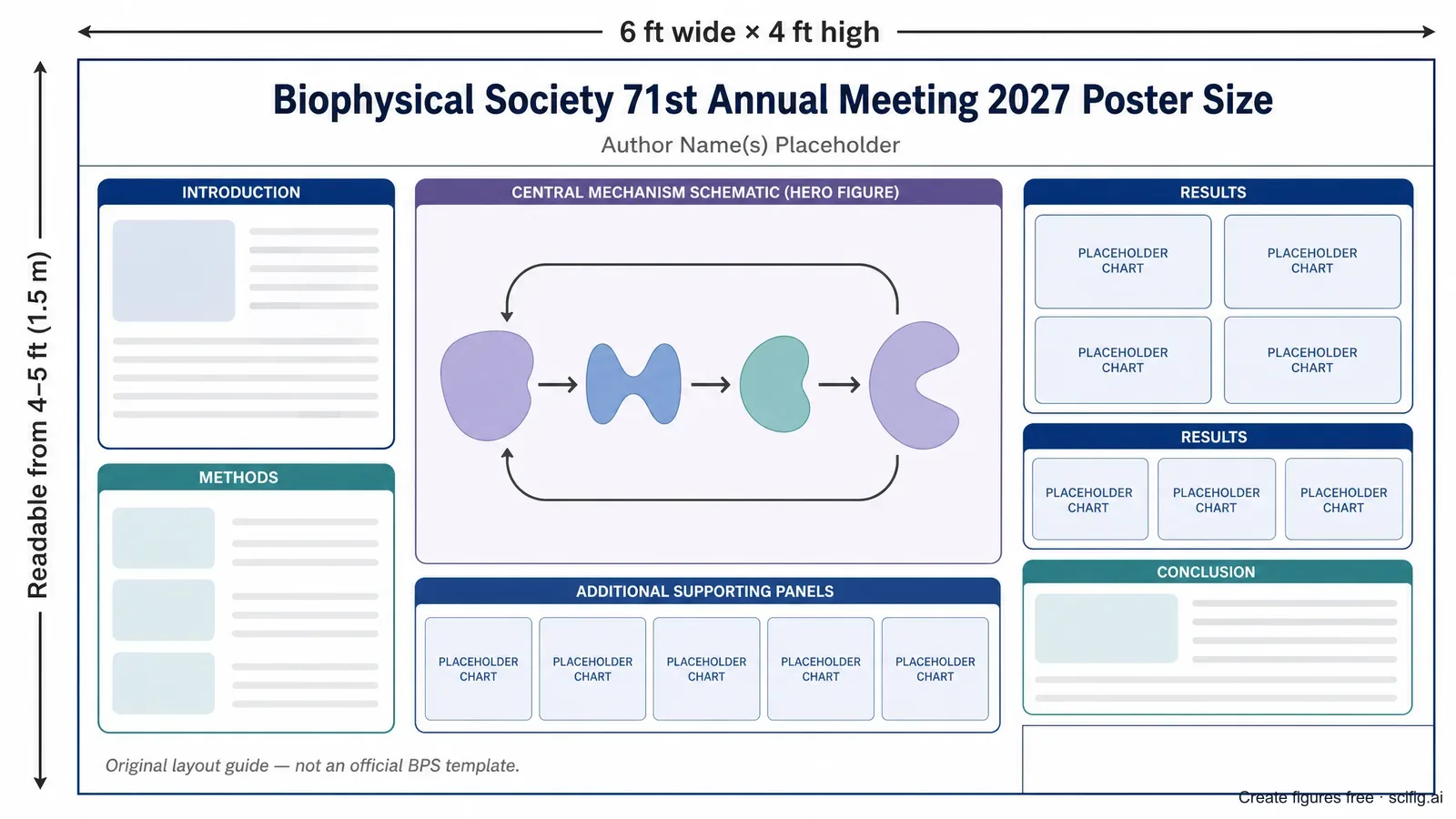
Each BPS 2027 poster board is 6 ft wide × 4 ft high, so design within a 72 × 48 in landscape-shaped board envelope and keep essential text readable from 4–5 ft (about 1.2–1.5 m) away. The dimensions describe the available board, not a requirement to fill every inch. At present, the official poster page provided board specifications and examples, but not a downloadable editable BPS poster template; the layout below is an original planning guide rather than an official society asset. If BPS publishes an editable template later, use the official poster-guidelines page as the source of truth.
Biophysical Society 71st Annual Meeting 2027 poster size guide showing a 6 ft wide by 4 ft high board and an original landscape layout, not an official BPS template (Figure generated with SciFig)
Use the full board shape to reserve a clear title and author band, one dominant mechanism or structure figure, and short supporting panels. The official BPS 2027 poster guidelines also tell authors to display a copy of the abstract and bring their own pushpins, thumbtacks, or Velcro. Build the hero figure first, then scale the remaining text and plots around it instead of shrinking every panel at the end.
Build the hero figure before laying out your BPS poster
Start with the mechanism or structure your audience must understand, then design the 6 × 4 ft board around it.
BPS provides board specifications but no downloadable poster template, so the sheet is yours to build from an empty page. Our conference poster templates give you an unbranded landscape layout in editable PowerPoint with the section structure and type scale already set — resize the canvas to the 72 × 48 in board envelope and drop your figures in.
3. BPS 2027 Poster Session Mounting and Presentation Times
BPS 2027 posters are displayed in the Exhibit Hall, with mounting and removal times tied to the assigned presentation day and author-attended periods split by odd or even poster number. Sunday through Tuesday, odd-numbered presenters attend 1:45–2:45 p.m. and even-numbered presenters attend 2:45–3:45 p.m. Wednesday shifts earlier: odd numbers present 10:30–11:30 a.m. and even numbers present 11:30 a.m.–12:30 p.m.
The official schedule gives these mounting and removal windows:
Presentation day
Mount the poster
Remove the poster
Sunday
Saturday at 6:00 p.m.
Sunday at 5:30 p.m.
Monday
Sunday at 6:00 p.m.
Monday at 5:30 p.m.
Tuesday
Monday at 6:00 p.m.
Tuesday at 4:00 p.m.
Wednesday
Wednesday at 7:00 a.m.
Wednesday at 3:00 p.m.
Check the poster number in the programming notice before planning travel or printing. Bring the mounting materials specified by BPS, arrive early enough to find the assigned board, and remove the poster within the stated window. At present, the instructions described a physical poster workflow and did not specify an ePoster or PDF upload step.
4. BPS 2027 Presentation Options and 16:9 Speaker Guidelines
BPS 2027 speakers should prepare widescreen 16:9 slides, bring their own laptop, power supplies, and adapters, and carry a USB backup. BPS says session rooms provide a projector, screen, laser pointer, and audiovisual technician. The verified speaker pages do not provide an official downloadable slide template or a required slide-upload deadline yet, so build a portable deck and test its fonts, movies, and aspect ratio on the laptop you will bring.
15-minute presentation plus 5 minutes for questions
Platform presentation
15 minutes; selected presenters may also choose a poster
Flash talk
5 minutes and the same work must also be presented as a poster
Poster only
Physical poster session
A short talk needs fewer visual claims than a poster. Use one figure per slide when possible, reveal only the states or comparisons needed for that moment, and leave enough time for the discussion included in the official slot.
The BPS speaker pages confirm 16:9 but publish no downloadable slide template. Our scientific presentation templates are 16:9 academic decks already ordered the way a platform talk runs: background, methods, results, discussion, conclusion — portable enough to carry on the laptop BPS asks you to bring.
5. What Scientific Figures Work for a BPS 2027 Poster and Slides?
In our view, the strongest BPS 2027 figures make a biophysical relationship visible: a conformational ensemble, a membrane-channel or transport cycle, a single-molecule measurement scheme, or a molecular-dynamics and analysis workflow. These formats match topics named in the official BPS 2027 scientific program, including protein conformations, membrane proteins, ion channels, GPCRs, lipids, molecular motors, RNA, mitochondria, optical probes, molecular dynamics, AI, and deep mutational scanning.
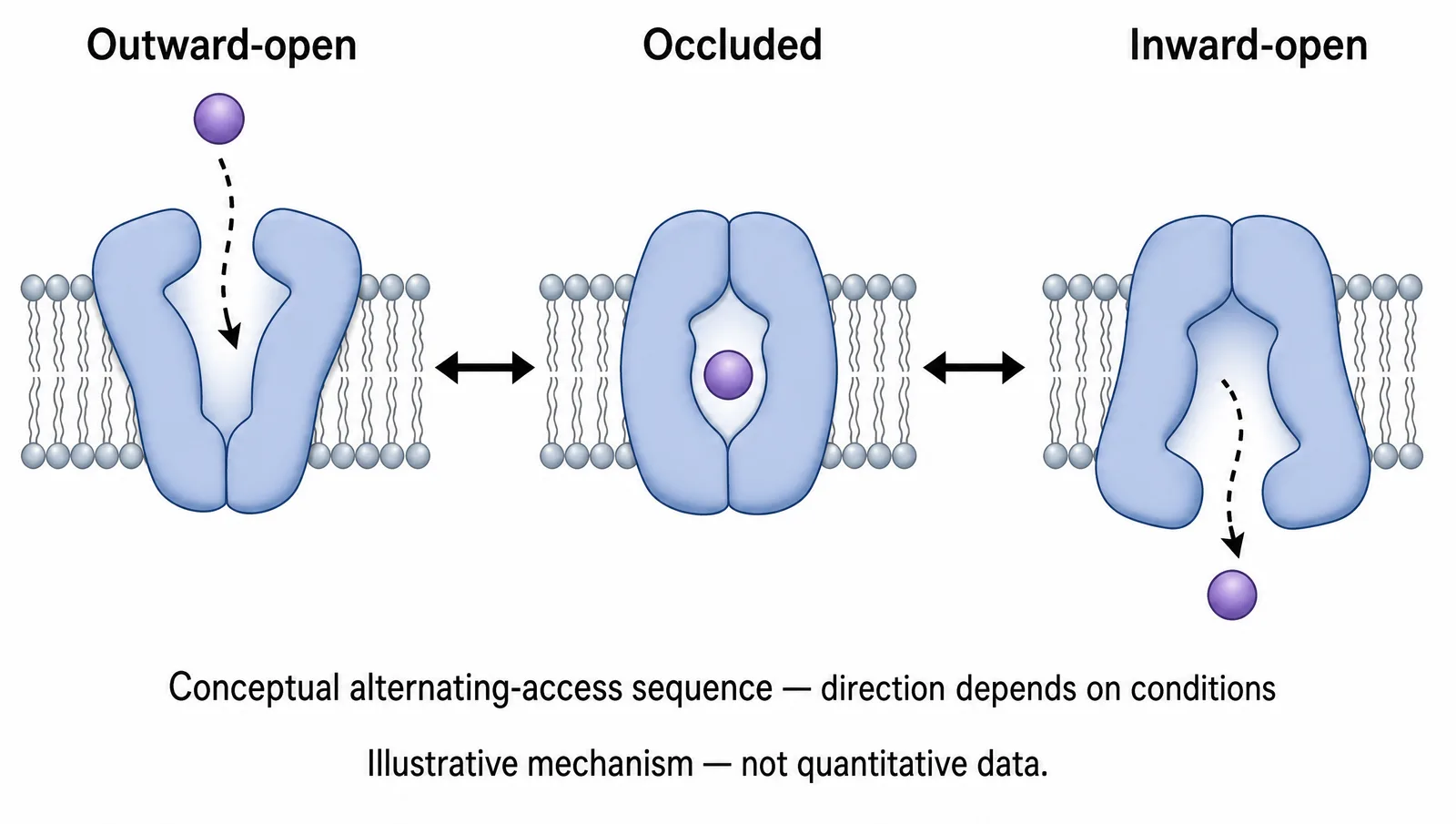
BPS 2027 membrane-protein transport cycle poster figure with outward-open, occluded, and inward-open states and reversible transitions across the lipid bilayer (Figure generated with SciFig)
Choose the visual form that answers the study question rather than the one that looks most complex:
Mechanism or state cycle: show ordered states, ligand or ion movement, and the direction or reversibility of each transition.
Structural ensemble: align conformations consistently and label the domains or residues that support the claim.
Measurement schematic: connect sample, perturbation, optical or force readout, preprocessing, and the reported observable.
Simulation or analysis workflow: separate experimental inputs, model assumptions, molecular-dynamics stages, and validation outputs.
A typed mechanism can start in Text-to-Figure; a photo of your experimental setup can start in Photo-to-Figure; and an image used solely as a style reference can start in Reference-to-Figure. A reference image supplies visual style only, not its subject, components, or labels. In every case, treat the generated figure as a draft and verify it against the underlying data and source material.
Draft a biophysics mechanism from your actual study
Describe the states, molecules, orientation, and evidence you need, then review every scientific relationship before presentation.
6. BPS 2027 Poster Accuracy: An Editable, Author-Reviewed Workflow
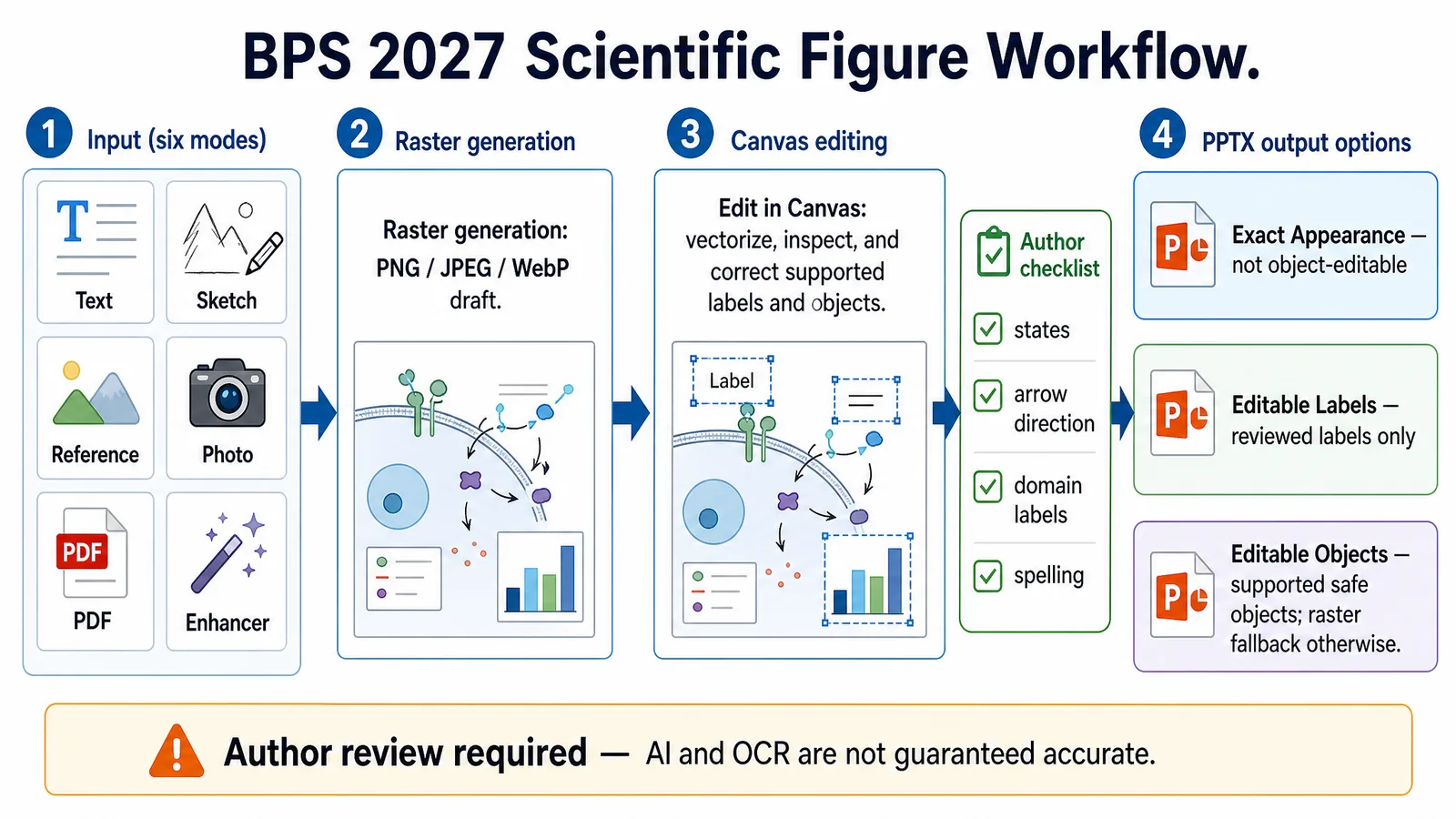
A scientifically credible BPS 2027 figure keeps state order, membrane orientation, arrow meaning, domain labels, and evidence boundaries explicit. An editable workflow then gives the author a practical way to inspect and correct every element. AI output is a starting draft, not scientific evidence. Before it reaches a poster or slide, compare each label and relationship with the study record, correct what does not match, and regenerate anything that cannot be represented faithfully.
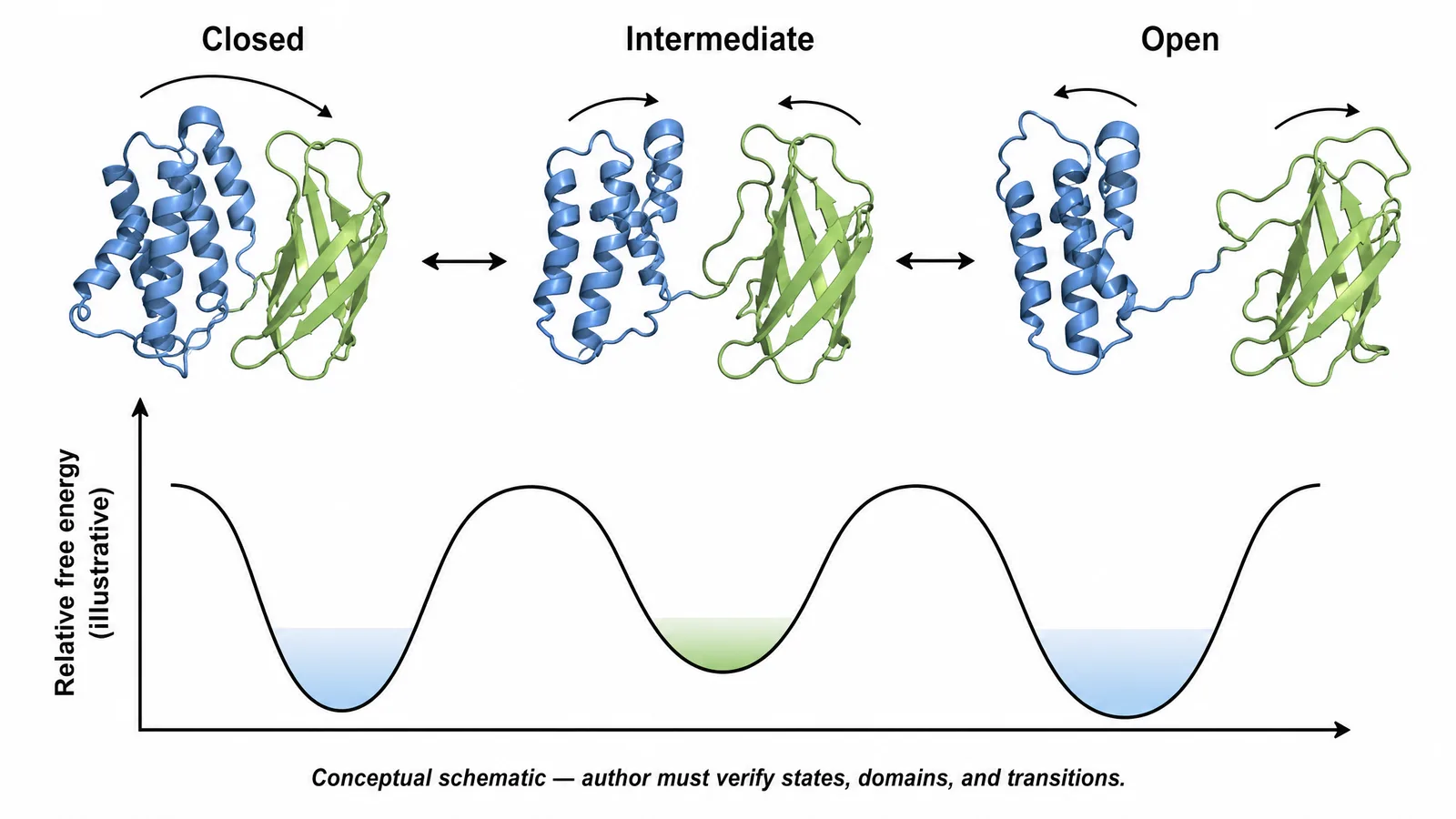
BPS 2027 protein conformational ensemble poster figure with closed, intermediate, and open states, motion arrows, and an illustrative free-energy profile (Figure generated with SciFig)
For a conformational ensemble, confirm that the closed, intermediate, and open states are not merely decorative poses; the ordering and movement arrows must reflect the intended model. For a membrane mechanism, verify extracellular and cytosolic orientation, ligand identity, stoichiometry, channel or transporter state, and whether an arrow means equilibrium, directional flux, or a proposed transition. For an imaging or simulation workflow, distinguish measured quantities from derived or predicted ones.
After the scientific review, use the five common scientific figure mistakes checklist to catch resolution, typography, color, and export problems before printing the poster or presenting the deck.
Warning
Scientific accuracy remains the author's responsibility. Review AI generated text, state names, arrow direction, molecular labels, and unsupported visual additions before using any figure in a BPS poster or presentation.
7. BPS 2027 Scientific Figure Workflow with SciFig
SciFig can begin from six supported input modes — text, sketch, reference image, photo, PDF, or an existing figure that needs enhancement — then open the draft in Canvas for author review and editing. Choose the input that preserves the strongest source information, correct the figure against your study record, and export only after checking the science.
Aim to improve clarity while the author verifies that the scientific content remains unchanged
BPS 2027 SciFig biophysics figure editor mockup with prompt input, editable membrane-transporter canvas, layers panel, and PPTX, SVG, JPEG, and PNG export buttons (Figure generated with SciFig)
SciFig can start from a prompt or source material, then open the draft in Canvas. Every label, state, arrow, and layout element is editable, so you can correct the figure against your source material before exporting to PPTX, SVG, JPEG, or PNG.
Move from first draft to an author-reviewed conference figure
Generate from the source you already have, correct every label and relationship in Canvas, and export when the science checks out.
8. BPS 2027 Abstract Guidelines, Registration, and Publication
A BPS 2027 early abstract has a combined title-and-body limit of 300 words, a maximum of 25 authors, and no graphics; accepted late abstracts are poster-only and are not published in the meeting supplement. The official submission guidelines also say early submissions must present scientific research rather than marketing for a specific company or product, so keep promotional claims out of the abstract and reserve figure work for the poster and slides.
Early abstracts are not peer-reviewed, but BPS describes them as citable and publishes them online before the meeting in a supplement to Biophysical Journal. They appear as entered in the submission portal, and BPS does not copyedit them. Accepted late abstracts are assigned to poster presentation only and do not enter that supplement. That difference makes the final portal proof especially important for early submitters.
The early abstract deadline is October 1, 2026; the late abstract deadline and early-registration deadline are both January 5, 2027. An abstract submission fee does not include meeting registration, so the presenting author must complete registration separately through the official BPS registration process.
Frequently Asked Questions
BPS 2027 runs February 20–24, 2027 at the Pennsylvania Convention Center in Philadelphia. The event is the Biophysical Society 71st Annual Meeting. See §1 BPS 2027 dates and venue.
The available BPS 2027 poster board is 6 ft wide × 4 ft high, or 72 × 48 in. At present, the official poster page provided specifications and examples but no downloadable editable poster template. See §2 BPS poster dimensions.
Sunday through Tuesday, odd-numbered posters are presented 1:45–2:45 p.m. and even numbers 2:45–3:45 p.m.; Wednesday uses 10:30–11:30 a.m. and 11:30 a.m.–12:30 p.m. Mounting and removal depend on the assigned day. See §3 poster session times.
BPS 2027 speaker slides should use widescreen 16:9 format. Official formats include symposium or workshop talks, 20-minute Select slots, 15-minute platform talks, 5-minute flash talks paired with a poster, and poster-only presentation. See §4 speaker guidelines.
The early BPS 2027 abstract deadline is October 1, 2026, at 11:59 p.m. USA Eastern. Late submission opens October 7, 2026, and closes January 5, 2027, at the same time. These are abstract deadlines, not a poster-upload deadline. See §1 key dates.
No. BPS states that graphics are not accepted in the early abstract submission. The title and body together may contain no more than 300 words, with no more than 25 authors. Figures belong in the poster or presentation rather than the submitted abstract. See §8 abstract guidelines.
Early BPS 2027 abstracts are published online before the meeting in a supplement to Biophysical Journal and are citable, although they are not peer-reviewed. Accepted late abstracts are poster-only and do not appear in that supplement. See §8 abstract publication.
References
All specifications and dates above are drawn from official Biophysical Society materials, accessed August 9, 2026:
Disclaimer: This article is educational content about scientific figure design for conference posters and presentations. Confirm current dates and specifications on the official BPS pages before submitting, printing, or traveling. SciFig is an independent scientific illustration tool and is not affiliated with or endorsed by the Biophysical Society; review every scientific label, state, and relationship against the underlying study before presenting.
Keep going
Recommended resources
Templates, tools, and further reading for your research