Cell Bio 2026 Poster & Presentation Guidelines and Template
Official Cell Bio 2026 poster guidelines: the 6 ft landscape board, the Sept 14 abstract deadline, minisymposium talk times, and the MBoC abstract supplement.
SciFig Team
Scientific Illustration Experts
Cell Bio 2026 runs December 12–15 at the San Diego Convention Center, San Diego.
This is a practical guide to the official poster and presentation rules for Cell Bio 2026, the joint ASCB and EMBO meeting: the poster board size and layout, the three abstract deadlines, and the Digital Poster Program.
It also covers how minisymposium talks are selected and how long they run, the presenter policies you agree to, and where accepted abstracts are published. Every date and specification below links to official Cell Bio and ASCB materials.
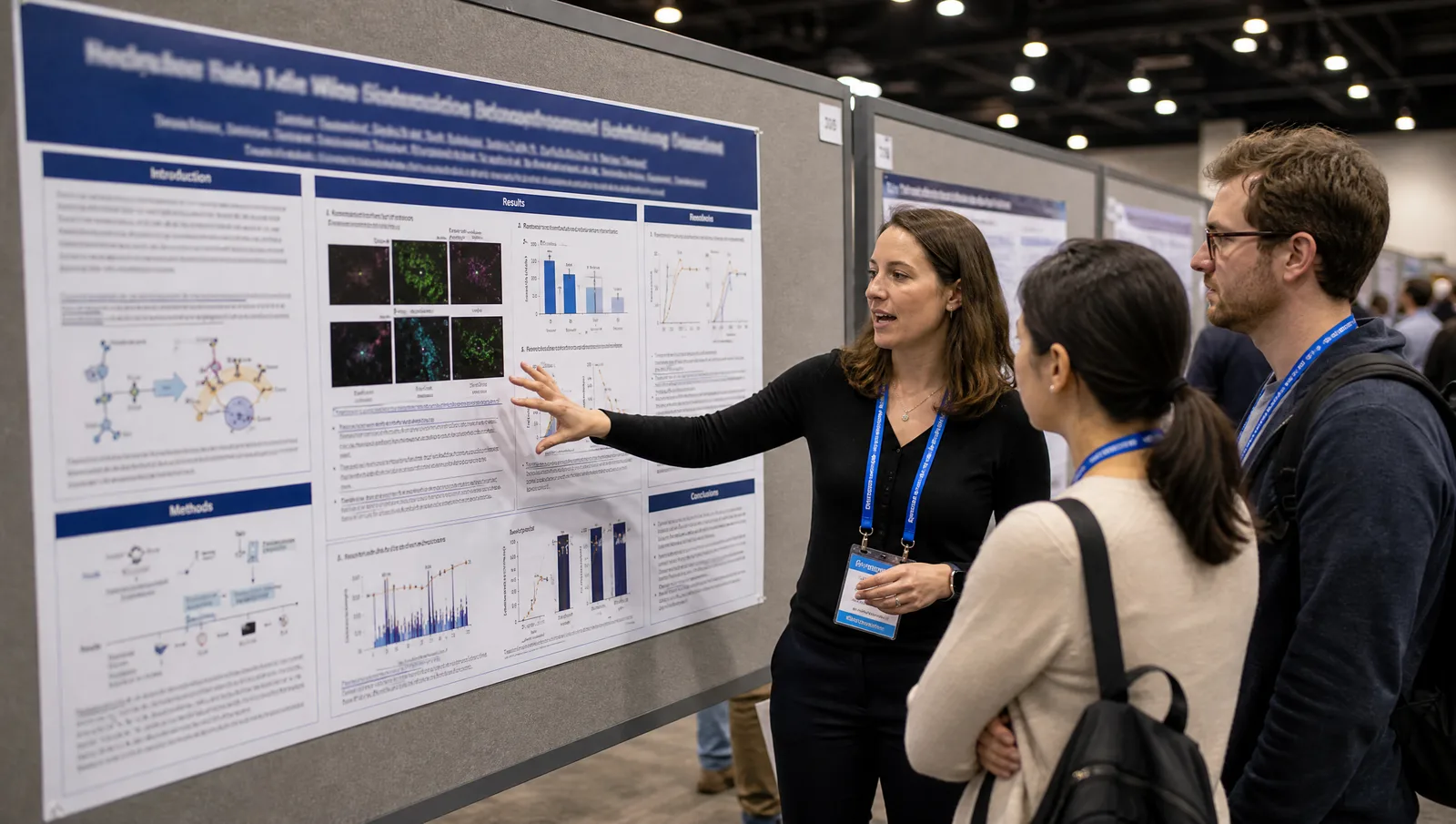
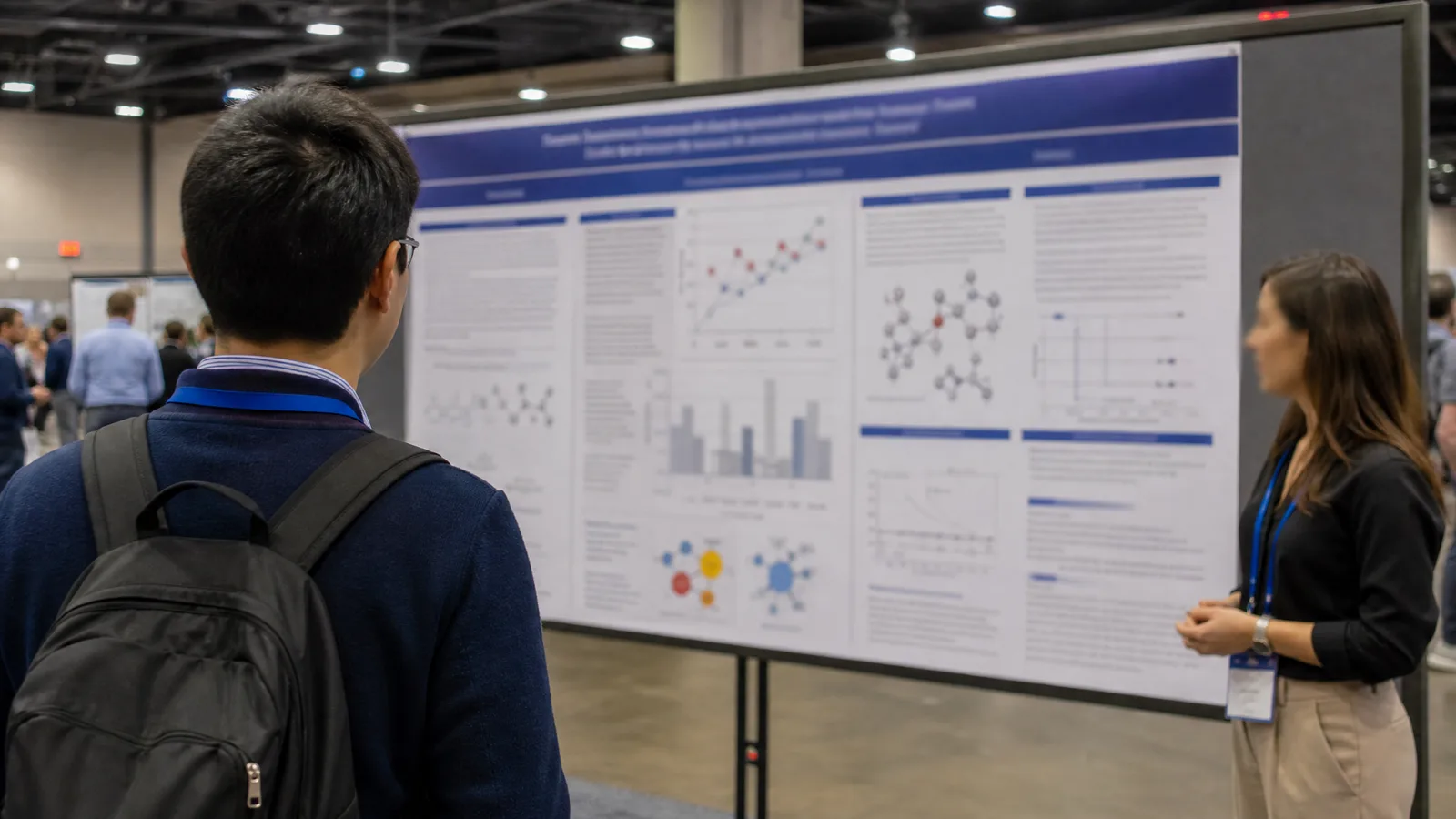
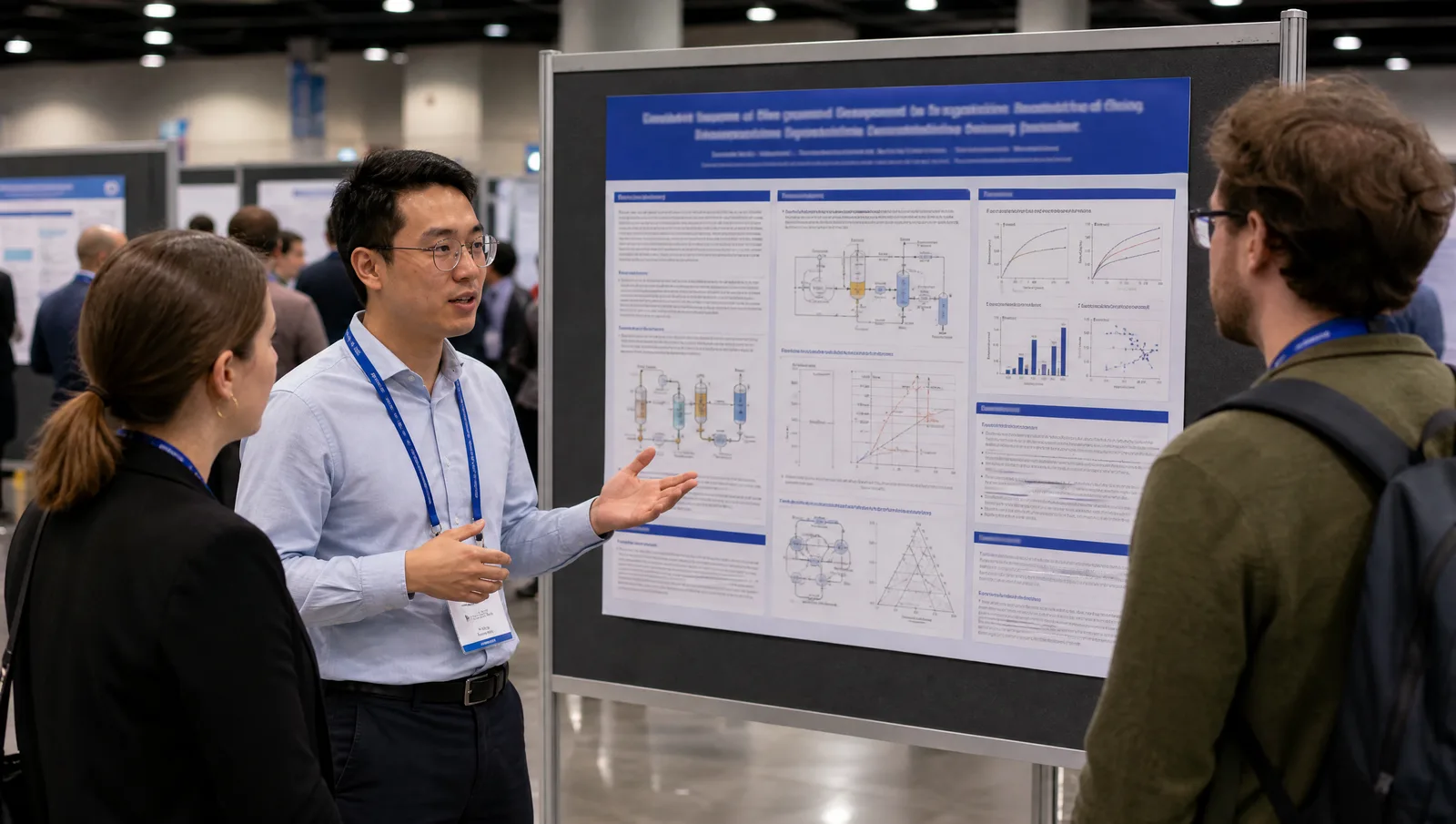
Cell Bio 2026 poster session: a presenter explains a landscape poster with title header and multi-column panels to two attendees in an exhibit hall (Figure generated with SciFig)
Transparency note: Illustrations in this article were generated with SciFig AI and reviewed by the author for scientific accuracy. Factual claims about dates and specifications link to official Cell Bio 2026 materials.
1. Cell Bio 2026 at a Glance: Abstract Deadlines, Key Dates, and Venue
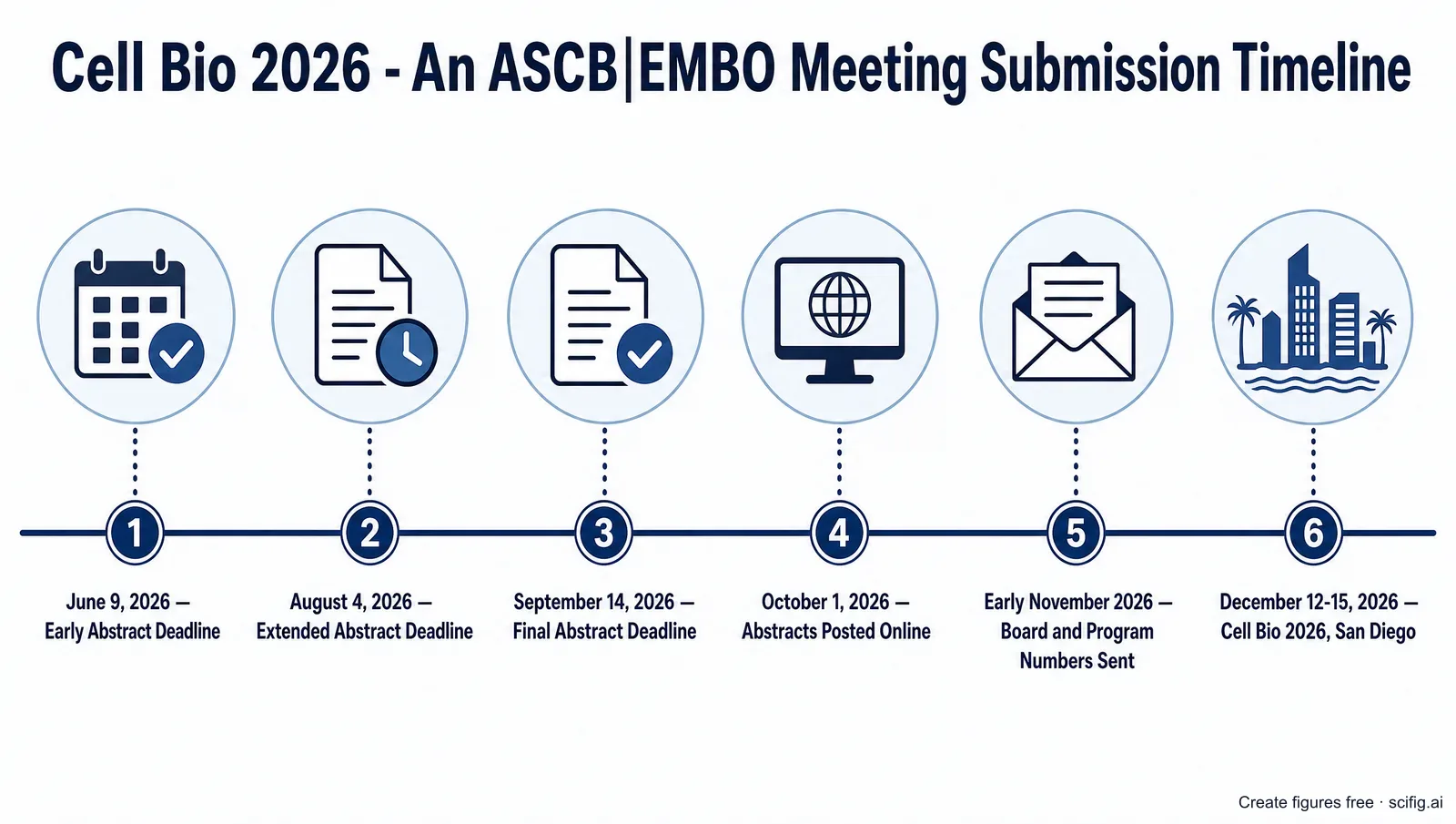
Cell Bio 2026 — an ASCB and EMBO meeting — runs December 12–15, 2026 at the San Diego Convention Center in San Diego, California, and the final abstract deadline is September 14, 2026 at 11:59 pm PT. ASCB runs three submission windows rather than one: an early deadline on June 9, an extended deadline on August 4 at the same fees, and a final deadline on September 14 at higher fees. All three windows put your abstract in the running for the same two things — a Minisymposium Talk or a poster presentation (ASCB abstract information).
One detail is worth knowing before you agonize over the deadline: ASCB states that all abstracts that meet the submission guidelines and select "poster" as a presentation type will be accepted. The competitive selection happens on the talk side, not the poster side.
Cell Bio 2026 submission timeline: abstract deadlines June 9, August 4 and September 14, abstracts posted October 1, meeting December 12-15 (Figure generated with SciFig)
Date
Milestone
9 June 2026
Early talk and poster abstract deadline, 11:59 pm PT (95 USD member / 125 USD nonmember)
4 August 2026
Extended abstract deadline, 11:59 pm PT (same fees; rates increase after this date)
14 September 2026
Final abstract deadline, 11:59 pm PT (180 USD member / 230 USD nonmember)
Week of 14 October 2026
Talk notifications for abstracts submitted after June 9
Week of 11 November 2026
Poster notifications for abstracts submitted August 5 – September 14
Early November 2026
Email with your session assignment, program number, board number, and presentation time
12–15 December 2026
Cell Bio 2026, San Diego Convention Center
Notification timing depends on which window you submitted in. Talk decisions for the June 9 batch went out the week of July 24; everything submitted after that is notified the week of October 14. Poster decisions for the June 9 batch went out the week of July 29, poster decisions for the June 10 – August 4 window are issued on a rolling basis, and the final window is notified the week of November 11 (ASCB abstract information). The complete scientific session schedule, organizers, and speakers are published in the online Program and Mobile App in October (Scientific Sessions Schedule).
2. Cell Bio 2026 Poster Size and Format: A 6 ft Wide Landscape Board
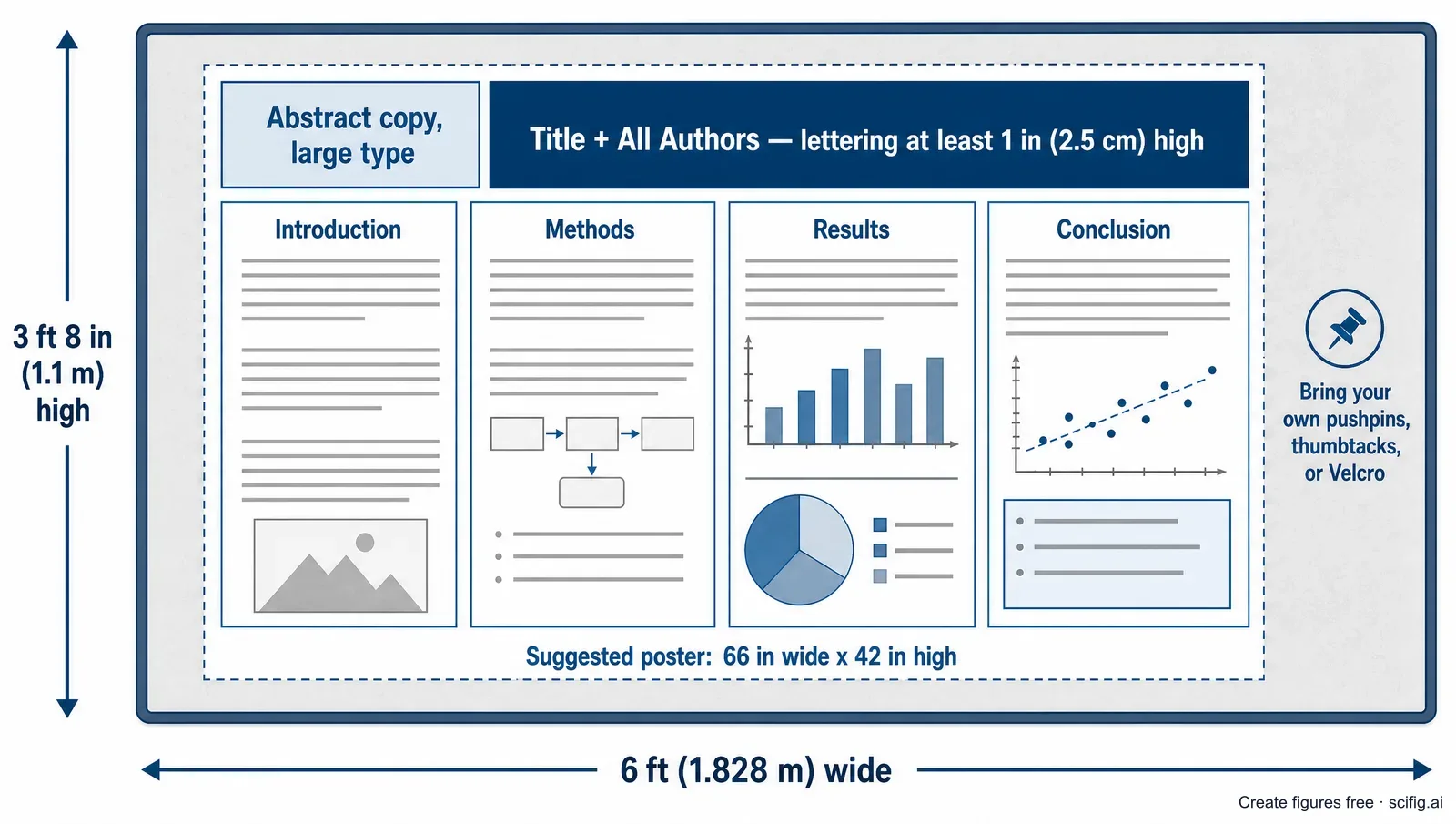
A Cell Bio 2026 poster board gives you a usable surface of 3 ft 8 in (1.1 m) high by 6 ft (1.828 m) wide, and ASCB's suggested poster size is 42 in high by 66 in wide — a board wider than it is tall, so design a landscape layout from the start. Bring your own thumbtacks, pushpins, or Velcro. Poster sessions run on December 13, 14, and 15: you set up between 8:30 and 9:30 am on your presentation day, present for a 90-minute block (odd-numbered boards 12:45–2:15 pm, even-numbered boards 2:15–3:45 pm), and take the poster down between 3:30 and 4:00 pm the same day (Poster Presentation Guidelines).
ASCB also specifies what must appear on the sheet, which is stricter than many meetings:
A top label with your assigned program number, the title, and all authors, in lettering no less than 1 in (2.5 cm) high.
A copy of your abstract, in large type, in the upper left-hand corner of the board — plan this block into your layout rather than bolting it on at the print shop.
Illustrations, charts, and graphs readable from three feet or more, and body text readable comfortably from four to five feet (1.5 m).
You must stand at your poster for your full assigned 90-minute window, and nothing may be left unattended at the board.
One scheduling note: if you present on Tuesday, December 15 and want to keep your poster, you must remove it by 4:00 pm — after that no attendees are admitted to the Exhibit Hall while it is dismantled. The official pages do not state whether on-site printing is available, so print your poster ahead of time and travel with it.
Cell Bio 2026 poster size diagram: a 6 ft wide by 3 ft 8 in high landscape board with title header, upper-left abstract block and four content panels (Figure generated with SciFig)
A 66-inch-wide sheet read from four feet away is unforgiving: it rewards one large, clean schematic and punishes a grid of small, dense panels. The cell biology schematics that carry that layout are the slowest part to produce well, and you can generate publication-grade versions online for free before you open your poster template.
Need a hero figure for your Cell Bio poster?
Start from a pathway, organelle, or cell-division schematic sized to read across a 6-foot board.
ASCB suggests a size but publishes no poster template, so the landscape sheet starts from an empty page. Our conference poster templates give you an unbranded landscape layout in editable PowerPoint with the column structure and print type scale already set — resize the canvas to 66 × 42 in and drop your figures in.
3. Cell Bio 2026 Digital Poster Program: Online Gallery and Add-On Fee
The Cell Bio 2026 Digital Poster Program is an optional 155 USD add-on, not a replacement for your printed poster and not a required e-poster upload. It places your poster in an interactive online gallery for registered attendees, with searchable browsing, 1:1 appointment scheduling, and live or asynchronous chat with presenters. There are two ways to take part (Digital Poster Program).
In-Person Digital Poster Presenter keeps your traditional printed poster in the Exhibit Hall and adds a digital upgrade: a 1.5-hour dedicated slot on digital displays, virtual appointments with remote attendees, on-site tech support, and gallery visibility starting three weeks before the meeting. ASCB lists an abstract deadline of June 9 for this option.
Remote Digital Poster Presenter is for researchers who cannot travel. You submit and present a fully digital poster in the gallery only, with scheduled 1:1 virtual appointments in the week before, during, and the week after the meeting. Conference registration is still required (450 USD members / 825 USD nonmembers), and ASCB lists an abstract deadline of August 4 for this option.
Both routes cost the abstract submission fee plus the 155 USD add-on, both keep posters accessible for 60 days after the meeting, and both include presenter discussion groups in January 2027. One practical caveat from ASCB: virtual appointments cannot be scheduled during the official in-person dedicated poster hours.
File specifications are not published as of August 4, 2026. The Digital Poster Program page describes the format and the engagement windows but does not state a file type, resolution, aspect ratio, or upload deadline, so confirm those with ASCB before you build a digital-only layout. In our analysis, the safest approach is to design the printed 66 × 42 in sheet first and treat the digital version as a derivative — a vector-native figure set rescales to either without redrawing.
4. Cell Bio 2026 Minisymposium Talks: How Abstracts Become 12-Minute Talks
A Minisymposium is the one Cell Bio 2026 talk format open to every abstract submitter — sessions run 120 minutes with 8–10 presenters, and in ASCB's published session formats a speaker in a 15-minute slot gets up to 12 minutes to present with the remainder for Q&A. Organizers choose among several published arrangements, so slot length varies: eight speakers at 15 minutes each (talk up to 12 minutes), six speakers at 10 minutes each (talk up to 7 minutes), four at 15 minutes, or two at 20 minutes (talk up to 15 minutes) (Session Proposals). Talks are selected from abstract submissions.
The other Cell Bio 2026 presentation formats are invitation-only: Special Interest Subgroup Talks, where organizers invite speakers directly and only consider invited abstracts; Award Talks; and Keynote and Symposia Talks. When you submit, you choose one of three routes — Talk Only, Talk and Poster, or Poster Only — and ASCB notes explicitly that selecting Talk and Poster does not increase your chances of being accepted for a talk (ASCB abstract information). Speakers may give a talk in only one scientific session.
Slide specifications are not published as of August 4, 2026. ASCB's abstract, session, and policy pages do not state a slide aspect ratio, a file format, an upload deadline, or speaker-ready-room procedures for Cell Bio 2026 — so do not assume the 16:9 default that other societies publish; check the presenter instructions that accompany your acceptance email. What the 12-minute ceiling does tell you is structural: a Minisymposium talk has room for a handful of slides, which means most slides need to carry their argument in one clear schematic rather than a paragraph of text.
Because ASCB has not published a slide ratio or template for Cell Bio 2026, do not assume the 16:9 default — but you can still build the structure now. Our scientific presentation templates are ordered the way a minisymposium talk runs: background, methods, results, discussion, conclusion, which is what a 12-minute slot leaves no time to design.
5. What Figures Do You Need for a Cell Bio 2026 Poster or Talk?
Cell Bio 2026 gives you exactly two places to show a figure — the poster and your slides — because ASCB's abstract rules state plainly: "Please do not include tables, charts, or other figures." Abstracts are text-only, capped at 2,400 characters excluding spaces (under 500 words) with a 400-character minimum, and titles are capped at 200 characters including spaces. Your abstract must state an objective, a brief methods statement, a summary of results, and a conclusion — "the results will be discussed" is explicitly not acceptable — and it prints exactly as it appears in the submission preview (ASCB abstract information).
That makes the poster and the slide deck the first and only place your figures reach a reader. Across the Cell Bio topic list — genome biology, membrane trafficking, cytoskeleton and motility, organelles, cell division, cell death, condensates, and the rest — three figure jobs recur:
A pathway or trafficking schematic — the route your cargo, signal, or protein actually takes, with compartments in the correct spatial order and arrows in the correct direction.
A structural or organelle schematic — the cytoskeletal geometry, membrane contact site, or organelle architecture your study interrogates, drawn to the conventions your field already reads fluently.
A process or stage series — cell cycle stages, organelle biogenesis, or endosome maturation shown as an ordered sequence rather than a single frozen frame.
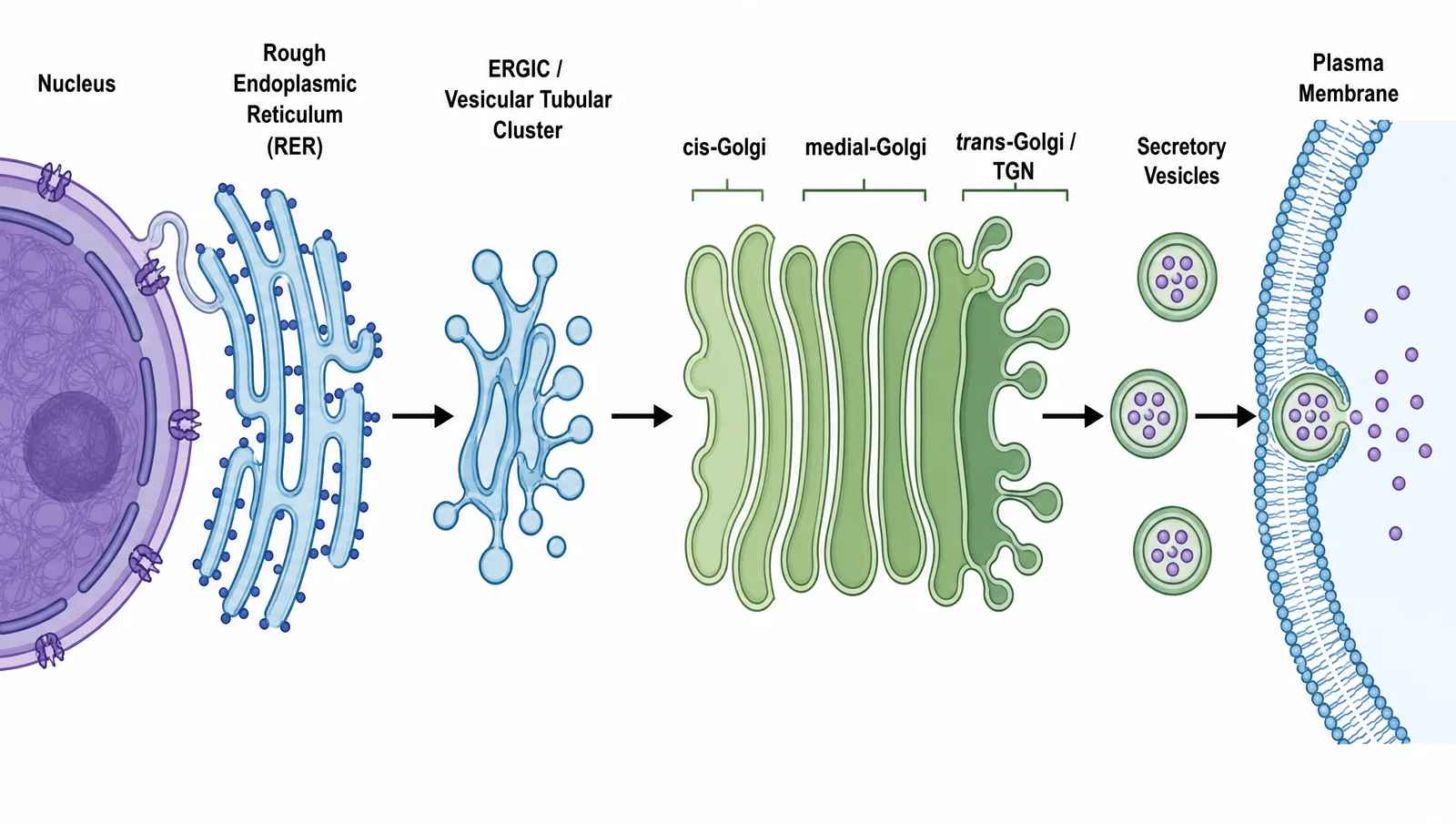
Cell Bio 2026 secretory pathway figure for a cell biology poster: rough ER to ERGIC to cis, medial and trans Golgi to secretory vesicles fusing with the plasma membrane (Figure generated with SciFig)
Remember that ASCB requires your abstract copy in large type in the upper left corner of the board, so the figure space you actually control is smaller than the board — one more reason to lead with a single dominant schematic. You can generate one from a text prompt or turn your submitted abstract PDF into a starter figure, then refine it.
Turn your abstract into a pathway or organelle schematic
Paste the mechanism you described in 2,400 characters and get a labeled figure you can refine for the board or the slide.
6. Designing a Winning Cell Bio Poster: Accuracy That Survives Peer Scrutiny
A winning Cell Bio poster passes two tests: someone walking the aisle grasps the story in three seconds, and the cell biology holds up to a specialist standing two feet away for ninety minutes. The first test is layout — one dominant schematic, the abstract block where ASCB requires it, everything else supporting. The second test is where scientific figures live or die, and where general-purpose AI image generators fall short.
Almost every figure a cell biologist puts on a board has hard topological constraints: a direction, an order, a polarity. A tool like Nano Banana Pro or GPT Image will happily produce something that looks about 99% right — but on a cell biology schematic, 99% right is effectively 0% right, and the people standing in front of your poster are the least likely audience on earth to miss the difference. A flat raster image also gives you no way to fix that last one percent; you re-roll and gamble that the next version is wrong somewhere else instead.
This is the difference with SciFig. Every figure comes back as a layered, fully editable SVG — organelle shapes, arrowheads, polarity labels, and stage annotations are individually selectable — so you, the person who actually knows the pathway, close the gap to 100% and sign off on the science yourself. It is well-established that reviewers in this field read these conventions automatically, which is why the errors below are so costly:
Golgi polarity and secretory direction. The route is ER to ERGIC to cis-Golgi to medial-Golgi to trans-Golgi/TGN to secretory vesicle to plasma membrane. Generic models routinely put the trans face toward the ER or bud secretory vesicles off the cis face — which reverses the entire secretory pathway. Cis-toward-the-ER is a first-week spatial convention; at a cell biology meeting it is a title-bar-sized error.
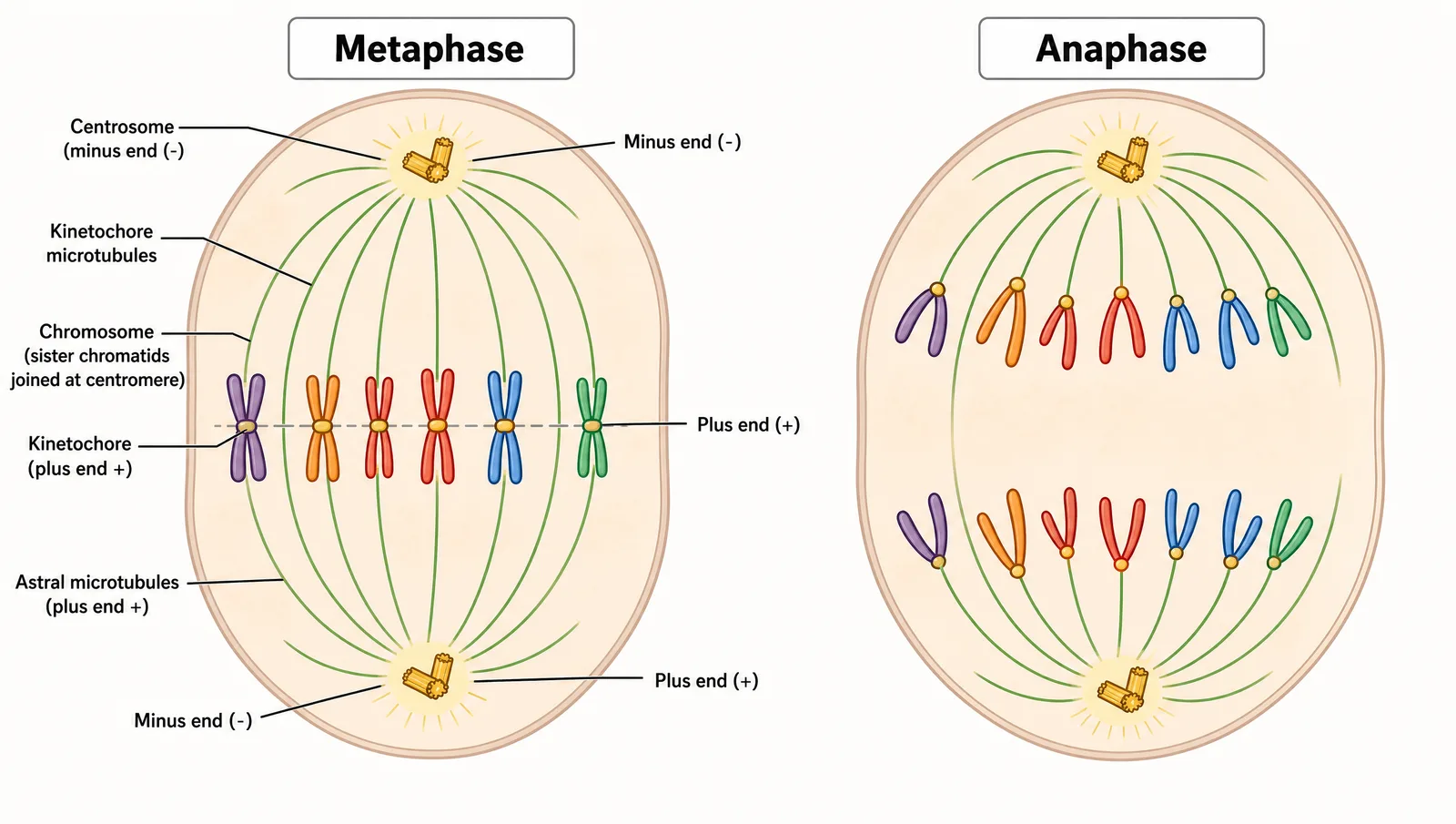
Microtubule polarity. Minus ends are anchored at the centrosome or MTOC and plus ends grow outward toward the periphery and the kinetochores. Reverse that label and you have simultaneously reversed motor directionality (kinesins are predominantly plus-end-directed, dynein minus-end-directed), spindle mechanics, and cargo transport — in front of an audience that includes cytoskeleton specialists.
Mitotic stage mismatch. Metaphase means chromosomes aligned at the equator with sister chromatids still cohered; anaphase means cohesin has been cleaved and separated chromatids are moving poleward with nothing left at the plate. Generic output frequently labels a panel "anaphase" while drawing a metaphase plate, and the caption-versus-image mismatch reads instantly as a figure the author did not draw.
Cell Bio 2026 poster figure: a metaphase spindle with microtubule minus ends at the centrosomes and plus ends at the kinetochores, beside an anaphase panel (Figure generated with SciFig)
Whether your Cell Bio 2026 poster earns its ninety minutes comes down to whether these schematics are accurate, legible at four feet, and yours to correct — which is exactly what an editable AI figure workflow gives you without surrendering scientific control.
7. Create Your Cell Bio 2026 Figures with AI: The SciFig Workflow
You already have the two things that matter: a submitted abstract and a working understanding of the pathway, structure, or stage series you study — use both to generate your figures online for free, then edit them until they are exactly right. Here is the SciFig workflow for a Cell Bio presenter:
Path 1 — Upload your abstract PDF. Drop it into PDF-to-Figure. It parses your objective, methods, and results and returns a starter schematic in one click, so you begin refining from a 70%-there draft rather than a blank canvas.
Path 2 — Write a structured prompt. For a pathway or organelle figure, Text-to-Figure gives more control. Copy and adapt:
Schematic of the secretory pathway in a eukaryotic cell: rough ER with
ribosomes, ERGIC, a stacked Golgi with the cis face toward the ER and the
trans face toward the plasma membrane, secretory vesicles budding from the
TGN, and one vesicle fusing with the plasma membrane. Label every
compartment and show directional arrows in that order.
Path 3 — Photograph your sketch. If you drew the mechanism on a whiteboard or in a notebook, photograph it and drop it into Sketch-to-Figure to get a publication-style version that keeps your original arrangement.
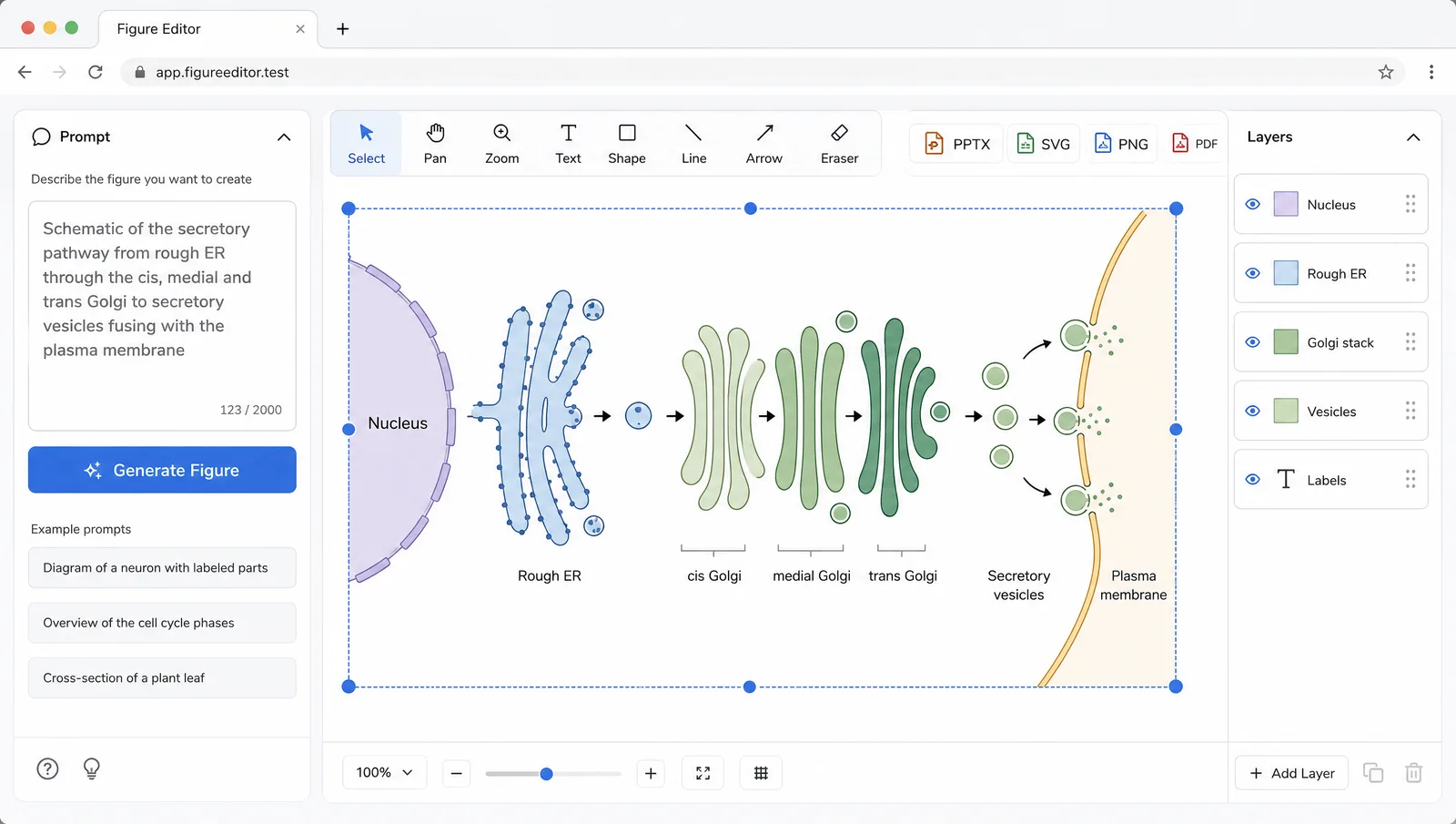
Cell Bio 2026 poster figure workflow: a text prompt on the left generating an editable secretory pathway schematic on the right, with PPTX and SVG export (Figure generated with SciFig)
From any path you edit individual elements in the vector canvas — relabel a compartment, flip an arrow, adjust a polarity annotation — and export to editable PPTX or layered SVG for final composition, at a resolution that survives a 66-inch print without artifacting. A new SciFig account starts with 50 starter credits plus 50 refill credits every day — 100 credits on day one, then 50 more daily. Generating a figure costs 50 credits, so most authors work through a full poster figure set over their first few days. Taking a figure into the vector canvas for an editable PPTX or layered SVG export is a separate 150-credit pass that needs a paid plan or a credit pack, since daily refill credits expire the same day and do not accumulate. For companion guides in this conference series, see the Keystone Structural Biology 2026 poster guide, the EMBO Chemical Biology 2026 poster guide, and the ÖGMBT / FEBS3+ 2026 poster guide.
Optional — disclose your AI use. ASCB does not publish an AI-use policy for Cell Bio 2026 (see §8 Presenter Policies), but a growing number of journals and societies ask authors to state AI assistance and to remain responsible for the accuracy of their work. If you build and review a figure in SciFig, you can add one line to its caption — for example: Figure created by the authors using SciFig and reviewed for scientific accuracy (scifig.ai).
Start your Cell Bio figure from a prompt, a PDF, or a sketch
Use whichever you already have, then edit every arrow and label until the cell biology is exact.
8. Cell Bio 2026 Presenter Policies: Disclosure, Embargo, and Recording
Every Cell Bio 2026 presenter must disclose conflicts of interest at the beginning of their presentation, keep their data under embargo until the scheduled presentation time, and pay conference registration separately from the abstract submission fee. ASCB requires presenters to disclose financial relationships, funding sources, affiliations, or personal interests that could be perceived as a conflict — clearly, up front, and covering both current and relevant past relationships (Meeting Policies and Terms).
Three more policies shape how you prepare:
Embargo. All data and results presented at Cell Bio 2026 are embargoed until the date and time of formal presentation, including on social media and in press coverage.
No recording or photography. Recording or photographing any speaker, slide, or session content is strictly prohibited without written permission from both the presenter and ASCB. That protects your unpublished data — and it means you cannot rely on attendees photographing your poster, so make the printed sheet self-contained.
No commercial promotion in abstracts. ASCB will not accept abstracts that promote a specific product without providing new biological insight; a claim that "product X works better than product Y" is treated as promotion (ASCB abstract information).
Registration is a separate transaction from abstract submission: to attend Cell Bio and receive a badge, every abstract submitter must also pay the conference registration fee. Early registration runs through September 30, regular registration from October 1 to December 11, and onsite registration December 12–15; refund requests must be submitted in writing no later than November 4, 2026 (Registration). ASCB does not publish an artificial intelligence or generative-tool policy for Cell Bio 2026 abstracts, posters, or slides as of August 4, 2026 — the abstract, poster, policy, digital poster, and session pages contain no such rule — so treat authorship and accuracy responsibility as the operative standard and confirm before the meeting if this matters to your submission.
Tip
The highest-leverage decision in your preparation window is which schematic becomes the hero. Pick the one a passerby should still remember an hour later — usually the pathway or the stage series that carries your result — and build the rest of the 66 × 42 in sheet around it, with the abstract block already placed in the upper left corner where ASCB requires it.
9. Where Cell Bio 2026 Abstracts Are Published (Molecular Biology of the Cell)
Accepted Cell Bio 2026 abstracts are published online before the meeting and as a citable supplement to a Q1 2027 issue of Molecular Biology of the Cell, ASCB's own journal — the abstracts themselves are not peer-reviewed. Abstracts become publicly viewable on the Cell Bio 2026 meeting website on or around October 1, 2026, at which point all the information in them is considered public (ASCB abstract information). ASCB's poster guidelines page identifies the supplement more precisely as the February 15, 2027 issue (Poster Presentation Guidelines).
ASCB gives the citation format as: Smith AB, Jones CD (2026). Abstract title. Mol. Biol. Cell 38, page # (Abstract #XXXX) — where the abstract number is the presentation number assigned in early November, not the submission ID you received at submission, and the page number is where your abstract begins in the supplement PDF. Because the official pages carry more than one supplement date, confirm the exact issue on ASCB's abstract page before you cite it.
Two things follow from this. First, your abstract becomes a permanent citable record, so the figure story on your poster should match what the text claims. Second, presenting at Cell Bio is a separate matter from publishing in Molecular Biology of the Cell: ASCB invites presenters to indicate intent to submit a related manuscript to MBoC during abstract submission, which is a distinct editorial track from the abstract supplement.
Frequently Asked Questions
The Cell Bio 2026 poster board surface is 3 ft 8 in (1.1 m) high by 6 ft (1.828 m) wide, and ASCB's suggested poster size is 42 in high by 66 in wide. Bring your own pushpins, thumbtacks, or Velcro. See §2 Poster Size and Format.
Landscape. The board is 6 ft wide by 3 ft 8 in high — wider than it is tall — and ASCB's suggested 66 × 42 in poster matches that shape, so design a horizontal layout with one dominant schematic. See §2 Poster Size and Format.
The final Cell Bio 2026 abstract deadline is September 14, 2026 at 11:59 pm PT, at higher fees. Earlier windows closed June 9 and August 4 at the standard fee. See §1 At a Glance for the full timeline.
No — ASCB states "Please do not include tables, charts, or other figures." Abstracts are text-only, capped at 2,400 characters excluding spaces. Your poster and slides are the only place your figures reach a reader. See §5 What Figures Do You Need.
Minisymposia run 120 minutes with 8–10 presenters; in a 15-minute slot ASCB allows up to 12 minutes of talk with the rest for Q&A. Organizers may instead use 10- or 20-minute slots. Slide specifications are not published as of August 4, 2026. See §4 Minisymposium Talks.
No — the Digital Poster Program is an optional 155 USD add-on, not a required e-poster upload. It adds an online gallery, 1:1 appointments, and 60 days of post-meeting access. File specifications are not published as of August 4, 2026. See §3 Digital Poster Program.
Accepted abstracts appear online before the meeting and as a citable supplement to a Q1 2027 issue of Molecular Biology of the Cell, and become public on the meeting website on or around October 1, 2026. See §9 Where Abstracts Are Published.
References
All specifications and dates above are drawn from official Cell Bio 2026 and ASCB materials, accessed August 4, 2026:
American Society for Cell Biology. Cell Bio 2026 — An ASCB/EMBO Meeting. ascb.org. Accessed August 4, 2026. https://www.ascb.org/cellbio2026/
American Society for Cell Biology. Cell Bio 2026 Abstract Submission Site. submissions.mirasmart.com. Accessed August 4, 2026. https://submissions.mirasmart.com/ASCB2026
Disclaimer: This article is educational content about scientific figure design for Cell Bio posters and presentations. Dates, fees, and specifications are summarized from official ASCB materials linked above and were accurate at the time of writing; always confirm current details on the official Cell Bio 2026 website before printing or submitting. SciFig is a scientific illustration tool for creating figures and schematics, not an official ASCB or EMBO resource.
Keep going
Recommended resources
Templates, tools, and further reading for your research