ÖGMBT / FEBS3+ 2026 Poster Guidelines and Template
Official FEBS3+ 2026 guidelines: DIN A0 portrait poster size, abstract deadlines, Science Flash Talk rules, and the biochemistry figures every poster needs.
SciFig Team
SciFig editorial team
FEBS3+ 2026 runs 15–17 September 2026 in Vienna, Austria, at the University of Vienna Biology Building.
This is a practical guide to the official poster and presentation rules for the FEBS3+ 2026 meeting, the biochemistry and molecular biology section of the 18th ÖGMBT Annual Meeting: the two-track abstract system, and the DIN A0 portrait poster format.
It also covers oral and Science Flash Talk time limits, plus the biochemistry and molecular biology figures worth building before you submit. Every date and specification below links to official ÖGMBT and FEBS3+ materials.
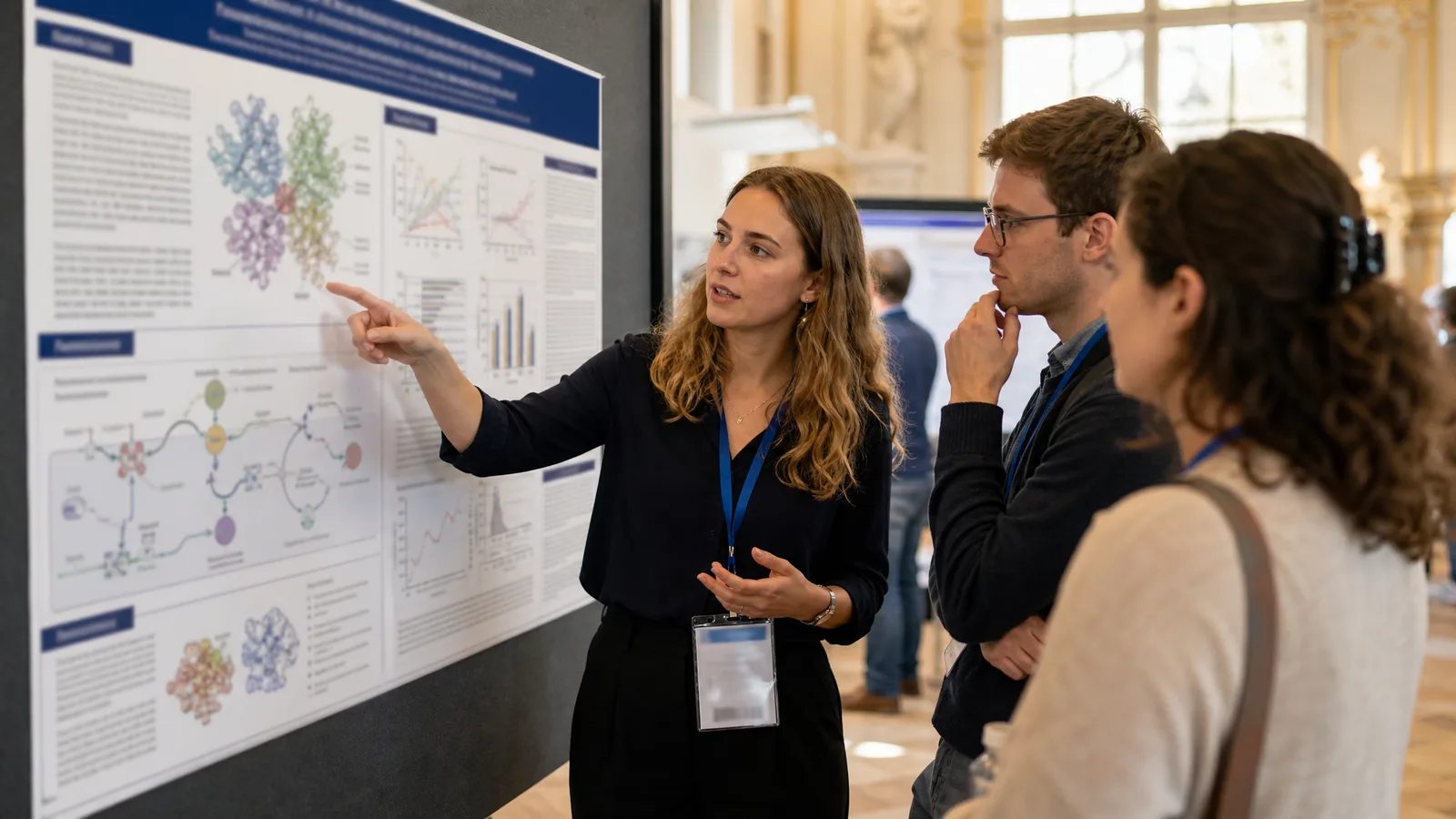
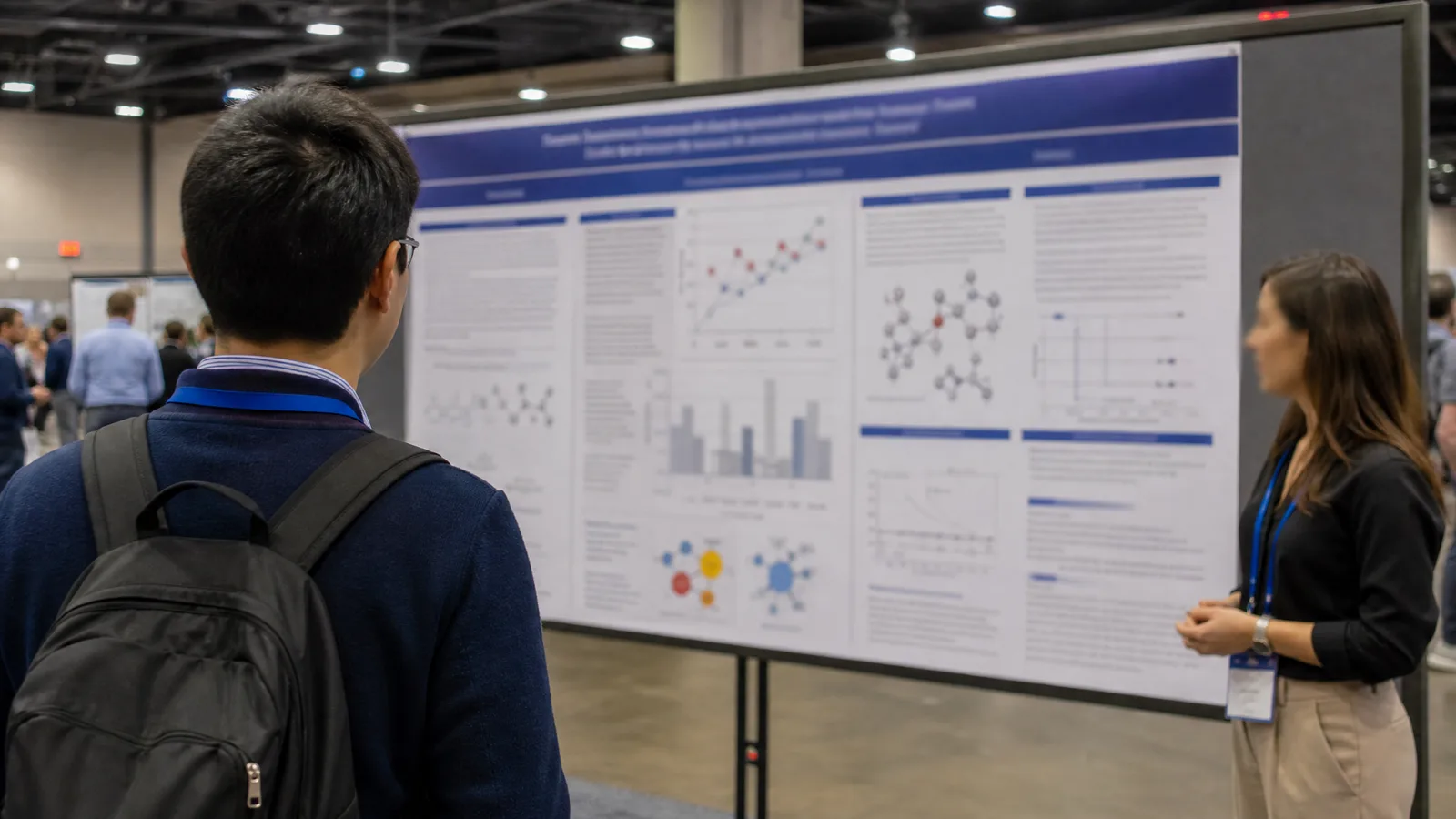
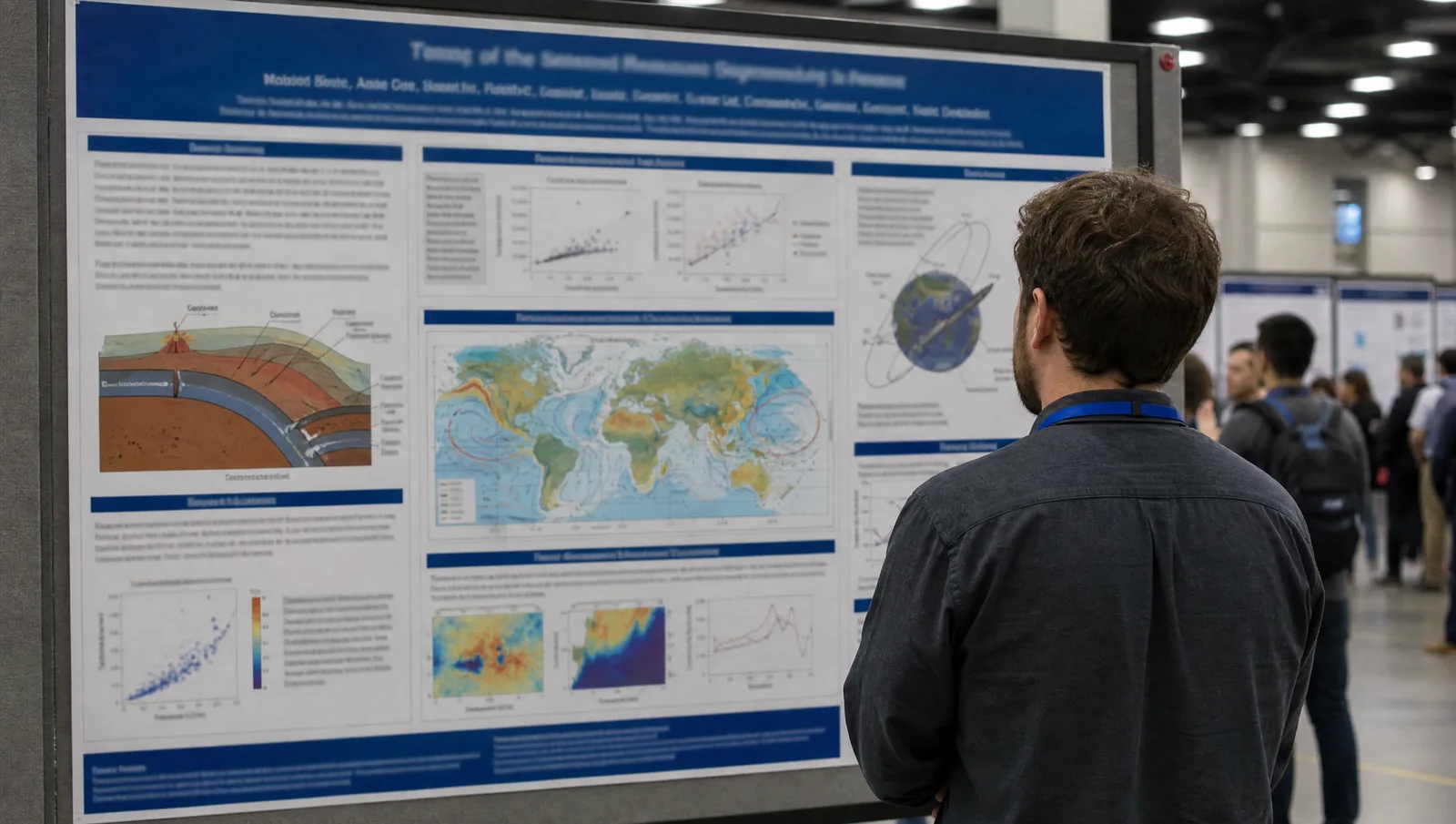
FEBS3+ 2026 poster session in Vienna: a presenter explaining a full A0 portrait biochemistry poster with a title band and author row to two attendees (Figure generated with SciFig)
Transparency note: Illustrations in this article were generated with SciFig AI and reviewed by the author for scientific accuracy. Factual claims about dates and specifications link to official ÖGMBT and FEBS3+ materials.
1. ÖGMBT / FEBS3+ 2026 at a Glance: Dates, Venue, and Two Abstract Tracks
The 18th ÖGMBT Annual Meeting runs 14–17 September 2026 in Vienna, Austria, in a split format: a FEMS Regional COLLAB satellite (14–15 September, microbiology-focused) followed by the FEBS3+ Meeting (15–17 September, biochemistry and molecular biology), with a joint programme on Tuesday 15 September. Both parts are held at the University of Vienna Biology Building (UBB), Carl-Djerassi-Platz 1, 1030 Vienna, Austria, and the scientific programme runs entirely in English. FEBS3+ is organized jointly by the Austrian Association of Molecular Life Sciences and Biotechnology (ÖGMBT) with the Czech Society for Biochemistry and Molecular Biology and the Slovenian Biochemical Society, under the meeting motto "Life Sciences — Stronger Together."
If you are presenting research, it matters which part you are registering for: FEMS Regional COLLAB uses a different Research Profile Abstract format (up to 2,700 characters, structured around a lab's expertise and collaboration opportunities, presented as posters with some invited to panelist talks), while FEBS3+ uses a classical scientific abstract (title and results, presented as a poster or oral talk). This guide covers the FEBS3+ track, since that is where the poster size, oral time limits, and Best Poster / Best Talk prizes apply.
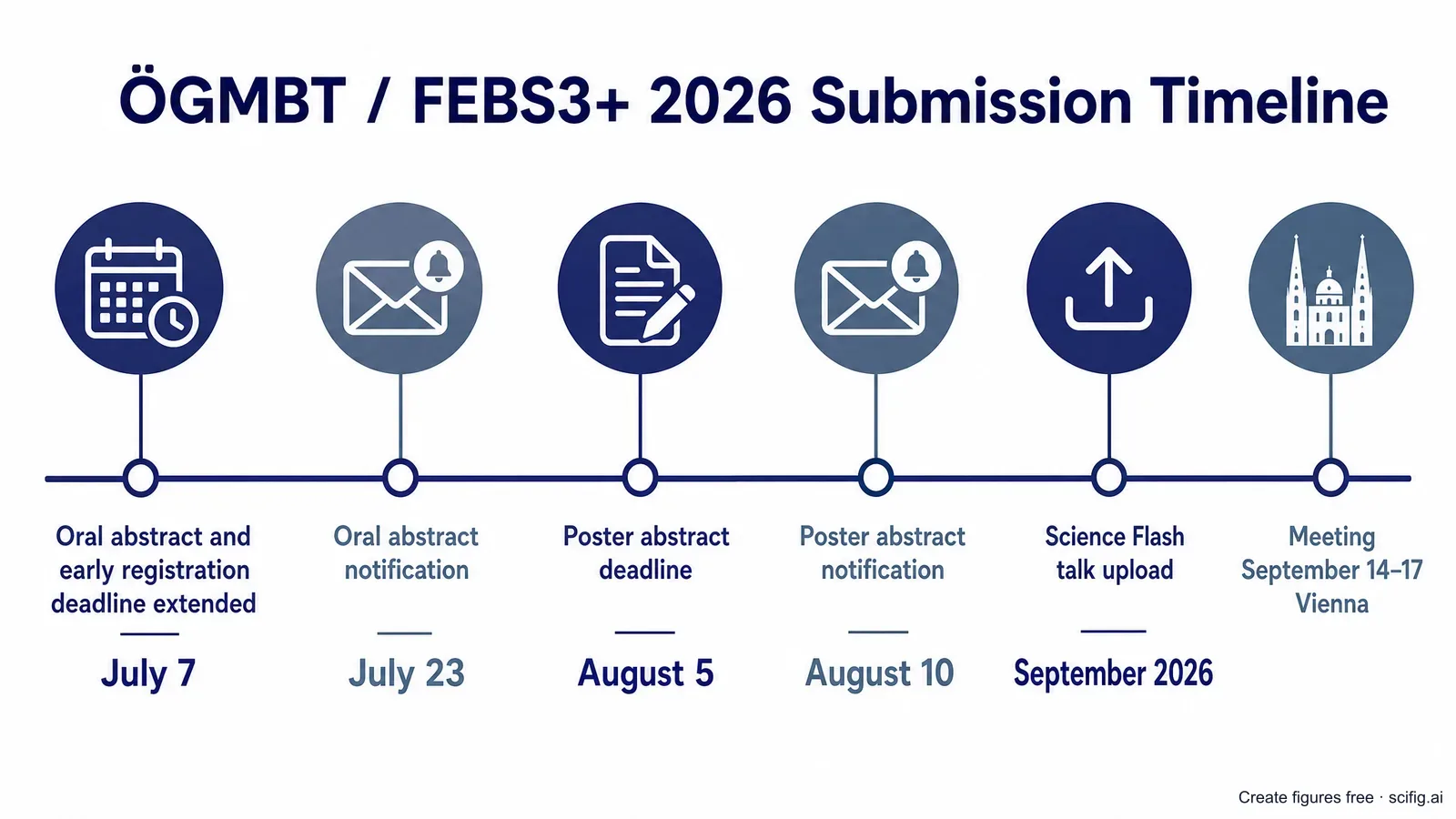
ÖGMBT / FEBS3+ 2026 submission timeline: oral abstracts extended to July 7, oral acceptance July 23, poster abstract August 5, meeting September 14-17 Vienna (Figure generated with SciFig)
Date
Milestone
End April/beginning May 2026
Online registration and abstract submission opens
July 7, 2026
End of early registration and oral abstract submission — extended (poster abstracts still open)
July 23, 2026
Notification of acceptance for oral presentations
August 5, 2026
Deadline for poster abstract submission
August 5, 2026
Deadline for FEBS3+ young-researcher travel grant applications
August 10, 2026
Notification of acceptance for poster presentations
September 2026 (exact date not yet published)
Science Flash Talk presentation upload deadline
September 7, 2026
Online registration and late-fee payment closes
September 14–17, 2026
18th ÖGMBT Annual Meeting, Vienna
If you are reading this after July 7, 2026, the oral abstract window has already closed — but poster abstract submission stays open through August 5, so a poster is still a live option. Note that abstract submission requires prior registration and payment of the registration fee, submitted through the official ÖGMBT Registration & Abstract Submission System.
2. FEBS3+ 2026 Abstract Submission: Format Rules and the Poster Deadline
A FEBS3+ 2026 abstract is a short, text-only submission: a title of up to 250 characters, an abstract body of up to 2,500 characters, and up to 18 authors, with simple formatting (bold, italic, underline, super/subscript, and special characters) allowed in the online editor — but no images or tables. That last rule matters for planning: unlike some conferences that let you preview a figure in the abstract itself, at FEBS3+ your first chance to show a mechanism or pathway figure is on the poster or slide, not in the abstract text.
Abstracts submitted before the oral deadline are considered by the scientific committee for either a poster or an oral presentation (a Short Talk or a Science Flash — more on that format below); every submitter is notified by email of the acceptance and presentation type, and the status is also visible in the registration system. The poster abstract deadline is August 5, 2026, with acceptance notification on August 10, 2026 — so a submitter typically knows their format about five weeks before the meeting, leaving time to build the figures once the presentation type is confirmed.
3. FEBS3+ 2026 Poster Size: DIN A0 Portrait and the Poster Sessions
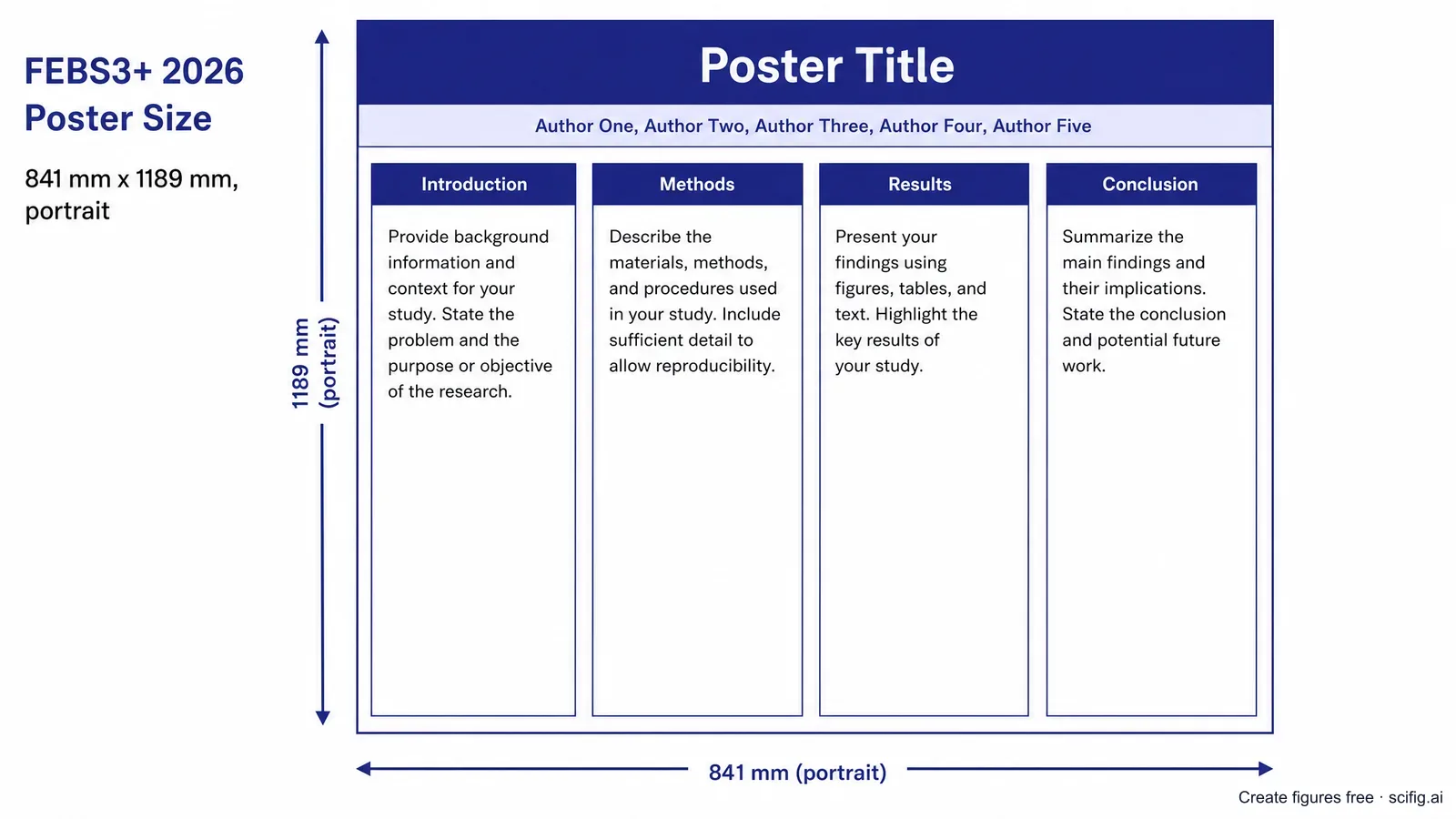
FEBS3+ 2026 posters must be printed at a maximum size of DIN A0 (841 × 1189 mm) in portrait format (upright), and there will be several poster sessions during the meeting. This is a physical, printed poster board — the official presenter instructions describe only this printed format, with no digital or e-poster option mentioned anywhere on the ÖGMBT site, so plan to print and bring (or ship) a physical A0 sheet rather than a PDF for a screen.
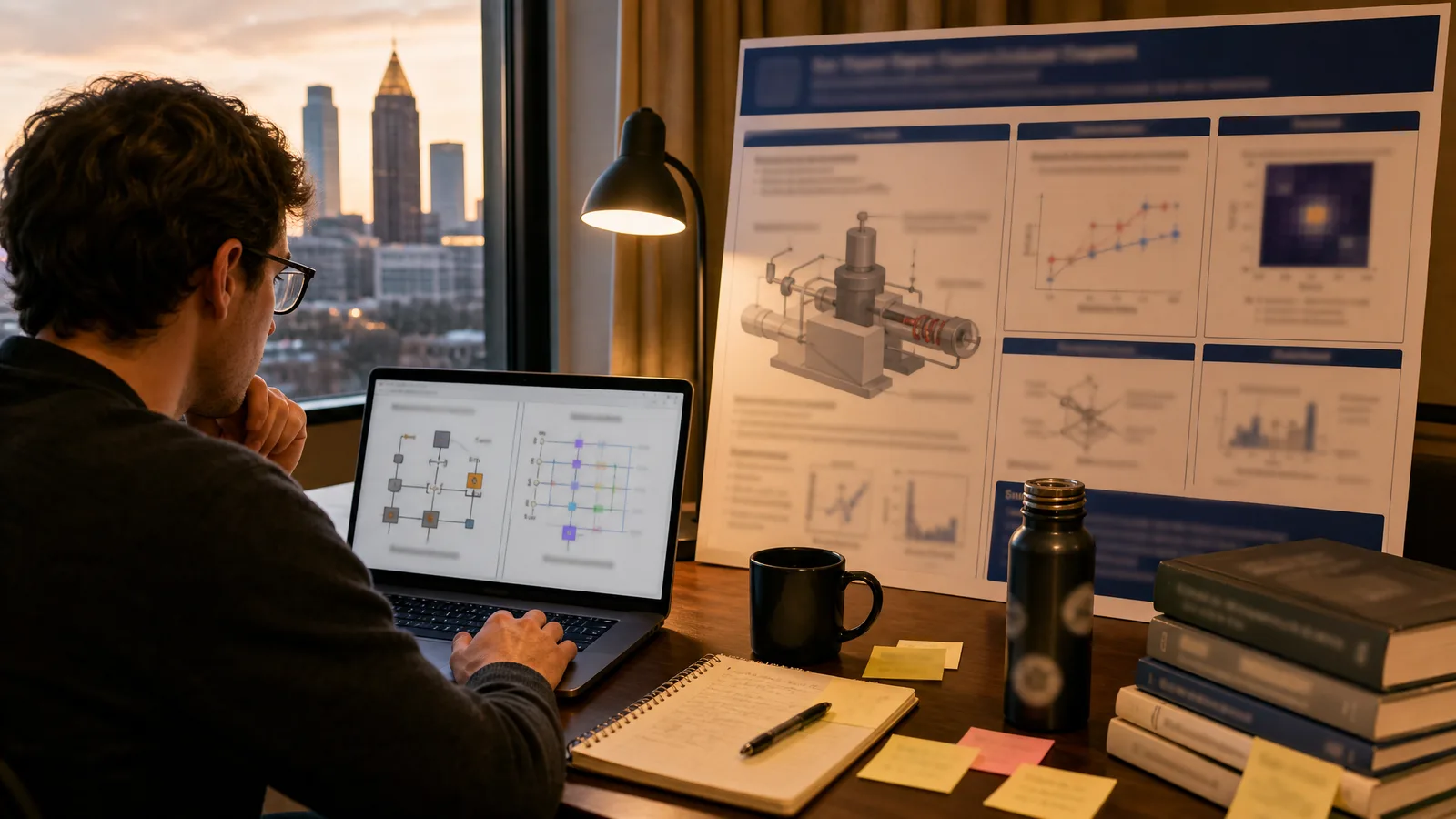
ÖGMBT / FEBS3+ 2026 poster template: a DIN A0 portrait layout with a title band, author row, and columns for introduction, methods, results and conclusion (Figure generated with SciFig)
Portrait A0 rewards a vertical reading flow — most attendees will scan top to bottom rather than left to right across a landscape sheet — so the figures that carry the most information (your key mechanism or pathway diagram) should sit high enough to catch a passerby glancing down the poster aisle, with supporting panels below.
Need a hero figure for your FEBS3+ poster?
Start from an enzyme mechanism, a metabolic pathway, or a signaling diagram before you lay out your A0 portrait sheet.
DIN A0 portrait is the maximum and there is no digital alternative, so the canvas is settled before you start. Our conference poster templates ship A0 portrait as its own file in editable PowerPoint, with the print type scale already applied.
4. FEBS3+ 2026 Oral Presentations and the Science Flash Talk Format
FEBS3+ 2026 on-site oral formats have four tiers by time: Plenary Speaker Talks (30 minutes plus 10 minutes discussion), Invited Speaker Talks (25 plus 5), Short Talks (12 plus 3), and Science Flash Talks — a distinctive mixed format that is a 2-minute oral teaser for your poster, followed by discussion at the poster itself during that afternoon's poster session. If your abstract is assigned a Science Flash, you upload a PDF (maximum 3 slides, maximum 2 MB) through "Science Flash Upload" in the registration system, with the deadline falling in September 2026 (the official page has not yet published the exact day).
For standard oral slots, presenters bring their file on a USB stick in PDF or Microsoft Office format and hand it to the technician in the lecture hall before their session; the presentation computer runs Windows, the beamer resolution is 1920×1080, and the projection screen is 16:9 widescreen. Whether you have 2 minutes or 30, the visual logic is the same: one clear, correctly labeled mechanism or pathway figure does more work than a slide of dense text.
The lecture hall projects 16:9 at 1920 × 1080, but no slide template is published. Our scientific presentation templates are 16:9 academic decks already ordered the way a Short Talk runs — and the first three slides double as the maximum-3-slide PDF a Science Flash requires.
5. What Figures Do You Need for a FEBS3+ Poster or Talk?
Across FEBS3+ 2026's twelve themed sessions — from Mitochondria and Metabolism to Computational Biology and Protein Design — the figures that do the most work on a poster or Science Flash slide are a clean enzyme or metabolic pathway mechanism and a correctly directed signaling or protein-protein interaction diagram. Because the abstract itself cannot carry a figure (see §2), your poster or slide is the first place your mechanism becomes visible to a reviewer — which makes getting it right the whole game.
On your poster and slides, the recurring biochemistry and molecular biology figure types are:
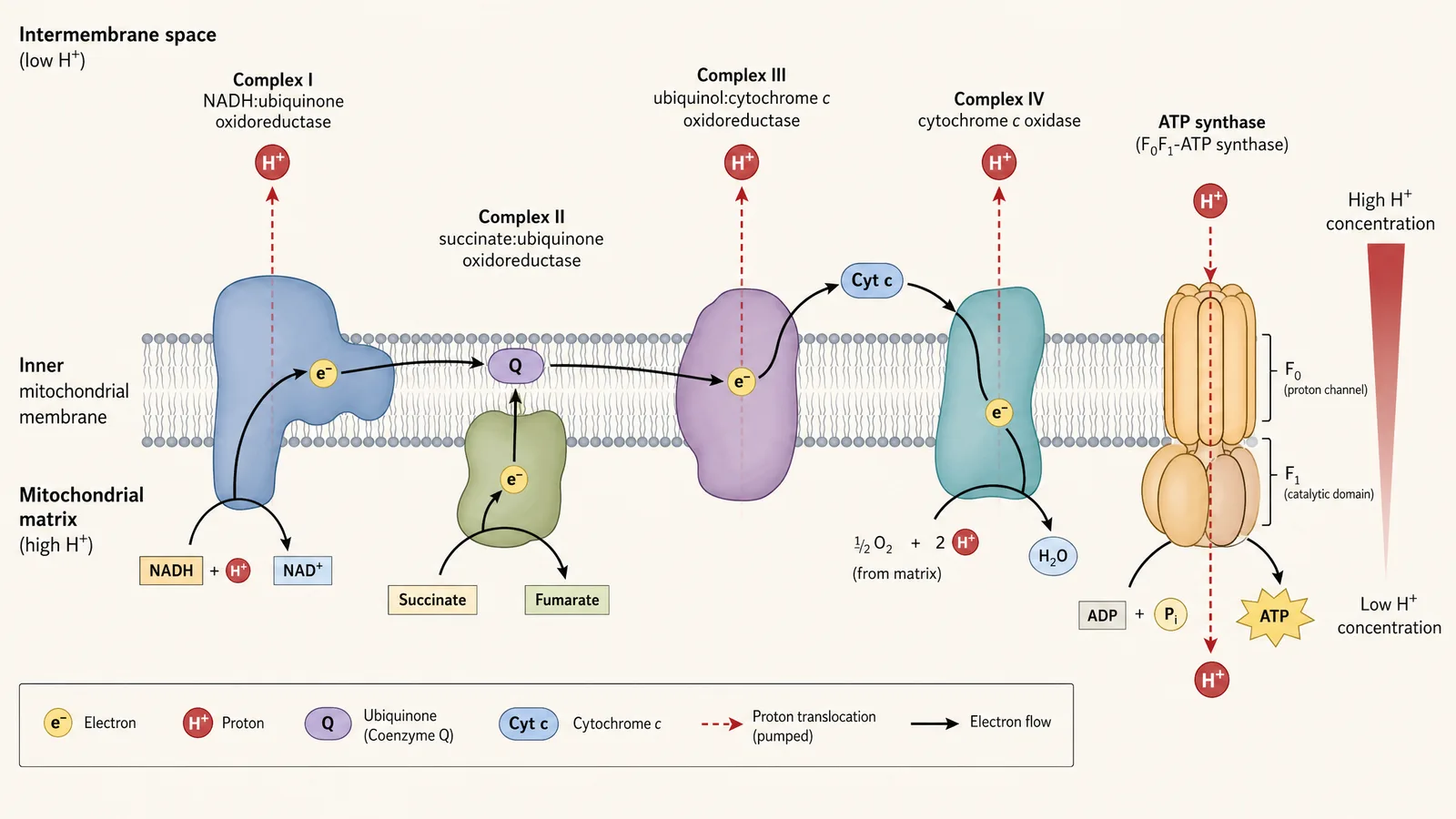
Enzyme catalysis / metabolic pathway mechanism — for example, the mitochondrial electron transport chain (Complexes I–IV and ATP synthase) driving oxidative phosphorylation, relevant to the meeting's Mitochondria and Metabolism and Molecular Nutrition sessions.
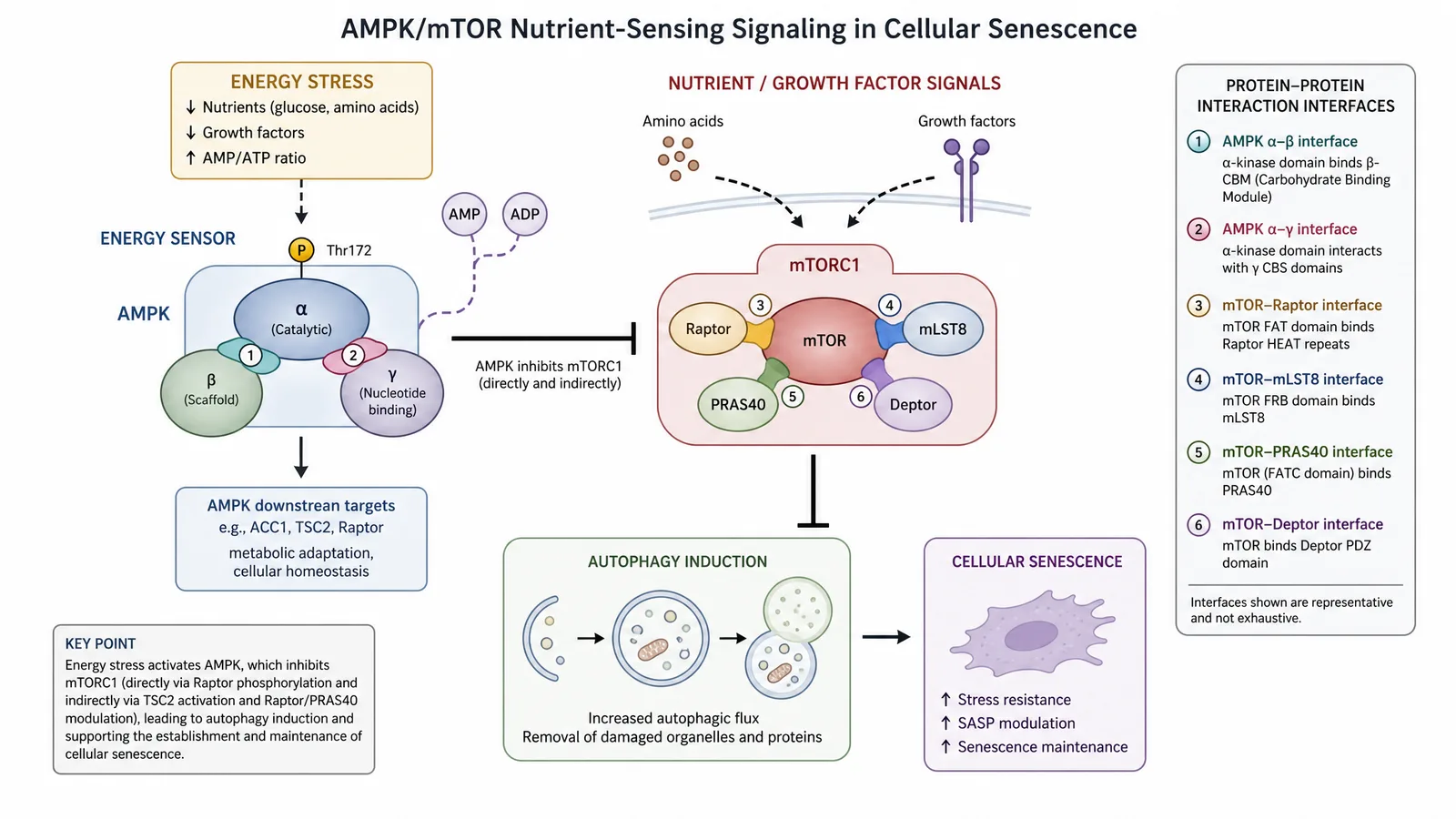
Signaling pathway / protein-protein interaction — for example, the AMPK/mTOR nutrient-sensing axis in cellular senescence and autophagy, relevant to the Mechanisms of Aging and Cellular Senescence and Mitochondria, Metabolism, and the Autophagy Axis in Aging sessions.
ÖGMBT / FEBS3+ 2026 metabolic pathway figure: the mitochondrial electron transport chain Complexes I through IV driving the proton gradient that powers ATP synthase (Figure generated with SciFig)
6. Designing a Winning FEBS3+ Poster: Accuracy That Survives Peer Review
A strong FEBS3+ poster is grasped in seconds by someone walking the poster aisle, and scientifically exact enough to survive scrutiny from a biochemist who knows the pathway cold — which matters directly, since every submitted abstract has a chance at the Best Poster Prize (sponsored by FEBS Open Bio Journal) or the Best Talk Prize (sponsored by Microsynth Austria and ÖGMBT), awarded at the Thursday closing ceremony. Build the poster around one dominant "hero" figure — usually the metabolic pathway or signaling mechanism at the center of your abstract — and let the panels below support it.
This is exactly where general-purpose AI image generators fall short. A tool like Nano Banana Pro or GPT Image can produce something that looks about 99% right, but on a scientific figure 99% right is effectively 0% right: a reversed catalytic arrow, a signaling step drawn in the wrong order, or a mislabeled interaction interface turns a compelling figure into one that misleads a reviewer — and possibly a prize committee.
This is the core difference with SciFig. Every figure is a fully editable SVG whose elements — arrows, labels, interaction interfaces — you can correct individually, so you (the author who actually knows the biochemistry) can adjust any element until the figure matches your science before you print. The kinds of errors that reviewers in this field actually catch:
Enzyme catalysis drawn backward — substrate-to-product arrows reversed, or a cofactor (such as NAD+/NADH) mislabeled at the wrong step.
Signaling cascade direction reversed — a common and subtle error is showing AMPK activating mTORC1, when under energy stress AMPK actually inhibits mTORC1 to promote autophagy; the arrow direction is the whole point of the diagram.
Protein-protein interaction interface or stoichiometry wrong — showing the wrong binding domain, or a monomer where the pathway requires a dimer, misleads readers working in computational biology or protein design.
ÖGMBT / FEBS3+ 2026 signaling pathway figure: AMPK sensing energy stress and inhibiting mTORC1 to promote autophagy, with correctly directed interaction arrows (Figure generated with SciFig)
Whether your FEBS3+ 2026 figure earns a second look — or a prize nomination — comes down to whether it is accurate, clear, and legible from a few steps away, which is exactly where an editable AI figure workflow compresses days of design work into hours without giving up scientific control.
7. Create Your ÖGMBT / FEBS3+ 2026 Figures with AI: The SciFig Workflow
You already have two things most poster designers do not: your accepted abstract and a precise understanding of your pathway's mechanism — use both to generate your figure online for free, then edit it until it is exactly right. Here is the SciFig workflow for a FEBS3+ presenter:
Path 1 — Upload your accepted abstract PDF. Drop it into PDF-to-Figure. It parses your background and results and returns a mechanism diagram in one click. SciFig generates the figure, and every element stays editable so you can adjust it to your data and poster layout — no blank A0 sheet.
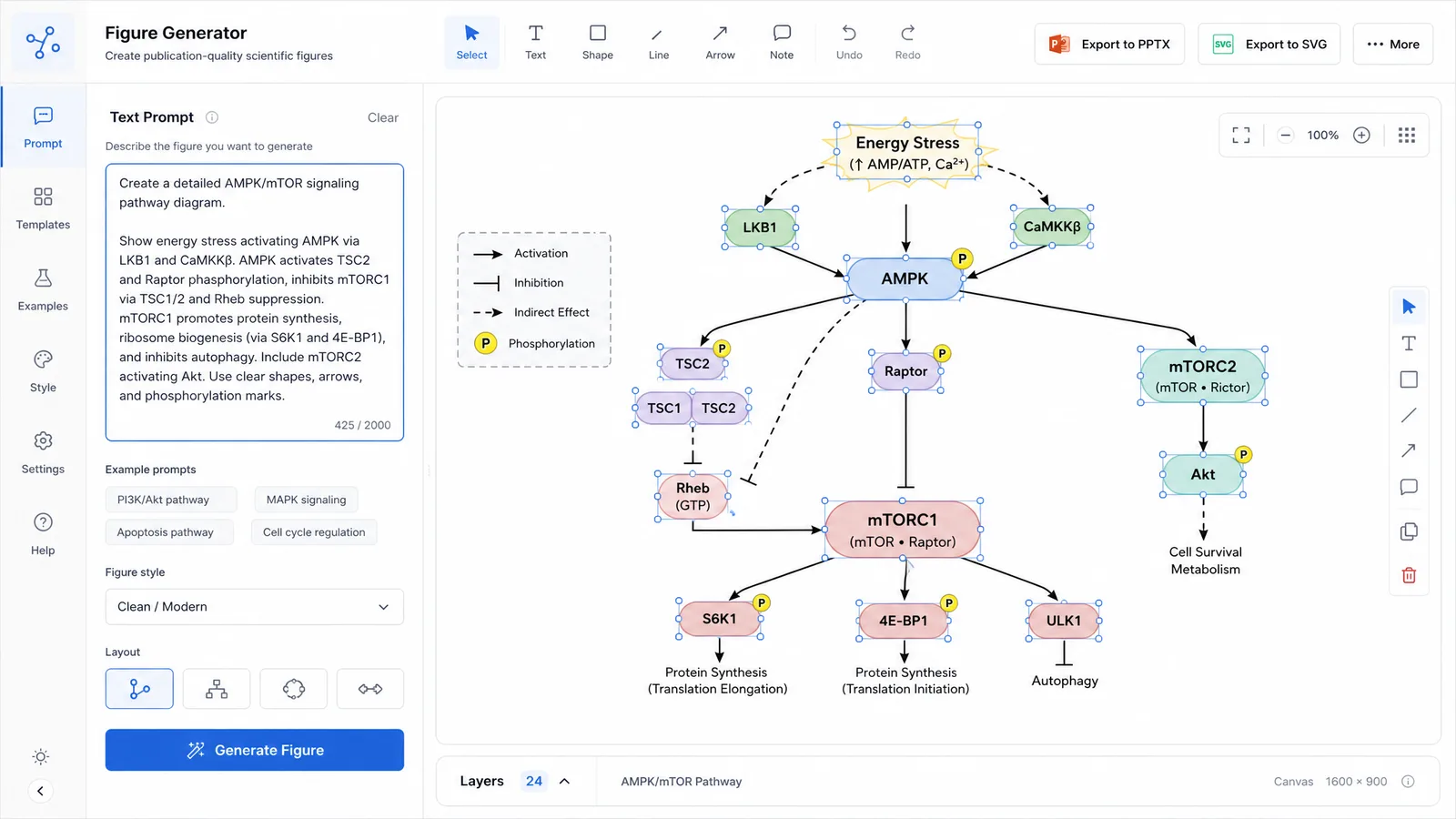
Path 2 — Copy a structured prompt. For a mechanism or pathway figure, Text-to-Figure gives more control. Copy and adjust to your study:
Schematic of AMPK sensing cellular energy stress (rising AMP:ATP ratio),
activating and inhibiting mTORC1 at the lysosome, with downstream
induction of autophagy initiation complexes, arrows drawn in the
correct inhibitory direction.
Path 3 — Sketch and scan. If you sketched your pathway on paper, photograph it and drop it into Sketch-to-Figure for a publication-style version that preserves your layout.
Start your FEBS3+ figure from a prompt, PDF, or sketch
Whichever path fits your workflow, generate an editable figure online for free and adjust any element before you print your A0 poster.
ÖGMBT / FEBS3+ 2026 figure workflow in SciFig: a metabolic pathway prompt left, an editable SVG diagram right, PPTX and SVG export (Figure generated with SciFig)
From any path, you edit individual elements in the vector canvas — arrow direction, labels, colors — and export to editable PPTX or layered SVG for your A0 print file or Science Flash slide. Start free: 150 credits on day one, plus daily check-in credits. If you use AI assistance to build a figure, a short, honest disclosure line in your figure caption — such as "Figure created by the authors using SciFig and reviewed for scientific accuracy (scifig.ai)" — is a simple way to keep that transparent, since AI-generated content disclosure is increasingly expected across scientific meetings even where a given conference has not published its own explicit policy. For companion guides in this conference series, see the SfN 2026 poster guide and the ASH 2026 poster guide.
FAQ
FEBS3+ 2026 posters must be a maximum of DIN A0 (841 × 1189 mm) in portrait format (upright). There will be several poster sessions during the meeting. See §3 FEBS3+ 2026 Poster Size for design guidance.
No — the official presenter instructions describe only a printed DIN A0 portrait poster; no digital or e-poster format is mentioned anywhere on the ÖGMBT site. Plan to print and bring a physical poster rather than prepare a screen-only PDF.
The early registration and oral abstract deadline was extended to July 7, 2026, and the poster abstract deadline is August 5, 2026, with acceptance notifications on July 23 (oral) and August 10 (poster). See §1 at a Glance for the full timeline.
A Science Flash Talk is a 2-minute oral teaser for your poster, followed by discussion at the poster itself during that afternoon's poster session. Presenters assigned a Science Flash upload a PDF (maximum 3 slides, maximum 2 MB) through the registration system in September 2026 (exact date not yet published).
Yes — every submitted abstract has a chance at the Best Poster Prize (sponsored by FEBS Open Bio Journal) or the Best Talk Prize (sponsored by Microsynth Austria and ÖGMBT), with winners nominated by session chairs and prizes awarded during the closing ceremony on Thursday, September 17.
As of July 21, 2026, ÖGMBT has not published an abstract book or a journal supplement for FEBS3+ 2026 abstracts. The Best Poster Prize being sponsored by FEBS Open Bio Journal is a prize sponsorship, not a confirmed abstract publication venue — check the official registration page for updates closer to the meeting.
Plenary Speaker Talks run 30 minutes plus 10 minutes discussion, Invited Speaker Talks 25 plus 5, and Short Talks 12 plus 3 minutes, alongside the 2-minute Science Flash Talk format. Slides use a 16:9 widescreen projection at 1920×1080 resolution.
FEBS3+ 2026 runs September 15–17, 2026 at the University of Vienna Biology Building (UBB), Carl-Djerassi-Platz 1, 1030 Vienna, Austria, as the second part of the 18th ÖGMBT Annual Meeting, which opens September 14 with a FEMS Regional COLLAB satellite meeting.
References
All specifications and dates above are drawn from official ÖGMBT and FEBS materials, accessed July 21, 2026:
Austrian Association of Molecular Life Sciences and Biotechnology (ÖGMBT). 18th ÖGMBT Annual Meeting 2026 — Welcome. Accessed July 21, 2026. https://oegmbt.at/events/annual-meeting/about
Disclaimer: This article is educational content focused on scientific figure design for conference posters and presentations. It is not a substitute for official meeting instructions — check current dates and specifications on the official ÖGMBT and FEBS3+ pages linked above before submitting or printing. SciFig is a scientific figure platform covering AI illustrations (SciFig AI Illustration), data charts (SciFig DataChart), and flowcharts (SciFig FlowChart); it does not review, judge, or submit abstracts on your behalf.
Keep going
Recommended resources
Templates, tools, and further reading for your research