EMBO Chemical Biology 2026 Poster & Presentation Guidelines
Official EMBO Chemical Biology 2026 guidelines: the A0 poster board size, abstract format, registration deadlines, and the Heidelberg poster session schedule.
SciFig Team
SciFig editorial team
The EMBO Workshop Chemical Biology 2026 runs 8–11 September 2026 at EMBL Heidelberg, Germany.
This is a practical guide to the official poster rules for EMBO Chemical Biology 2026: the A0 portrait poster board size, and how abstracts are selected for an oral or poster slot.
It also covers the registration deadlines, where accepted abstracts appear afterward, and the chemical biology figures that make a poster or talk worth stopping for. Every date and specification below links to official EMBL materials.
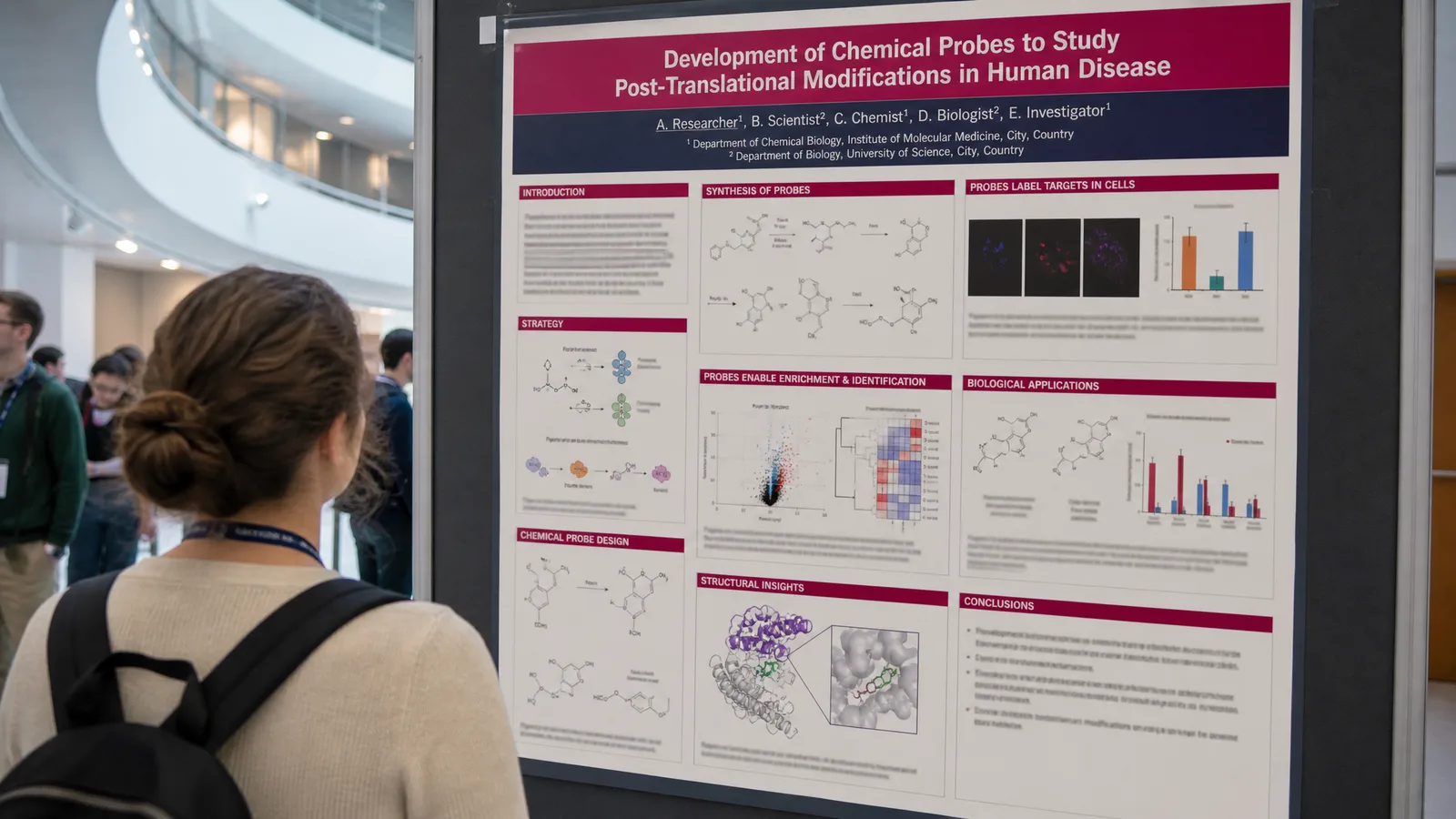
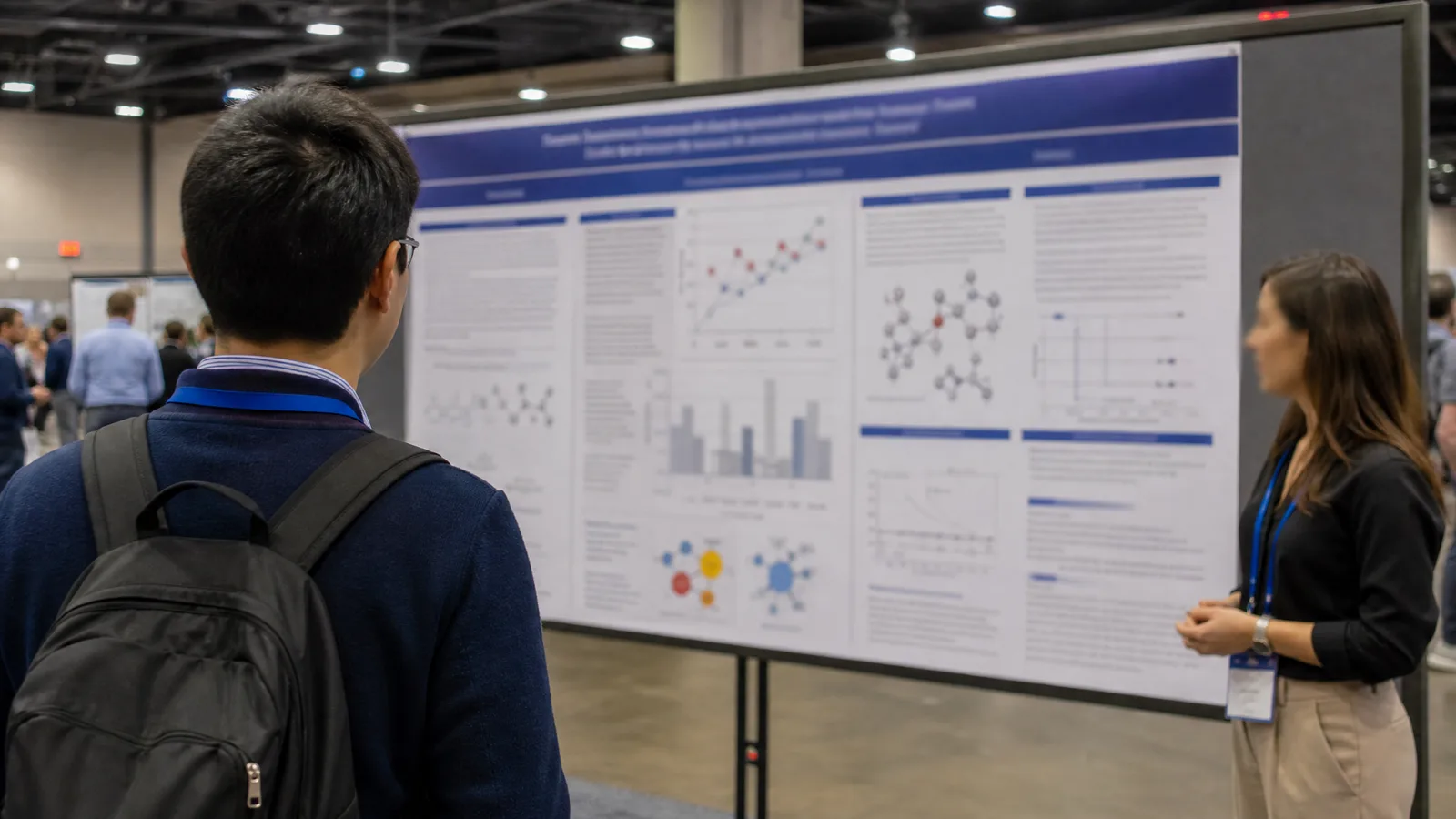
EMBO Chemical Biology 2026 poster session at EMBL Heidelberg: a participant seen from behind reading an A0 portrait poster with a title bar and multi-panel layout (Figure generated with SciFig)
Transparency note: Illustrations in this article were generated with SciFig AI and reviewed by the author for scientific accuracy. Factual claims about dates and specifications link to official EMBL materials.
1. EMBO Chemical Biology 2026 at a Glance: Dates, Venue, and Registration Deadlines
The EMBO Workshop Chemical Biology 2026 runs Tuesday 8 September through Friday 11 September 2026 at the EMBL Advanced Training Centre, Meyerhofstraße 1, in Heidelberg, Germany (Europe/Berlin time), and is a hybrid meeting with both on-site and virtual registration. Only on-site registrants can submit an abstract and take part in the poster sessions — virtual participants attend the talks but cannot present. The scientific programme is organized by Bryan Dickinson (University of Chicago), Maja Köhn (University of Bonn), Edward Lemke (Institute of Molecular Biology, Mainz), and Xiao Wang (MIT).
Workshop opens — Session 1: Big Data, AI and Design; Poster session 1 (even-numbered posters)
9 September 2026
Session 2: Chemical Technologies to Probe Biology; Poster session 2 (odd-numbered posters)
10 September 2026
Sessions 3–4: Chemical Technologies to Manipulate Biology / Chemical Synthetic Biology; Poster session 3 (all posters)
11 September 2026
Session 5: The RNA World; poster prize announcement and closing
Abstract submission for EMBO Chemical Biology 2026 is now closed, and the official page does not publish an exact submission deadline date — if you already have an accepted abstract, the sections below cover exactly what to prepare next.
2. EMBO Chemical Biology 2026 Poster Size: A0 Portrait on a 1.05 × 2.30 m Board
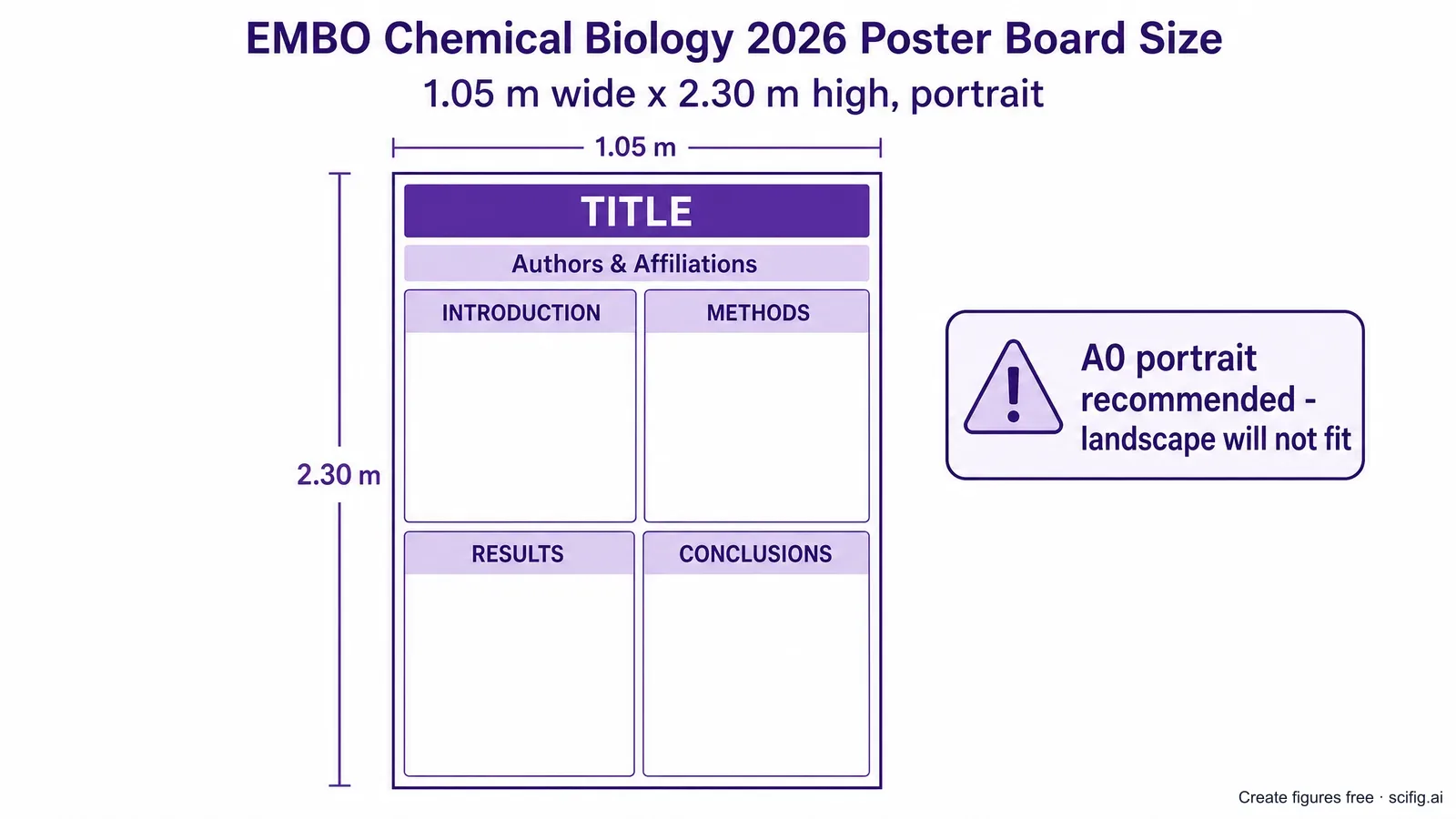
An EMBO Chemical Biology 2026 poster is a printed, physical poster — recommended at A0 portrait size — mounted on a board measuring 1.05 m wide by 2.30 m high, and a landscape-oriented poster will not fit on a single board. Pins are provided at the board for mounting. Your numbered board assignment is included in the abstract book you receive after registration, so check that document rather than guessing your slot.
Posters go up and come down across three sessions tied to your board number: Poster session 1 on 8 September covers even-numbered posters, Poster session 2 on 9 September covers odd-numbered posters, and Poster session 3 on 10 September is open to all posters. Poster prizes are announced at the closing session on 11 September.
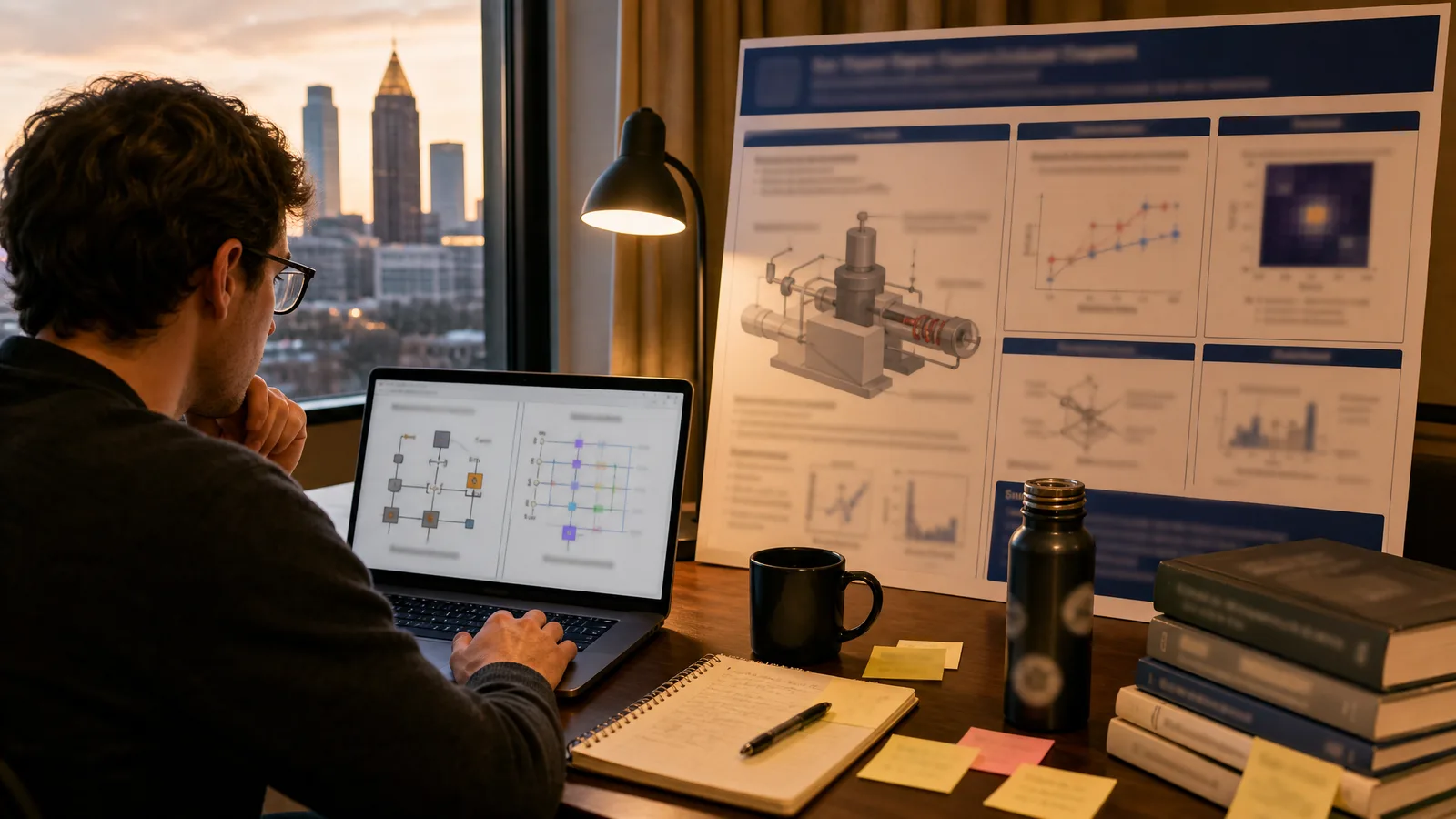
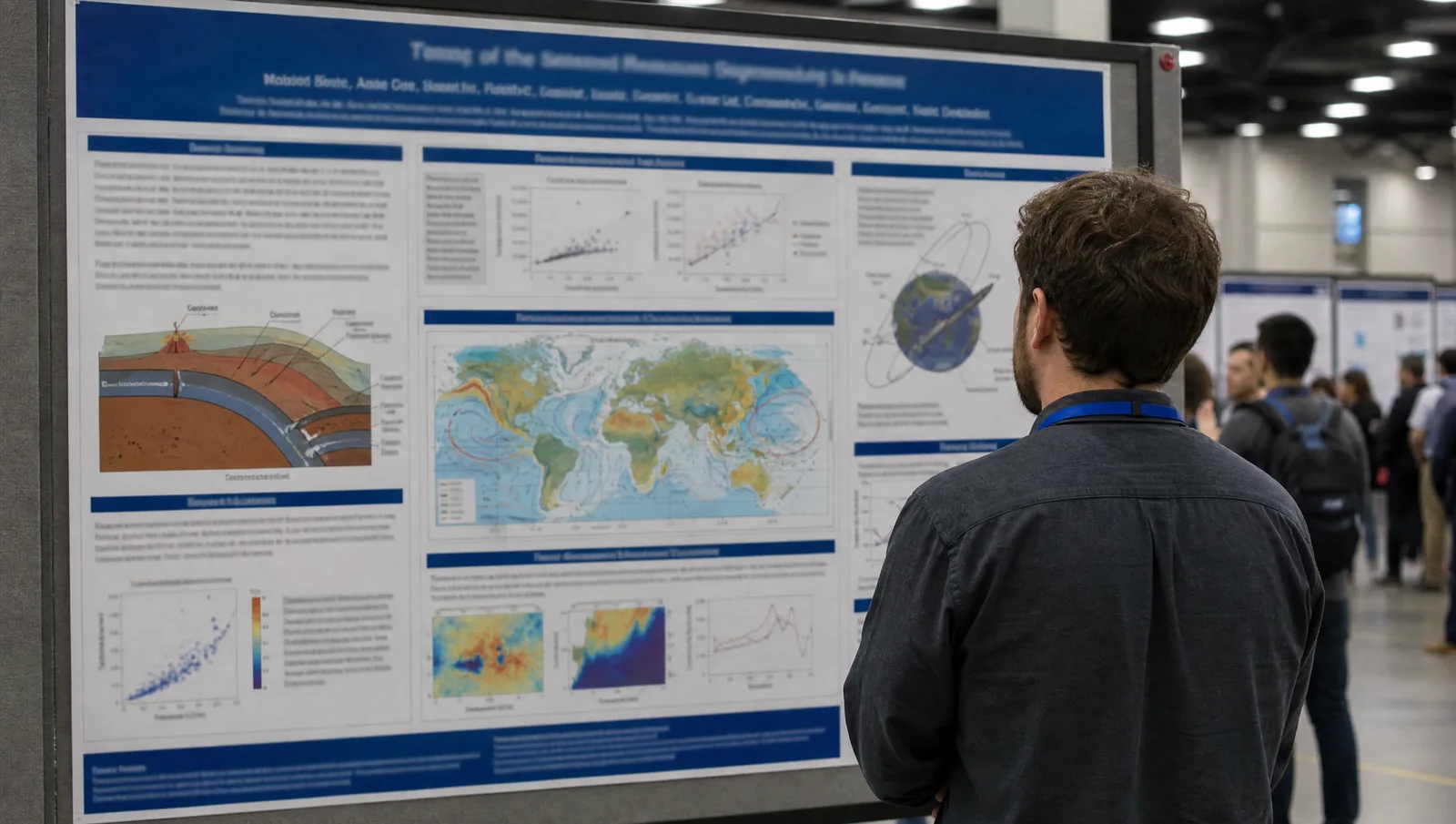
EMBO Chemical Biology 2026 poster board template: an A0 portrait layout at 1.05 by 2.30 metres with a title bar, author row, and introduction, methods and results panels (Figure generated with SciFig)
The chemical biology figures that anchor that A0 board — a PROTAC or covalent probe mechanism, a chemically controlled signaling pathway — are the slowest part of the layout to produce by hand. You can generate publication-grade versions online for free and drop them straight into your composition.
Need a hero figure for your EMBO Chemical Biology poster?
Start from a PROTAC mechanism, a covalent probe schematic, or a pathway diagram before you build your A0 portrait board.
A landscape sheet will not fit on a single board here, so portrait is settled before you start. Our conference poster templates ship A0 portrait as its own file in editable PowerPoint, with the print type scale already applied to the 1.05 m board width.
3. From Abstract to Oral or Poster: The EMBO Chemical Biology 2026 Submission Format
An EMBO Chemical Biology 2026 abstract is a text submission of up to 2,000 characters (excluding spaces) with a title of up to 20 words, and the organizers select each accepted abstract for either an oral or a poster presentation — you do not choose the format yourself. Selection results are announced roughly three weeks after the abstract submission deadline. Special characters in your abstract text must use standard Unicode encoding so they render correctly in the abstract book.
Only on-site registrants are eligible to submit an abstract and present a poster; if you registered for virtual attendance only, you can watch the talks but the poster sessions and oral slots are reserved for on-site participants. Abstract submission for the 2026 workshop has already closed, and the official page does not list an exact calendar deadline — if your abstract was accepted, focus on the oral or poster preparation covered in the sections below rather than the submission window itself.
Since the slide ratio and template are not published, a standard 16:9 academic deck is the safe default while you confirm with the Course and Conference Office. Our scientific presentation templates are 16:9 and already ordered the way a conference talk runs, so the structure holds whichever format you are assigned.
4. What Figures Do You Need for a Chemical Biology Poster or Talk?
Whether you present a poster or an oral slot at EMBO Chemical Biology 2026, the workshop's five session themes — from Big Data, AI and Design through Chemical Synthetic Biology and The RNA World — reward the same handful of mechanism figures, and the most time-consuming ones can be generated online for free in minutes. Two figure types recur across the sessions on probing and manipulating biology with chemistry.
On your poster or talk slides, the recurring chemical biology figure types are:
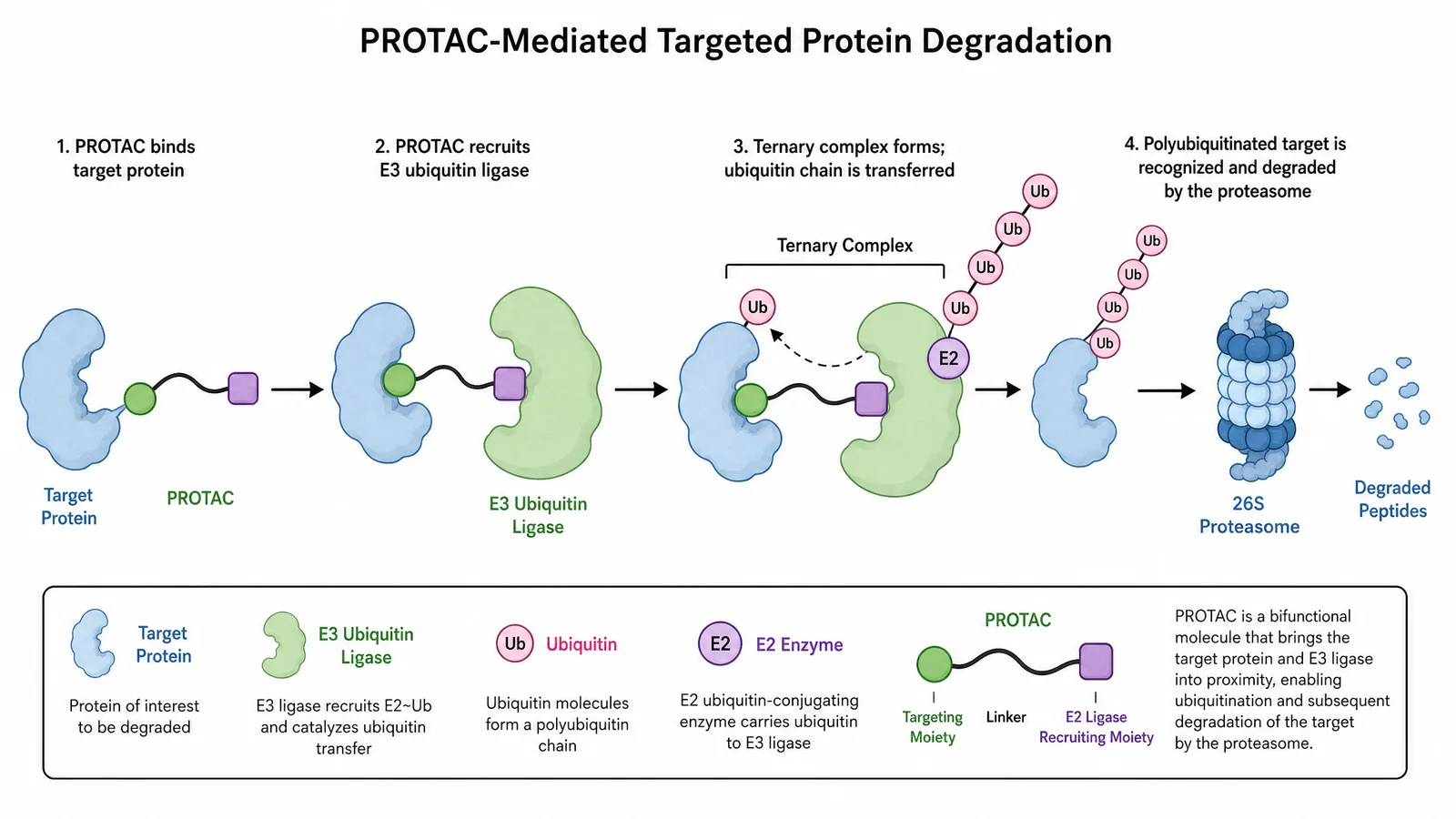
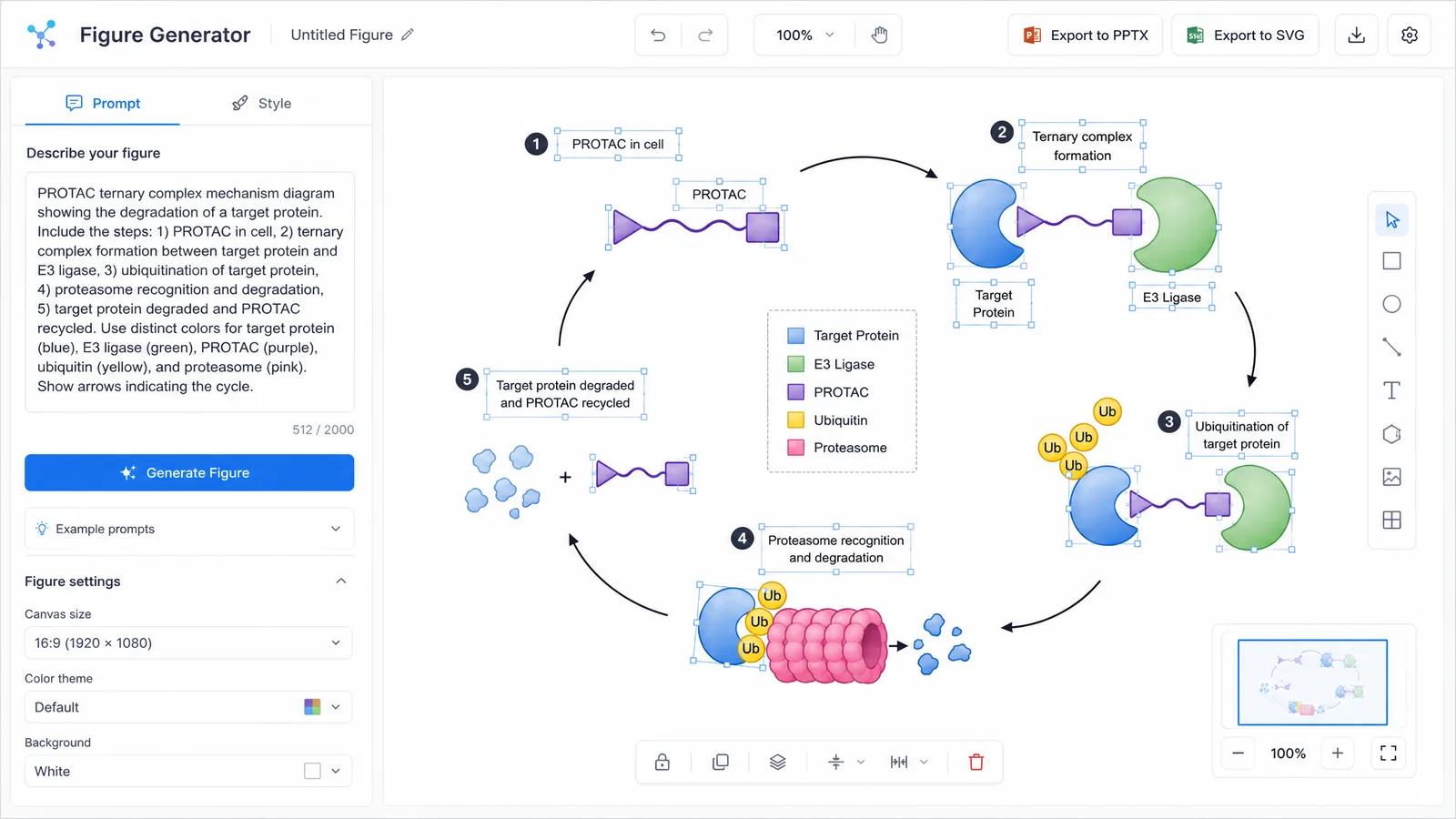
PROTAC / molecular glue degradation mechanism — a bifunctional small molecule simultaneously engaging a target protein and an E3 ubiquitin ligase, forming the ternary complex that recruits the ubiquitin-proteasome system to degrade the target. Central to the meeting's "Chemical Technologies to Manipulate Biology" session.
Covalent probe / activity-based protein profiling mechanism — a covalent probe reacting with a nucleophilic active-site residue on a target enzyme, forming a labeled adduct that enables target identification. Central to the "Chemical Technologies to Probe Biology" session.
EMBO Chemical Biology 2026 PROTAC degradation figure: a bifunctional molecule bridging a target protein and an E3 ubiquitin ligase into a ternary complex (Figure generated with SciFig)
5. Designing a Winning EMBO Chemical Biology Poster: Accuracy That Survives Peer Scrutiny
A strong EMBO Chemical Biology poster passes two tests: it is grasped in seconds during a busy corridor poster session, and it is chemically exact enough to survive scrutiny from a chemist or biologist who works on the same mechanism. In a focused workshop like this one, the people reading your board know the chemistry — so build around one dominant "hero" figure and get every bond, residue, and complex right.
The second test is where scientific figures live or die — and where general-purpose AI image generators fall short. A tool like Nano Banana Pro or GPT Image can produce something that looks about 99% right, but on a mechanism figure 99% right is effectively 0% right: a PROTAC diagram that skips the ternary complex, a covalent probe drawn reacting with the wrong residue, or a riboswitch shown with the wrong base-pairing turns a compelling figure into one that misleads a reviewer. And a flat, raster AI image gives you no way to fix that last one percent.
This is the core difference with SciFig. Every figure is a fully editable SVG whose elements — small molecules, residues, arrows, labels — you can modify individually, so you (the chemist or biologist who actually knows the mechanism) can adjust every element until the science is exactly right:
PROTAC / molecular glue mechanisms — show the full ternary complex (small molecule, target, E3 ligase) rather than a simplified "degradation arrow" that skips it.
Covalent probe reactivity — pair the electrophile with the correct nucleophilic residue instead of a generic non-covalent binding cartoon.
RNA riboswitch structure — keep aptamer and expression-platform base-pairing distinct rather than collapsing the two states into one.
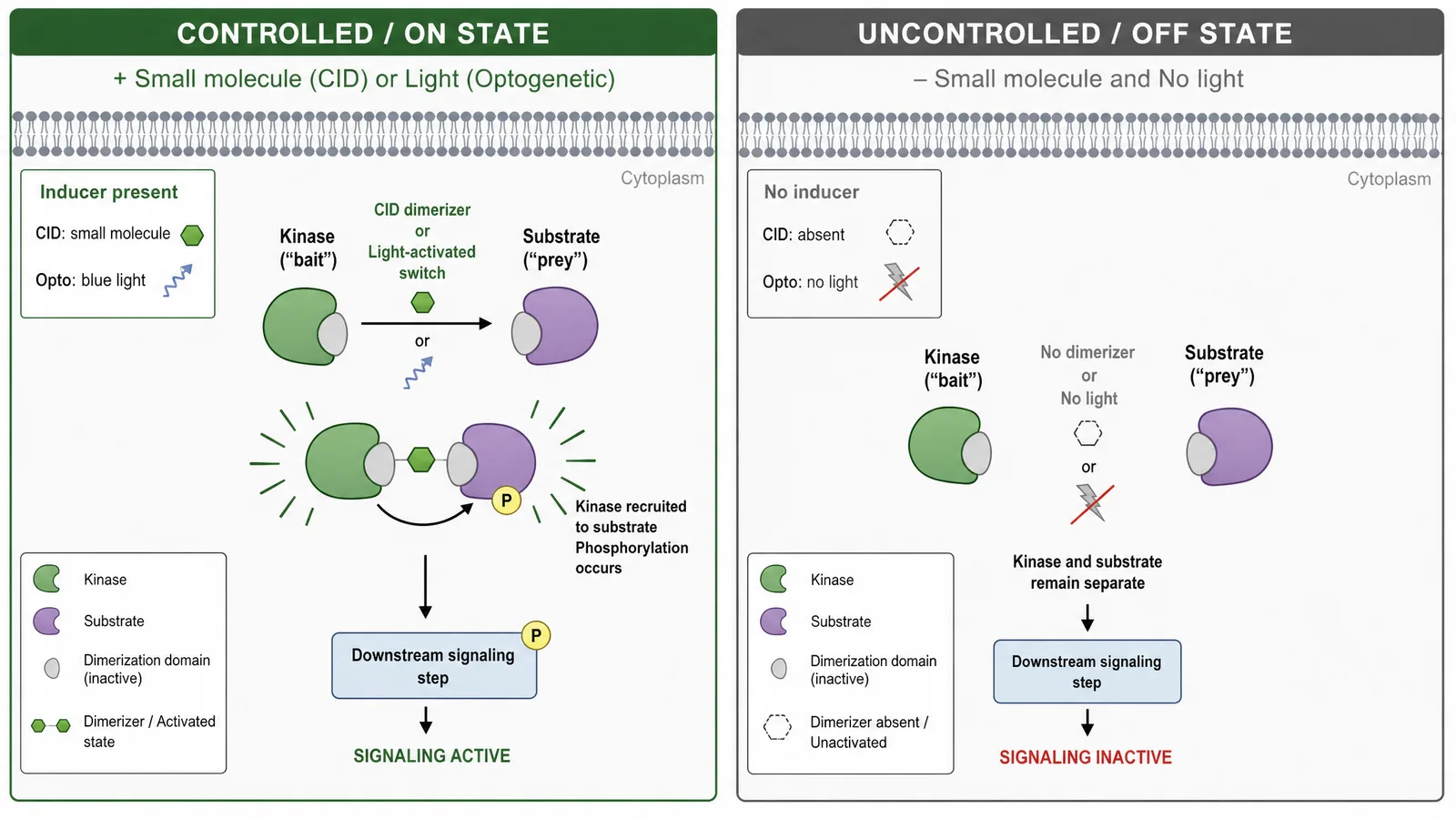
EMBO Chemical Biology 2026 chemogenetic pathway control figure: a chemically induced dimerization switch recruiting a kinase to its substrate, in on and off states (Figure generated with SciFig)
Whether your EMBO Chemical Biology 2026 figure earns attention comes down to whether it is accurate, clear, and legible from a few feet away — which is exactly where an editable AI figure workflow compresses days of design work into hours without giving up chemical control.
6. Create Your EMBO Chemical Biology 2026 Figures with AI: The SciFig Workflow
You already have two things most colleagues do not: your accepted abstract and a precise understanding of your mechanism — use both to generate your figures online for free, then edit them to exactly right. Here is the SciFig workflow for an EMBO Chemical Biology presenter, starting in SciFig AI Illustration (AI scientific illustration):
Path 1 — Upload your accepted abstract PDF. Drop it into PDF-to-Figure. It parses your text and returns a mechanism diagram in one click — every element stays editable, so you can adjust it to your data and poster layout instead of starting from a blank canvas.
Path 2 — Copy a structured prompt. For a PROTAC, probe, or pathway figure, Text-to-Figure gives more control. Copy and adjust to your study:
Schematic of a PROTAC degradation mechanism: a bifunctional small
molecule simultaneously binding a target protein and an E3 ubiquitin
ligase, forming a ternary complex that recruits the ubiquitin-
proteasome system, with the target protein subsequently degraded.
Path 3 — Sketch and scan. If you sketched your hero figure on paper, photograph it and drop it into Sketch-to-Figure to get a publication-style version that preserves your topology.
EMBO Chemical Biology 2026 figure workflow in SciFig: a PROTAC mechanism prompt left, an editable SVG diagram right, PPTX and SVG export (Figure generated with SciFig)
From any path, you edit individual elements in the vector canvas — adjust labels, molecules, arrow directions — and export to editable PPTX or layered SVG at high resolution for your A0 board. Start free, no card required: 150 credits on day one (3 figures), plus daily check-in credits that grow with your streak (up to 150 a day) — up to about 44 figures in your first month, so most authors work through a full set of figures over their first few days. For companion guides in this conference series, see the SfN Neuroscience 2026 poster guide and the RSNA 2026 poster guide.
7. Where EMBO Chemical Biology 2026 Abstracts Appear (Not a Journal Supplement)
Accepted EMBO Chemical Biology 2026 abstracts are compiled into an abstract book that is made available to registered participants through the official event platform — the workshop does not publish abstracts in an external journal or supplement. Your poster board number is listed in that abstract book, so it doubles as your seating chart for the poster sessions.
Because there is no journal deadline pulling in a different direction, plan your poster and abstract figure to tell the same mechanism story — the abstract book is the citable record most colleagues will actually revisit after the meeting.
Frequently Asked Questions
An EMBO Chemical Biology 2026 poster is a printed, physical poster recommended at A0 portrait size, mounted on a board measuring 1.05 m wide by 2.30 m high. A landscape-oriented poster will not fit on a single board. Pins are provided at the board, and your numbered board assignment appears in the abstract book. See §2 Poster Size.
No — only on-site registrants can submit an abstract and take part in the poster sessions. Virtual registration lets you attend the talks, but poster sessions and oral presentation slots are reserved for on-site participants. See §1 At a Glance.
Abstract submission for EMBO Chemical Biology 2026 is already closed, and the official EMBL event page does not publish an exact calendar deadline date — selection results are announced roughly three weeks after the submission deadline closed. If your abstract was accepted, see §3 Submission Format for what to prepare next.
Accepted abstracts are compiled into an abstract book available to registered participants through the official event platform — there is no external journal or supplement. Your poster board number is also listed there. See §7 Where Abstracts Appear.
The on-site registration deadline is 28 July 2026, and the virtual registration deadline is 1 September 2026. On-site registration fees are €450 for academia, €350 for PhD students, €770 for industry, and €300 for journal editors; virtual fees are €200, €150, and €275 respectively.
There are three poster sessions tied to your board number: Poster session 1 on 8 September (even-numbered posters), Poster session 2 on 9 September (odd-numbered posters), and Poster session 3 on 10 September (all posters). Poster prizes are announced at the closing session on 11 September.
The official event page has not published a specific slide aspect ratio, template, or time limit for oral or flash-talk presentations as of this writing. Confirm the current format with the EMBL Course and Conference Office before finalizing your slides, and check back on the official event page closer to the meeting for any updated presenter instructions.
References
All specifications and dates above are drawn from official EMBL materials, accessed July 21, 2026:
Disclaimer: This article is educational content focused on scientific figure design for conference posters and presentations. Dates and specifications are summarized from official EMBL materials linked above and were accurate at the time of writing; always confirm current details on the official EMBL event page before submitting, printing, or traveling. SciFig is an AI scientific figure platform covering illustrations (SciFig AI Illustration), data-driven charts (SciFig DataChart), and flowcharts (SciFig FlowChart).
Keep going
Recommended resources
Templates, tools, and further reading for your research