AIChE 2026 Poster & Presentation Guidelines and Template
Official AIChE 2026 poster guidelines: the 3.75 ft square poster board, 16:9 slide template, the Nov 22 proceedings paper deadline, and the figures you need.
SciFig Team
Scientific Illustration Experts
AIChE 2026 runs November 8-12, 2026 at the Minneapolis Convention Center, Minneapolis, MN.
This is a practical guide to the official poster and presentation rules for the AIChE Annual Meeting: the unusual 3.75 ft square poster board, and 16:9 oral slides with the official PowerPoint template.
It also covers what figures your poster, slides and abstract each need, the November 22 proceedings deadline, and where accepted work is published. Every date and specification below links to official AIChE materials.
Need the file, not just the specs? Download our conference poster templates — 24 editable PowerPoint layouts, sized for both printed boards and e-posters.
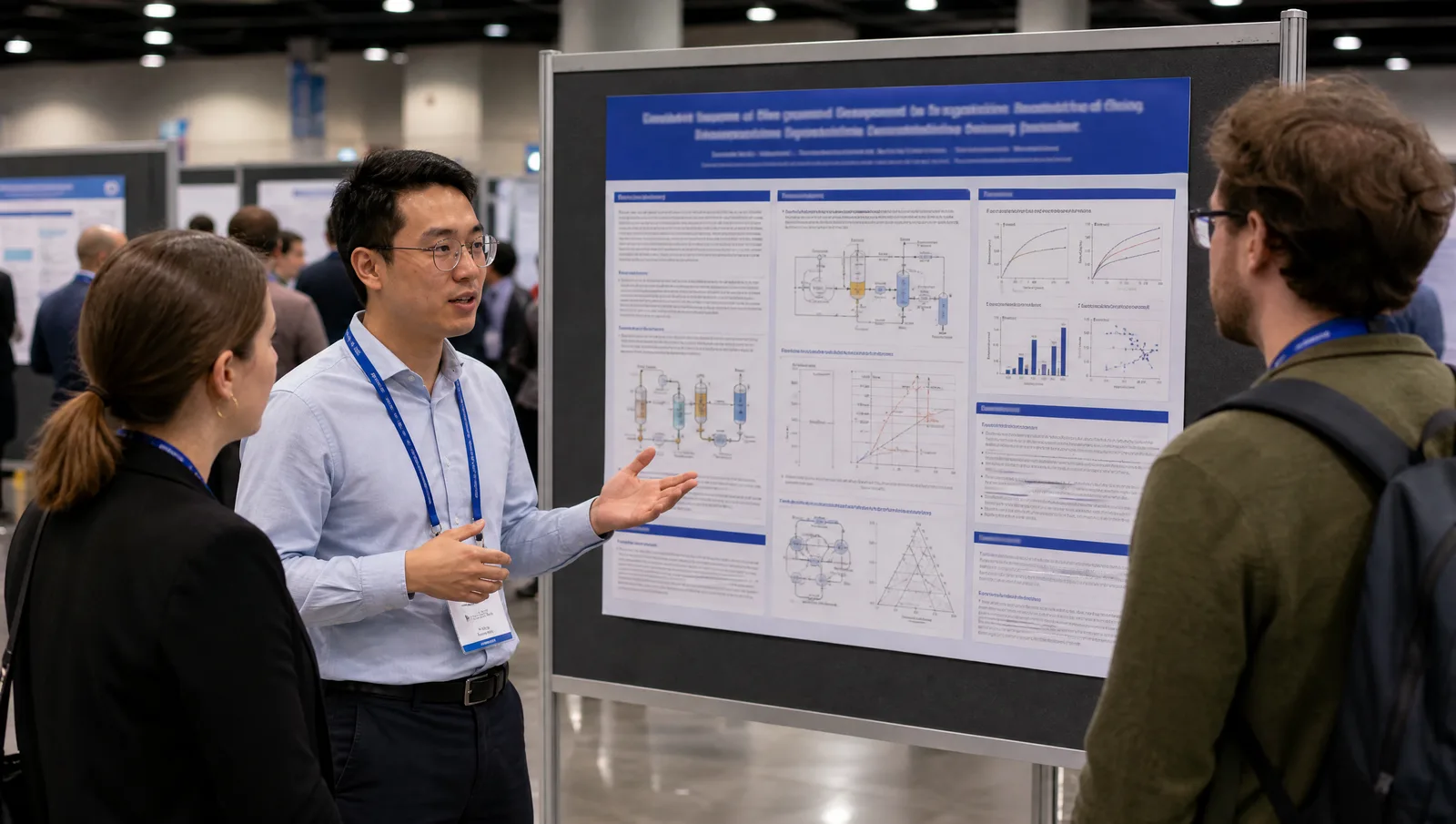
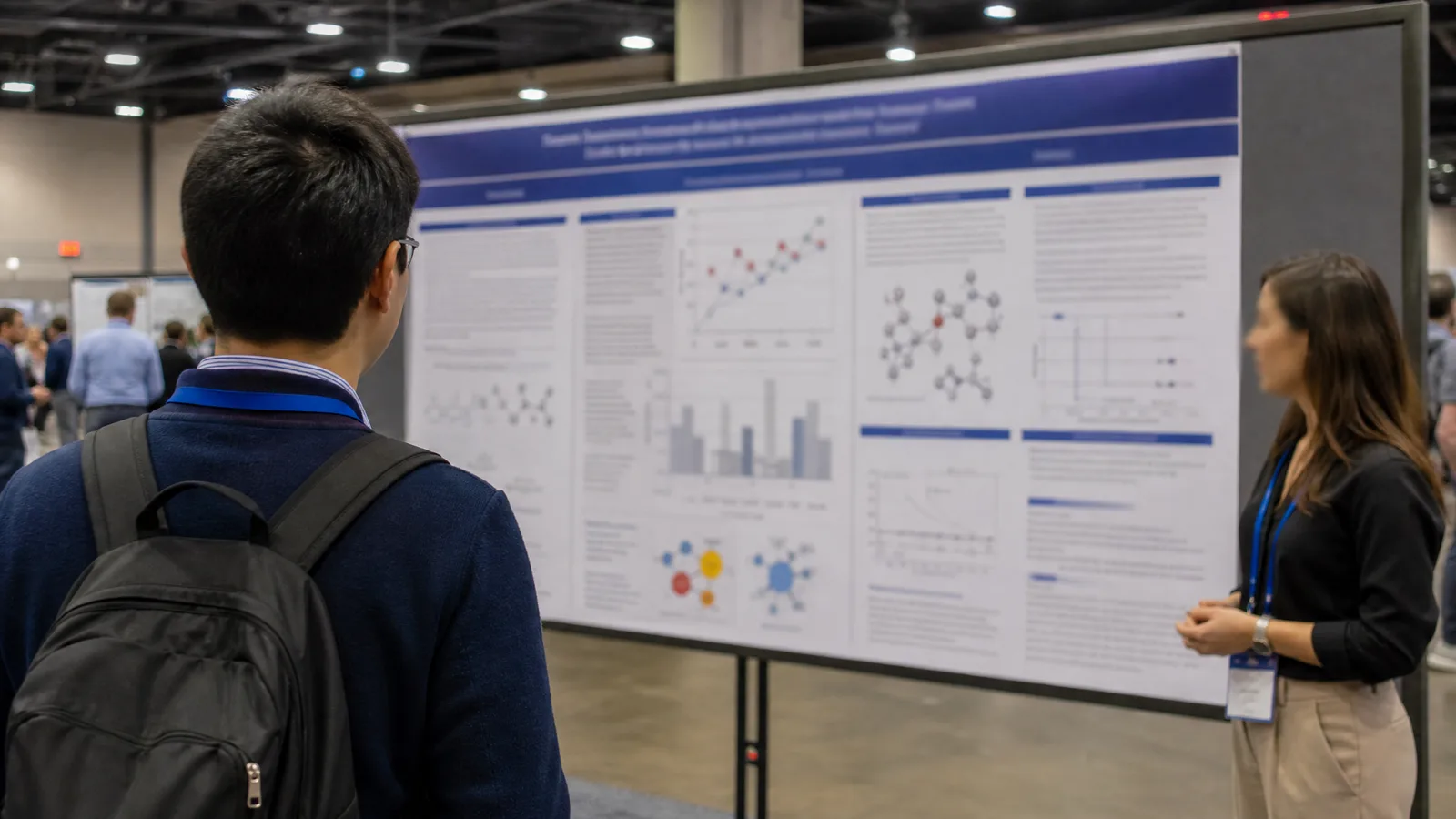
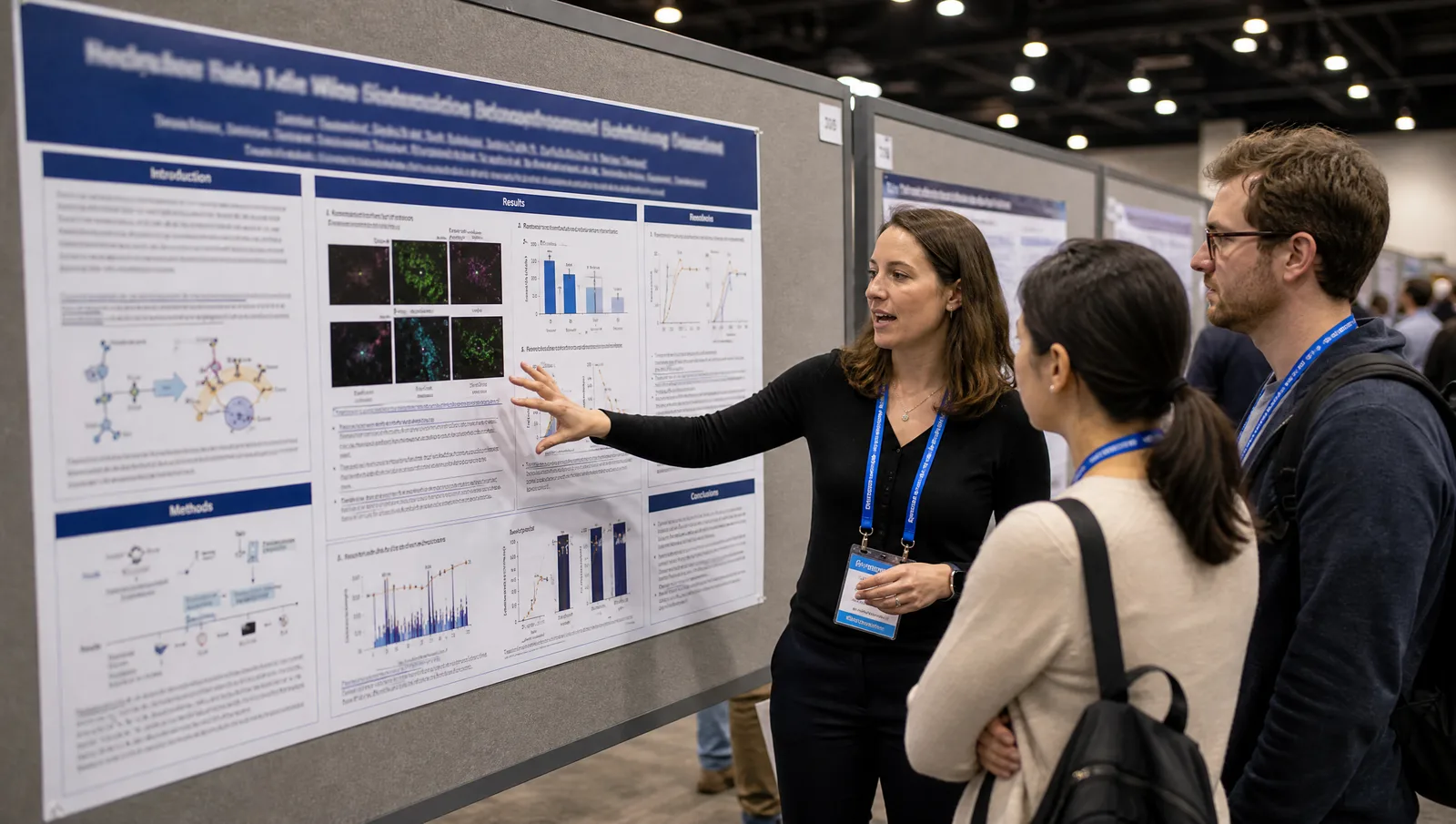
AIChE 2026 poster session: a presenter explaining a square conference poster on a display board to two attendees in a convention hall (Figure generated with SciFig)
Transparency note: Illustrations in this article were generated with SciFig AI and reviewed by the author for technical accuracy. Factual claims about dates and specifications link to official AIChE materials.
1. AIChE 2026 at a Glance: Dates, Venue, and Presenter Deadlines
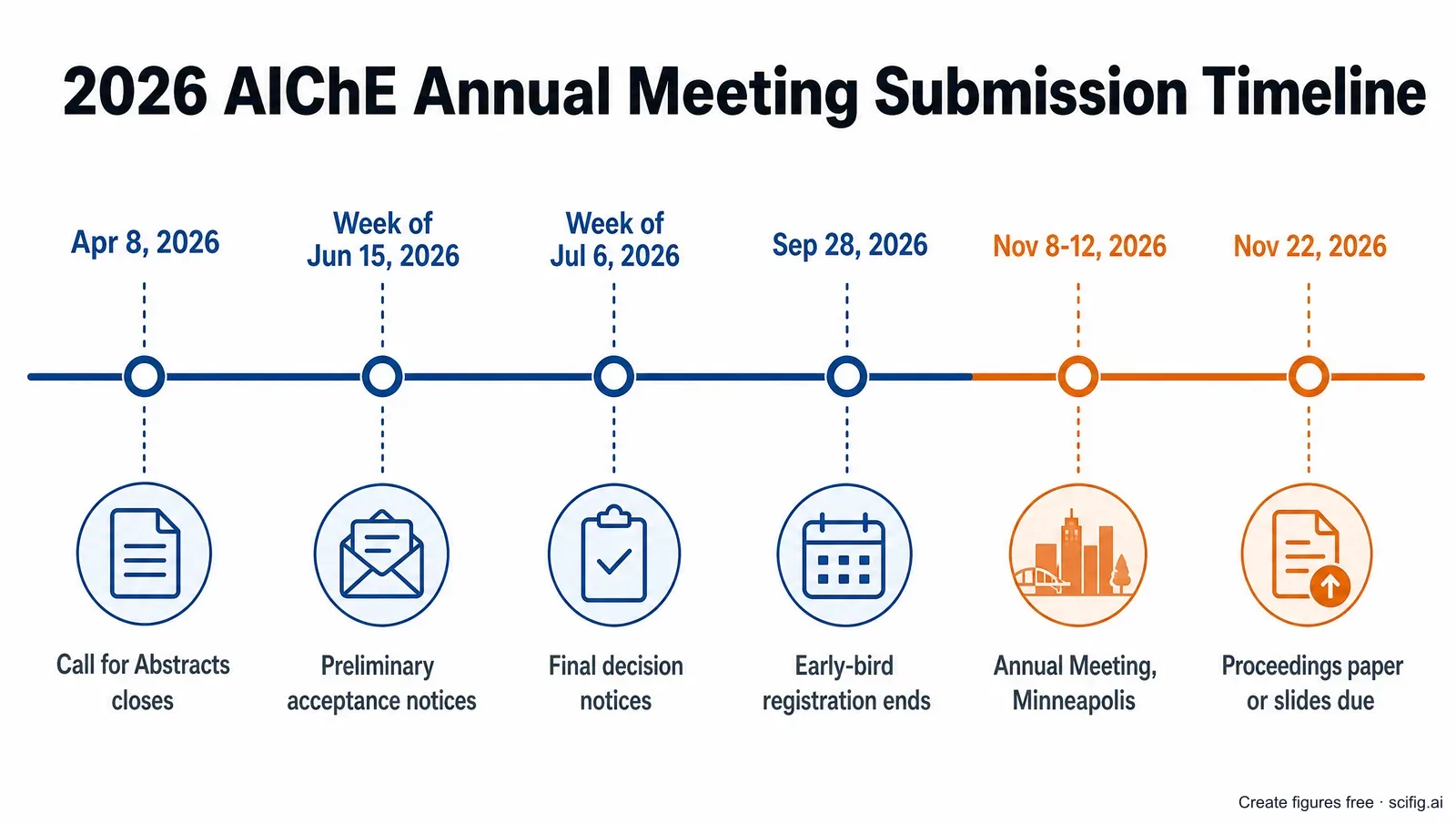
The 2026 AIChE Annual Meeting runs November 8-12, 2026 at the Minneapolis Convention Center in Minneapolis, Minnesota, and the deadline that still matters for accepted authors is November 22, 2026 — the date your proceedings paper or presentation slides are due. The general Call for Abstracts closed on April 8, 2026; preliminary acceptance notices went out the week of June 15 and complete decision notices the week of July 6, so if you are reading this you most likely already know whether you are presenting. All technical sessions are held at the Minneapolis Convention Center (AIChE Accepted Author's Guide).
One structural point shapes everything that follows: AIChE runs a two-stage submission. You submit a short abstract first, and the official instructions state that "should your paper be accepted, a longer extended abstract/full paper will be requested later" (AIChE 2026 Instructions and Rubric). The abstract deadline and the paper deadline are seven months apart, and only the second one is still ahead of you.
AIChE 2026 submission timeline: abstract deadline April 8, acceptance notices in June and July, meeting November 8-12, proceedings paper deadline November 22 (Figure generated with SciFig)
Date
Milestone
8 April 2026
Call for Abstracts closed (all oral and general poster sessions)
Week of 15 June 2026
Preliminary acceptance notices
1 July 2026
"Meet the Candidates" poster submissions closed (11:59 PM ET)
Week of 6 July 2026
Complete acceptance / decision notices
28 September 2026
Early-bird registration ends
8-12 November 2026
AIChE Annual Meeting, Minneapolis Convention Center
22 November 2026
Paper / slide submission for proceedings due
Two administrative points catch presenters out every year. First, presenting does not waive your registration: all speakers and contributors are expected to register on a paid basis, and AIChE states plainly that it has no grant program covering meeting registration or travel expenses. Second, the undergraduate track is separate — the AIChE Annual Student Conference and its Undergraduate Student Poster Competition run their own call for submissions, with an early-notification window closing August 8 and standard submissions open through October 20 (2026 Call for Abstracts Information).
2. AIChE 2026 Poster Size and Format: The 3.75 ft Square Board
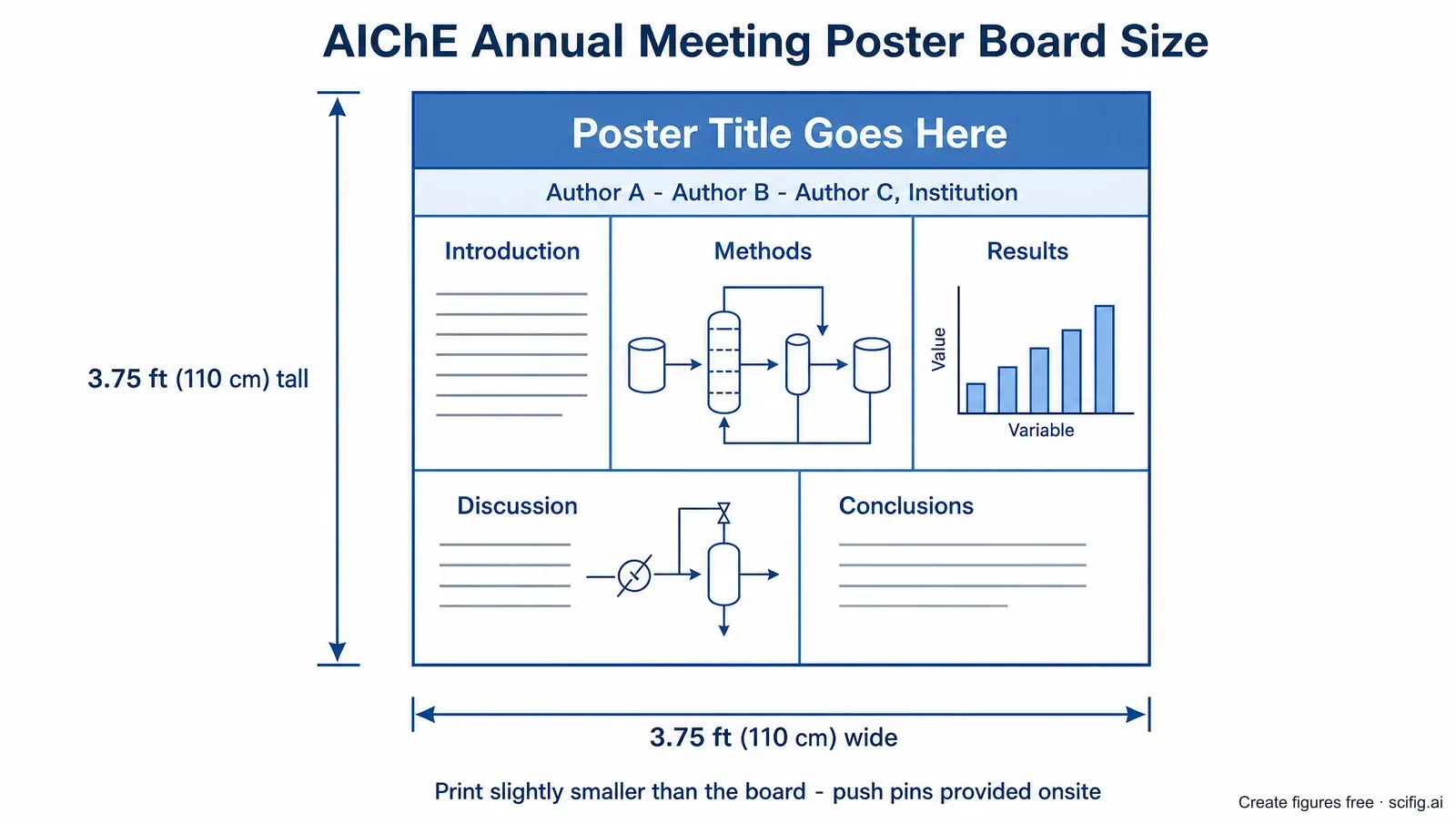
An AIChE 2026 poster board measures 3.75 ft wide by 3.75 ft tall (110 cm x 110 cm), and AIChE recommends printing your poster slightly smaller than that so it fits the board properly. That specification is worth pausing on, because it is unusual: the board is square. AIChE posters are neither portrait nor landscape, so a sheet designed on the A0 portrait or 48 x 36 in landscape templates that circulate for other conferences will not fit. Push pins are provided at the board, and the official presenter guidelines do not describe any e-poster, virtual poster, or digital upload requirement — AIChE 2026 is a printed-poster meeting (AIChE Accepted Author's Guide).
AIChE 2026 poster size diagram: a 3.75 ft by 3.75 ft square poster board layout with title bar, author row and introduction, methods, results and conclusions panels (Figure generated with SciFig)
The on-site rules for an AIChE poster session are equally specific, and several of them change how you should build the sheet (AIChE Poster Session FAQs):
Square layout, up to 3.75 x 3.75 ft — plan a grid, not a wide strip. A square board rewards a 3 x 3 or 2 x 2 panel arrangement built around one dominant figure, rather than the left-to-right column flow that suits a landscape sheet.
No audio-visual equipment is allowed in poster sessions, and electricity is not supplied to poster boards. There is no laptop, no monitor, no animation — everything you want to show has to be printed on the sheet.
Arrive no earlier than one hour before your session; you are not permitted to hang your poster before then, and set-up typically takes 30 to 60 minutes. Take the poster down immediately when the session concludes unless you are told otherwise.
Find your board by number — AIChE provides a list of presentations with the poster board number next to each paper title.
AIChE also publishes its own design guidance, and it is more prescriptive than most: a poster should be readable from two to three feet away, with title panels set at at least 36 point and body text at 24 point; text should sit in small chunks rather than paragraphs; and — the line that matters most for figures — "flow charts should be simple, leaving more complicated explanations to verbal interaction between the presenter and the viewers." AIChE expects you to have a three-to-five-minute walkthrough ready for anyone who asks. That is a direct instruction to make your process diagrams cleaner and larger than you think you need to, and to move the detail into what you say.
The process flow diagrams, unit-operation schematics, and reaction pathways that fill a chemical engineering poster are the slowest part of that grid to produce well, and on a square board they have to read at a glance. You can generate publication-grade versions online for free and drop them straight into your layout.
Need a hero figure for your 3.75 ft square AIChE poster?
Start from a process flow diagram, column schematic, or reaction pathway before you commit to a poster layout.
Because the board is square, an A0 portrait or 48 × 36 in landscape sheet will not scale into it. Our conference poster templates include a square layout built as a balanced grid rather than a squeezed rectangle — resize it down to the 3.75 ft board and the column structure still reads.
3. AIChE 2026 Oral Presentation Guidelines: 16:9 Slides and the Official Template
AIChE provides an official Annual Meeting PowerPoint template for oral presentations, and if you do not use it AIChE advises building your slides in 16:9 — the aspect ratio of the projectors in the meeting rooms. You can download the template directly from the Accepted Author's Guide; it is optional, not mandatory, but it settles the ratio question for you.
The room setup deserves attention before you travel. Each meeting room has a projector, screen, and podium, but microphones are only provided in select rooms, and — the detail that strands presenters every year — AIChE does not provide computers in all function rooms. You are expected to bring your own laptop, or arrange in advance with your session chair to use theirs and bring your presentation on a flash drive. Carry both: your laptop and a PDF fallback on a USB stick.
One thing the official author-facing pages do not state is how long an individual talk runs. As of August 4, 2026, the Accepted Author's Guide, the Confex Instructions and Rubric, the Call for Abstracts page, and the Poster Session FAQs all omit any per-presentation time limit or Q&A allowance, so confirm your slot length with your session chair or the final technical program rather than assuming a duration from another conference. Practically, that means building a deck you can compress: lead with the figure that carries your result, and keep backup slides after the conclusion rather than in the main flow.
4. What Figures Do You Need for an AIChE Poster, Slides, and Abstract?
A chemical engineering submission needs figures in three different places — the abstract, the poster or slides, and the proceedings paper — and AIChE sets different rules for each. The abstract accepts images but with a constraint many authors miss; the poster is print-only and square; and the proceedings paper has formatting rules that will quietly ruin a figure designed for the screen.
In your abstract. AIChE abstracts are capped at 150 characters for the title and, in most cases, 1,500 words of text, with specific limits set by individual divisions and forums. Image upload is optional and explicitly allowed — but "if you have any images/tables you need to upload with your abstract submission, they must be merged into a single image file to be uploaded" (AIChE 2026 Instructions and Rubric). One file means one composed panel: if you want a process schematic and a results plot to appear together, you need them laid out as a single composite image, not two attachments. It is also worth designing that image against the review rubric, which weights Relevance/Impact, Completeness, Clarity, and Conclusions/Significance at 25% each and expects the abstract to cover Problem, Methods, Results, and Implications.
On your poster and slides, the figures that carry a chemical engineering presentation are:
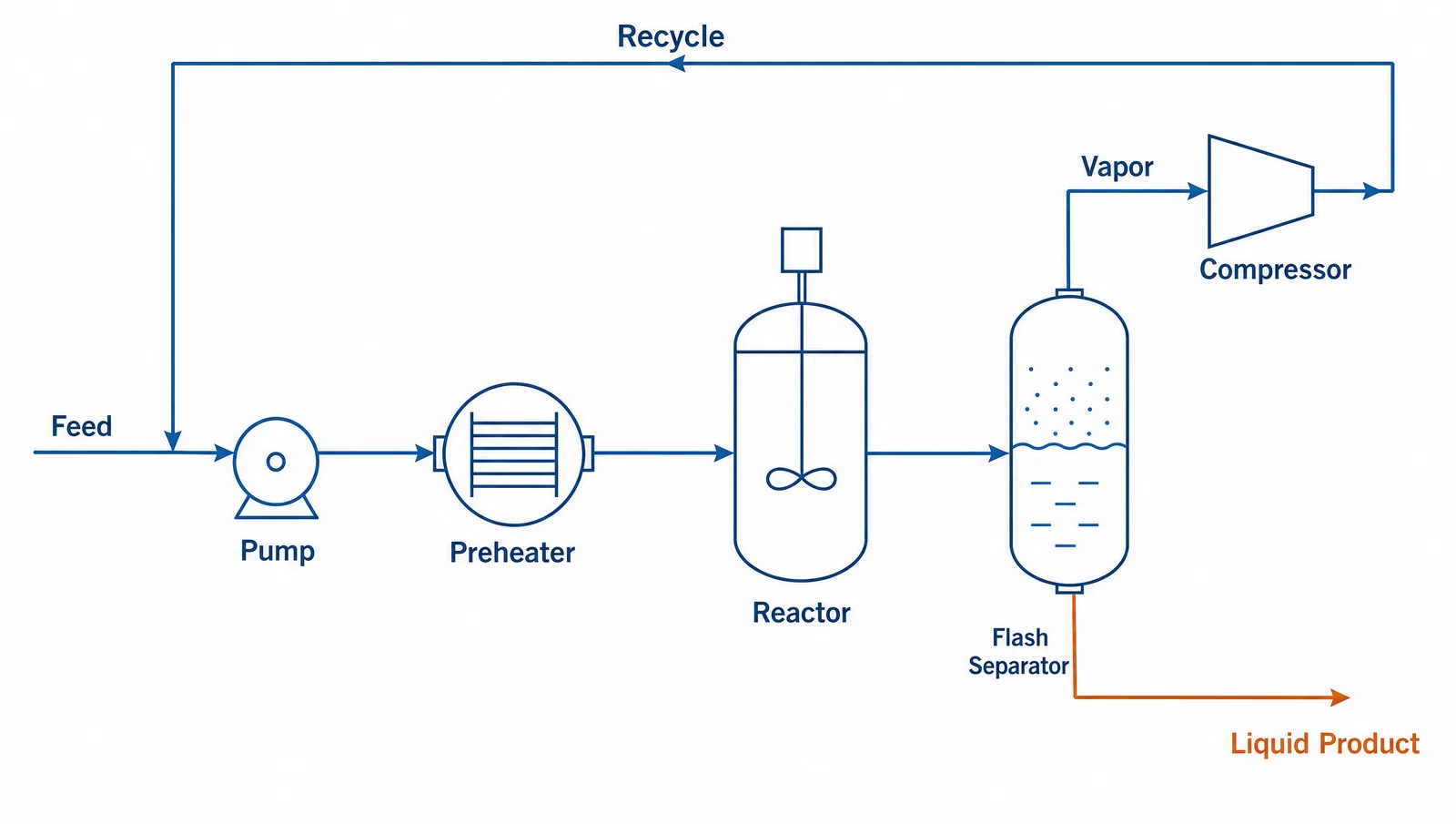
A process flow diagram (PFD) — the unit operations, the streams between them, and the recycle loops, with correct symbols and unambiguous flow directions. This is usually the figure a passerby reads first.
A unit-operation schematic — the distillation column, reactor, membrane module, or heat exchanger your work actually concerns, drawn in enough detail to show the mechanism you are claiming.
A mechanism or pathway schematic — a catalytic cycle, a transport or adsorption mechanism, a degradation route: the causal story behind your numbers.
AIChE 2026 poster figure example: a chemical engineering process flow diagram with pump, preheater, reactor, flash separator and compressor recycle loop (Figure generated with SciFig)
In your proceedings paper. This is the constraint that surprises people. AIChE's official style guidance for meeting papers asks authors to put a centered caption below each graphic or photo (tables are the opposite — a bold numeric reference such as "Table 1." centered above the table), and it explicitly says to avoid color graphics and graphics with dark backgrounds, because they do not reproduce well (AIChE Guidelines & Style Manuals). A figure built with a dark background and colour-coded streams can read beautifully on a poster and become unreadable in the proceedings. It is well-established practice in technical publishing to make line weight, hatching, and labelling carry the information so a figure survives greyscale reproduction — AIChE's guidance is an explicit instance of it, and it is far easier to satisfy if your figure is editable rather than a flat image you have to regenerate.
5. Designing a Winning AIChE Poster: Accuracy a Chemical Engineer Will Check
A winning AIChE poster passes two tests: someone walking the aisle grasps the process in a few seconds, and the engineering is exact enough to survive a specialist reading it from two feet away. The first test is a layout problem, and the square board makes it easier than it looks — one dominant figure occupying roughly the centre or upper-left quadrant, with supporting panels arranged around it, beats nine equal-weight boxes. AIChE's own guidance points the same direction: keep flow charts simple and leave the complications to the conversation.
The second test is where technical figures live or die — and where general-purpose AI image generators fall short. A tool like Nano Banana Pro or GPT Image can produce something that looks about 99% right, but on an engineering schematic 99% right is effectively 0% right. This is not a complaint about one vendor; no general image model today reliably gets a complex process diagram correct on the first try. The problem is that a flat, raster output gives you no way to fix the last one percent: you re-roll the whole image and gamble that the next version is wrong somewhere else instead.
This is the core difference with SciFig. Every figure comes back as a fully editable vector canvas — streams, arrowheads, vessel outlines, section labels are individually selectable — so you, the engineer who actually knows the process, close the gap to 100% and put your name behind it. The errors worth checking on a chemical engineering figure are specific and recognisable:
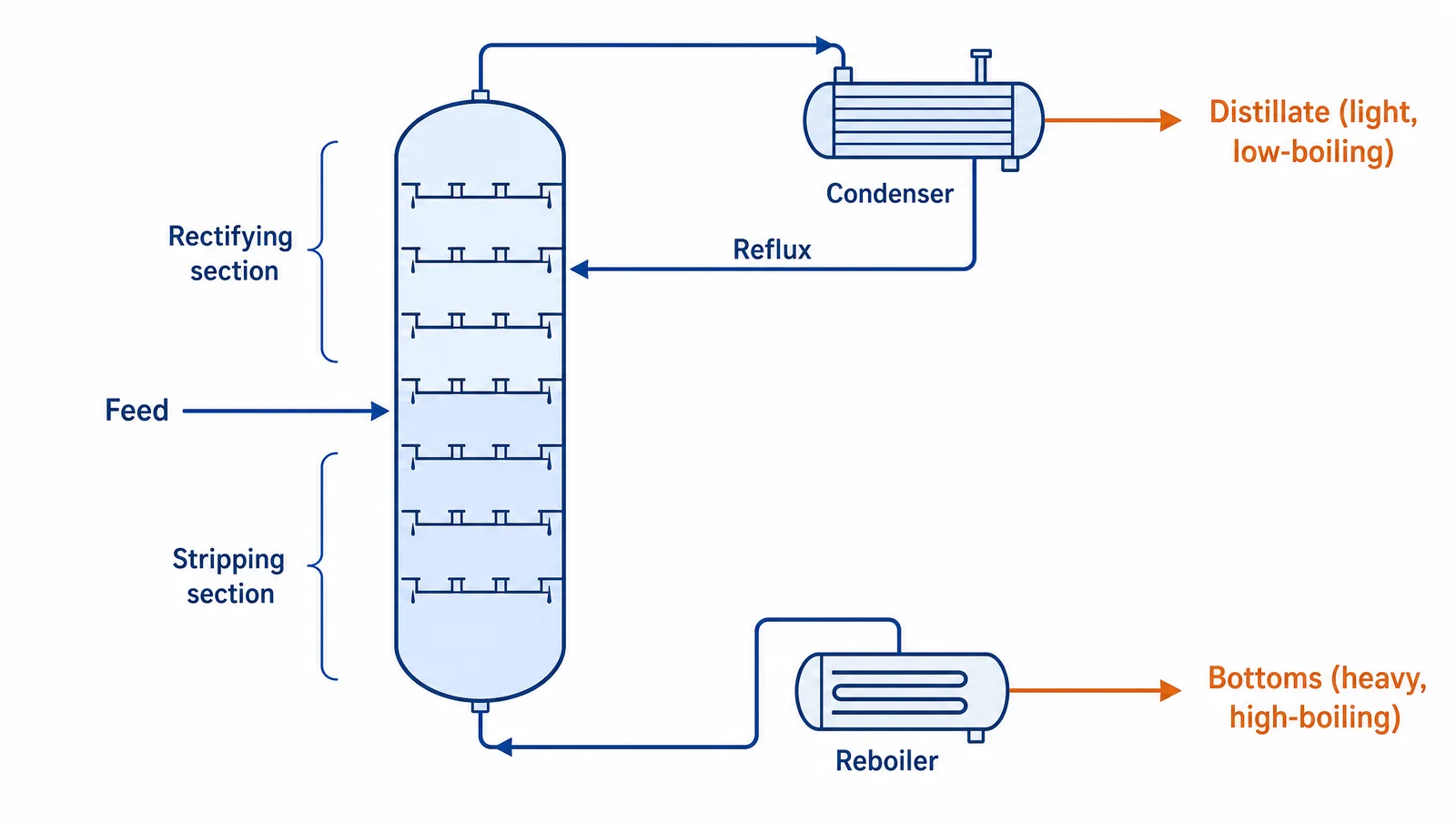
Overhead and bottoms products swapped on a distillation column — the light, low-boiling component leaves the top through the condenser as distillate; the heavy, high-boiling component leaves the bottom through the reboiler. Generic models routinely label the heavy component at the top, or draw the reboiler at the top and the condenser at the bottom. A Separations Division reviewer checks "light up, heavy down" and "condenser top, reboiler bottom" before reading anything else, so this one error discredits the whole panel.
A counter-current heat exchanger drawn co-current, or temperatures that contradict the flow — the two streams in a counter-current exchanger run in opposite directions, yet generic output often draws both arrows the same way while the label still says counter-current. Worse is a temperature annotation that breaks thermodynamics, such as a cold outlet hotter than the hot inlet, or a temperature cross shown in a co-current arrangement where it is impossible. The four terminal temperatures and the arrow directions are the highest-information marks on the figure, and readers check them one by one.
Pump and compressor symbols on the wrong phase — pumps move liquids and compressors move gases. Generic models place a compressor symbol on a liquid line, or a pump on the vapour outlet of a flash drum, and often route the vapour stream out of the bottom of the vessel and the liquid out of the top. PFD symbols are the shared grammar of the discipline; a symbol-phase mismatch reads like a swapped noun and verb, and it signals that nobody who has drawn this process actually checked the figure.
AIChE 2026 poster figure: a distillation column schematic with feed at the middle tray, condenser and reflux at the top and reboiler at the bottom (Figure generated with SciFig)
Whether your AIChE 2026 poster earns the three-minute conversation it is designed for comes down to whether these figures are accurate, clean, and legible from two to three feet — which is exactly where an editable AI figure workflow compresses days of drafting into hours without giving up engineering control.
6. Create Your AIChE 2026 Figures with AI: The SciFig Workflow
You already have two things most colleagues do not: an accepted abstract and a clear picture of your process — use both to generate your figures online for free, then edit them until every arrow and label is right. Here is the SciFig workflow for an AIChE presenter:
Path 1 — Upload your accepted abstract PDF. Drop it into PDF-to-Figure. It parses your description of the system, methods, and results and returns a starter process schematic in one click, so you begin refining from a partly-there draft rather than a blank canvas.
Path 2 — Copy a structured prompt. For a unit-operation or flowsheet figure, Text-to-Figure gives more control. Copy and adjust to your system:
Continuous distillation column schematic: feed entering at a middle
tray, rectifying section above and stripping section below the feed,
overhead vapour to a condenser splitting into reflux returning to the
top tray and a distillate product, and a reboiler at the bottom
returning vapour to the column with a bottoms product draw. Label
every stream and mark flow direction on each arrow.
Path 3 — Sketch and scan. If you sketched your flowsheet on paper or a whiteboard, photograph it and drop it into Sketch-to-Figure to get a publication-style version that keeps your original arrangement of units.
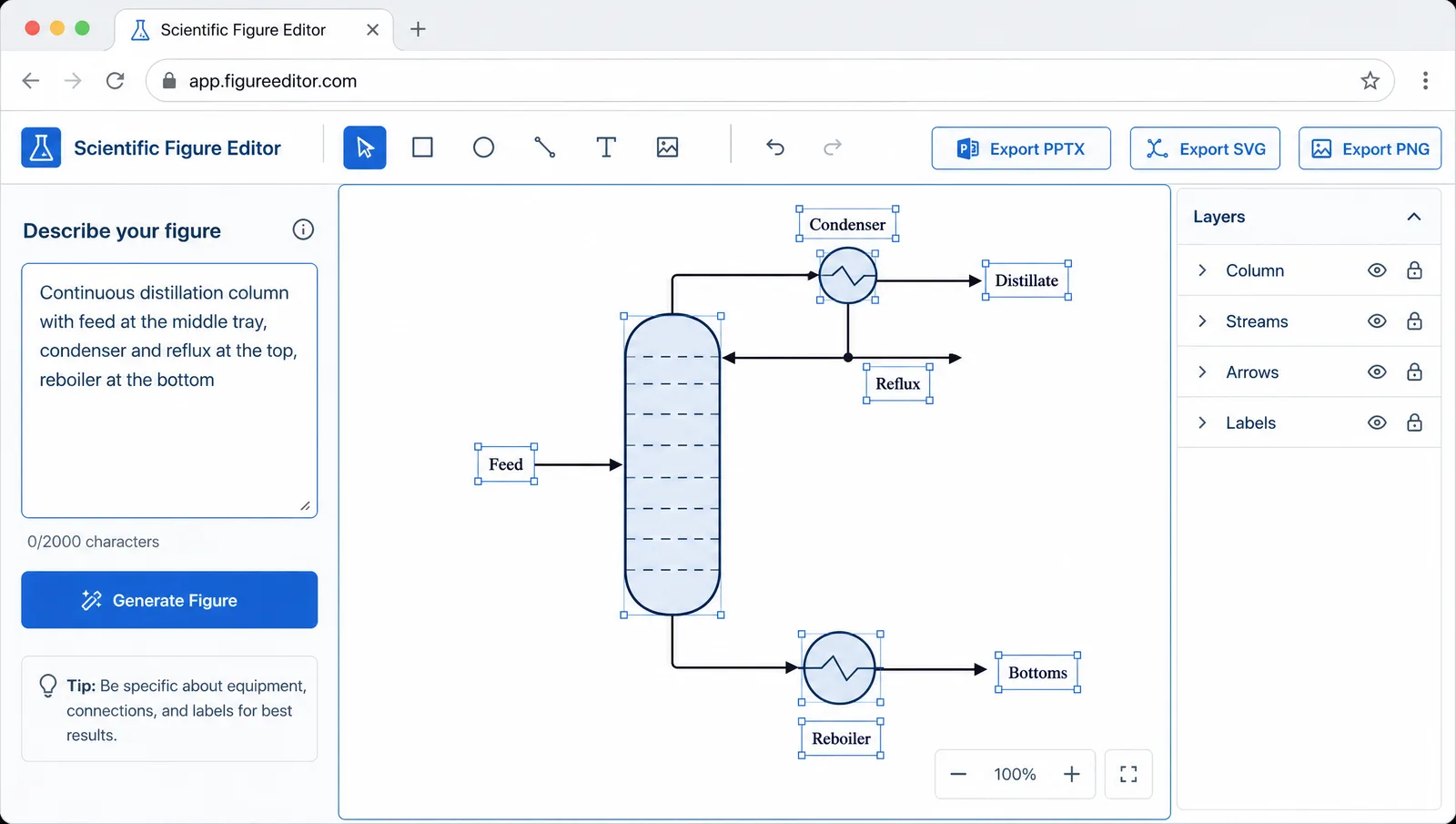
AIChE 2026 figure workflow in SciFig: a text prompt on the left generating an editable distillation column diagram on the right with PPTX and SVG export (Figure generated with SciFig)
From any path, you edit individual elements in the vector canvas — reverse an arrow, rename a stream, move a feed tray, drop the colour fills for a greyscale-safe proceedings version — and export to editable PPTX or layered SVG, at a resolution that prints cleanly at 3.75 ft square without artifacting. A new SciFig account starts with 50 starter credits plus 50 refill credits every day — 100 credits on day one, then 50 more daily. Generating a figure costs 50 credits, so most authors work through a full set of poster figures over their first few days: two on day one, then one a day. Taking a figure into the vector canvas for an editable PPTX or layered SVG export is a separate 150-credit pass that needs a paid plan or a credit pack, since daily refill credits expire the same day and do not stack up to it. For the companion guides in this conference series, see the ECS Meeting poster guide and the E-MRS Fall poster guide.
Optional — disclose your AI use. Some journals and meetings now ask authors to disclose AI assistance and to remain responsible for the accuracy of their own work. AIChE's author-facing pages for the Annual Meeting do not publish a specific AI policy, but if you build and review a figure in SciFig you can add one line to its caption — for example: Figure created by the authors using SciFig and reviewed for technical accuracy (scifig.ai).
Start your AIChE figure from a prompt, a PDF, or a sketch
Use the path that matches what you already have, then edit every stream and label until the process is exact.
7. AIChE 2026 Meet the Candidates Poster Sessions and Presentation Limits
AIChE caps how much you can present — no more than three oral presentations per person, and no more than two posters on any given day or three posters in total — and it runs a distinctive set of career-focused "Meet the Candidates" poster sessions alongside the technical program. Those limits come from the official submission instructions (AIChE 2026 Instructions and Rubric) and they are worth knowing before you agree to fill a colleague's slot.
The Meet the Candidates sessions are an AIChE signature: separate poster sessions for faculty candidates, post-doc candidates, and industry candidates, hosted by divisions and forums including PD2M, PDD, the Particle Technology Forum, the North American Mixing Forum, the Nuclear Engineering Division, and CAST. They have their own submission deadline — July 1, 2026 for the 2026 meeting — and their own content requirements: faculty candidates must include both a "Teaching Interests" and a "Research Interests" section in the abstract body, while post-doc and industry candidates include research interests, with the option to attach a CV (2026 Call for Abstracts Information). If you are on the job market, this is a recruiting event with a poster attached, and the poster is doing different work than a technical one: it has to communicate a research program, not a single result.
Two structural details about the program shape where your work lands. The Annual Meeting is organised through AIChE's divisions and forums — Catalysis and Reaction Engineering, CAST, Separations, Transport and Energy Processes, Materials Engineering and Sciences, Process Safety and the rest, plus forums such as CoMSEF, NSEF, and the Sustainable Engineering Forum — and abstract word limits are set by the individual division or forum, not centrally. Session chairs may also move your presentation to a different session if they judge it a better fit. Finally, remember that presenting is not a registration waiver: early-bird registration ends September 28, 2026, and every speaker and contributor is expected to register on a paid basis.
Tip
On a square board, the highest-leverage decision is which single figure anchors the grid. Pick the one a passerby needs to remember an hour later — usually the process flow diagram or the unit-operation schematic carrying your key result — place it where the eye lands first, and build the surrounding panels to support it rather than compete with it.
8. Where AIChE 2026 Papers and Abstracts Are Published: Annual Meeting Proceedings
Accepted AIChE 2026 work is published in the AIChE Annual Meeting Proceedings, and you control how much of your work appears there: AIChE invites every author to upload either a paper of roughly seven to eight pages or a PDF of their presentation or poster, due November 22, 2026. Uploads go through the Speaker Center in the Confex gateway, under "Upload Final Paper / Extended Abstract" (AIChE Accepted Author's Guide). The proceedings themselves live at proceedings.aiche.org, which carries proceedings from AIChE Spring and Annual meetings plus selected topical conferences from 2003 to the present, browsable by programming area.
Three points are worth knowing before you decide what to upload. First, you keep your rights: AIChE's instructions state that the author retains all rights, including copyright, and may submit the same abstract or paper to another publication — so contributing to the proceedings does not close off a journal submission. Second, your submission date can serve as the public disclosure date for patent filing, and the technical program becomes publicly viewable in the first week of July, which matters if you have IP considerations. Third, if you do write the full paper, follow AIChE's style manual: 12 pt Tahoma body text, a centered title of no more than three lines in 14 pt bold capitals, full justification, no page numbers of your own, numbered references without endnotes, and PDF files with fonts fully embedded — plus the figure rules from §4, captions below graphics and no dark or colour-dependent artwork.
Because the proceedings become the citable record of your presentation, it is worth making sure the figures you upload are the corrected versions — the ones you fixed after seeing them printed — rather than the drafts that went onto the poster.
Frequently Asked Questions
An AIChE 2026 poster board is 3.75 ft wide by 3.75 ft tall (110 cm x 110 cm), and AIChE recommends printing slightly smaller so the poster fits the board. Push pins are provided on site. See §2 Poster Size and Format for the full specification.
Neither — an AIChE poster board is square, 3.75 ft by 3.75 ft. Templates built for A0 portrait or 48 x 36 in landscape will not fit, so design a square grid around one dominant figure. See §2 Poster Size and Format.
The official presenter guidelines do not describe any e-poster, virtual poster, or upload requirement — AIChE 2026 is a printed-poster meeting. Note that no audio-visual equipment is allowed and electricity is not supplied to poster boards. See §2 Poster Size and Format.
AIChE provides an official Annual Meeting PowerPoint template, and advises 16:9 slides if you do not use it — the meeting room projectors are 16:9. Bring your own laptop, since AIChE does not supply computers in all rooms. See §3 Oral Presentation Guidelines.
Yes — image upload is optional but allowed, provided all images and tables are merged into a single image file. If you want a schematic and a plot to appear together, compose them as one panel before uploading. See §4 What Figures Do You Need.
Paper and slide submissions for the AIChE 2026 proceedings are due Sunday, November 22, 2026, uploaded through the Speaker Center. You may submit a roughly seven-to-eight-page paper or a PDF of your presentation or poster. See §8 Where Papers Are Published.
No more than three oral presentations per individual, and no more than two posters on any given day or three posters in total. Session chairs may also move a submission to a session they judge a better fit. See §7 Meet the Candidates and Presentation Limits.
Yes — all speakers and contributors are expected to register on a paid basis, and AIChE has no grant program for registration or travel costs. Early-bird registration ends September 28, 2026. See §1 At a Glance.
References
All specifications and dates above are drawn from official AIChE materials, accessed August 4, 2026:
American Institute of Chemical Engineers. Proceedings. proceedings.aiche.org. Accessed August 4, 2026. https://proceedings.aiche.org/
Disclaimer: This article is educational content about scientific figure design for AIChE posters, presentations, and proceedings papers. Dates, dimensions, and formatting rules are summarized from the official AIChE materials linked above and were accurate at the time of writing; always confirm current details on the official AIChE Annual Meeting website before printing or uploading. SciFig is a scientific figure tool for creating figures, not an official AIChE resource.
Keep going
Recommended resources
Templates, tools, and further reading for your research