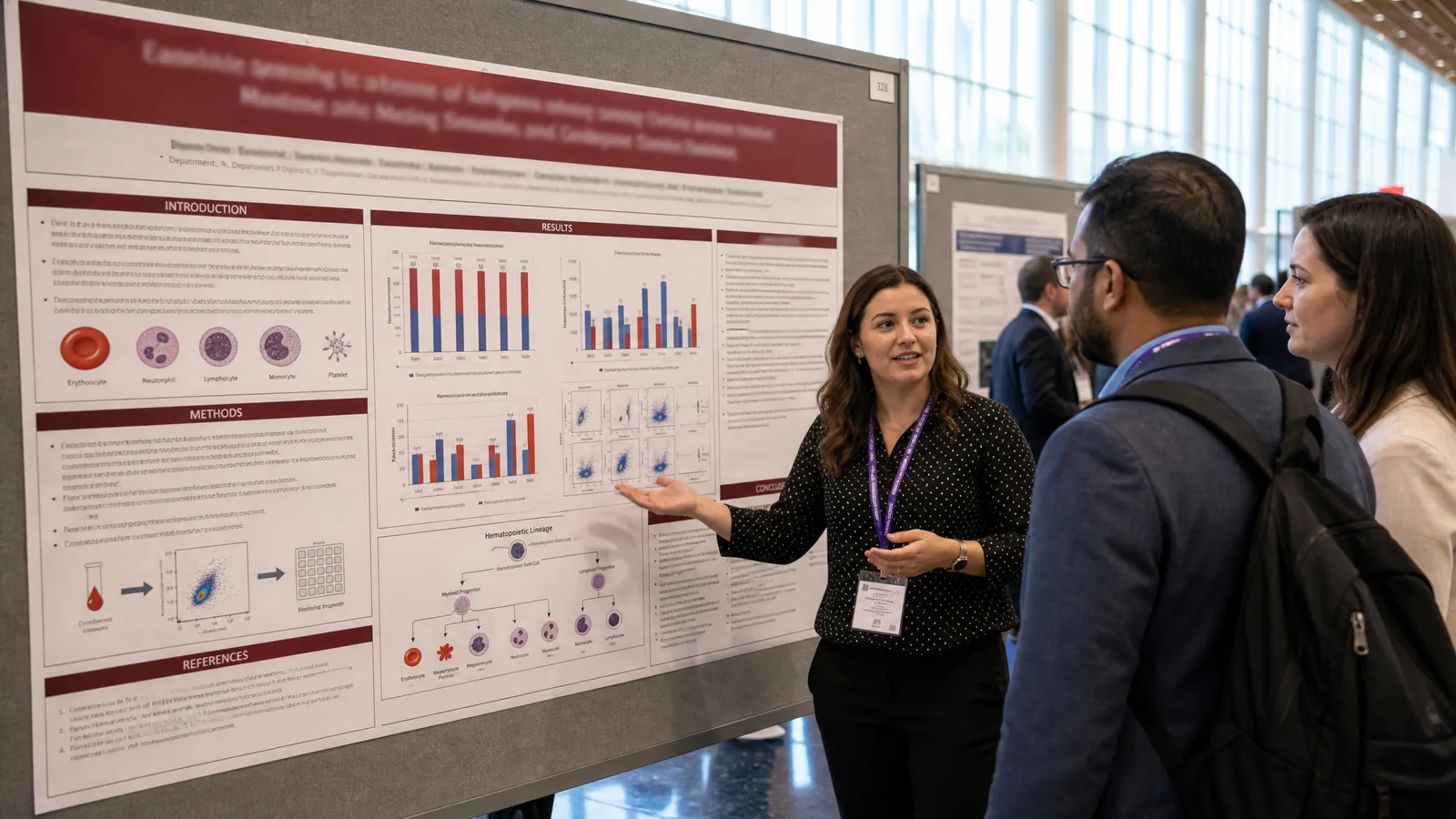
Official E-MRS Fall 2026 poster guidelines: mandatory A0 portrait size, Sept 14-17 Warsaw dates, oral time limits, and where symposium papers are published.
SciFig Team
SciFig editorial team
E-MRS Fall 2026 runs 14–17 September 2026 at Warsaw University of Technology in Warsaw, Poland.
This is a practical guide to the official poster and presentation rules for the European Materials Research Society's 2026 Fall Meeting & Exhibit: the mandatory A0 portrait poster size, and oral presentation time limits across the meeting's 25 symposia.
It also covers the Young Researcher Award and the device, crystal-structure, and band-diagram figures that make a materials-science poster worth stopping for. Every date and specification below links to official E-MRS materials.
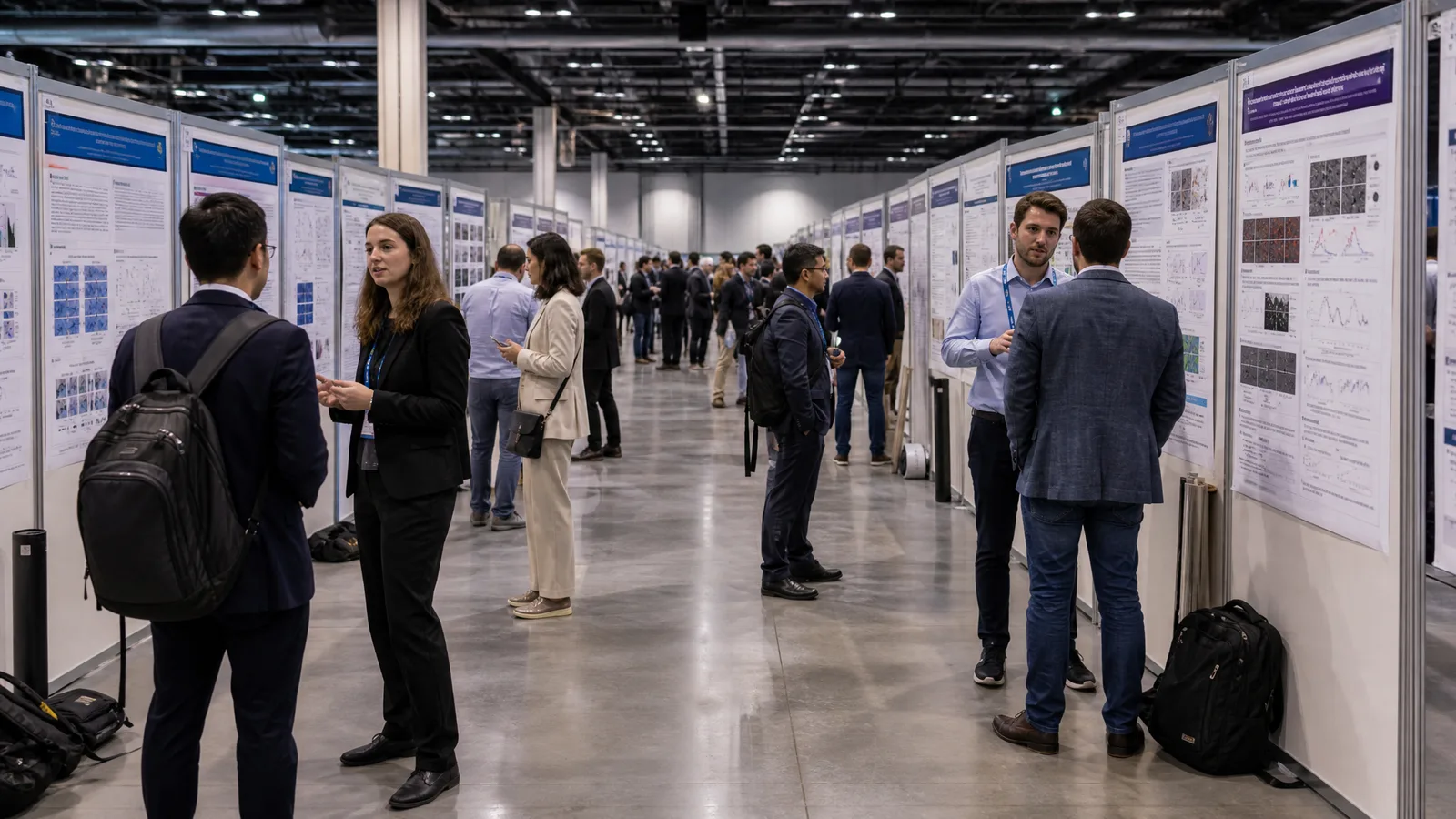
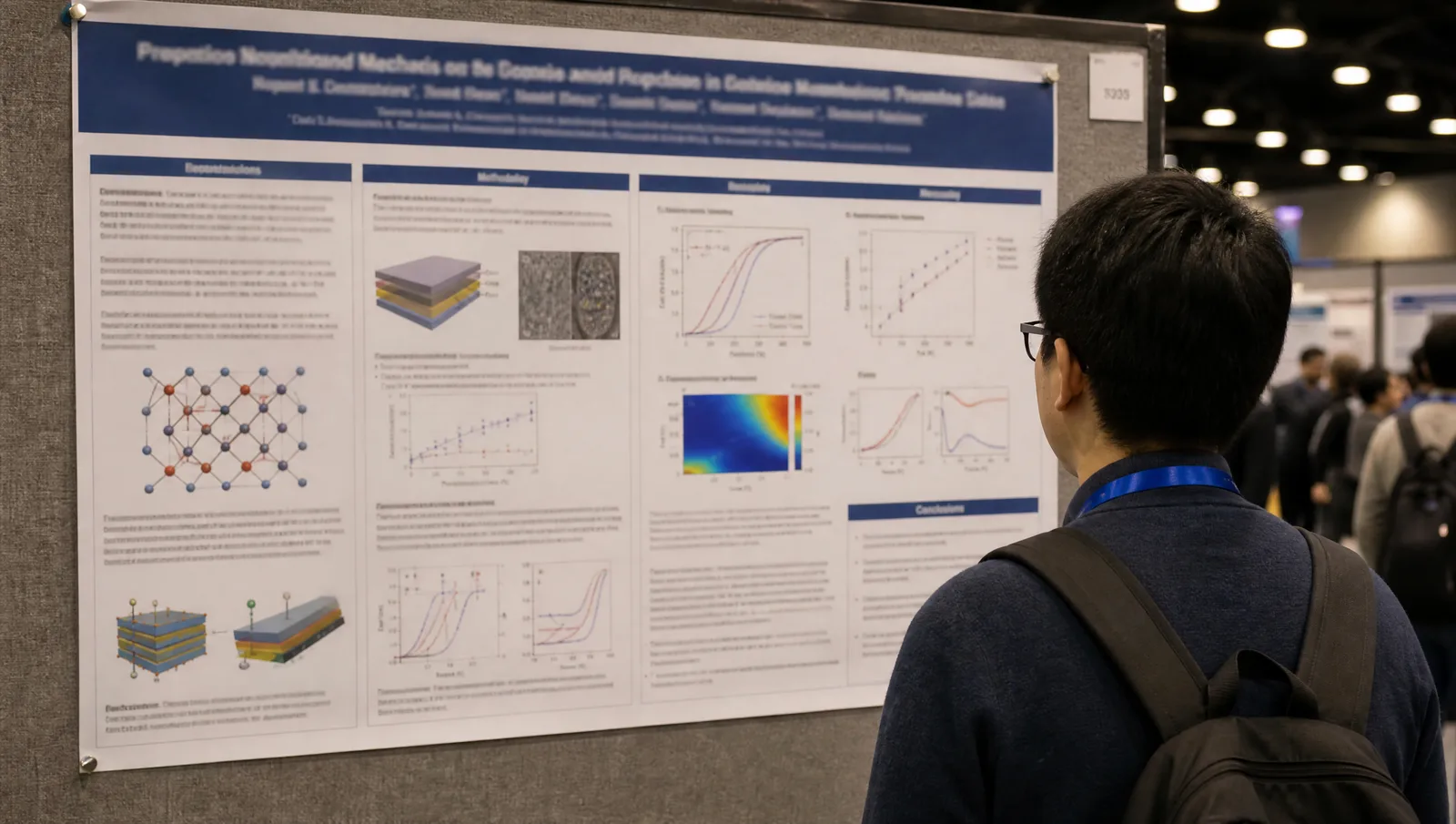
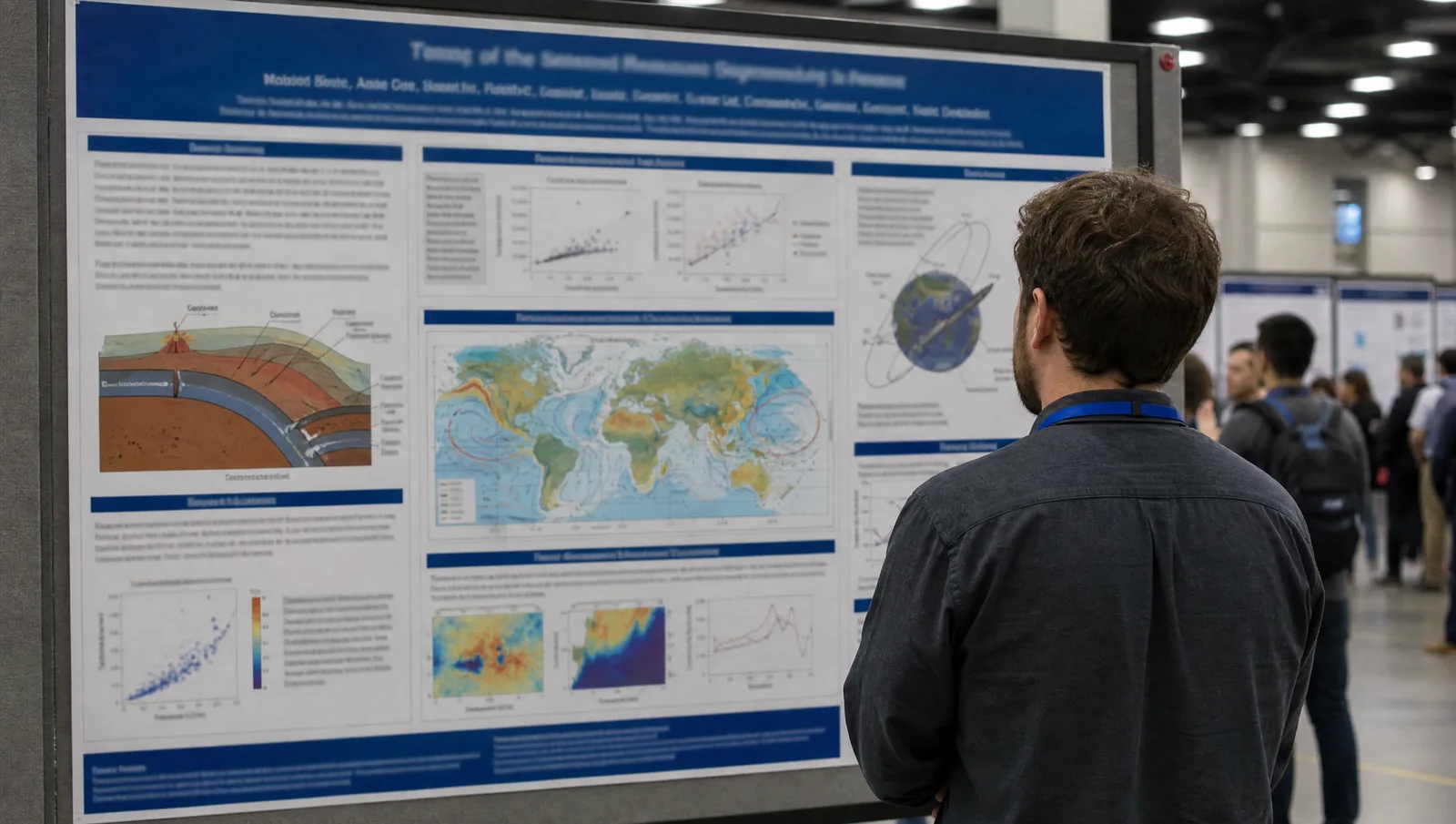
E-MRS Fall 2026 poster hall at Warsaw University of Technology: rows of A0 portrait posters along a wide aisle, researchers discussing materials science figures (Figure generated with SciFig)
Transparency note: Illustrations in this article were generated with SciFig AI and reviewed by the author for scientific accuracy. Factual claims about dates and specifications link to official E-MRS materials.
1. E-MRS Fall 2026 at a Glance: Dates, Venue, and Key Deadlines
E-MRS Fall 2026 runs 14–17 September 2026 at Warsaw University of Technology (main campus), Pl. Politechniki 1, Warsaw, Poland, and the abstract notification (already sent 15 July 2026) means most presenters are now in the poster- and slide-preparation window. The scientific programme covers 25 symposia across six clusters — Materials for Electronics, Optoelectronics and Sensing; Functional Materials; Bioinspired and Biomaterials; Nano and Smart Materials; Modelling and Characterisation; and Energy and Environmental Applications (E-MRS 2026 Fall Meeting & Exhibit).
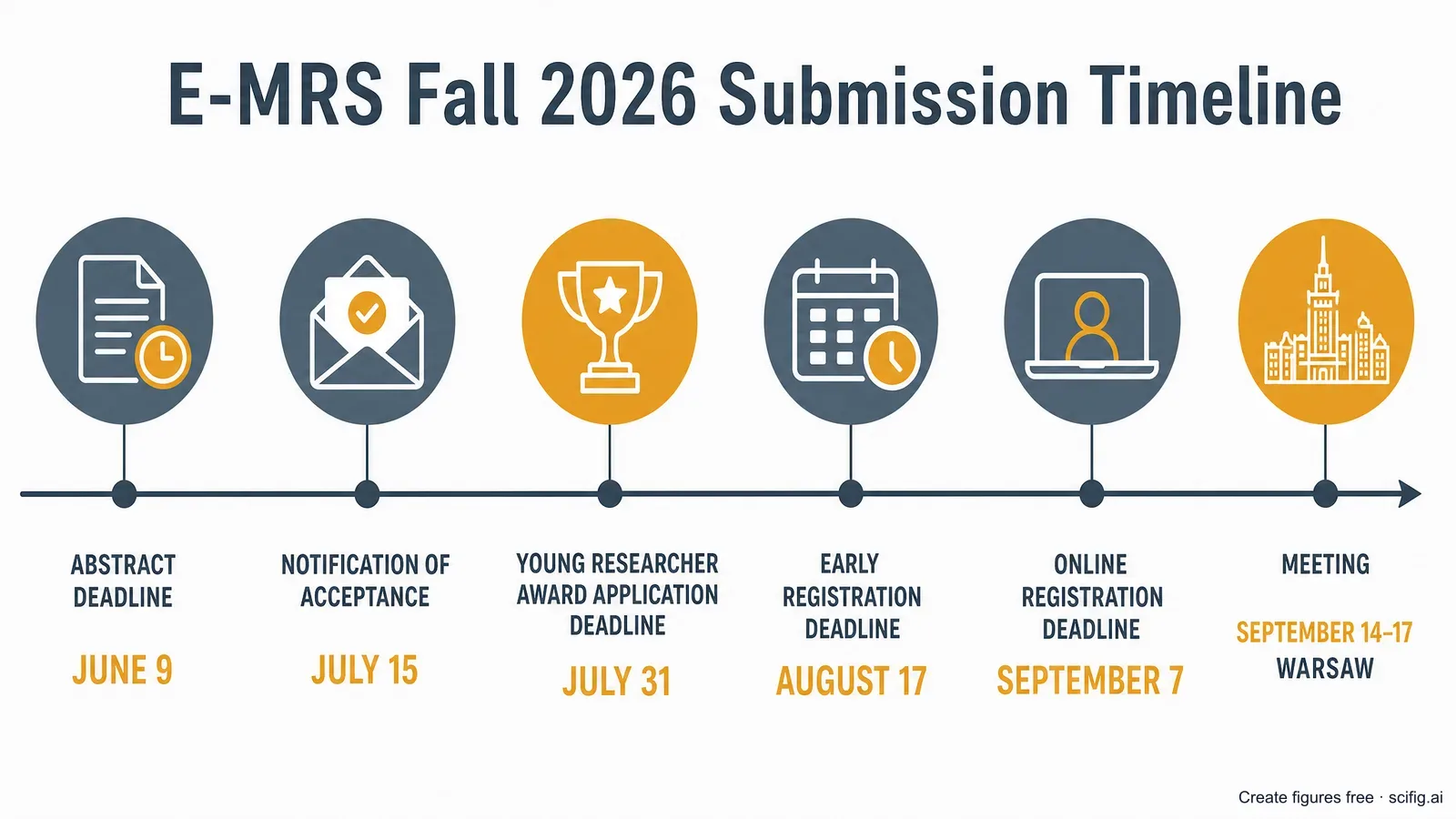
E-MRS Fall 2026 submission timeline: abstract deadline 9 June, notification 15 July, Young Researcher Award 31 July, early registration 17 August, meeting 14-17 Sept (Figure generated with SciFig)
Date
Milestone
9 June 2026 (23:59, Paris time)
Abstract submission deadline (extended)
15 July 2026
Notification of acceptance and mode of presentation
31 July 2026
Young Researcher Award application deadline
17 August 2026
Early registration deadline (€570 full / €350 student)
7 September 2026 (5 p.m. CET)
Online registration closes
14–17 September 2026
E-MRS Fall Meeting & Exhibit, Warsaw University of Technology
Registration (early €570, late €680; student rates €350/€410) covers access to all symposia, all poster sessions, the exhibition and workshops, a PDF programme, lunches Monday to Thursday, coffee breaks, the Wednesday-evening social event, one year of E-MRS membership, and one proceedings volume where applicable (E-MRS 2026 Fall registration). This per-registration proceedings option is separate from any single shared conference proceedings volume — see §7 for how symposium papers are actually published.
2. E-MRS Fall 2026 Poster Size, Format, and Guidelines: Mandatory A0 Portrait
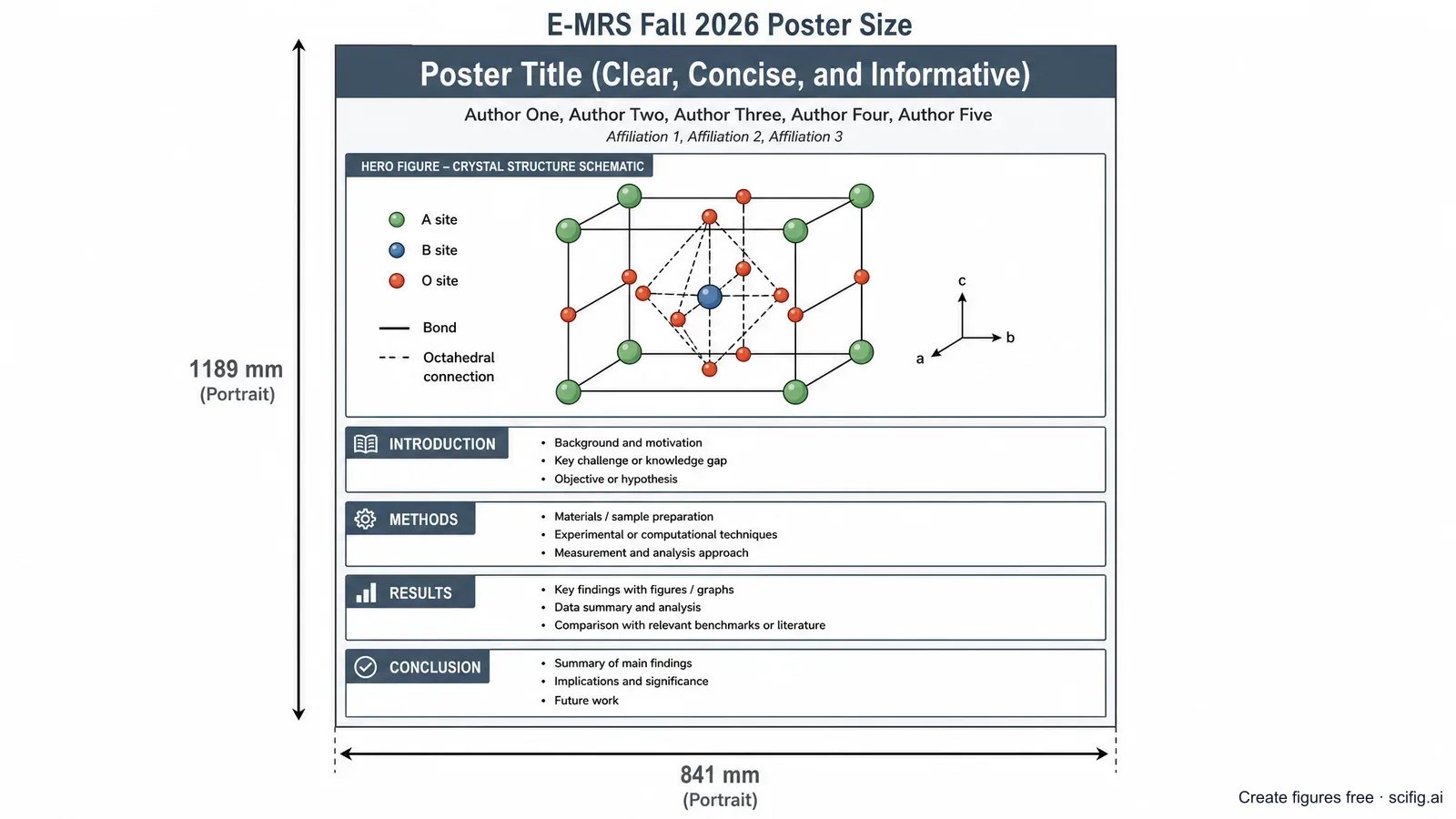
An E-MRS Fall 2026 poster must be A0 (841 × 1189 mm), vertical (portrait) orientation — this is a mandatory size, not a maximum, and there is no landscape option and no e-poster or virtual-platform alternative. Posters are displayed across four poster sessions running 14–17 September, and presenting authors must be at their poster during the assigned session for discussion with attendees; each author is responsible for removing their own poster immediately once the session ends (E-MRS 2026 Fall practical information).
A few points shape how you prepare the sheet:
A0 portrait, no exceptions — design a vertical (tall) layout from the start; there is no landscape or oversized option.
No tapes or pins needed — E-MRS supplies the hanging system, so you only need to bring the printed sheet itself.
No on-site printing office — there are print shops within walking distance of the venue, but plan and print before you travel to avoid a last-minute scramble.
Be present for your assigned session — attendees can preview posters in the morning before the formal session, so a clear visual hierarchy that reads from a few feet away matters.
E-MRS Fall 2026 poster size and template: A0 portrait layout with a title bar, author row, and a multi-panel arrangement around a device or crystal-structure hero figure (Figure generated with SciFig)
The device schematics, crystal structures, and band diagrams that fill an E-MRS poster are usually the slowest part of that layout to produce. You can generate publication-grade versions online for free and drop them straight into your composition.
Need a hero figure for your E-MRS poster?
Start from a device stack, a crystal-structure schematic, or a band diagram before you build your A0 portrait layout.
A0 portrait is a mandatory size here, not a maximum — so the canvas is fixed before you start. Our conference poster templates ship A0 portrait as its own file in editable PowerPoint, with the print type scale already applied, so nothing needs rescaling to fit the board.
3. E-MRS Fall 2026 Oral Presentation Time Limits: Plenary, Invited, and Contributed
E-MRS Fall 2026 oral slots come in three lengths, each including Q&A: plenary talks get 45 minutes, invited talks get 30 minutes, and contributed talks get 15 minutes. Which slot you were assigned is stated in your notification of acceptance (sent 15 July 2026), so check that message rather than assuming a default length. Presentations that are not delivered are not included in the final programme, so confirming your slot and building your slides around it early avoids a scramble in the final week (E-MRS 2026 Fall practical information).
A 15-minute contributed talk leaves time for only a handful of slides, which means nearly every E-MRS presentation slide needs one clear figure — a device cross-section, a crystal-structure schematic, or a band diagram — carrying the explanation rather than a paragraph of text.
E-MRS publishes no slide template, so a 15-minute contributed talk starts from an empty deck. Our scientific presentation templates are 16:9 and already ordered the way a conference talk runs: background, methods, results, discussion, conclusion.
4. What Figures Do You Need? Device, Crystal Structure, and Band Diagrams for Your E-MRS Poster
Whether you are building a poster or oral slides, E-MRS Fall 2026's materials-science audience expects the same handful of figure types — and because the abstract itself is limited to 3,000 characters of plain text with no figures, your poster and slides carry the entire visual story. The exact mix depends on your symposium (spanning energy materials, semiconductors, biomaterials and nanomaterials, among others, across six clusters), but three jobs recur across the meeting.
On your poster, the recurring materials-science figure types are:
Device or crystal structure schematic — a device stack cross-section (electrodes, transport layers, active material) or a unit-cell diagram showing the correct coordination geometry. The figure that decides whether your poster gets read.
Synthesis pathway or reaction mechanism — the processing route or growth mechanism behind your material.
Band diagram — energy-level alignment at an interface or heterojunction, drawn with the correct band-offset direction.
Characterisation schematic — the measurement geometry (XRD, synchrotron, or microscopy setup) that produced your data.
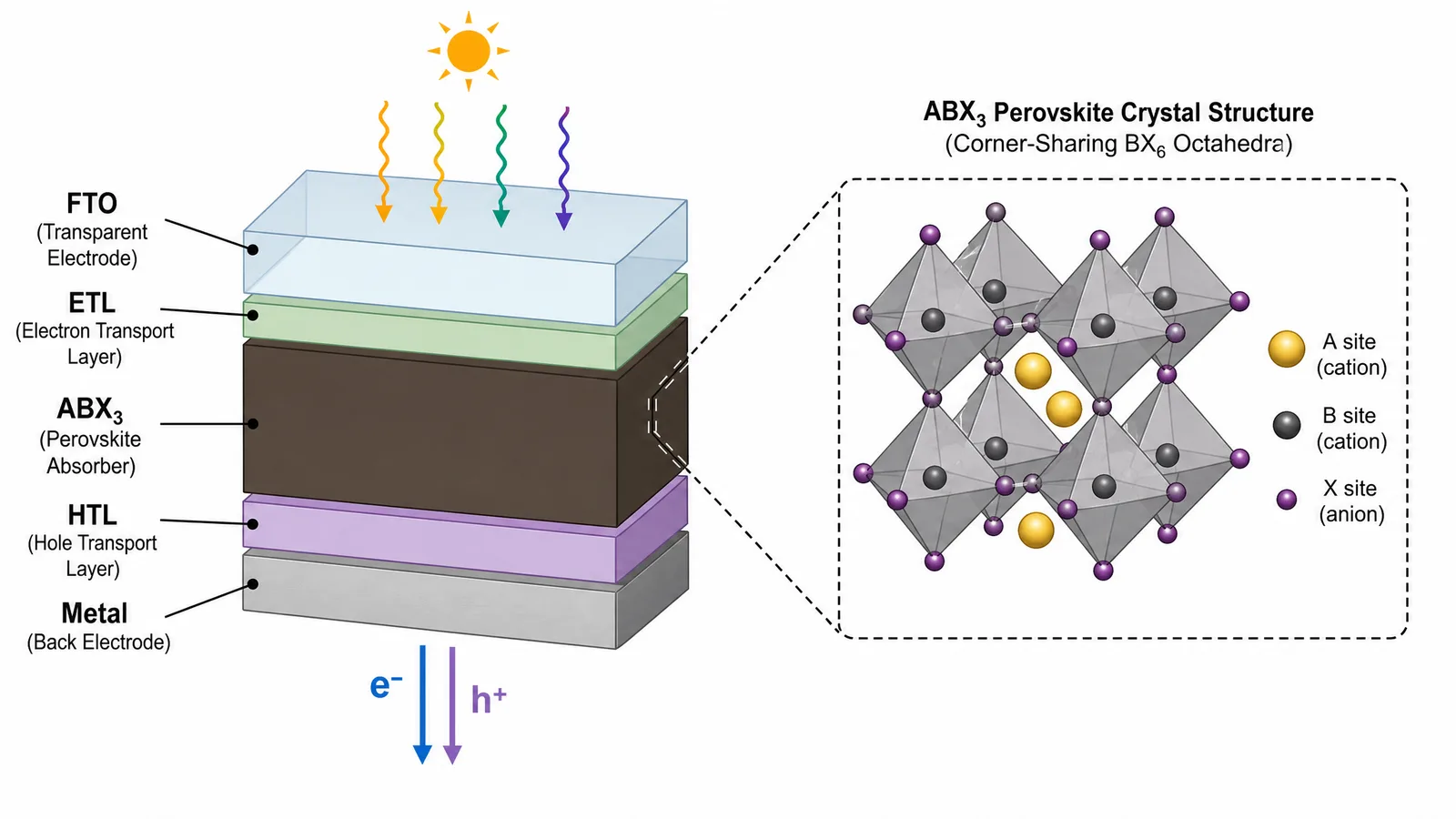
E-MRS Fall 2026 device and crystal structure figure: a perovskite solar cell layer stack with a magnified BX6 octahedral unit cell inset (Figure generated with SciFig)
On your slides, a 15-minute contributed talk needs one clean figure per slide — usually the single device, crystal, or band diagram that carries the argument. In your abstract itself, remember that E-MRS's web submission form is plain text only — no figures or formulae — so the figure work starts once your abstract is accepted, not before.
5. Designing a Winning E-MRS Poster: Accuracy That Survives Peer Scrutiny
A winning E-MRS poster passes two tests: it is grasped in a few seconds by a researcher walking the poster hall, and it is precise enough to survive scrutiny from a materials scientist standing in front of it. The best layouts build the A0 portrait sheet around one dominant "hero" figure — usually the device stack, crystal structure, or band diagram with the key result nearby — with supporting panels arranged around it. The closest thing to formal poster recognition at E-MRS is the Young Researcher Award — a €450 grant and diploma, up to two per symposium, for PhD students presenting an oral or poster (application due 31 July 2026: form, abstract copy, work description, and a supervisor's letter) — which rewards the same clarity and rigor a strong hero figure signals.
The second test is where scientific figures live or die — and where general-purpose AI image generators fall short. A tool like Nano Banana Pro or GPT Image can produce something that looks about 99% right, but on a materials-science figure 99% right is effectively 0% right: a wrong coordination number, a reversed band offset, or a swapped device layer turns a compelling poster into one that misleads a reviewer. And a flat, raster AI image gives you no way to fix that last one percent.
This is the core difference with SciFig. Every figure is a fully editable SVG whose elements — atoms, layers, arrows, labels — you can modify individually, so you (the researcher who actually knows the chemistry and physics) can adjust every element until the science is exactly right. That element-level editing is what separates a publication-grade figure from a plausible-looking one. The materials-science figures that reward this care are exactly the ones a symposium audience scrutinizes:
Crystal structure coordination — an ABX₃ perovskite's B-site cation should sit inside a corner-sharing BX₆ octahedron; AI generators commonly draw a tetrahedral coordination instead, or octahedra that do not share corners, breaking the lattice topology the figure is supposed to convey.
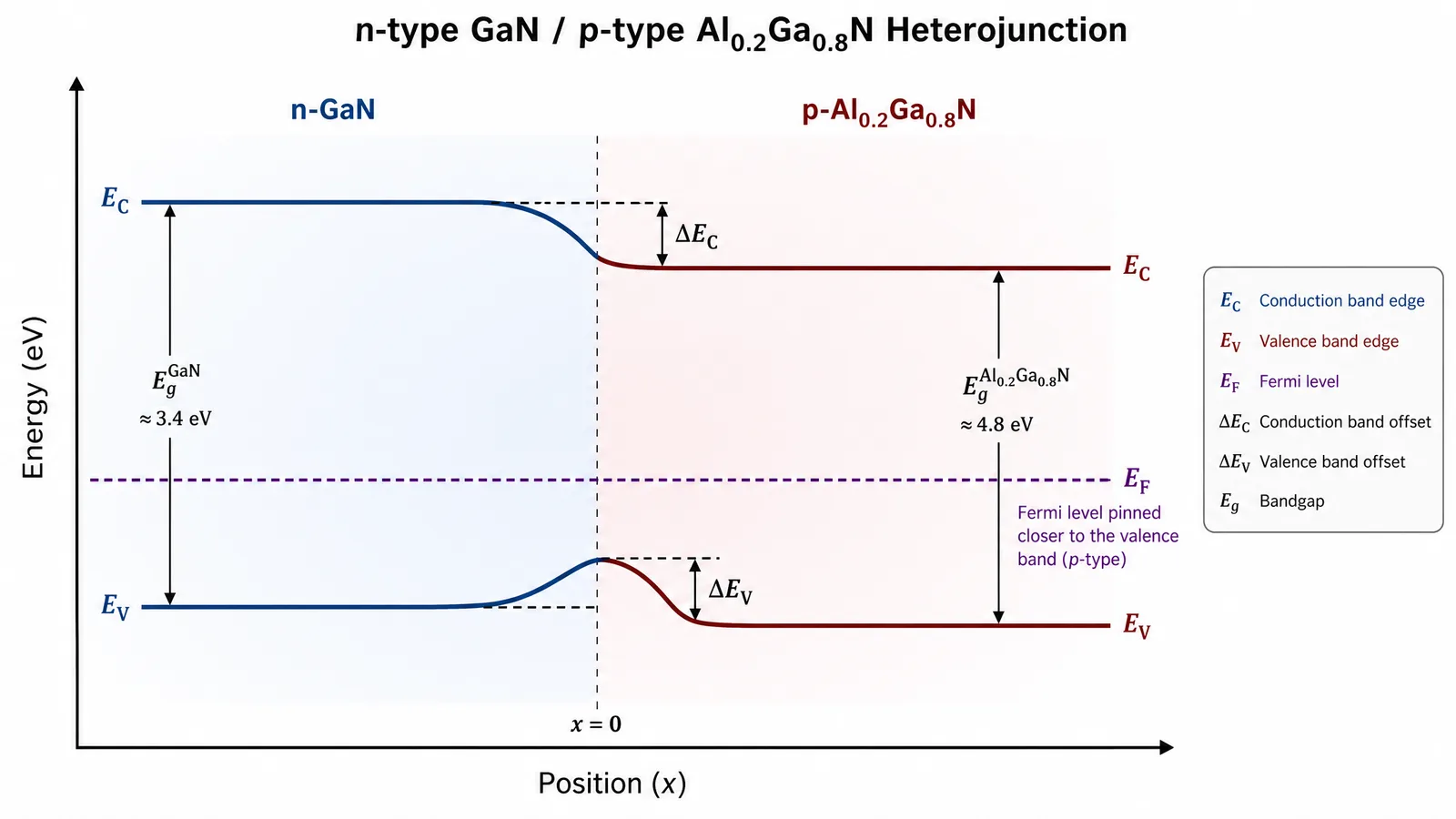
Heterojunction band alignment — a wide-bandgap semiconductor heterostructure's conduction- and valence-band offset should bend in the direction dictated by Type-I or Type-II alignment; AI generators frequently draw the band bending, or the Fermi-level pinning, in the wrong direction, which misleads any conclusion about carrier transport.
Device layer order — a perovskite solar-cell stack (transparent electrode, electron-transport layer, perovskite absorber, hole-transport layer, metal back contact) is not physically valid if the electron- and hole-transport layers are swapped, a mistake AI image generators make more often than researchers expect.
E-MRS Fall 2026 band diagram figure: a wide-bandgap semiconductor heterojunction with conduction and valence band offsets bending correctly at the interface (Figure generated with SciFig)
Whether your E-MRS Fall 2026 poster earns its attention comes down to whether these figures are accurate, clear, and legible on an A0 portrait sheet — which is exactly where an editable AI figure workflow compresses days of design work into hours without giving up scientific control.
6. Create Your E-MRS 2026 Figures with AI: The SciFig Workflow
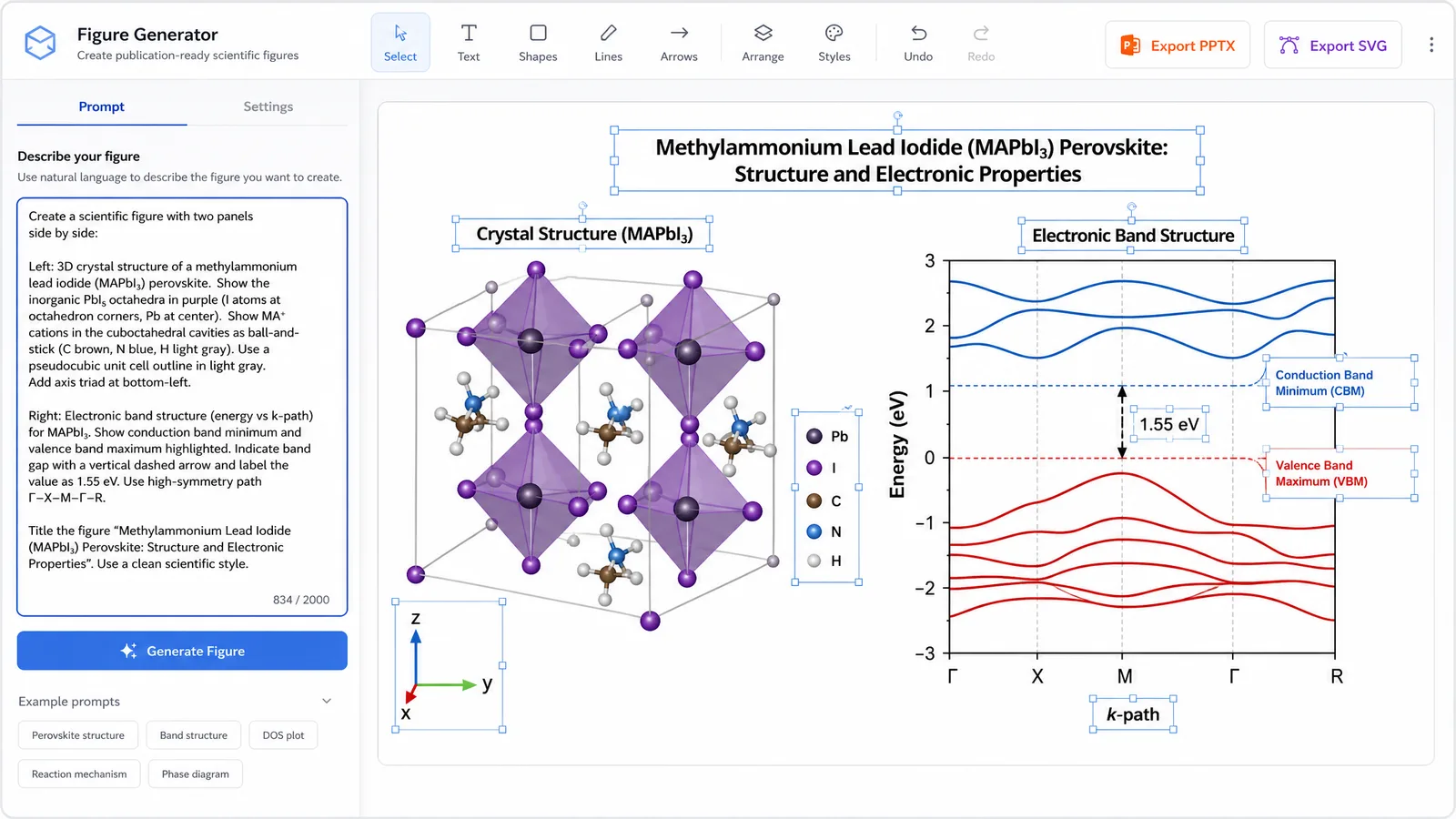
You already have two things most colleagues do not: your accepted abstract and a clear understanding of your material system — use both to generate your figures online for free, then edit them to exactly right. Here is the SciFig workflow for an E-MRS presenter, starting in SciFig AI Illustration (AI scientific illustration):
Path 1 — Copy a structured prompt. For a device stack, crystal structure, or band diagram, Text-to-Figure gives you the most control. Copy and adjust to your system:
Cross-sectional schematic of a perovskite solar cell device stack:
transparent electrode, electron transport layer, ABX3 perovskite
absorber layer with a magnified BX6 octahedral unit cell inset,
hole transport layer, and metal back contact, each layer labeled.
Path 2 — Sketch and scan. If you sketched your device stack or crystal unit cell on paper, photograph it and drop it into Sketch-to-Figure to get a publication-style version that preserves your topology and layer order.
Path 3 — Upload your manuscript draft. If you are already drafting the full paper for the journal your symposium organizers select (§7 below), PDF-to-Figure parses your Methods and Results and returns a diagram in one click — every element stays editable, so you can adjust it to your data and poster layout instead of starting from a blank canvas.
E-MRS Fall 2026 poster figure workflow in SciFig: a crystal structure prompt left, an editable SVG device stack and band diagram right, PPTX and SVG export (Figure generated with SciFig)
From any path, you edit individual elements in the vector canvas — adjust labels, layer colors, atom positions — and export to editable PPTX or layered SVG for final composition, at high resolution for an A0 print without artifacting. Start free, no card required: 150 credits on day one (3 figures), plus daily check-in credits that grow with your streak (up to 150 a day) — up to about 44 figures in your first month, so most researchers work through a full set of poster figures over their first few days. For the companion guides in this conference series, see the SfN Neuroscience 2026 poster guide and the RSNA 2026 poster guide.
Optional — disclose your AI use. E-MRS has not published a generative-AI use policy as of this writing, but many journals and conferences now ask authors to disclose AI assistance and remain responsible for accuracy. If you build and review a figure in SciFig, you can add one line to its caption — for example: Figure created by the authors using SciFig and reviewed for scientific accuracy (scifig.ai).
Start your E-MRS figure from prompt, sketch, or manuscript
Use the path that matches what you already have, then edit every element until the science is exact.
E-MRS Fall 2026 does not publish a single shared proceedings volume or abstract book — instead, presenting authors are invited to submit a full paper to a journal matched to their symposium's scope, refereed to that journal's own standards, with the specific journal decided jointly by the symposium organizers and journal editors. Instructions for authors are dispatched together with the notification of acceptance, so check that message (or ask your symposium organizers) for the exact submission process and deadline for your symposium (E-MRS 2026 Fall Meeting & Exhibit).
Because publication runs symposium-by-symposium rather than through one shared supplement, it is worth confirming your target journal early with your session organizers — and because your paper's figures become part of a citable, peer-reviewed record, it is worth making sure the device, crystal-structure, or band-diagram figure on your poster, your slides, and your eventual manuscript all tell the same materials story.
Frequently Asked Questions
An E-MRS Fall 2026 poster must be A0 (841 × 1189 mm) in vertical (portrait) orientation — this is a mandatory size, with no landscape option. E-MRS supplies the hanging system, so no tapes or pins are needed, but there is no on-site printing office, so bring your printed poster with you.
E-MRS Fall 2026 posters are portrait (vertical) only — A0, 841 × 1189 mm. There is no landscape option, so design your panels for a tall format from the outset, built around one dominant hero figure such as a device stack or crystal structure.
No — E-MRS does not operate a printing office at the venue, though print shops are within walking distance for emergencies. Plan and print your A0 portrait poster before you travel to Warsaw to avoid relying on last-minute options.
No — E-MRS web abstract submissions are limited to 3,000 characters of plain text, with no figures or formulae. All of your visual material — device schematics, crystal structures, band diagrams — goes into your poster and slides, prepared after your abstract is accepted.
The E-MRS Fall 2026 abstract submission deadline was 9 June 2026 (23:59, Paris time), with notification of acceptance and presentation mode sent 15 July 2026. If you are reading this after mid-July, your acceptance has already arrived and it is time to prepare your poster or slides.
E-MRS Fall 2026 oral slots run 45 minutes for plenary talks, 30 minutes for invited talks, and 15 minutes for contributed talks, each including Q&A. Your exact slot is stated in your notification of acceptance — presentations that are not delivered are excluded from the final programme.
E-MRS Fall 2026 has no single shared proceedings volume — presenting authors are invited to submit a full paper to a journal matched to their symposium's scope, with the specific journal chosen jointly by the symposium organizers and journal editors. Submission instructions arrive with your notification of acceptance.
References
All specifications and dates above are drawn from official European Materials Research Society (E-MRS) materials, accessed July 21, 2026:
Disclaimer: This article is educational content focused on scientific figure design for conference posters and presentations. Dates and specifications are summarized from official E-MRS materials linked above and were accurate at the time of writing; always confirm current details on the official E-MRS website before printing or submitting. SciFig is an AI scientific figure platform covering illustrations (SciFig AI Illustration), data-driven charts (SciFig DataChart), and flowcharts (SciFig FlowChart).
Keep going
Recommended resources
Templates, tools, and further reading for your research