MRS Fall 2026 poster guide: what MRS has published on board size so far, talk timing, 16:9 slides, mid-August confirmations, Nov 29-Dec 4 in Boston.
SciFig Team
Scientific Illustration Experts
MRS Fall 2026 runs November 29 – December 4, 2026 at the Hynes Convention Center in Boston, Massachusetts.
This is a practical guide to the poster and presentation rules for the Materials Research Society's 2026 Fall Meeting & Exhibit: what MRS has already published for 2026 — the abstract rules, the submission timeline, the mid-August confirmation emails, and the 68-symposium program.
It also covers the square poster board and 15-minute oral format MRS has used at its most recent Meetings, plus the device, crystal-structure and band-diagram figures that decide whether a materials poster gets read. Every date and specification below links to official MRS materials.
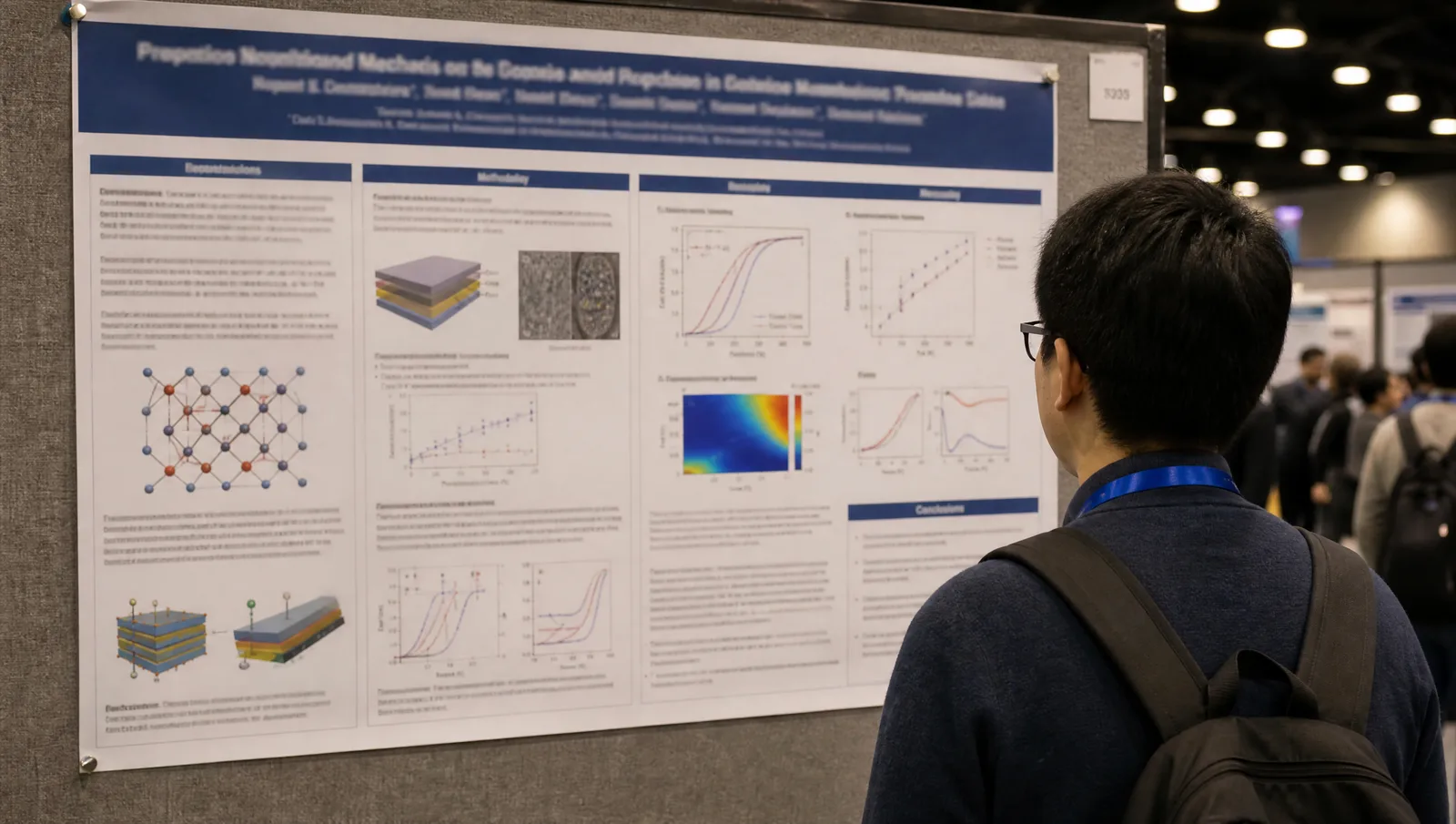
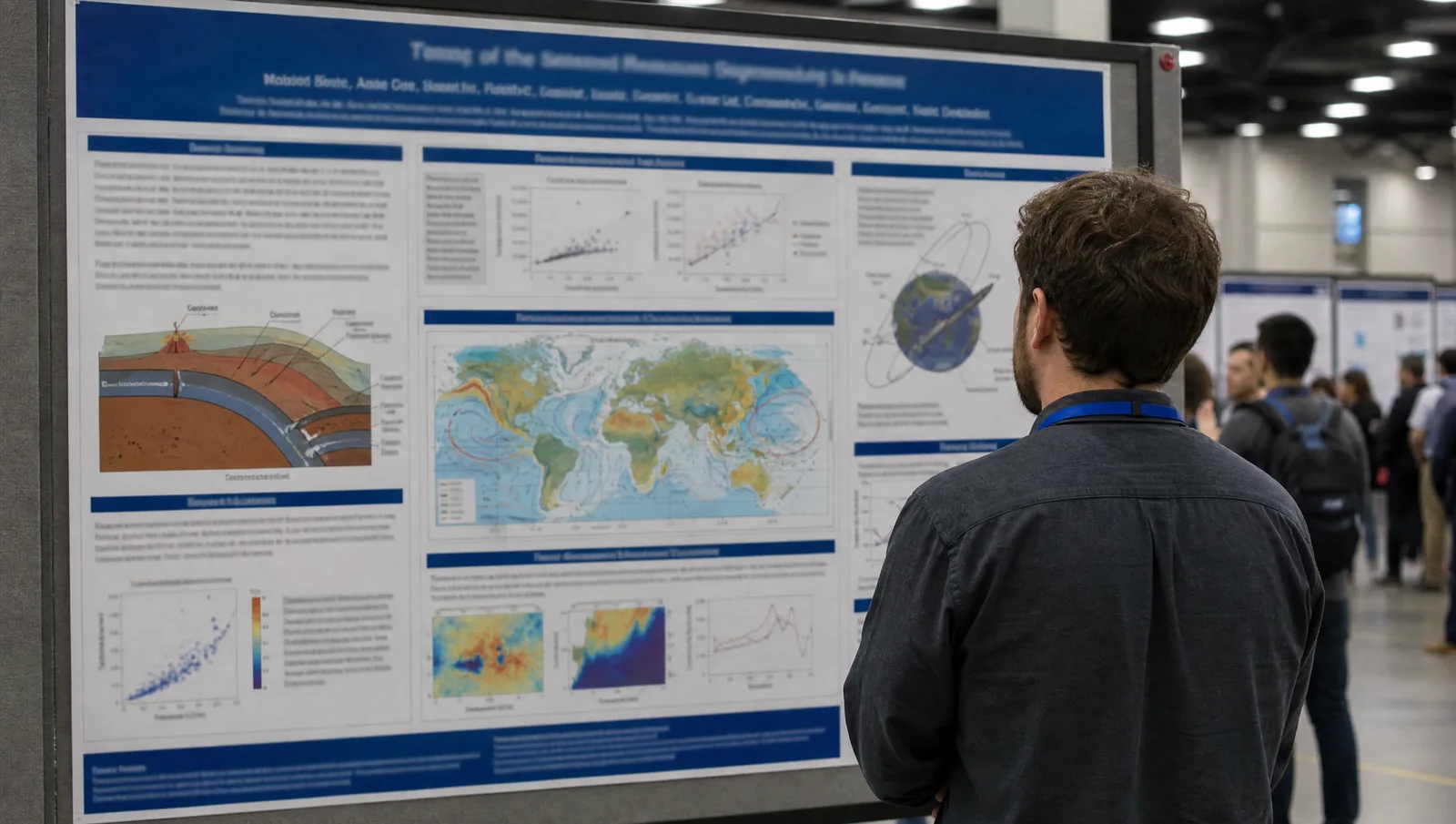
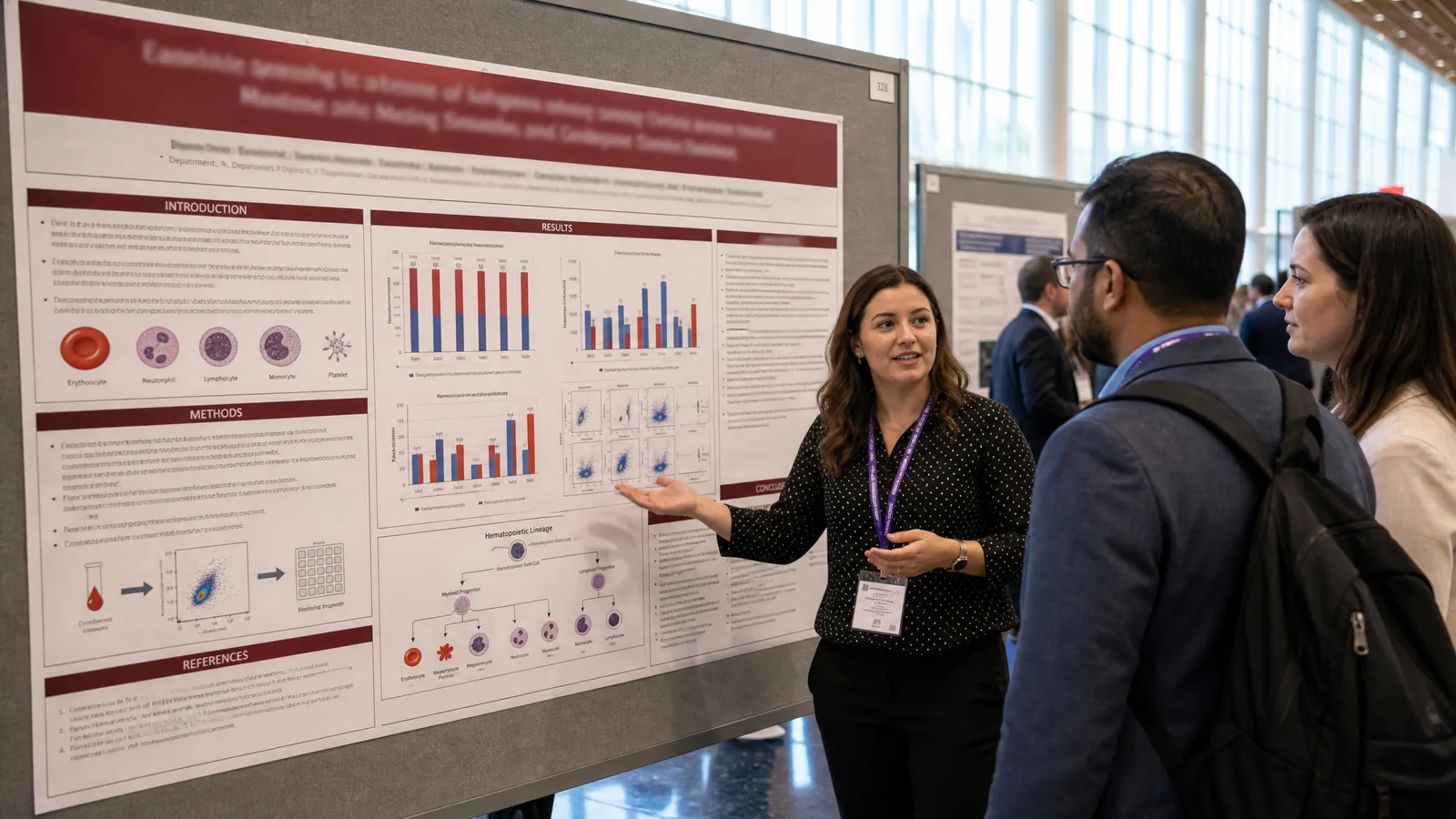
MRS Fall 2026 poster hall: an attendee reading a square conference poster with a title bar, author row and multi-panel layout on a fabric board (Figure generated with SciFig)
Transparency note: Illustrations in this article were generated with SciFig AI and reviewed by the author for scientific accuracy. Factual claims about dates and specifications link to official MRS materials.
1. MRS Fall 2026 at a Glance: Dates, Venue and the Mid-August Confirmation Email
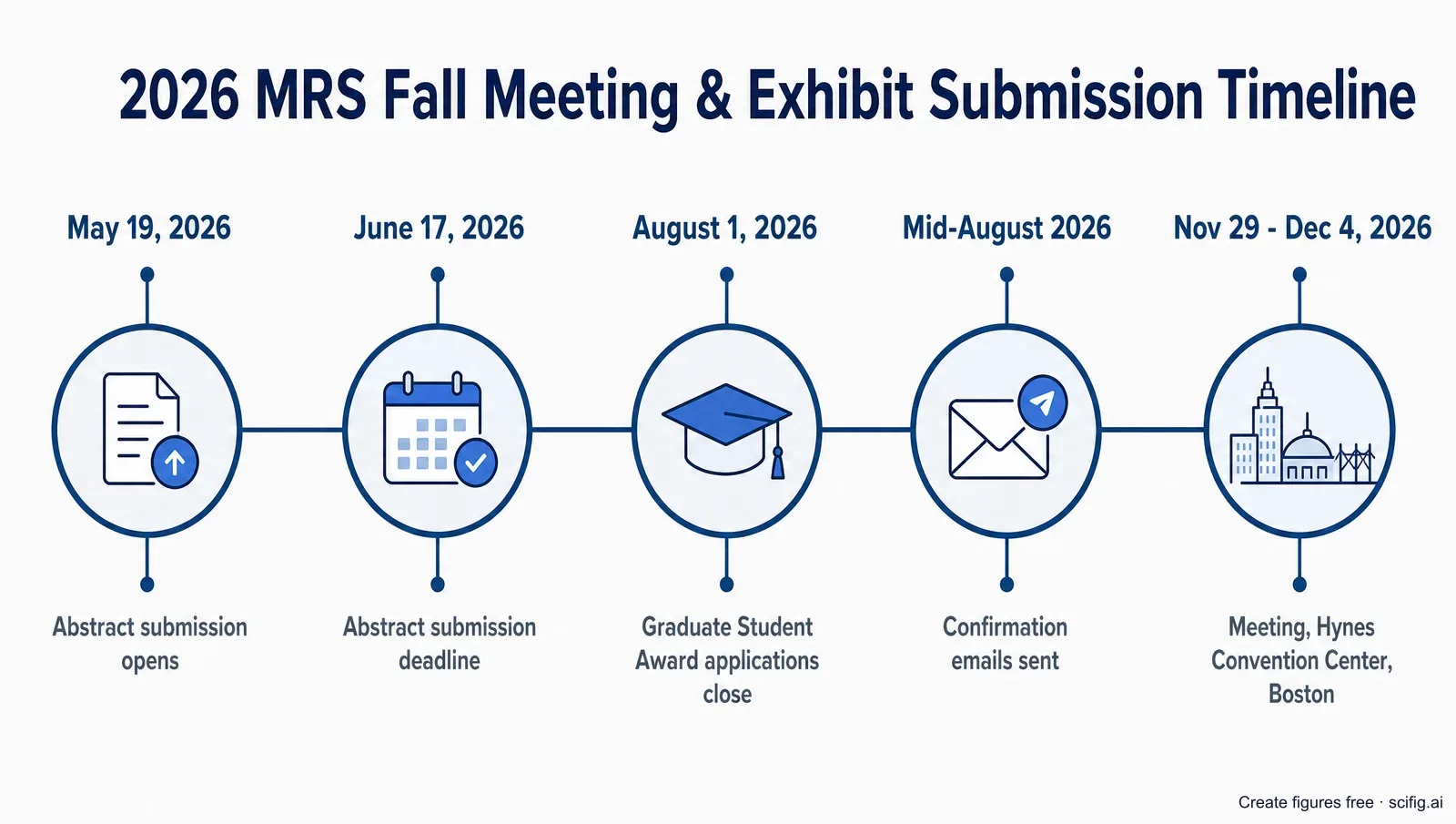
The 2026 MRS Fall Meeting & Exhibit runs November 29 – December 4, 2026 at the Hynes Convention Center and the adjacent Sheraton Boston Hotel in Boston, Massachusetts, and if you submitted an abstract, your confirmation email arrives in mid-August 2026. Abstract submission opened May 19, 2026 at 8:00 am ET and closed June 17, 2026 at 11:59 pm ET; MRS states that confirmation emails are sent in mid-August, which is when you learn whether your abstract was scheduled as an oral or a poster presentation (2026 MRS Fall Meeting & Exhibit and Call for Abstracts).
MRS Fall 2026 submission timeline: abstracts open May 19 and close June 17, confirmations mid-August, meeting Nov 29 to Dec 4 in Boston (Figure generated with SciFig)
Date
Milestone
May 19, 2026 (8:00 am ET)
Abstract submission opens
June 17, 2026 (11:59 pm ET)
Abstract submission deadline
August 1, 2026
Graduate Student Award applications close
Mid-August 2026
Confirmation emails sent (oral or poster assignment)
November 29 – December 4, 2026
2026 MRS Fall Meeting & Exhibit, Hynes Convention Center + Sheraton Boston Hotel, Boston
The 2026 technical program spans nine topical clusters — Broader Impact; Characterization; Electronics, Optics and Photonics; Energy and Sustainability; Materials Theory―AI for Materials Science; Nanomaterials; Quantum Materials, Interfaces and Topological Systems; Soft Materials and Biomaterials; and Structural and Functional Materials — divided into 68 symposia, listed in full in the official Searchable Call for Abstracts PDF (dated July 14, 2026 by MRS). One detail worth knowing before your confirmation lands: MRS instructs symposium organizers to move an abstract to a different symposium if they think it fits better there, and the organizers — not you — make the final call on oral versus poster (Abstract Submission Guidelines). So the safest plan is to build figures that work equally well on a printed board and on a projected slide.
2. MRS Fall 2026 Poster Size and Format: What MRS Has Published So Far
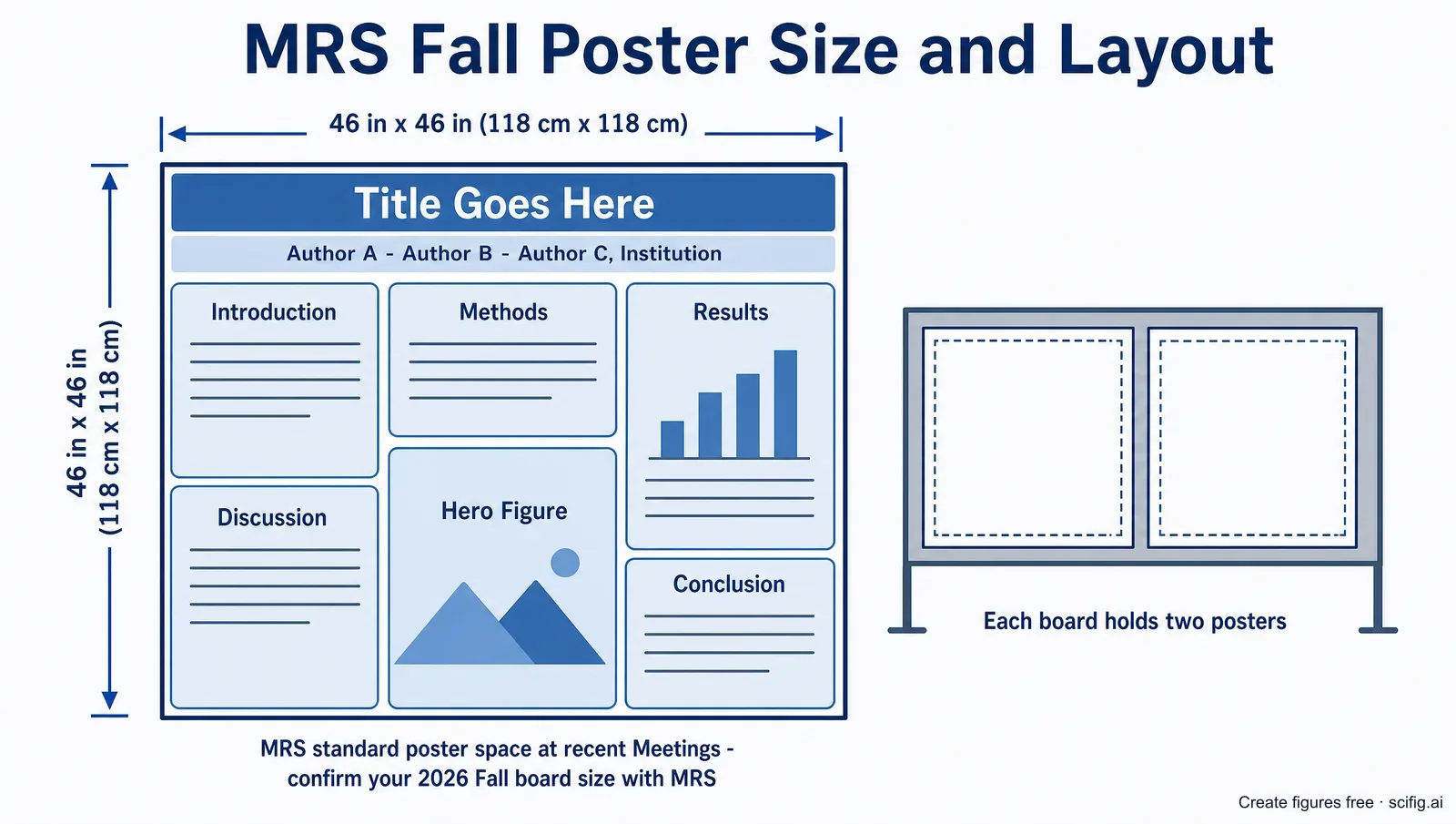
MRS had not published the 2026 Fall Meeting presenter guidelines as of August 4, 2026 — both the presenter-guidelines and poster-sessions pages for this Meeting return "Page Not Found" — so the official 2026 Fall board dimensions arrive with your mid-August confirmation email. What MRS does publish for its two most recent Meetings is a square poster space of 46 in × 46 in (118 cm × 118 cm), with two posters per board, and no requirement to use any specific poster template. That figure comes from the official presenter guidelines for the 2026 MRS Spring Meeting and the archived guidelines for the 2025 MRS Fall Meeting, which state the same dimensions. Treat it as the format to design toward, not as a confirmed 2026 Fall specification — check your confirmation email before you send anything to a printer.
The practical consequences of a square board are worth planning around now:
Design square, not wide — a 46 × 46 in space is closer to 1:1 than the landscape sheets used at many other meetings, so a two- or three-column layout with a large hero figure reads better than a wide four-column strip. This is the single biggest reason not to reuse a poster built for another conference.
You share the board — MRS states that each poster board has space for two posters, so your sheet must not overlap or obstruct your neighbour's. Print to the stated size rather than "a bit bigger to fill the space".
No specific template is required — MRS explicitly does not mandate a poster template. Searching for an "MRS poster template" will not turn up an official file, because there is not one; what MRS does ask for is the title and author list in extra-large print across the top, and material large enough to read from a distance.
Pushpins are provided — posters go up with pushpins available in the Poster Hall, and you take the poster and the pins with you at the end of your session.
Printed posters, not e-posters — the official MRS presenter guidelines describe a printed sheet on a physical board and do not describe any e-poster, virtual poster platform or file-upload step. At the 2025 Fall Meeting, presenters collected a poster ID card at the Poster Support Desk on the day of their session and needed it to enter the Poster Hall; MRS also arranged optional FedEx poster printing that year. MRS has not yet published either arrangement for 2026, so plan to print in advance and bring your poster with you.
MRS Fall 2026 poster size and template layout: a 46 x 46 inch square board with title bar, author row and a hero figure panel among the content panels (Figure generated with SciFig)
The device cross-sections, crystal structures and band diagrams that fill a materials poster are usually the slowest part of that square layout to produce well. You can generate publication-grade versions online for free and drop them straight into your composition.
Need a hero figure for your MRS Fall poster?
Start from a device stack, a crystal-structure schematic or a band diagram before you lay out the square board.
At the last two Meetings the poster space was a 46 × 46 in square, and that is a size our library ships as its own file: the conference poster templates include a square layout built as a balanced grid rather than a squeezed rectangle. Treat it as a starting canvas, not a confirmed 2026 spec — re-check the board dimensions in your mid-August confirmation email before printing.
3. MRS Fall 2026 Oral Presentation Format: Timing, Slides and Equipment
MRS has not published the 2026 Fall Meeting oral guidelines yet, but at both of its two most recent Meetings the format was the same: 15 minutes for a contributed talk and 30 minutes for an invited talk, each including laptop setup and Q&A, with 16:9 recommended as the PowerPoint screen size and no required slide template. Presenters bring their own laptop and adaptors — MRS supplies an LCD projector, screen and microphone in each room but not laptops, laser pointers or slide advancers — and there is no advance upload step. Remote presentation is prohibited, and presenters may not ask for a pre-recorded video to be played on their behalf (2026 MRS Spring presenter guidelines and 2025 MRS Fall presenter guidelines). In our analysis, the format is stable enough across MRS Meetings to plan around — but the 2026 Fall figures are the ones that count, so confirm them when your confirmation email arrives.
At the 2025 Fall Meeting MRS also ran Poster Spotlight presentations: a 5-minute talk in an oral session, chosen by the symposium organizers, highlighting a poster that will be presented later in that symposium. Whether MRS keeps Poster Spotlights for 2026 is not published yet — but if you draw one, you will be compressing a whole poster into roughly three slides, which is the strongest possible argument for building one figure that carries your result on its own.
With 15 minutes covering setup, talk and questions, an MRS contributed talk realistically leaves room for a handful of slides. That means nearly every slide needs one clear figure — a device cross-section, a unit cell, a band diagram — doing the explaining instead of a paragraph of text.
MRS recommends 16:9 but requires no slide template, so the deck is yours to build. Our scientific presentation templates are 16:9 academic decks already ordered the way a 15-minute contributed talk runs: background, methods, results, discussion, conclusion.
4. What Figures Do You Need? Device, Crystal and Band Diagrams for Your MRS Poster
Your MRS abstract could not contain a single figure — MRS limits the abstract body to 4,000 characters including spaces and states plainly that "no images, graphics or charts are accepted" — so your poster and your slides carry the entire visual story of your work. That rule appears identically in the MRS Abstract Submission Guidelines page and in both official 2026 Fall submission PDFs. With 68 symposia across nine clusters, the exact figure mix depends on your track, but a handful of types recur across almost every materials poster in the hall.
On your poster and slides, the figures that carry a materials-science story are:
Device or cell stack cross-section — the layer order of a solar cell, a transistor gate stack, or a battery cell, with each layer named and the transport direction marked. For most device papers this is the hero figure.
Crystal structure or unit cell — the coordination geometry, lattice planes and site occupancies your synthesis or characterization actually changed, with Miller indices labeled where they matter.
Band diagram or energy-level alignment — conduction and valence bands, band offsets at an interface, and the Fermi level, drawn in the direction your transport data supports.
Synthesis or processing route — the growth, deposition or sintering sequence, drawn as an ordered process schematic rather than described in a paragraph.
Characterization geometry — the measurement setup (TEM, XRD, synchrotron, scanning probe) that produced the data, which is what a specialist checks before trusting the result.
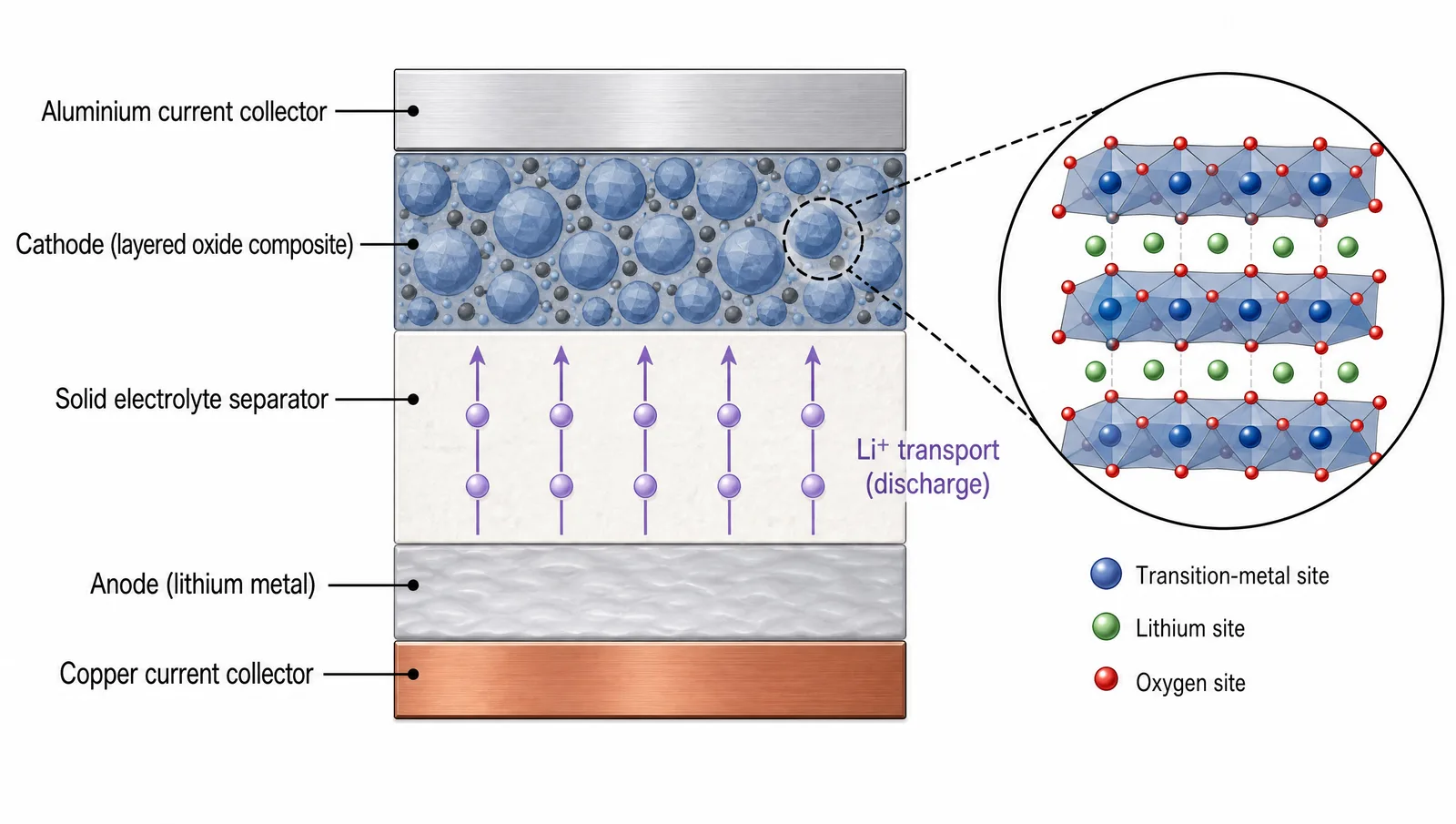
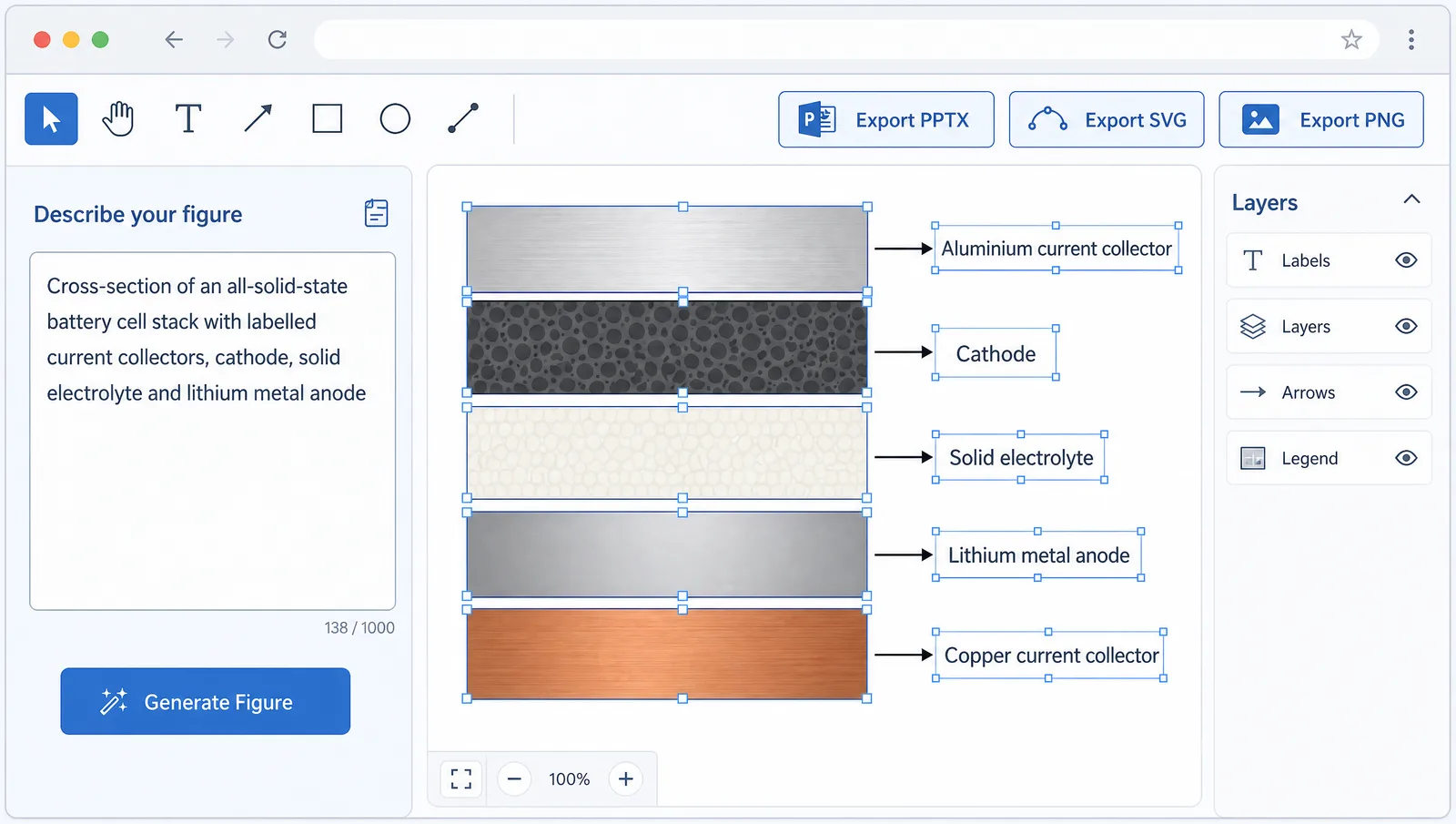
MRS Fall 2026 poster figure: an all-solid-state battery cell stack cross-section labelling the current collectors, cathode, solid electrolyte and lithium anode (Figure generated with SciFig)
Each of these has historically taken hours in general-purpose drawing software, and because the organizers decide oral versus poster, you need versions that survive both a 46-inch print — the board size MRS has used at its two most recent Meetings, pending 2026 Fall confirmation — and a projected 16:9 slide. You can generate them from a text prompt or turn a hand-drawn device sketch into a clean schematic instead, then refine and export at whichever resolution you need.
Turn your device stack or crystal structure into a diagram
Describe your material system or processing route and generate a clean figure you can refine for a square poster or a 16:9 slide.
5. Designing a Winning MRS Fall Poster: Accuracy That Survives a Materials Audience
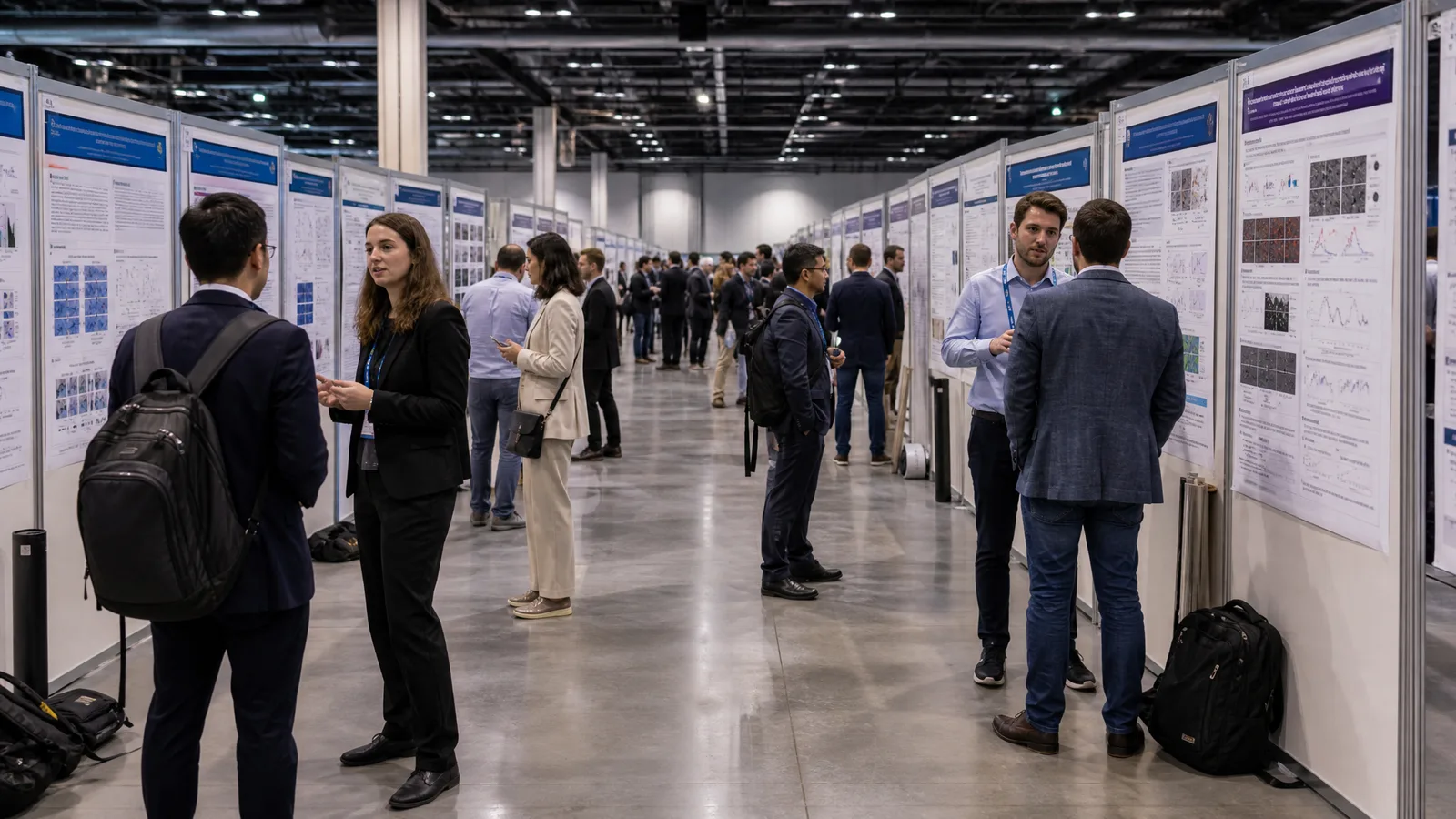
A winning MRS poster passes two tests: a researcher walking the Poster Hall grasps the result in a few seconds, and the materials science is exact enough to survive a specialist standing in front of the board asking about it. The first test is layout — a square 46-inch sheet (the size MRS has used at its two most recent Meetings, not yet confirmed for 2026 Fall) built around one dominant hero figure, with supporting panels arranged around it, beats a dense grid of small panels every time. There is a concrete reason to care beyond pride: MRS recognises posters at the Meeting, and at the 2025 Fall Meeting a poster had to be displayed with its poster ID card before 4:00 pm on the day of its session to be considered for the MRS Best Poster Award. Graduate students had a second route as well — the MRS Fall Graduate Student Awards, whose 2026 applications ran June 1 to August 1, 2026, ask finalists to present the research behind their accepted Meeting abstract, with Gold ($400) and Silver ($200) awards plus the $500 Arthur Nowick Graduate Student Award.
The second test is where scientific figures live or die — and where general-purpose AI image generators fall short. A tool like Nano Banana Pro or GPT Image will produce something that looks about 99% right, but on a materials figure 99% right is effectively 0% right: a Miller index that does not match the plane it labels, a reversed electrode stack, or an inverted band diagram turns a strong result into a poster that misleads the person you most wanted to convince. This is not a one-vendor problem — no general image model today, including the ones behind SciFig, reliably reaches 100% on a complex scientific figure on the first attempt. And a flat, raster output gives you no way to fix that last one percent.
That gap is the reason SciFig exists in the shape it does. Every figure comes back as a fully editable, layered SVG whose elements — atoms, layers, arrows, axis labels, index annotations — you correct individually, so the person who actually ran the experiment closes the distance to 100% and signs off on the science. Everything happens in the browser and exports straight to editable PPTX, layered SVG, or 8K PNG, which is what a 46-inch print — MRS's recent poster size, pending 2026 Fall confirmation — and a 16:9 slide both need out of the same source file. The materials figures that reward that care are exactly the ones an MRS audience scrutinises:
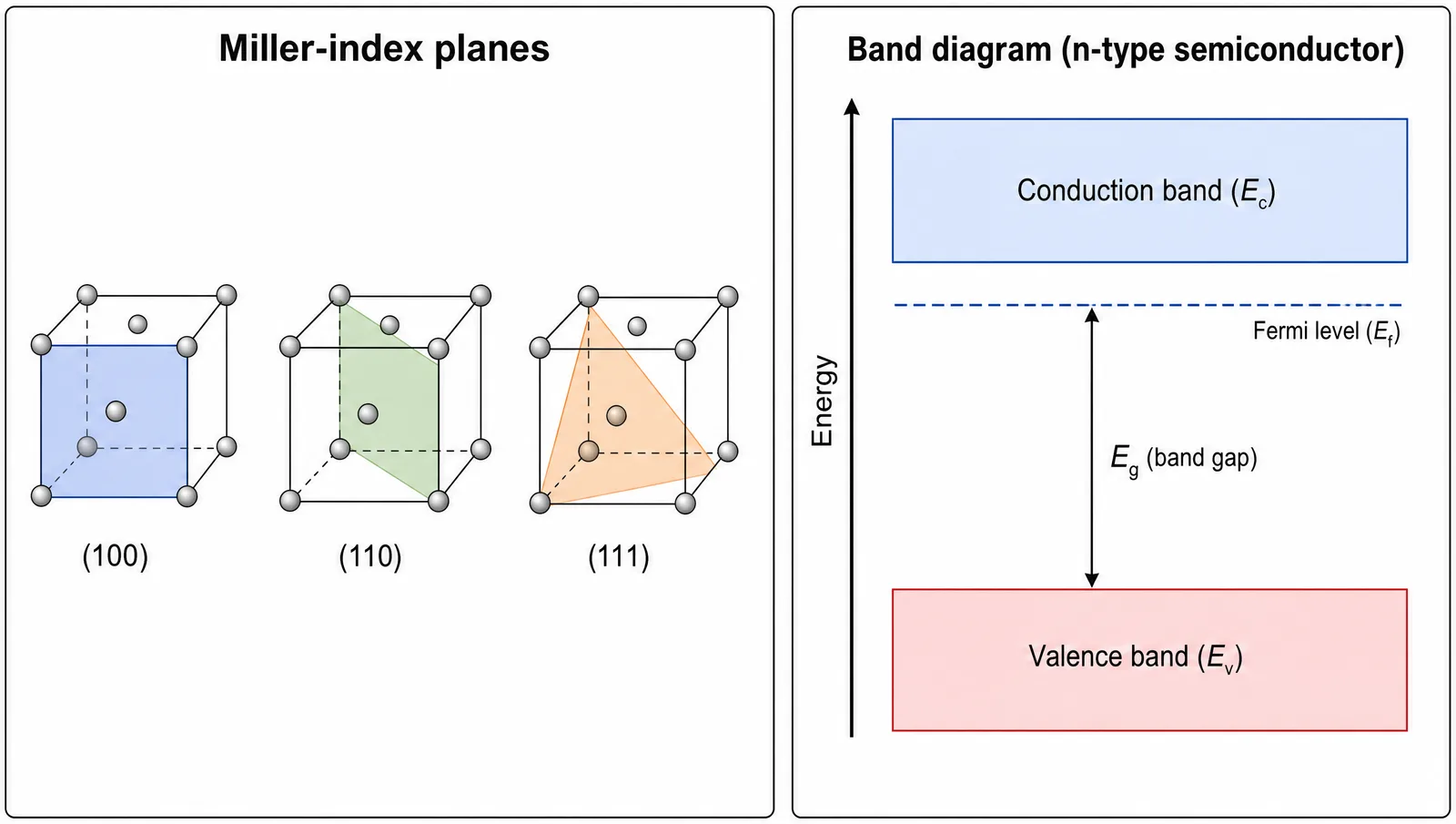
Miller indices that match the plane they label — in a cubic cell, (100) is a cube face, (110) is the diagonal plane through two opposite edges, and (111) is the triangular plane cutting three adjacent corners. Generic AI output routinely shades one plane and labels it as another, or invents an index with no corresponding geometry. It is first-week crystallography, which is precisely why a CH, SF or QT audience spots it instantly.
Electrode and layer order in a device or cell stack — in an all-solid-state lithium cell, the aluminium current collector belongs on the cathode side and the copper on the anode side, and Li⁺ moves from anode to cathode on discharge. Swap the collectors, flip the electrodes, or reverse the ion arrows and the cross-section is no longer electrochemically valid, which is the first thing an energy-materials reviewer checks.
Band diagram orientation and Fermi level placement — the conduction band sits above the valence band with the gap E_g between them, and an n-type semiconductor's Fermi level sits nearer the conduction band (p-type, nearer the valence band). Generic models frequently invert the bands or park E_F on the wrong side, which quietly reverses whatever carrier-transport conclusion the figure was drawn to support.
MRS Fall 2026 poster figure: cubic unit cells with 100, 110 and 111 Miller planes beside an n-type band diagram with conduction band, valence band and Fermi level (Figure generated with SciFig)
Whether your MRS Fall 2026 poster earns the attention it deserves comes down to whether these figures are accurate, clear and legible from several feet away — which is exactly where an editable AI figure workflow compresses days of drafting into hours without handing over scientific control.
6. Create Your MRS Fall 2026 Figures with AI: The SciFig Workflow
You already have the two things that matter most: a submitted abstract and a working understanding of your material system — use both to generate your figures online for free now, so that when the mid-August confirmation tells you whether it is a board or a podium, the figures are already done. Here is the SciFig workflow for an MRS Fall presenter:
Path 1 — Copy a structured prompt. For a device stack, unit cell or band diagram, Text-to-Figure gives the most control. Copy and adapt to your system:
Cross-sectional schematic of an all-solid-state lithium battery cell:
aluminium current collector, layered oxide cathode composite, solid
electrolyte separator, lithium metal anode, and copper current
collector, each layer labeled, with Li+ transport arrows crossing the
electrolyte from anode to cathode on discharge.
Path 2 — Sketch and scan. If you drew the stack or the unit cell on paper first, photograph it and drop it into Sketch-to-Figure to get a publication-style version that keeps your layer order and geometry.
Path 3 — Upload your manuscript draft. If you are already drafting the paper you plan to submit to MRS Advances (§7 below), PDF-to-Figure parses your Methods and Results and returns a starter diagram in one click — a much faster starting point than a blank canvas.
MRS Fall 2026 figure workflow in SciFig: a text prompt on the left generating an editable battery stack schematic on the right with PPTX and SVG export buttons (Figure generated with SciFig)
From any path, you edit individual elements in the vector canvas — labels, layer colours, atom positions, arrow directions — and export to editable PPTX or layered SVG for final composition, at a resolution that survives a 46-inch print — MRS's recent poster size, pending 2026 Fall confirmation — without artifacting. A new SciFig account starts with 50 starter credits plus 50 refill credits every day — 100 credits on day one, then 50 more daily. Generating a figure costs 50 credits, so most researchers work through a full set of poster figures over their first few days: two on day one, then one a day. Taking a figure into the vector canvas for an editable PPTX or layered SVG export is a separate 150-credit pass that needs a paid plan or a credit pack, since daily refill credits expire the same day and do not stack up to it. For the companion guides in this conference series, see the E-MRS Fall 2026 poster guide — a separate European society with its own, different rules — and the Graphene Week 2026 poster guide.
Optional — disclose your AI use. MRS has not published a generative-AI policy for Meeting posters or slides, but MRS Advances, the society's journal, states that large language models do not satisfy its authorship criteria and that LLM use should be documented in the Methods section. If you build and review a figure in SciFig, you can add one line to its caption — for example: Figure created by the authors using SciFig and reviewed for scientific accuracy (scifig.ai).
Start your MRS Fall figure from a prompt, sketch or draft
Use the path that matches what you already have, then edit every element until the materials science is exact.
7. Where MRS Fall 2026 Abstracts and Papers Are Published (MRS Advances)
MRS Fall 2026 abstracts appear in the Meeting's own program rather than in a journal supplement, and the route to a citable, peer-reviewed record is MRS Advances — the society's archival journal, published with Springer Nature, which reports "snapshots of work in progress on key materials topics identified by leading-edge MRS Meeting programming". An MRS Advances Article is deliberately short: a maximum of 2,500 words, four figures and tables combined, 30 references and a 150-word abstract; longer Snapshot Reviews run to 5,000 words and 5 to 10 figures but need the Editor-in-Chief's pre-approval (MRS Advances submission guidelines). MRS also explicitly allows submission of figures and content that already appeared as part of a Meeting presentation, so the diagram on your board can go into the paper.
The submission window is announced per Meeting, and as of this writing the MRS Advances guidelines list only the 2026 MRS Spring Meeting window — the 2026 Fall Meeting window had not been published yet, so watch that page and your confirmation email for the dates. One planning consequence follows from the four-figure limit: with so little room, the figure you build for your poster is very likely to become one of the four in your paper, which is a good reason to build it as an editable vector file rather than as a flattened image you cannot revise later.
Frequently Asked Questions
MRS had not published the 2026 Fall poster dimensions as of August 4, 2026 — that page returns "Page Not Found" and the specification arrives with your mid-August confirmation email. At its two most recent Meetings, MRS used a 46 in × 46 in (118 × 118 cm) square poster space with two posters per board. See §2 Poster Size and Format.
No — MRS states that it does not require the use of a specific poster template, so there is no official MRS template file to download. What MRS does ask for is your title and author list in extra-large print across the top and material legible from a distance. See §2 Poster Size and Format.
The official MRS presenter guidelines describe a printed poster on a physical board and do not describe any e-poster, virtual poster platform or file upload. MRS Fall is run as a printed-poster meeting with a staffed Poster Hall, so plan to print and bring your poster. See §2 Poster Size and Format.
MRS states that confirmation emails for the 2026 Fall Meeting are sent in mid-August 2026. That email is also where you learn whether the symposium organizers scheduled your abstract as an oral or a poster presentation — the choice is theirs, not yours. See §1 At a Glance.
No — MRS limits the abstract body to 4,000 characters including spaces and states that no images, graphics or charts are accepted. All of your visual material goes into the poster or the slides you prepare after your confirmation email. See §4 What Figures Do You Need?.
MRS has not published the 2026 Fall oral guidelines yet; at its two most recent Meetings a contributed talk ran 15 minutes and an invited talk 30 minutes, each including setup and Q&A, with 16:9 recommended for slides. Presenters bring their own laptop and there is no advance upload. See §3 Oral Presentation Format.
MRS Advances, the society's archival peer-reviewed journal published with Springer Nature, is the route from an MRS Meeting presentation to a citable paper. Articles are capped at 2,500 words and four figures or tables. The 2026 Fall submission window had not been published as of August 4, 2026. See §7 Where Abstracts and Papers Are Published.
References
All specifications and dates above are drawn from official Materials Research Society (MRS) materials, accessed August 4, 2026:
Disclaimer: This article is educational content about scientific figure design for MRS Fall Meeting posters and presentations. Dates and specifications are summarized from the official MRS materials linked above and were accurate at the time of writing; where MRS has not yet published a 2026 Fall specification, this is stated explicitly and the most recent published MRS figures are given for planning only — always confirm current details in your MRS confirmation email and on the official MRS website before printing or submitting. SciFig is a scientific illustration tool for creating figures, not an official MRS resource.
Keep going
Recommended resources
Templates, tools, and further reading for your research