Official Graphene Week 2026 poster guide: registration deadlines, Best Poster Award judging criteria, and 2D materials figures for your poster.
SciFig Team
SciFig editorial team
Graphene Week 2026 runs 21–25 September at the Super Bock Convention Center in Porto, Portugal.
This is a practical guide to attending Graphene Week 2026 as a poster presenter: the registration deadlines, and the Best Poster Award categories and judging criteria.
It also gives an honest breakdown of what is and is not yet officially published about poster format, plus the 2D materials figures — device schematics, growth mechanisms, band structure — that make a poster worth stopping for. Every date and specification below links to official Graphene Week materials.
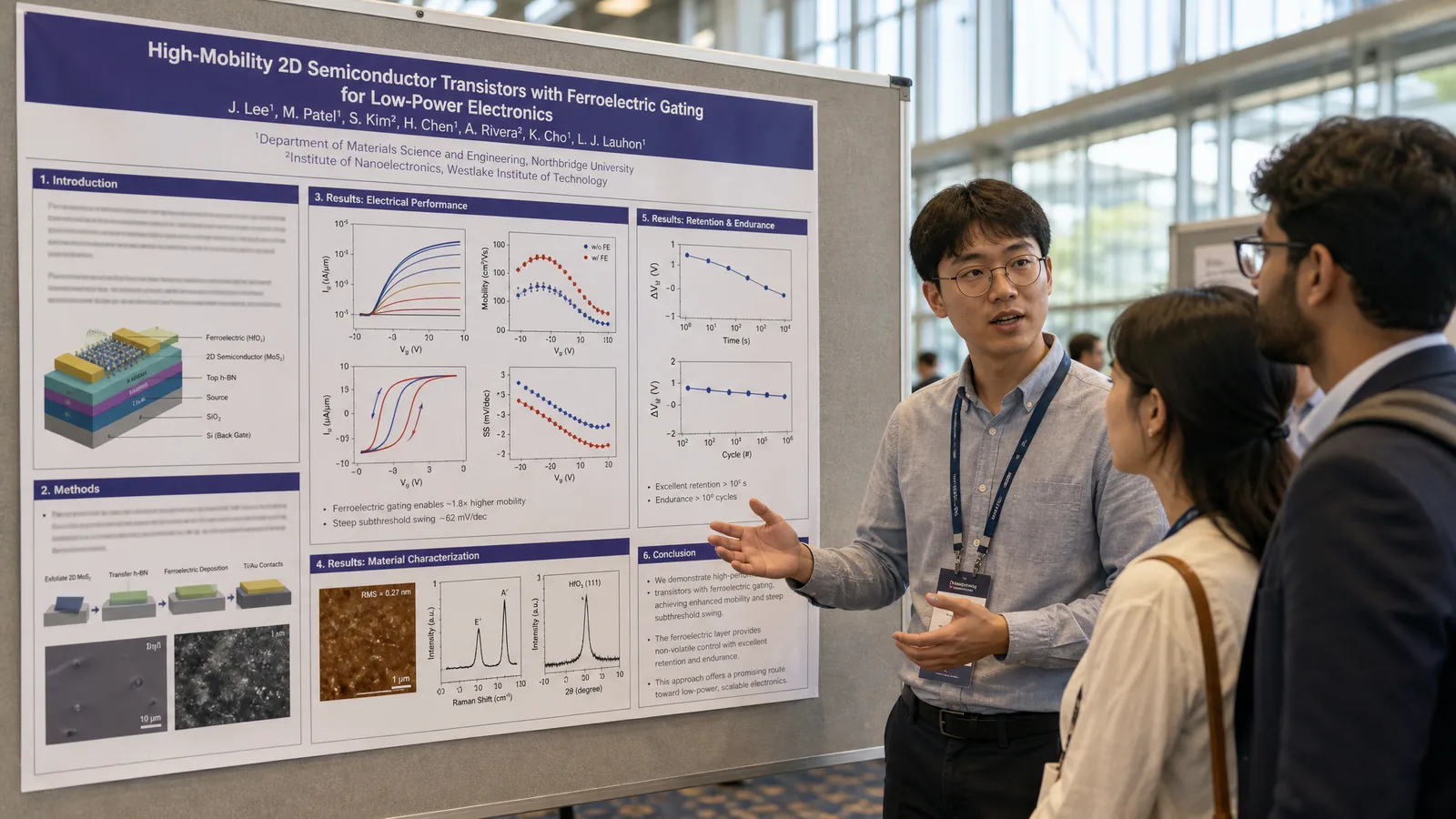
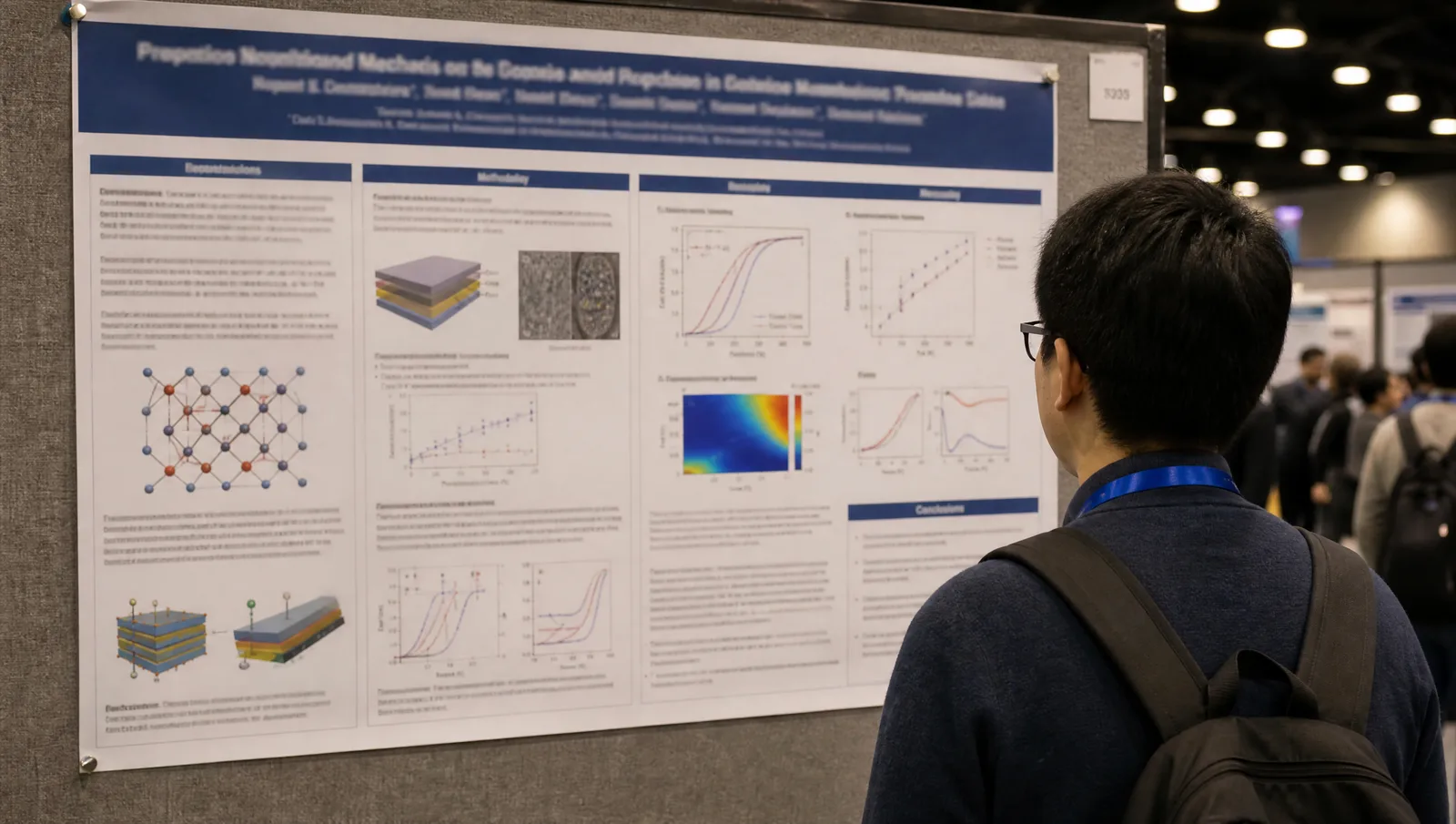
Graphene Week 2026 poster session in Porto: a presenter explaining a conference poster with a title band, author row and 2D materials device schematic panels (Figure generated with SciFig)
Transparency note: Illustrations in this article were generated with SciFig AI and reviewed by the author for scientific accuracy. Factual claims about dates and specifications link to official Graphene Week materials.
1. Graphene Week 2026 at a Glance: Dates, Venue, Registration & Poster Awards
Graphene Week 2026 — the 21st edition of the Graphene Flagship's flagship conference — runs Monday 21 to Friday 25 September 2026 at the Super Bock Convention Center in Porto, Portugal, chaired by Professor Elvira Fortunato and featuring keynote speakers including Nobel laureate Kostya Novoselov and Harvard's Philip Kim. Abstract submission has closed, and official pages do not publish an exact submission or notification date — so most accepted presenters are now in the poster- and slide-preparation window. Registration itself is straightforward to plan around: it follows three fee tiers, independent of the abstract process.
Abstract submission (opened February 2026; now closed — exact deadline and notification date not published)
30 June 2026
Early Bird registration deadline
14 August 2026
Normal registration deadline
15 September 2026
Late registration deadline
21–25 September 2026
Graphene Week 2026, Porto
Category
Early Bird
Normal
Late
Student
€425
€525
€625
Student Grant Receiver
€125
€225
—
Academic
€625
€725
€825
Industry
€725
€800
€900
Fees cover five days, exclude 23% VAT, and include session access, exhibition entry, and the welcome reception. Fifty student grants of €300 each are also available toward registration, continuing a programme that has supported over 1,000 students across past editions (Graphene Week 2026 abstract submission page). According to the Graphene Flagship's own description of the event, each edition brings researchers together across "oral and poster formats," alongside plenary and parallel sessions, an exhibition, and the Graphene Innovation Forum.
2. Graphene Week 2026 Poster Guidelines: What's Confirmed and What's Not Yet Published
Graphene Week 2026 has not published a poster board size, orientation, or printed-versus-electronic format spec on any official page as of July 21, 2026 — what is confirmed is how posters are judged: every accepted poster automatically qualifies for the Best Poster Award, assessed by the Poster Award Committee on research level, novelty of findings, poster quality, and presentation clarity, across five categories (Fundamentals, Applications, Processing, Sustainable Use, and Devices) plus a new second-place prize, for ten awarded posters in total. We checked the event page, the abstract submission page, the registration page, and the exhibitor page — none use the terms "e-poster" or "electronic poster," language that conferences running fully digital poster halls (like ASTRO or EADV) state explicitly. That absence, combined with Graphene Week's description of poster sessions as an in-person, walk-the-hall networking activity at the Super Bock Convention Center, points toward a traditional printed poster — but treat that as an informed reading of the available evidence, not an official confirmation, until Graphene Flagship publishes exact board dimensions.
What's confirmed:
All accepted posters automatically enter the Best Poster Award.
Judging criteria: research level, novelty of findings, poster quality, and presentation clarity.
Five award categories (Fundamentals, Applications, Processing, Sustainable Use, Devices) plus a second-place prize — 10 awarded posters total.
Not yet published (as of July 21, 2026):
Poster board size and orientation (portrait vs. landscape).
Whether Graphene Week provides on-site printing or presenters must arrive with a printed poster.
Abstract format rules (word/character limit, whether a figure is permitted in the abstract itself).
Check the official Graphene Week 2026 abstract submission page directly closer to the meeting, and design your hero figure at a resolution and aspect ratio that scales cleanly to whatever final board size is confirmed — a vector figure resizes without quality loss, unlike a flat raster export.
Need a hero figure while poster specs finalize?
Start your 2D materials device schematic or CVD growth mechanism now — a vector figure scales cleanly to whatever board size Graphene Week ultimately confirms.
With no board size published, the practical move is a layout you can rescale rather than rebuild. Our conference poster templates ship every common board size in editable PowerPoint, portrait and landscape, with the print type scale already applied — build the sheet now and switch files once Graphene Week publishes the spec.
3. What Figures Do You Need for a Graphene Week Poster?
Whether your Graphene Week 2026 poster covers fundamental 2D materials, electronics and photonics, manufacturing and scale-up, energy applications, biomedicine, or industrial translation, the same handful of scientific figure types recur across the meeting's six tracks — and the most time-consuming ones can be generated online for free in minutes. The exact mix depends on your subfield, but four jobs recur across nearly every Graphene Week poster:
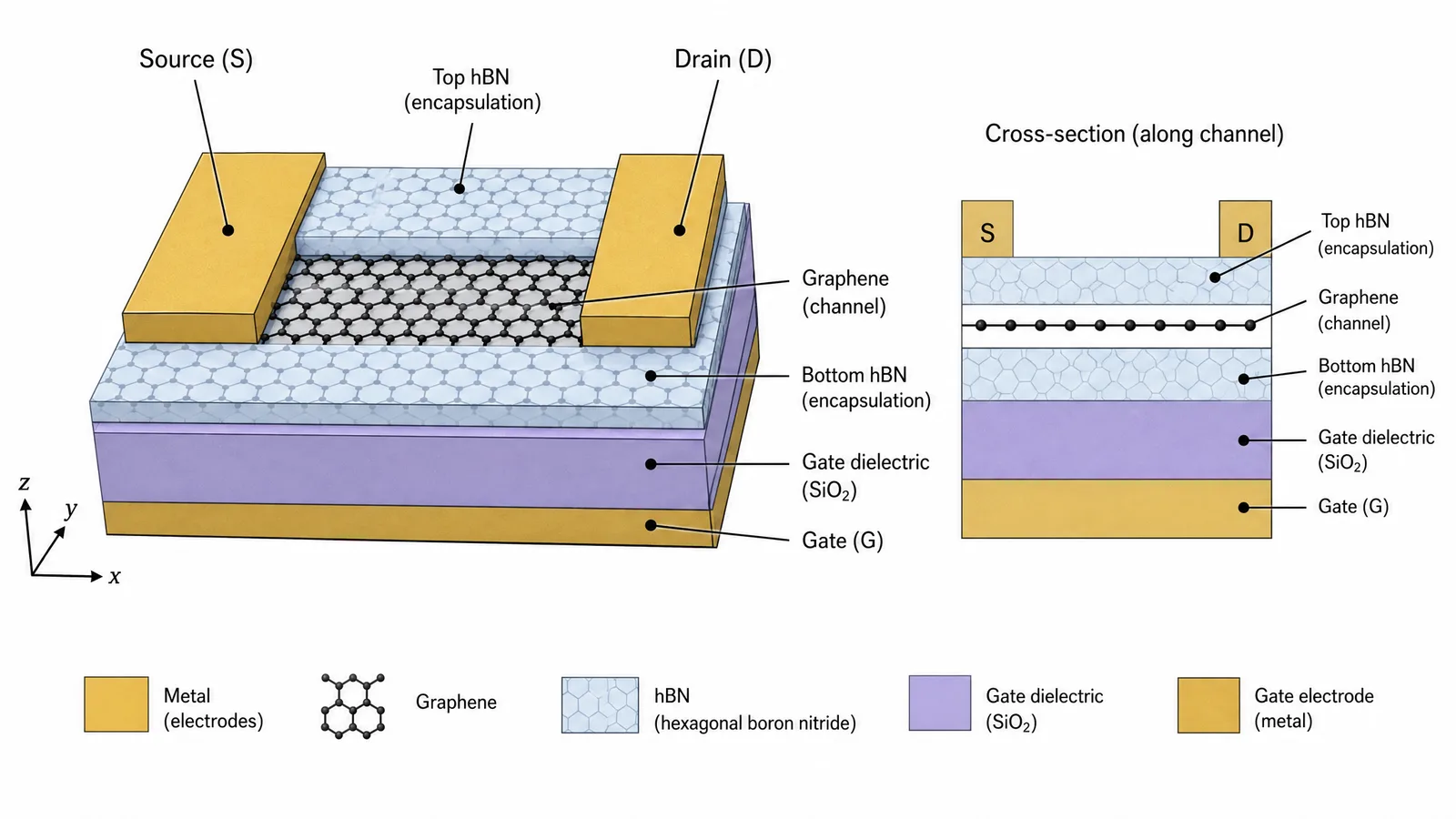
Device or heterostructure schematic — a graphene field-effect transistor (FET), a van der Waals heterostructure stack, or an hBN-encapsulated channel with labeled contacts and gate geometry.
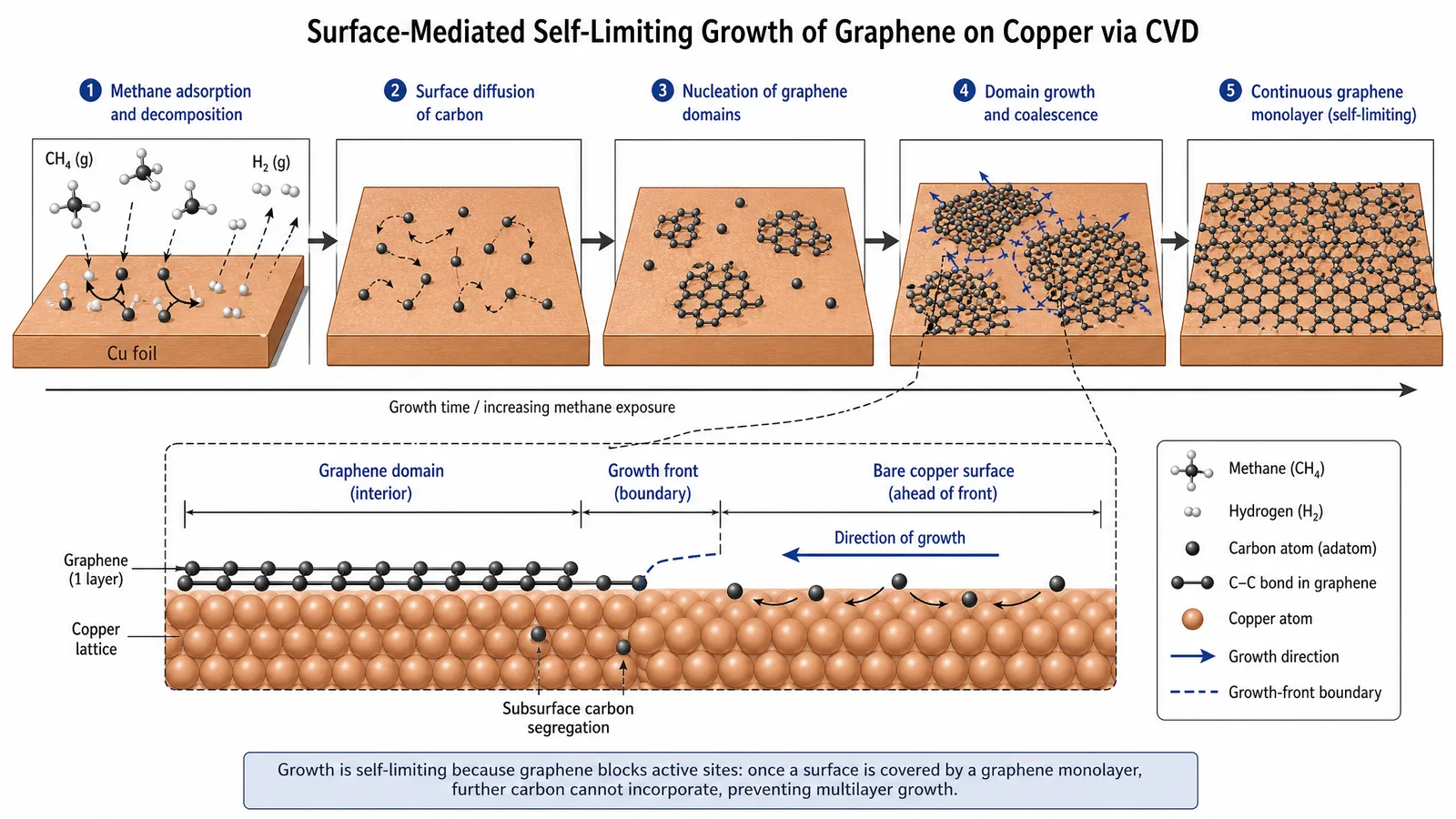
Synthesis or growth mechanism — chemical vapor deposition (CVD) growth on a catalyst substrate, mechanical exfoliation, or a transfer process from growth substrate to target wafer.
Band structure / electronic structure schematic — the Dirac cone at the K and K' points, band alignment across a heterojunction, or doping-induced shifts in the Fermi level.
Characterization geometry — the measurement setup for Raman spectroscopy, AFM, or TEM, drawn to show exactly what was probed and how.
Graphene Week 2026 device schematic figure: a graphene field-effect transistor with source and drain contacts, an hBN encapsulation layer and a labeled gate stack (Figure generated with SciFig)
The oral format is equally undocumented, so a standard 16:9 academic deck is the safe default. Our scientific presentation templates are 16:9 and already ordered the way a conference talk runs: background, methods, results, discussion, conclusion.
4. Designing a Winning Graphene Week Poster: Accuracy That Survives Peer Scrutiny
A winning Graphene Week poster passes two tests: it is grasped in seconds by a delegate walking past a crowded poster hall, and it is scientifically exact enough to survive scrutiny from a materials scientist who works on 2D materials every day. Build the sheet around one dominant "hero" figure — usually the device schematic or growth mechanism with the key result nearby — and let everything else support it.
The second test is where scientific figures live or die — and where general-purpose AI image generators fall short. A tool like Nano Banana Pro or GPT Image can produce something that looks about 99% right, but on a scientific figure 99% right is effectively 0% right: a fabricated band gap, a swapped growth mechanism, or a garbled stacking order turns a compelling figure into one that misleads a reviewer. And a flat, raster AI image gives you no way to fix that last one percent. This is the core difference with SciFig: every figure is a fully editable SVG whose elements — bands, layers, arrows, labels — you can correct individually, so you (the author who actually knows the physics) can adjust any element until the figure matches your science. The 2D materials figures that reward this care are exactly the ones reviewers scrutinize:
Band structure — it is well established that single-layer graphene has a gapless, linear Dirac cone at the K and K' points; a generic AI generator will often draw a band gap between conduction and valence bands out of habit, which is a fundamental error for graphene specifically.
CVD growth mechanism — within the materials community, it is well established that graphene grown on copper foil is a surface-mediated, self-limiting process (low carbon solubility caps growth near one layer), while growth on nickel is bulk-precipitation driven (high carbon solubility, multilayer-prone); generic AI tools commonly blur the two into one generic "carbon precipitates from the bulk" cartoon.
Twisted-bilayer / moiré stacking — it is well established that the AA and AB registry regions and the moiré superlattice periodicity in a twisted bilayer (including magic-angle twisted bilayer graphene) carry real physical meaning; a generic AI render often produces an arbitrary overlapping pattern that loses the stacking registry entirely.
Graphene Week 2026 CVD growth mechanism figure: methane decomposition on a copper foil catalyst, surface diffusion of carbon adatoms, and graphene domain nucleation (Figure generated with SciFig)
Whether your Graphene Week 2026 poster earns its attention comes down to whether these figures are accurate, clear, and legible from across a poster hall — which is exactly where an editable AI figure workflow compresses days of design work into hours without giving up scientific control.
5. Create Your Graphene Week 2026 Figures with AI: The SciFig Workflow
You already have two things most colleagues do not: your accepted abstract and a precise understanding of your device, material, or mechanism — use both to generate your figures online for free, then edit them until they are exactly right. Here is the SciFig workflow for a Graphene Week presenter:
Path 1 — Upload your accepted abstract PDF. Drop it into PDF-to-Figure. It parses your background, methods, and results and returns a device schematic or mechanism diagram in one click. SciFig generates the figure, and every element stays editable so you can adjust it to your data and poster layout — no blank canvas.
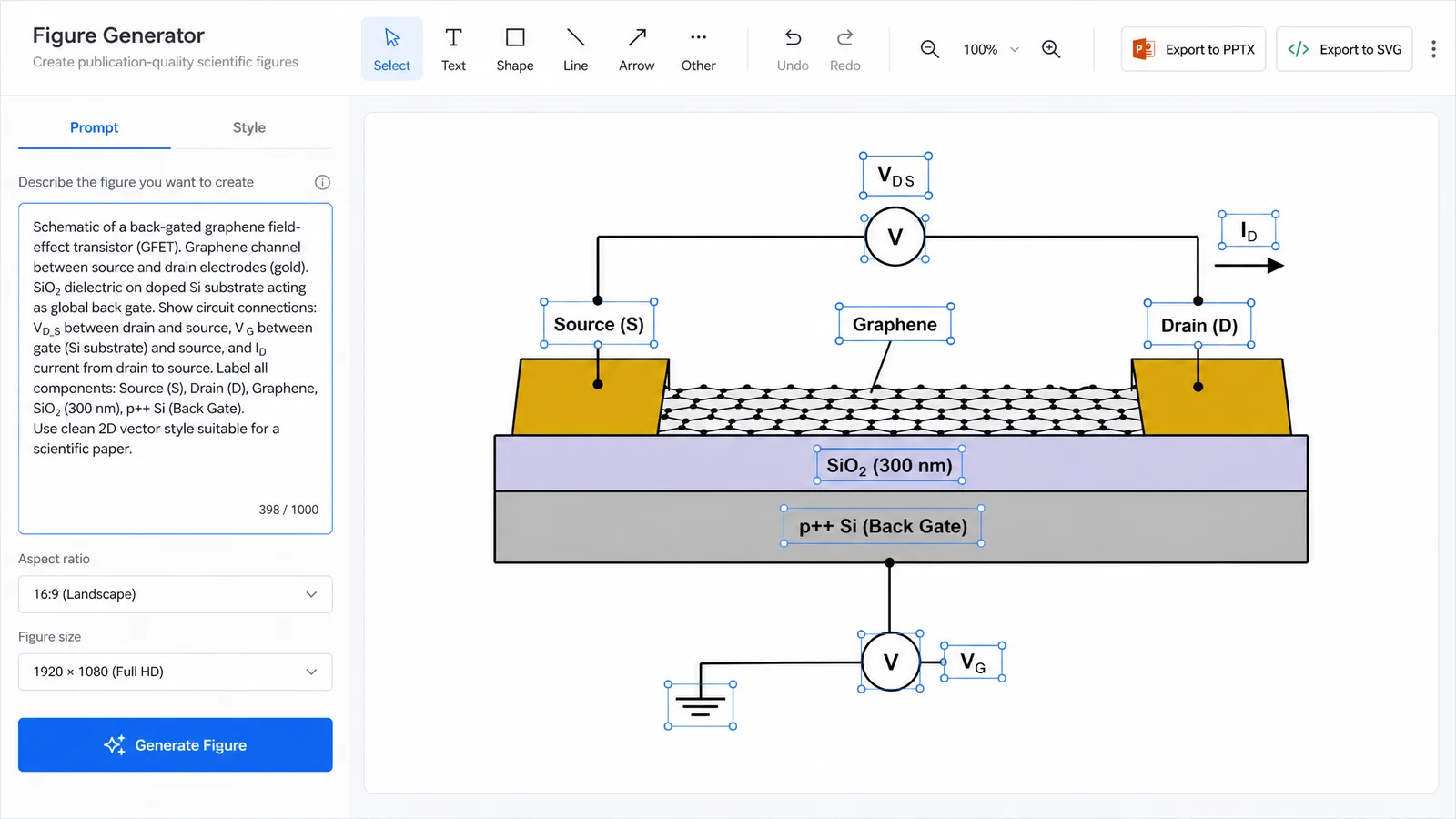
Path 2 — Copy a structured prompt. For a device or mechanism figure, Text-to-Figure gives more control. Copy and adjust to your study:
Schematic of a back-gated graphene field-effect transistor (GFET):
a graphene channel between gold source and drain electrodes on an
SiO2 dielectric over a doped-silicon back gate, with the source,
drain, gate, and graphene channel clearly labeled.
Path 3 — Sketch and scan. If you sketched your device architecture or stacking order on paper, photograph it and drop it into Sketch-to-Figure to get a publication-style version that preserves your layer order and geometry.
Graphene Week 2026 figure workflow in SciFig: a graphene FET (GFET) device prompt left, an editable SVG diagram right, PPTX and SVG export (Figure generated with SciFig)
From any path, you edit individual elements in the vector canvas — adjust labels, layer colors, arrow directions — and export to editable PPTX or layered SVG for your poster. Start free: 150 credits on day one, plus daily check-in credits.
Optional — disclose your AI use. Many conferences and journals now ask authors to disclose AI assistance and to remain responsible for the accuracy of their work. If you build and review a figure in SciFig, you can add one line to its caption — for example: Figure created by the authors using SciFig and reviewed for scientific accuracy (scifig.ai).
6. Where Graphene Week Research Gets Published (2D Materials Focus Issue)
Graphene Week does not publish an automatic abstract book or conference proceedings volume — instead, in past editions, IOP Publishing's 2D Materials journal has curated an annual "Focus on Graphene Week" collection inviting speakers and researchers to submit original papers, topical reviews, or perspectives after the meeting (confirmed for the 2024 edition); as of July 21, 2026, a 2026 edition of this collection has not yet appeared on IOPscience. If you are looking for a citable record of your Graphene Week 2026 contribution beyond your own accepted-abstract confirmation, the most likely path — based on this historical pattern, not a 2026 confirmation — is a full-length submission to 2D Materials after the meeting if a 2026 focus collection follows.
Graphene Week 2026 runs 21–25 September 2026 at the Super Bock Convention Center in Porto, Portugal. It is the 21st edition of the Graphene Flagship's flagship conference, chaired by Professor Elvira Fortunato, with keynote speakers including Nobel laureate Kostya Novoselov and Harvard's Philip Kim. See §1 Graphene Week 2026 at a Glance for the full timeline.
Registration follows three tiers: Early Bird closes 30 June 2026, Normal closes 14 August 2026, and Late registration runs through 15 September 2026. Five-day fees (excluding 23% VAT) range from €125 for student grant recipients at Early Bird to €900 for late industry registration. Fifty grants of €300 each are also available toward registration.
No — Graphene Week 2026 abstract submission is closed. The official submission page does not publish an exact submission or notification date, so if you are unsure of your acceptance status, check your confirmation from the submission portal directly. Abstracts covered six tracks: Fundamental 2D Materials & Interfaces, Electronics/Photonics/Sensing, Manufacturing/Composites/Scale-Up, Energy/Environment/Sustainability, Health & Biomedicine, and Innovation/Industrialization/Translation.
Graphene Flagship has not published a poster board size or orientation for Graphene Week 2026 as of July 21, 2026. No official page uses "e-poster" or "electronic poster" language, which suggests a traditional printed format, but this is an informed reading rather than an official confirmation. Design your hero figure as a scalable vector so it adapts cleanly once the exact dimensions are confirmed — see §2 Poster Guidelines.
Every accepted poster automatically qualifies for the Best Poster Award, judged by the Poster Award Committee on research level, novelty of findings, poster quality, and presentation clarity. There are five categories — Fundamentals, Applications, Processing, Sustainable Use, and Devices — plus a new second-place prize, for 10 awarded posters in total.
There is no automatic abstract book — in past editions, IOP Publishing's 2D Materials journal has run an annual "Focus on Graphene Week" collection for original papers submitted after the meeting (confirmed for 2024). A 2026 edition of this collection had not appeared on IOPscience as of July 21, 2026; check the journal directly closer to the meeting.
Graphene Week 2026 covers six official tracks: Fundamental 2D Materials & Interfaces, Electronics, Photonics & Sensing, Manufacturing, Composites & Scale-Up, Energy, Environment & Sustainability, Health & Biomedicine, and Innovation, Industrialization & Translation. The programme also includes the Graphene Innovation Forum and a dedicated Diversity in Graphene session.
References
All specifications and dates above are drawn from official Graphene Flagship materials, accessed July 21, 2026, plus one historical journal reference used only to describe a past editorial pattern (clearly marked below):
Disclaimer: This article is educational content focused on scientific figure design for conference posters. Dates and specifications are summarized from official Graphene Week materials linked above and were accurate at the time of writing — several details (exact abstract deadlines, poster board dimensions, presentation format) had not yet been published by Graphene Flagship as of this writing, so see the official Graphene Week website for current details before printing or submitting.
Keep going
Recommended resources
Templates, tools, and further reading for your research