AACR 2027 poster guide: April 2–7 in Orlando, the January 6, 2027 late-breaking abstract deadline, poster size, e-poster formats, and slide template.
SciFig Team
SciFig editorial team
AACR Annual Meeting 2027 runs April 2–7, 2027, at the Orange County Convention Center in Orlando.
This is a practical guide to the official poster and presentation rules for the American Association for Cancer Research (AACR) Annual Meeting 2027: the key dates, the printed poster format, and the companion e-poster that every poster presenter must submit.
It also covers the minisymposium presentation rules, AACR's optional slide template, the disclosure and AI policies, and where abstracts are published in Cancer Research. Every date and specification below links to official AACR materials; any prior-year planning reference is labeled with its year.
Need the file, not just the specs? Download our conference poster templates — 24 editable PowerPoint layouts, sized for both printed boards and e-posters.
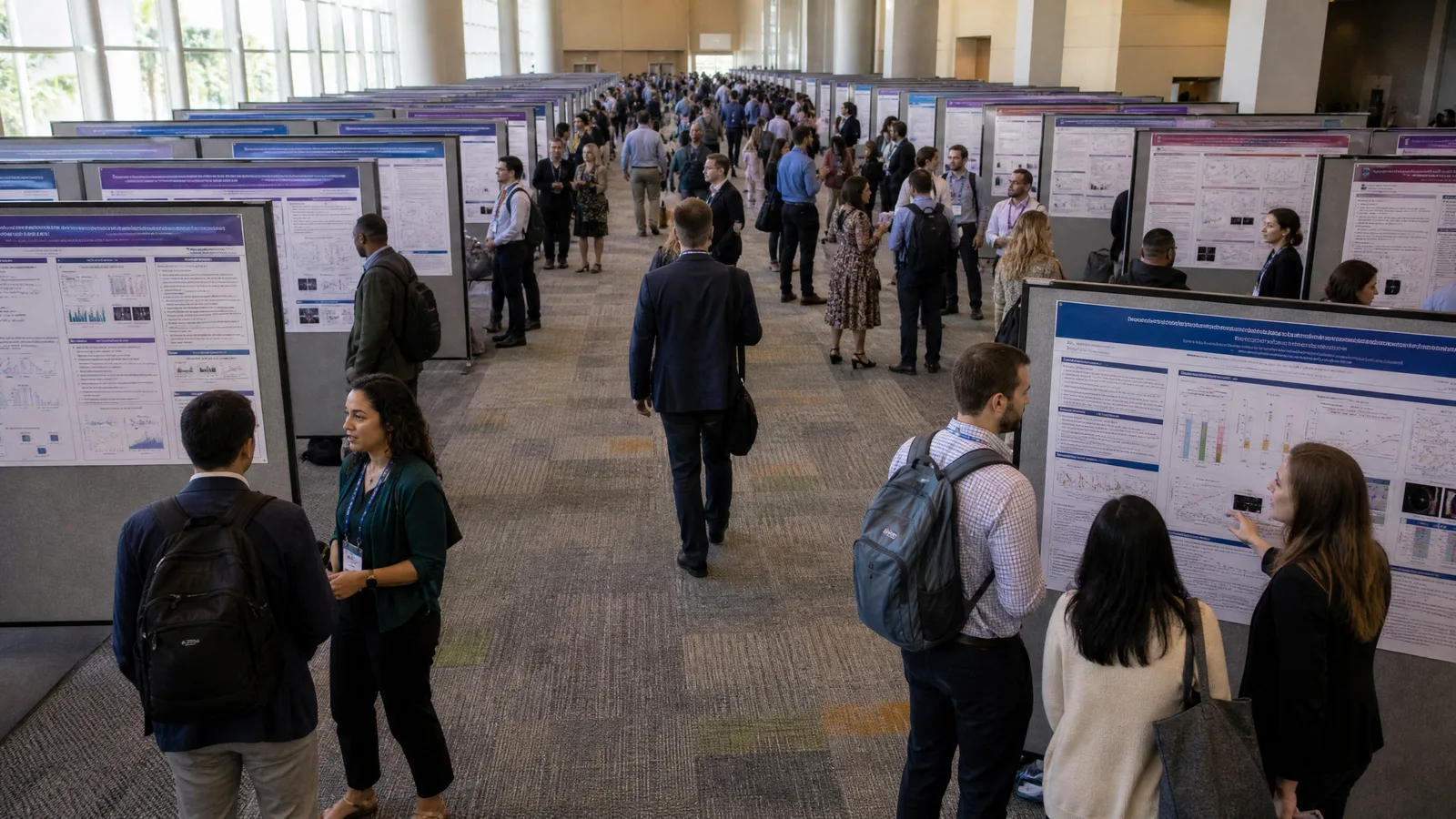
AACR 2027 poster guidelines cover showing a wide cancer research poster hall with rows of landscape conference posters and attendees in Orlando (Figure generated with SciFig)
Illustrations generated with SciFig AI.
1. AACR 2027 Abstract Deadline, Key Dates, and Venue
AACR Annual Meeting 2027 takes place April 2–7, 2027, at the Orange County Convention Center in Orlando, Florida. The regular abstract deadline closed on November 10, 2026; late-breaking and clinical trial abstracts are due Wednesday, January 6, 2027, at 11:59 p.m. U.S. Eastern Time. That January date is an abstract-submission deadline, not a poster-upload deadline: AACR has not yet published a date for the companion e-poster upload or poster-hanging times.
The official AACR Annual Meeting 2027 page gives the meeting theme as "Delivering Discovery Science: The Bridge to Breakthrough Therapeutics," and the 2027 Call for Abstracts expects more than 23,000 attendees and more than 7,000 presentation slots. The AACR 2027 key dates set this timeline:
Date
AACR 2027 milestone
November 10, 2026, 11:59 p.m. ET
Regular abstract submission and editing deadline (closed)
December 2, 2026
Late-breaking and clinical trial abstract submission opens
December 7, 2026
Early registration deadline
December 21, 2026
Regular abstract status notifications sent
January 6, 2027, 11:59 p.m. ET
Late-breaking and clinical trial abstract deadline
January 21, 2027
Regular abstract scheduling notifications
January 28, 2027, 12:00 noon ET
Final data due for placeholder abstracts
February 3, 2027
Late-breaking and clinical trial notifications
February 12, 2027
Advance registration deadline
March 2, 2027, 4:30 p.m. ET
Regular abstract titles and texts posted online; late-breaking and clinical trial titles posted, texts embargoed until April 2
April 2, 2027, 3 p.m. ET
Meeting begins; e-posters posted to the virtual meeting platform
The AACR 2027 abstracts page adds two planning points: the submission fee is US$85 per abstract, and abstract presenters must register to attend the meeting. The AACR 2027 Call for Abstracts also requires every coauthor to have a verified myAACR account before they can be added. Accepted posters must be presented in person.
2. AACR 2027 Poster Size, Format, and Template
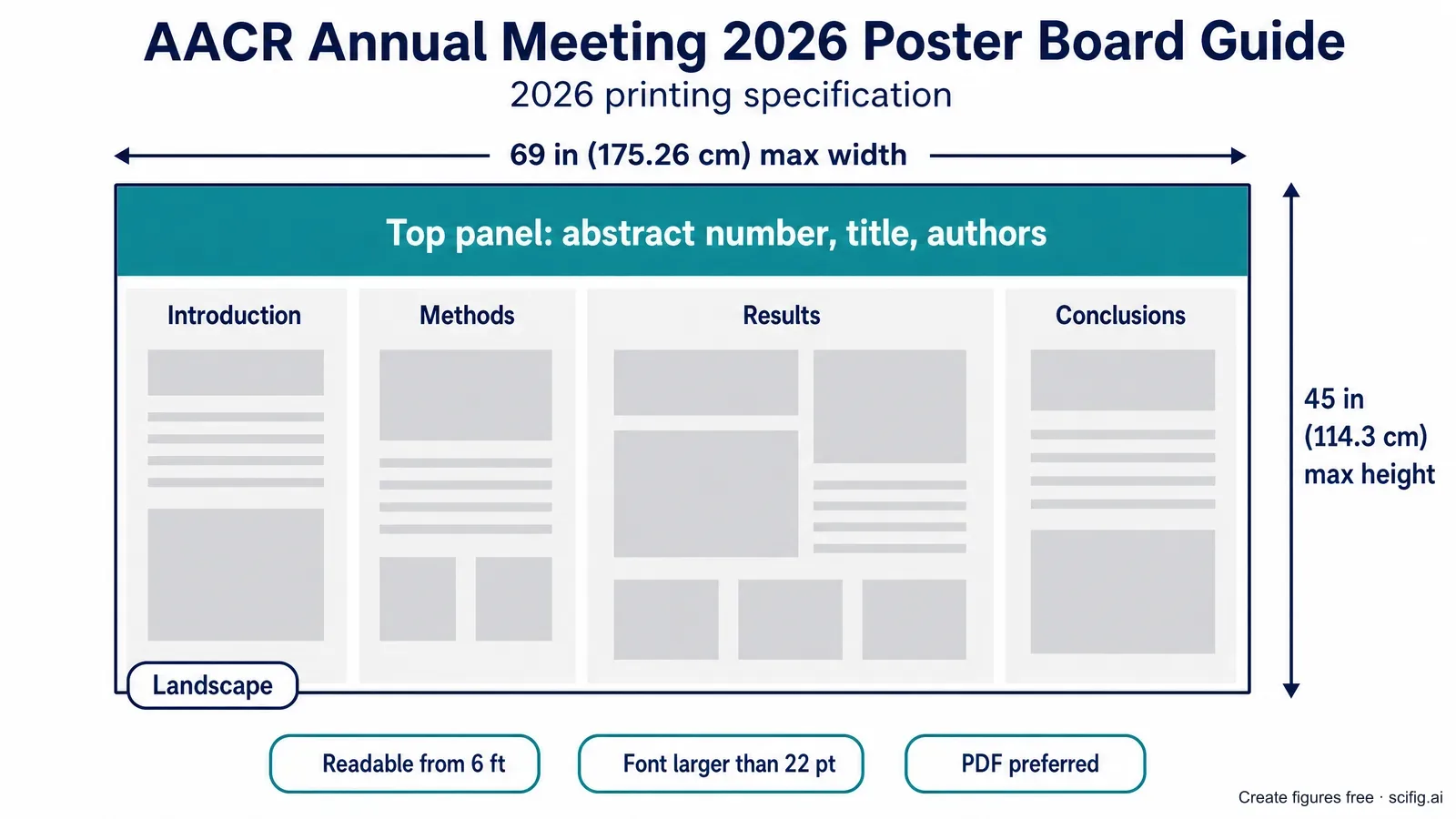
For AACR 2026, the poster specification on AACR's official printing-partner page (linked from aacr.org/poster) was a landscape poster no larger than 69 inches wide by 45 inches high (175.26 × 114.3 cm). AACR has not yet published the 2027 board size or orientation, so treat that 2026 rule as a planning reference for your AACR 2027 poster, not as the confirmed 2027 board, and confirm the 2027 size before you print.
69 in wide × 45 in high (175.26 × 114.3 cm); larger posters will not fit the boards
Orientation
Landscape (horizontal)
Top panel
Permanent abstract number, abstract title, and author names
Readability
Content should be easily read from 6 ft; a font size greater than 22 pt (3/8 in high when printed) is strongly encouraged
Print file
PDF or PowerPoint; PDF preferred
AACR Annual Meeting 2026 poster board guide used as a planning reference for an AACR 2027 poster: 69 in wide by 45 in high maximum, landscape format, top panel, and readability rules (Figure generated with SciFig)
Several AACR 2027 poster rules are already official. The 2027 abstracts page asks presenters to place the Presentation Number on the poster and not the Control Number. The AACR meetings FAQ says AACR provides poster numbers and pushpins, that poster printing services are available for the Annual Meeting, and that presenters must put up and remove their posters on the published schedule; posters left in the Poster Hall after that time may be discarded.
Make the hero figure before you size the AACR board
Start with the mechanism or tumor biology your audience must grasp, then build the landscape poster around it.
Because the 2027 board size is not out yet, build the layout first and size it last. Start from a landscape layout in our conference poster templates, resize the canvas to the board AACR publishes for 2027 (in 2026, up to 69 × 45 in), and recheck the official AACR 2027 abstracts page before you send the file to print.
3. AACR 2027 E-Poster Requirements: PDF and Slide-Video Formats
Every AACR 2027 poster presenter must also submit a companion e-poster as either a PDF or a video. AACR says the e-poster can be an electronic copy of the printed poster, a modified version of it, or a summary of the key findings. E-posters are posted to the virtual meeting platform on April 2, 2027, and stay available to registered Annual Meeting attendees through October 2027.
AACR has not yet published the 2027 e-poster upload deadline or file specifications; the 2027 page says only that files are due by the established deadline. The latest official format details come from AACR's January 2026 instructions for creating e-posters:
E-poster option
2026 rule (planning reference for 2027)
PDF
Page slightly larger than an average screen (for example, 24–36 in wide); file no larger than 50 MB; crop extraneous margins
Audio
Optional, in MP3 or M4A format
Slide video
MP4; up to five slides plus a title slide that shows the title, presenter name, and affiliation; 16:9 widescreen
Not accepted
PowerPoint or Keynote files as the e-poster
A PDF e-poster is read on a screen and zoomed in, so figures exported as clean vector graphics stay sharp where photographed or low-resolution panels blur. Check the AACR 2027 abstracts page for the 2027 upload deadline and format.
4. AACR 2027 Presentation Rules and Slide Template
AACR 2027 minisymposium speakers must agree to have their presentations recorded and posted on the virtual meeting platform, or they are withdrawn from the session, and remote abstract presentations are not permitted. AACR has not yet published the 2027 talk length, slide format, or slide-upload instructions, so plan a deck that also works as a recording and confirm the details in your scheduling notification.
AACR provides an optional slide template. Its 2026 e-poster instructions say: "While it is not required, you may use the current AACR Annual Meeting slide template," which is useful for the slide-video e-poster as well as for talks. The official link, aacr.org/AMslides, currently opens the 2026 version of the file, so download the latest version from that link once AACR posts the 2027 template. The only official slide format so far is the 2026 slide-video e-poster rule (16:9 widescreen, up to five slides plus a title slide); it is not an oral-talk requirement.
In our view, an AACR 2027 poster is carried by one mechanism figure that explains the biology, supported by result charts and, for clinical work, a trial schema. The 2027 Call for Abstracts describes an audience of scientists, clinicians, other health care professionals, patients, and advocates, so the figure mix depends on the study, but a few figure types recur on oncology posters and slides.
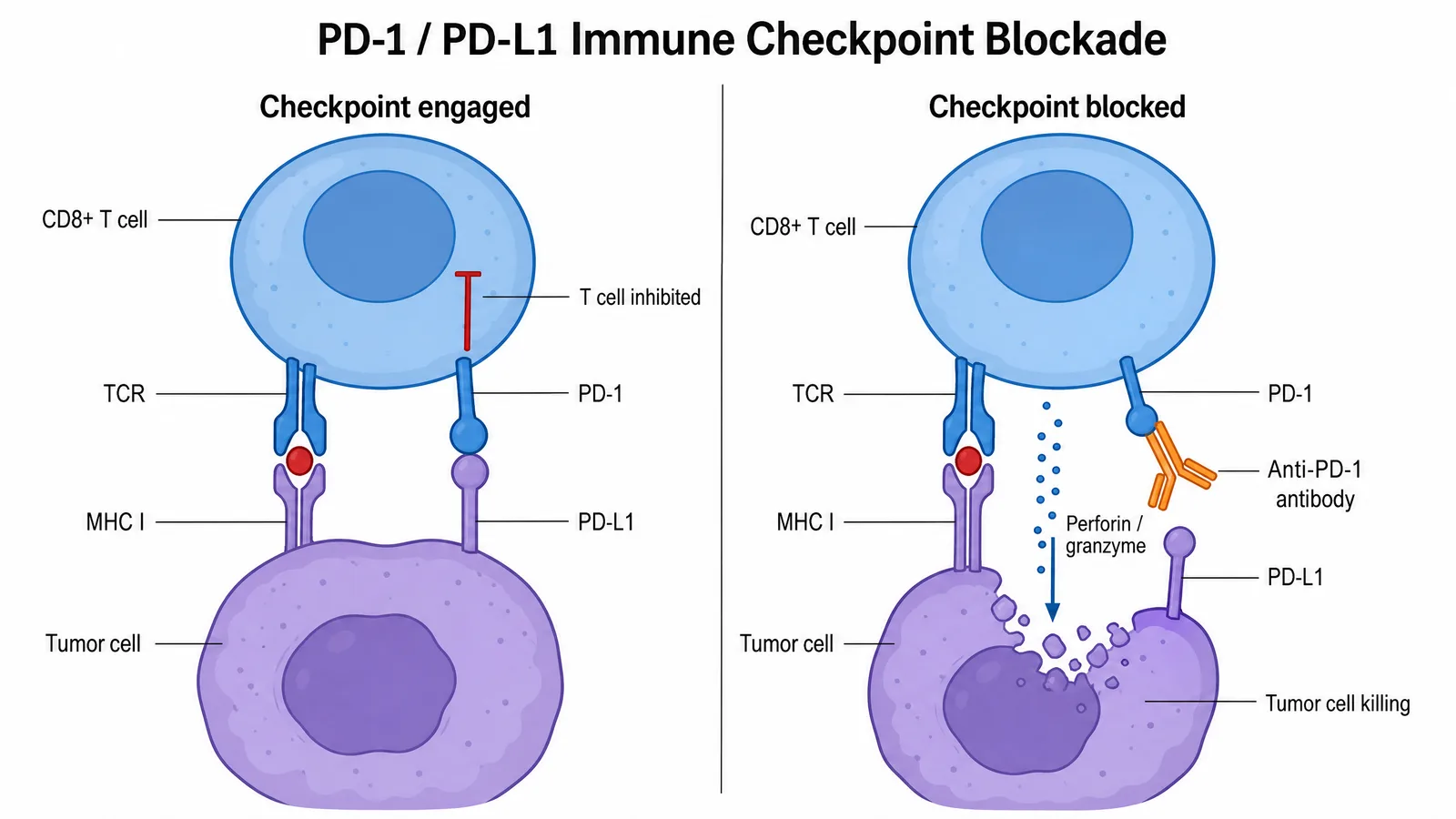
AACR 2027 immune checkpoint mechanism of action figure for a cancer research poster: PD-1 on a CD8+ T cell binding PD-L1 on a tumor cell, and an anti-PD-1 antibody blocking it to restore perforin and granzyme killing (Figure generated with SciFig)
Drug mechanism of action: an immune checkpoint inhibitor, an antibody–drug conjugate, or a targeted inhibitor, drawn as an ordered sequence of binding, signaling, and effect. It is widely understood that blocking the PD-1/PD-L1 interaction releases a brake on T-cell activity, which is why the receptor–ligand contact and the antibody's position are the details reviewers check first. The immune checkpoint diagram generator starts that figure from a description.
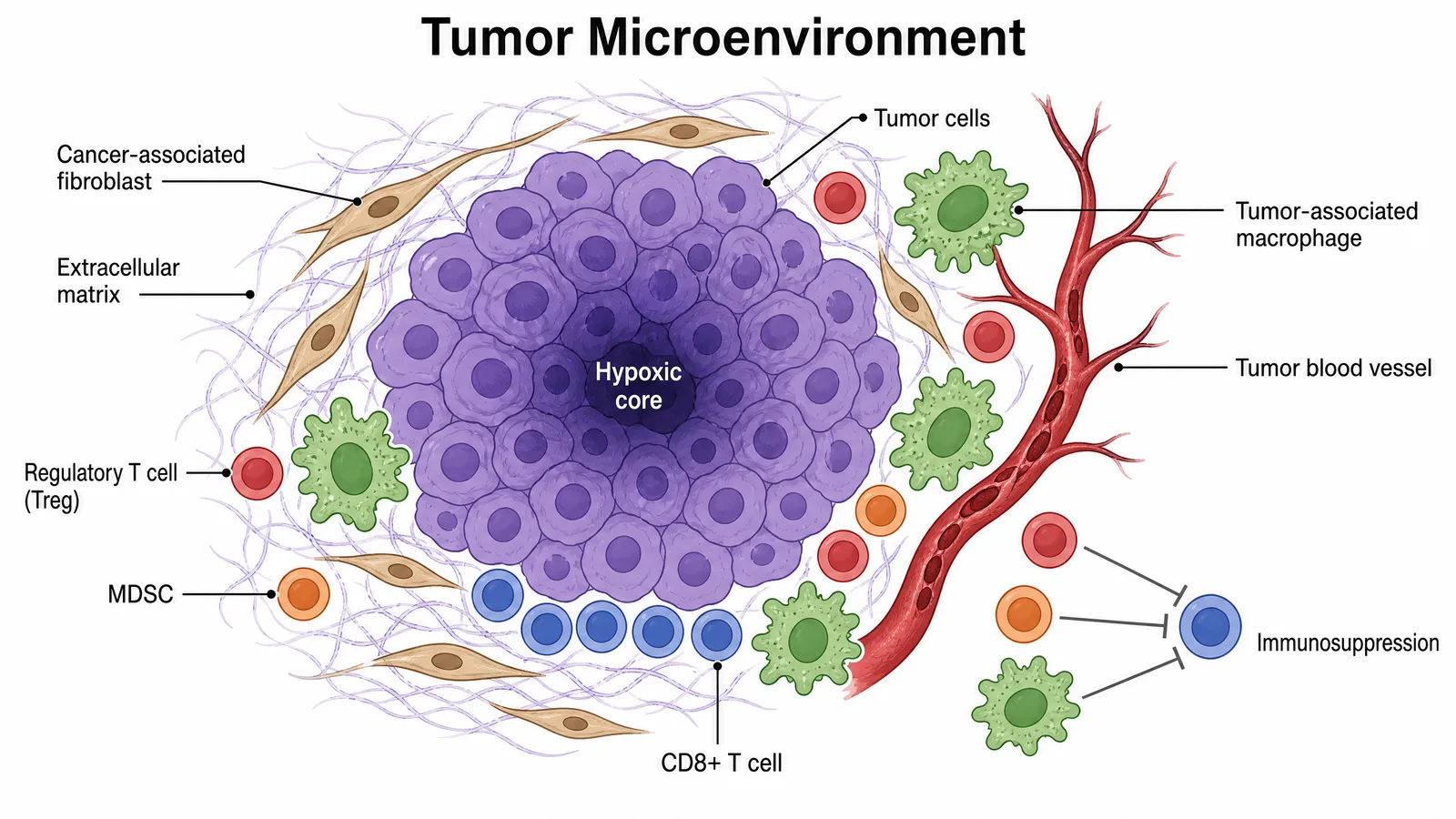
Tumor microenvironment: tumor cells with fibroblasts, immune cells, vasculature, and extracellular matrix, showing which cells your data implicate.
Signaling pathway: the pathway your compound or genetic change acts on, with activation and inhibition arrows drawn consistently.
Trial schema: for a clinical trial abstract, a flow from enrollment and randomization to arms and endpoints; the CONSORT flow diagram generator builds it as an editable diagram.
On slides, use one figure per slide; in the PDF e-poster, the same figures must stay legible when zoomed. The abstract itself has a strict budget: the 2027 limit is 2,600 characters for the body, title, and tables combined (not counting spaces or the author string), and each table counts as 800 characters.
Draw your cancer mechanism for the AACR poster
Describe the receptors, cells, drug, and direction of each step, then edit any element until it matches your study.
6. Winning AACR 2027 Poster Design: Accuracy You Can Edit
A winning AACR 2027 poster is readable from across the aisle and exact up close: one dominant mechanism or result figure, a clear top panel, short supporting panels, and every label, arrow, and cell type correct. AACR's own audience includes basic scientists, clinicians, and advocates, so the hero figure has to explain the biology in seconds and still hold up when an expert checks the details.
AACR 2027 tumor microenvironment figure for a winning cancer research poster: tumor cells with a hypoxic core, cancer-associated fibroblasts, extracellular matrix, tumor blood vessel, macrophages, Tregs, MDSCs, and CD8+ T cells (Figure generated with SciFig)
A tumor microenvironment figure shows why exactness matters. Each cell type has to be labeled as what it is, inhibitory interactions need a flat-headed symbol rather than an arrowhead, and the immune cells your data actually measured should stand out from background context. General image generators such as Nano Banana Pro or GPT Image can produce a convincing-looking cell scene, but the output is a flat picture: a mislabeled macrophage or a reversed arrow means generating it again and hoping. In SciFig AI Illustration (AI scientific illustration), the figure opens in Canvas, where every label, arrow, and cell stays editable, so you can match each element to your data and convert the figure to editable SVG.
Keep the 2026 readability rule in mind while you build: AACR's printing partner asked for content readable from 6 ft and fonts larger than 22 pt. Before printing, the five common scientific figure mistakes checklist helps you check resolution, typography, color, and export.
Tip
Pick the hero figure first: the one an attendee should remember the next day. On most AACR posters that is the mechanism or the key result, and the rest of the board supports it.
7. AACR 2027 Scientific Figure Workflow with SciFig
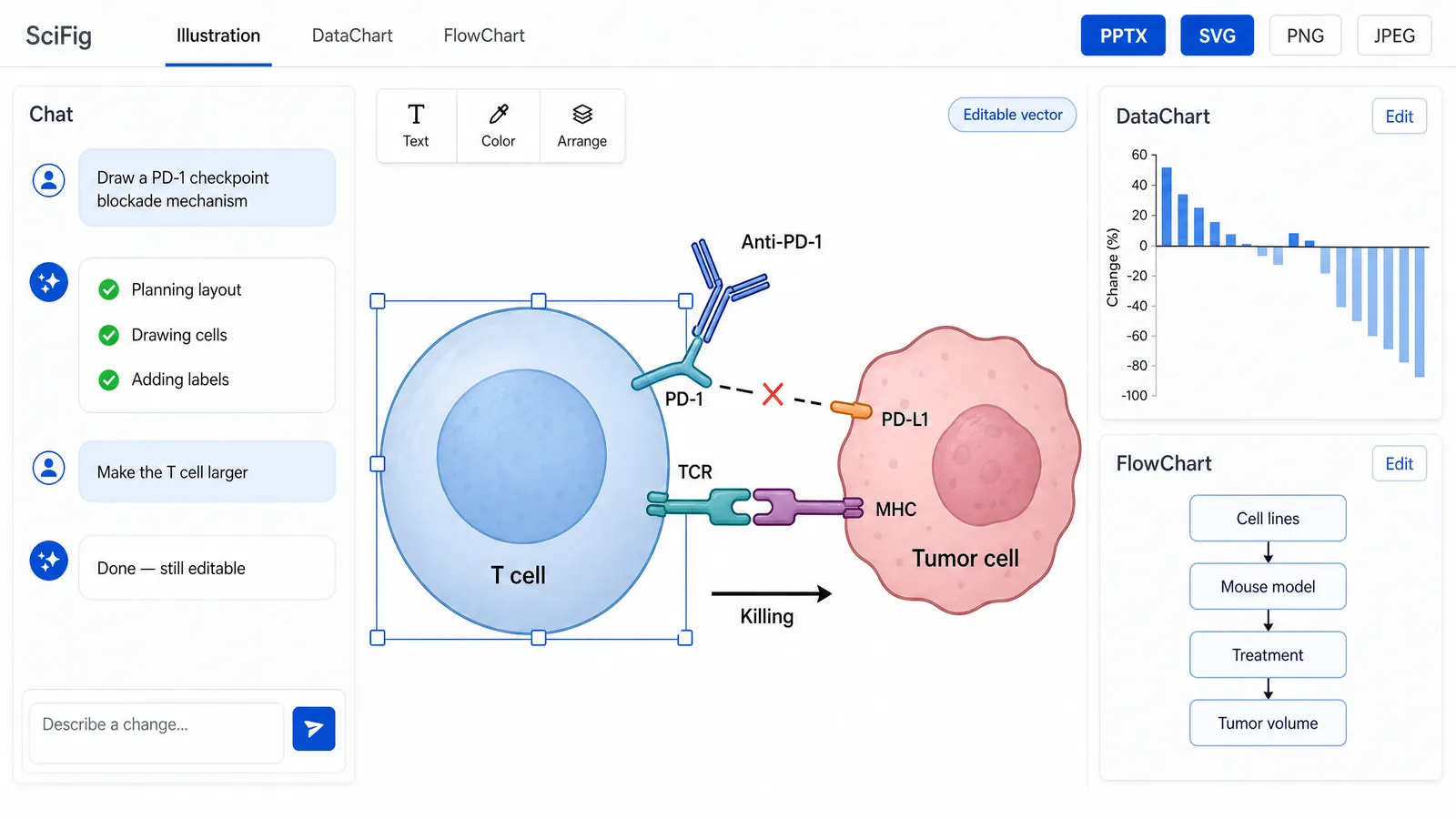
SciFig covers the three figures an AACR poster or slide deck usually needs — SciFig AI Illustration (AI scientific illustration) for the mechanism, SciFig DataChart (charts and graphs from your data) for results, and SciFig FlowChart (flowcharts) for the experimental workflow — and every result stays editable.
What you need for your poster or slides
Use
What it helps with
Explain a drug mechanism, tumor pathway, or graphical abstract
Generate from text or a template; edit text, boxes, and connectors; export SVG or PPTX
AACR 2027 SciFig workspace mockup for a cancer research poster: a chat panel generating an editable PD-1 checkpoint blockade mechanism on the canvas, waterfall-plot DataChart and preclinical-study FlowChart cards, and PPTX, SVG, PNG, and JPEG export buttons (Figure generated with SciFig)
A structured prompt gives you the most control over a mechanism figure. Copy and adapt this one:
Mechanism of action of an antibody-drug conjugate: the antibody binds a
tumor-cell surface antigen, the complex is internalized by endocytosis
and trafficked to the lysosome, the linker is cleaved, and the cytotoxic
payload is released into the cytoplasm, leading to tumor cell death.
Label each step in order.
Optional AI disclosure. If you make a poster figure with an AI tool, you can add a short caption line such as Figure created by the authors using SciFig (scifig.ai). AACR's 2027 AI rules apply to the abstract itself (see §8), so a caption line is an optional courtesy on the poster.
8. AACR 2027 Disclosure, AI Policy, and Poster Sharing Rules
AACR 2027 requires the designated abstract presenter to disclose financial relationships during submission, and its 2027 AI policy requires authors to describe AI used in the underlying study in the abstract's Methods and to disclose AI-produced text or other material in a sentence at the end of the abstract body. If a coauthor is the presenter, the submitter enters that presenter's financial disclosures.
The AACR 2027 abstracts page also states that all abstract authors are fully responsible for reviewing the completed abstract before submission. These AI rules are written for abstracts; AACR has not published a separate AI rule for posters or slides.
For sharing, AACR's 2026 e-poster instructions and the AACR meetings FAQ let presenters label posters or slides "DO NOT POST" when they do not want them shared on social media, and the FAQ limits photography to personal, noncommercial use. We found no AACR logo or branding rule for posters on the 2027 meeting pages.
9. AACR 2027 Abstracts in Cancer Research: Proceedings and Abstract PDF
Accepted AACR 2027 abstracts are published in an online-only Proceedings supplement to the AACR journal Cancer Research in two parts: regular abstracts on Friday, March 19, 2027, and clinical trial and late-breaking abstracts on Friday, April 2, 2027. The April 2 date comes from the AACR abstracts and key-dates pages; the meeting resources page lists April 3, so check the supplement itself for the final date. An update with the full text of embargoed abstracts and any late changes appears in Cancer Research about one month after the meeting.
Online Itinerary Planner and Proceedings (titles and texts)
March 2, 2027, 4:30 p.m. ET
PDF Proceedings (regular abstracts only)
March 17, 2027
Annual Meeting app
March 15, 2027 (tentative)
Cancer Research Proceedings, Part 1 (regular abstracts)
March 19, 2027
Cancer Research Proceedings, Part 2 (clinical trial and late-breaking)
April 2, 2027
Because the abstract becomes a citable Cancer Research record, keep the terms, drug names, and numbers in your poster and slide figures consistent with the abstract text you submitted.
Frequently Asked Questions
AACR Annual Meeting 2027 runs April 2–7, 2027, at the Orange County Convention Center in Orlando, Florida. The meeting opens at 3 p.m. ET on April 2. See §1 AACR 2027 key dates and venue.
Late-breaking and clinical trial abstracts for AACR 2027 are due January 6, 2027, at 11:59 p.m. ET. The regular abstract deadline closed on November 10, 2026. These are abstract deadlines; the e-poster upload deadline is not yet published. See §1 key dates.
For AACR 2026, AACR's printing-partner page (linked from aacr.org/poster) set a landscape poster no larger than 69 in wide × 45 in high (175.26 × 114.3 cm). The 2027 board size is not yet published, so confirm it before printing. See §2 poster size.
Yes. Every AACR 2027 poster presenter must submit a companion e-poster as a PDF or video. In 2026, PDFs were capped at 50 MB and slide videos used MP4, 16:9, and up to five slides plus a title slide. See §3 e-poster requirements.
AACR provides an optional slide template at aacr.org/AMslides, which currently opens the 2026 file. We found no AACR-published poster template; its printing partner hosts poster templates on its AACR page. See §4 slide template.
AACR's 2027 AI policy covers abstracts: AI used in the study goes in Methods, and AI-produced text or material is disclosed at the end of the abstract. SciFig figures stay editable, and you can add an optional caption such as "Figure created by the authors using SciFig (scifig.ai)." See §8 AI policy.
Accepted AACR 2027 abstracts appear in an online-only Proceedings supplement to Cancer Research: regular abstracts in March 2027 and clinical trial and late-breaking abstracts in early April 2027. A PDF Proceedings of regular abstracts is due March 17, 2027. See §9 Cancer Research Proceedings.
American Association for Cancer Research. AACR Annual Meeting Slide Template (2026 file) [PPTX]. Accessed November 14, 2026. https://www.aacr.org/AMslides/
American Association for Cancer Research. Poster information short link (redirects to the printing-partner page). Accessed November 14, 2026. https://aacr.org/poster
Disclaimer: Educational content on scientific figure design — not medical advice. For clinical decisions, consult primary literature and licensed clinicians. SciFig is an independent scientific figure platform and is not affiliated with or endorsed by the American Association for Cancer Research.
Keep going
Recommended resources
Templates, tools, and further reading for your research