ATS 2027 poster guide: May 14–19 in New Orleans, 2026 board size and landscape poster sizes, the January 27 late-breaking deadline, ePoster rules and AJRCCM.
SciFig Team
SciFig editorial team
ATS 2027 runs May 14–19, 2027, in New Orleans, with its exhibit hall at the Ernest N. Morial Convention Center.
This is a practical guide to the official poster and presentation rules for the American Thoracic Society (ATS) 2027 International Conference: poster board size and landscape format, the three poster session types, the ePoster requirement, and mini-symposium time limits.
It also covers the late-breaking abstract deadline, the one-table-or-one-figure abstract rule, disclosure and logo rules, and publication in AJRCCM. Every date and specification below links to official ATS materials; any prior-year planning reference is labeled with its year.
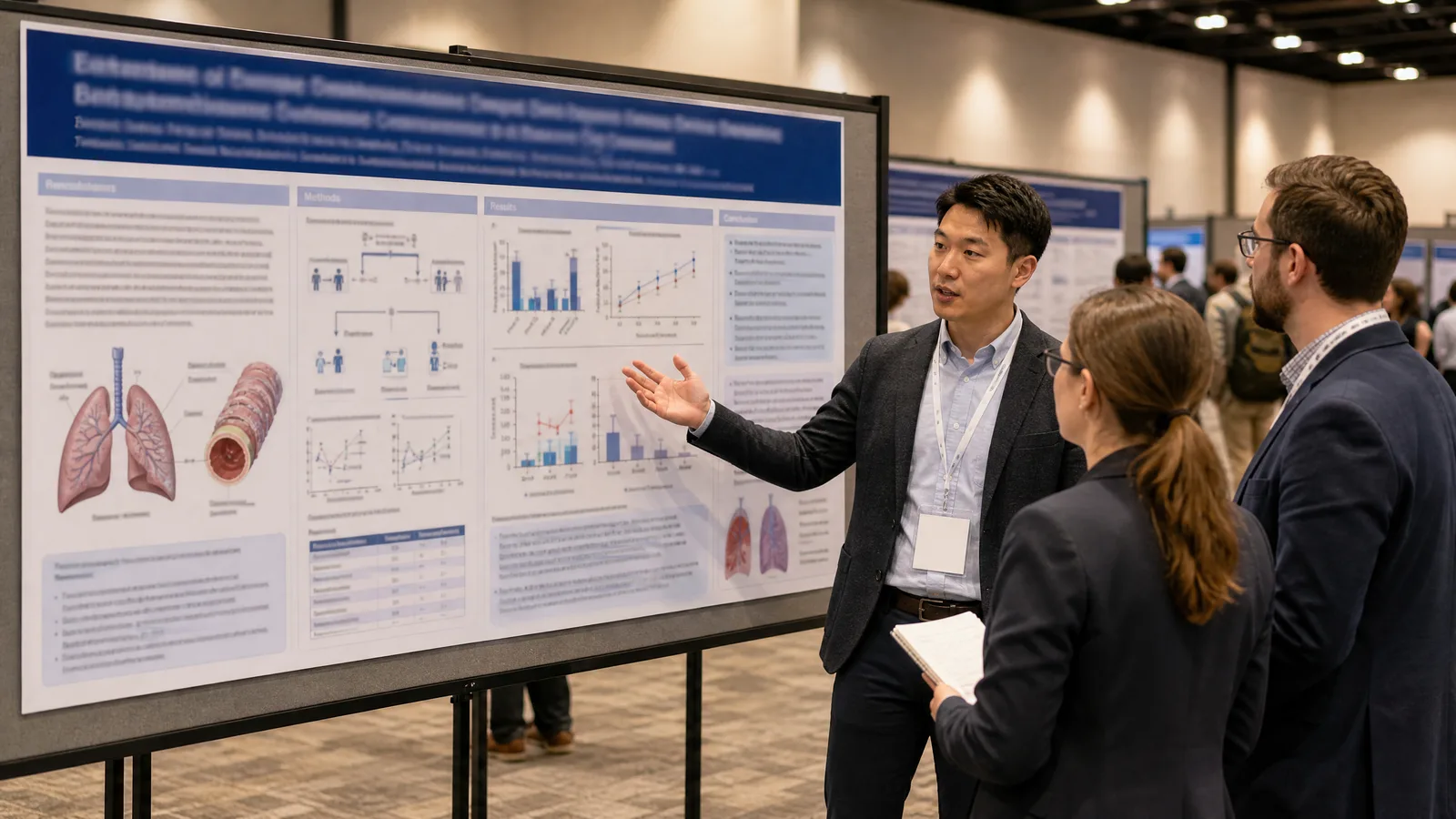
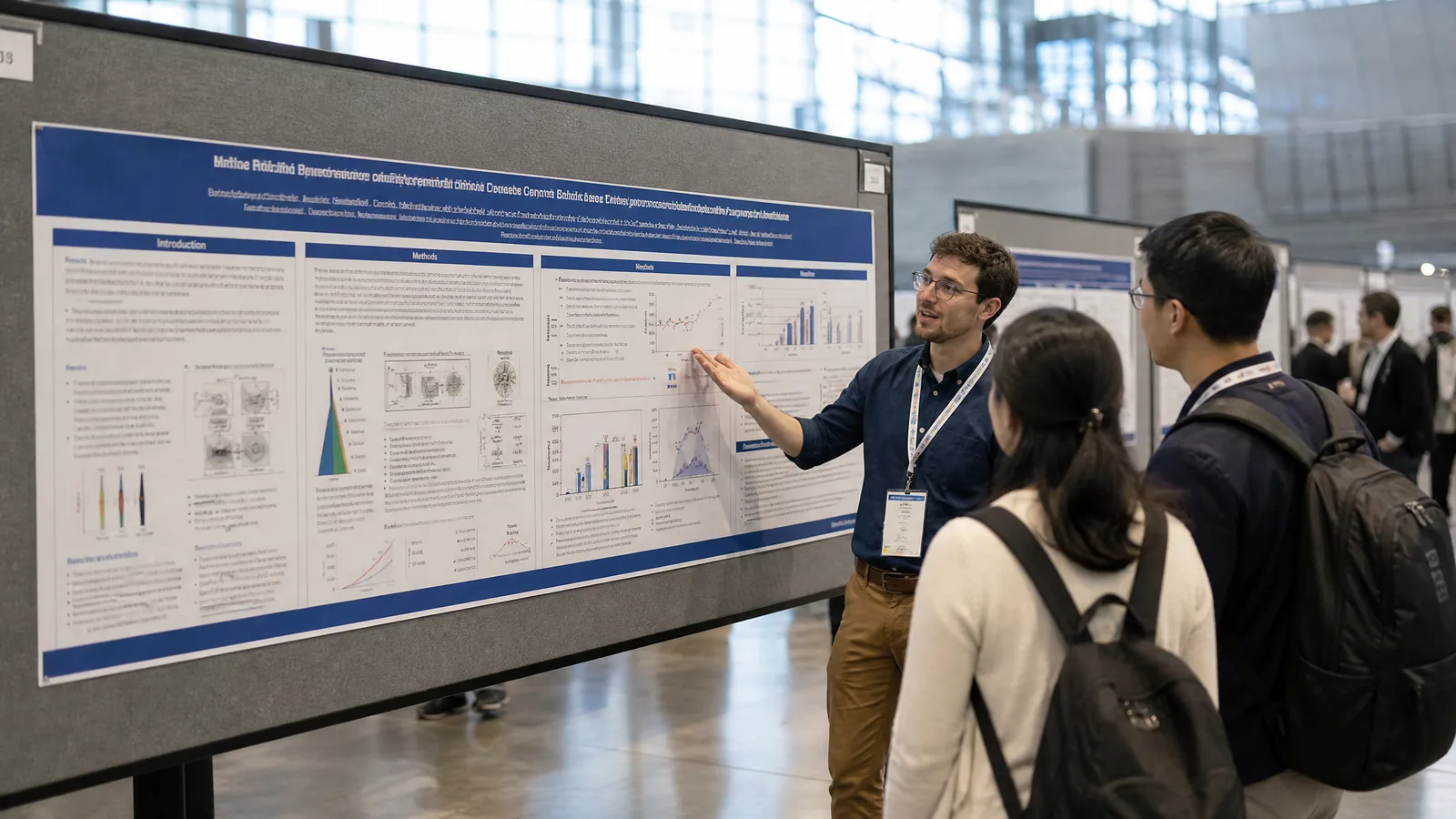
ATS 2027 poster guidelines cover: a presenter explaining a landscape pulmonary medicine poster with lung and airway diagrams to two attendees in a conference poster area (Figure generated with SciFig)
Illustrations generated with SciFig AI.
1. ATS 2027 Dates, Late-Breaking Abstract Deadline, and Venue
ATS 2027 takes place May 14–19, 2027, in New Orleans, with the exhibit hall in the Ernest N. Morial Convention Center. The regular abstract deadline (5 p.m. ET, November 4, 2026) has closed, acceptance notices arrive in mid-January 2027, and the late-breaking abstract deadline is Wednesday, January 27, 2027. ATS says details of the late-breaking call will be posted in December. The notification email also tells each submitter the presentation date and time, and ATS states that the schedule cannot be changed.
Regular abstract and case report deadline (closed)
December 2026
Late-breaking abstract call details posted
Mid-January 2027
Acceptance or rejection notices, with presentation date and time
January 15, 2027
Last day an abstract can be withdrawn
January 27, 2027
Late-breaking abstract deadline
April 2027 (subject to change)
Accepted abstracts appear in ATSConference365
May 2027
AJRCCM Online Abstract Issue and the ATS Conference App
May 14–19, 2027
ATS 2027 International Conference, New Orleans
ATS describes the meeting as drawing nearly 14,000 pulmonary, critical care, and sleep professionals each year, about 40 percent from outside the United States (About ATS). The Ernest N. Morial Convention Center hosts the exhibit hall. If an abstract is accepted, the presenting author must register for the conference separately; the abstract fee does not include registration.
2. ATS 2027 Poster Size, Format, and Template
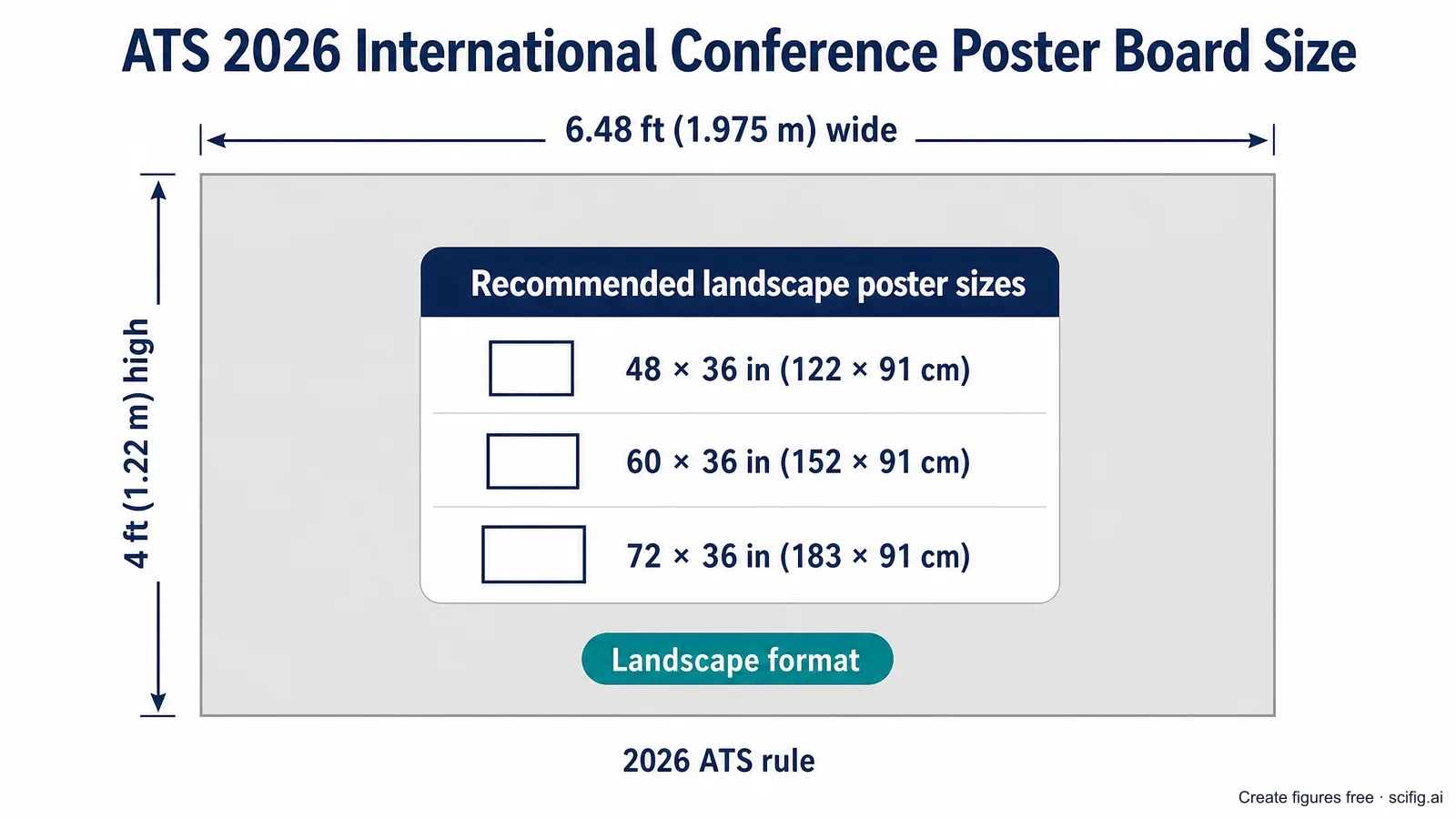
ATS has not published its 2027 poster guidelines yet. In 2026, the ATS poster board surface was 4 ft high × 6.48 ft wide (1.22 × 1.975 m), posters had to be landscape, and the recommended sizes were 48 × 36 in, 60 × 36 in, and 72 × 36 in (width × height). Use the 2026 rule as a planning reference for 2027 and confirm it against the 2027 guidelines when ATS posts them.
48″ w × 36″ h (122 × 91 cm); 60″ w × 36″ h (152 × 91 cm); 72″ w × 36″ h (183 × 91 cm)
Orientation
Landscape
Mounting
Pushpins provided in the session room or poster hall
Logos
"Do not use industry logos or brand names."
QR codes
Allowed only if they link to a PDF version of the poster, not to an institution or company website
Official template
None; the PDF gives sizes and design tips, not a template file
ATS 2027 poster size planning figure based on the ATS 2026 poster board: a 6.48 ft wide by 4 ft high board listing the recommended 48 × 36, 60 × 36, and 72 × 36 in landscape poster sizes (Figure generated with SciFig)
All three recommended 2026 sizes share a 36 in height, so the difference is width. In our view, a 72 × 36 in poster gives the most room for a multi-panel results story, while 48 × 36 in suits a tighter four-panel layout. The 2026 guidance also asks for a coherent sequence (top to bottom or left to right), brief text, figures and tables "when appropriate," and a poster that "can be understood without an oral explanation."
Build the hero figure before laying out your ATS poster
Start with the airway, alveolar, or trial figure your audience must grasp first, then arrange the landscape board around it.
ATS provides no downloadable poster template, so the file is yours to build. In 2026, ATS listed 48 × 36 in landscape among its recommended sizes, and our conference poster templates include a 48 × 36 in landscape layout in editable PowerPoint with the title band and section structure already set. Start the layout there now, then re-check the size against the 2027 ATS poster guidelines before you print.
ATS 2027 programs poster abstracts into three formats: two-hour Poster Discussion Sessions, two-hour RAPiD (Rapid Abstract Poster Discussion) sessions that open with a one-slide summary from each author, and full-day Thematic Poster Sessions in the poster hall. The International Conference Committee decides the format of every accepted abstract, and that decision is final (ATS 2027 submission criteria). Check the acceptance notice for the session type before planning travel or printing.
Set-up times for 2027 are not published yet. In 2026, ATS used these windows (2026 rule, used as a planning reference for 2027):
Stay in the room for the entire session; take the poster down by the end of the session
Thematic Poster Session
Poster hall
Recommended 8:00–8:45 a.m.
Poster up 9:15 a.m.–4:15 p.m.; author at the poster 11:30 a.m.–1:15 p.m.; take down by 4:15 p.m.
The 2026 guidelines warned that materials left on a board at the end of a session are removed and discarded. On printing, ATS offered an on-site FedEx printing service in 2026, said posters may not be mailed in advance to the conference venue, and noted that ATS is not responsible for posters ordered at FedEx. Authors not using that service brought their posters themselves. The ATS conference site is where the 2027 schedule will appear.
4. ATS 2027 ePoster Upload Requirement
Every ATS 2027 presenting author in an oral or poster presentation must also upload an ePoster before the conference. That requirement is stated in the official ATS 2027 submission criteria, so the ePoster is in addition to the printed poster or the talk, not a replacement for either.
ATS has not published the 2027 ePoster file format, page size, upload deadline, or platform yet. Plan on producing the ePoster from the same source file as your printed poster, so that the figures, labels, and data stay identical between the two versions. Watch the acceptance notice and the ATS conference site for the ePoster instructions.
5. ATS 2027 Oral Presentation: Mini-Symposium Time Limits and RAPiD Slides
ATS 2027 oral abstract presenters get seven minutes for a PowerPoint presentation followed by five minutes for discussion, within two-hour Mini Symposium sessions of thematically related abstracts. If an abstract is programmed as an oral presentation in a mini symposium, the 2026 poster guidelines said no physical poster is needed, although the 2027 ePoster upload still applies.
RAPiD authors present both a physical poster and one PowerPoint slide. The 2027 criteria say the slide "must be submitted prior to the conference," and an author who does not submit it cannot take part in the summary presentations. The 2026 RAPiD moderator instructions (PDF) add these 2026 details:
2026 RAPiD element
2026 ATS instruction
Oral summary length
"no more than 90 seconds"
Slide content
The presenting author's name, poster board number, and a key piece of data or a summary figure
Missed slide submission
"Any poster presenter who fails to submit a slide prior to the session will NOT present."
The 2026 poster guidelines were explicit that other poster presenters "should NOT prepare a PowerPoint presentation." ATS has not published a 2027 slide aspect ratio, upload deadline, or slide template for abstract presenters yet. A seven-minute talk usually works best with one key figure per slide; for the RAPiD slide, put the single summary figure front and center.
ATS publishes no slide template for abstract presenters, so build the deck from a clean academic layout. Our scientific presentation templates are editable PowerPoint decks ordered the way a short abstract talk runs: background, methods, results, and conclusion.
6. What Scientific Figures Work for an ATS 2027 Poster, Slides, and Abstract?
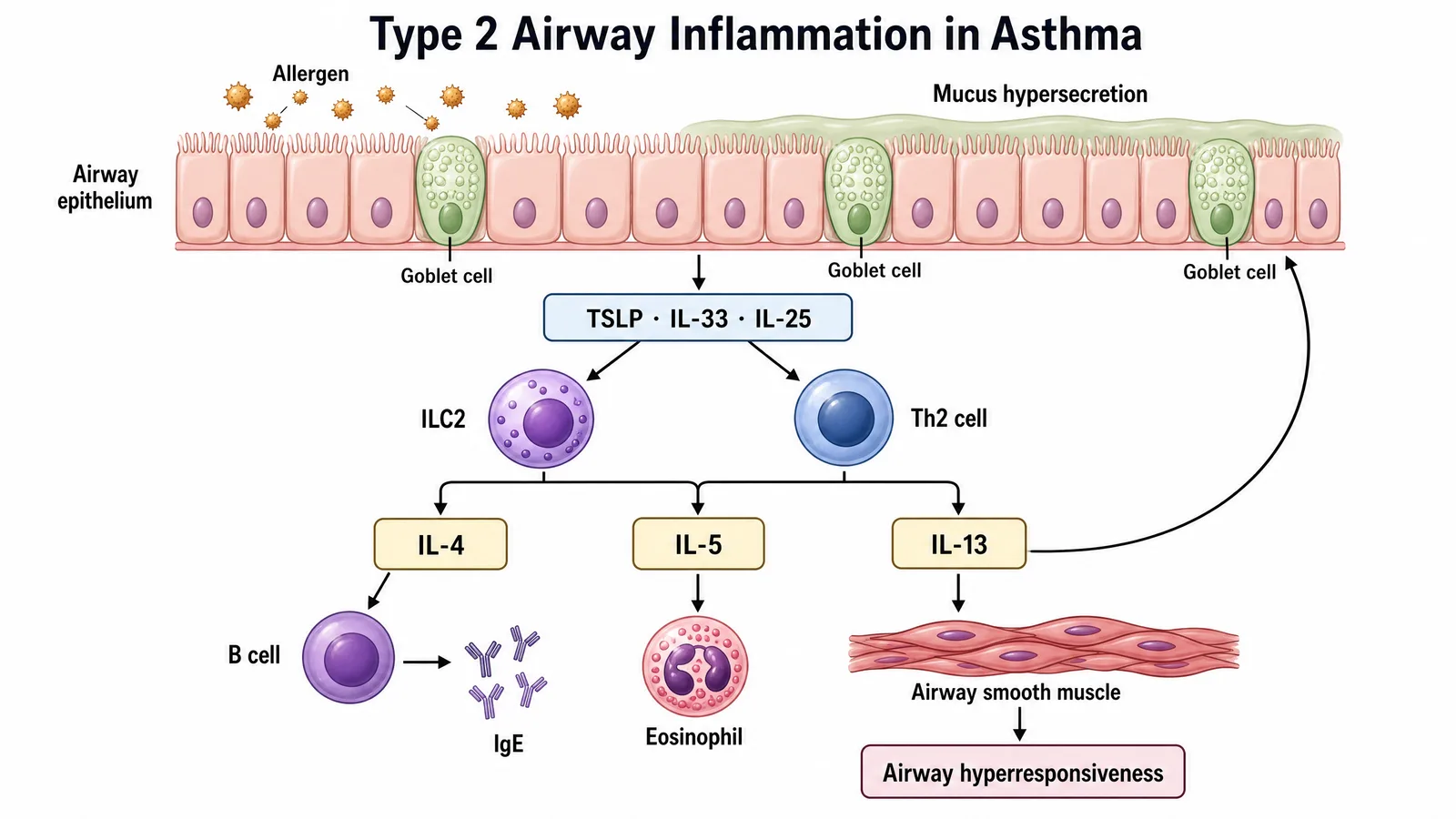
In our view, the strongest ATS 2027 figures make a respiratory mechanism or study design visible: an airway-inflammation mechanism for asthma, a fibrogenic pathway for pulmonary fibrosis, a COPD or ARDS trial schema, and spirometry or outcome charts drawn from your data. ATS lists COPD, pediatric and adult asthma, IPF, cystic fibrosis, pulmonary hypertension, lung cancer, ARDS, sepsis, and mechanical ventilation among its 2027 topics (About ATS), and the 2027 criteria say poster authors are "expected to display illustrative material (graphs, charts, and tabular matter)."
ATS 2027 asthma mechanism figure for a pulmonary poster: allergen triggers epithelial TSLP, IL-33, and IL-25, activating ILC2 and Th2 cells; IL-4 drives B cells and IgE, IL-5 drives eosinophils, and IL-13 drives mucus hypersecretion and airway hyperresponsiveness (Figure generated with SciFig)
The figure has three different jobs at ATS 2027:
Abstract figure: each ATS 2027 abstract may include a maximum of 1 table OR 1 figure, in JPG format only. Tables are best saved as an image and uploaded into the abstract body; the image does not count toward the 400-word limit, and ATS asks that it be legible for review and publication.
Poster figures: one dominant hero figure (mechanism, pathway, or study schema) plus supporting charts for the results panel.
Slide figures: one figure per slide for a seven-minute talk, and one summary figure for a RAPiD slide.
Within pulmonary medicine, mechanism figures are widely used for disease biology such as type 2 airway inflammation, while trial and cohort studies lean on a study-flow schema and outcome charts. In SciFig AI Illustration (AI scientific illustration), a typed mechanism can start in Text-to-Figure, and a sketch from a lab meeting can start in Sketch-to-Figure. The result is an editable figure: you can vectorize it to SVG and change any cell, cytokine label, or arrow. For measured results such as FEV1 or survival curves, SciFig DataChart (charts and graphs from your data) plots the chart from your data table, and for enrollment, randomization, or a ventilation protocol, SciFig FlowChart (flowcharts and diagrams) outputs native SVG with every box editable.
Create a respiratory mechanism figure from your own study
Describe the cells, mediators, and airway structures in your model, then edit every label and arrow until it matches your data.
7. ATS 2027 Poster Accuracy: An Editable, Element-Level Workflow
A credible ATS 2027 mechanism figure keeps cell identity, mediator names, arrow direction, and the order of events explicit, and an editable workflow lets you correct each of those elements directly instead of starting over. In SciFig every label, arrow, and cell stays editable, so you can match each one to your study and the literature you cite before the figure reaches a poster, an ePoster, or a slide.
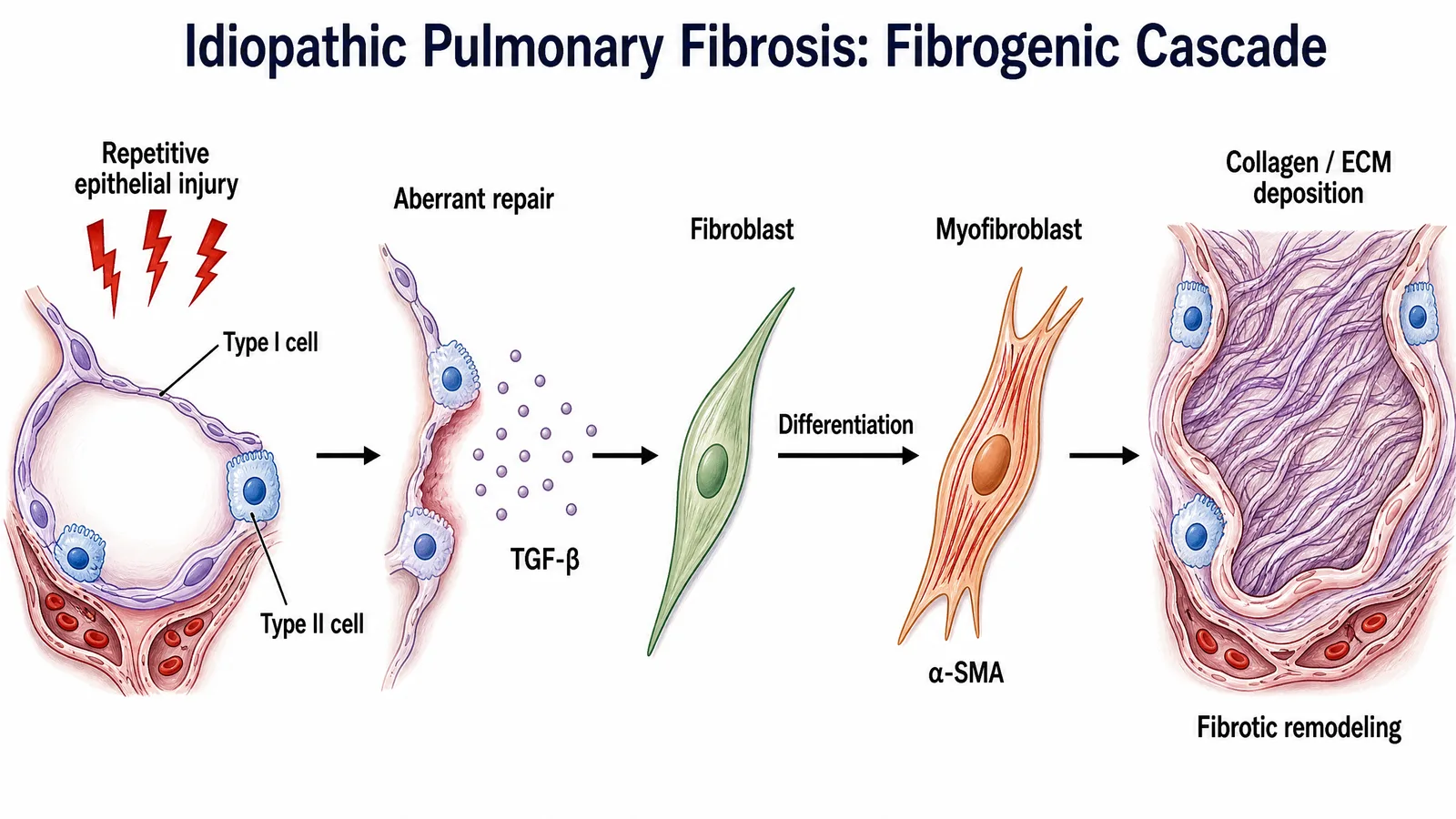
ATS 2027 pulmonary fibrosis pathway figure for a respiratory poster: repetitive alveolar epithelial injury and aberrant repair release TGF-β, driving fibroblast-to-myofibroblast differentiation and collagen deposition (Figure generated with SciFig)
For a pulmonary fibrosis figure, it is well established that the cascade starts with repetitive alveolar epithelial injury and aberrant repair, with TGF-β signaling driving fibroblasts toward α-SMA-positive myofibroblasts that deposit collagen. The details that carry the model are the ones to check element by element:
Cell types: type I and type II alveolar cells, fibroblasts, and myofibroblasts should be visually distinct and correctly labeled.
Direction and sequence: injury precedes repair, and arrows run from mediator to target cell, never the reverse.
Mediator naming: Greek letters (TGF-β, α-SMA) and interleukin numbers must match the source you cite.
Evidence boundaries: separate what your data show from the background pathway you include for context.
Every cell name, mediator label, and arrow stays editable in SciFig, so you can adjust any element to match your model before it goes on your ATS poster, ePoster, or slides.
8. ATS 2027 Scientific Figure Workflow with SciFig
SciFig covers the three figures an ATS poster or slide deck usually needs — SciFig AI Illustration (AI scientific illustration) for the respiratory mechanism, SciFig DataChart (charts and graphs from your data) for results, and SciFig FlowChart (flowcharts) for the trial schema — and every result stays editable.
What you need for your poster or slides
Use
What it helps with
Explain alveolar gas exchange, airway biology, or an immune pathway
Generate from text or a template; edit text, boxes, and connectors; export SVG or PPTX
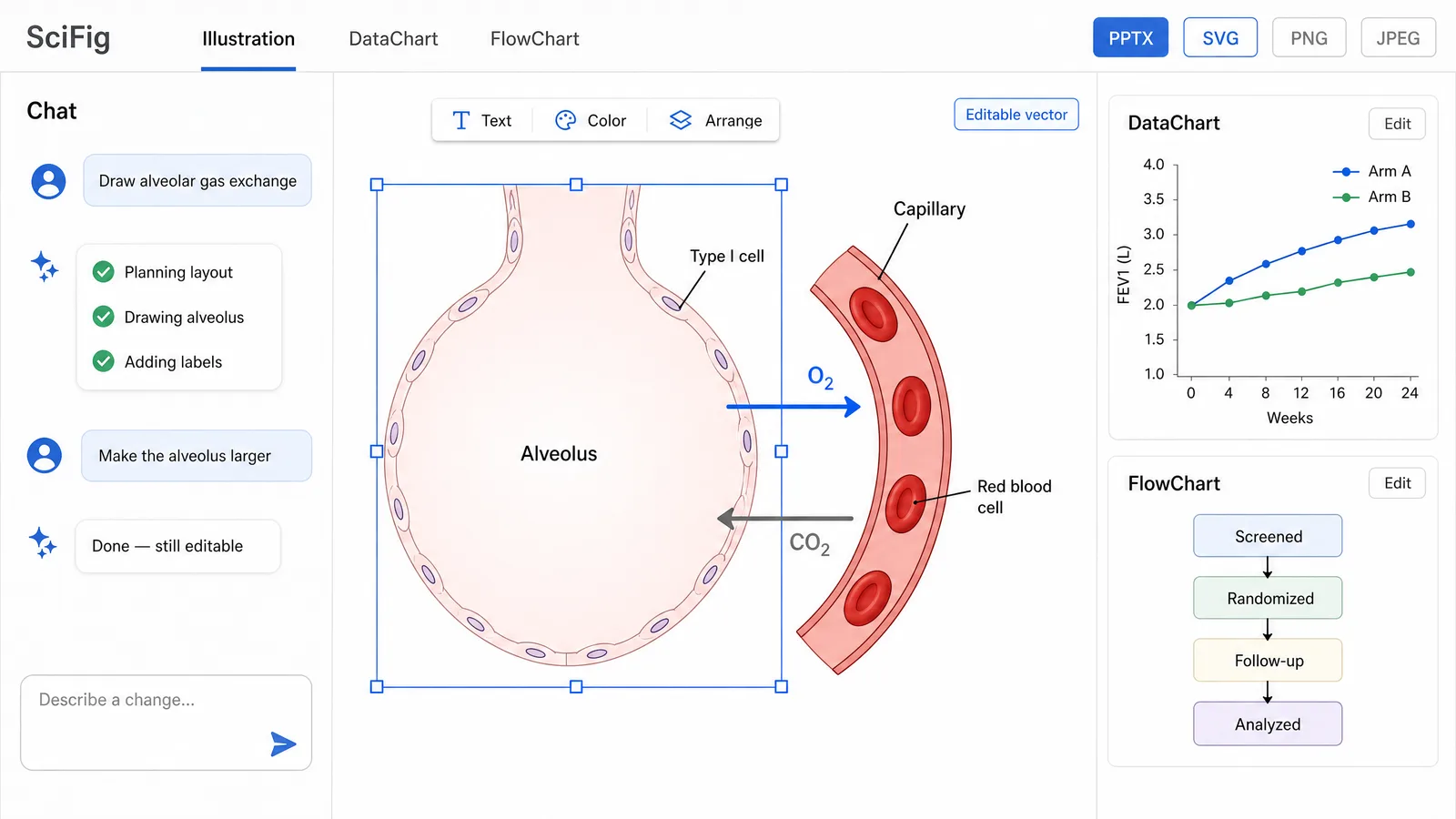
ATS 2027 SciFig workspace mockup for a pulmonary poster: a chat panel generating an editable alveolar gas exchange figure on the canvas, lung-function DataChart and trial-flow FlowChart cards, and PPTX, SVG, PNG, and JPEG export buttons (Figure generated with SciFig)
A structured prompt gives you the most control over a mechanism figure. Copy and adapt this one:
Schematic of alveolar gas exchange: an alveolus beside a pulmonary
capillary, O₂ diffusing from alveolar air across the type I pneumocyte,
interstitium, and capillary endothelium into red blood cells, and CO₂
diffusing in the opposite direction. Label each layer and gas.
Turn your abstract into an editable ATS figure
Start from a prompt, sketch, or PDF, edit each label and arrow in Canvas, and export to PPTX or SVG for your poster and slides.
For ATS 2027, the presenting author must complete the 2027 Abstract Author Disclosure Questions, every abstract must name its funding source, research funded by the tobacco industry is not considered, and the 2026 ATS guidance asked that posters and slides carry no industry logos or brand names. The disclosure covers commercial financial support for the work, other personal financial interests that could be perceived as a conflict of interest, and relationships with the tobacco, vaping, or cannabis industries (ATS 2027 submission criteria).
Funding: abstracts must specify the funding source, or state "none."
Embargo: ATS asks that research content in an abstract be withheld until after it has been presented at the conference, with limited case-by-case exceptions.
Logos: the 2026 poster guidelines said "Do not use industry logos or brand names," and the ATS session speaker instructions, which still carry 2026 dates, apply the same rule to speakers' PowerPoint presentations.
AI use (invited session speakers): the ATS speaker instructions say speakers should disclose when and how AI is used in creating educational content and state it on the introductory slides. That instruction is written for session speakers; the 2027 abstract criteria do not add a separate AI rule for abstract authors.
If you build a figure with an AI tool and want to note it, an optional caption such as "Figure created by the authors using SciFig (scifig.ai)." keeps the disclosure short and accurate.
10. ATS 2027 Abstract Publication in AJRCCM and ATSConference365
Accepted ATS 2027 scientific abstracts and case reports are published in the Online Abstract Issue of the American Journal of Respiratory and Critical Care Medicine (AJRCCM), available online in May 2027. They also appear in ATSConference365 in April 2027 and in the ATS Conference App in May 2027; ATS marks both of those dates as subject to change (ATS 2027 Call for Abstracts).
Because the abstract is published, the one permitted table or figure appears in the record, so make it legible at small size. The 2027 criteria also require new data not previously published or presented at a major national or international meeting, an abstract body of no more than 400 words, and submission and presentation in English. The ATS submission criteria list the full rules, including the four-step category and review-committee selection.
Frequently Asked Questions
ATS 2027 runs May 14–19, 2027, in New Orleans, with the exhibit hall at the Ernest N. Morial Convention Center. It is the American Thoracic Society International Conference. See §1 ATS 2027 dates and venue.
The ATS 2027 late-breaking abstract deadline is Wednesday, January 27, 2027. ATS says details of the late-breaking call will be posted in December; the regular abstract deadline of November 4, 2026, has closed. See §1 key dates.
ATS has not published its 2027 poster size yet. In 2026, the board was 4 ft high × 6.48 ft wide, posters were landscape, and the recommended sizes were 48 × 36, 60 × 36, and 72 × 36 in. Confirm against the 2027 guidelines. See §2 poster size.
ATS publishes no official poster or abstract slide template that we could find. The 2026 poster guidelines give sizes and design tips only, and RAPiD authors prepare one PowerPoint slide of their own. See §2 poster template.
Yes. Presenting authors in oral and poster presentations must also upload an ePoster before ATS 2027. The file format and upload deadline have not been published yet. See §4 ePoster requirement.
ATS 2027 oral abstract presenters have seven minutes for a PowerPoint presentation followed by five minutes for discussion. Oral abstracts are grouped into two-hour Mini Symposium sessions. See §5 oral presentation.
Yes, one. Each ATS 2027 abstract may include a maximum of 1 table OR 1 figure, in JPG format only. The image does not count toward the 400-word limit. See §6 abstract figure.
Accepted ATS 2027 abstracts are published in the Online Abstract Issue of AJRCCM, available online in May 2027. They also appear in ATSConference365 and the ATS Conference App. See §10 abstract publication.
References
American Thoracic Society. ATS 2027 International Conference (conference home). Accessed November 14, 2026. https://site.thoracic.org/conference
Disclaimer: Educational content on scientific figure design — not medical advice. For clinical decisions, consult primary literature and licensed clinicians.
Keep going
Recommended resources
Templates, tools, and further reading for your research