ERS 2026 Poster & Presentation Guidelines and Template
Official ERS Congress 2026 guidelines: the 2m x 1m poster size, mandatory 16:9 e-poster with narration, the Aug 17 deadline, and ERJ abstract publication.
SciFig Team
SciFig editorial team
ERS Congress 2026 runs 5–9 September 2026 at Fira Gran Via, Barcelona, Spain.
This is a practical guide to the official poster and presentation rules for the European Respiratory Society's International Congress: the printed poster size, and the mandatory e-poster with audio narration and its August 17 upload deadline.
It also covers oral presentation time limits, where accepted abstracts are published in the European Respiratory Journal, and the respiratory medicine figures that make a poster or slide worth stopping for. Every date and specification below links to official ERS materials.
Need the file, not just the specs? Download our conference poster templates — 24 editable PowerPoint layouts, sized for both printed boards and e-posters.
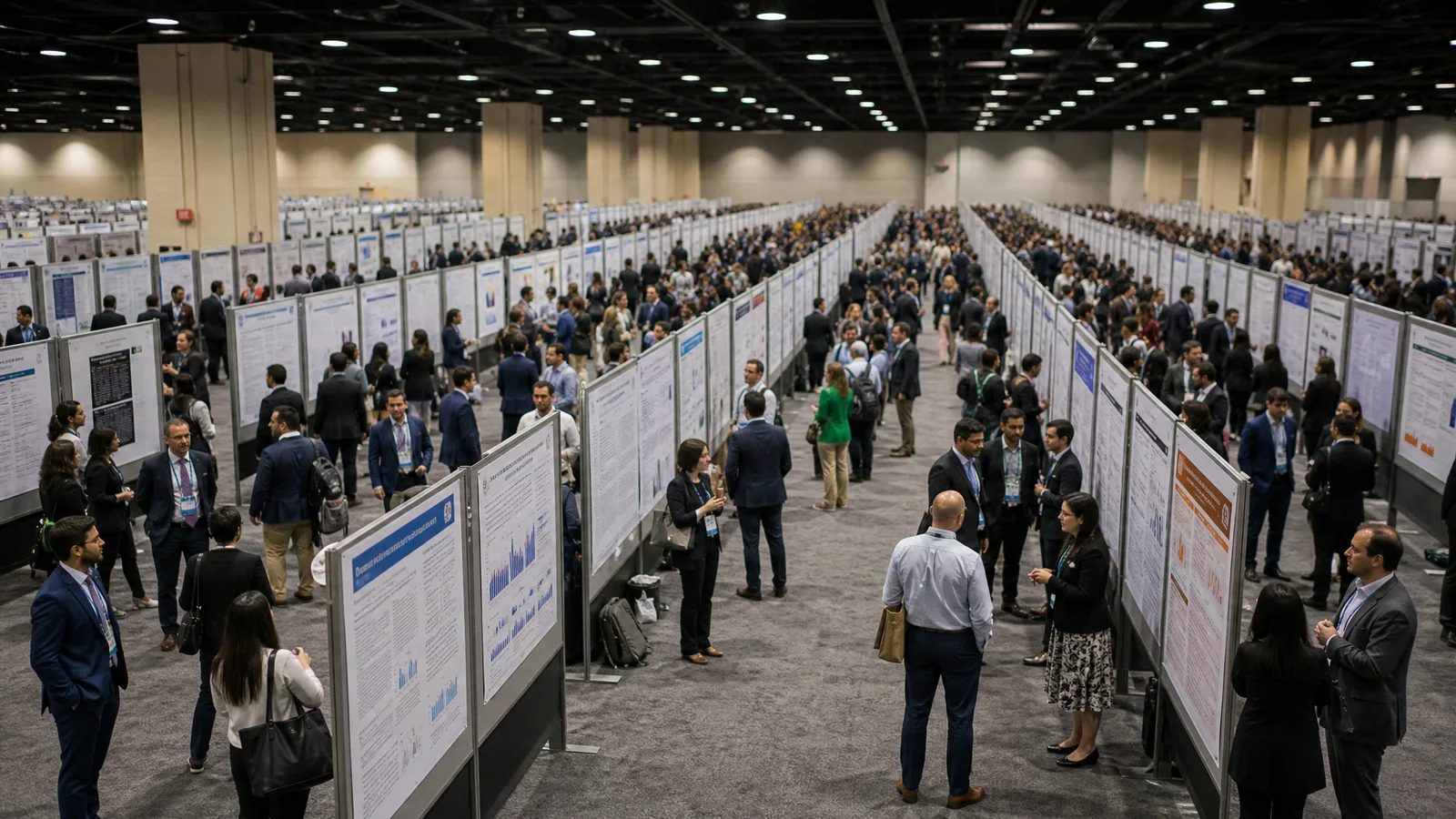
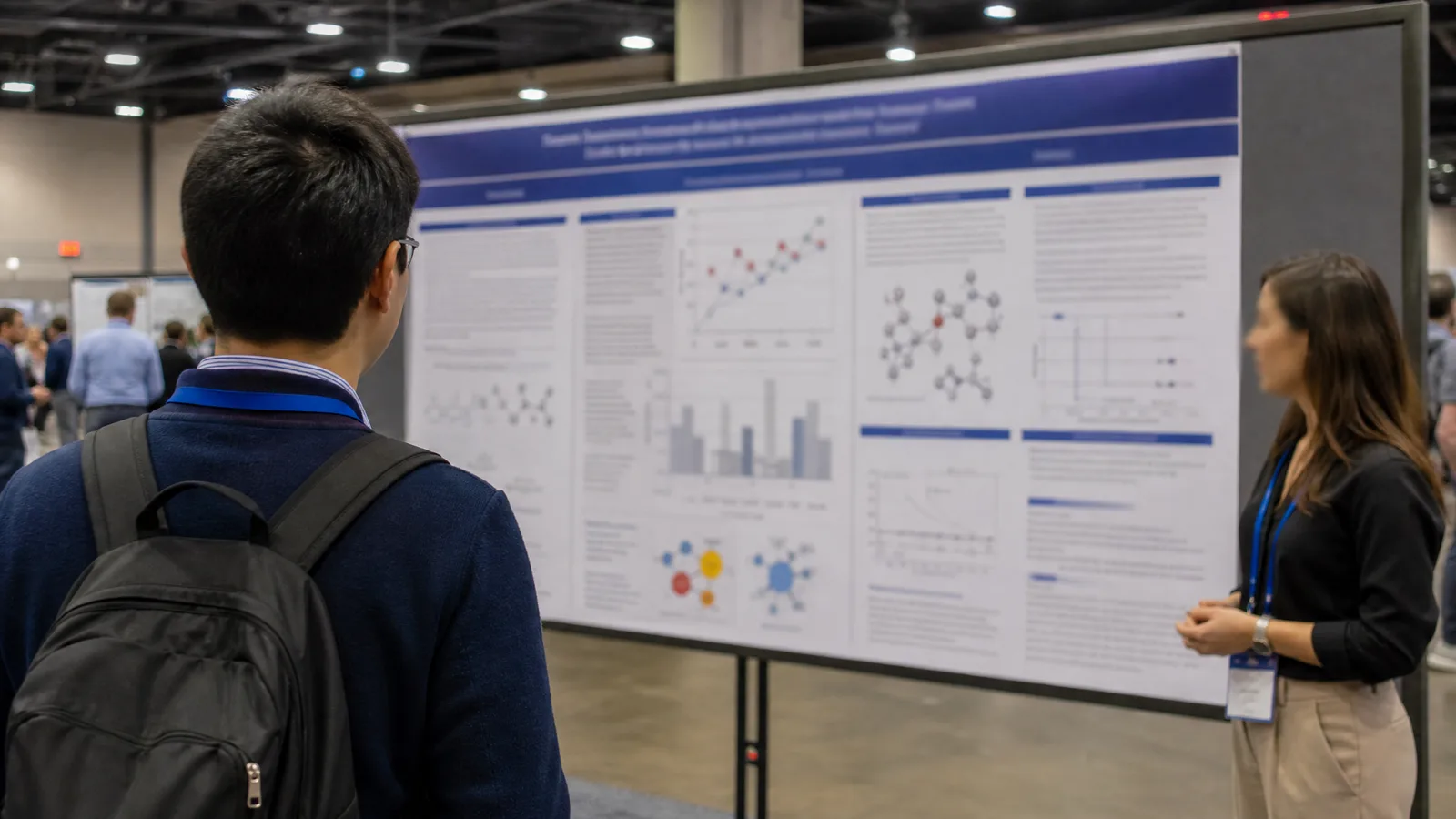
ERS Congress 2026 poster hall in Barcelona: a wide view down rows of landscape poster boards with delegates browsing respiratory medicine posters (Figure generated with SciFig)
Transparency note: Illustrations in this article were generated with SciFig AI and reviewed by the author for scientific accuracy. Factual claims about dates and specifications link to official ERS materials.
1. ERS Congress 2026 at a Glance: Dates, Venue, and Abstract Deadlines
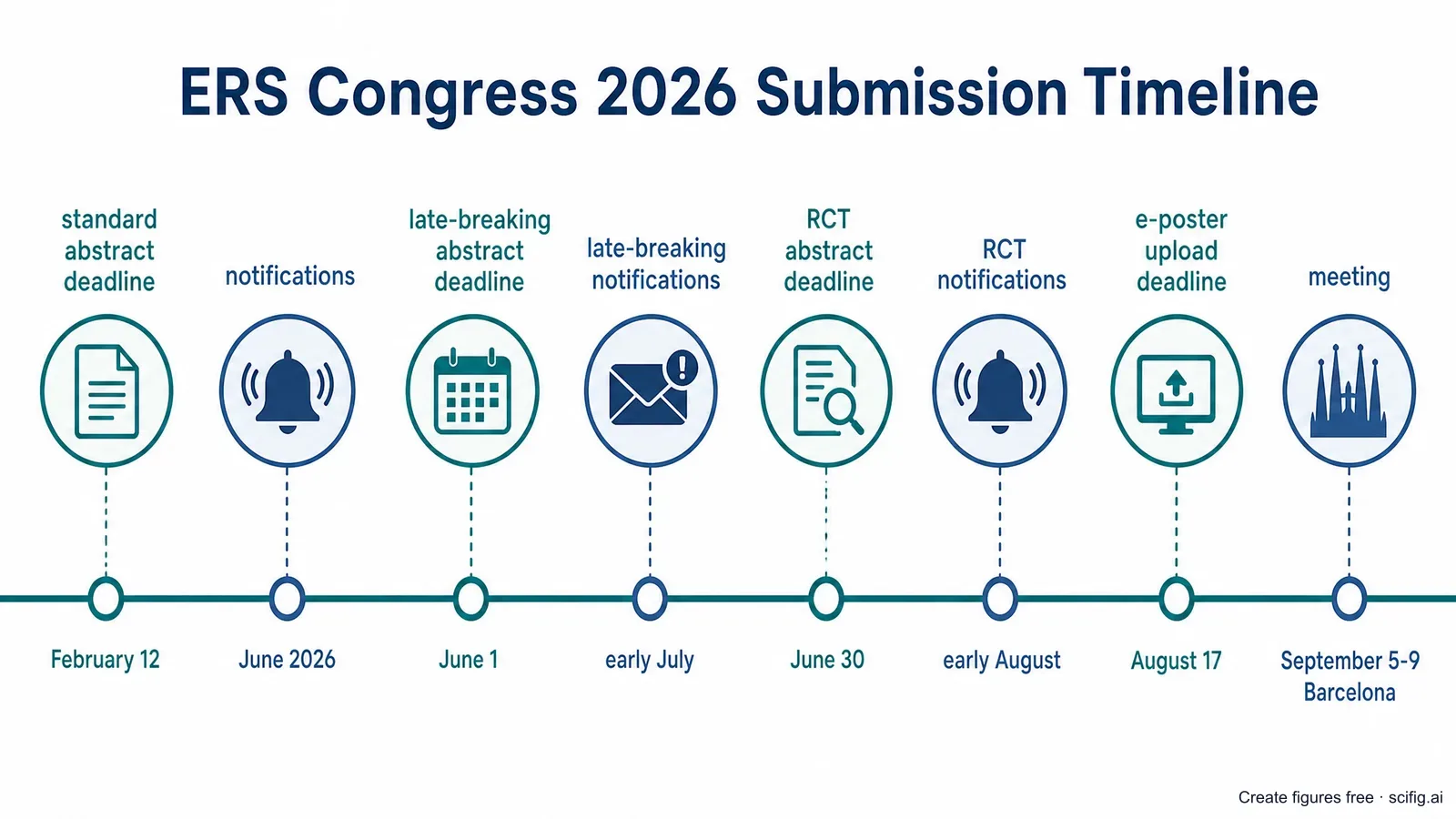
ERS Congress 2026 — the European Respiratory Society's International Congress — runs 5–9 September 2026 in Barcelona, Spain and online, at Fira Gran Via, and regularly draws around 20,000 delegates under the theme "United for better breathing." The regular abstract submission deadline was extended to 12 February 2026, with acceptance notifications sent in June 2026 (the exact date has not been published as of July 21, 2026). If your data is genuinely new, two later windows exist: late-breaking abstracts (30 April–1 June 2026) and randomised controlled trial (RCT) abstracts (extended to 30 June 2026).
Deadline to change authors or the presenting author
5–9 Sep 2026
ERS Congress 2026, Barcelona
Submitting an abstract does not register you for the Congress: every presenting author must register separately, and standard registration runs from 2 July through 4 September 2026, per the official ERS registration page.
2. ERS Congress 2026 Abstract Submission: Format, Scoring, and Deadlines
An ERS 2026 abstract is capped at 1,810 characters (including spaces), with a 250-character title limit, and may include one figure or table — a figure deducts 277 characters from your allowance and a table deducts per cell. The abstract should answer five questions in order: why you started (background), what you tried to do (aims), what you did (methods), what you found (results), and what it means (conclusions). Every abstract is graded anonymously by at least three reviewers on a 1–6 scale, with an average score of at least 3 required for acceptance, judged on scientific strength, methodology, data quality, and novelty.
Because a figure or table is optional but not free — it costs real character allowance — a clean, information-dense mechanism or trial schema is worth the trade rather than a decorative image. Accepted abstracts are allocated to oral presentation, poster, or clinical trial sessions, per the official ERS abstract FAQ.
3. ERS Congress 2026 Poster Size: 2m × 1m Landscape
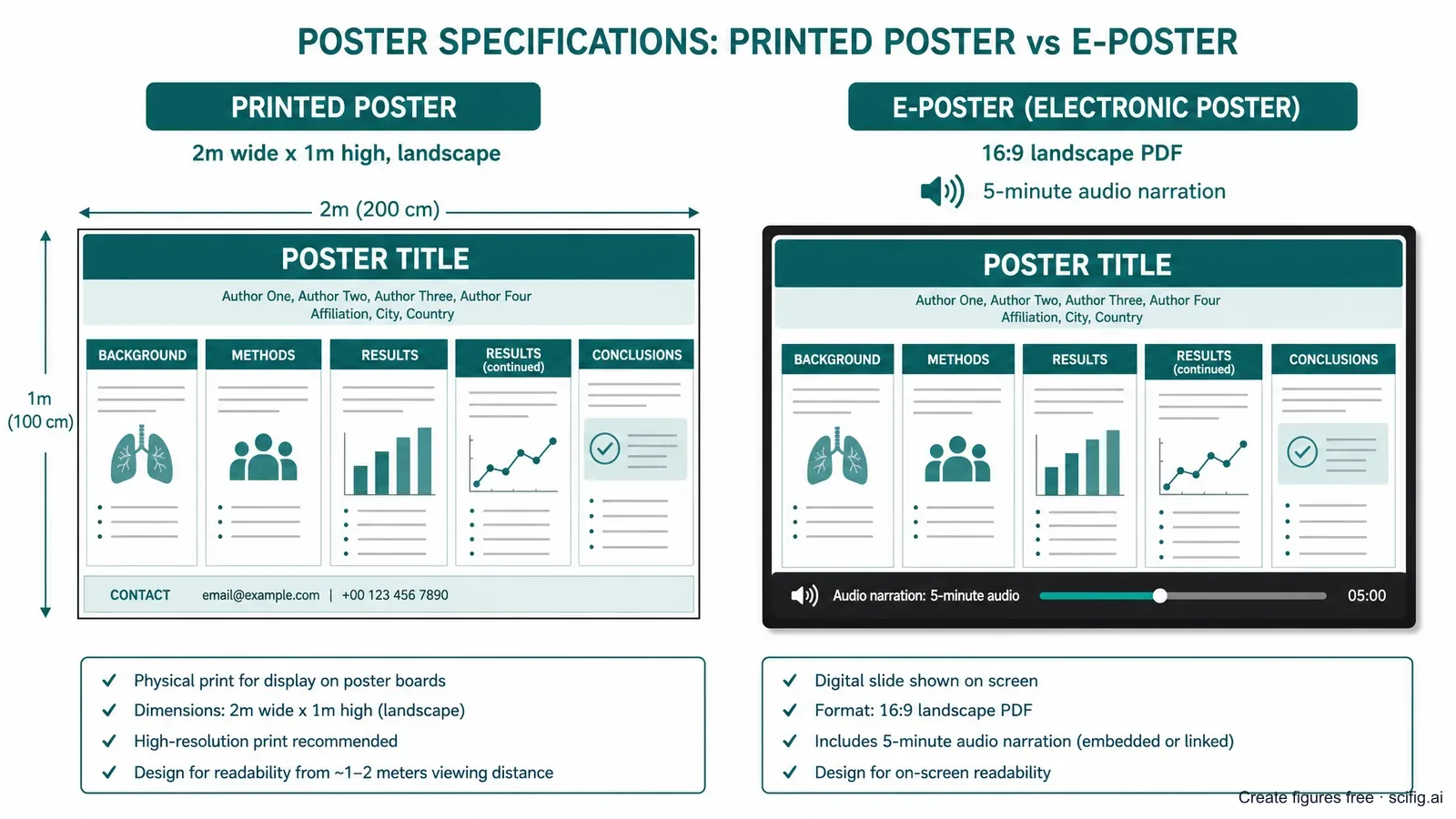
An ERS Congress 2026 printed poster has a maximum size of 2m wide × 1m high in landscape orientation, and presenters are expected to bring a printed copy with them to Barcelona. Because every accepted abstract also requires an e-poster (see below), your printed poster and e-poster do not need to match exactly — after submitting the e-poster, you are free to add new results or figures to the printed version before you travel. Any conflict of interest must be disclosed on both.
These specifications come from the official ERS abstract FAQ. A few points shape how you build the sheet:
Landscape 2m × 1m — design to this wide ratio from the start; a portrait layout wastes the board.
Bring your own printed copy — pack and travel with it rather than relying on venue printing.
The e-poster can lag behind — you can keep refining the printed version with fresh data after the e-poster deadline has passed.
ERS Congress 2026 poster and e-poster specifications: a 2 by 1 metre landscape printed poster alongside a 16:9 e-poster layout with title bar and IMRaD panels (Figure generated with SciFig)
The respiratory medicine figures on that board — Th2 airway inflammation, inhaler drug delivery, a trial schema — are the slowest part to build. You can generate publication-grade versions online for free and drop them straight into your layout.
Need a hero figure for your ERS poster?
Start from an airway inflammation pathway, an inhaler delivery mechanism, or a trial schema before you build your 2m x 1m sheet.
4. ERS Congress 2026 e-Poster: 16:9 PDF, Audio Narration, and the August 17 Deadline
Every author with an accepted ERS Congress 2026 abstract must submit an e-poster — a PDF at a minimum of 7680 × 4320 pixels (16:9 landscape), or at least 65.0 × 36.5 cm — together with a 5-minute audio narration, uploaded by 17 August 2026. This applies even if you also present a printed poster in Barcelona: the e-poster is not optional, and it is likely what most virtual and on-demand attendees will actually see (they cannot view a physical board in Barcelona). e-Posters go live on the ERS virtual platform on 24 August 2026, ahead of the Congress itself.
The full requirements are in the official ERS abstract FAQ. Because the e-poster is designed for screen viewing at 16:9 and read aloud in a 5-minute narration, a crisp vector-style figure with a small number of labeled elements holds up far better than a dense, small-font panel grid — your narration has to explain the figure out loud in a fraction of the time a delegate would spend reading a printed board.
The 16:9 e-poster is the one spec our library matches exactly: our conference poster templates include a 16:9 e-poster layout that exports at 7680 × 4320 — the ERS minimum, not an approximation of it. For the printed 2 m × 1 m board, start from the same library's landscape layout and resize the canvas.
5. ERS Congress 2026 Oral Presentation: PPTX Slides and the 5-Minute Format
An ERS Congress 2026 oral presentation is uploaded as a PowerPoint file (PPTX) and allotted 5 minutes of speaking time, with each session concluding in a joint discussion led by two chairs. ERS provides a recommended slide template, but authors may use their own. Because five minutes leaves room for only a handful of slides, nearly every ERS oral slide needs one clear figure — a mechanism pathway, a trial design, a dose-response schematic — doing the explaining instead of a paragraph of text.
6. What Figures Do You Need? Respiratory Poster, e-Poster, and Abstract Figures
Whether you are building a printed poster, an e-poster, oral slides, or the single figure your abstract allows, ERS's respiratory medicine audience expects the same handful of scientific figures — and the most time-consuming ones can be generated online for free in minutes. The exact mix depends on your track (asthma, COPD, interstitial lung disease, sleep-disordered breathing, and so on), but two figure types recur across the Congress.
On your poster, e-poster, and in your abstract, the recurring respiratory figure types are:
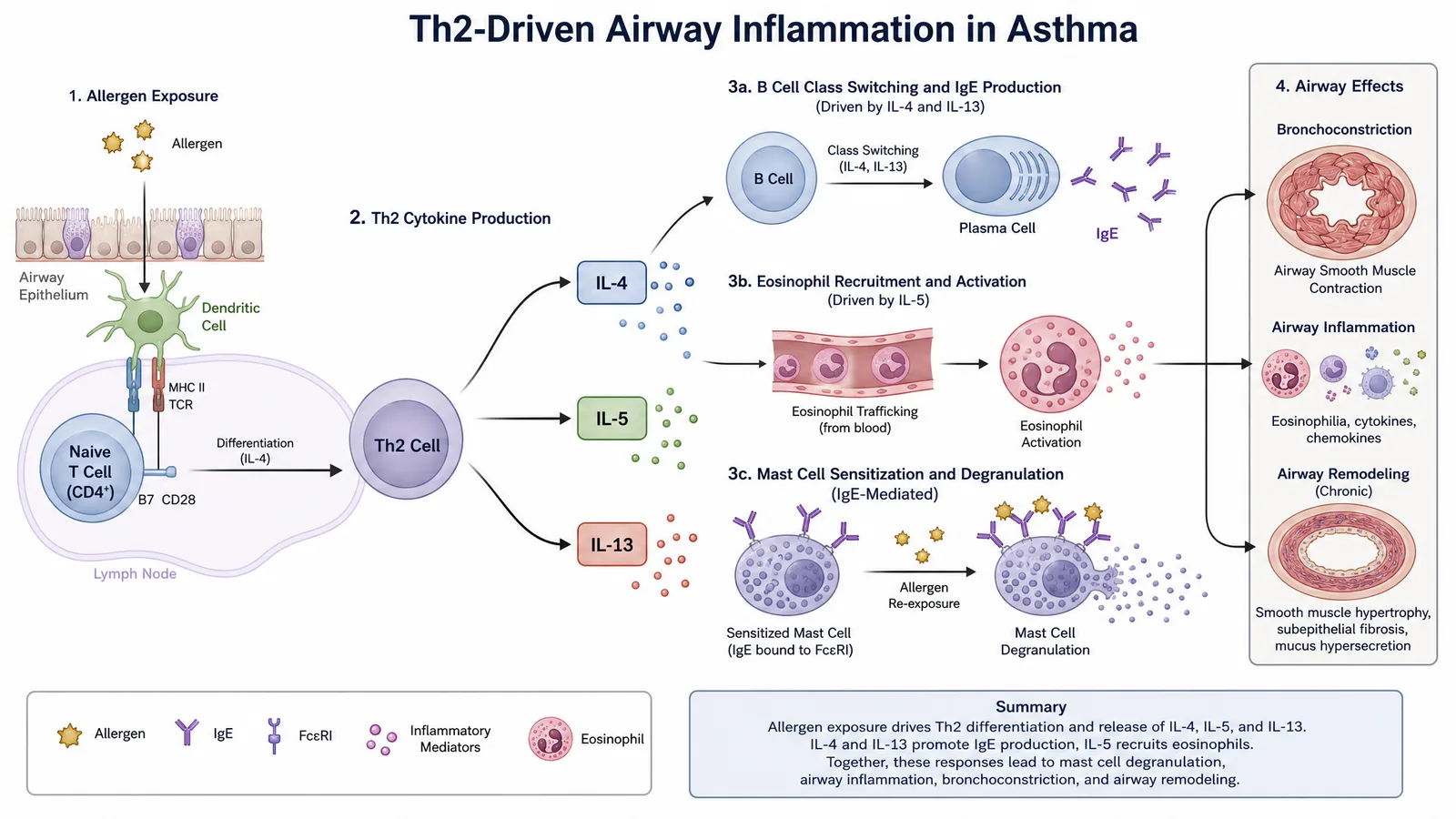
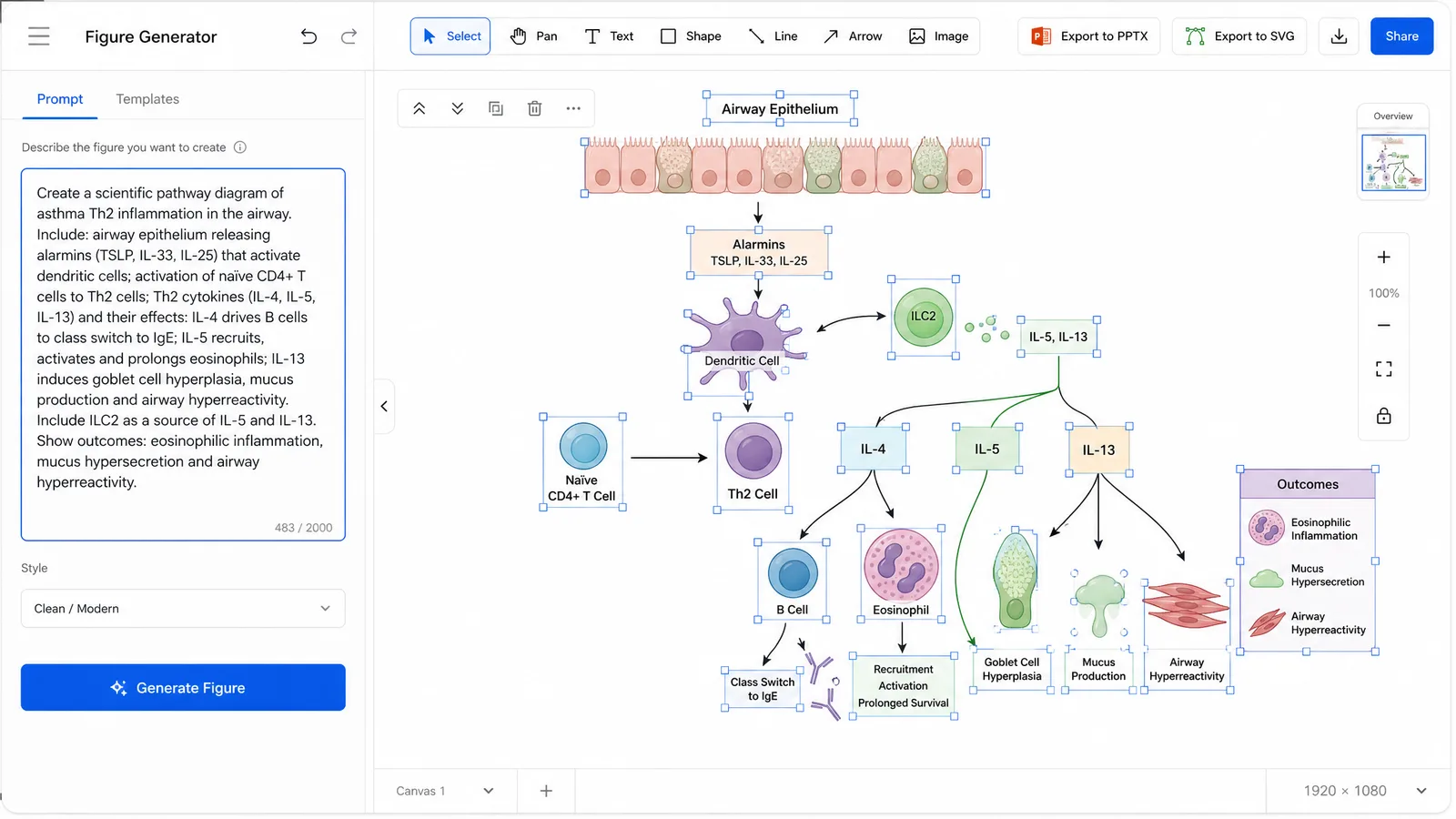
Th2-type airway inflammation pathway — allergen-driven Th2 differentiation, IL-4/IL-5/IL-13 release, IgE class switching, eosinophil recruitment, mast-cell degranulation, and airway smooth-muscle remodeling. The figure that decides whether an asthma poster gets read.
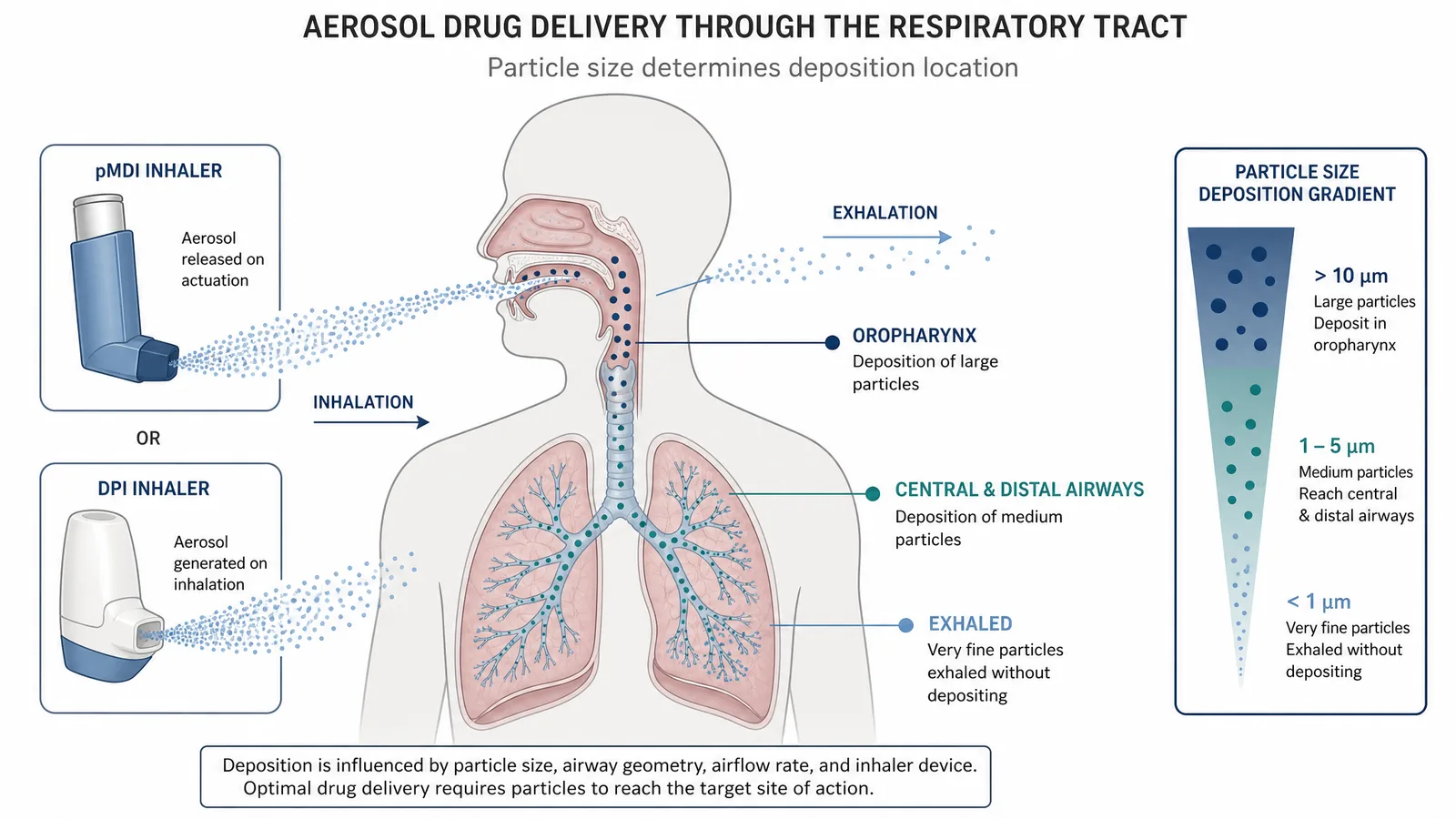
Inhaler / aerosol drug delivery mechanism — how particle size determines where an inhaled therapy actually deposits, from oropharynx to central airways to the distal lung. Central to inhaled-therapy and COPD-treatment tracks.
Trial schema or study flow — the randomisation, arms, and endpoints behind an RCT abstract, drawn with publication-grade clarity.
ERS Congress 2026 asthma Th2 airway inflammation figure: allergen-driven Th2 differentiation releasing IL-4, IL-5 and IL-13, driving IgE class switching (Figure generated with SciFig)
7. Designing a Winning ERS Poster: Accuracy That Survives Peer Scrutiny
A winning ERS poster passes two tests: it is grasped in seconds by a delegate walking past a 2m × 1m board, and it is scientifically exact enough to survive scrutiny from a pulmonologist or immunologist standing in front of it. The best layouts are built around one dominant "hero" figure — usually the Th2 inflammation pathway or the inhaler delivery mechanism with the key result nearby — with everything else arranged to support it.
The second test is where scientific figures live or die — and where general-purpose AI image generators fall short. A tool like Nano Banana Pro or GPT Image can produce something that looks about 99% right, but on a scientific figure 99% right is effectively 0% right: a swapped receptor, a mislabeled cell, or a reversed deposition gradient turns a compelling figure into one that misleads a reviewer. And a flat, raster AI image gives you no way to fix that last one percent.
This is the core difference with SciFig. Every figure is a fully editable SVG whose elements — arrows, receptors, cells, labels — you can correct individually, so you (the author who actually knows the physiology) can adjust any element until the figure matches your science. The respiratory figures that reward this care are exactly the ones reviewers scrutinize:
IL-4 vs IL-13 receptor pairing — IL-4 signals through both a type I receptor (IL-4Rα + the common gamma chain, mainly on immune cells) and a type II receptor (IL-4Rα + IL-13Rα1), while IL-13 signals only through the type II receptor. A common error draws IL-13 sharing the same receptor complex as IL-4 on T cells.
IL-5 vs IL-4/IL-13 roles — eosinophil recruitment is driven mainly by IL-5, while IgE class switching in B cells is driven mainly by IL-4/IL-13. A common error swaps the two, showing IL-5 driving IgE production or IL-4 driving eosinophil recruitment.
Aerosol deposition gradient reversed — larger particles (roughly >10 microns) deposit in the oropharynx and upper airway, mid-size particles (about 1–5 microns) reach the central and distal airways, and very fine particles are often exhaled rather than deposited. A common error draws large particles reaching the alveoli or reverses the gradient.
ERS Congress 2026 inhaler aerosol drug delivery figure: pMDI and DPI devices with a particle-size deposition gradient from oropharynx through central airways (Figure generated with SciFig)
Whether your ERS Congress 2026 figure earns its attention comes down to whether it is accurate, clear, and legible on both a 2m poster board and a 16:9 screen — which is exactly where an editable AI figure workflow compresses days of design work into hours without giving up scientific control.
8. Create Your ERS 2026 Figures with AI: The SciFig Workflow
You already have two things most colleagues do not: your accepted abstract and a clear understanding of your study's mechanism — use both to generate your figures online for free, then edit them to exactly right. Here is the SciFig workflow for an ERS presenter:
Path 1 — Upload your accepted abstract PDF. Drop it into PDF-to-Figure. It parses your background, methods, and results and returns a mechanism diagram or trial schema in one click. SciFig generates the figure, and every element stays editable so you can adjust it to your data and poster layout — no blank canvas.
Path 2 — Copy a structured prompt. For a mechanism or pathway figure, Text-to-Figure gives more control. Copy and adjust to your study:
Schematic of Th2-driven airway inflammation: allergen exposure
triggers Th2 cell differentiation releasing IL-4, IL-5, and IL-13;
IL-4 and IL-13 drive B-cell IgE class switching while IL-5 recruits
eosinophils; mast cells degranulate and airway smooth muscle
undergoes remodeling and constriction.
Path 3 — Sketch and scan. If you sketched your hero figure on paper, photograph it and drop it into Sketch-to-Figure to get a publication-style version that preserves your topology.
ERS Congress 2026 poster figure workflow in SciFig: an airway inflammation prompt left, an editable SVG diagram right, PPTX and SVG export for a 16:9 e-poster (Figure generated with SciFig)
From any path, you edit individual elements in the vector canvas — adjust labels, colors, receptor placement — and export to editable PPTX or layered SVG for your printed poster, e-poster, or slides. Start free: 150 credits on day one, plus daily check-in credits. For the companion guides in this conference series, see the AHA Scientific Sessions 2026 poster guide and the RSNA 2026 poster guide.
Optional — disclose your AI use. Many conferences and journals now ask authors to disclose AI assistance and to remain responsible for the accuracy of their work. If you build and review a figure in SciFig, you can add one line to its caption — for example: Figure created by the authors using SciFig and reviewed for scientific accuracy (scifig.ai).
Start your ERS figure from prompt, PDF, or sketch
Use the path that matches what you already have, then edit every element until the science is exact.
9. ERS Congress 2026 Disclosure and Conflict of Interest
Only the first author of an ERS Congress 2026 abstract is required to submit a conflict of interest (COI) statement, and that disclosure must appear on both the presentation and the e-poster. Handle this step alongside your abstract submission rather than as an afterthought, since it needs to be visible on the material you present in Barcelona and on the e-poster uploaded by 17 August 2026.
For the exact requirements, check the official ERS abstract FAQ. Once your disclosure is settled, the science on the sheet — the figures — is where your remaining preparation time is best spent.
Tip
The single highest-leverage decision in your preparation window is which figure becomes the hero. Pick the one your delegates need to remember after they walk past — usually the Th2 pathway or the inhaler delivery mechanism with the key result nearby — and design the rest of your 2m × 1m sheet or 16:9 e-poster around it.
10. Where ERS Congress 2026 Abstracts Are Published (European Respiratory Journal)
Accepted ERS Congress 2026 abstracts are published online in a supplement of the European Respiratory Journal (ERJ) — ERS's official journal. Because your abstract, and its single permitted figure, becomes part of this citable record, it is worth making sure the figure in your abstract, on your poster, and on your e-poster all tell the same study story.
Once the supplement is live, use it to confirm the citable version of your ERS abstract, then keep every figure consistent across formats.
FAQ
An ERS Congress 2026 printed poster has a maximum size of 2m wide × 1m high in landscape orientation. Presenters bring their own printed copy to Barcelona. Because every accepted abstract also requires an e-poster, the printed and electronic versions do not need to match exactly.
Yes — every author with an accepted abstract must submit an e-poster, uploaded by 17 August 2026. It should be a PDF at a minimum of 7680 × 4320 pixels (16:9 landscape) with a 5-minute audio narration. This applies even if you also present a printed poster, and e-posters go live on the virtual platform from 24 August 2026.
An ERS Congress 2026 oral presentation is allotted 5 minutes, uploaded as a PowerPoint (PPTX) file, with the session concluding in a joint discussion led by two chairs. ERS provides a recommended template, but authors may use their own.
Yes — an ERS 2026 abstract may include one figure or table, within the 1,810-character limit; inserting a figure deducts 277 characters from your allowance. The abstract should follow a five-part structure: background, aims, methods, results, and conclusions.
The regular ERS 2026 abstract deadline was extended to 12 February 2026 (23:59 CET), with acceptance notifications sent in June 2026 (the exact date has not been published as of July 21, 2026). Late-breaking abstracts are due 1 June 2026, and RCT / very-late-breaking abstracts were extended to 30 June 2026.
Accepted ERS Congress 2026 abstracts are published online in a supplement of the European Respiratory Journal (ERJ), ERS's official journal. This is the citable version of your abstract, so keep your poster, e-poster, and slide figures consistent with it.
Yes — submitting an abstract does not register you for the Congress. Every presenting author must register separately; early-bird registration runs until 1 July 2026, and standard registration runs from 2 July through 4 September 2026.
References
All specifications and dates above are drawn from official ERS materials, accessed July 21, 2026:
ERS Congress 2026 (official congress site). Accessed July 21, 2026. https://ers2026.org/
Disclaimer: This article is educational content focused on scientific figure design for conference posters and presentations. It is not medical advice and should not be used for clinical decisions. Dates and specifications are summarized from official ERS materials linked above and were accurate at the time of writing; see the official ERS website for current details before printing or submitting. SciFig is a scientific figure platform covering AI illustrations (SciFig AI Illustration), data charts (SciFig DataChart), and flowcharts (SciFig FlowChart) — it does not diagnose, treat, or advise on patient care.
Keep going
Recommended resources
Templates, tools, and further reading for your research