Official SOT 2027 poster guidance: the 91 × 45 in landscape board, mounting and attendance times, the optional ePoster PDF, and 15-minute 16:9 platform talks.
SciFig Team
SciFig editorial team
SOT 2027 runs March 14–17, 2027, at the Henry B. González Convention Center in San Antonio.
This practical guide covers the official poster and presentation rules for the Society of Toxicology (SOT) 66th Annual Meeting and ToxExpo: the 91 × 45 in landscape poster board, mounting and attendance times, and the optional ePoster PDF.
It also covers 15-minute platform talks and SOT's slide template, disclosure and logo rules, abstract publication, and the toxicology figures worth building. Every date and specification below links to official SOT materials.
Need the file, not just the specs? Download our conference poster templates — 24 editable PowerPoint layouts, sized for both printed boards and e-posters.
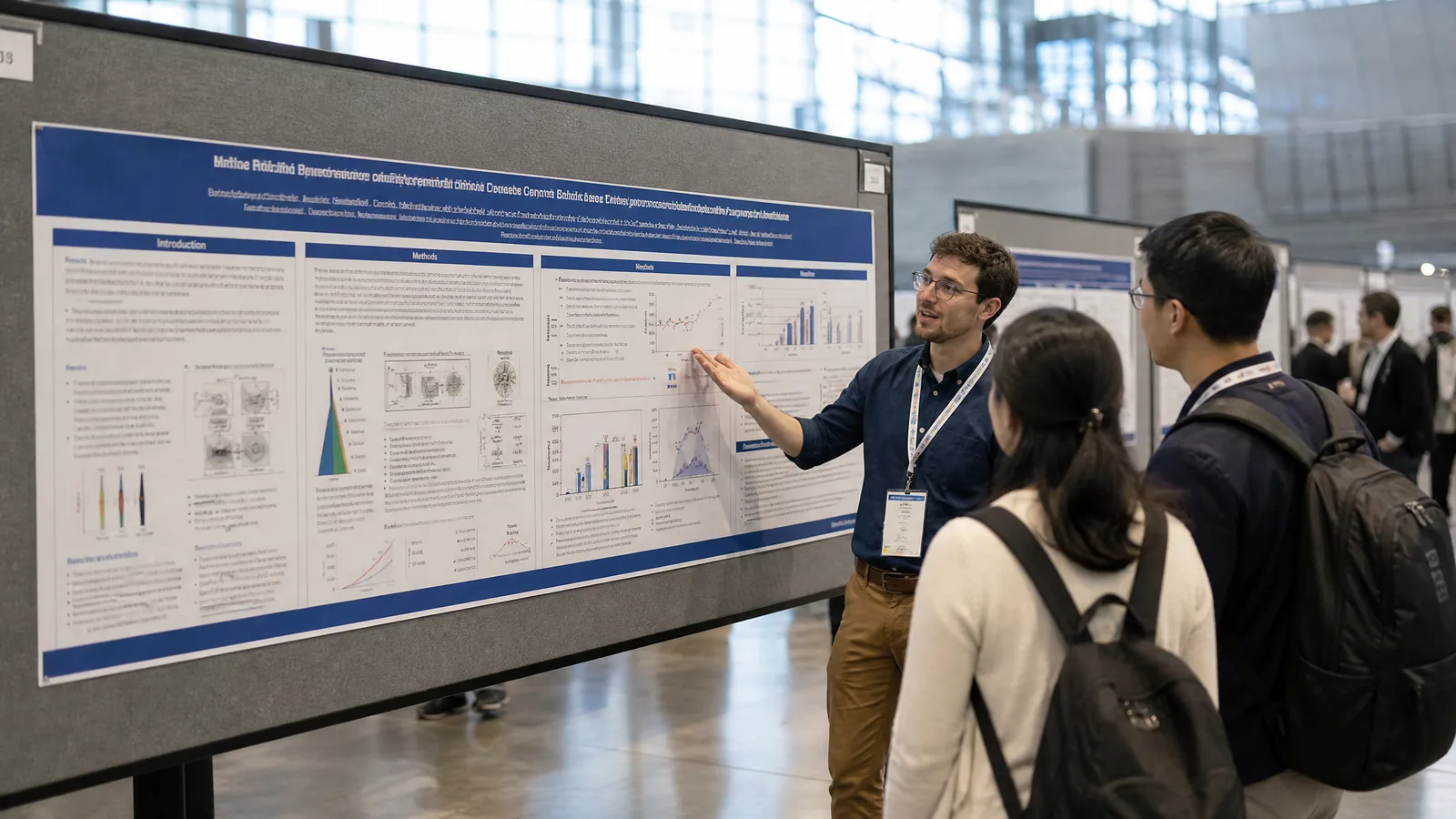
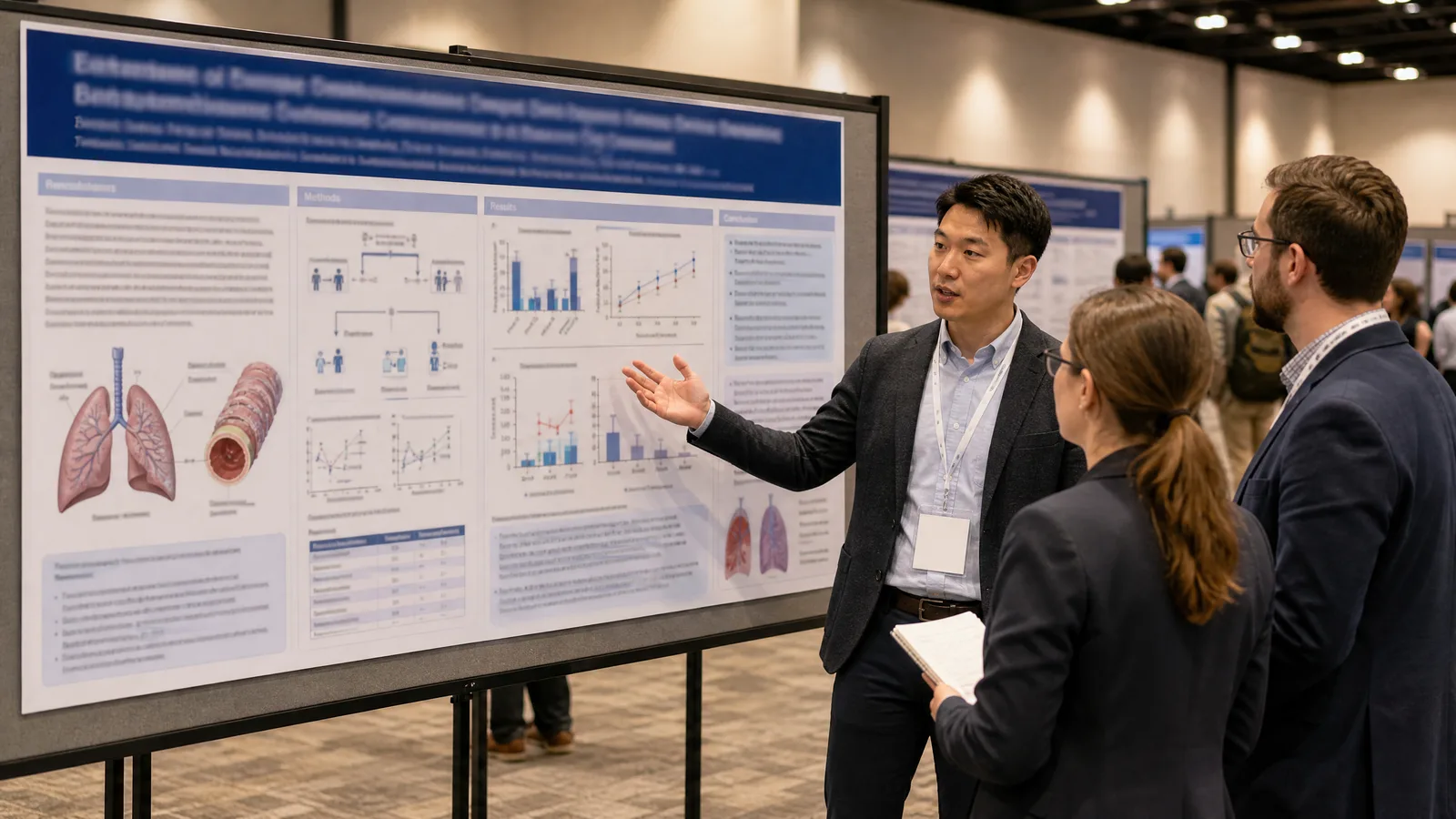
SOT 2027 poster guidelines cover showing a presenter explaining a wide landscape toxicology poster to two attendees in a conference poster hall (Figure generated with SciFig)
Illustrations generated with SciFig AI.
1. SOT 2027 at a Glance: Dates, Venue, and Key Timeline
SOT 2027 takes place Sunday, March 14, through Wednesday, March 17, 2027, at the Henry B. González Convention Center, 900 E. Market Street, San Antonio, Texas, and acceptance notices with session timing reach authors by email in early January 2027. The official SOT fact sheet describes a meeting of 4,000+ attendees, 1,900+ scientific presentations, 275+ exhibitors, and toxicologists from over 45 countries, and the meeting ends the evening of Wednesday, March 17. Most accepted abstracts are placed in Poster Sessions, so the poster is the format most SOT 2027 presenters prepare.
Regular abstract submission deadline, as extended on the abstract submissions page (the earlier instructional guide listed November 13)
December 15, 2026 – January 22, 2027
Late-breaking abstract submission period
Early January 2027
Acceptance notification with session timing and instructions, sent before the early-bird registration deadline
January 18, 2027
Written notice required to withdraw an abstract
By January 22, 2027
Early-bird registration
Late January 2027
Late-breaking abstract notifications
February 2027
ePoster upload emails to presenting authors; slide upload instructions to Scientific Session speakers
March 14–17, 2027
SOT 2027 in San Antonio
Because the instructional guide and the abstract submissions page give different closing dates for regular abstracts, treat the abstract submissions page as the operative source. An accepted author is expected to pay the meeting registration fee and present the abstract, and late-breaking abstracts are presented on Wednesday afternoon during ToxExpo hours.
2. SOT 2027 Poster Size, Format, and Template
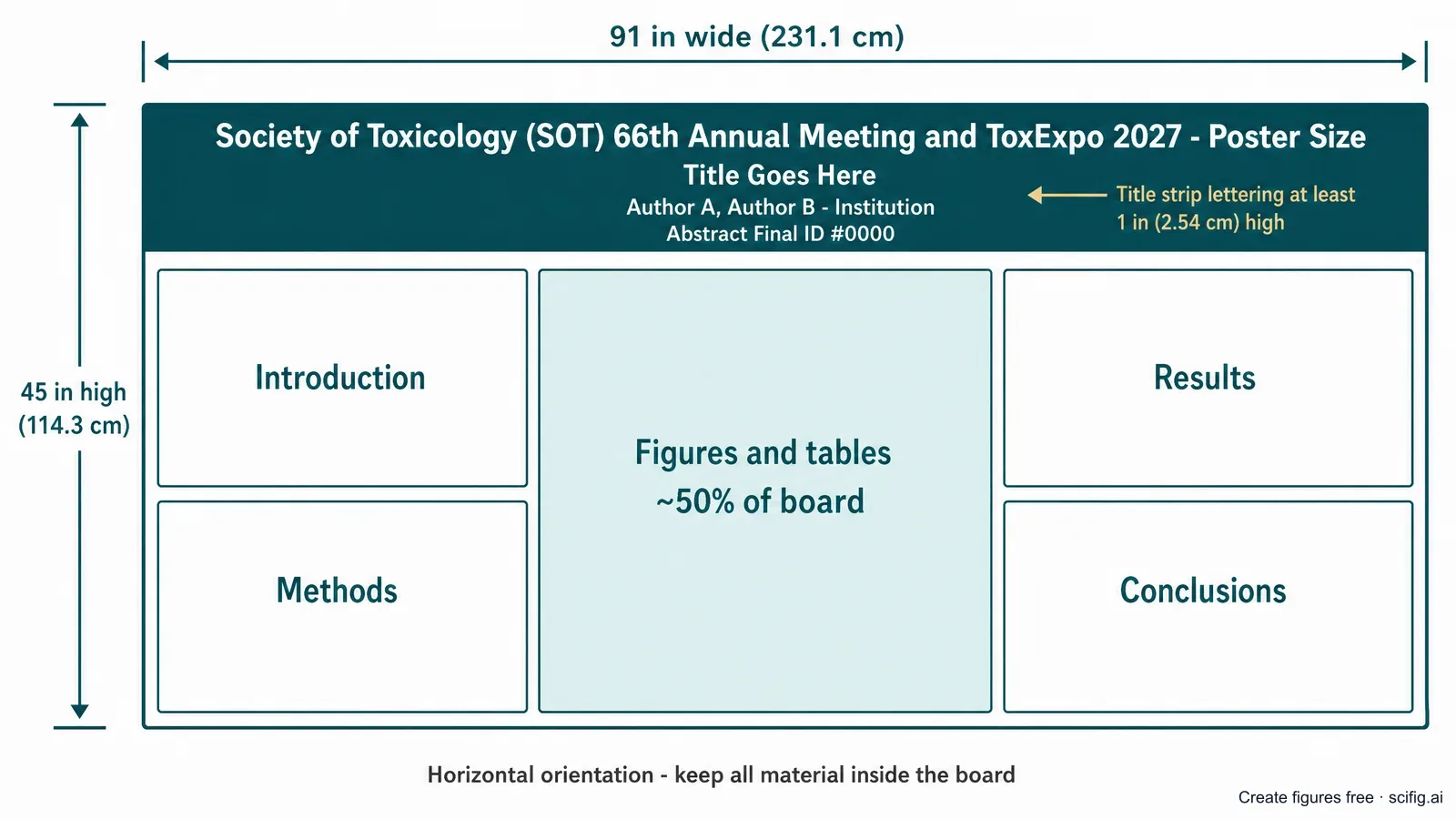
SOT 2027 posters are mounted horizontally on a usable space of 91 in wide × 45 in high (231.1 × 114.3 cm), and all poster material must stay within that area. The official SOT 2027 poster planning page asks for a title strip listing the title, authors, affiliations, and the abstract final ID number, with lettering at least 1 in (2.54 cm) high. Text should be readable from five feet away, and SOT suggests giving about 50% of the board area to figures and tables.
SOT 66th Annual Meeting and ToxExpo 2027 poster size guide showing a 91 in by 45 in landscape board with a title strip, lettering at least 1 inch high, and figures and tables filling about half the board (Figure generated with SciFig)
The SOT 2027 poster format at a glance:
SOT 2027 poster item
Official requirement
Usable board area
91 in wide × 45 in high (231.1 × 114.3 cm)
Orientation
Horizontal (landscape)
Title strip
Title, authors, affiliations, and abstract final ID; lettering at least 1 in high
Legibility
Readable from five feet away
Figures and tables
About 50% of the board area
Board surface
Fabric over corkboard; pushpins or Velcro, with pushpins provided on-site
Required content
Conflict of interest disclosures
SOT does not provide a downloadable poster template. Its poster page links a one-page Poster Preparation Tips and Layout Suggestions PDF, an official layout sketch for a 91 × 45 in board showing the title block, an optional abstract, an introduction, figures, a table, and conclusions. Use it as an official layout example rather than an editable file, and where it differs from the current poster page — for example on bringing your own pushpins — follow the poster page.
For printing, SOT points presenters to Shepard's PosterPro service with on-site pickup. The 2027 PosterPro ordering guide lists sizes including 91 × 42 in and 84 × 42 in, with an advance-price deadline of February 19, 2027, and a regular-price deadline of March 10, 2027. SOT names no recommended print size, so any print that fits within 91 × 45 in satisfies the board rule.
Build the hero figure before laying out your SOT poster
Start with the pathway or exposure story your audience must grasp in one look, then arrange the 91 × 45 in board around it.
Because SOT supplies a layout sketch rather than a file, the poster itself is yours to build. Our conference poster templates give you unbranded landscape layouts in editable PowerPoint with the section structure and type scale already set — pick a landscape layout, resize the canvas to 91 × 45 in, and keep the title strip lettering at least 1 in high.
3. SOT 2027 Poster Sessions: Mounting, Attendance, and Removal
SOT 2027 posters are displayed only on the author's assigned day, during ToxExpo hours of 9:00 a.m.–4:30 p.m., and presenters can mount them on their assigned board from 7:30 a.m. that morning. The poster planning page lists author attendance blocks of 9:30–11:30 a.m. and 2:00–4:00 p.m., Monday through Wednesday. Poster sessions conclude at 4:15 p.m., and presenters remove their posters after 4:15 p.m. and before the Exhibit Hall closes at 4:30 p.m.
The SOT 2027 poster day in order:
Time on the assigned day
SOT 2027 poster step
From 7:30 a.m.
Mount the poster on the assigned board (bring the poster or print receipt to enter before 9:00 a.m.)
9:00 a.m. – 4:30 p.m.
Poster on display during ToxExpo hours
9:30 – 11:30 a.m. and 2:00 – 4:00 p.m.
Author attendance blocks
After 4:15 p.m., before 4:30 p.m.
Remove the poster
Posters left after 4:30 p.m. on Monday or Tuesday are moved to retrieval tables and can be collected through 4:30 p.m. on Wednesday; unclaimed posters are recycled. SOT's meeting policies also state that posters may not be photographed without the author's permission.
4. SOT 2027 ePoster: Optional PDF Upload
An SOT 2027 ePoster is optional: it is shared in addition to the physical poster, never instead of it, and the two should be identical. For a static ePoster, the poster planning page asks for a PDF version of the poster and notes that a PowerPoint upload will not work. Presenting authors may also add a brief narrated version using the instructions in the upload email.
SOT 2027 ePoster item
Official detail
Requirement
Optional; does not replace the physical poster
Static file format
PDF (PowerPoint uploads do not work)
Narrated version
Optional; static and narrated versions may both be uploaded
Upload information
Emailed to presenting authors in February 2027
Where it appears
SOT Event App and SOT Online Planner
Only the presenting author receives the upload invitation, and that author must be registered with a matching email address; each presenting author may upload one ePoster. ePosters are not offered for Platform Session talks. SOT publishes no separate ePoster size or aspect ratio, so export the same 91 × 45 in layout you print.
5. SOT 2027 Platform Presentations and the Official Slide Template
An SOT 2027 Platform Session talk runs 15 minutes including discussion, and slides should be in widescreen 16:9 format. The official SOT 2027 platform planning page asks for text of at least 18 points and no more than 10 lines per slide, and lists seven required slides: title, conflict of interest disclosures, the question or hypothesis, the approach, methods, results, and conclusions.
SOT provides a PowerPoint Template of Required Slides for platform presenters. It is already in widescreen format, and each new slide follows a predetermined format and style intended to maximize readability during platform presentations. Download the current file from the platform planning page, or directly as the SOT oral presentation starter template (PPTX).
Platform sessions are 90 or 75 minutes long, and session rooms use Windows PCs running Microsoft PowerPoint. All presenters must preload their slides through the online speaker management site or at the Speaker Ready Room on-site, at least 60 minutes before the session begins; upload instructions arrive by email in February 2027. Platform slots are scarce: the instructional guide describes a poster-to-platform ratio of roughly 80:10, and submitters cannot request a platform-only presentation.
6. What Scientific Figures Do You Need for an SOT 2027 Poster and Slides?
In our view, the strongest SOT 2027 figures show how an exposure becomes an effect: an adverse outcome pathway, a biotransformation scheme, a dose-response relationship, or a study-design workflow. SOT abstracts may not contain figures, tables, or chemical structures, so all of that visual work belongs on the poster and the platform slides — two places where SOT asks for large, legible graphics.
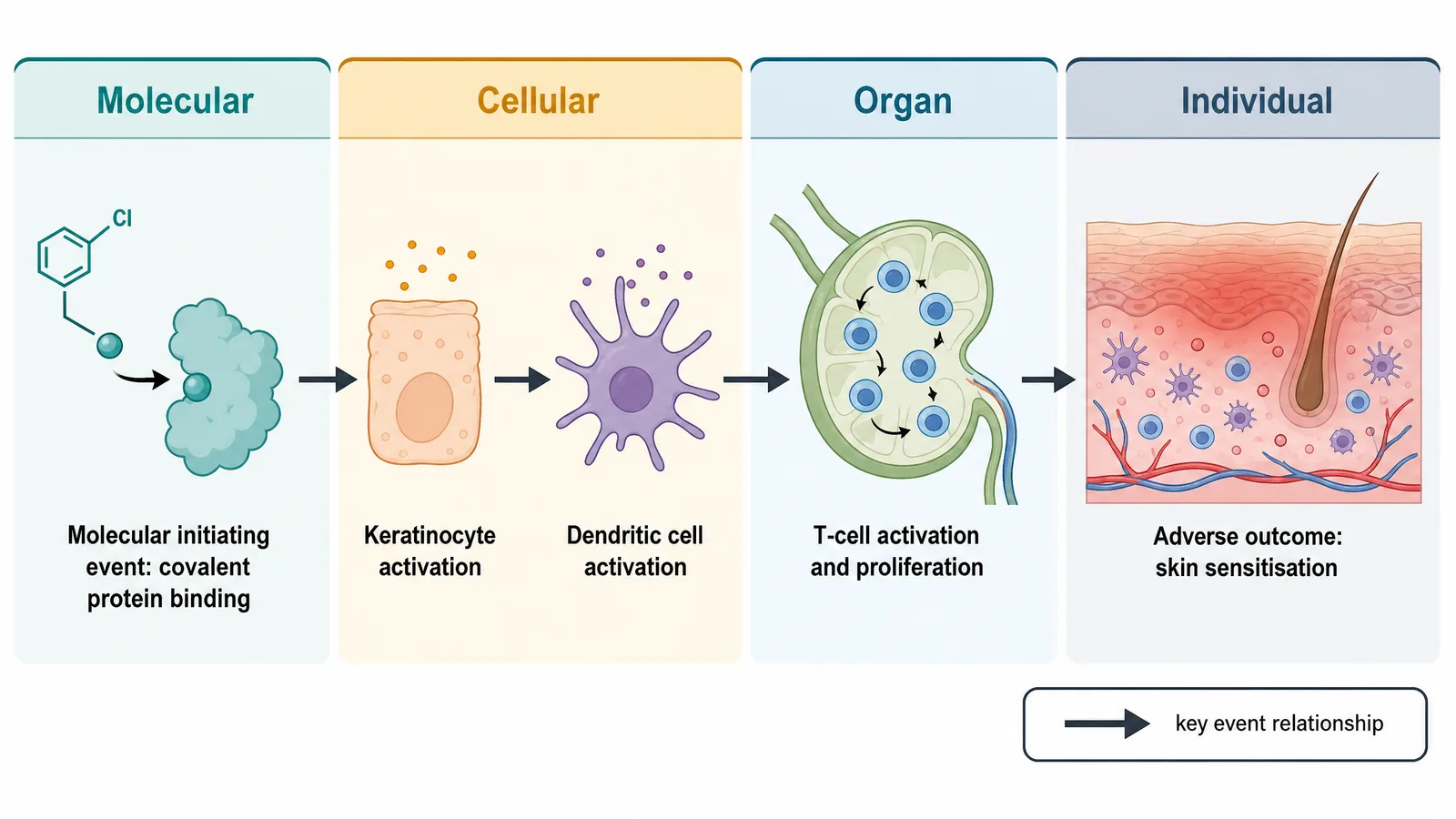
SOT 2027 adverse outcome pathway figure for a toxicology poster: a molecular initiating event leading to cellular key events, an organ-level key event, and the adverse outcome, arranged left to right by biological level (Figure generated with SciFig)
An adverse outcome pathway (AOP) is a natural hero figure for a toxicology poster because it reads left to right across biological levels. The OECD-endorsed AOP-Wiki entry for skin sensitisation (AOP 40) is a widely used example: covalent protein binding is the molecular initiating event, keratinocyte and dendritic cell activation are cellular key events, T-cell activation and proliferation follow, and skin sensitisation is the adverse outcome. AOP-Wiki also records how strong the evidence is for each link, which is exactly what a reviewer at your board will ask about.
Match the figure to the claim your study makes:
Adverse outcome pathway: order the molecular initiating event, key events, and adverse outcome by biological level, and mark which links your own data support.
Biotransformation scheme: separate bioactivation from conjugation and clearance routes, and label each enzyme family and metabolite.
Dose-response: plot the measured response against dose or concentration and mark the points your conclusions rest on.
Study design: connect test system, exposure regimen, endpoints, and analysis so reviewers can follow the methods at a glance.
7. Designing a Winning SOT 2027 Poster: Pathway Figures That Hold Up
A credible SOT 2027 pathway figure keeps the direction of every arrow, the identity of every label, and the relative weight of each route explicit — and an editable figure lets you correct any of them directly. In SciFig each enzyme label, intermediate, and arrow is an editable element, so you can match every one to your study record before the poster is printed.
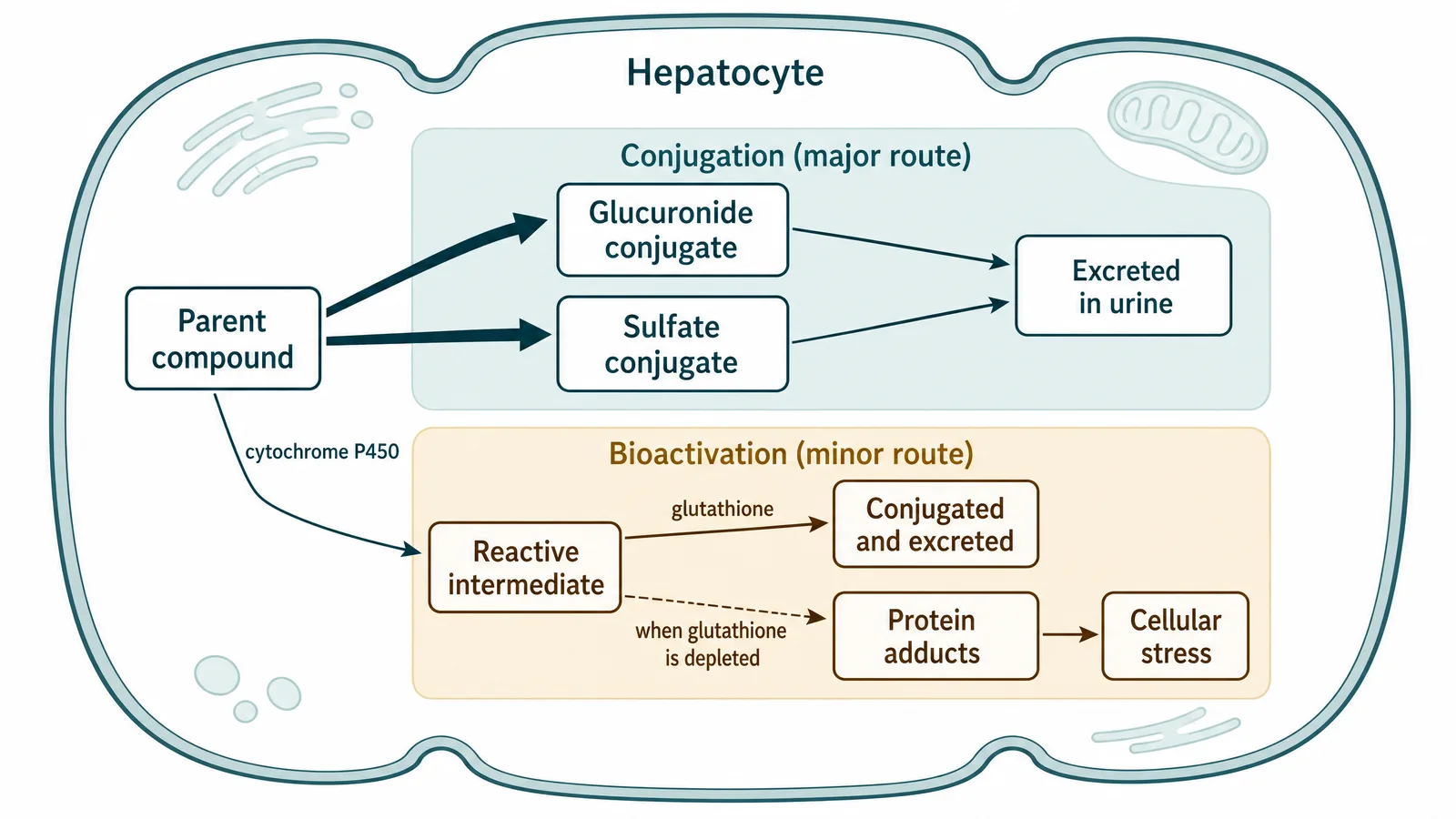
SOT 2027 biotransformation pathway figure for a toxicology poster: a parent compound branching into conjugation and clearance routes and a bioactivation route to a reactive intermediate, with cellular stress as the downstream effect (Figure generated with SciFig)
A biotransformation figure carries several claims at once, and each is worth checking before printing:
Arrow direction: every arrow should point from substrate to product; a detoxifying step must not read as if it created the reactive species.
Route weighting: draw the major route as the major route. If one branch dominates at ordinary exposures, the layout should say so rather than giving every branch equal visual weight.
Conditions, not parallel routes: show saturation, depletion, or induction as the condition that shifts flux between routes, not as an extra arrow of its own.
Labels: keep enzyme and metabolite names spelled exactly as in your text, define abbreviations once, and keep type legible from five feet away.
Toxicology posters also carry negative and dose-dependent results, which deserve the same care: label the control group, state the units on every axis, and let the reader see the spread rather than only the mean. Before printing, the five common scientific figure mistakes checklist covers resolution, typography, color, and export, and these scientific poster examples show how a title strip, figure panels, and conclusions fit together on a wide landscape board.
Tip
Every key event, arrow direction, and enzyme label stays editable in SciFig, so you can adjust any element to match your data before the poster goes to print.
8. Creating Your SOT 2027 Figures with SciFig: The Workflow
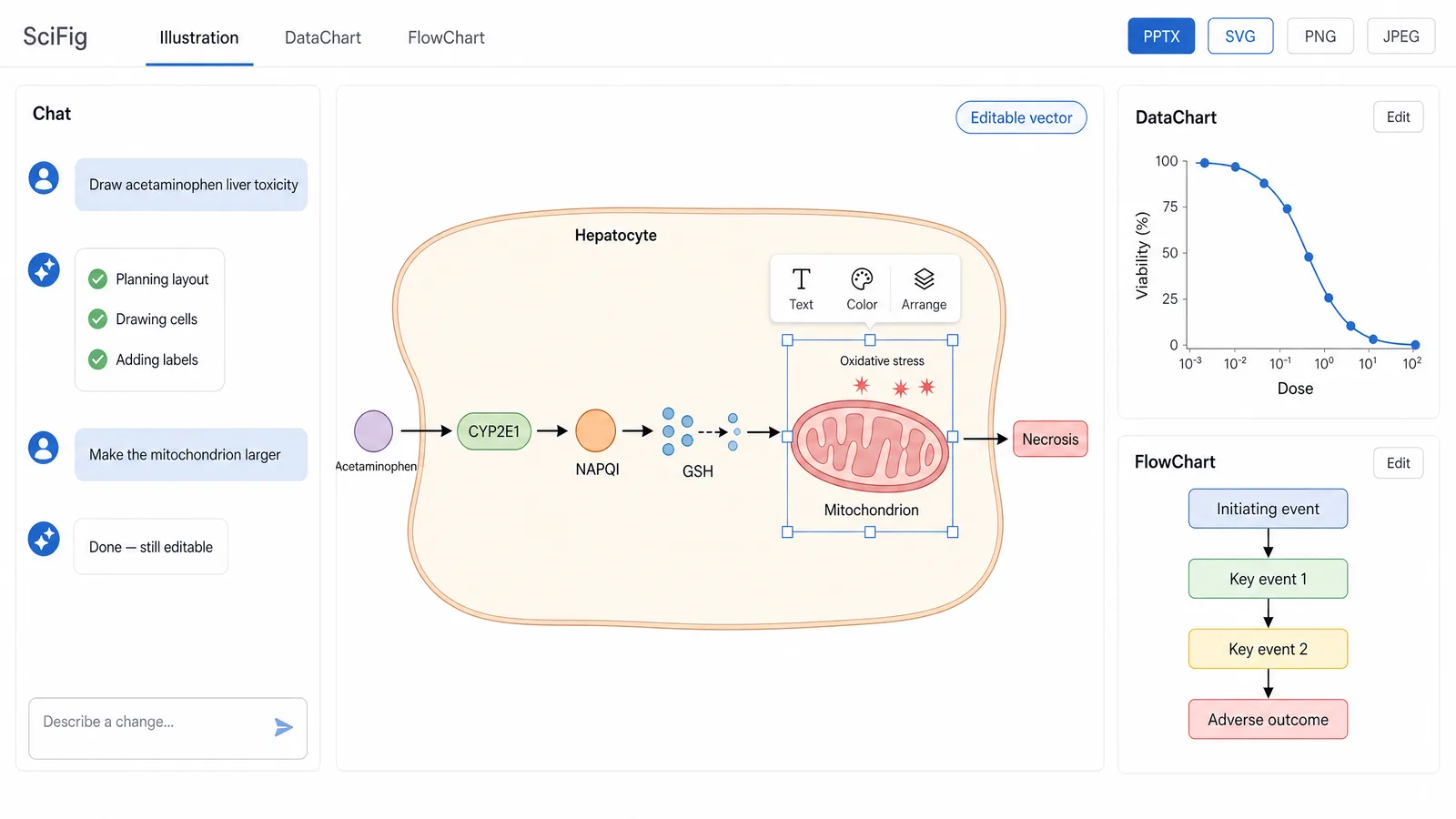
SciFig covers the three figures an SOT poster or slide deck usually needs — SciFig AI Illustration (AI scientific illustration) for the adverse outcome pathway, SciFig DataChart (charts and graphs from your data) for results, and SciFig FlowChart (flowcharts) for the study design — and every result stays editable.
What you need for your poster or slides
Use
What it helps with
Explain an adverse outcome pathway, a toxicity mechanism, or an exposure setup
Generate from text or a template; edit text, boxes, and connectors; export SVG or PPTX
SOT 2027 SciFig workspace mockup for a toxicology poster: a chat panel generating an editable acetaminophen liver-toxicity pathway on the canvas, dose–response DataChart and adverse-outcome-pathway FlowChart cards, and PPTX, SVG, PNG, and JPEG export buttons (Figure generated with SciFig)
A structured prompt gives you the most control over a pathway figure. Copy and adapt this one:
Adverse outcome pathway diagram, left to right: a molecular initiating
event (a chemical binding its target protein), then key events at the
cellular, tissue, and organ levels, ending in the adverse outcome in the
exposed organism. Label each key event and connect them with arrows.
If a journal or your institution asks how AI was used, a line such as Figure created by the authors using SciFig (scifig.ai) can go in your figure caption.
Turn your pathway notes into a poster-ready figure
Start from the text, sketch, or PDF you already have, edit every label in Canvas, and export to PPTX or SVG for the board.
SOT 2027 requires conflict of interest disclosures on the poster itself and as a required slide in platform presentations, and allows institutional logos but not product logos on a poster. The abstract site also requires a conflict of interest declaration from presenting authors, so the same information appears in three places over the course of a submission.
SOT 2027 rule
What the official pages say
Conflict of interest
Disclosures belong on the poster; a disclosures slide is a required platform slide; a declaration is required at abstract submission
Logos
Institutional logos are allowed on a poster; product logos are not
Promotion
SOT may remove posters that specifically promote a ToxExpo booth; listing author affiliations in the poster title is not considered promotion
Animal images
Photographs of animals only where absolutely necessary
Human subject data
The poster should indicate that protocols were reviewed and approved by a Human Subjects Institutional Review Board
These rules shape figure choices directly. An institutional logo can sit in the title strip; a sponsor's product mark cannot. And because photographs of animals are limited to cases where they are necessary, a labeled schematic of the test system is usually the better way to show an exposure model.
10. Where SOT 2027 Abstracts Are Published
Accepted SOT 2027 abstracts are published in the SOT Event App and the SOT online abstract database, with the Event App launching in February 2027. The SOT Event App and Online Planner page describes the Online Planner as including all session details — presentation titles, speakers, and abstracts — which is how most attendees will find your poster before the meeting. No journal supplement or printed abstract book is named on the 2027 pages.
The abstract itself is text only. The abstract submissions page sets a limit of 4,000 characters or less, not including spaces, covering the title, author block, and section headers, and asks for four sections: Background and Purpose, Methods, Results, and Conclusions. It also instructs authors not to include figures, tables, or chemical structures, and to avoid nonstandard acronyms. The submission fee is $70 per abstract for the regular period and $95 for late-breaking abstracts.
Because the published record is what readers search after the meeting, write the abstract so that it stands without the visuals, and save the pathway schematic, the dose-response plot, and the study-design diagram for the board and the slides.
Frequently Asked Questions
SOT 2027, the Society of Toxicology 66th Annual Meeting and ToxExpo, runs March 14–17, 2027, at the Henry B. González Convention Center in San Antonio, Texas. The meeting ends the evening of Wednesday, March 17. See §1 SOT 2027 dates and timeline.
SOT 2027 poster boards give a usable space of 91 in wide × 45 in high (231.1 × 114.3 cm), mounted horizontally, and material must not exceed it. The title strip lettering should be at least 1 in high. See §2 SOT 2027 poster size and format.
No. SOT provides a one-page Poster Preparation Tips and Layout Suggestions PDF showing a suggested 91 × 45 in layout, but no downloadable editable poster file. SOT does provide a PowerPoint template of required slides for platform presenters. See §2 poster template.
Author attendance blocks are 9:30–11:30 a.m. and 2:00–4:00 p.m. on the assigned day, Monday through Wednesday. Posters can be mounted from 7:30 a.m. and must be removed after 4:15 p.m. and before 4:30 p.m. See §3 poster session times.
No. An SOT 2027 ePoster is optional and is uploaded in addition to the physical poster, which it must match. A static ePoster is a PDF; PowerPoint uploads do not work. Upload information is emailed to presenting authors in February 2027. See §4 SOT 2027 ePoster.
An SOT 2027 Platform Session talk is 15 minutes including discussion, and slides should be widescreen 16:9 with at least 18-point text and no more than 10 lines per slide. SOT lists seven required slides and offers a PowerPoint template. See §5 platform presentations.
No. SOT instructs authors not to include figures, tables, or chemical structures in the abstract, and to avoid nonstandard acronyms. The abstract is limited to 4,000 characters excluding spaces, in four required sections. See §10 where SOT 2027 abstracts are published.
Institutional logos are allowed on an SOT 2027 poster; product logos are not. SOT also reserves the right to remove posters that specifically promote a ToxExpo booth. See §9 disclosure, logo, and promotion rules.
References
All specifications and dates above are drawn from official Society of Toxicology materials, accessed November 14, 2026:
OECD AOP-Wiki. AOP 40: Covalent Protein binding leading to Skin Sensitisation. Accessed November 14, 2026. https://aopwiki.org/aops/40
Disclaimer: Educational content on scientific figure design — not medical advice. For clinical or regulatory decisions, consult primary literature, official guidance, and licensed professionals.
Keep going
Recommended resources
Templates, tools, and further reading for your research