Official DDW 2027 poster guidance: the 4 × 6 ft board, the December 2, 2026 abstract deadline, ePoster uploads, oral rules, and abstract publication details.
SciFig Team
SciFig editorial team
DDW 2027 runs May 15–18, 2027, at the Walter E. Washington Convention Center in Washington, DC.
This practical guide covers the official poster and presentation rules for Digestive Disease Week 2027: the 4 × 6 ft poster board, the optional ePoster upload, and in-person oral and video presentations.
It also covers the December 2, 2026 abstract deadline, the two-image abstract limit, disclosure rules, and abstract publication. Every date and specification below links to official DDW materials; any prior-year planning reference is labeled with its year.
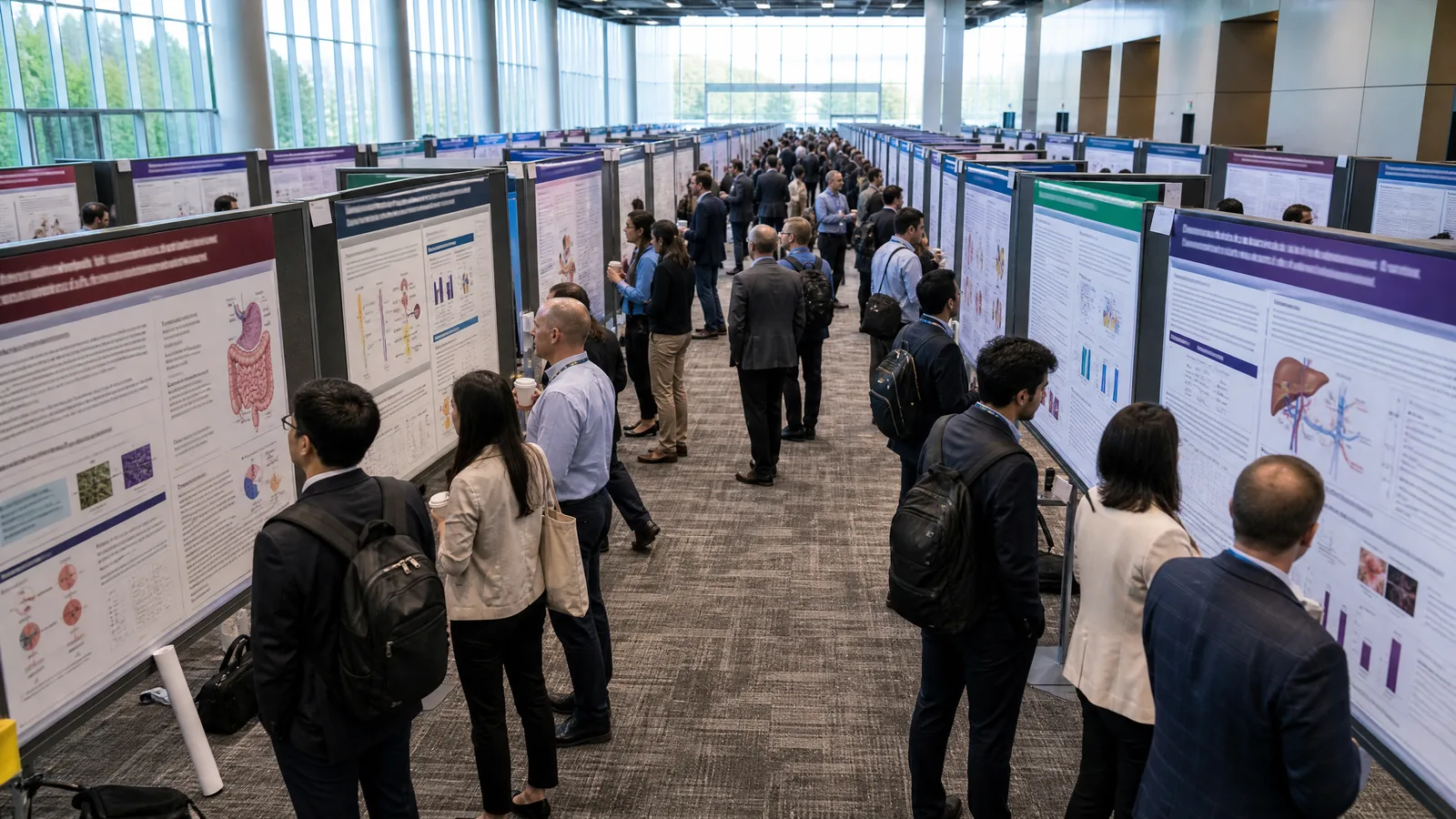
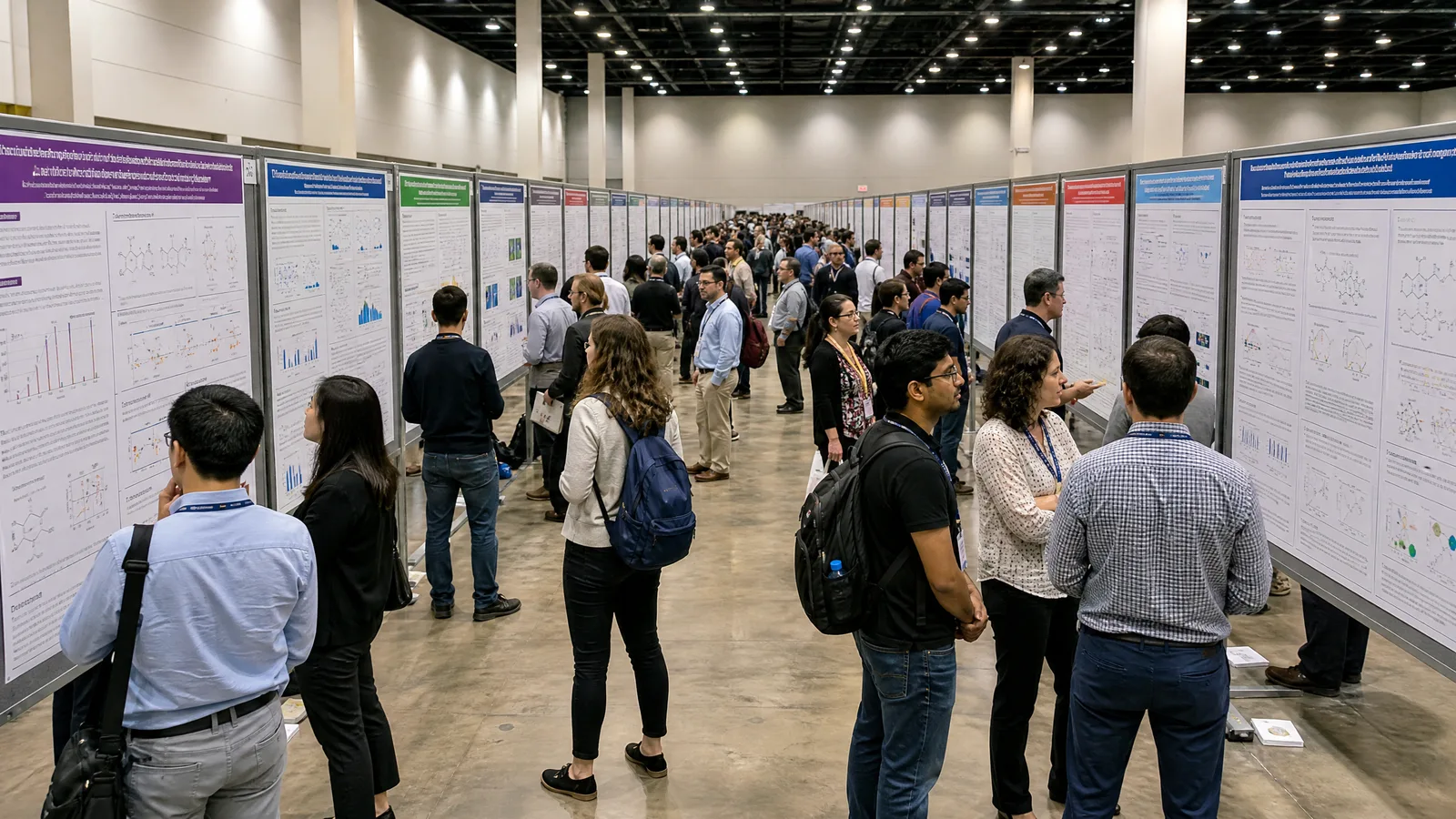
DDW 2027 poster guidelines cover showing a wide poster hall aisle with complete gastroenterology and hepatology posters on landscape boards (Figure generated with SciFig)
Illustrations generated with SciFig AI.
1. DDW 2027 Abstract Deadline, Key Dates, and Venue
DDW 2027 takes place May 15–18, 2027, at the Walter E. Washington Convention Center (801 Allen Y. Lew Place NW, Washington, DC), and the abstract submission deadline is Wednesday, December 2, 2026, at 21:00 Eastern time. That date is an abstract-submission milestone, not a poster deadline: DDW has not published a separate 2027 poster or slide upload deadline, and poster specifications such as the board size are already available in the presenter help center (see §2). No edits to abstracts or author strings are accepted after December 2.
DDW charges a $70 (USD) nonrefundable processing fee per abstract, or $200 for a late-breaking abstract. Presenter-change requests open in January 2027. The host city page confirms the convention center address.
2. DDW 2027 Poster Size, Board Dimensions, and Template
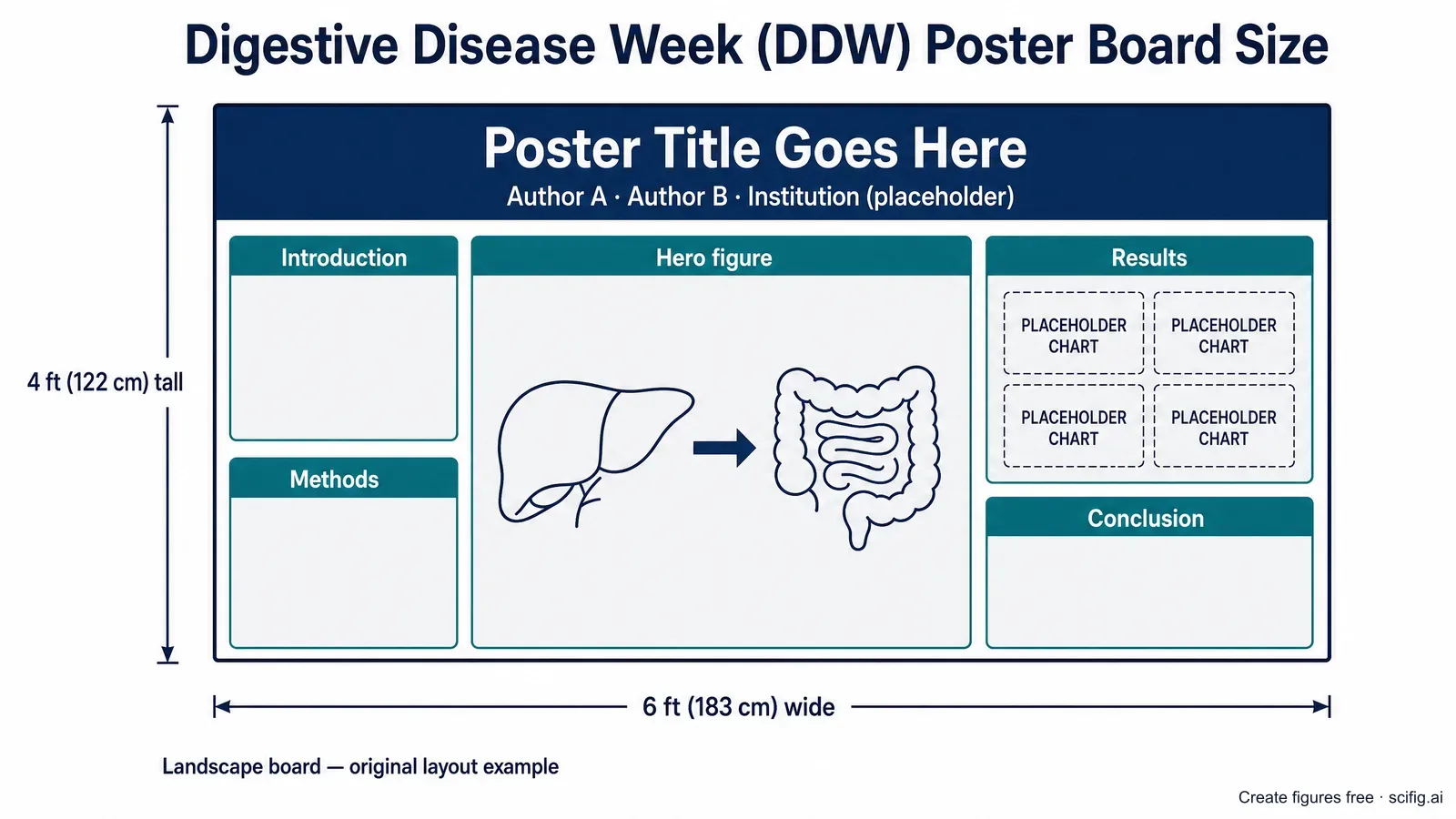
DDW's official presenter help center currently lists poster boards as 4 feet (122 cm) tall by 6 feet (183 cm) wide, so the maximum DDW poster size is 4 × 6 ft — a landscape format that is wider than it is tall. The help-center article on DDW poster size does not name a meeting year; it is DDW's current presenter guidance, so confirm it against the instructions that arrive with your acceptance. DDW does not provide a downloadable poster template.
DDW poster item
Current official guidance
Board size
4 ft (122 cm) tall × 6 ft (183 cm) wide
Maximum poster size
4 × 6 ft
Orientation
Landscape (the board is wider than it is tall)
Poster removal
16:00–18:00 Eastern time; materials left after 18:00 are discarded
Poster material
Avoid lamination; plastic-coated posters cannot be recycled in normal paper streams
Photography
A "no photos" icon is placed in the cup at your board if you request one
Official poster template
None published
Digestive Disease Week DDW 2027 poster size guide showing a landscape poster board 6 ft (183 cm) wide by 4 ft (122 cm) tall with an original placeholder layout (Figure generated with SciFig)
For sustainability, DDW's poster sustainability guidance suggests FSC-certified or recycled poster paper, screenboard or heavy cardboard, or FSC honeycomb board instead of laminated prints. Presenters who want photography restricted can request the no-photos icon and tack it next to the poster.
DDW has not published 2027 Poster Hall hours yet. In 2026 (Chicago), the Poster Hall was organized by DDW track across all four days and open 9:30 a.m.–4 p.m., and authors stood at their posters from 12:30 to 1:30 p.m. on their presentation day. That is a 2026 schedule, used only as a planning reference for 2027. The 2026 poster take-down rule and Poster Hall hours are on the DDW presenter help center; for 2027 times, use the presenter instructions DDW sends with your acceptance.
Plan your DDW poster around one hero figure
Start with the GI or liver mechanism readers must grasp from the aisle, then lay out the 4 × 6 ft board around it.
DDW gives a board size but no poster template, so the layout is yours to build. Our conference poster templates are unbranded, editable PowerPoint layouts with the section structure and type scale already set — pick a landscape layout, resize the slide to 72 × 48 in (6 × 4 ft), and drop your figures in.
3. DDW 2027 ePoster Guidelines and Upload
DDW 2027 offers no ePoster-only presentation format: every poster is presented in person, and on-site poster authors are strongly encouraged — but not required — to also upload an ePoster to the DDW ePosters site, with no fee to submit. The abstract submission guidelines state that no virtual or ePoster-only formats will be offered in 2027, and the ePoster FAQ confirms that the upload is optional.
The DDW ePosters site is an online extension of the main Poster Hall, and full-text poster abstracts are available there. For DDW 2026, presenters were encouraged to upload ePoster files by an April 20 deadline and could still upload through the end of the meeting — a 2026 timeline, used only as a planning reference for 2027.
DDW has not published a 2027 ePoster file format, size, or aspect ratio yet. Keep your poster source file editable so you can export whatever the 2027 upload instructions request, and take the 2027 upload deadline from the presenter instructions that come with your acceptance (in 2026, the ePoster deadline FAQ gave the date).
4. DDW 2027 Oral Presentation and Video Abstract Guidelines
DDW 2027 presentations are in person only: presenters speak at the Walter E. Washington Convention Center at the date and time in their acceptance notification, in English, and livestreamed or prerecorded video presentations are not permitted. All oral presentations are captured and included in DDW On Demand, and the virtual presentation FAQ confirms that DDW 2027 offers in-person presentation options only.
Seven to 10 minutes, with live narration by the presenter
PowerPoint introduction
Must be indicated in the submission if required
DDW has not published a 2027 lecture time slot, slide aspect ratio, or slide upload method yet. Build the deck so the aspect ratio can change without reflowing every figure.
DDW publishes no slide template either. Our scientific presentation templates are editable academic decks already ordered the way a scientific talk runs — background, methods, results, discussion, conclusion — so you can drop in your GI figures and match the aspect ratio your presenter instructions specify.
5. What Scientific Figures Work for a DDW 2027 Poster, Slides, and Abstract?
In our view, the strongest DDW 2027 figures make one digestive-disease relationship visible at a glance: a gut–liver axis or IBD immune mechanism, a liver fibrosis pathway, an endoscopic procedure workflow, or a trial schema with its key outcome chart. At DDW the abstract itself may carry figures — up to two images — so figure work starts at submission, not only after acceptance.
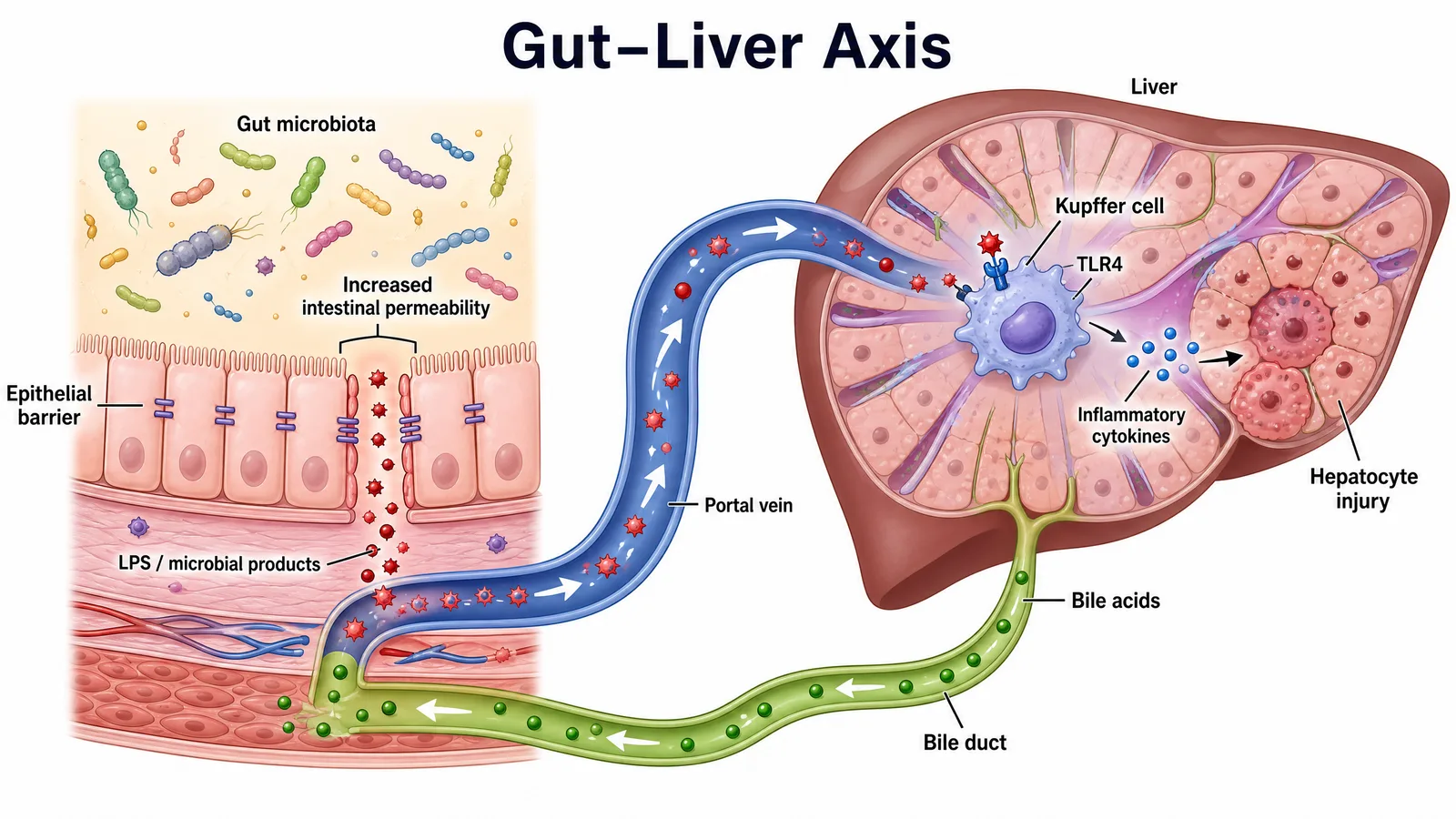
DDW 2027 gut–liver axis mechanism figure for a gastroenterology poster: microbial products cross a leaky intestinal barrier, travel through the portal vein to Kupffer cells in the liver, and bile acids return to the gut (Figure generated with SciFig)
Match the figure to the format it has to work in:
DDW 2027 format
What the figure has to do
Official constraint
Poster
Carry the main message from several feet away on a landscape board
4 × 6 ft board (§2)
Oral or video presentation
Show one claim per slide, readable on a projected screen
In person, in English (§4)
Abstract
Summarize the result in one or two images that print as submitted
Up to two images; GIF, PNG, TIFF, TIF, JPG, or JPEG; no PDFs
The abstract submission guidelines add that tables must be uploaded as image files and that images are published as submitted if the abstract is accepted, so export the final image at full quality before you upload it. Content inside tables or images does not count toward the 2,900-character abstract text limit, which makes a compact figure a practical way to show data you cannot fit into the text.
Within gastroenterology and hepatology, the gut–liver axis is widely understood as a two-way route: microbial products reach the liver through the portal vein, and bile acids return from the liver to the intestine. A mechanism figure has to keep those directions straight. Typical figure choices for DDW work:
6. DDW 2027 Poster Accuracy: Editing a GI Mechanism Element by Element
A credible DDW 2027 mechanism figure gets the biology's direction, cell states, and labels right — and an editable figure lets you correct any one of them without redrawing the rest. In SciFig every label, arrow, and cell stays editable, so you can match each element to your study and your sources before the figure goes on a poster, slide, or abstract.
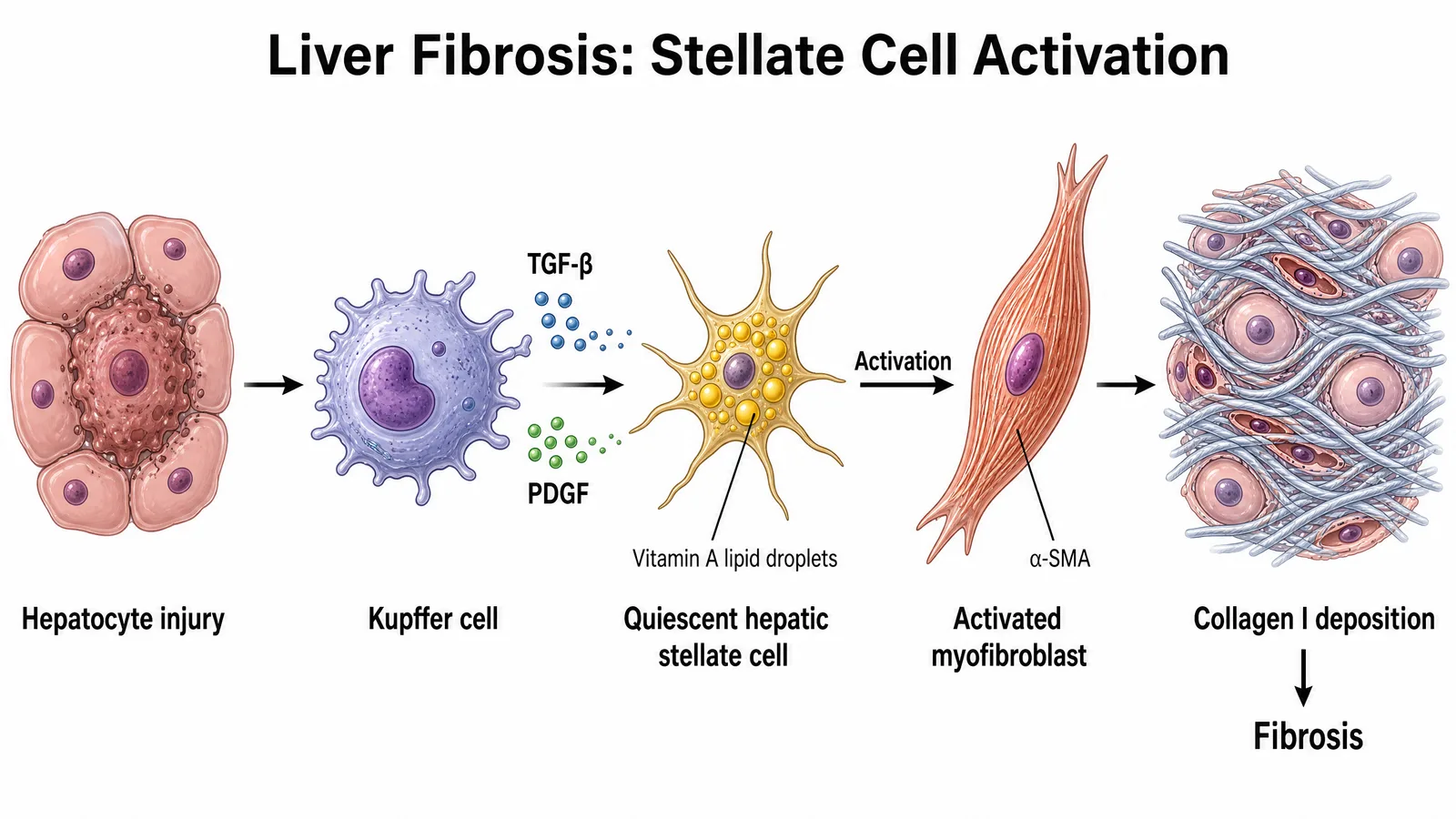
DDW 2027 liver fibrosis pathway figure for a hepatology poster: hepatocyte injury, Kupffer cell TGF-β and PDGF signals, quiescent hepatic stellate cell activation into an α-SMA myofibroblast, and collagen I deposition (Figure generated with SciFig)
Take hepatic stellate cell activation, one of the most common figures in liver fibrosis work. It is well established that quiescent stellate cells store vitamin A in lipid droplets and, once activated by injury signals such as TGF-β and PDGF, become myofibroblasts that lose those droplets, express α-SMA, and deposit collagen I. The details that carry the model are the direction of activation, which cell releases which signal, and whether the stellate cell is drawn before or after it loses its lipid droplets — each is an editable element.
The same applies to a gut–liver axis figure: portal blood flows from the intestine to the liver, bile acids return through the bile duct, and Kupffer cells sit in the liver rather than the gut wall. For an endoscopy or trial workflow, keep the order of steps and the arm labels consistent with your protocol.
Every cell name, arrow direction, and signaling label stays editable in SciFig, so you can adjust any element to match your model before it goes on your DDW poster, slides, or abstract.
7. DDW 2027 Scientific Figure Workflow with SciFig
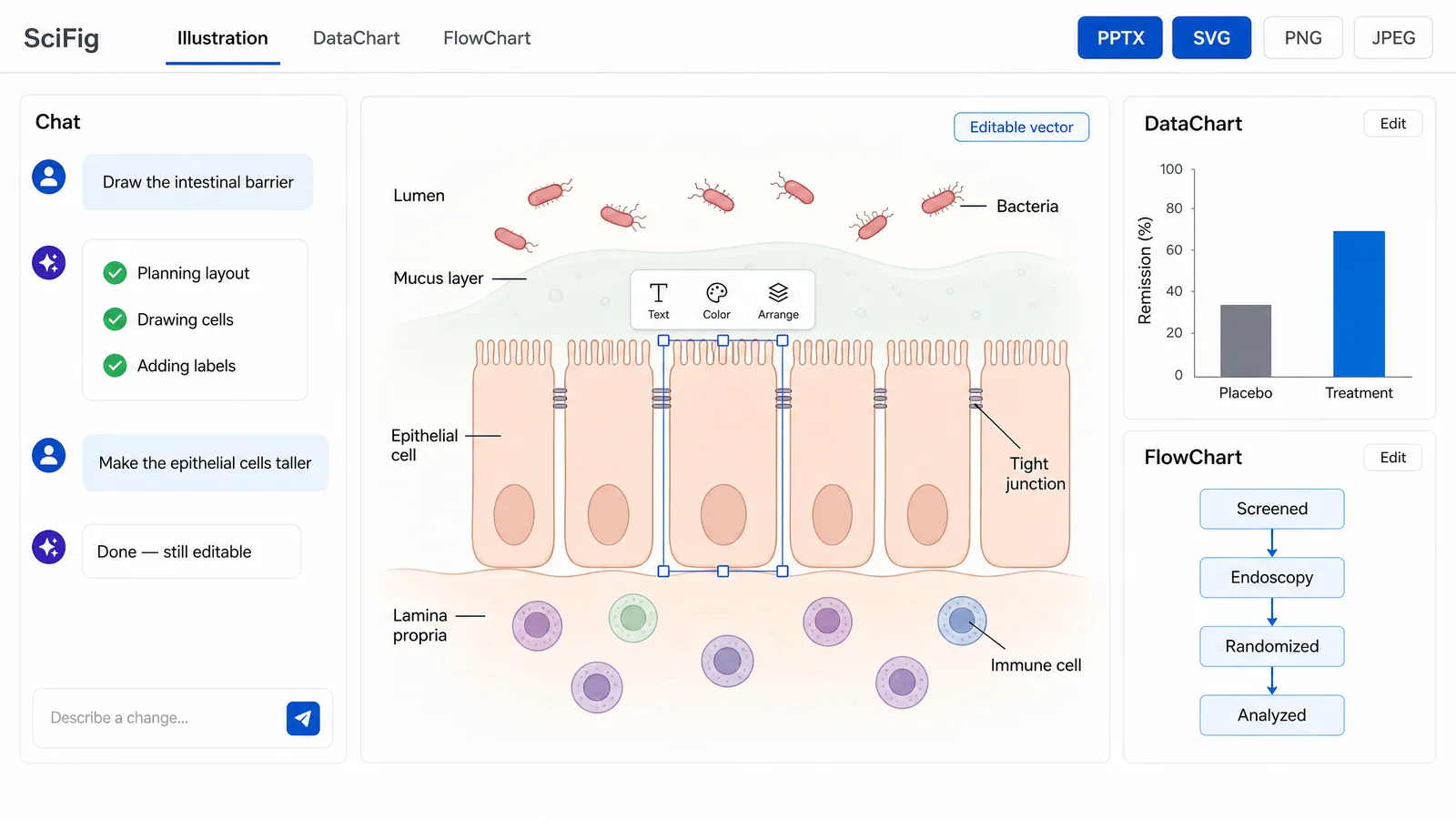
SciFig covers the three figures a DDW poster or slide deck usually needs — SciFig AI Illustration (AI scientific illustration) for the gastrointestinal mechanism, SciFig DataChart (charts and graphs from your data) for results, and SciFig FlowChart (flowcharts) for the trial schema — and every result stays editable.
What you need for your poster or slides
Use
What it helps with
Explain the intestinal barrier, gut–liver axis, or an IBD pathway
Generate from text or a template; edit text, boxes, and connectors; export SVG or PPTX
DDW 2027 SciFig workspace mockup for a gastroenterology poster: a chat panel generating an editable intestinal barrier figure on the canvas, bar-chart DataChart and trial-flow FlowChart cards, and PPTX, SVG, PNG, and JPEG export buttons (Figure generated with SciFig)
A structured prompt gives you the most control over a mechanism figure. Copy and adapt this one:
Schematic of the intestinal epithelial barrier: a mucus layer over
enterocytes joined by tight junctions, goblet cells secreting mucus, and
immune cells in the lamina propria. Show an intact barrier beside a
disrupted one with luminal bacteria crossing into the tissue. Label
each component.
Go from abstract text to an editable DDW figure
Start from your prompt, sketch, or PDF, refine any element in Canvas, and export PPTX or SVG for the poster and slides.
8. DDW 2027 Disclosure, Logo, and QR Code Rules for Presenters
Presenting authors of DDW 2027 abstracts selected for lecture presentation must submit financial disclosure by Wednesday, December 9, 2026, at 17:00 Eastern time, and DDW asks poster presenters to avoid industry logos and commercial QR codes. The abstract submission guidelines state that if a financial conflict cannot be mitigated, DDW may reschedule the abstract for poster presentation or withdraw it so attendees can still claim CME.
The disclosure FAQ explains that the ACCME requires anyone controlling educational content to disclose financial relationships with commercial interests, and that disclosure is completed on the DDW 2027 abstract submission site. Abstracts missing presenting-author disclosures at the deadline risk involuntary withdrawal.
For the poster itself, DDW's logo and QR code guidance, updated during the 2026 cycle, asks presenters to avoid industry logos or QR codes linking to third-party sites that may imply sponsorship, endorsement, or advertising. QR codes are permitted when they link to research-based scientific information free of commercial bias. Under DDW's photography policy, attendees may not photograph a board that displays the "no photos" icon.
9. DDW 2027 Abstract Book and Publication in Gastroenterology and GIE
Abstracts selected for presentation at DDW 2027 will be published online in May 2027 supplements to Gastroenterology and GIE: Gastrointestinal Endoscopy, and surgical abstracts will also be co-published in JOGS. The abstract publication FAQ names the May 2027 Gastroenterology supplement and the May 2027 GIE supplement as the DDW 2027 abstract book.
For DDW 2026, ASGE-selected abstracts appeared in a GIE supplement, while abstracts accepted by AASLD, AGA, and SSAT, along with late-breaking abstracts, appeared in Gastroenterology. Full-text poster abstracts are also available on the DDW ePosters site, and for DDW 2026 full-text abstracts were available in the DDW Mobile App and Meeting Planner with an attendee login, per the abstract viewing FAQ.
Because accepted abstracts are published as submitted, the text and images you upload by December 2, 2026 are the version readers will cite. DDW 2027 limits the title to 255 characters and the abstract text to 2,900 characters, both including spaces, and the image FAQ confirms the two-image limit. All abstract data presented at DDW, including posters, is embargoed until 12:01 a.m. EDT on the day of the presentation.
Frequently Asked Questions
DDW 2027 runs May 15–18, 2027, at the Walter E. Washington Convention Center in Washington, DC. See §1 DDW 2027 key dates and venue.
DDW's presenter help center lists poster boards as 4 ft (122 cm) tall by 6 ft (183 cm) wide, so the maximum poster is 4 × 6 ft in landscape. Confirm it against your acceptance instructions. See §2 DDW poster size.
DDW 2027 abstract submission closes Wednesday, December 2, 2026, at 21:00 Eastern time. It is an abstract-submission milestone, not a poster deadline; notifications go out February 9, 2027. See §1 DDW 2027 abstract deadline.
No. DDW publishes a board size but no downloadable poster or slide template. SciFig's editable conference poster and scientific presentation templates can be resized to the 4 × 6 ft board. See §2 DDW poster template.
No. On-site poster authors are strongly encouraged, but not required, to upload an ePoster, and there is no fee. DDW 2027 has no ePoster-only format. See §3 DDW 2027 ePoster guidelines.
Yes. A DDW 2027 abstract may include up to two images in GIF, PNG, TIFF, TIF, JPG, or JPEG format; PDFs are not accepted. Tables must be uploaded as images. See §5 DDW abstract figures.
No. DDW 2027 offers in-person presentation options only, and livestreamed or prerecorded presentations are not permitted. See §4 DDW 2027 oral presentation guidelines.
Selected DDW 2027 abstracts will be published online in May 2027 supplements to Gastroenterology and GIE: Gastrointestinal Endoscopy; surgical abstracts are also co-published in JOGS. See §9 DDW 2027 abstract book.
Disclaimer: Educational content on scientific figure design — not medical advice. For clinical decisions, consult primary literature and licensed clinicians. SciFig is an independent scientific figure platform and is not affiliated with or endorsed by Digestive Disease Week.
Keep going
Recommended resources
Templates, tools, and further reading for your research