EASD 2026 Poster & Presentation Guidelines and Template
Official EASD 2026 guidelines: oral and short oral only (no printed poster), the landscape A0 ePoster spec, 16:9 slides, and Diabetologia publication.
SciFig Team
SciFig editorial team
The 62nd EASD Annual Meeting runs 28 September–2 October 2026 in Milan, Italy.
This is a practical guide to how work is actually presented at the European Association for the Study of Diabetes' 62nd Annual Meeting: the abstract timeline, the fact that EASD has no printed poster session — only oral and short oral presentations — and the landscape A0 ePoster that accompanies a short oral.
It also covers slide and Speaker Centre rules, where accepted abstracts are published in Diabetologia, and the diabetes and metabolism figures that make a slide or ePoster worth stopping for. Every date and specification below links to official EASD materials.
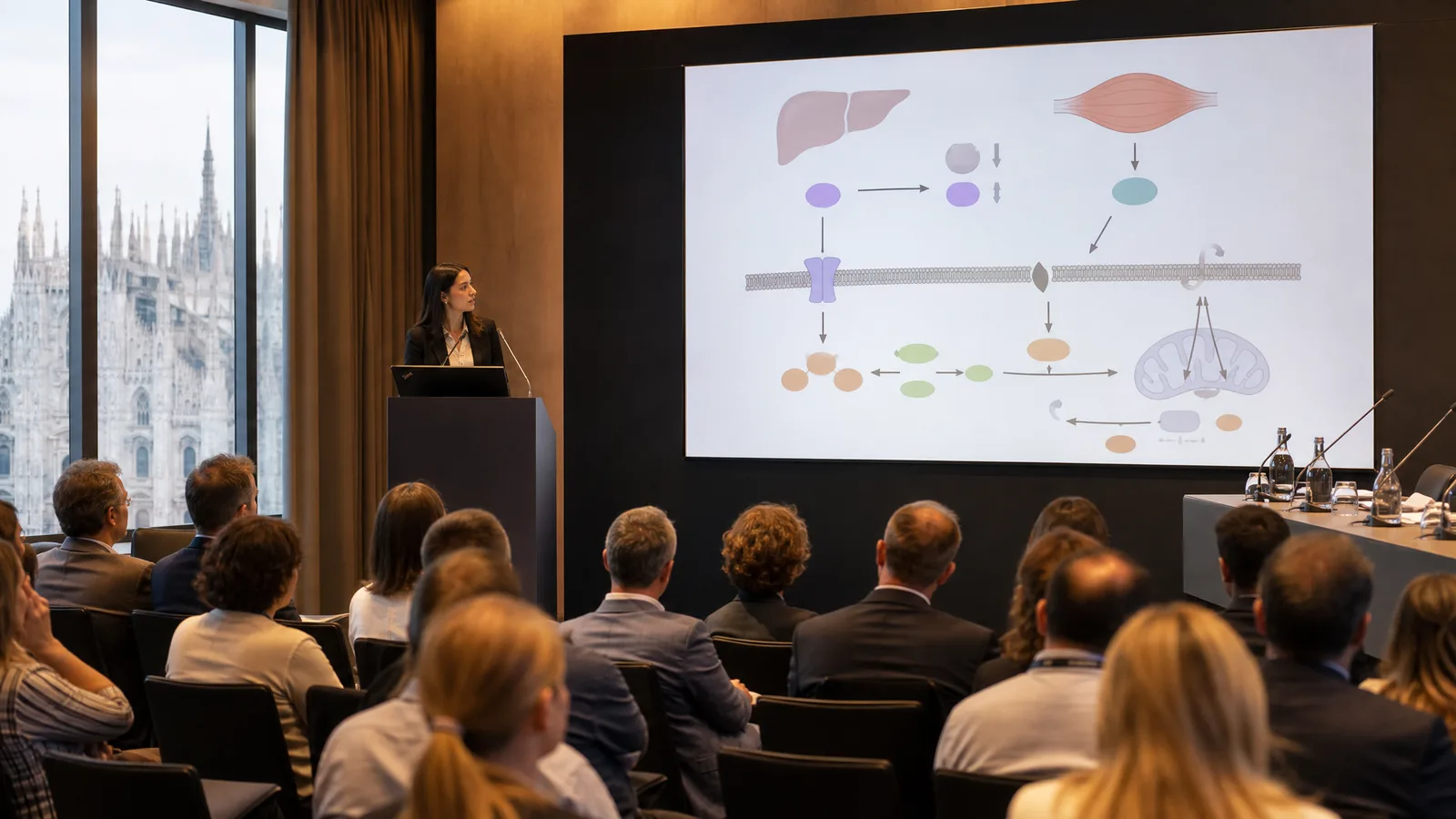
EASD 2026 short oral session in Milan: a presenter at the podium beside a 16:9 slide showing a metabolic pathway figure, delegates seated in a diabetes session (Figure generated with SciFig)
Transparency note: Illustrations in this article were generated with SciFig AI and reviewed by the author for scientific accuracy. Factual claims about dates and specifications link to official EASD materials.
1. EASD 2026 at a Glance: Dates, Venue, and Key Deadlines
The 62nd EASD Annual Meeting runs Monday 28 September to Friday 2 October 2026 at the Allianz MiCo – Milan Convention Centre in Milan, Italy (Central European Summer Time), and is held on-site and online. Because EASD presents work through oral and short oral sessions rather than a traditional poster hall — more on that below — the deadlines that matter to a presenter are the abstract submission date and, after acceptance, the Speaker Centre schedule on-site.
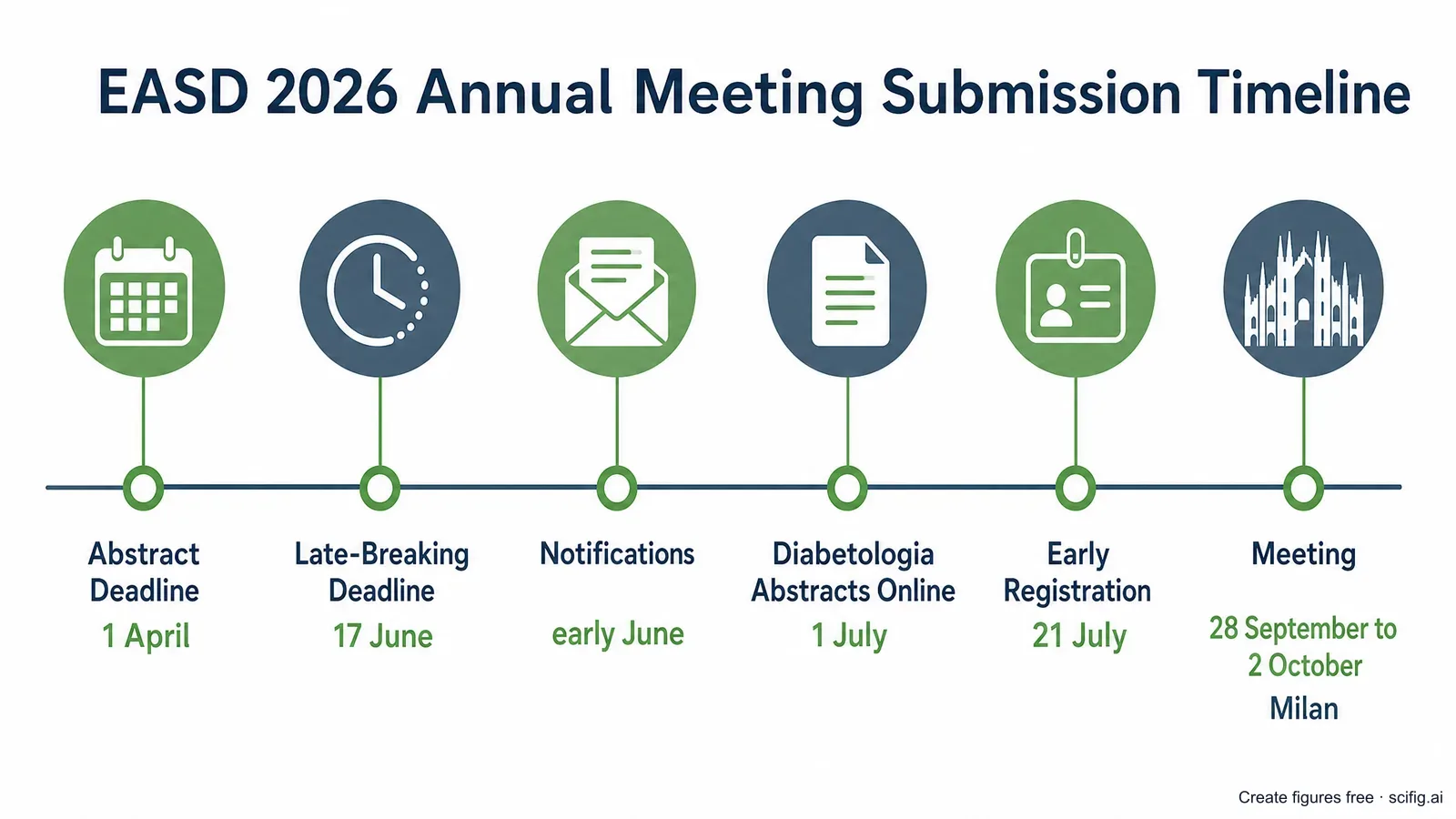
EASD 2026 submission timeline: general abstract deadline 1 April, late-breaking 17 June, Diabetologia abstracts online 1 July, meeting 28 Sept-2 Oct Milan (Figure generated with SciFig)
Date
Milestone
1 April 2026
General abstract submission deadline (18:00 CEST)
Early June 2026
Acceptance / rejection viewable in the submission portal
17 June 2026
Late-breaking abstract deadline (18:00 CEST)
1 July 2026
Accepted abstracts published on easd.org (Diabetologia Abstract Volume)
14 July 2026
Late-breaking acceptance viewable in the portal
21 July 2026
Early registration deadline
28 September–2 October 2026
EASD 2026 Annual Meeting, Milan
Note that submitting an abstract does not register you for the meeting: early registration closes 21 July 2026, and you register separately through the EASD 2026 registration page.
2. EASD 2026 Abstract Submission Timeline
An EASD 2026 abstract is an English, text-structured submission of up to 3,200 characters (excluding spaces) under four fixed headings — Background and aims, Materials and methods, Results, and Conclusion — with a title of up to 170 characters. You may include one table or figure (a table must be inserted as an image, which costs 400 characters of your allowance), references are not allowed, and drugs must be named generically rather than by brand. The general submission deadline is 1 April 2026; late-breaking abstracts, which must present genuinely novel data, are due 17 June 2026.
Because an EASD abstract permits a single figure, a clean mechanism schematic or trial design in the abstract is a real opportunity to make your science legible before a reviewer reaches your results — and that same figure carries forward to your slide and ePoster after acceptance. Acceptance is viewable in the submission portal from early June (14 July for late-breaking).
3. How EASD 2026 Presents Work: Oral, Short Oral, and No Printed Poster
EASD 2026 has no traditional printed poster session — accepted abstracts are presented as either an Oral presentation or a Short Oral Discussion, and the format is assigned by the Scientific Programme Committee (you cannot choose between them). A Short Oral Discussion is a brief talk — 4 minutes with a maximum of five slides — and, as covered in the next section, short oral presenters also prepare an accompanying ePoster. This is the single most important thing to know before you plan your EASD presentation: there is no physical poster board to print and ship.
If you have presented at other diabetes or medical meetings, this is the point where EASD differs most. Rather than designing a large printed sheet, you build (1) a tight set of slides for your oral or short oral talk and (2), for a short oral, a single landscape ePoster. Both reward one clear figure over dense text — which is where planning your mechanism or trial figure early pays off.
4. EASD 2026 ePoster: The Landscape A0 Spec for Short Oral
A short oral presenter at EASD 2026 also prepares an ePoster: a single-page PDF in landscape orientation, recommended at A0 size (1189 × 841 mm), appended to the end of the presentation and displayed at the ePoster stations. Per the official EASD speaker instructions, images should be built at a minimum of 200 dpi, videos must be embedded (not uploaded separately), and hyperlinks, animations, and moving images are not allowed. A QR code is permitted only if it links to an exact copy of the poster — the linked page must carry no advertising, branding, or extra content.
The full requirements are in the official EASD speaker instructions linked from the EASD 2026 scientific submissions page. Two design consequences follow:
Landscape A0, single page — design to the wide ratio from the start; one dominant figure with supporting panels reads far better than a dense grid.
Screen-first legibility — because an ePoster is viewed and zoomed on a screen, a crisp vector-style figure stays legible where a photographed or low-resolution image blurs.
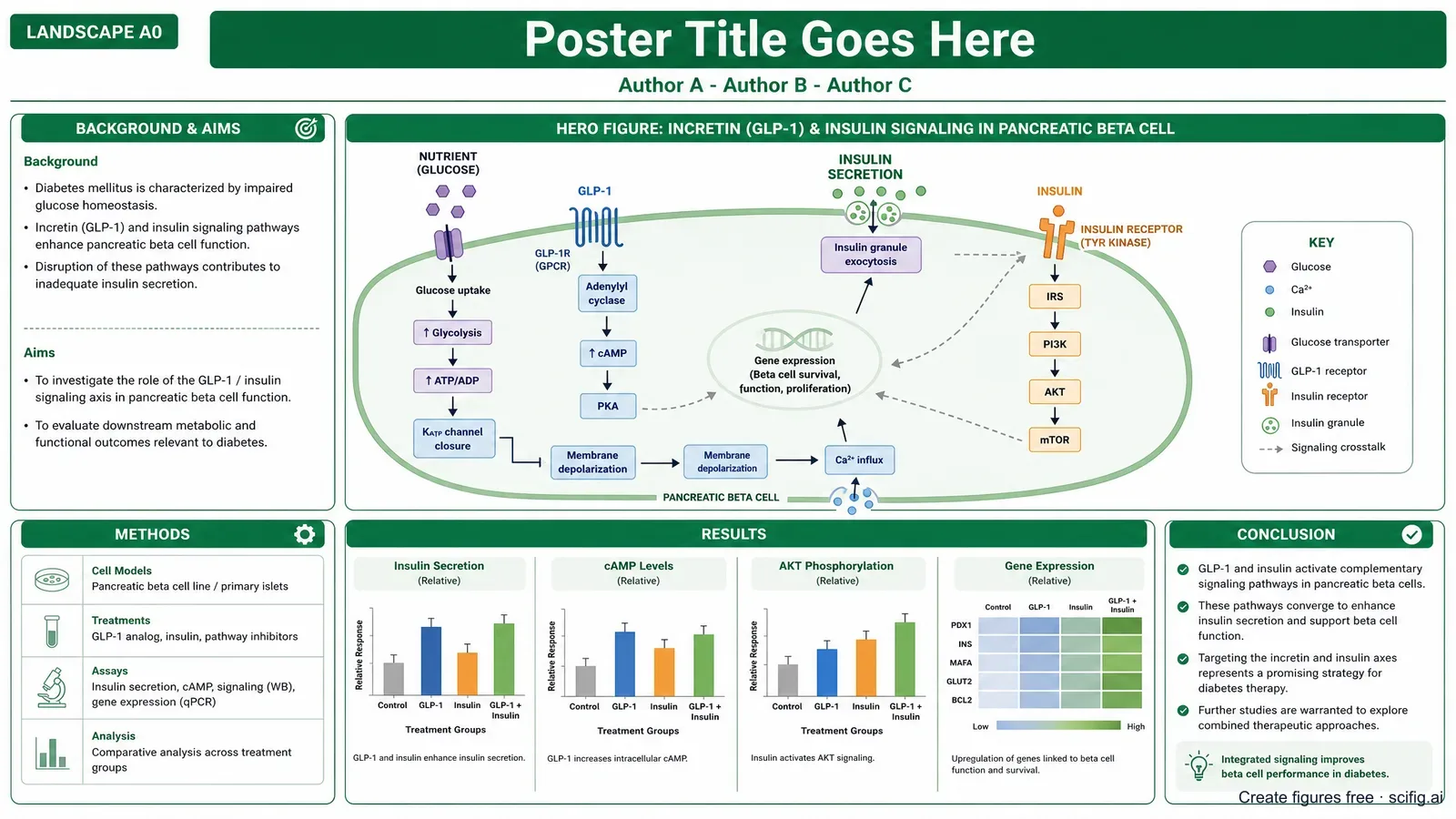
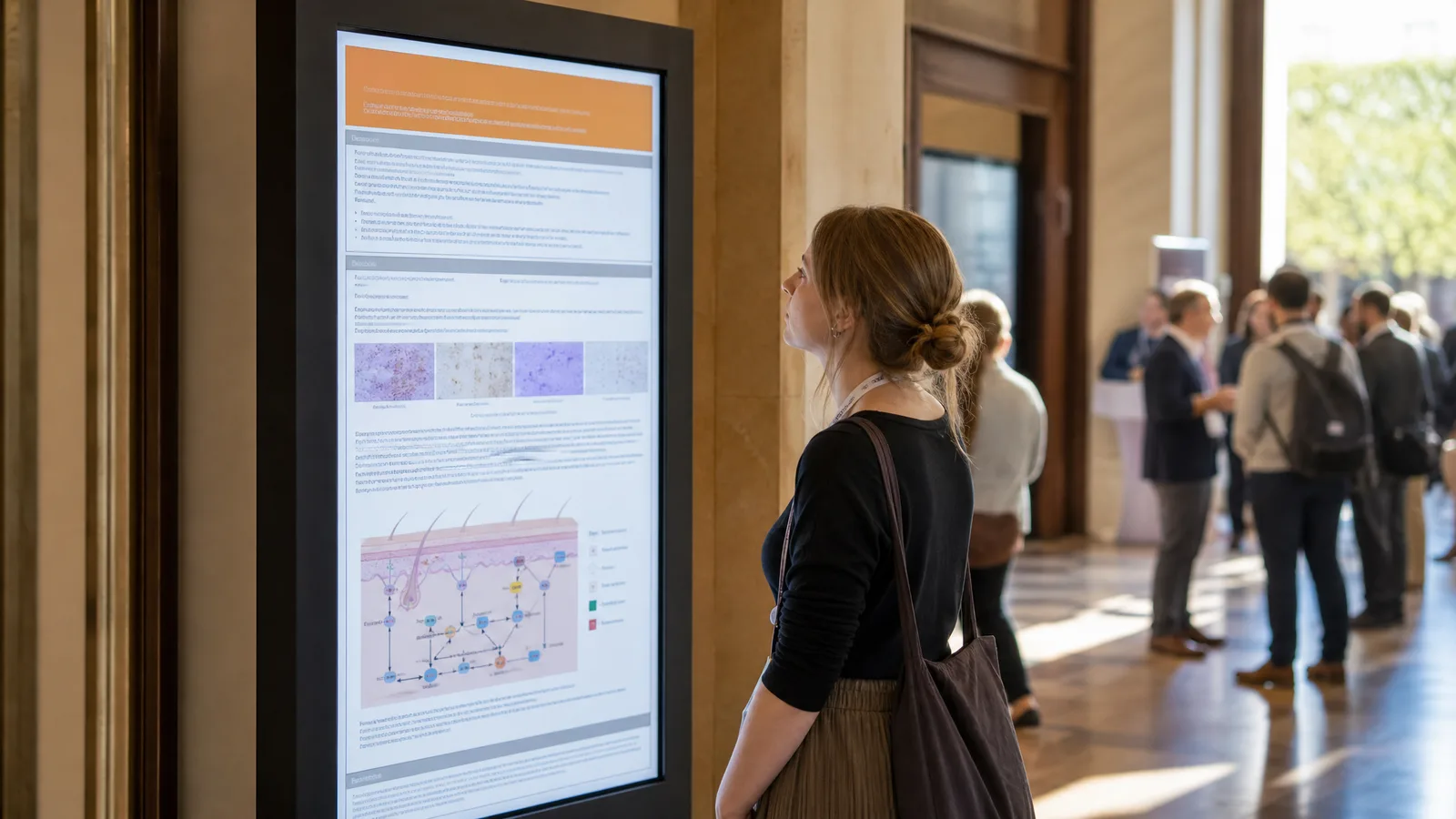
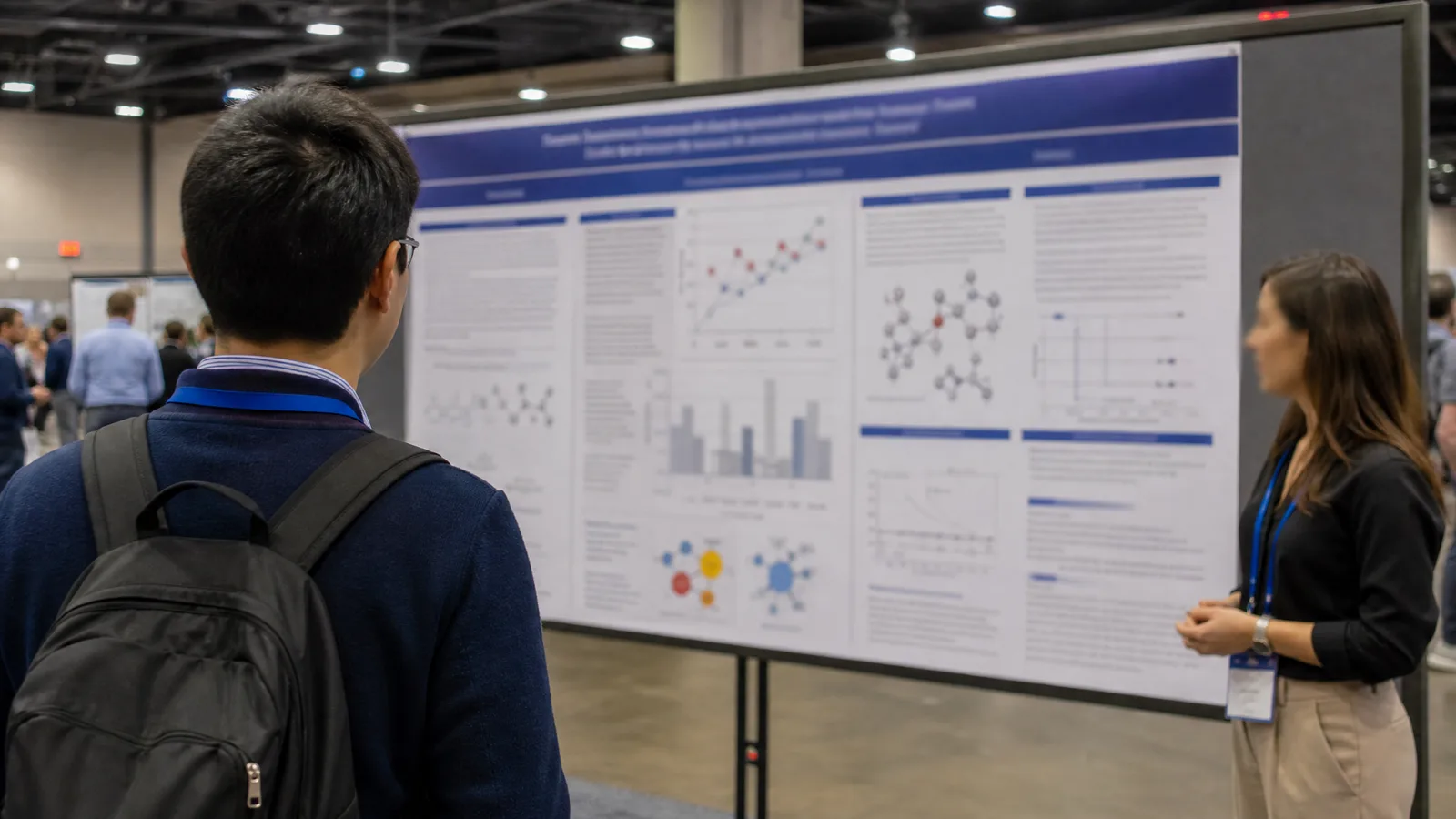
EASD 2026 ePoster template: a landscape A0 layout with title bar, author row, a hero metabolic pathway figure, and background-aims, methods and results panels (Figure generated with SciFig)
The diabetes and metabolism figures on that ePoster — an incretin pathway, an SGLT2 mechanism, a trial schema — are the slowest part to build. You can generate publication-grade versions online for free and drop them straight into your layout.
Need a hero figure for your EASD ePoster?
Start from an incretin pathway, an SGLT2 mechanism, or a trial schema before you lay out your landscape A0 sheet.
Landscape A0 is exactly one of the e-poster sizes our library ships. Our conference poster templates include an A0 landscape layout in editable PowerPoint with the section structure already set — export the finished sheet to a single-page PDF and it matches the EASD ePoster spec.
5. EASD 2026 Oral and Short Oral: Slides, 16:9, and the Speaker Centre
For any EASD 2026 oral or short oral presentation, slides must be in Microsoft PowerPoint (.pptx or .ppt) at a 16:9 widescreen ratio — Apple Keynote and personal laptops are not accepted — and videos must be embedded in the file. A Short Oral Discussion is capped at five slides for a 4-minute talk, so nearly every slide needs one clear figure doing the work rather than a paragraph of text. Presenters check, edit, and upload their files on-site at the Speaker Centre, which opens from Sunday 27 September and runs through the meeting.
EASD has not published a separate advance online upload deadline distinct from the on-site Speaker Centre windows, so plan to finalize your slides before you travel and confirm the current Speaker Centre schedule in your presenter instructions. Whether you have four minutes or a full oral slot, the visual logic is the same: one legible mechanism, pathway, or trial figure per slide.
EASD mandates 16:9 PowerPoint but publishes no slide template, and a Short Oral Discussion is capped at five slides. Our scientific presentation templates are 16:9 and already ordered the way a short talk runs, so the five slides you are allowed each arrive with a job to do.
6. What Figures Do You Need for an EASD Short Oral or ePoster?
Whether you are building short oral slides, an ePoster, or the single figure your abstract allows, EASD's diabetes and metabolism audience expects the same handful of scientific figures — and the most time-consuming ones can be generated online for free in minutes. Across EASD's keyword groups — from beta-cell signal transduction to incretin-based therapies and SGLT inhibitors — two figure types recur.
On your slides, ePoster, and in your abstract, the recurring diabetes and metabolism figure types are:
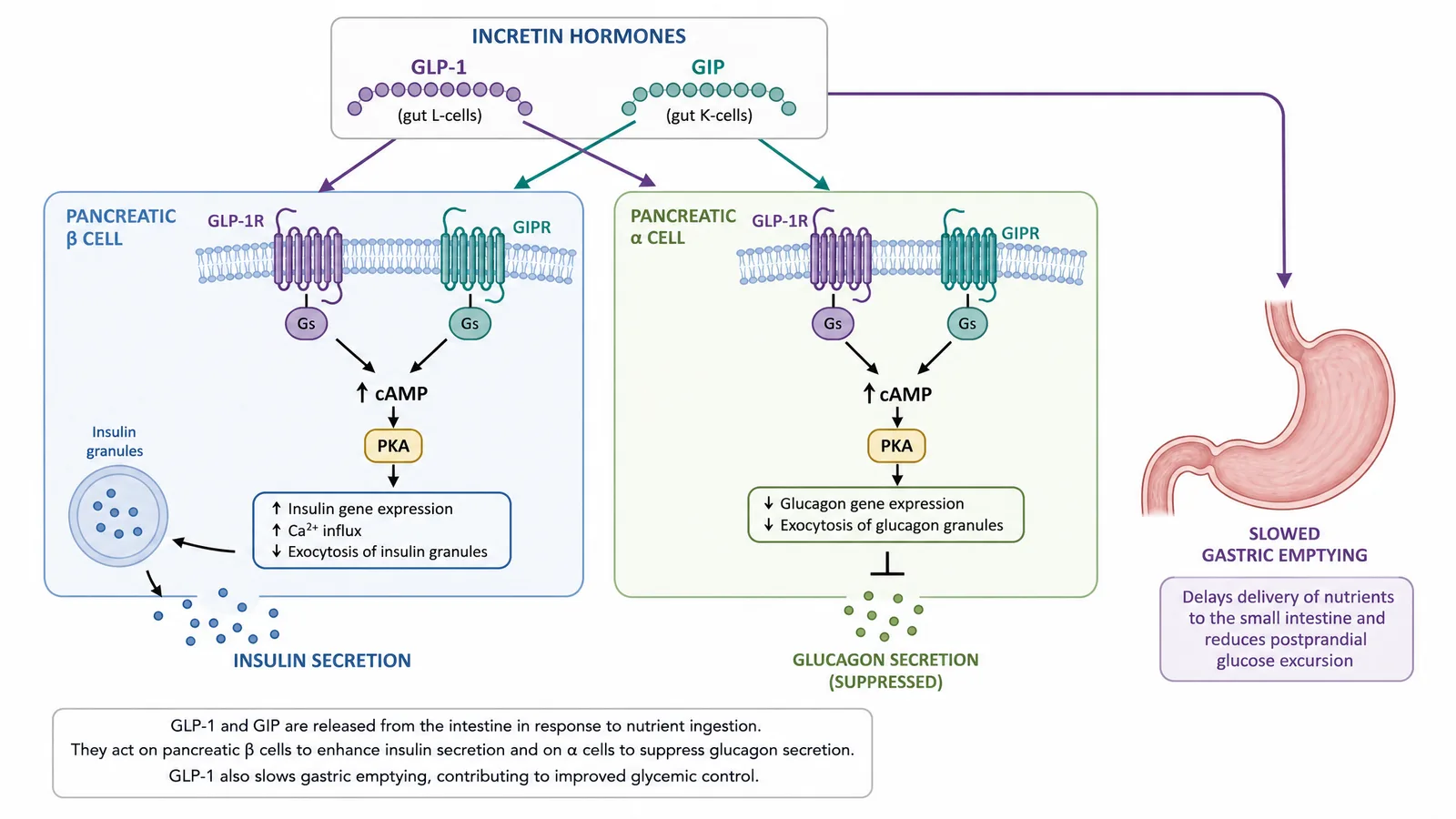
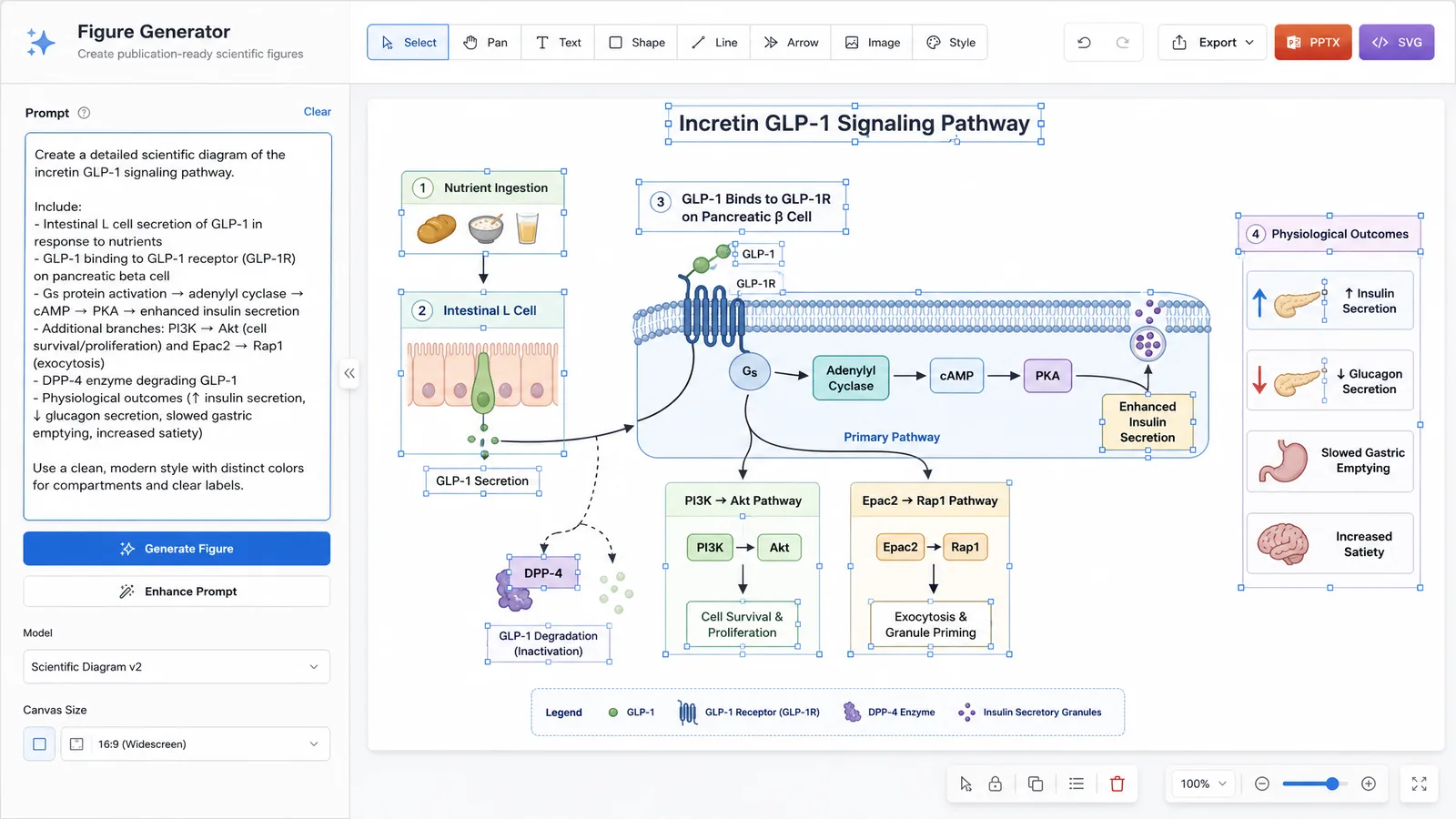
Incretin / GLP-1 receptor signaling pathway — how GLP-1 and GIP act on beta cells through cAMP/PKA to drive insulin secretion, suppress glucagon, and slow gastric emptying. Central to the meeting's large incretin-therapy track.
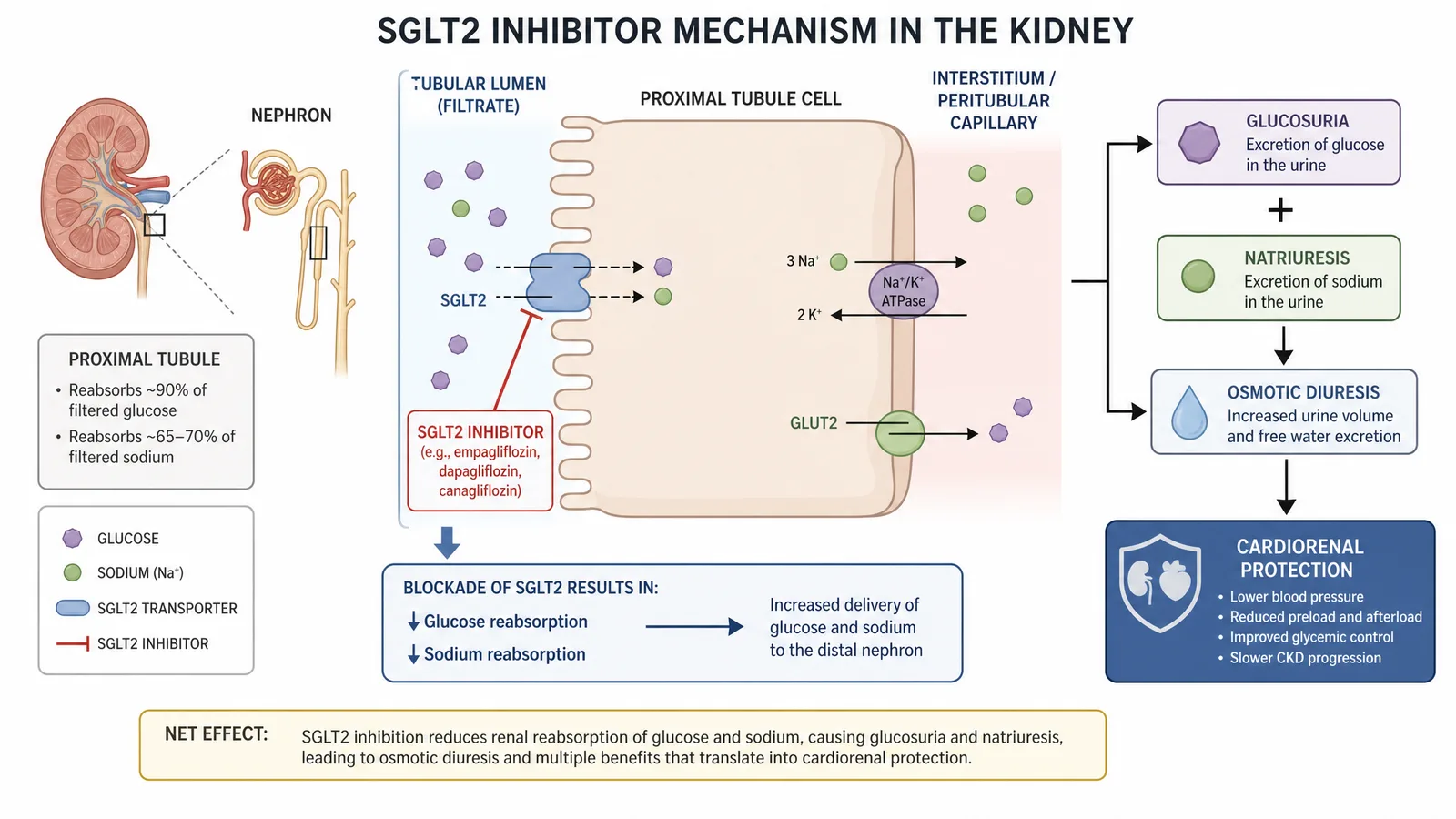
SGLT2 inhibitor mechanism — proximal-tubule glucose and sodium handling, osmotic diuresis, and the cardiorenal protection pathways behind diabetes outcome trials.
EASD 2026 incretin and GLP-1 receptor signaling figure: GLP-1 and GIP acting on a pancreatic beta cell through cAMP and PKA to drive insulin secretion (Figure generated with SciFig)
7. Designing Winning EASD Figures: Accuracy That Survives Peer Scrutiny
A strong EASD figure passes two tests: it is grasped in seconds during a fast-moving short oral session, and it is scientifically exact enough to survive scrutiny from a diabetologist or physiologist who knows the pathway cold. Build each slide and the ePoster around one dominant "hero" figure — usually the incretin signaling pathway or the SGLT2 mechanism with the key result nearby — and let everything else support it.
The second test is where scientific figures live or die — and where general-purpose AI image generators fall short. A tool like Nano Banana Pro or GPT Image can produce something that looks about 99% right, but on a scientific figure 99% right is effectively 0% right: a reversed signaling arrow, a transporter facing the wrong way, or a confused cell type turns a compelling figure into one that misleads a reviewer. And a flat, raster AI image gives you no way to fix that last one percent.
This is the core difference with SciFig. Every figure is a fully editable SVG whose elements — arrows, receptors, transporters, labels — you can modify individually, so you (the author who actually knows the physiology) can adjust every element until the science is exactly right. The metabolism figures that reward this care are exactly the ones reviewers scrutinize:
Incretin signaling — keep the cAMP/PKA cascade pointing the right way and put GLP-1 and GIP on the correct receptors rather than blurring the two.
SGLT2 mechanism — show glucose and sodium reabsorption at the proximal tubule in the correct direction, not a generic transport cartoon.
Islet biology — distinguish beta-cell insulin secretion from alpha-cell glucagon rather than mixing the two.
EASD 2026 SGLT2 inhibitor mechanism figure: the sodium-glucose cotransporter 2 blocked at the kidney proximal tubule, reducing glucose and sodium reabsorption (Figure generated with SciFig)
Whether your EASD 2026 figure earns its attention comes down to whether it is accurate, clear, and legible on a screen — which is exactly where an editable AI figure workflow compresses days of design work into hours without giving up scientific control.
8. Create Your EASD 2026 Figures with AI: The SciFig Workflow
You already have two things most colleagues do not: your accepted abstract and a clear understanding of your study's mechanism — use both to generate your figures online for free, then edit them to exactly right. Here is the SciFig workflow for an EASD presenter, starting in SciFig AI Illustration (AI scientific illustration):
Path 1 — Upload your accepted abstract PDF. Drop it into PDF-to-Figure. It parses your Background, Methods, and Results and returns a mechanism diagram or trial schema in one click — every element stays editable, so you can adjust it to your data and poster layout instead of starting from a blank canvas.
Path 2 — Copy a structured prompt. For a mechanism or pathway figure, Text-to-Figure gives more control. Copy and adjust to your study:
Schematic of incretin signaling: GLP-1 and GIP binding their
receptors on a pancreatic beta cell, activating cAMP and PKA to
trigger insulin secretion, with parallel suppression of glucagon
from alpha cells and slowed gastric emptying.
Path 3 — Sketch and scan. If you sketched your hero figure on paper, photograph it and drop it into Sketch-to-Figure to get a publication-style version that preserves your topology.
EASD 2026 figure workflow in SciFig: an incretin pathway prompt left, an editable SVG diagram right, PPTX and SVG export for a 16:9 short oral slide (Figure generated with SciFig)
From any path, you edit individual elements in the vector canvas — adjust labels, colors, arrow directions — and export to editable PPTX or layered SVG for your slides and ePoster. For a trial schema, SciFig FlowChart (flowcharts and diagrams) lays out randomization, arms, and endpoints as native SVG with every box editable. Start free, no card required: 150 credits on day one (3 figures), plus daily check-in credits that grow with your streak (up to 150 a day) — up to about 44 figures in your first month, so most authors work through a full set of figures over their first few days. For companion guides in this conference series, see the AHA 2026 poster guide and the ESMO 2026 poster guide.
9. Where EASD 2026 Abstracts Are Published (Diabetologia)
Accepted EASD 2026 abstracts are published as the Diabetologia Abstract Volume — a supplement to EASD's official journal — and made available on easd.org from 1 July 2026. Late-breaking abstracts are published on easd.org but are not guaranteed inclusion in the official Diabetologia journal. Searches for "EASD 2026 abstracts" or "EASD abstract book" almost always point to this Diabetologia Abstract Volume.
Because your abstract — and its single permitted figure — becomes part of this citable record, it is worth making sure the figure in your abstract, on your slide, and on your ePoster all tell the same study story. Keep every figure consistent across formats once your work is accepted.
FAQ
No — EASD 2026 has no traditional printed poster session. Accepted abstracts are presented as either an Oral presentation or a Short Oral Discussion (4 minutes, up to five slides), with the format assigned by the Scientific Programme Committee. Short oral presenters also prepare an accompanying ePoster — a single-page landscape PDF — so there is no physical poster board to print and ship.
An EASD 2026 ePoster is a single-page PDF in landscape orientation, recommended at A0 size (1189 × 841 mm). Images should be at least 200 dpi, videos must be embedded, and hyperlinks, animations, and moving images are not allowed. A QR code is permitted only if it links to an exact copy of the poster with no advertising or extra content. The ePoster accompanies a short oral presentation.
EASD 2026 slides must be Microsoft PowerPoint (.pptx or .ppt) at a 16:9 widescreen ratio, with videos embedded — Apple Keynote and personal laptops are not accepted. A Short Oral Discussion is capped at five slides for a 4-minute talk. Presenters check and upload files on-site at the Speaker Centre, which opens from Sunday 27 September.
The general EASD 2026 abstract deadline is 1 April 2026 (18:00 CEST), and the late-breaking abstract deadline is 17 June 2026 (18:00 CEST). General acceptance is viewable in the submission portal from early June, and late-breaking acceptance from 14 July. Late-breaking abstracts must present genuinely novel data.
Accepted EASD 2026 abstracts are published as the Diabetologia Abstract Volume, available on easd.org from 1 July 2026. Late-breaking abstracts appear on easd.org but are not guaranteed inclusion in the Diabetologia journal itself. This supplement is the citable version of your EASD abstract.
Yes — an EASD 2026 abstract may include one table or figure, within the 3,200-character limit (a table inserted as an image costs 400 characters of your allowance). References are not allowed and drugs must be named generically. Because the abstract is published in the Diabetologia Abstract Volume, a clean mechanism schematic makes your science legible in the permanent record.
References
All specifications and dates above are drawn from official EASD materials, accessed July 21, 2026:
Disclaimer: This article is educational content focused on scientific figure design for conference presentations and ePosters. It is not medical advice and should not be used for clinical decisions. Dates and specifications are summarized from official EASD materials linked above and were accurate at the time of writing; always confirm current details on the official EASD website before submitting or uploading. SciFig is an AI scientific figure platform covering illustrations (SciFig AI Illustration), data-driven charts (SciFig DataChart), and flowcharts (SciFig FlowChart) — it does not diagnose, treat, or advise on patient care.
Keep going
Recommended resources
Templates, tools, and further reading for your research