EADV 2026 Poster & Presentation Guidelines and Template
Official EADV 2026 guidelines: the digital-only ePoster format (A0 portrait PDF, no printed poster), Sept 21 upload deadline, abstract rules, embargo details.
SciFig Team
SciFig editorial team
The 35th EADV Congress runs 30 September–3 October 2026 in Vienna, Austria.
This is a practical guide to the official poster and presentation rules for the European Academy of Dermatology and Venereology's 35th Congress: the abstract timeline, the digital-only ePoster format and its A0 portrait spec, and the ePoster upload window.
It also covers the late-breaking oral track, where accepted abstracts appear after the embargo lifts, and the dermatology figures that make an ePoster or slide worth stopping for. Every date and specification below links to official EADV materials.
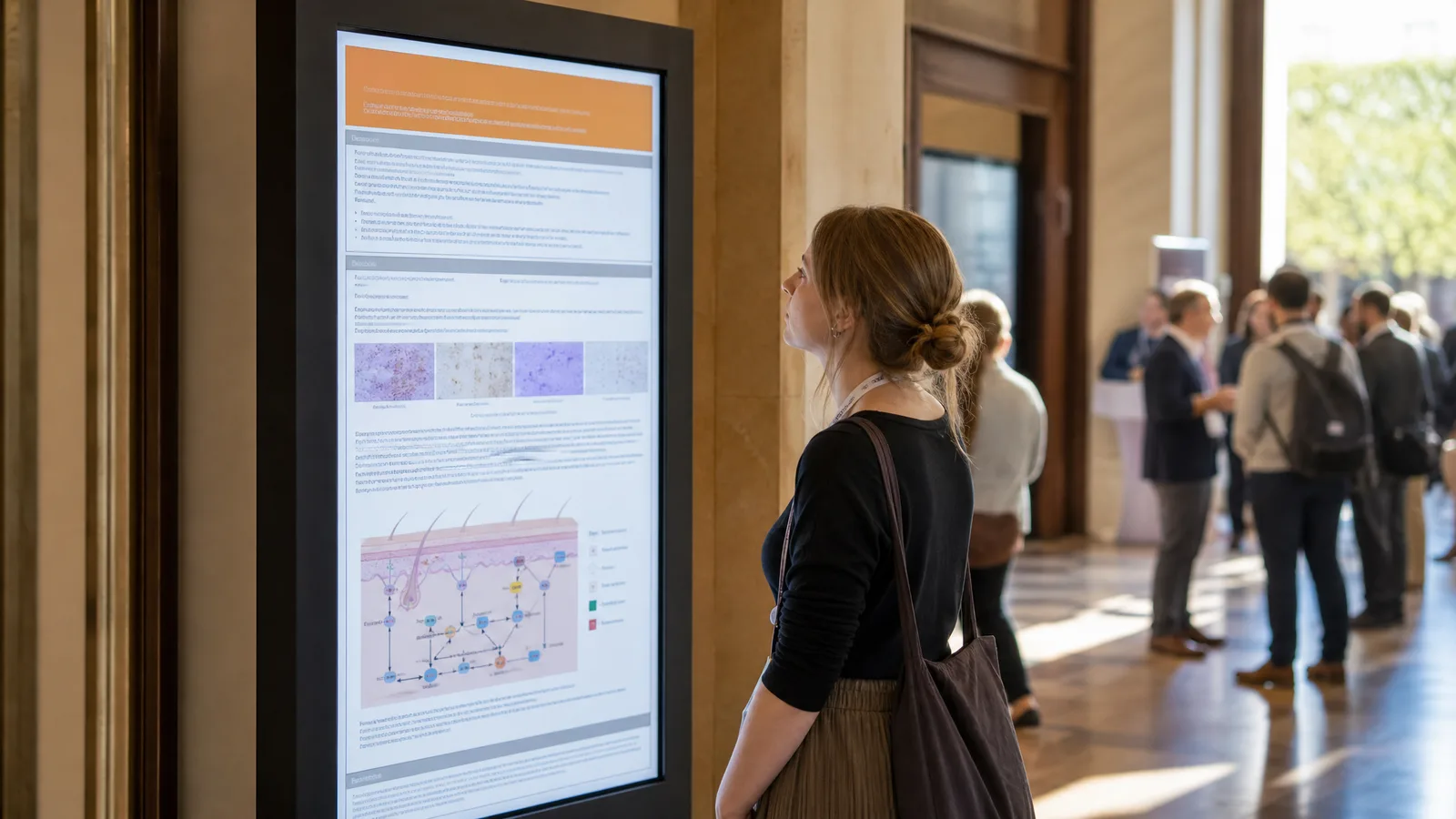
EADV 2026 Congress e-poster on a touchscreen kiosk in Vienna: a delegate viewing a portrait A0 dermatology e-poster with a skin immune pathway figure on screen (Figure generated with SciFig)
Transparency note: Illustrations in this article were generated with SciFig AI and reviewed by the author for scientific accuracy. Factual claims about dates and specifications link to official EADV materials.
1. EADV 2026 at a Glance: Dates, Venue, and Key Deadlines
The 35th EADV Congress runs 30 September–3 October 2026 at the Austria Center Vienna (ACV) in Vienna, Austria (Central European Summer Time), and presents accepted work as digital-only ePosters and oral sessions — there is no printed poster. The deadlines that matter most to a presenter are the abstract submission date and, after acceptance, the ePoster upload window that closes 21 September 2026.
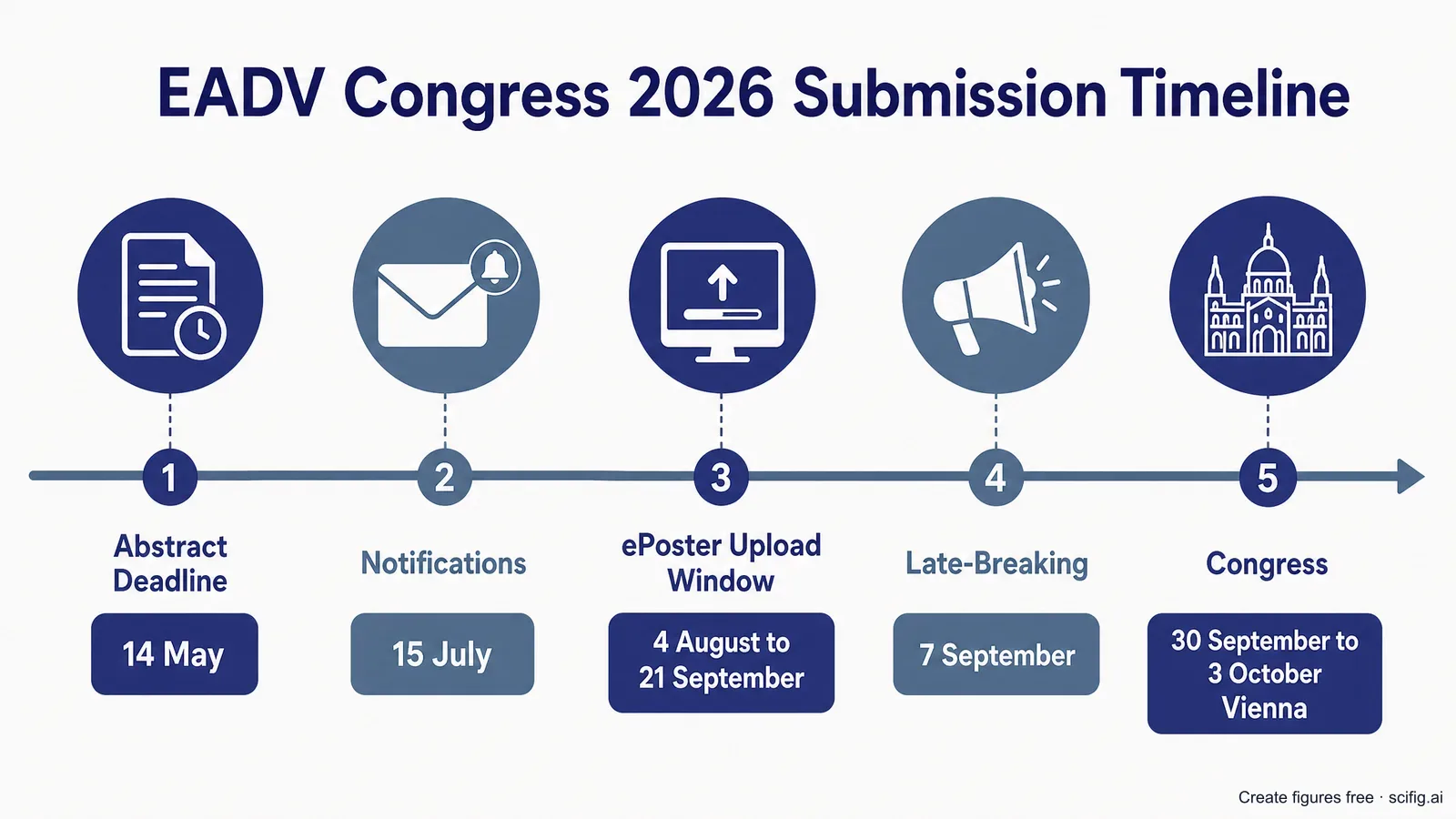
EADV 2026 submission timeline: abstract deadline 14 May, notifications 15 July, ePoster upload window 4 August to 21 September, Congress 30 September-3 October Vienna (Figure generated with SciFig)
Date
Milestone
14 May 2026
Abstract submission deadline (a "Deadline Extended" notice appears on the site — confirm the current date)
15 July 2026
Acceptance notifications sent
4 August 2026
ePoster upload window opens
2 September 2026
Abstract withdrawal deadline
7 September 2026
Late-breaking abstract submission deadline
14 September 2026
Late-breaking abstract notifications
21 September 2026
ePoster upload deadline
30 September–3 October 2026
EADV 2026 Congress, Vienna
Note that submitting an abstract does not register you for the meeting; early registration closed 15 April 2026, with the full rate open through 3 October 2026. Confirm the current abstract deadline on the official call-for-abstracts page, since the site shows a "Deadline Extended" notice without a stated new date.
2. EADV 2026 Abstract Submission Timeline and Late-Breaking Track
An EADV 2026 abstract is an English submission of up to 4,000 characters (including spaces) with an unlimited title, and each section permits one image file. Abstracts may not include patient photographs, identifiable locations or hospital names, or commercial drug names (use generic names). The general submission deadline is 14 May 2026 with acceptance sent 15 July 2026; a separate late-breaking track closes 7 September 2026 (notifications 14 September), costs €100 per abstract, and is accepted for oral presentation only — ePosters cannot be submitted to the late-breaking sessions.
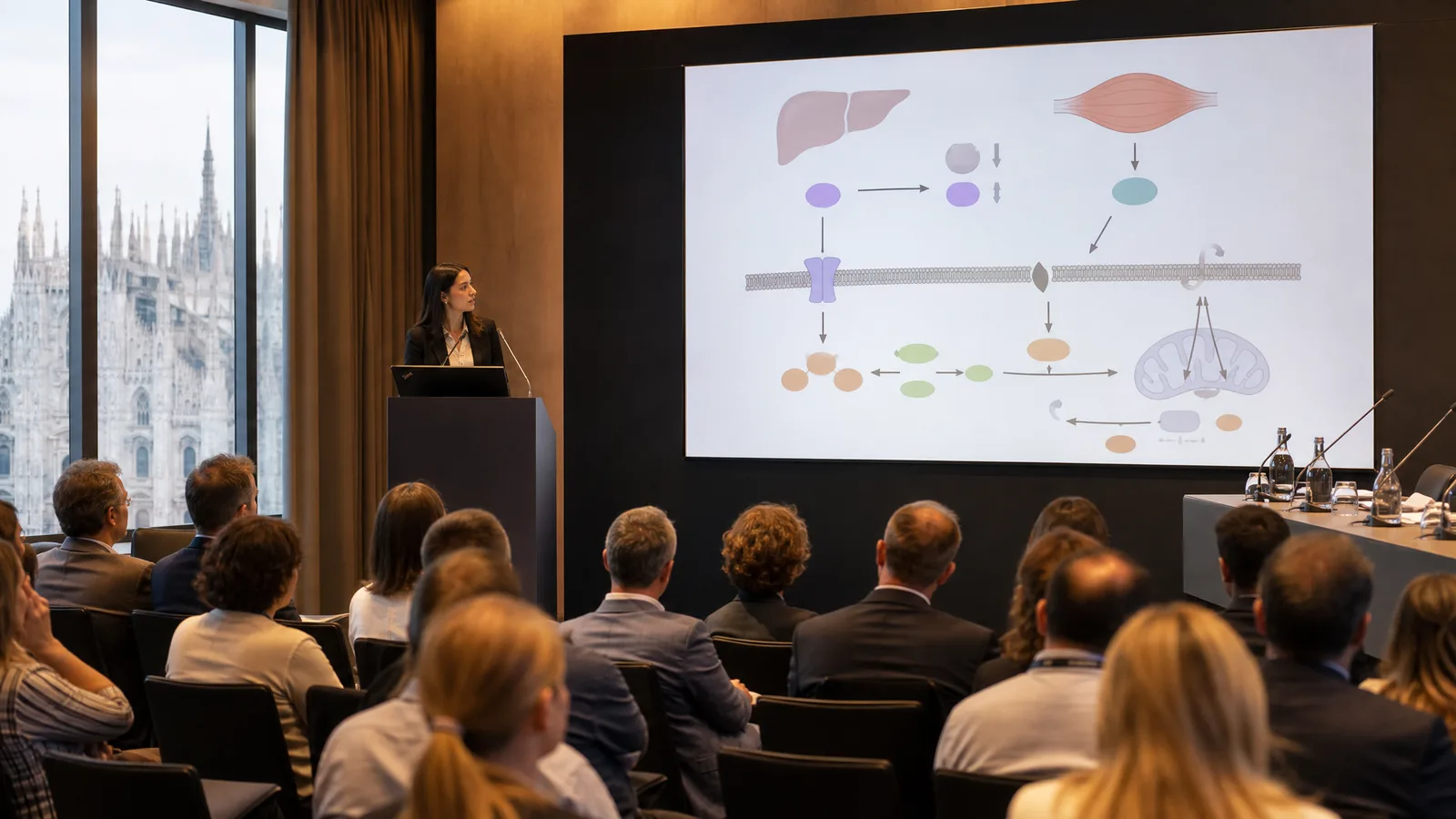
For a late-breaking oral, EADV specifies a 15-minute slot (12 minutes of presentation plus 3 minutes of Q&A) with required on-site attendance. For the regular oral / free-communication sessions, EADV had not published the specific slide format, ratio, or presentation length as of 21 July 2026 — those details typically arrive with the programme booklet closer to the congress, so confirm them in your presenter instructions rather than assuming a format.
With the regular-session slide format unpublished, a standard 16:9 academic deck is the safe default. Our scientific presentation templates are 16:9 and already ordered the way a short talk runs, which is what a 12-minute late-breaking slot leaves no time to design from scratch.
3. EADV 2026 Abstract Format Rules
Beyond the character limit, an EADV 2026 abstract follows a few firm content rules: English only, up to 4,000 characters including spaces, one image per section (.jpg, .gif, .png, or .bmp), and no patient photographs, identifiable places, or brand drug names. These rules shape the one figure you can attach: because photographs of identifiable patients are not allowed, a clean schematic — a skin cross-section, an immune pathway — is often the safest and most legible way to make a dermatology point in the abstract.
That same figure carries forward to your ePoster and any oral slides after acceptance, so it is worth building it once, cleanly, and reusing it across formats.
4. EADV 2026 ePoster: The A0 Portrait Spec (No Printed Poster)
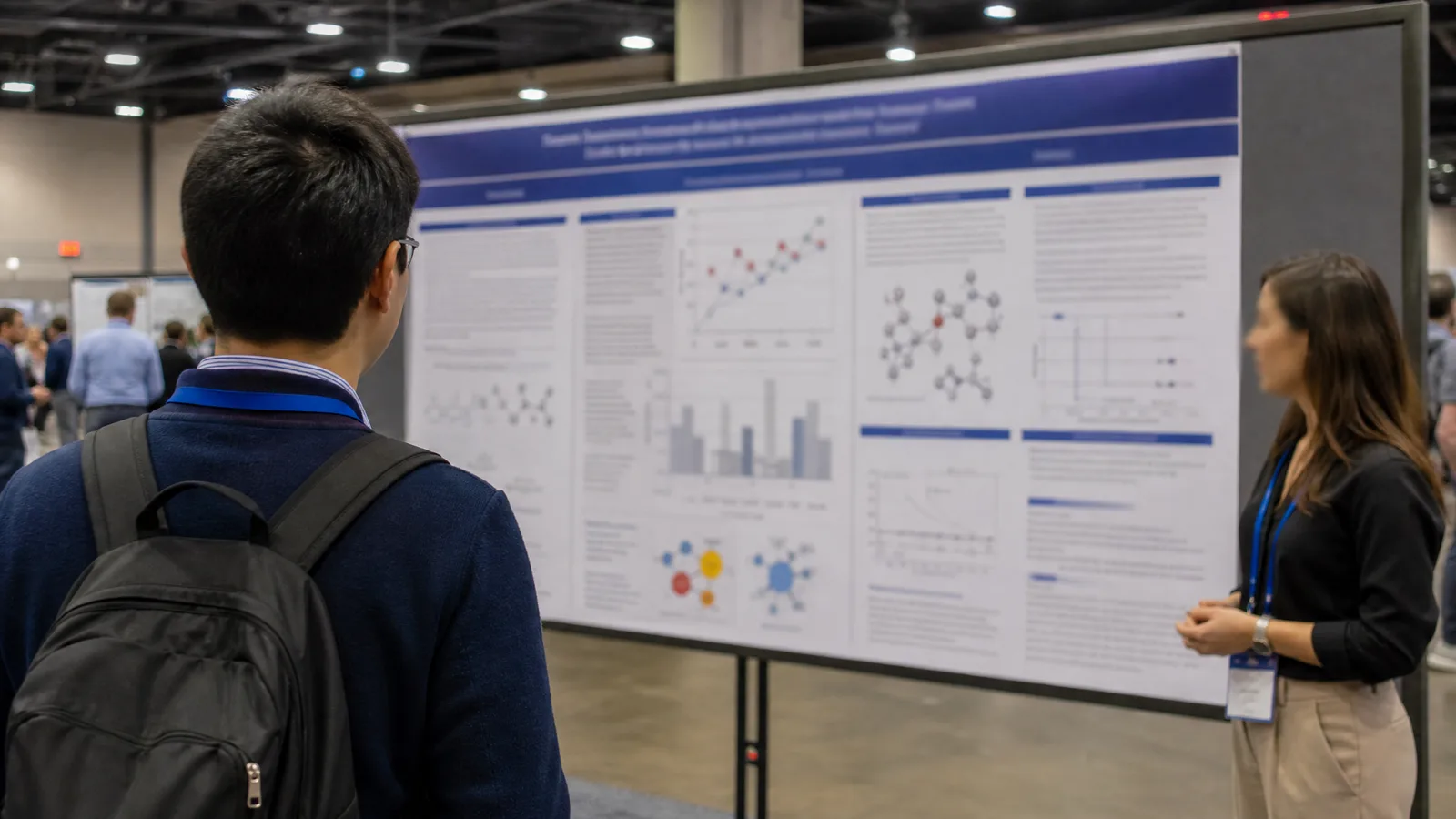
EADV Congress 2026 is digital-only — an ePoster is a single-page PDF in portrait orientation, recommended at A0 size (841 × 1189 mm / 33.1 × 46.8 in) at a minimum of 200 dpi, and there is no printed poster board. Per the official call for abstracts, animations are not allowed, a QR code is permitted, and EADV does not provide a graphic template or mandate a font size — the design is yours to build. Only the presenting author can log in to upload, using a link sent by email.
Portrait A0, single page — design to the tall ratio from the start; a clear top-to-bottom reading path with one dominant figure beats a dense grid.
Screen-first legibility — because an ePoster is viewed and zoomed on a screen, a crisp vector-style figure stays sharp where a photographed or low-resolution image blurs.
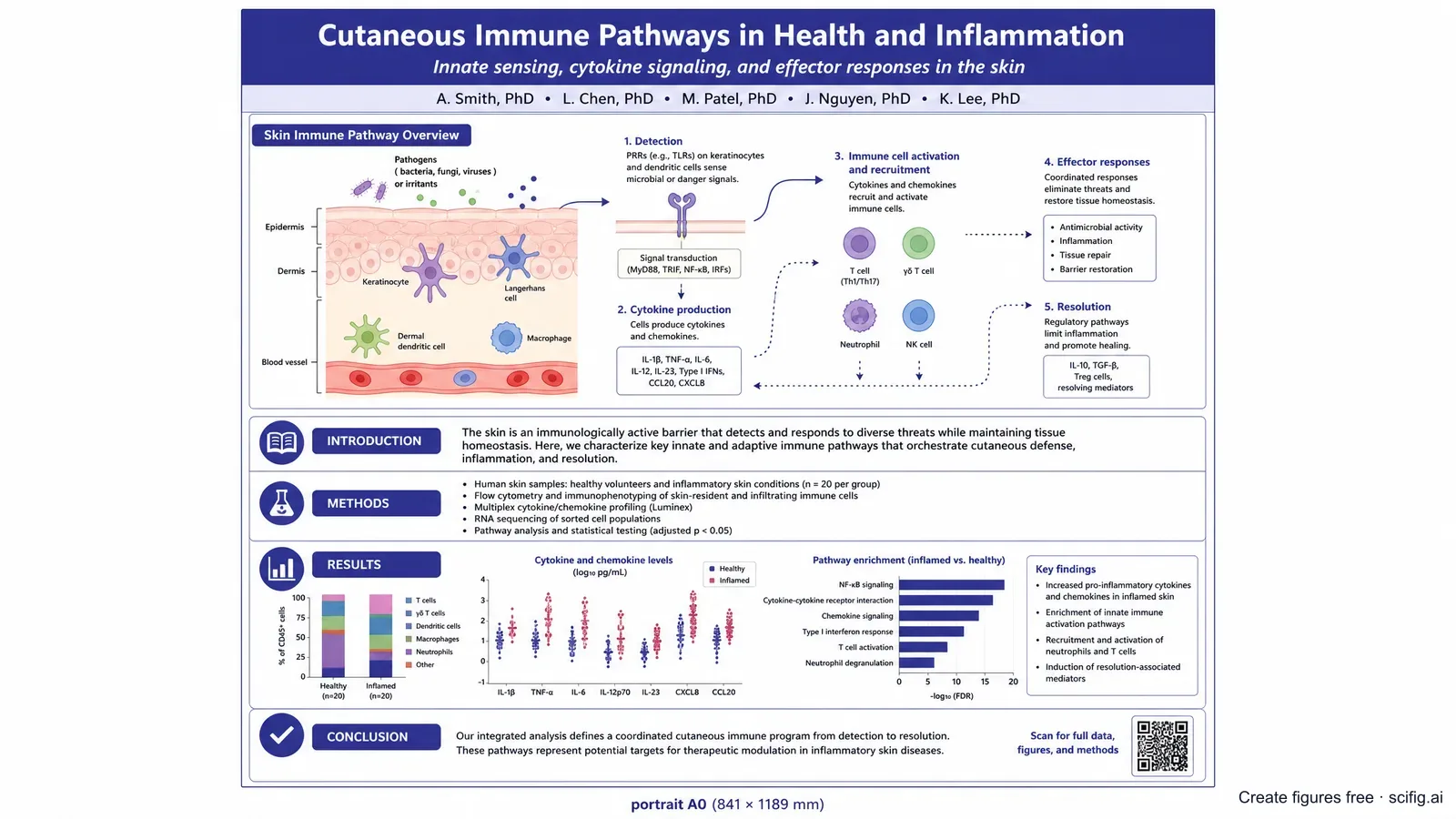
EADV 2026 ePoster template: an A0 portrait single-page layout with a title bar, author row, a hero skin immune pathway figure, and IMRaD panels (Figure generated with SciFig)
Since EADV supplies no graphic template, the A0 portrait sheet is yours to build from an empty page. Our conference poster templates include A0 portrait layouts in editable PowerPoint with the section structure and type scale already set — export the finished sheet to PDF at 200 dpi or above and it meets the EADV spec.
The dermatology figures on that ePoster — a skin immune pathway, a skin cross-section, a drug mechanism — are the slowest part to build. You can generate publication-grade versions online for free and drop them straight into your portrait layout.
Need a hero figure for your EADV ePoster?
Start from an IL-23/IL-17 pathway, a skin cross-section, or a drug mechanism before you lay out your A0 portrait sheet.
5. Uploading Your EADV 2026 ePoster: Workflow and the Sept 21 Deadline
Your EADV 2026 ePoster uploads through the presenting author's account, in a window that opens 4 August 2026 and closes 21 September 2026 — miss it and your accepted work does not display. The upload link is emailed to the presenting author, and only that author can submit. After the congress, accepted abstracts are released on the EADV Event platform once the embargo lifts (covered in the final section), where registered participants can view them.
Because the file is a single portrait PDF with no animation, the whole game is legibility and hierarchy on one page. A vector figure exported cleanly — rather than a screenshot or a photographed slide — keeps every label sharp when a delegate zooms in, which is exactly what a digital-only congress rewards.
6. What Figures Do You Need for an EADV ePoster or Talk?
Whether you are building an ePoster, oral slides, or the single figure your abstract allows, EADV's dermatology audience expects the same handful of scientific figures — and the most time-consuming ones can be generated online for free in minutes. Because patient photographs are restricted, clean schematics do much of the explaining, and two figure types recur across the meeting.
On your ePoster, slides, and in your abstract, the recurring dermatology figure types are:
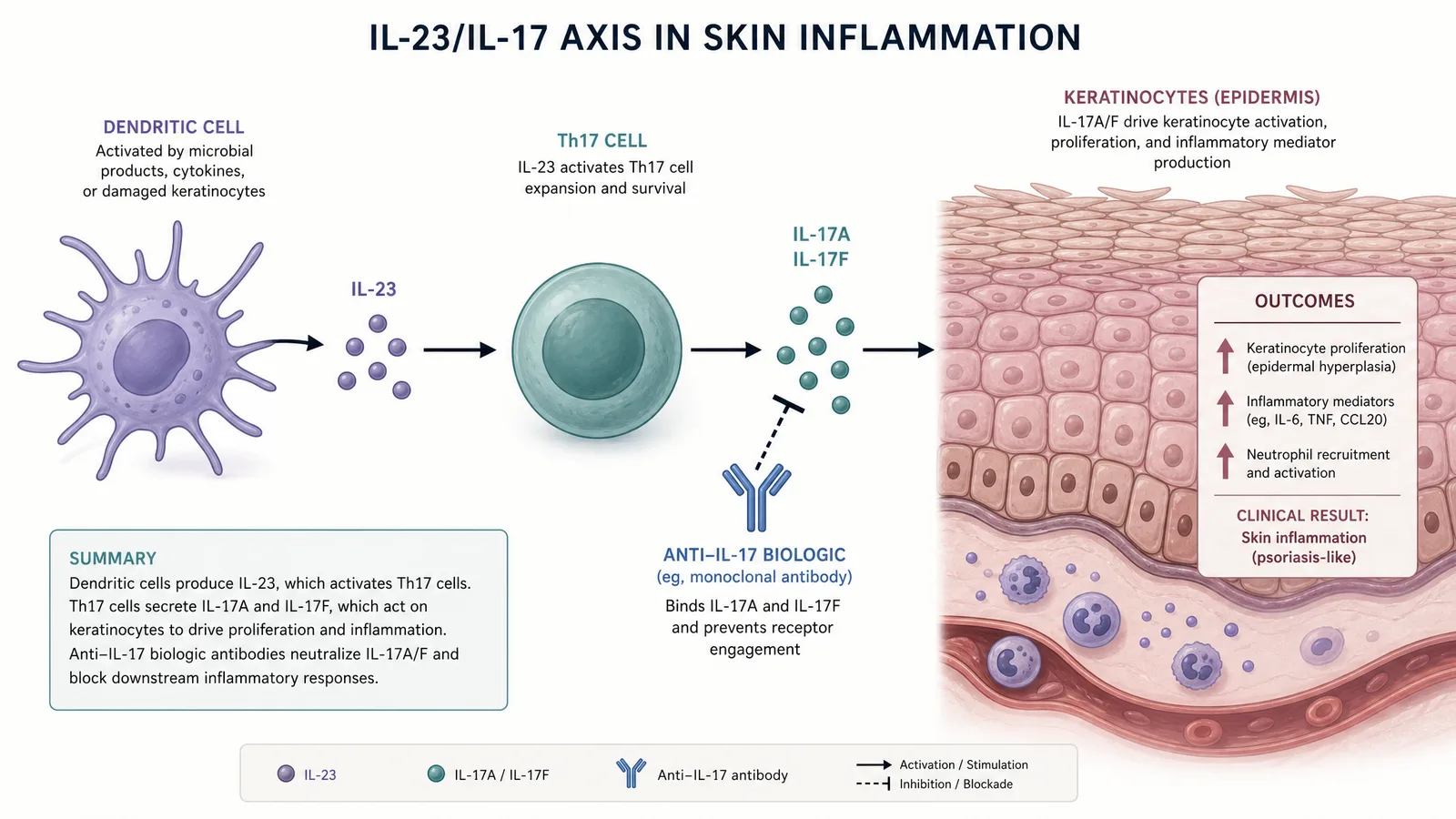
Immune / inflammatory pathway — for example the IL-23/IL-17 axis: Th17 activation, IL-23-driven IL-17A/F release, keratinocyte inflammation, and where a biologic blocks it. Central to psoriasis, hidradenitis, and atopic dermatitis work.
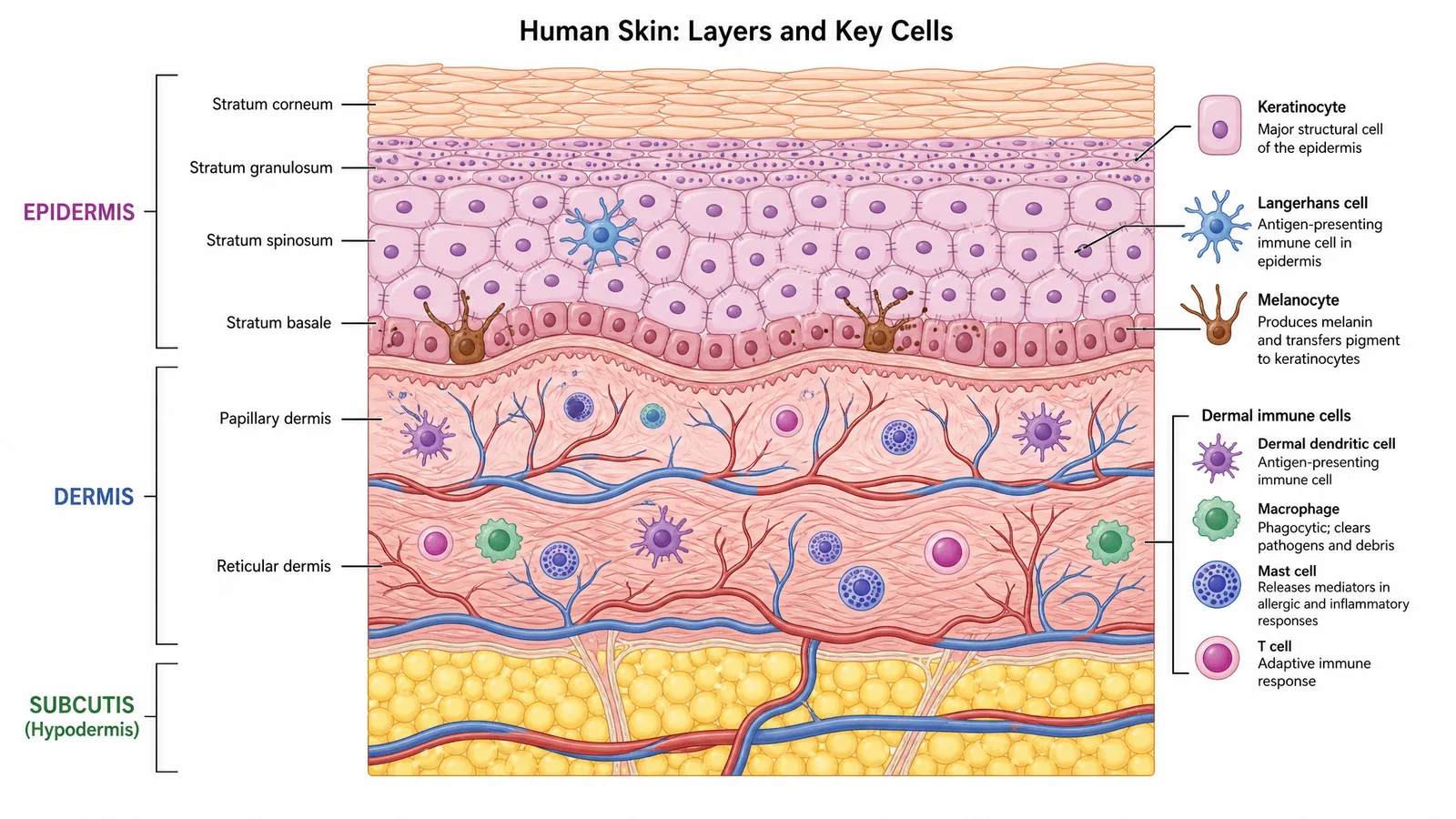
Skin cross-section / layer anatomy — the epidermal layers, dermis, and key cells (keratinocytes, Langerhans cells, melanocytes) that a barrier-function or pathology study intervenes on.
EADV 2026 IL-23/IL-17 immune pathway figure: Th17 activation, IL-23 driving IL-17A/F release, keratinocyte inflammation, and the target of an IL-17 or IL-23 biologic (Figure generated with SciFig)
7. Designing a Winning EADV ePoster: Accuracy That Survives Peer Scrutiny
A strong EADV ePoster passes two tests: it is grasped in seconds by a delegate scrolling a digital display, and it is scientifically exact enough to survive scrutiny from a dermatologist or immunologist who knows the pathway cold. Build the single A0 portrait page around one dominant "hero" figure — usually the immune pathway or the skin cross-section with the key result nearby — and let everything else support it.
The second test is where scientific figures live or die — and where general-purpose AI image generators fall short. A tool like Nano Banana Pro or GPT Image can produce something that looks about 99% right, but on a scientific figure 99% right is effectively 0% right: a reversed cytokine axis, a mislabeled skin layer, or a biologic hitting the wrong target turns a compelling ePoster into one that misleads a reviewer. And a flat, raster AI image gives you no way to fix that last one percent.
This is the core difference with SciFig. Every figure is a fully editable SVG whose elements — arrows, cytokines, cells, labels — you can modify individually, so you (the author who actually knows the dermatology) can adjust every element until the science is exactly right. The figures that reward this care are exactly the ones reviewers scrutinize:
Epidermal layers — keep the order right (stratum corneum → granulosum → spinosum → basale) rather than reversing them.
IL-23/IL-17 axis — put the biologic's target on the correct cytokine or receptor rather than a plausible-looking but wrong node.
Cell identity — distinguish melanocytes, keratinocytes, and dermal immune cells rather than inventing states that do not exist.
EADV 2026 skin cross-section anatomy figure: epidermal layers, dermis, and key cells including keratinocytes, Langerhans cells and melanocytes (Figure generated with SciFig)
Whether your EADV 2026 ePoster earns its attention comes down to whether these figures are accurate, clear, and legible on a screen — which is exactly where an editable AI figure workflow compresses days of design work into hours without giving up scientific control.
8. Create Your EADV 2026 Figures with AI: The SciFig Workflow
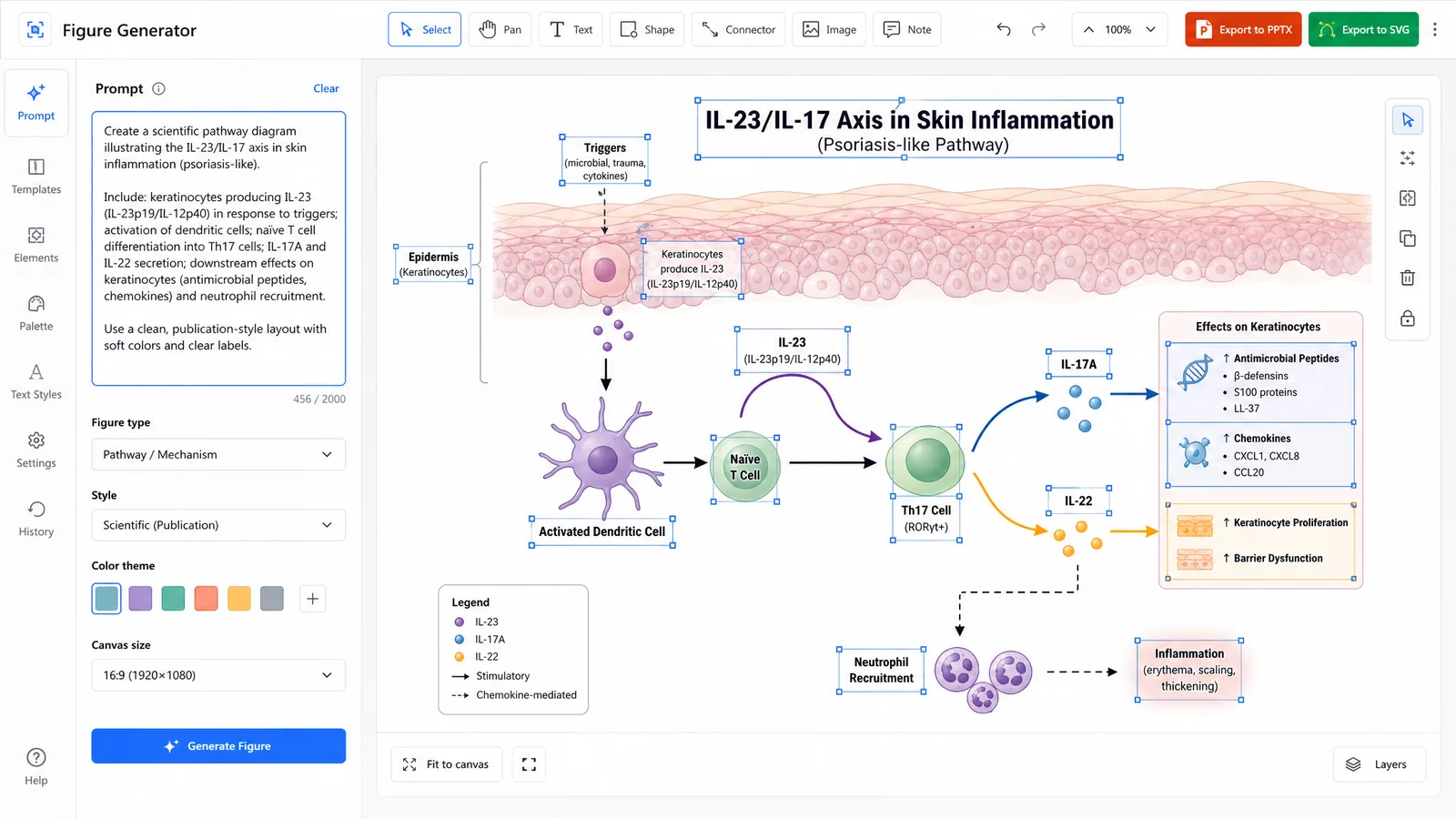
You already have two things most colleagues do not: your accepted abstract and a clear understanding of your study's mechanism — use both to generate your figures online for free, then edit them to exactly right. Here is the SciFig workflow for an EADV presenter, starting in SciFig AI Illustration (AI scientific illustration):
Path 1 — Upload your accepted abstract PDF. Drop it into PDF-to-Figure. It parses your Introduction, Methods, and Results and returns a mechanism diagram or skin schematic in one click — every element stays editable, so you can adjust it to your data and poster layout instead of starting from a blank canvas.
Path 2 — Copy a structured prompt. For a mechanism or pathway figure, Text-to-Figure gives more control. Copy and adjust to your study:
Schematic of the IL-23/IL-17 axis in psoriasis: a dendritic cell
releasing IL-23, activating a Th17 cell to secrete IL-17A and IL-17F,
driving keratinocyte proliferation and inflammation, with an anti-IL-17
biologic blocking the cytokine.
Path 3 — Sketch and scan. If you sketched your hero figure on paper, photograph it and drop it into Sketch-to-Figure to get a publication-style version that preserves your topology.
EADV 2026 figure workflow in SciFig: a skin immune pathway prompt left, an editable SVG diagram right, PPTX and SVG export for an A0 portrait ePoster (Figure generated with SciFig)
From any path, you edit individual elements in the vector canvas — adjust labels, colors, cytokine targets — and export to editable PPTX or layered SVG for your ePoster and slides. Start free, no card required: 150 credits on day one (3 figures), plus daily check-in credits that grow with your streak (up to 150 a day) — up to about 44 figures in your first month, so most authors work through a full set of figures over their first few days. For companion guides in this conference series, see the ESMO 2026 poster guide and the SITC 2026 poster guide.
9. Where EADV 2026 Abstracts Appear: Embargo and the EADV Event Platform
Accepted EADV 2026 abstracts are released when the embargo lifts at 7:00 AM CEST on 30 September 2026, and are then available on the EADV Event platform to registered participants. As of 21 July 2026, EADV had not published whether the 2026 congress abstracts will additionally appear as a JEADV (Journal of the EADV) supplement — the EADV site hosts abstract-book PDFs from past years — so confirm the citable version once it is announced. Searches for "EADV 2026 abstracts" point to this embargoed release on the EADV Event platform.
Because your ePoster and its figures become part of this record, it is worth making sure the figure in your abstract, on your ePoster, and on any slides all tell the same study story. Keep every figure consistent across formats once your work is accepted.
FAQ
No — EADV Congress 2026 is digital-only. Accepted work is presented as an ePoster (a single-page A0 portrait PDF) or in oral sessions; there is no printed poster board to print and ship. The ePoster is displayed digitally and released to registered participants on the EADV Event platform after the embargo lifts.
An EADV 2026 ePoster is a single-page PDF in portrait orientation, recommended at A0 size (841 × 1189 mm / 33.1 × 46.8 in) at a minimum of 200 dpi. Animations are not allowed, a QR code is permitted, and EADV does not provide a template or mandate a font size. Only the presenting author can upload, using an emailed link.
The EADV 2026 ePoster upload window opens 4 August 2026 and closes 21 September 2026. The upload link is emailed to the presenting author, and only that author can submit. Miss the deadline and the accepted ePoster does not display, so prepare your single portrait PDF well before the window closes.
The general EADV 2026 abstract deadline is 14 May 2026, with acceptance notifications on 15 July 2026 — though the site shows a "Deadline Extended" notice without a stated new date, so confirm on the official call-for-abstracts page. A separate late-breaking track (oral only, €100) closes 7 September 2026 with notifications on 14 September.
Yes — an EADV 2026 abstract permits one image per section (.jpg, .gif, .png, or .bmp), within the 4,000-character limit. Patient photographs, identifiable locations, and brand drug names are not allowed, so a clean schematic — a skin cross-section or an immune pathway — is often the most legible and compliant way to make a dermatology point.
EADV 2026 late-breaking orals are 15-minute slots (12 minutes plus 3 minutes of Q&A) with required on-site attendance. For the regular oral / free-communication sessions, EADV had not published the specific slide format or length as of 21 July 2026 — confirm these details in the programme booklet and your presenter instructions rather than assuming a format.
References
All specifications and dates above are drawn from official EADV materials, accessed July 21, 2026:
European Academy of Dermatology and Venereology. EADV Congress 2026. eadv.org. Accessed July 21, 2026. https://eadv.org/congress/
Disclaimer: This article is educational content focused on scientific figure design for conference ePosters and presentations. It is not medical advice and should not be used for clinical decisions. Dates and specifications are summarized from official EADV materials linked above and were accurate at the time of writing; always confirm current details on the official EADV website before submitting or uploading. SciFig is an AI scientific figure platform covering illustrations (SciFig AI Illustration), data-driven charts (SciFig DataChart), and flowcharts (SciFig FlowChart) — it does not diagnose, treat, or advise on patient care.
Keep going
Recommended resources
Templates, tools, and further reading for your research