ESB 2026 Poster & Presentation Guidelines and Template
Official ESB 2026 poster guidelines: A0 portrait size, Velcro-only mounting, the 8-minute oral format, and where ESB 2026 biomaterials research gets published.
SciFig Team
SciFig editorial team
ESB 2026 runs 7–11 September 2026 at the Flanders Meeting and Convention Center, Antwerp, Belgium.
This is a practical guide to the official poster and presentation rules for the European Society for Biomaterials' 35th Annual Conference: the A0 portrait poster size and Velcro-only mounting, and the 8-minute oral format.
It also covers where ESB 2026 research gets published and the biomaterials and tissue engineering figures that make a poster worth stopping for. Every date and specification below links to official ESB 2026 materials.
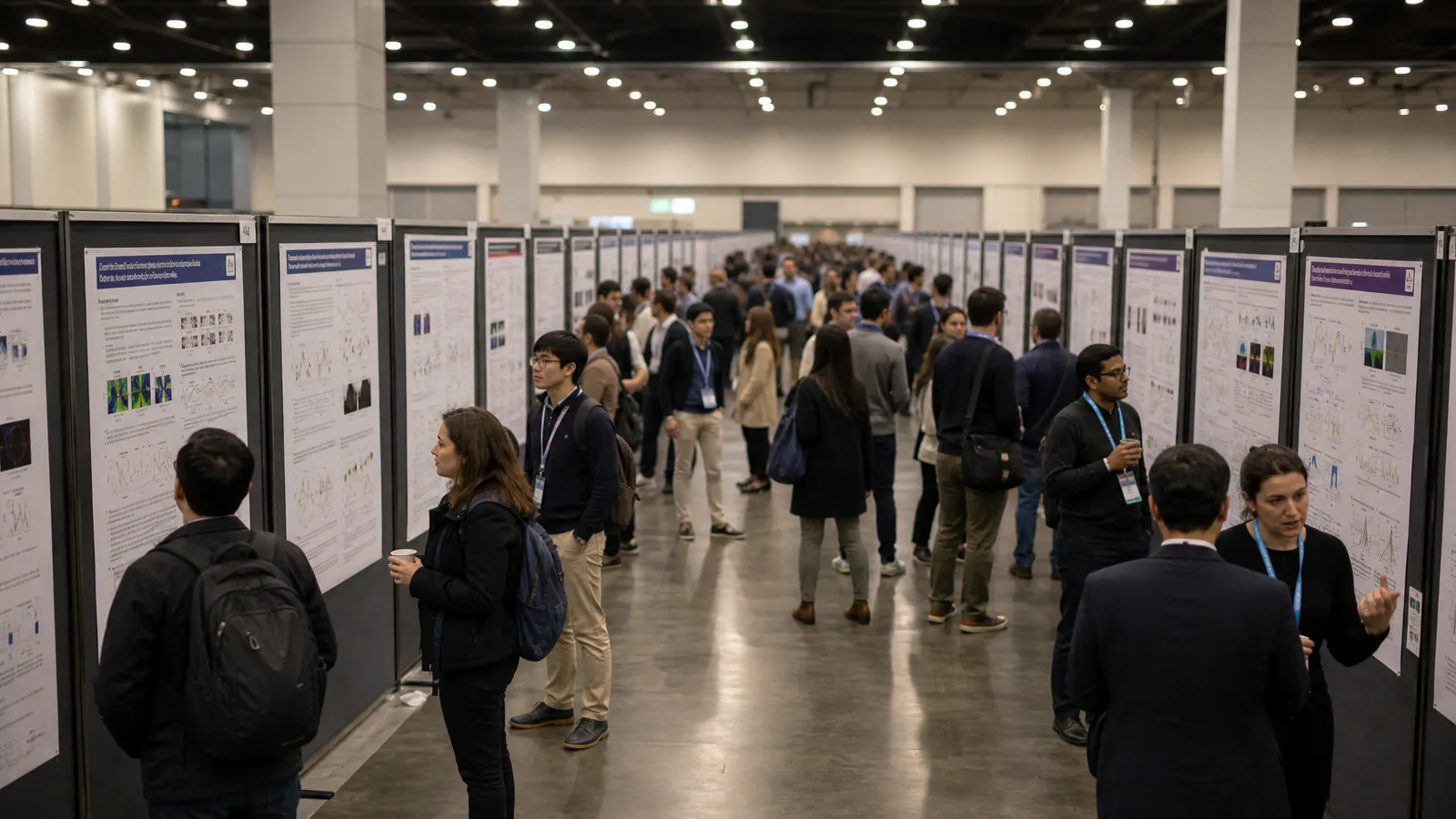
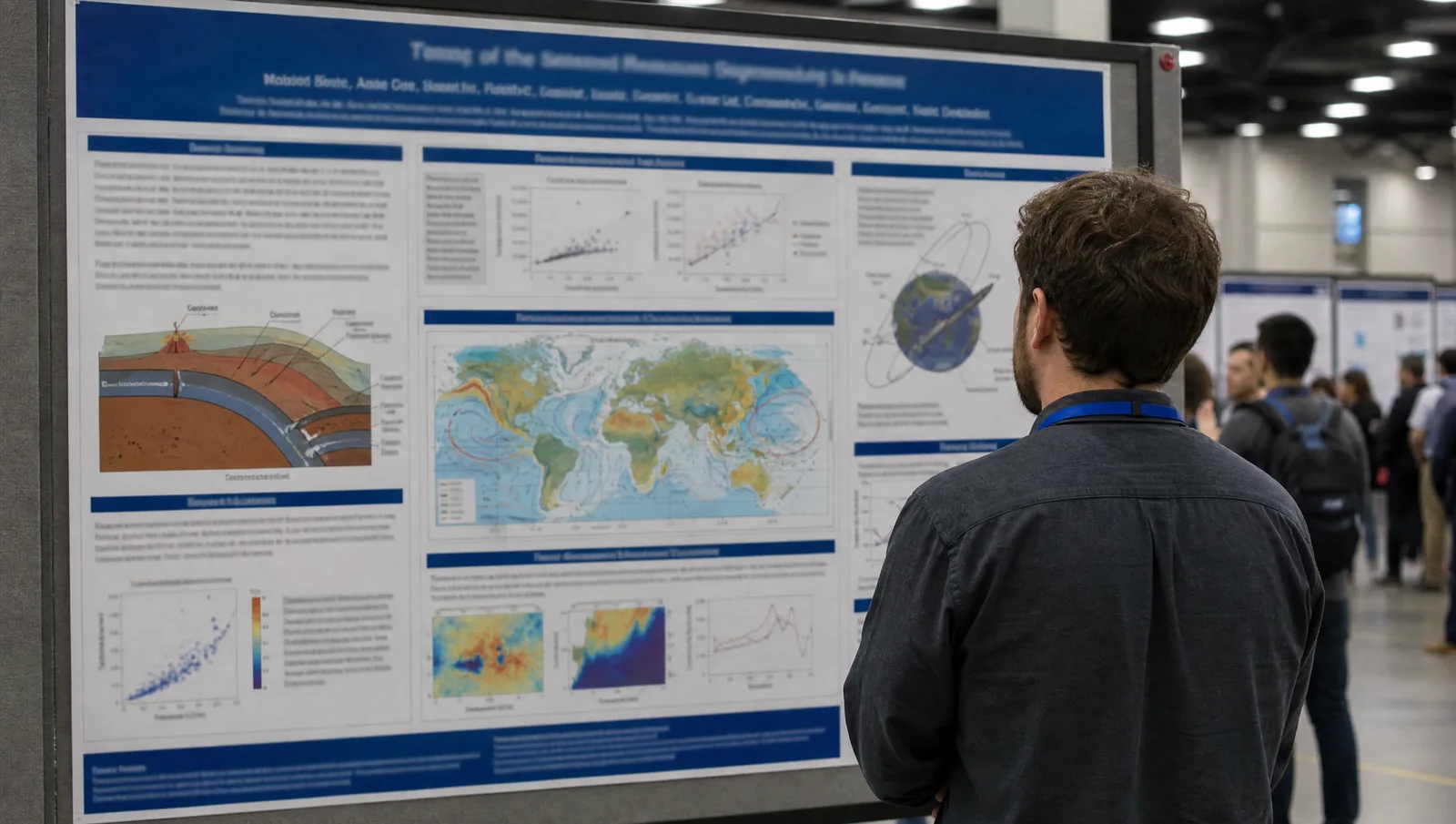
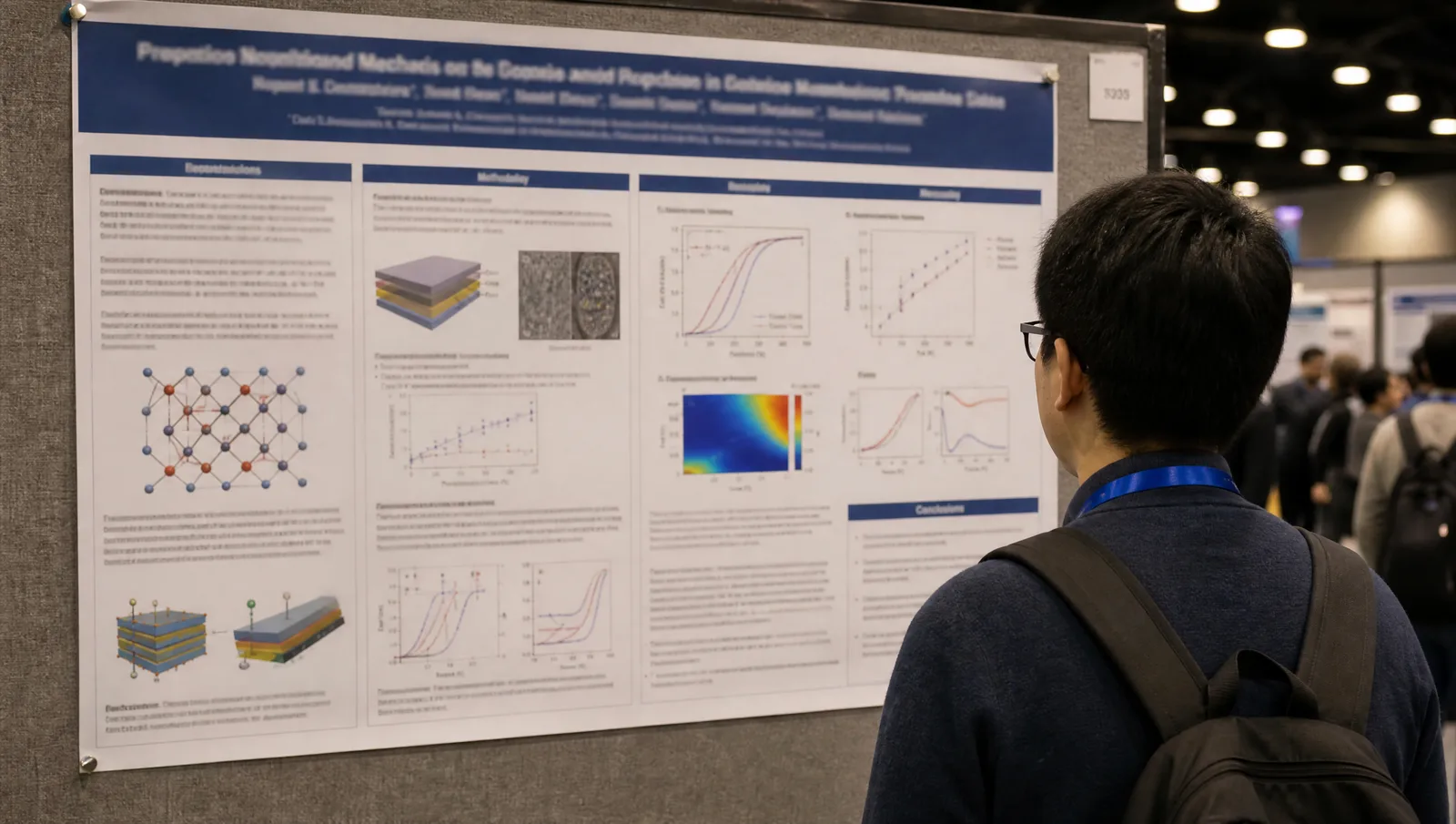
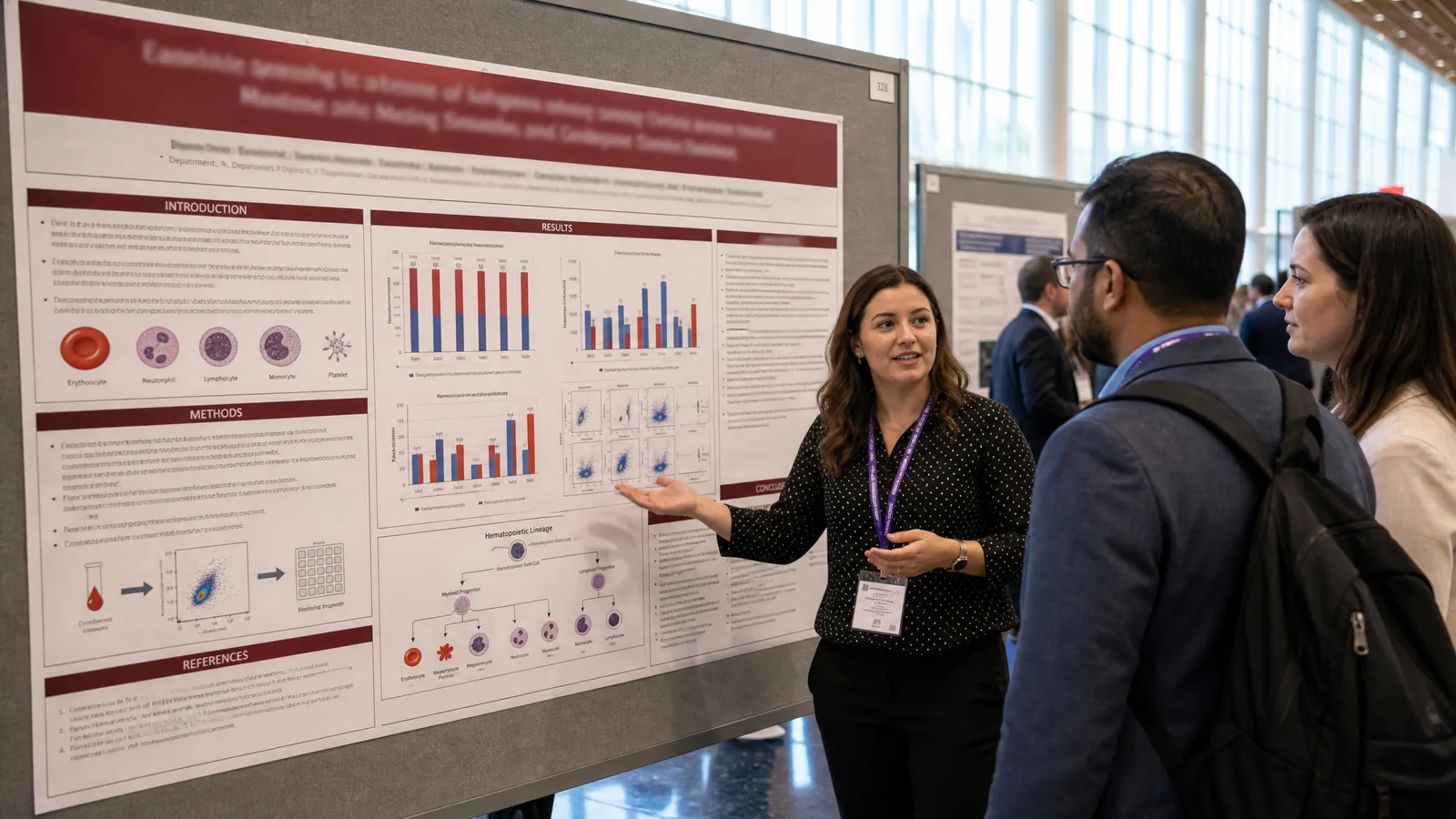
ESB 2026 European Society for Biomaterials poster hall in Antwerp: rows of portrait A0 biomaterials posters along a wide aisle, delegates discussing scaffold figures (Figure generated with SciFig)
Transparency note: Illustrations in this article were generated with SciFig AI and reviewed by the author for scientific accuracy. Factual claims about dates and specifications link to official ESB 2026 materials.
1. ESB 2026 at a Glance: Dates, Venue, and Key Deadlines
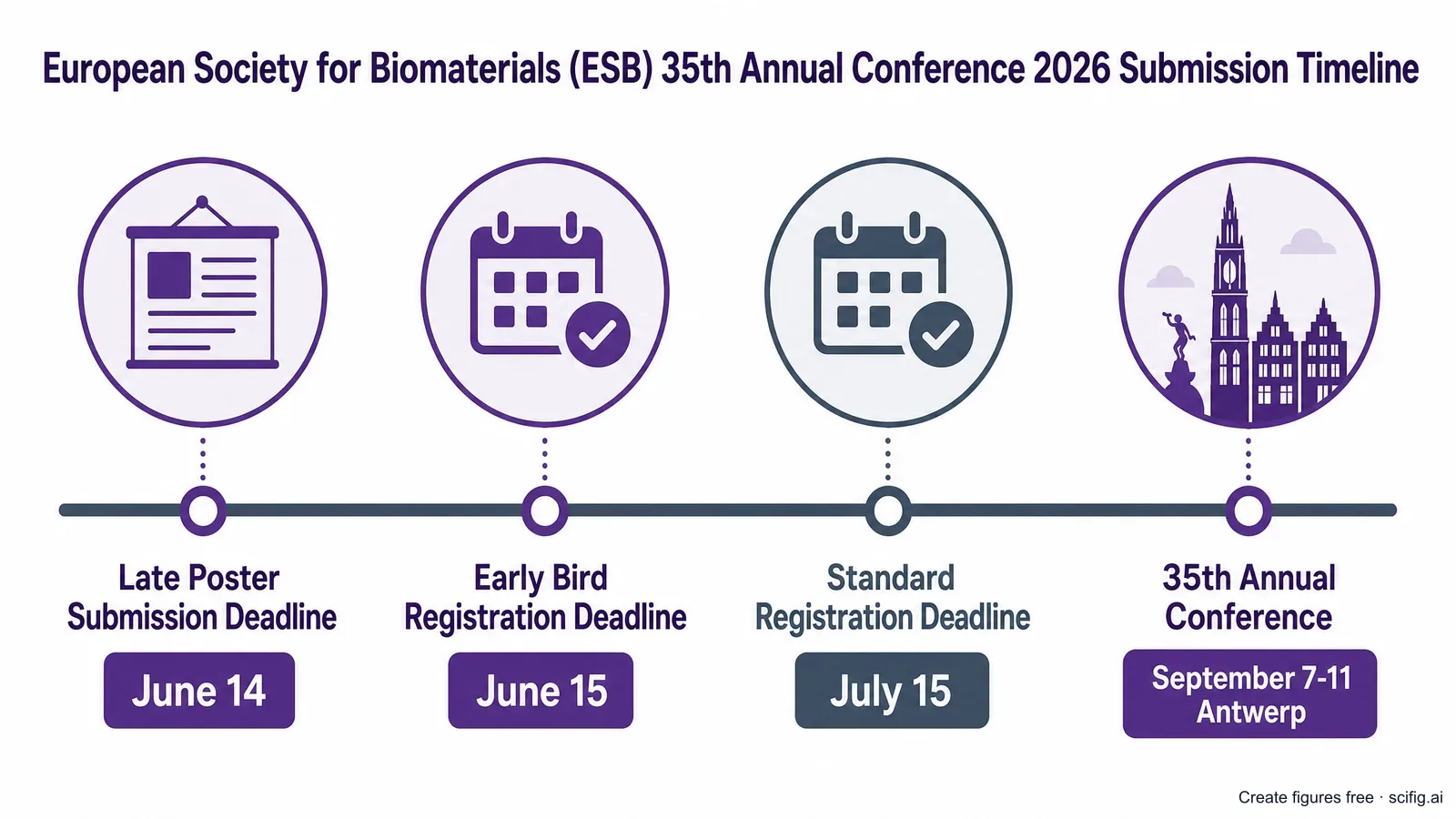
ESB 2026 — the European Society for Biomaterials' 35th Annual Conference — runs 7–11 September 2026 at the Flanders Meeting and Convention Center Antwerp (FMCCA), branded "A Room with a Zoo," in central Antwerp, Belgium, with more than 1,000 participants expected. The week opens Monday 7 September with a Young Scientist Forum (YSF) workshop, roundtables (including one on AI tools in scientific research), a plenary lecture, and the welcome reception; Tuesday through Thursday each carry a full day of parallel sessions plus a midday poster session. If you have an accepted ESB 2026 abstract, the two dates that matter most now are registration deadlines, not submission — abstract submission (both the regular round and the 14 June 2026 late-poster call) has closed.
ESB 2026 poster and registration timeline: late poster submission June 14, early bird registration June 15, standard July 15, conference September 7-11 Antwerp (Figure generated with SciFig)
Date
Milestone
14 June 2026
Late poster submission deadline (closed)
15 June 2026
Early Bird registration deadline (€795 participant / €475 Master's–PhD student)
15 July 2026
Standard registration deadline (€850 / €585)
16 July 2026 onward
Late registration (€1,050 / €685)
7–11 September 2026
ESB 2026 Annual Conference, Antwerp, Belgium
25 September 2026
Deadline for invited full-paper submissions to the Biomaterials Science themed issue
Every presenting author still needs to register for the conference themselves through the official ESB 2026 registration page — abstract acceptance does not include registration. As of this writing, the official abstract submission information page is not currently published on the conference site, so if you are still confirming your own submission status, check directly with the organizers rather than relying on a cached search result.
2. ESB 2026 Poster Size, Format, and Mounting Guidelines
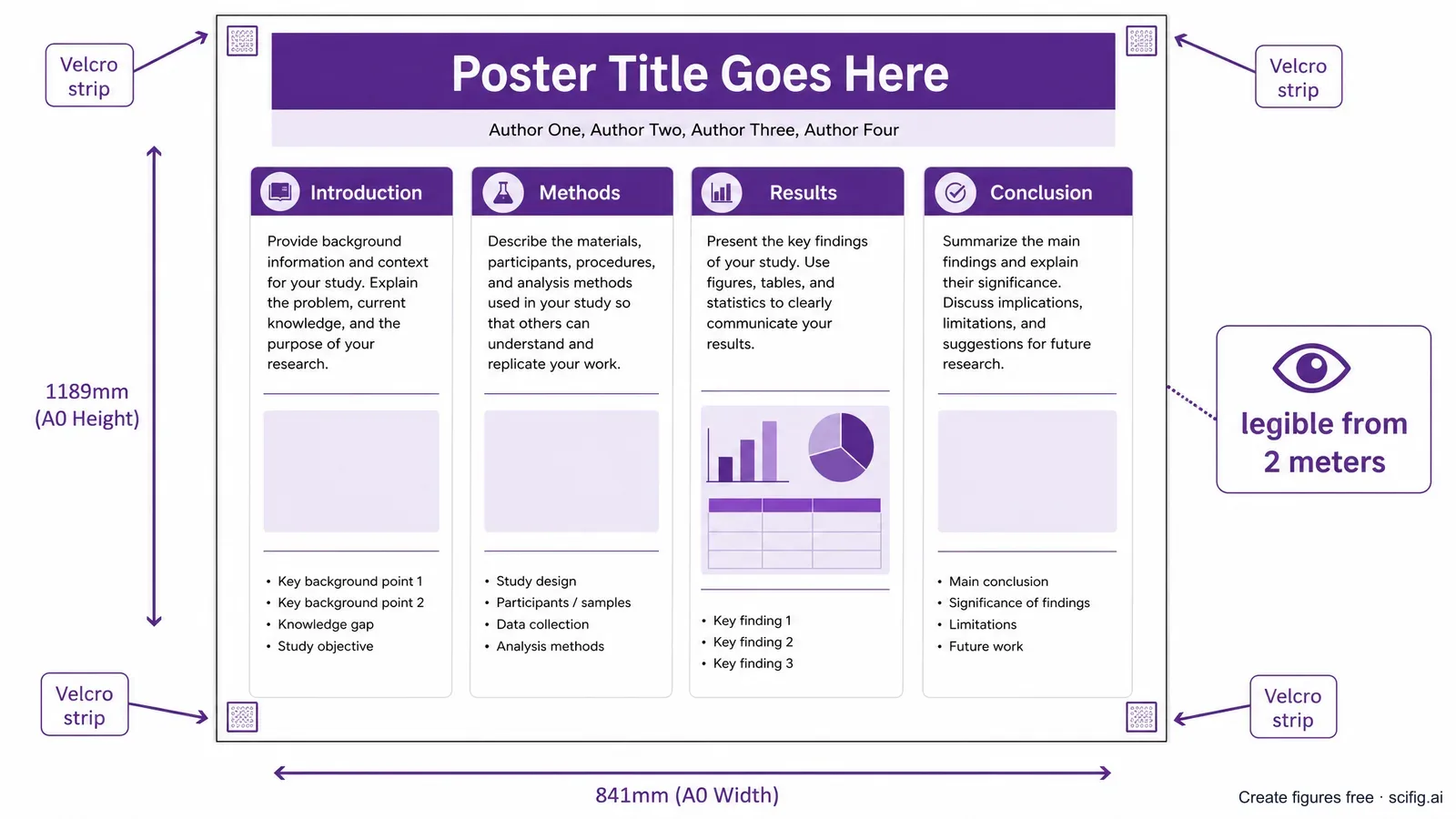
An ESB 2026 poster must be portrait orientation, no larger than A0 (841 × 1189 mm), printed on paper rather than canvas or heavy board, and mounted using only the Velcro strips provided — pins are not permitted. All text, figures, and titles must be legible from at least 2 meters away, the poster must be entirely in English, and it must clearly display the title, author names, and institutional affiliations. Presenters bring their own printed poster to Antwerp — ESB does not offer on-site printing — and place it on the assigned, numbered board about 30 minutes before their scheduled poster session; posters must come down once that session ends.
These ESB 2026 poster size and mounting rules come straight from the official ESB 2026 Guidelines for Presenters. A few points shape how you build the sheet:
Portrait A0, not landscape — design your panel layout for a tall format from the start.
Paper only, Velcro only — skip canvas or foam-board printing, and don't plan on pins or tape.
2-meter legibility — with parallel poster sessions running across multiple rooms, a poster that reads clearly from a normal walking distance gets stopped for.
Bring it yourself — there is no on-site printing service, so build in shipping or luggage time.
ESB 2026 poster size and template: A0 portrait layout with title bar, author row, Velcro mounting points at each corner, and methods and results panels (Figure generated with SciFig)
The scaffold, surface, and mechanism figures that anchor a biomaterials poster are typically the slowest part of that layout to produce. You can generate publication-grade versions online for free and drop them straight into your poster composition.
Need a hero figure for your ESB poster?
Start from a scaffold cross-section, surface-functionalization schematic, or degradation mechanism before you open your poster template.
ESB caps the sheet at A0 portrait and asks for legibility from 2 metres — both are settled by the canvas you start from. Our conference poster templates ship A0 portrait as its own file in editable PowerPoint, with the print type scale already set for that viewing distance.
3. ESB 2026 Oral Presentations: 16:9 Slides and the 8-Minute Format
An ESB 2026 oral presentation runs 8 minutes of talk plus 2 minutes of Q&A, and slides must be built in widescreen (16:9) PowerPoint (.pptx). Presenters are expected to deliver their file to the AV technician — preferably the day before their session — and to meet with the session chair, and full attendance for the entire allocated session is expected of every presenter, not just for their own talk.
The full presenter requirements are in the official ESB 2026 Guidelines for Presenters. With only 8 minutes to make the case for a study, the visual demand is high: nearly every ESB 2026 oral slide needs one clear scaffold, mechanism, or device schematic doing the explaining, rather than a slide of dense body text competing for the audience's attention.
ESB requires 16:9 PowerPoint but publishes no slide template, and 8 minutes leaves room for only a handful of slides. Our scientific presentation templates are 16:9 and already ordered the way a short conference talk runs, so each slide arrives with a job to do.
4. What Figures Do You Need? Scaffold, Surface, and Mechanism Diagrams for Your ESB Poster or Slide
Whether you are building an ESB 2026 poster or an 8-minute oral slide deck, the biomaterials and tissue engineering community expects the same handful of scientific figure types — and the most time-consuming ones can be generated online for free in minutes. The exact mix depends on your track (scaffold fabrication, surface engineering, drug delivery, biofabrication, and so on — the ESB 2026 programme spans dozens of parallel sessions on exactly these themes), but a few figure jobs recur across the meeting:
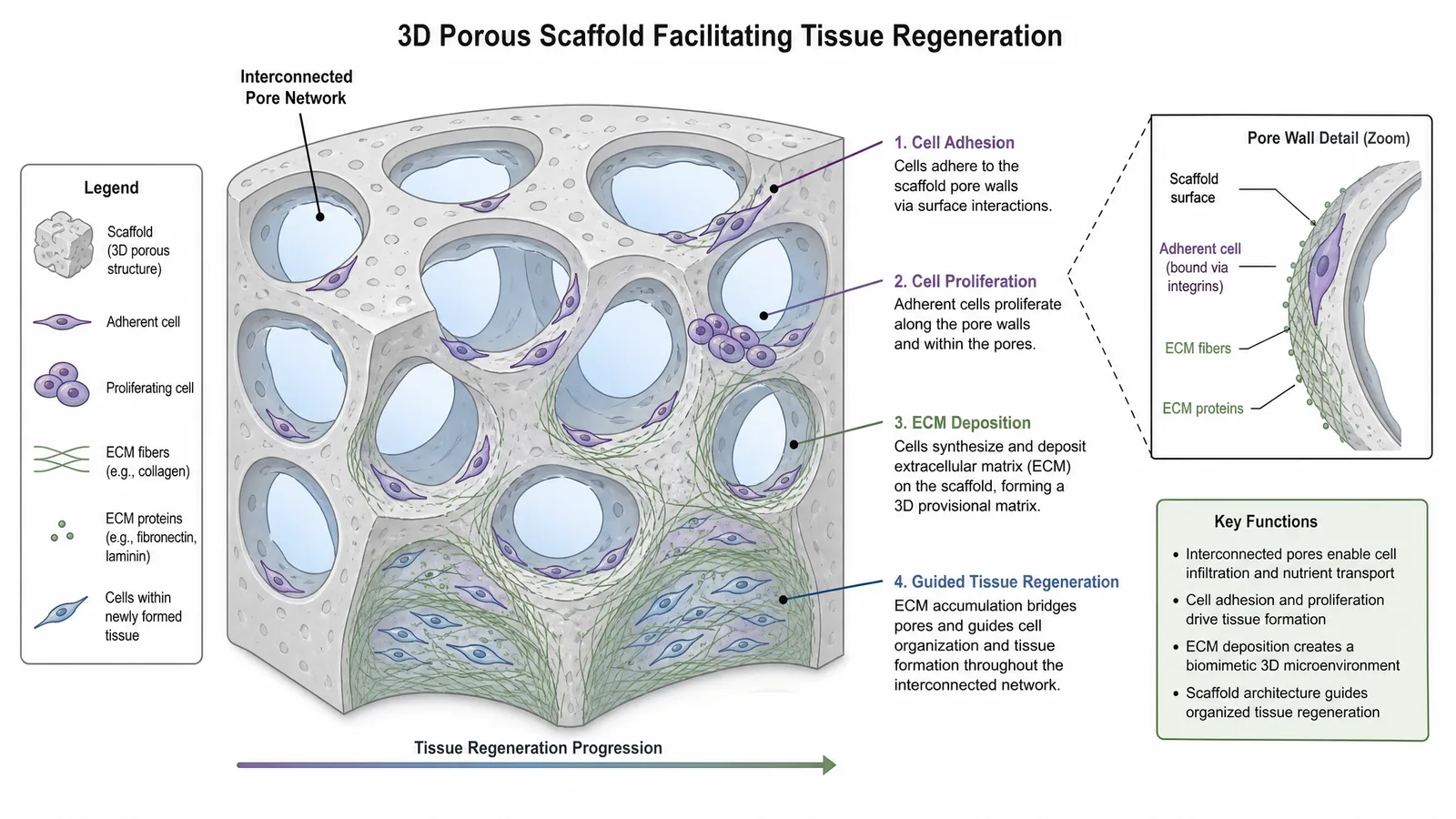
Scaffold architecture / cell–material interaction — the porous scaffold cross-section, cell seeding, adhesion, and extracellular matrix (ECM) deposition that carries a tissue-engineering story. The figure most likely to decide whether your poster gets read.
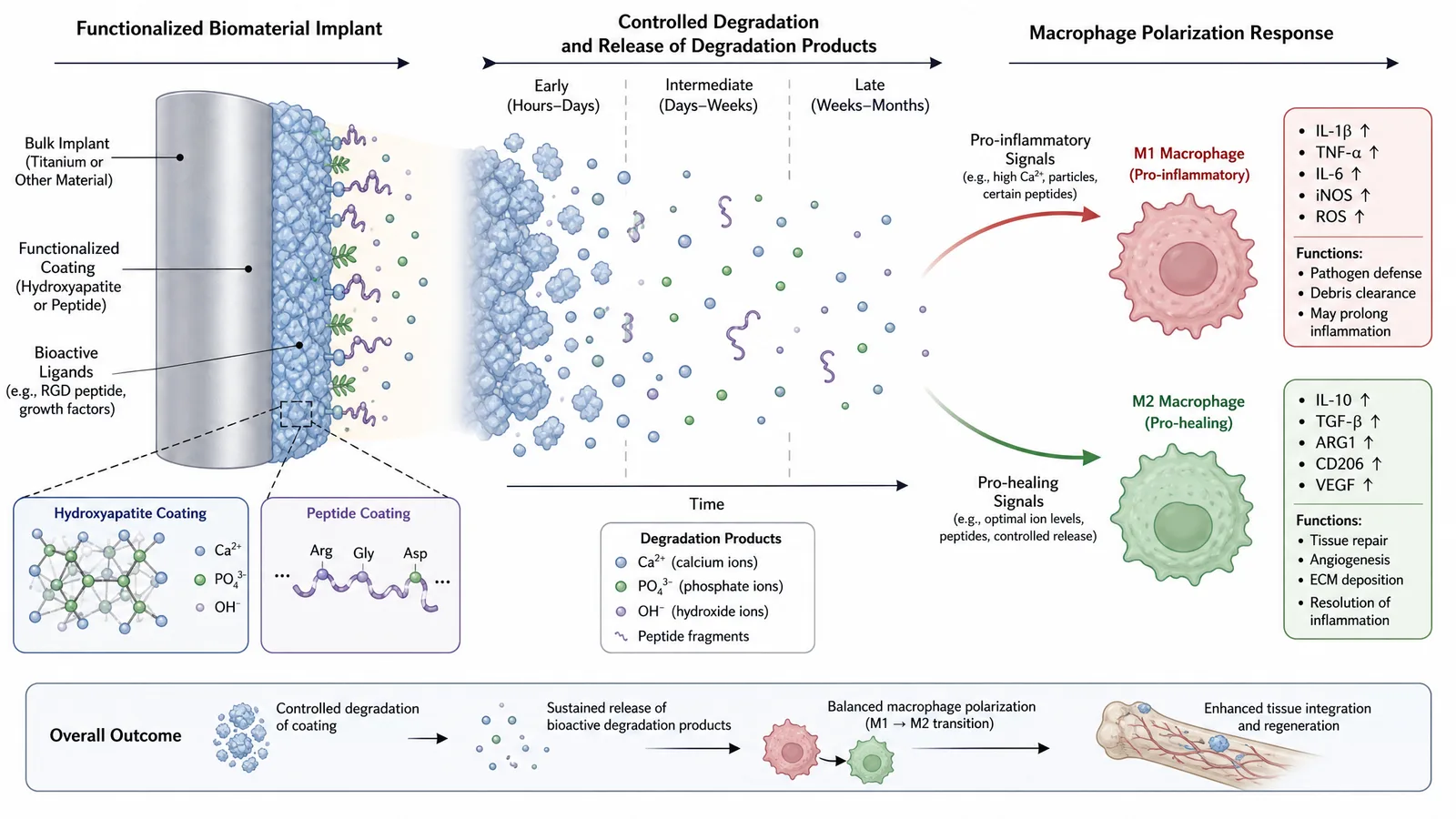
Surface functionalization or degradation mechanism — the coating, crosslinking, or controlled-release chemistry applied to an implant or scaffold surface, and how it degrades or releases its payload over time.
Biofabrication or 3D-printing process schematic — the bioprinting, electrospinning, or additive-manufacturing steps that turned raw material into your construct.
In vitro / in vivo model schematic — the culture system, organ-on-a-chip layout, or animal model your study used to test biocompatibility or efficacy.
ESB 2026 tissue engineering scaffold figure: a 3D porous scaffold cross-section with cell adhesion, proliferation and extracellular matrix deposition (Figure generated with SciFig)
5. Designing a Winning ESB 2026 Poster: Accuracy That Survives Peer Scrutiny
A winning ESB 2026 poster passes two tests: a delegate walking the aisle grasps it in three seconds, and it is precise enough to survive scrutiny from a biomaterials scientist standing in front of it. With poster sessions run in parallel across several rooms each day, the best layouts build around one dominant "hero" figure — usually the scaffold cross-section or the surface-functionalization mechanism with the key result beside it — with everything else arranged to support it. A tall A0 portrait sheet with one strong figure reads better than a dense grid of small panels.
The second test is where scientific figures live or die — and where general-purpose AI image generators fall short. A tool like Nano Banana Pro or GPT Image can produce something that looks about 99% right, but on a scientific figure 99% right is effectively 0% right: an inverted degradation pathway, a non-interconnected pore network drawn as a solid block, or a swapped cell-response label turns a compelling poster into one that misleads a reviewer. A flat, raster AI image gives you no way to fix that last one percent.
This is the core difference with SciFig. Every figure is a fully editable SVG whose elements — pores, coatings, cells, arrows — you can correct individually, so you (the author who actually knows the materials chemistry) can adjust any element until the figure matches your science. The figure types that reward this care most are exactly the ones reviewers scrutinize:
Scaffold pore architecture — draw a truly interconnected pore network, not a solid block with surface holes; a non-interconnected structure misrepresents cell infiltration and vascularization potential.
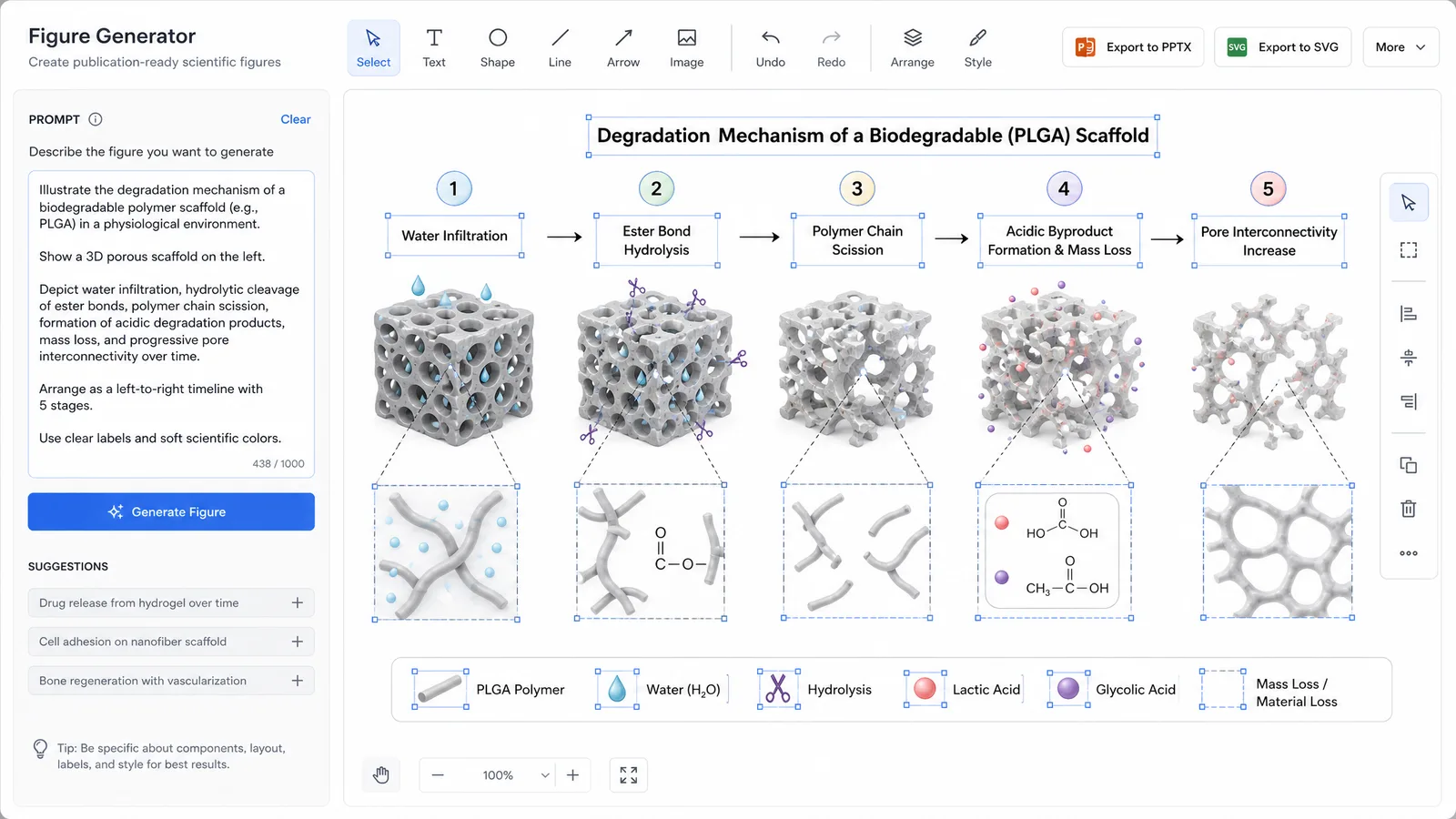
Degradation mechanism — get surface erosion versus bulk erosion right (or degradation direction right at all); confusing the two misrepresents how an implant's mechanical integrity actually changes over time.
Macrophage polarization in a foreign-body-response figure — M1 (pro-inflammatory) and M2 (pro-healing) states are commonly reversed or blurred, which undercuts a biocompatibility claim the whole poster may rest on.
ESB 2026 biomaterial surface functionalization figure: a hydroxyapatite-coated implant surface with a controlled degradation pathway and M1/M2 macrophage response (Figure generated with SciFig)
Whether your ESB 2026 poster earns attention in a crowded room comes down to whether these figures are accurate, clear, and legible from 2 meters — exactly where an editable AI figure workflow compresses days of design work into hours without giving up scientific control.
Tip
With poster sessions that run in parallel across several rooms and dozens of boards per room, the single highest-leverage decision in your preparation window is which figure becomes the hero. Pick the one a delegate needs to remember after they've walked past ten other posters — usually the scaffold or mechanism figure with the key result nearby — and design the rest of the A0 sheet around it.
6. Create Your ESB 2026 Figures with AI: The SciFig Workflow
You already have two things most colleagues do not: your accepted abstract and a clear understanding of your material's mechanism — use both to generate your figures online for free, then edit them to exactly right. Here is the SciFig workflow for an ESB 2026 presenter:
Path 1 — Upload your accepted abstract PDF. Drop it into PDF-to-Figure. It parses your Introduction, Methods, and Results and returns a scaffold or mechanism diagram in one click. SciFig generates the figure, and every element stays editable so you can adjust it to your data and poster layout — no blank canvas.
Path 2 — Copy a structured prompt. For a scaffold, surface, or degradation figure, Text-to-Figure gives more control. Copy and adjust to your material system:
Cross-section of a porous, interconnected 3D tissue-engineering scaffold
seeded with cells: cells adhering to pore walls, proliferating, and
depositing extracellular matrix that bridges adjacent pores, with an
inset showing the scaffold's controlled surface degradation releasing
byproducts over time.
Path 3 — Sketch and scan. If you sketched your hero figure on paper, photograph it and drop it into Sketch-to-Figure to get a publication-style version that preserves your topology.
ESB 2026 poster figure workflow in SciFig: a scaffold degradation prompt left, editable SVG diagram right, PPTX and SVG export (Figure generated with SciFig)
From any path, you edit individual elements in the vector canvas — adjust labels, colors, pore geometry, layer order — and export to editable PPTX or layered SVG for final composition, at high resolution for A0 print without artifacting. Start free: 150 credits on day one, plus daily check-in credits. For the companion guides in this conference series, see the RSNA 2026 poster guide and the SfN 2026 poster guide.
Optional — disclose your AI use. Some journals and conferences now ask authors to disclose AI assistance in figure preparation and to remain responsible for the accuracy of their work. If you build and review a figure in SciFig, you can add one line to its caption — for example: Figure created by the authors using SciFig and reviewed for scientific accuracy (scifig.ai).
Start your ESB figure from prompt, PDF, or sketch
Use the path that matches what you already have, then edit every element until the materials science is exact.
7. Where ESB 2026 Research Gets Published: The Biomaterials Science Themed Issue
ESB 2026 does not publish a traditional printed abstract book — instead, accepted authors can opt in to submit a full paper to a themed issue of Biomaterials Science (the Royal Society of Chemistry journal) dedicated to the conference, with invited full-paper submissions due 25 September 2026. This is an optional track: authors indicate their willingness during abstract submission by checking a box and confirming the work is not already published elsewhere, rather than an automatic publication of every accepted abstract.
If your work is invited into the Biomaterials Science themed issue, it is worth keeping the figure in your abstract, your poster, and your final manuscript telling the same materials story — the same scaffold or mechanism figure, refined at each stage, is easier for reviewers and readers to follow than three different renderings of the same idea.
Frequently Asked Questions
An ESB 2026 poster must be portrait orientation, no larger than A0 (841 × 1189 mm). It should be printed on paper — canvas or heavy board is discouraged — and all text, figures, and titles must be legible from at least 2 meters away. See §2 Poster Size, Format, and Mounting Guidelines.
ESB 2026 posters are portrait orientation, maximum A0 (841 × 1189 mm) — there is no landscape option. Design your title bar, author row, and panel columns for a tall sheet from the outset.
Only Velcro strips are permitted for mounting an ESB 2026 poster — pins cannot be used. Presenters bring a printed hardcopy and place it on their assigned, numbered board about 30 minutes before their scheduled poster session, then remove it once that session ends.
An ESB 2026 oral presentation is 8 minutes of talk plus 2 minutes of Q&A, and slides must be built in widescreen (16:9) PowerPoint (.pptx). Deliver your file to the AV technician — preferably the day before your session — and plan to attend the entire session. See §3 Oral Presentations.
ESB 2026 does not publish a traditional downloadable abstract book. Instead, authors can opt in to submit a full paper to a themed issue of Biomaterials Science (Royal Society of Chemistry), with invited submissions due 25 September 2026. See §7 Where ESB 2026 Research Gets Published.
Abstract submission for ESB 2026 has closed, including the late-poster submission call, which ended 14 June 2026. If you're confirming your own submission status, contact the ESB 2026 organizers directly, since the official abstract information page is not currently published on the conference site.
ESB 2026 — the European Society for Biomaterials' 35th Annual Conference — runs 7–11 September 2026 at the Flanders Meeting and Convention Center Antwerp (FMCCA), branded "A Room with a Zoo," in Antwerp, Belgium. More than 1,000 participants are expected.
Yes — AI tools like SciFig can generate publication-grade scaffold, surface, and mechanism figures from a text prompt or your abstract PDF. Every element stays editable in SciFig's vector canvas, so you can adjust any detail to match your materials system exactly. See §6 The SciFig Workflow.
References
All specifications and dates above are drawn from official ESB 2026 materials, accessed July 21, 2026:
European Society for Biomaterials. ESB 2026 — 35th Annual Conference. esb2026.org. Accessed July 21, 2026. https://esb2026.org/
Disclaimer: This article is educational content on scientific figure design for biomaterials and tissue engineering conference posters and presentations. It summarizes publicly available ESB 2026 conference specifications and is not engineering, materials-safety, or medical advice — see the official ESB 2026 website for current requirements before printing or submitting. SciFig is a scientific figure platform covering AI illustrations (SciFig AI Illustration), data charts (SciFig DataChart), and flowcharts (SciFig FlowChart); it does not certify biomaterial safety, efficacy, or clinical suitability.
Keep going
Recommended resources
Templates, tools, and further reading for your research