ASTRO 2026 Poster & Presentation Guidelines and Template
Official ASTRO 2026 guidelines: the 100% electronic poster format (16:9, one slide, audio), the Sept 21 upload deadline, oral limits, and Red Journal.
SciFig Team
SciFig editorial team
The ASTRO 2026 Annual Meeting runs 26–30 September 2026 in Boston, Massachusetts.
This is a practical guide to the official poster and presentation rules for the American Society for Radiation Oncology's 68th Annual Meeting: the abstract timeline and format, the fully electronic poster format and its September 21 upload deadline, and oral and Quick Pitch time limits.
It also covers the new generative-AI use policy, where accepted abstracts are published in the Red Journal, and the radiation-oncology figures that make a poster or slide worth stopping for. Every date and specification below links to official ASTRO materials.
Need the file, not just the specs? Download our conference poster templates — 24 editable PowerPoint layouts, sized for both printed boards and e-posters.
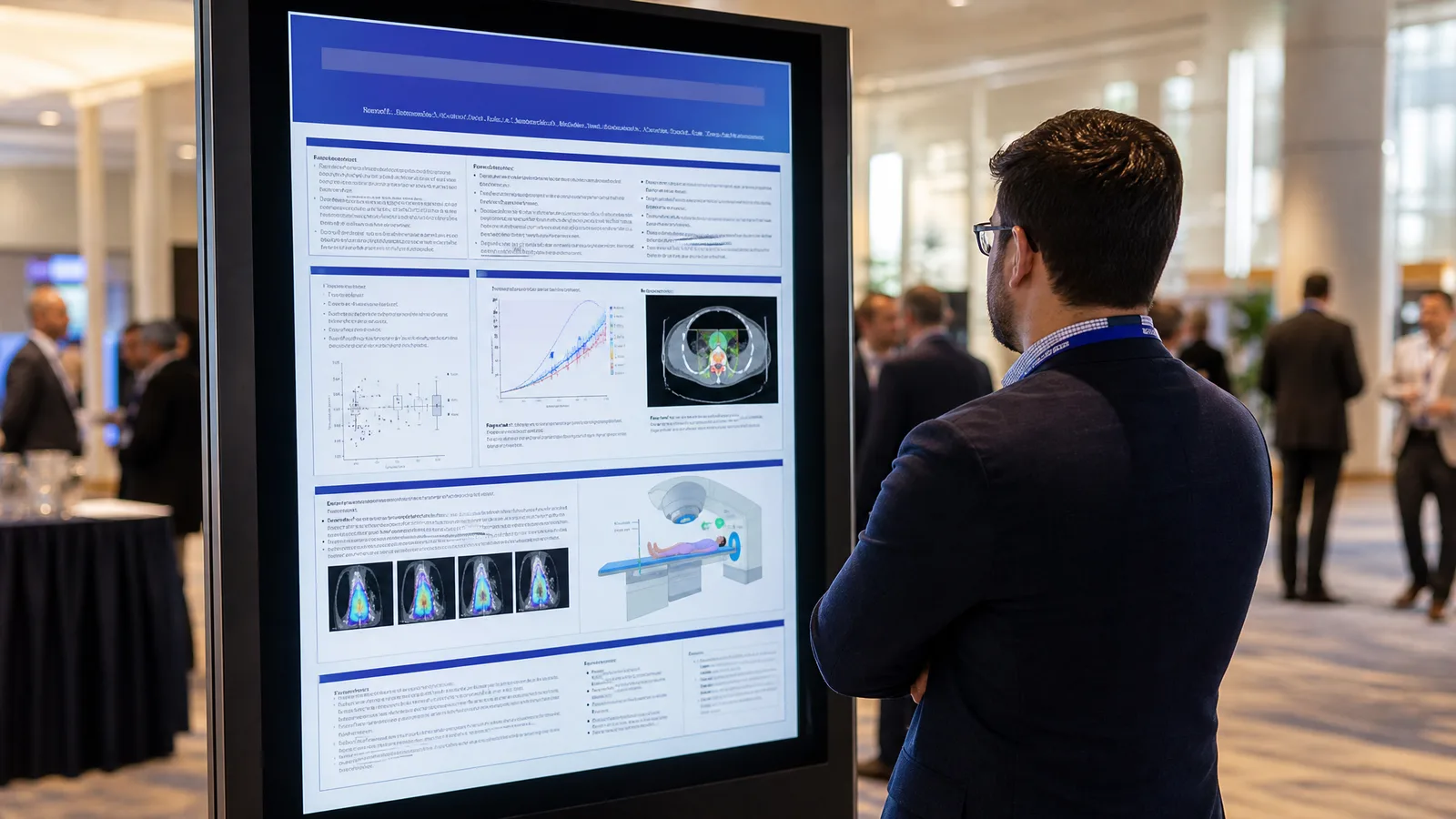
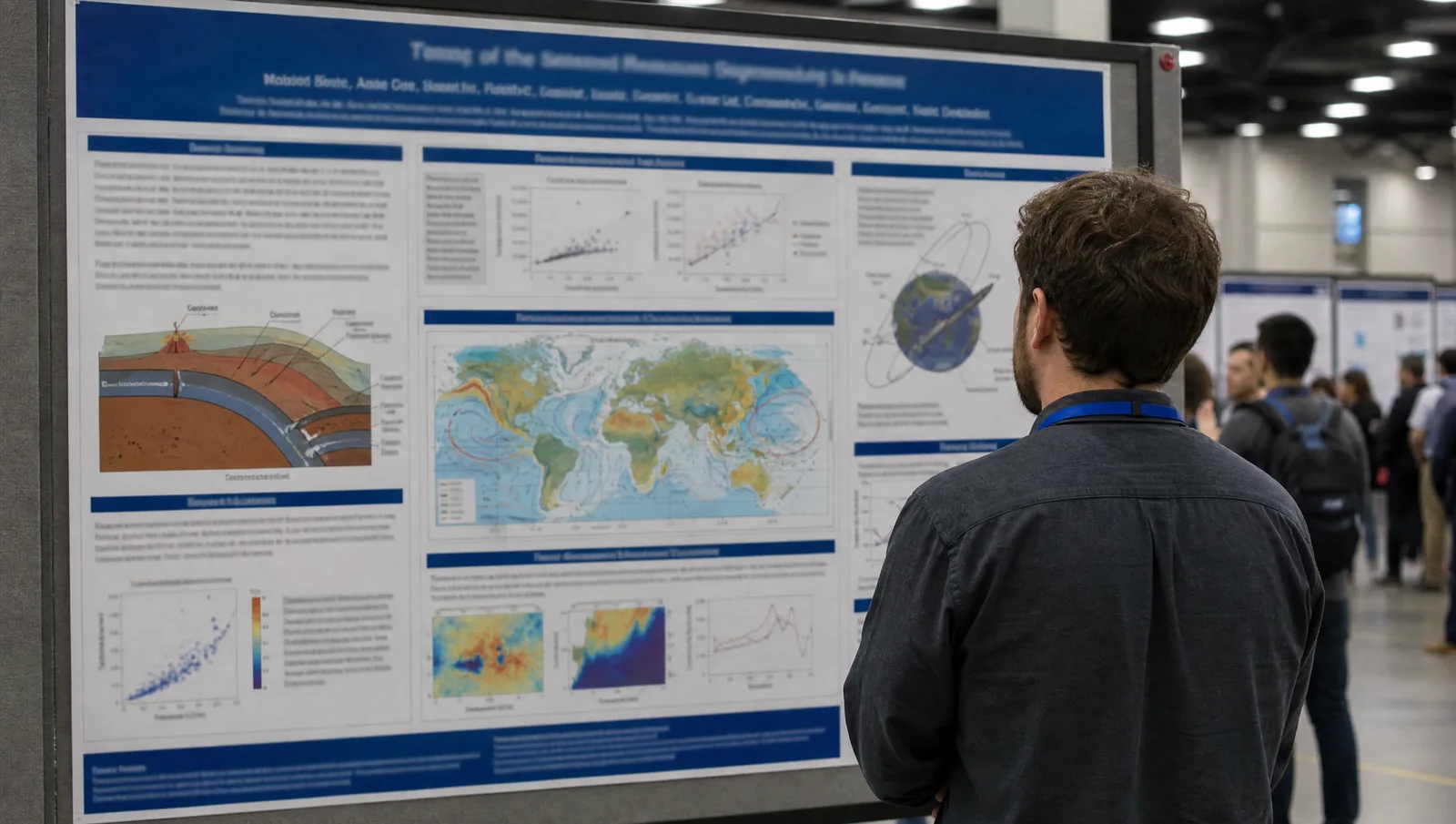
ASTRO 2026 electronic poster on a touchscreen kiosk in Boston: a delegate viewing a landscape 16:9 radiation-oncology e-poster with a dose-distribution figure on screen (Figure generated with SciFig)
Transparency note: Illustrations in this article were generated with SciFig AI and reviewed by the author for scientific accuracy. Factual claims about dates and specifications link to official ASTRO materials.
1. ASTRO 2026 at a Glance: Dates, Venue, and Key Deadlines
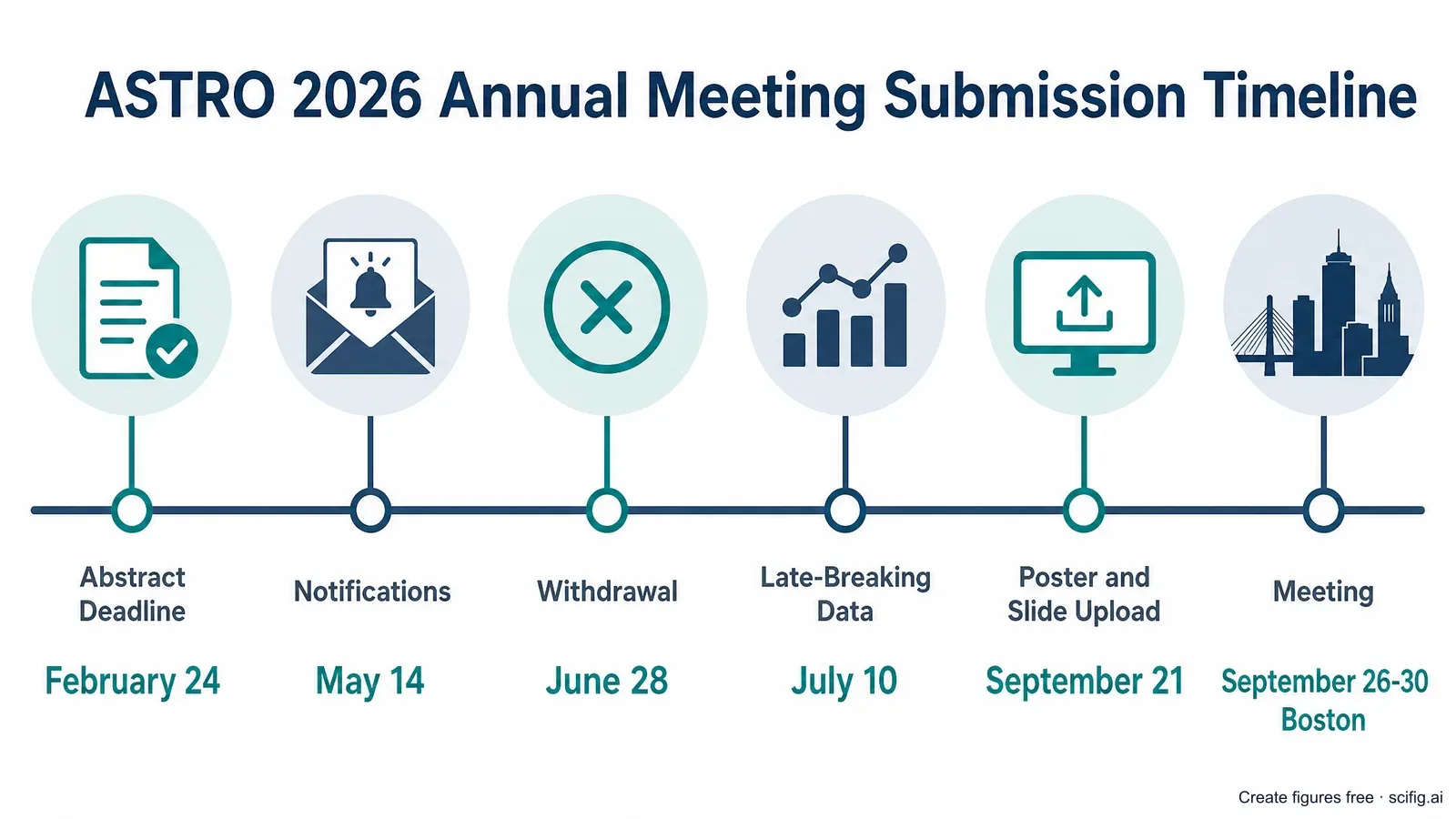
The ASTRO 2026 Annual Meeting — the 68th — runs 26–30 September 2026 at the Thomas M. Menino Convention & Exhibition Center in Boston, Massachusetts (Eastern Time), and every accepted poster must be uploaded as an electronic poster by 21 September 2026. Built around the theme "Data to Dialogue: Communicating Radiotherapy's Value to Advance Care," the meeting draws more than 10,000 radiation oncologists, physicists, biologists, and clinicians and features over 2,500 scientific presentations and posters. Because presenter deadlines fall months before the meeting opens, it is worth mapping the full ASTRO 2026 timeline early.
Late-breaking abstract final data (results and conclusions) deadline
21 September 2026
Electronic poster and oral slide upload deadline (11:59 PM PT)
25 September 2026
Embargo lifts; abstracts published in the Red Journal (5:00 PM ET)
26–30 September 2026
ASTRO 2026 Annual Meeting, Boston
Note that submitting an abstract does not register you for the meeting: ASTRO's official registration and housing provider is SPARGO, Inc., and you register separately through the ASTRO 2026 attendee resources.
2. ASTRO 2026 Abstract Submission Timeline and Format Rules
An ASTRO 2026 abstract is a structured, text-only submission of up to 2,600 characters (excluding spaces), organized into four sections — Purpose/Objectives, Materials/Methods, Results, and Conclusions — and figures are not permitted in the abstract body itself. You may include at most one small table, and titles and text may not name institutions or commercial products. The abstract submission fee is $75 per abstract (non-refundable), with a fee waiver available to first authors from World Bank–defined low-income countries.
One point shapes how you plan your figures: the abstract text cannot contain diagrams, but once your work is accepted, your figures come into their own on the electronic poster and in your slides. So while you draft a tight, four-section abstract now, it is worth planning the mechanism or trial-design figure you will build for the poster and talk in parallel. Late-breaking abstracts follow the same February 24 submission deadline for a "shell" abstract, with final data due 10 July 2026.
3. ASTRO 2026 Electronic Poster: 16:9, One Slide, Audio, and the Sept 21 Deadline
ASTRO 2026 posters are 100% electronic — there is no printed poster board and no printed-poster size to design for. Back by popular demand, all poster viewing presentations are displayed as electronic posters on large touchscreens on-site and in the online Virtual Poster Library. Per the official ASTRO presenter resources, an electronic poster is a single, landscape slide in PowerPoint or PDF at a 16:9 ratio (unencrypted), and it must include a recorded audio narration — so plan for one clean, legible slide rather than a multi-panel printed sheet.
The full requirements are in the official ASTRO 2026 presenter resources. Two deadlines and one design consequence matter most:
Upload by 21 September 2026 (11:59 PM PT) through ASTRO's poster vendor (MultiLearning) — a tiered late fee applies before that ($25 through 7/17, $55 for 7/18–8/7, $85 for 8/8–9/21), so upload early.
One 16:9 landscape slide — with only a single screen to work with, one dominant figure and a clear visual hierarchy do far more than dense text.
Record your audio narration — because a viewer experiences your poster on a screen (often before they hear you speak), a crisp vector-style figure that stays legible when they zoom in reads far better than a photographed or low-resolution image.
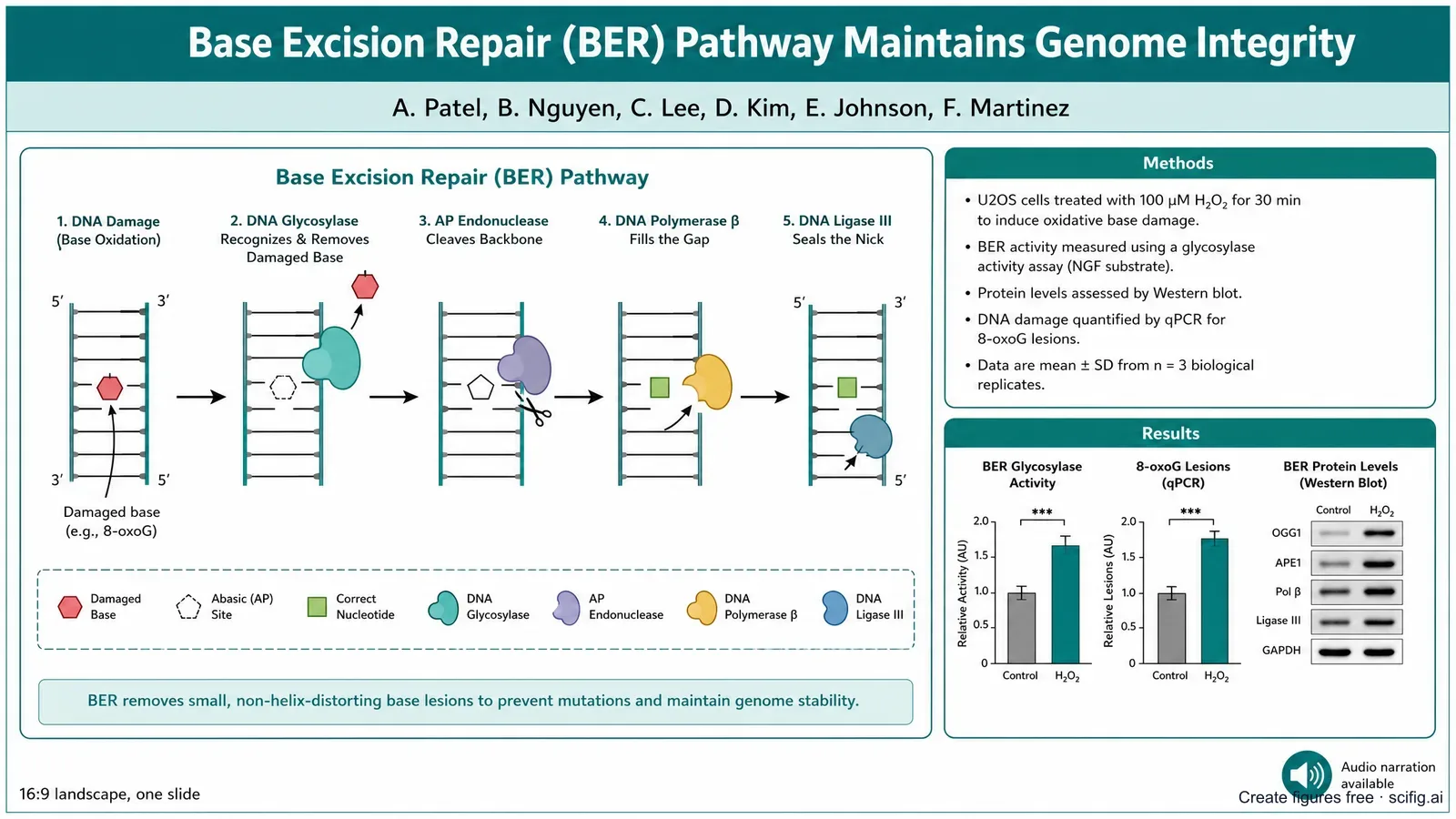
ASTRO 2026 electronic poster template: a landscape 16:9 slide with title bar, author row, a hero radiotherapy mechanism figure, and compact methods and results panels (Figure generated with SciFig)
The radiation-oncology figures on that single slide — a DNA damage-repair pathway, a dose-distribution schematic, a trial schema — are the slowest part to produce. You can generate publication-grade versions online for free and drop them straight into your PowerPoint slide.
Need a hero figure for your ASTRO e-poster?
Start from a DNA-repair pathway, a dose schematic, or a trial design before you build your single 16:9 slide.
A single 16:9 landscape slide is exactly the e-poster format our library ships: the conference poster templates include a 16:9 e-poster layout that exports at 7680 × 4320, well above what a touchscreen wall needs — so the canvas is already the right shape before you place a figure.
4. ASTRO 2026 Oral, Quick Pitch, and Poster Q&A: Slides and Time Limits
ASTRO 2026 presents science in several formats, and each has its own time limit: Oral Scientific Sessions give each presenter 7 minutes of talk plus 3 minutes of Q&A (10 minutes total), Quick Pitch gives 5 minutes across 5 slides with grouped Q&A, and Poster Q&A gives 5 minutes of presentation plus 3 minutes of Q&A. Plenary and Clinical Trials sessions sit above these, unopposed on the main stage. Whichever format you are assigned, slides are due to the Speaker Center by the same 21 September 2026 deadline as posters.
For an ASTRO 2026 oral or Quick Pitch presentation, ASTRO recommends 16:9 widescreen slides and provides an official PowerPoint template (optional, not mandatory). The visual demand is the same across formats: a 5-minute Quick Pitch across five slides leaves no room for walls of text, so nearly every ASTRO slide needs one clear figure — a mechanism schematic, a dose distribution, a trial design — carrying the point. All speakers confirm their slides with ASTRO AV staff in the Speaker Ready Room before presenting.
5. What Figures Do You Need for an ASTRO Poster or Slide?
Whether you are building an electronic poster or oral slides, ASTRO's radiation-oncology audience expects the same handful of scientific figures — and the most time-consuming ones can be generated online for free in minutes. Because the abstract itself cannot contain figures, your visual work lives on the poster and in the talk, where two figure types recur across the meeting's 22 disease-site tracks.
On your e-poster and slides, the recurring radiation-oncology figure types are:
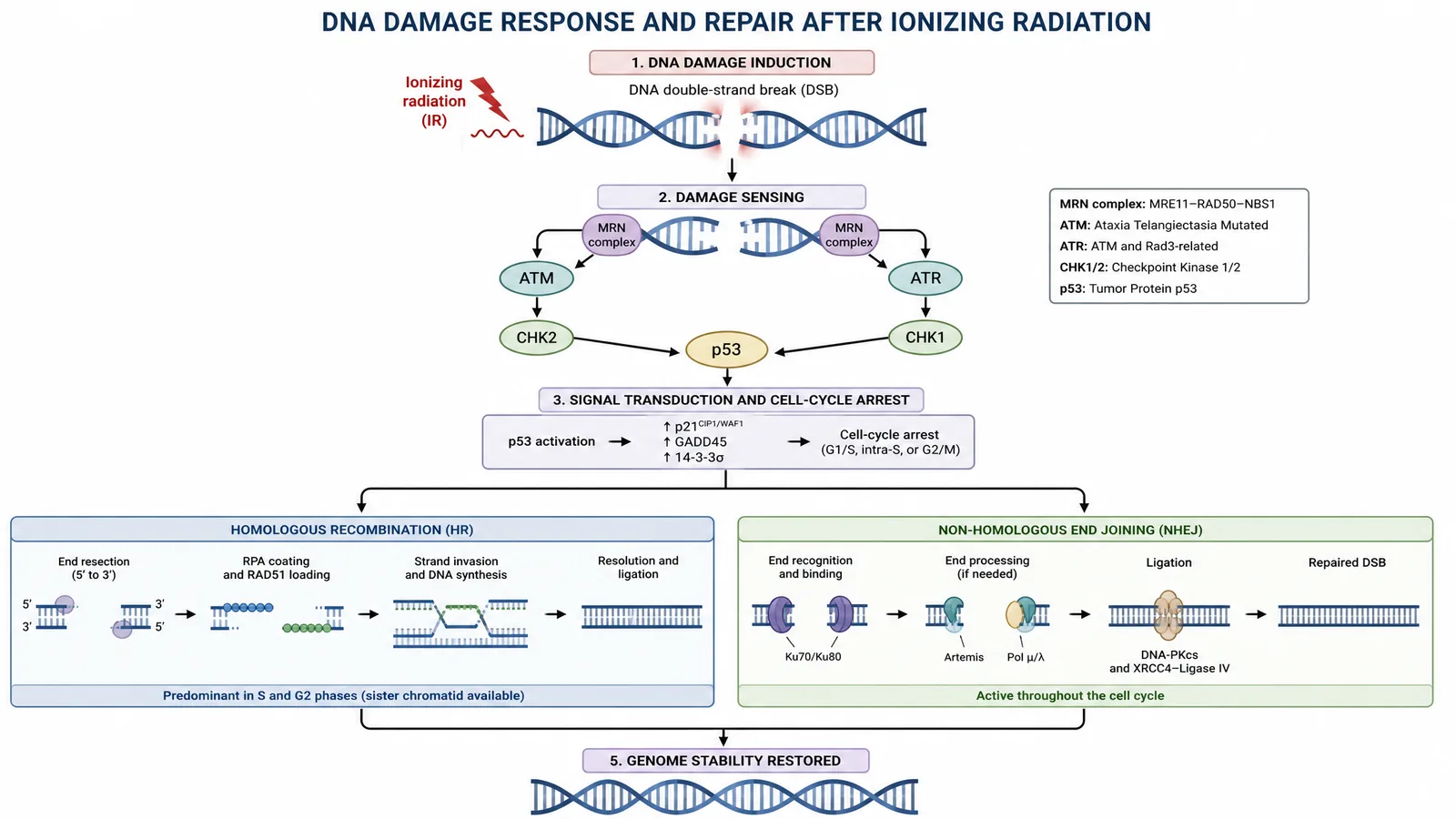
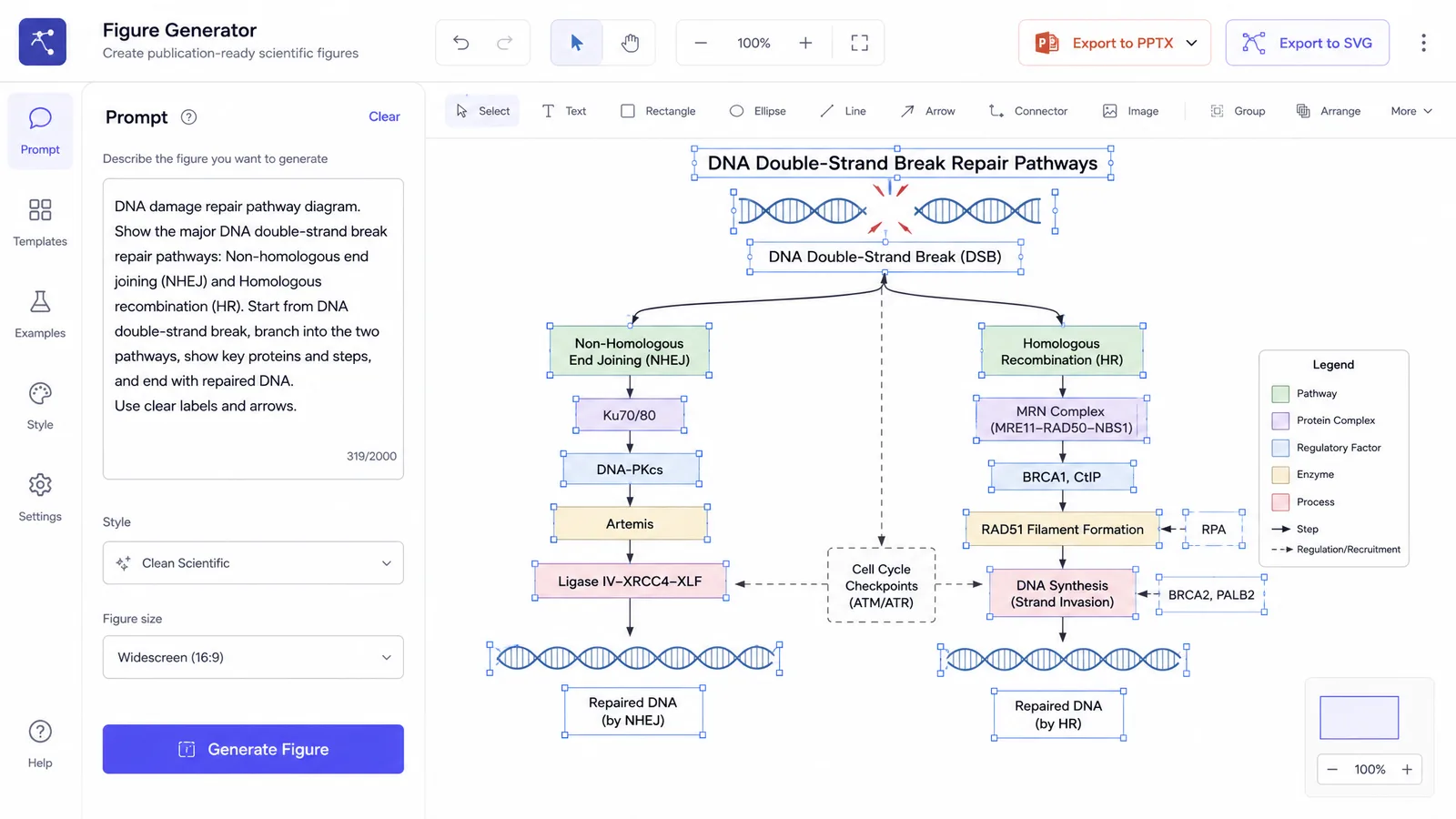
Radiobiology mechanism / DNA damage-repair pathway — how ionizing radiation drives double-strand breaks and how the cell responds (ATM/ATR sensing, cell-cycle checkpoints, and the split between homologous recombination and non-homologous end joining). The figure that explains why a treatment effect happens.
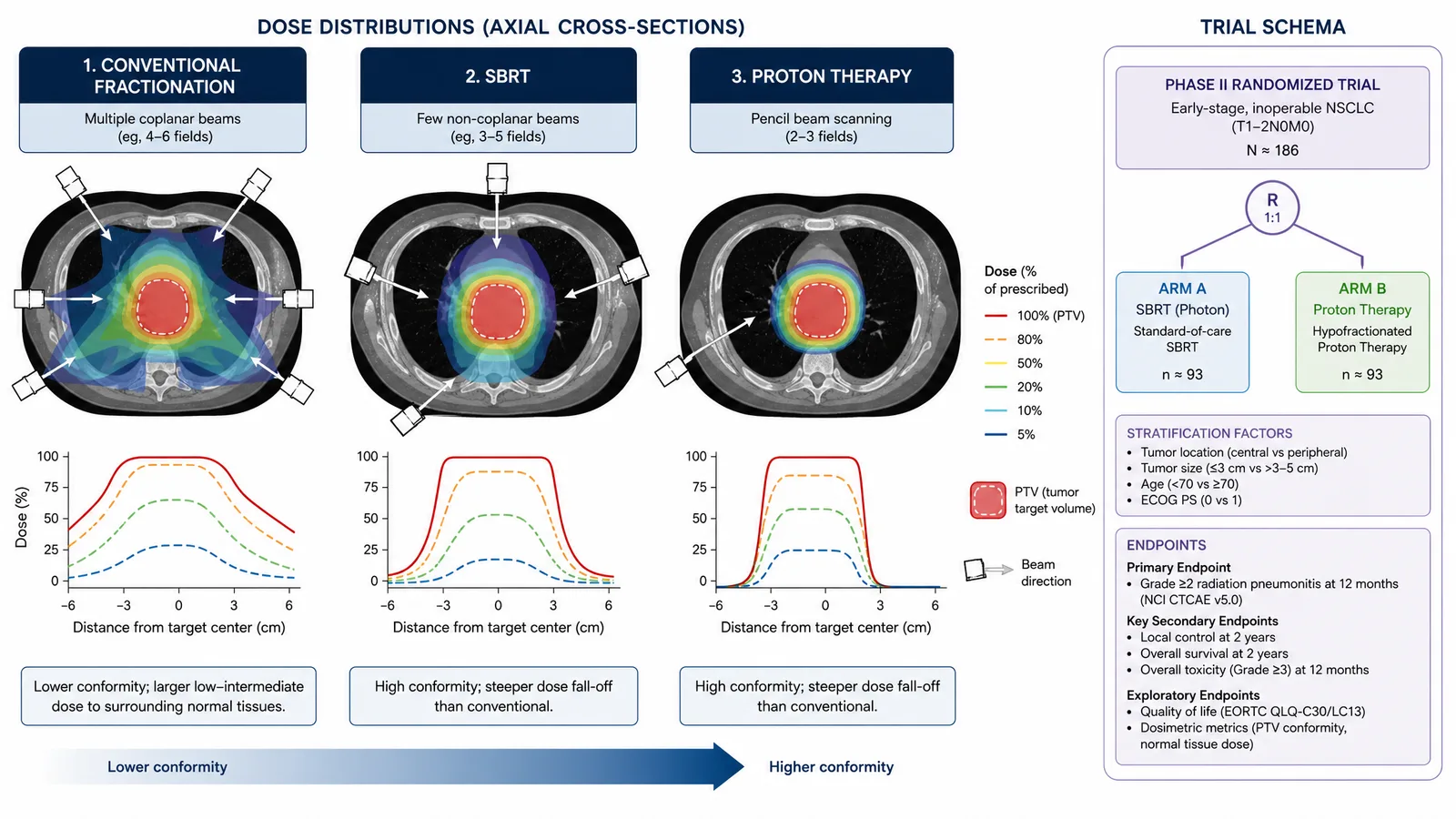
Radiotherapy plan or dose-distribution schematic — comparing conformal, SBRT, and proton approaches to a target, or a trial schema laying out randomization and endpoints. The figure that shows what you did.
ASTRO 2026 DNA damage response and repair pathway figure: ionizing radiation causing double-strand breaks, ATM/ATR sensing, CHK1/CHK2 and p53 checkpoint signaling (Figure generated with SciFig)
6. Designing a Winning ASTRO Poster: Accuracy That Survives Peer Scrutiny
A strong ASTRO e-poster passes two tests: it is grasped in seconds on a busy touchscreen wall, and it is scientifically exact enough to survive scrutiny from a radiation oncologist or medical physicist reading it up close. ASTRO does not run a general "best poster" competition, but it does recognize excellence — the Resident Poster Viewing Recognition Award honors the top-scoring resident posters across biology, clinical practice, and physics, and every abstract is scored by at least seven peer reviewers. The lesson is the same either way: build around one dominant "hero" figure and make the science unimpeachable.
The second test is where scientific figures live or die — and where general-purpose AI image generators fall short. A tool like Nano Banana Pro or GPT Image can produce something that looks about 99% right, but on a scientific figure 99% right is effectively 0% right: a reversed repair pathway, a mislabeled checkpoint kinase, or a dose curve that falls off the wrong way turns a compelling poster into one that misleads a reviewer. And a flat, raster AI image gives you no way to fix that last one percent.
This is the core difference with SciFig. Every figure is a fully editable SVG whose elements — arrows, labels, molecules, dose lines — you can modify individually, so you (the author who actually knows the radiobiology) can adjust every element until the science is exactly right. The radiation-oncology figures that reward this care are exactly the ones reviewers scrutinize:
DNA damage repair — keep the ATM/ATR → CHK1/CHK2 → p53 cascade pointing the right way, and split homologous recombination and non-homologous end joining correctly rather than blurring them.
Dose distribution — show conformity and fall-off that actually match the technique (SBRT vs proton vs conventional fractionation), not a generic gradient.
Trial schema — get the randomization, arms, and endpoints right; ASTRO's reviewers score for clearly defined endpoints and appropriate statistics.
ASTRO 2026 radiotherapy treatment plan schematic: a target volume with conformal, SBRT and proton dose distributions compared, plus a trial schema with randomization (Figure generated with SciFig)
Whether your ASTRO 2026 poster earns its attention comes down to whether these figures are accurate, clear, and legible on a single screen — which is exactly where an editable AI figure workflow compresses days of design work into hours without giving up scientific control.
7. Create Your ASTRO 2026 Figures with AI: The SciFig Workflow
You already have two things most colleagues do not: your accepted abstract and a clear understanding of your study's mechanism — use both to generate your figures online for free, then edit them to exactly right. Here is the SciFig workflow for an ASTRO presenter, starting in SciFig AI Illustration (AI scientific illustration):
Path 1 — Upload your accepted abstract PDF. Drop it into PDF-to-Figure. It parses your Purpose, Methods, and Results and returns a mechanism diagram or trial schema in one click — every element stays editable, so you can adjust it to your data and poster layout instead of starting from a blank canvas.
Path 2 — Copy a structured prompt. For a mechanism or pathway figure, Text-to-Figure gives more control. Copy and adjust to your study:
Schematic of the DNA damage response after ionizing radiation: a
double-strand break sensed by ATM and ATR, activating CHK2 and CHK1
and p53-mediated cell-cycle arrest, then branching into homologous
recombination and non-homologous end joining repair pathways.
Path 3 — Sketch and scan. If you sketched your hero figure on paper, photograph it and drop it into Sketch-to-Figure to get a publication-style version that preserves your topology.
ASTRO 2026 poster figure workflow in SciFig: a DNA-repair pathway prompt left, an editable SVG diagram right, PPTX and SVG export for a 16:9 e-poster (Figure generated with SciFig)
From any path, you edit individual elements in the vector canvas — adjust labels, colors, arrow directions — and export to editable PPTX or layered SVG that drops straight onto your single 16:9 slide. For a trial schema, SciFig FlowChart (flowcharts and diagrams) lays out randomization, arms, and endpoints as native SVG with every box editable. Start free, no card required: 150 credits on day one (3 figures), plus daily check-in credits that grow with your streak (up to 150 a day) — up to about 44 figures in your first month, so most authors work through a full set of poster figures over their first few days. For companion guides in this conference series, see the SITC 2026 poster guide and the ESMO 2026 poster guide.
8. ASTRO 2026 Disclosure, COI, and the New AI Use Policy
Every ASTRO presenter completes a Conflict of Interest disclosure, and for 2026 ASTRO added an explicit generative-AI use policy: AI writing assistance is allowed but must be disclosed (tool, purpose, and how you verified the output), AI cannot be listed as an author, and AI must not generate, alter, or fabricate data, results, or images. A presenting author may not hold ownership, founder, or partner interests tied to the abstract's science; where such a conflict exists, an unconflicted co-author presents instead — and if the presenting author is employed by an ineligible company, an alternate presenter must be named for the CME-accredited oral and Quick Pitch sessions.
That policy places full responsibility for the accuracy and integrity of your submission on you, the author — and that responsibility is the point to design around. SciFig keeps you in control of your figure: you generate the figure, then edit every element as a vector SVG and keep the editable layers — the same hands-on authoring you would do in any drawing software — so the final figure is exactly the science you intend, and ASTRO's policy is the reference for disclosing your tools. Optional — disclose your figure's origin. If you build and review a figure in SciFig, you may add one line to its caption — for example: Figure created by the authors using SciFig and reviewed for scientific accuracy (scifig.ai). Whether to include such a note is entirely your call.
Start your ASTRO figure from prompt, PDF, or sketch
Use the path that matches what you already have, then edit every element until the science is exact.
9. Where ASTRO 2026 Abstracts Are Published (Red Journal)
Accepted ASTRO 2026 abstracts are published in the International Journal of Radiation Oncology • Biology • Physics (the Red Journal) as the Annual Meeting Proceedings supplement, released when the embargo lifts on 25 September 2026 at 5:00 PM ET. Abstract titles, including late-breaking abstracts, are posted earlier on the Annual Meeting Portal on 14 May 2026. Searches for "ASTRO 2026 abstracts" almost always point to this Red Journal supplement.
Because your abstract becomes part of this citable record, and because your figures live on the poster and slides rather than in the abstract text, it is worth making sure the mechanism or trial-design figure you build tells the same study story across your e-poster and your talk. Keep every figure consistent across formats once your work is accepted.
FAQ
ASTRO 2026 posters are 100% electronic — there is no printed poster and no printed-poster size. An electronic poster is a single landscape slide in PowerPoint or PDF at a 16:9 ratio (unencrypted), with a recorded audio narration, uploaded through ASTRO's poster vendor by 21 September 2026. Because you have only one screen to work with, one dominant figure and a clear hierarchy read far better than a dense multi-panel layout.
No — ASTRO displays all poster viewing presentations as electronic posters on large touchscreens on-site and in the online Virtual Poster Library. You build a single 16:9 landscape slide (PowerPoint or PDF) with audio narration rather than printing and shipping a physical poster board, so there is no printed size to design for.
Electronic posters and oral slides are due by 21 September 2026 (11:59 PM PT). A tiered late fee applies before that date ($25 through July 17, $55 for July 18–August 7, and $85 for August 8–September 21), so upload early. Posters go through ASTRO's vendor (MultiLearning) and slides through the Speaker Center.
ASTRO permits disclosed AI writing assistance, but its 2026 abstract policy says AI must not generate, alter, or fabricate data, results, or images. SciFig DataChart plots the chart from the table you supply, with AI planning the layout; SciFig FlowChart generates native editable SVG diagrams with AI.
Accepted ASTRO 2026 abstracts are published in the Red Journal (International Journal of Radiation Oncology • Biology • Physics) as the Annual Meeting Proceedings supplement, released when the embargo lifts on 25 September 2026 at 5:00 PM ET. Abstract titles are posted earlier on the Annual Meeting Portal on 14 May 2026.
Oral Scientific Sessions give 7 minutes of talk plus 3 minutes of Q&A (10 minutes total); Quick Pitch gives 5 minutes across 5 slides; and Poster Q&A gives 5 minutes plus 3 minutes of Q&A. ASTRO recommends 16:9 widescreen slides and provides an optional PowerPoint template. Slides are due to the Speaker Center by 21 September 2026.
References
All specifications and dates above are drawn from official ASTRO materials, accessed July 21, 2026:
International Journal of Radiation Oncology • Biology • Physics (Red Journal). Elsevier / ASTRO. Accessed July 21, 2026. https://www.redjournal.org
Disclaimer: This article is educational content focused on scientific figure design for conference posters and presentations. It is not medical advice and should not be used for clinical decisions. Dates and specifications are summarized from official ASTRO materials linked above and were accurate at the time of writing; always confirm current details on the official ASTRO website before uploading or submitting. SciFig is an AI scientific figure platform covering illustrations (SciFig AI Illustration), data-driven charts (SciFig DataChart), and flowcharts (SciFig FlowChart) — it does not diagnose, treat, or advise on patient care.
Keep going
Recommended resources
Templates, tools, and further reading for your research