ASHG 2026 Poster & Presentation Guidelines and Template
Official ASHG 2026 poster and abstract guide for Montreal: dates, session tiers, poster hall schedule, publication, and the genetics figures your poster needs.
SciFig Team
SciFig editorial team
The ASHG 2026 Annual Meeting runs October 20–24 at the Palais des Congrès de Montréal, Montréal, Québec.
This is a practical guide to the official poster and presentation rules for the American Society of Human Genetics' 2026 Annual Meeting: the abstract and late-breaking timeline, and what is (and is not yet) confirmed about poster format.
It also covers the six-tier abstract review outcomes from Poster to Plenary, where accepted abstracts are published, and the human genetics figures that make a poster or slide worth stopping for. Every date and specification below links to official ASHG materials.
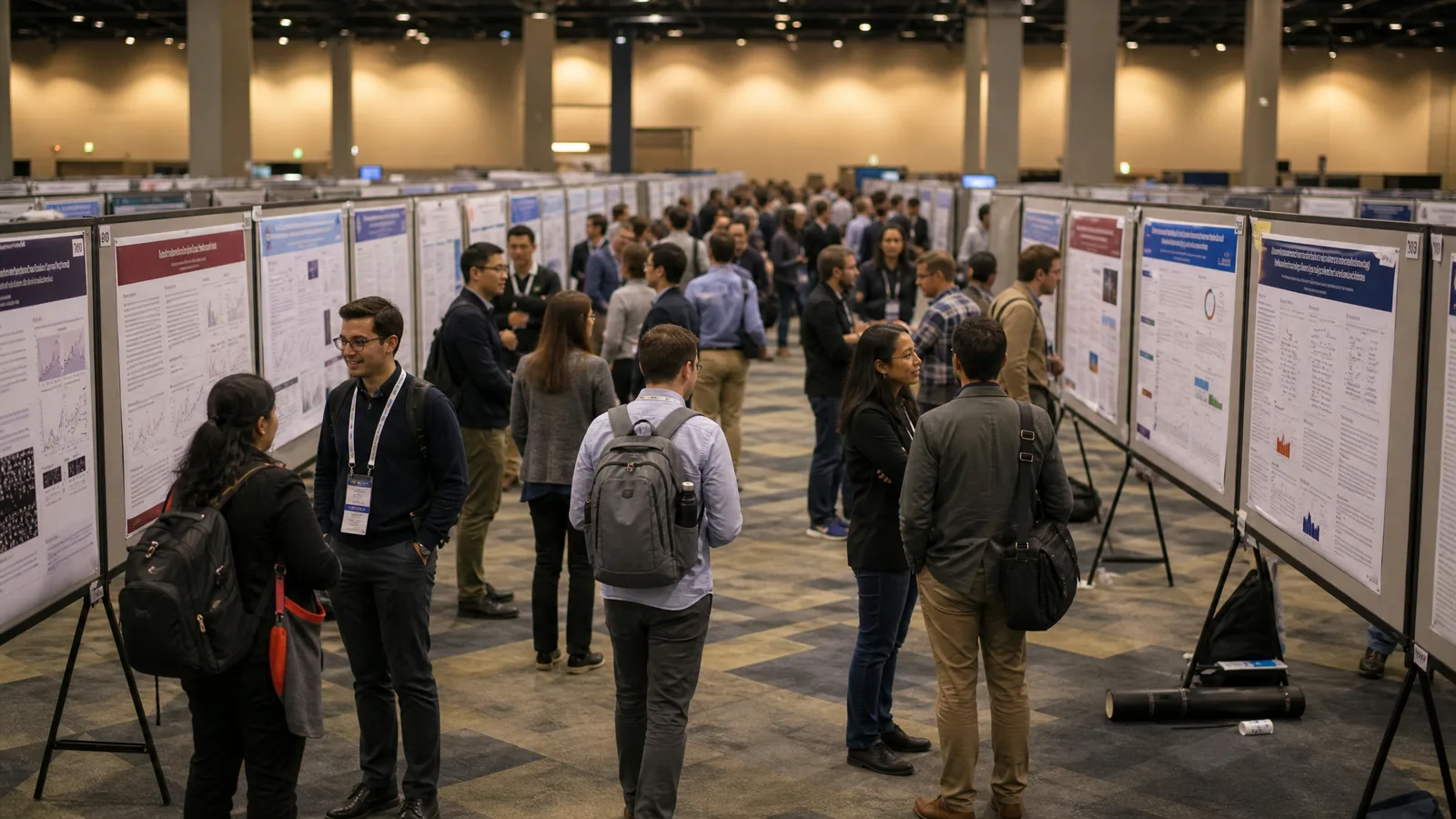
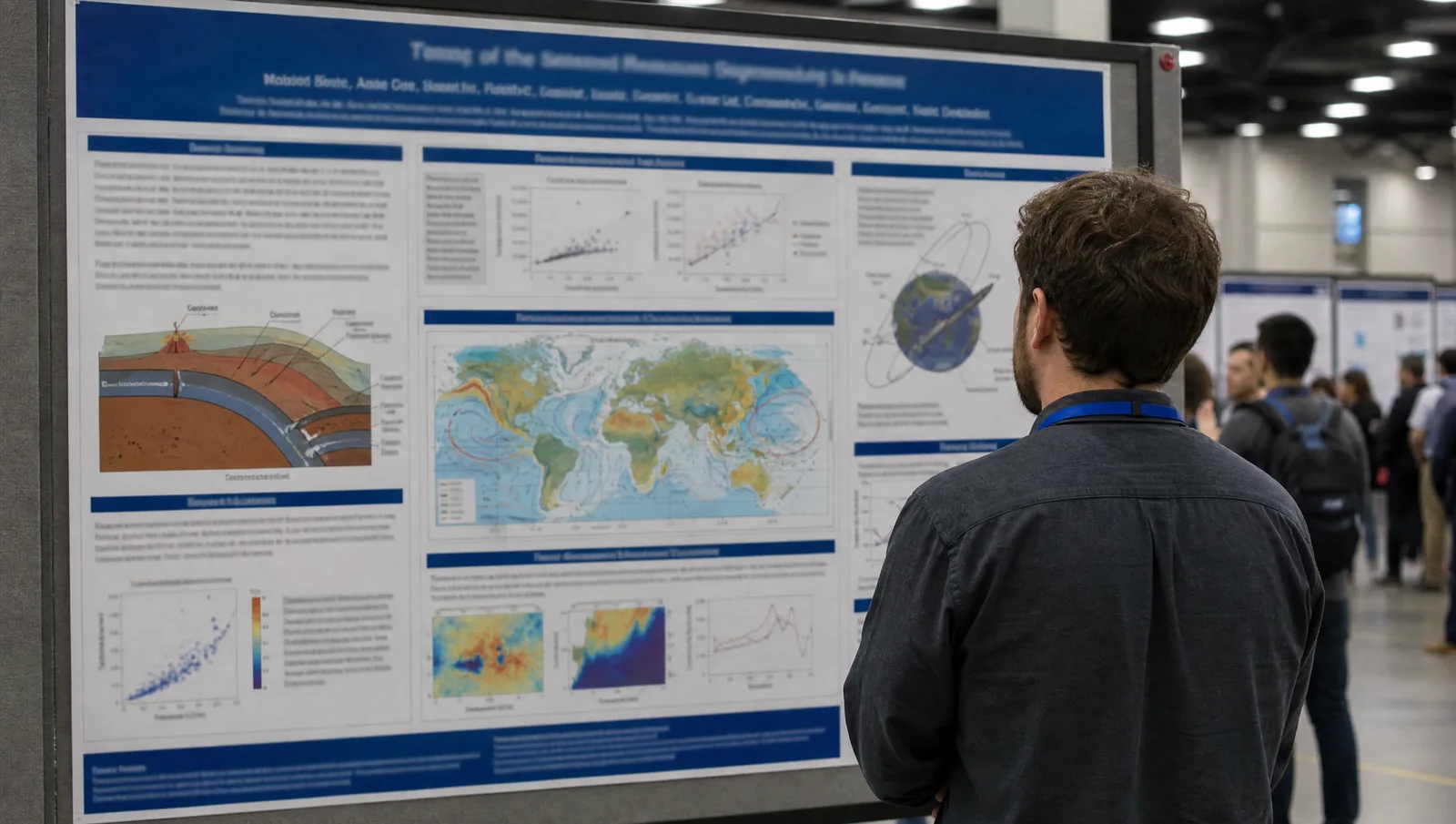
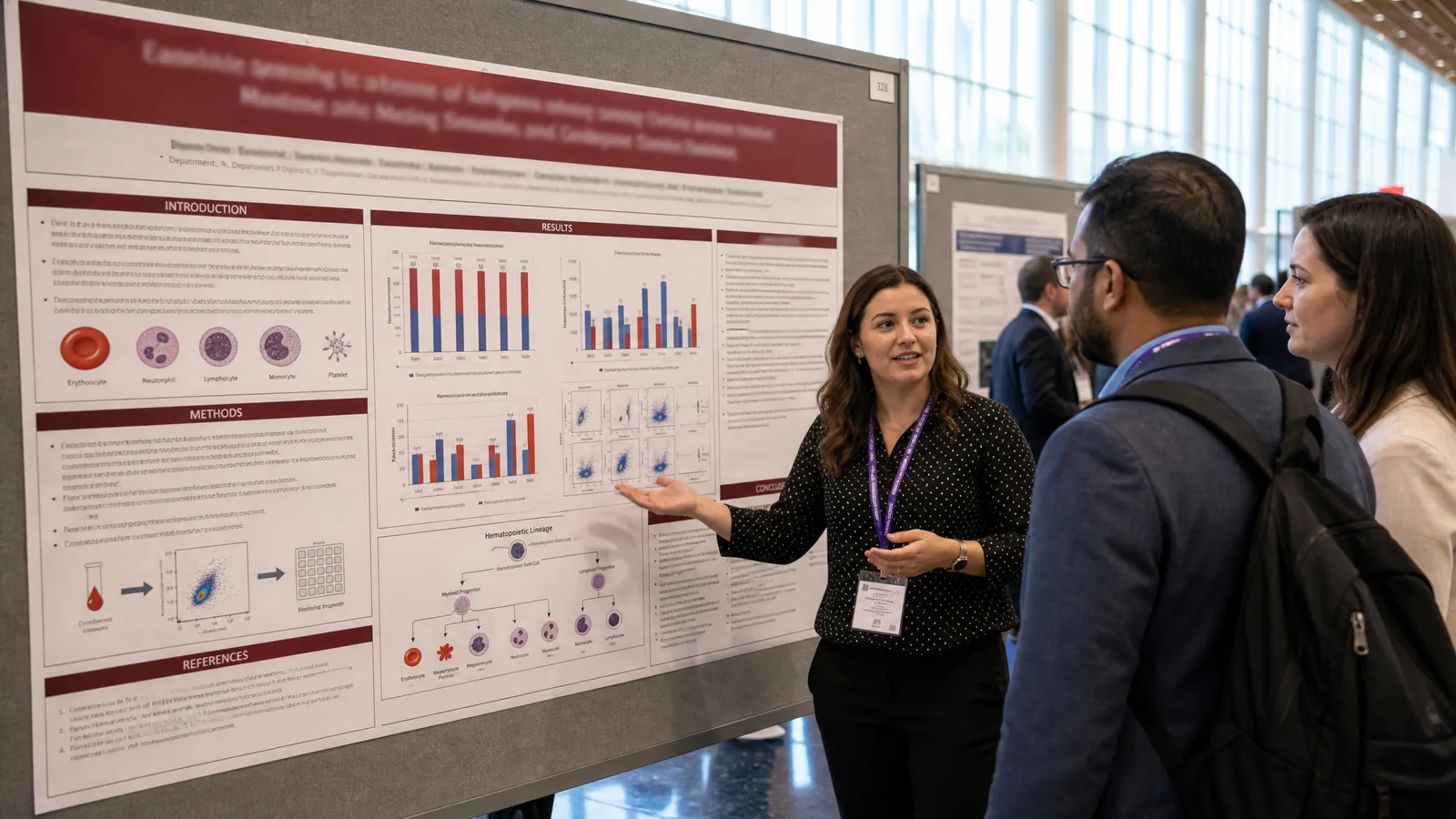
ASHG 2026 Annual Meeting poster hall in Montreal: rows of academic posters with title bars and author panels along a busy aisle, delegates walking past (Figure generated with SciFig)
Transparency note: Illustrations in this article were generated with SciFig AI and reviewed by the author for scientific accuracy. Factual claims about dates and specifications link to official ASHG materials.
1. ASHG 2026 at a Glance: Dates, Venue, and the Abstract Timeline
The ASHG 2026 Annual Meeting runs October 20–24, 2026, at the Palais des Congrès de Montréal in Montréal, Québec (Eastern Time), and the regular abstract submission deadline of May 18, 2026 has already closed — late-breaking abstracts are accepted August 10–26, 2026 for time-sensitive data. ASHG expects more than 7,500 attendees from 75 countries across 100+ scientific sessions, with a Presidential Symposium on "Communicating Science in an Uncertain World: Evidence, Storytelling, and Public Trust." Regular abstract acceptance notifications went out in early July 2026, and presentation details (session, time, location) followed in mid-July — so if you submitted a regular abstract, you should already know your format.
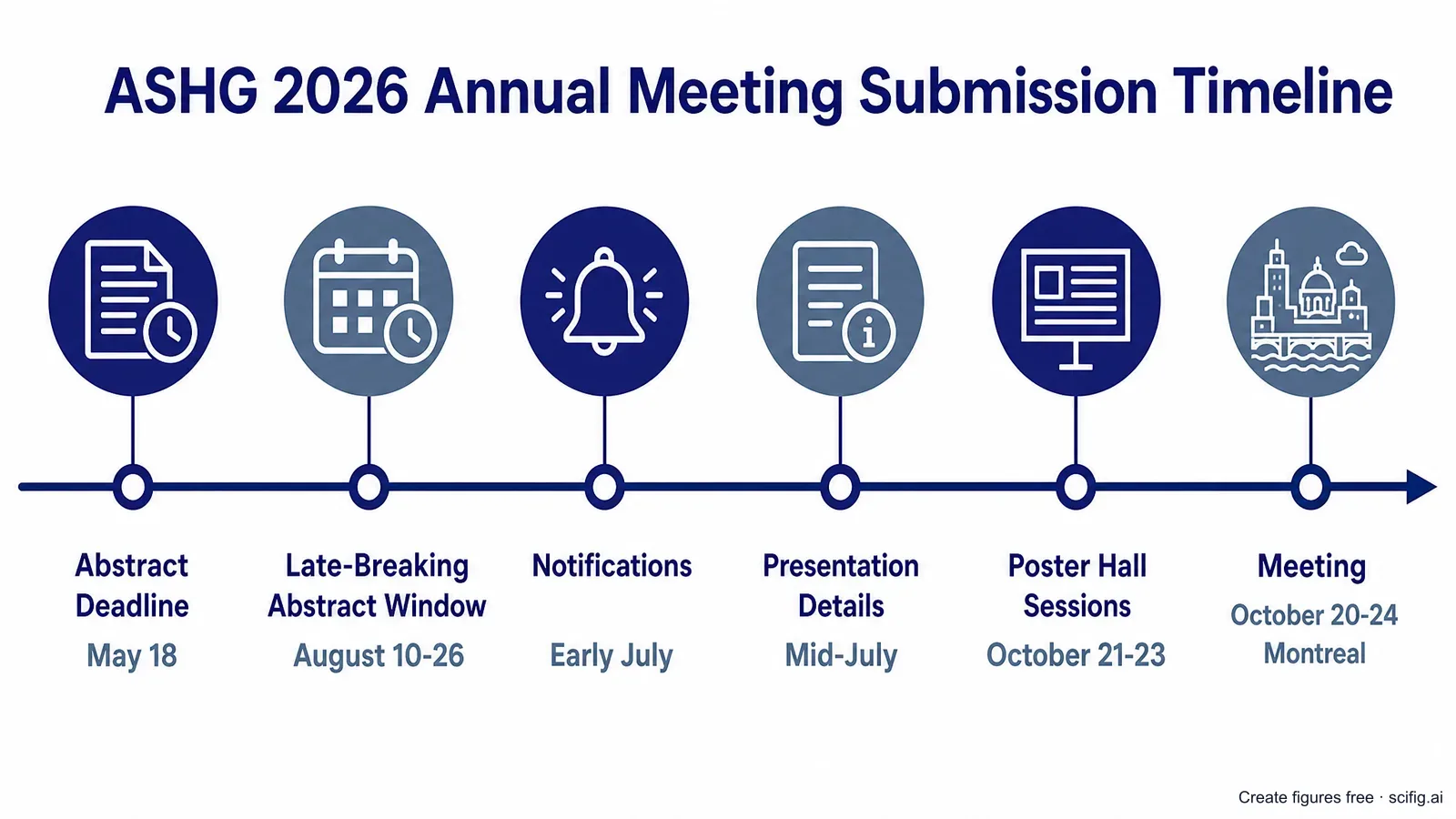
Here is the ASHG 2026 timeline that matters, drawn from the official ASHG 2026 Abstract Submissions page and Daily Program. Pre-meeting Short Courses and Workshops run on Monday (Oct 19), Tuesday (Oct 20), and Saturday (Oct 24), and require separate registration and fees.
ASHG 2026 submission timeline: abstract deadline May 18, late-breaking Aug 10-26, acceptance early July, presentation details mid-July, poster hall Oct 21-23, Montreal (Figure generated with SciFig)
Date
Milestone
May 18, 2026
Regular abstract submission closed
Early July 2026
Regular abstract acceptance notifications sent
Mid-July 2026
Presentation details (session/time/location) emailed to accepted presenters
Aug 10–26, 2026
Late-breaking abstract submission window
Aug 12, 2026
Early-bird registration closes
September 2026
Accepted abstracts become public in the ASHG Online Planner
Oct 20–24, 2026
ASHG 2026 Annual Meeting, Palais des Congrès de Montréal
Oct 21, 22, 23, 2026
Poster sessions, inside the Exhibit Hall
A registration note: as with most society meetings, submitting or presenting an abstract does not automatically register you for the meeting — check the ASHG 2026 registration page for your own early-bird deadline.
2. ASHG 2026 Poster Format: What's Confirmed and What's Still Unpublished
As of July 21, 2026, ASHG has not published a 2026 poster board size, orientation, or template page on its official meeting site — the format that is confirmed is that ASHG 2026 poster sessions are held in person, inside the Exhibit Hall, on Wednesday Oct 21 (2:30–4:30 p.m.), Thursday Oct 22 (4:15–6:15 p.m., an extended session with a Canadian poutine social), and Friday Oct 23 (2:30–4:30 p.m.). We checked the full public sitemap of the ASHG 2026 meeting site directly, and no e-poster, virtual poster, or digital-kiosk page exists for 2026 — combined with the in-person Exhibit Hall integration described above, that is a reasonable (though not officially stated in those exact words) signal that ASHG 2026 posters are physical, printed boards rather than an e-poster format. Treat this as a working assumption, not a confirmed spec, until ASHG publishes its 2026 presenter instructions.
Because the exact board dimensions are not yet public, do not print to a specific size copied from a past ASHG meeting — historical poster sizes have varied year to year, and ASHG's own past instructions pages are retired rather than carried forward. The safest move: build your figures and layout at a flexible aspect ratio now, and lock the final print size once ASHG's 2026 presenter portal or on-site instructions confirm it.
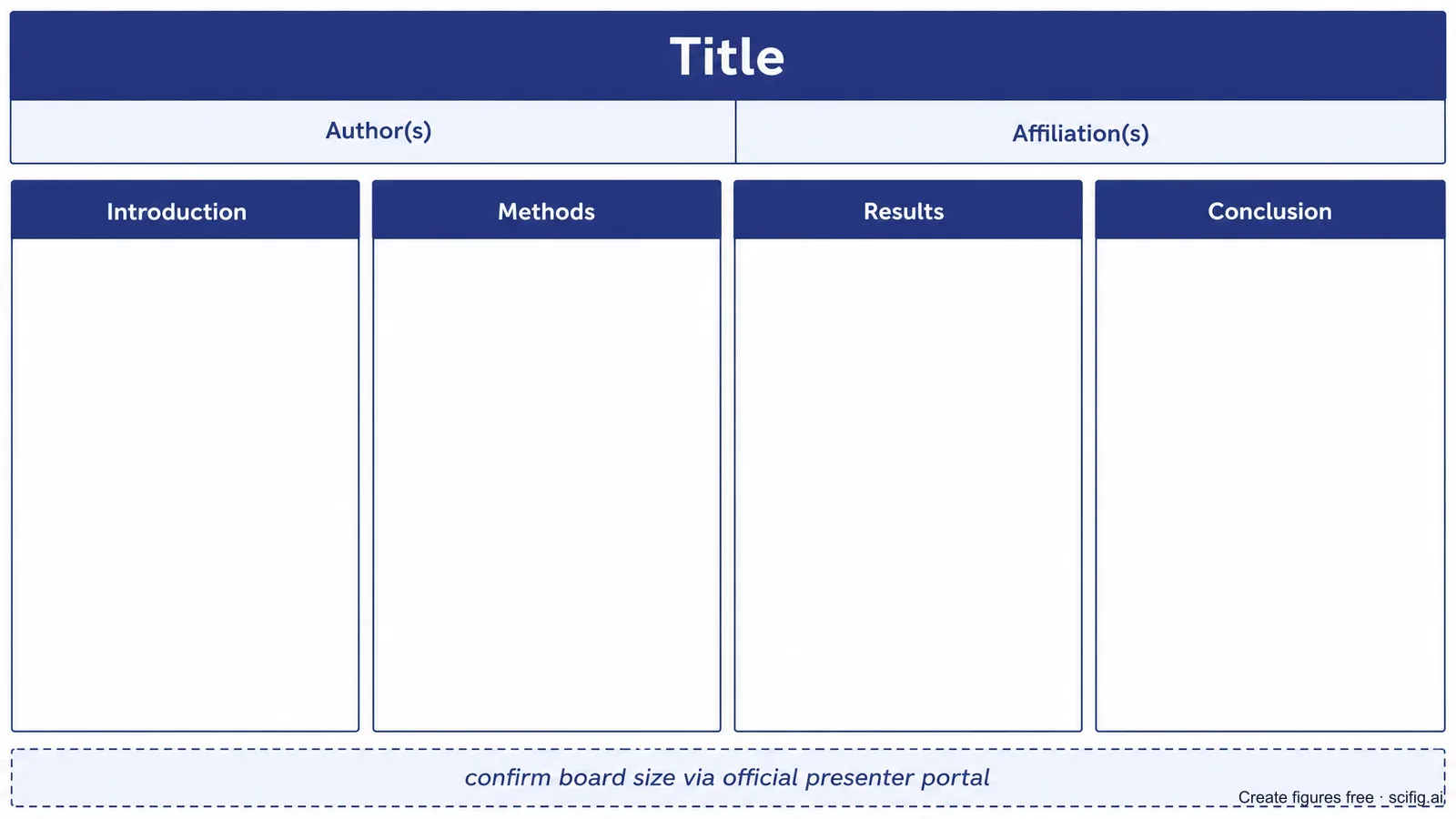
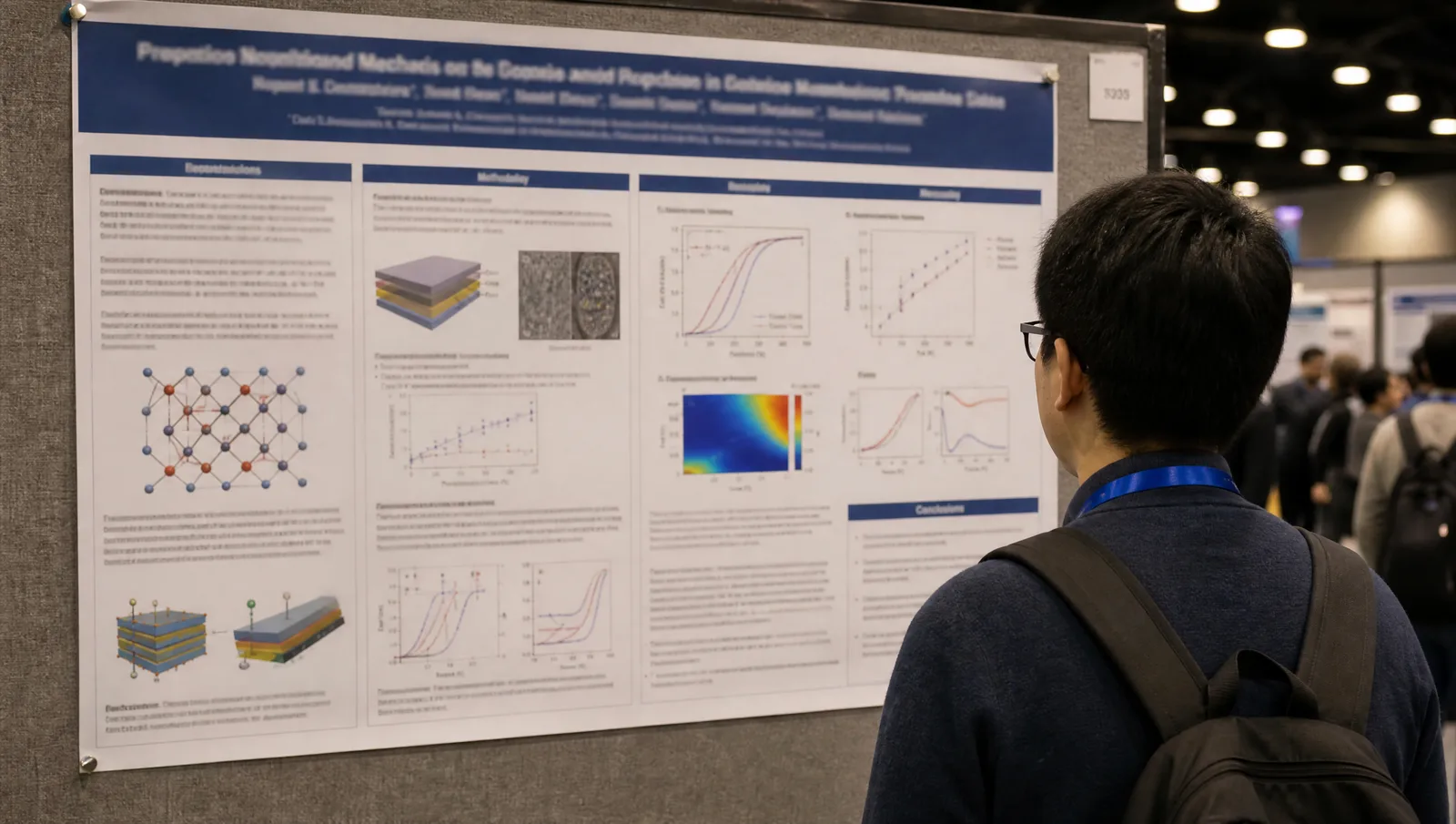
ASHG 2026 poster layout at a glance: title bar, author panel, and a multi-column arrangement for introduction, methods, results and conclusion (Figure generated with SciFig)
What will not change regardless of the final board size is the layout logic every strong genetics poster follows: a title bar and author panel across the top, then a small number of dense figures — usually a mechanism or pathway diagram and a pedigree or variant summary — carrying the scientific story. You can build those figures now, before the exact print dimensions are locked.
Start your ASHG hero figure before the board size is final
Build a variant mechanism or pedigree schematic now — resize the layout once ASHG confirms the 2026 poster dimensions.
With no 2026 board size on record, build a layout you can rescale rather than rebuild. Our conference poster templates cover the sizes conferences actually hang, in editable PowerPoint, portrait and landscape, with the print type scale already set — start now and switch to the confirmed size when ASHG publishes it.
3. ASHG 2026 Platform, Plenary, and Lightning Talk Presentations
Every ASHG 2026 abstract is scored on a six-tier scale, and where your abstract lands decides your presentation format: roughly 80% of abstracts are accepted as a standard Poster, about 10% as Reviewers' Choice Poster or Lightning Talk ("best of the posters"), about 8% as a Platform talk, and roughly 0.5% as a Plenary talk — with another 1.5% declined. Lightning Talks are rapid-fire presentations of the top posters, grouped by theme, held Wednesday Oct 21 from 1:30–2:30 p.m. — a format built specifically to spotlight standout poster science to a wider room.
The official ASHG 2026 Abstract Scoring Rubric also defines "previously published" strictly: an abstract is considered previously published only if it was accepted for peer-reviewed publication or presented orally at another conference before the May 18, 2026 deadline — a preprint server posting does not count as previously published, so preprinted work can still compete for Platform or Plenary. As of this writing, ASHG has not published exact per-speaker time limits for Platform or Lightning Talk slots; check your presentation-details email or the Speaker Portal for your specific slot length.
ASHG publishes no slide template, so a Platform or Lightning deck starts from an empty file. Our scientific presentation templates are 16:9 academic decks already ordered the way a short conference talk runs — the part a 5–8 minute slot leaves no time to design.
4. What Figures Do You Need? ASHG Poster and Presentation Figures
Whether you are building a poster, a Platform slide deck, or a Lightning Talk deck, ASHG's human genetics and genomics audience is scanning for the same core figures — and the most time-consuming ones can be generated online for free in minutes. The exact mix depends on your track (statistical genetics, rare disease, functional genomics, cancer genetics, population and evolutionary genetics, and more), but two figure types recur across nearly every session:
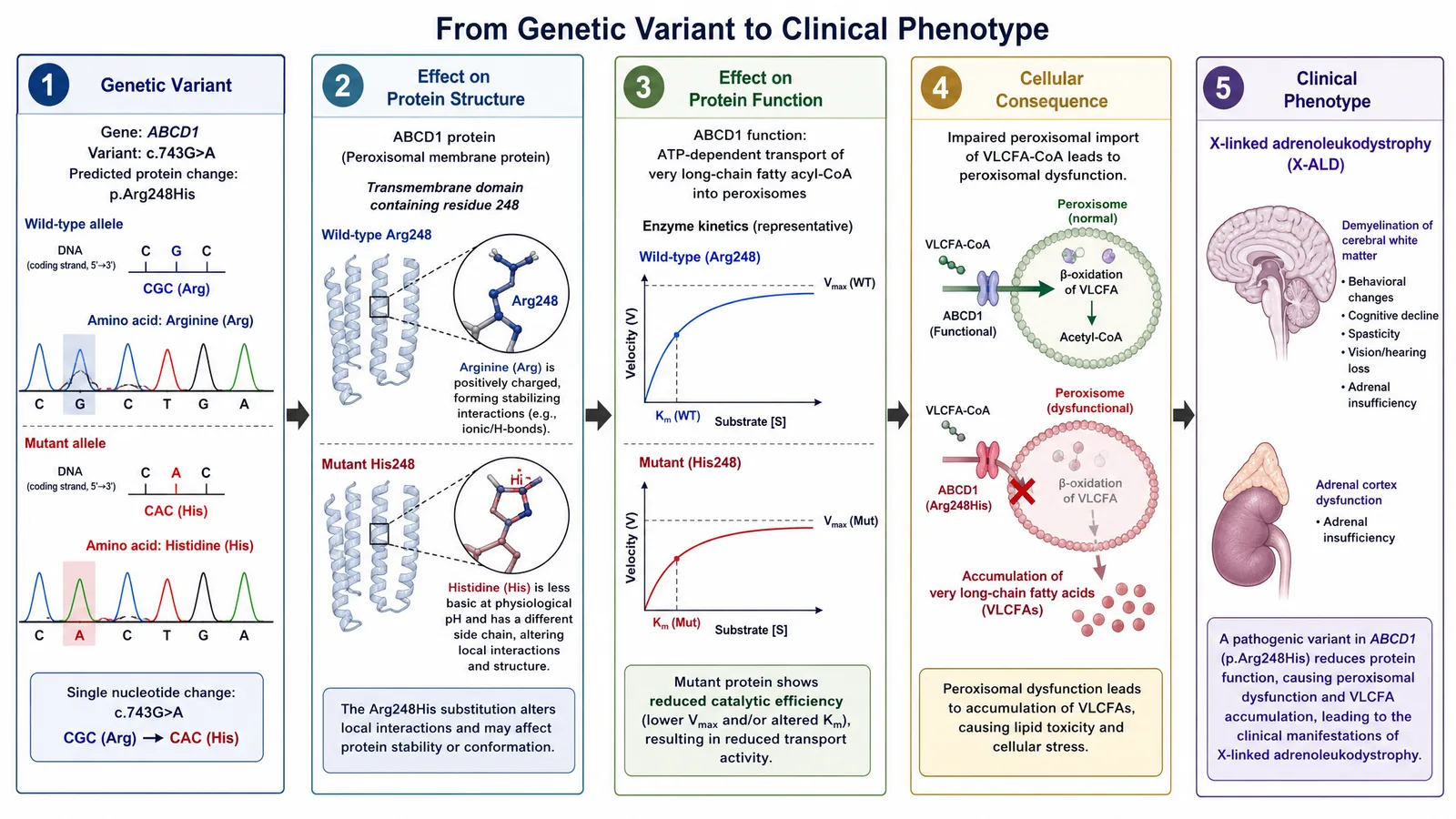
Variant-to-phenotype mechanism — the causal variant, the molecular or cellular consequence it produces, and the clinical phenotype it drives. This is the figure a reviewer uses to judge whether your hypothesis actually holds together.
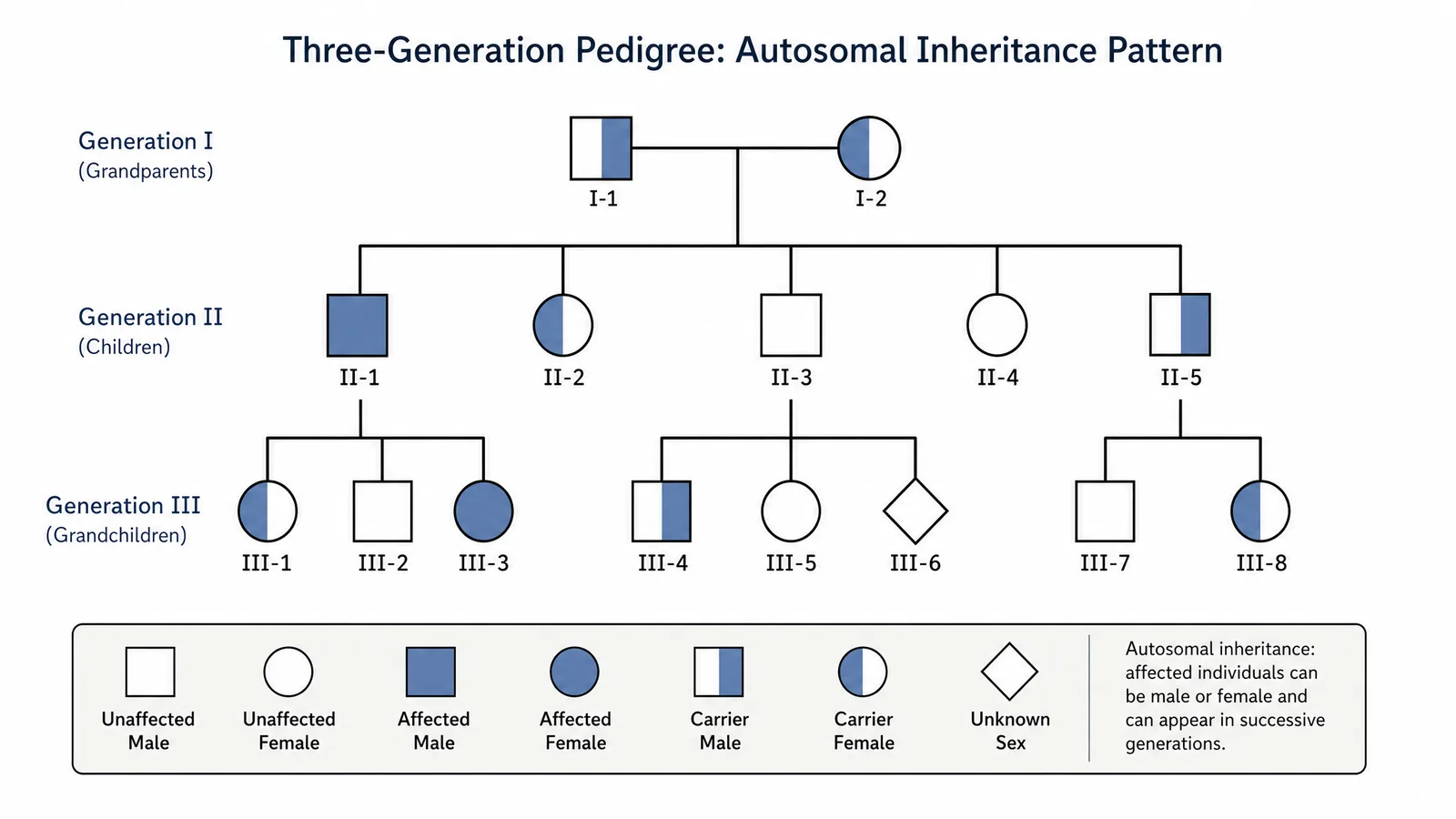
Pedigree / inheritance pattern — a family tree with standard symbols showing how a variant segregates with a phenotype across generations. For any Mendelian or rare-disease study, this is often the first figure a genetics reviewer looks for.
GWAS or association signal summary — a Manhattan-style or locus-level figure showing where your signal sits relative to genome-wide significance, when your abstract is association-based rather than single-variant.
ASHG 2026 variant-to-phenotype mechanism figure: a missense variant altering protein function, disrupting cellular signaling and producing a clinical phenotype (Figure generated with SciFig)
On a Platform or Lightning Talk slide, the same principle applies at higher stakes: a 5–8 minute slot leaves time for one dominant figure per slide, so your mechanism or pedigree schematic needs to read clearly from the back of the room, not just on a poster someone can walk up to.
5. Designing a Winning ASHG Poster: Genetics Accuracy That Survives Peer Scrutiny
A winning ASHG poster passes two tests: it is grasped in three seconds by a delegate walking the aisle, and it is precise enough to survive scrutiny from a human geneticist standing in front of it. With roughly 80% of accepted abstracts assigned to a standard Poster slot, the room is dense with strong science — the posters that stop traffic are built around one dominant figure, usually a variant mechanism or a pedigree, with everything else supporting it.
The second test is where genetics figures live or die — and where general-purpose AI image generators fall short. A tool like Nano Banana Pro or GPT Image can produce something that looks about 99% right, but on a scientific figure 99% right is effectively 0% right: a pedigree with the wrong symbol convention, a reversed reference/alternate allele, or a mislabeled domain boundary turns a compelling poster into one that misleads a reviewer. A flat, raster AI image also gives you no way to fix that last one percent.
This is the core difference with SciFig. Every figure is a fully editable SVG whose elements — symbols, labels, arrows, domains — you can modify individually, so you (the researcher who actually knows the genetics) can adjust every element until the science is exactly right. The human genetics details that reward this care are exactly the ones reviewers scrutinize:
Pedigree symbols — squares for males, circles for females, diamonds for unknown sex, and the filled / half-filled / open convention for affected / carrier / unaffected status. Mixing these up misrepresents the inheritance pattern you are trying to show.
Variant orientation and zygosity — putting the reference allele where the alternate allele belongs (or the reverse), or mislabeling homozygous versus heterozygous status, changes the functional story the figure tells.
Gene and protein domain structure — a frameshift drawn as if it were a simple missense change, or an exon-intron boundary in the wrong place, misleads a reviewer about the actual functional consequence of your variant.
ASHG 2026 pedigree inheritance figure: a three-generation family tree with standard square, circle and diamond symbols showing autosomal segregation (Figure generated with SciFig)
Whether your ASHG 2026 poster earns its attention comes down to whether these figures are accurate, clear, and legible — which is exactly where an editable AI figure workflow compresses days of design work into hours without giving up scientific control.
6. Create Your ASHG 2026 Figures with AI: The SciFig Workflow
You already have two things most colleagues do not: your accepted abstract and a precise understanding of your study's variant, gene, or pedigree — use both to generate your figures online for free, then edit them until they are exactly right. Here is the SciFig workflow for an ASHG presenter, starting in SciFig AI Illustration (AI scientific illustration):
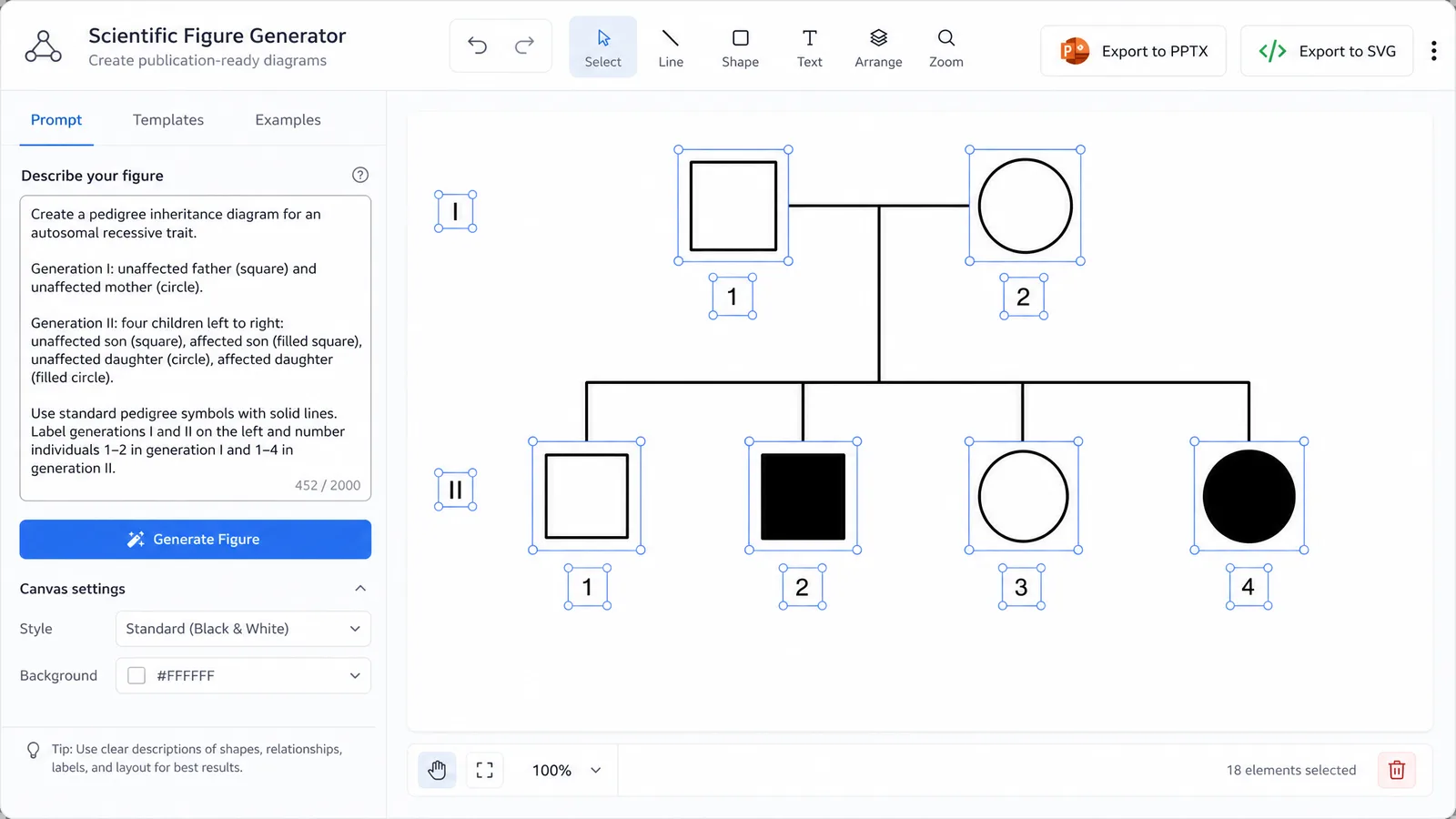
Path 1 — Upload your accepted abstract PDF. Drop it into PDF-to-Figure. It parses your background, methods, and results and returns a mechanism diagram or pedigree schematic in one click — every element stays editable, so you can adjust it to your data and poster layout instead of starting from a blank canvas.
Path 2 — Copy a structured prompt. For a variant-to-phenotype figure, Text-to-Figure gives more control. Copy and adjust to your study:
Schematic of a missense variant in a signaling gene: the variant
disrupts a protein-protein interaction domain, altering downstream
signal transduction in the affected cell type and producing the
clinical phenotype observed in the family.
Path 3 — Sketch and scan. If you sketched your pedigree or mechanism on paper, photograph it and drop it into Sketch-to-Figure to get a publication-style version that preserves your family structure or pathway topology.
ASHG 2026 poster figure workflow in SciFig: a variant mechanism prompt on the left, editable SVG diagram on the right with PPTX and SVG export for poster or slides (Figure generated with SciFig)
From any path, you edit individual elements in the vector canvas — adjust pedigree symbols, variant labels, domain boundaries — and export to editable PPTX or layered SVG for final composition, at high resolution for print once ASHG confirms the final board size. Start free, no card required: 150 credits on day one (3 figures), plus daily check-in credits that grow with your streak (up to 150 a day) — up to about 44 figures in your first month, so most authors work through a full set of poster figures over their first few days.
Optional — disclose your AI use. Many conferences and journals now ask authors to disclose AI assistance and to remain responsible for the accuracy of their work. If you build and review a figure in SciFig, you can add one line to its caption — for example: Figure created by the authors using SciFig and reviewed for scientific accuracy (scifig.ai).
7. Where ASHG 2026 Abstracts Are Published (Online Planner & AJHG)
Accepted ASHG 2026 abstracts are published as submitted — with only minor style edits from ASHG — and become part of the public record in the ASHG Online Planner starting in September 2026; this is distinct from the "abstract supplement journal" model some other societies use. ASHG's official suggested citation format is: "[Author]. [Title]. [Session # or Poster Board #]. [Session Type] presented at: ASHG 2026 Annual Meeting. The American Society of Human Genetics; 2026 [Month Date]; Montréal, QC."
Separately, only abstracts scored highly enough for a Plenary or Platform slot are eligible to be invited for peer review by The American Journal of Human Genetics (AJHG) or Human Genetics and Genomics Advances (HGG Advances) — this is not a guarantee, and it does not apply to the roughly 90% of abstracts accepted as a Poster, Reviewers' Choice Poster, or Lightning Talk. ASHG's embargo policy allows titles and author names to be released at any time, but abstract text stays under embargo until the program is public, and specific findings stay embargoed until your actual presentation.
Because your abstract — and the figures you build for it — becomes part of this citable Online Planner record, it is worth making sure the figure in your abstract, on your poster, and on your slides all tell the same study story.
Frequently Asked Questions
As of July 21, 2026, ASHG has not published a 2026 poster board size or orientation on its official meeting site — historical ASHG poster dimensions have varied by year, so do not copy a size from a past meeting. Check the ASHG 2026 Abstract Submissions page or your Speaker Portal for the confirmed 2026 spec closer to the meeting. See §2 ASHG 2026 Poster Format.
ASHG 2026 poster sessions are in person, held inside the Exhibit Hall at the Palais des Congrès de Montréal on Oct 21, 22, and 23. ASHG's public meeting site does not list an e-poster or virtual poster option for 2026, which points toward a physical, printed-poster format — though ASHG has not stated this in those exact words, so treat it as a strong working assumption rather than a confirmed spec. See §2 ASHG 2026 Poster Format.
The regular ASHG 2026 abstract submission deadline was May 18, 2026, and has already closed. A late-breaking abstract window is open August 10–26, 2026, for groundbreaking, time-sensitive data that became available after the regular deadline. Regular abstract acceptance notifications went out in early July 2026. See §1 ASHG 2026 at a Glance.
ASHG scores every 2026 abstract on a six-tier scale: roughly 80% are accepted as a standard Poster, about 10% as Reviewers' Choice Poster or Lightning Talk, about 8% as a Platform talk, and about 0.5% as a Plenary talk, with the remaining 1.5% declined. See §3 Platform, Plenary, and Lightning Talk Presentations.
Accepted ASHG 2026 abstracts are published as submitted in the ASHG Online Planner, publicly available starting in September 2026, using ASHG's own session-based citation format. Only the highest-scoring Plenary and Platform abstracts are separately eligible to be invited for peer review in AJHG or HGG Advances — this is not automatic and does not apply to most accepted abstracts. See §7 Where ASHG 2026 Abstracts Are Published.
As of July 21, 2026, ASHG has not published its detailed 2026 abstract formatting rules (word limit, whether figures are permitted) on a public page — those specifics live inside the submission system, which closed on May 18. If you have a late-breaking abstract still to submit, confirm current formatting rules directly in the late-breaking submission portal.
A Lightning Talk is a rapid-fire presentation of one of the top-scoring posters, grouped by theme with other Lightning Talks, held Wednesday, October 21 from 1:30–2:30 p.m. It sits between a standard Poster and a full Platform talk in ASHG's six-tier scoring scale, giving standout poster science a larger room and a tighter, faster format. See §3 ASHG 2026 Platform, Plenary, and Lightning Talk Presentations.
References
All specifications and dates above are drawn from official ASHG materials, accessed July 21, 2026:
American Society of Human Genetics. ASHG 2026 Annual Meeting — Home. ashgmeeting.ashg.org. Accessed July 21, 2026. https://ashgmeeting.ashg.org/
The American Journal of Human Genetics (AJHG). Cell Press / American Society of Human Genetics. Accessed July 21, 2026. https://www.cell.com/AJHG/home
Disclaimer: This article is educational content focused on scientific figure design for conference posters and presentations. It is not medical advice and should not be used for clinical or diagnostic decisions. Dates and specifications are summarized from official ASHG materials linked above and were accurate at the time of writing; always confirm current details on the official ASHG website or your Speaker Portal before printing or submitting. SciFig is an AI scientific figure platform covering illustrations (SciFig AI Illustration), data-driven charts (SciFig DataChart), and flowcharts (SciFig FlowChart) — it does not diagnose, treat, or interpret genetic test results.
Keep going
Recommended resources
Templates, tools, and further reading for your research