
A manuscript is a research document prepared for submission but not yet published.
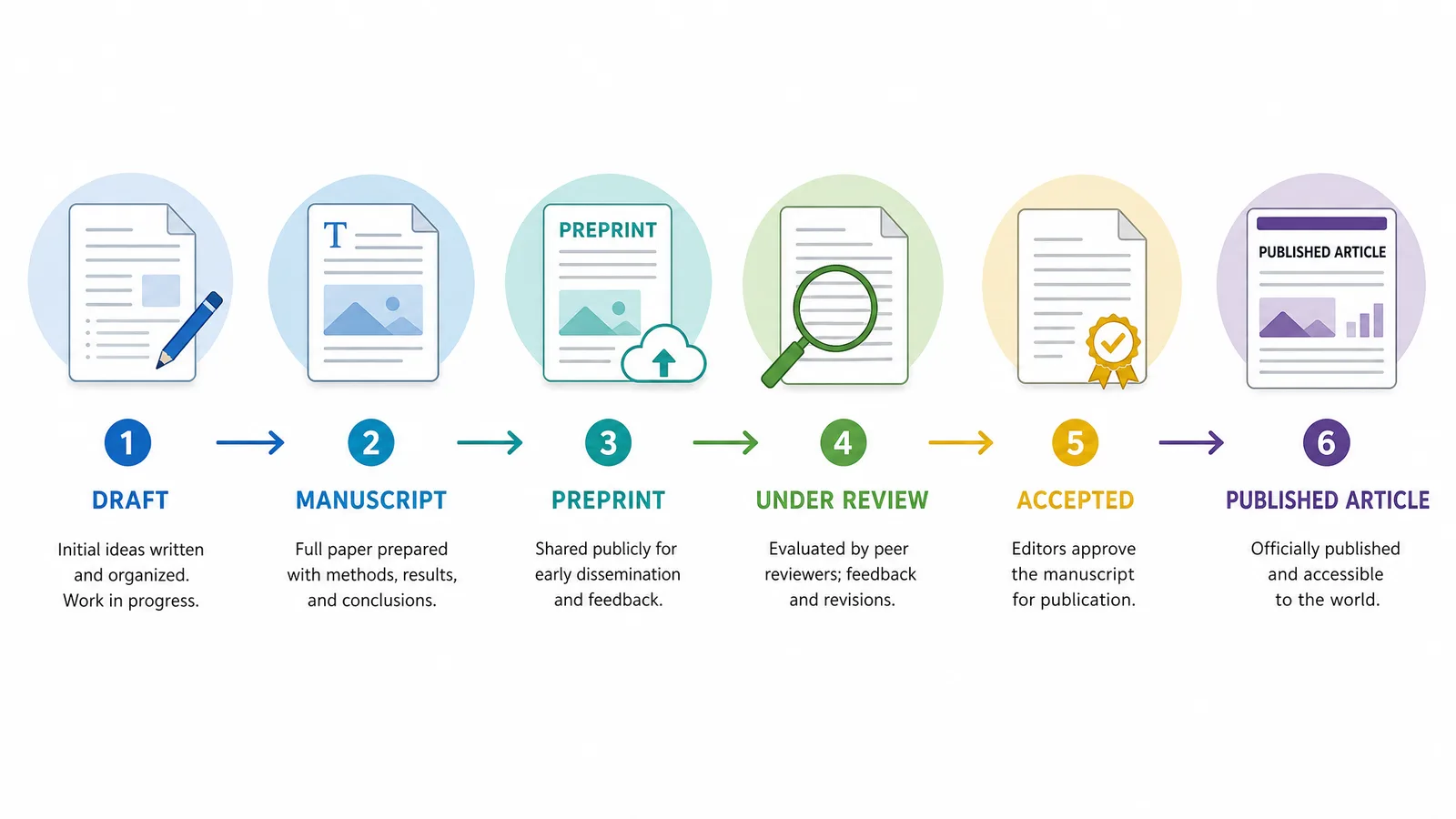
The word marks a stage rather than a format. The same document is a manuscript while you write and submit it, and becomes an article once a journal accepts and publishes it. Understanding where a document sits in that lifecycle tells you which rules apply to it and what you are still allowed to change.
Manuscript, Paper, Preprint, Article
These words are used loosely in conversation and precisely in editorial systems. The distinctions that matter:
| Term | Stage | Peer reviewed | Citable |
|---|---|---|---|
| Draft | Being written | No | No |
| Manuscript | Prepared for or under submission | Not yet, or in progress | No |
| Preprint | Posted publicly before review | No | Yes, with a DOI |
| Article | Accepted and published | Yes | Yes |
"Paper" is the informal umbrella term and can refer to any of these. When a journal, funder, or supervisor says manuscript, they mean the version that has not completed peer review.
See AI Scientific Figure Generation in Action
Watch how researchers create publication-ready scientific figures from text descriptions.
Explore the Tool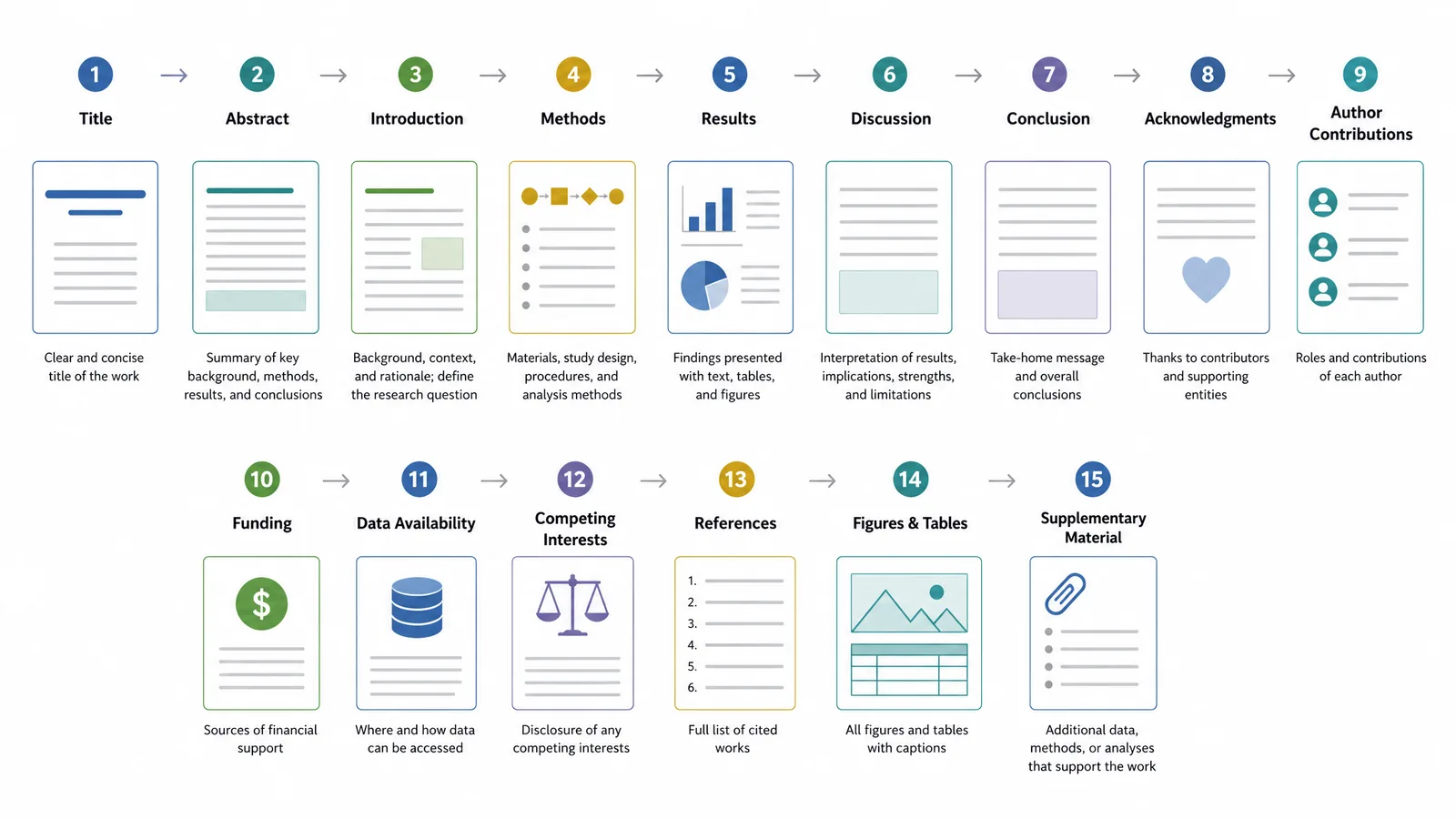
Standard Sections
Most empirical manuscripts in the sciences follow the IMRaD structure, plus the front and back matter that journals require:
- Title and running head
- Authors and affiliations
- Abstract and keywords
- Introduction — what is known, what gap remains, what you did
- Methods — enough detail to reproduce
- Results — findings, without interpretation
- Discussion — interpretation, limitations, implications
- References
- Figures and tables with captions
- Supplementary material
What Happens After Submission
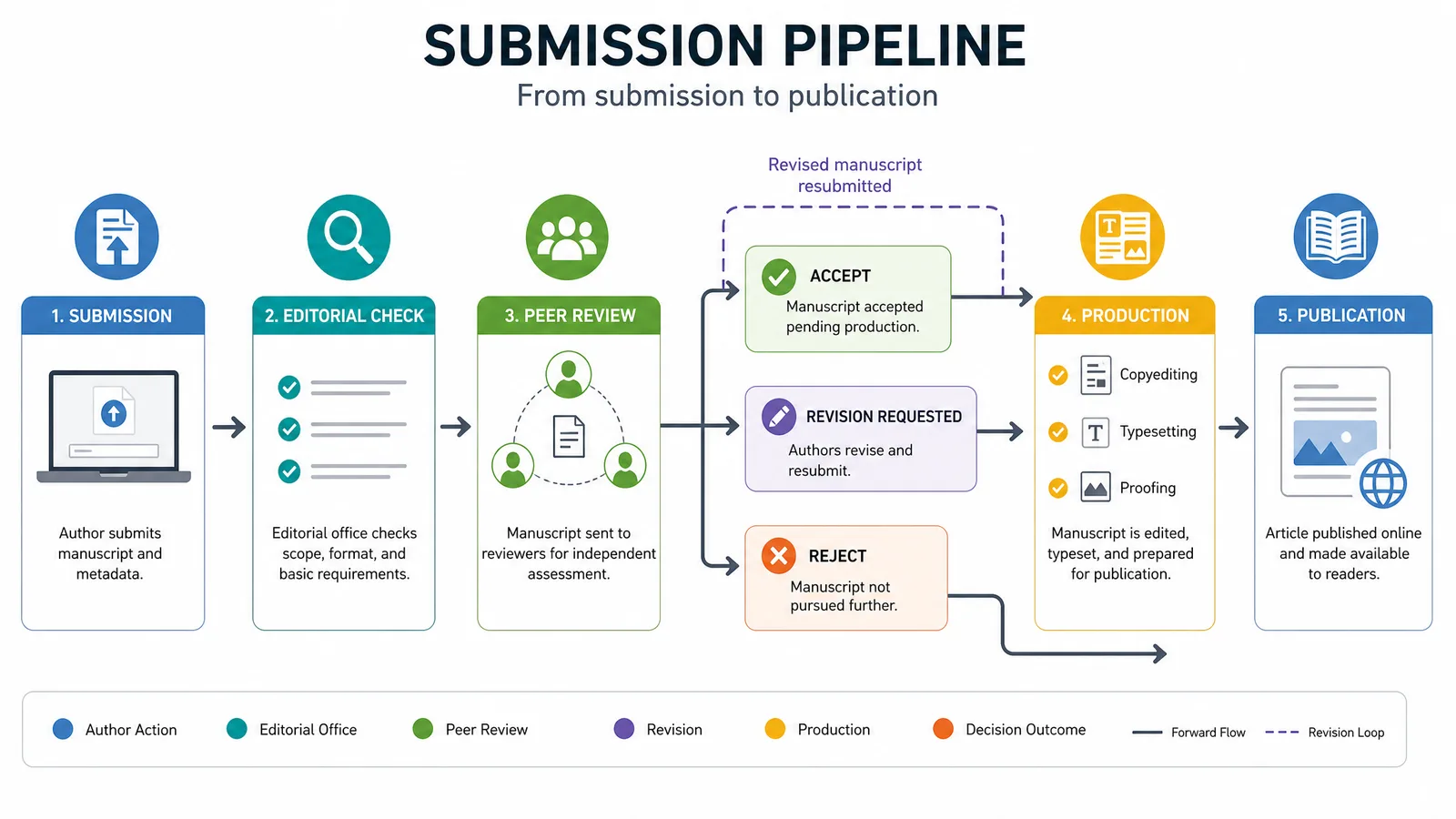
Understanding the pipeline makes the waiting less opaque:
- Editorial check. Staff verify scope and formatting compliance. Desk rejection is common here and usually fast.
- Peer review. Reviewers assess validity and contribution. This is the slow stage.
- Decision. Accept, minor revision, major revision, or reject. Revision is the normal outcome, not a bad one.
- Revision and resubmission. You respond point by point to each reviewer comment.
- Acceptance and production. Copyediting, typesetting, proofs. The manuscript becomes an article.
Once a manuscript is under review at one journal you cannot submit it elsewhere simultaneously. Concurrent submission is treated as misconduct across essentially all reputable venues.
Preparing Figures for a Manuscript
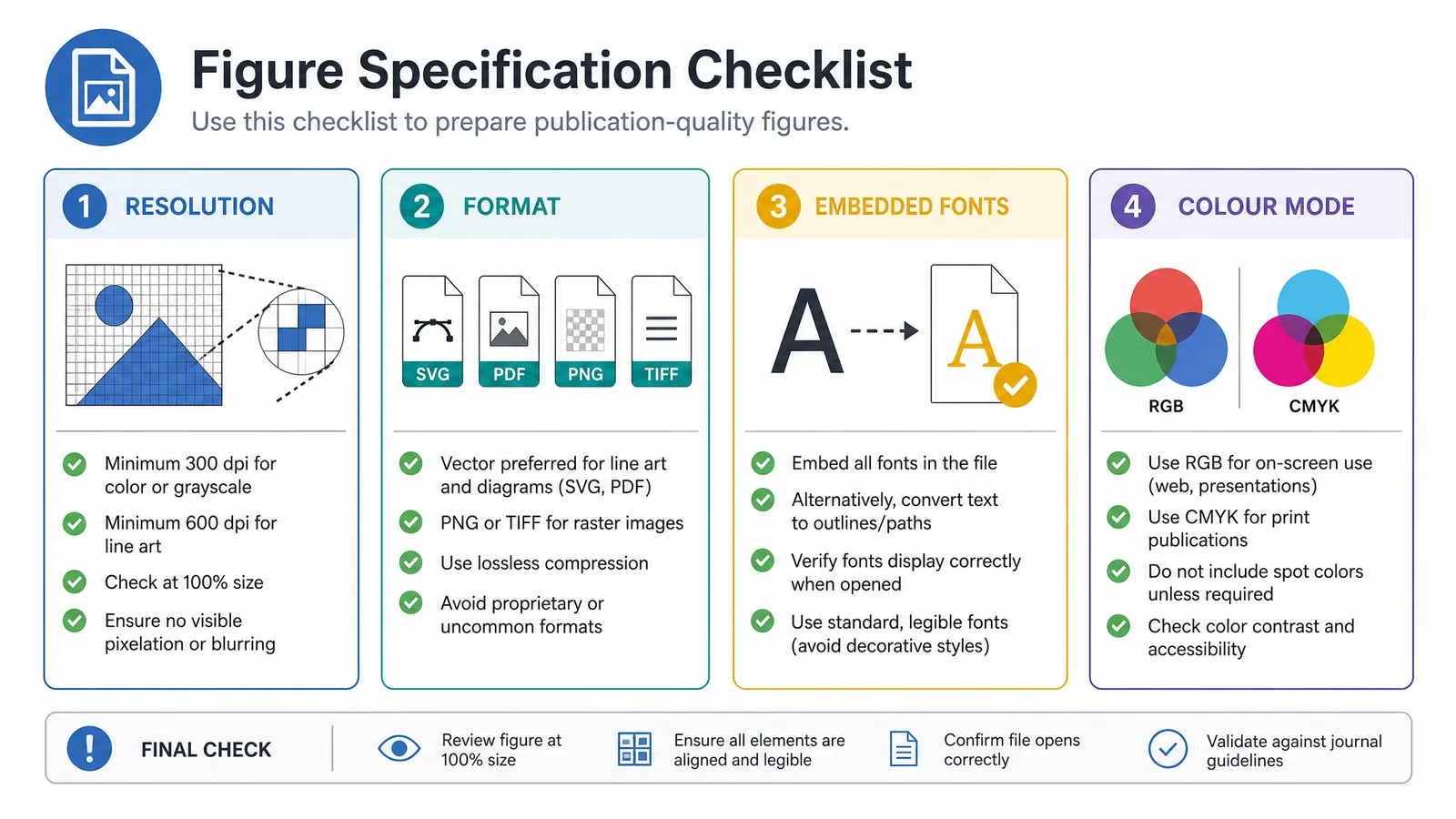
Figures cause a disproportionate share of production delays, because the requirements are specific and checked mechanically:
- Resolution. Commonly 300 dpi for halftones and 600-1200 dpi for line art. Check the journal.
- Format. Vector formats such as EPS or PDF for line art; TIFF or PNG for images. Many publishers reject scientific figures embedded only in a Word file.
- Fonts. Embedded or converted to outlines, so glyphs do not shift during typesetting.
- Color mode. Some print workflows still require CMYK.
- Labels. Legible at the final printed column width, not just on your screen.
Preparing figures at submission quality from the start avoids rebuilding them under a revision deadline.
Tip
Keep an editable source for every figure, not just the exported image. Reviewers routinely ask for a changed axis range, an added significance marker, or a relabeled panel, and rebuilding a flattened image from scratch is far slower than editing the original.
Create Scientific Figures Now
Describe your scientific figure in natural language — get publication-ready illustrations in minutes.
Try FreeRelated Reading
Related reading: How to Add Figures to a Research Paper, AI Figures in Journals: 2026 Policy Guide.