How applied and basic research differ in aim, timeline, funding, and outputs, why the boundary is blurrier than textbooks suggest, and where your work fits.
SciFig Team
Scientific Illustration Experts
Basic research seeks understanding; applied research solves a specific problem.
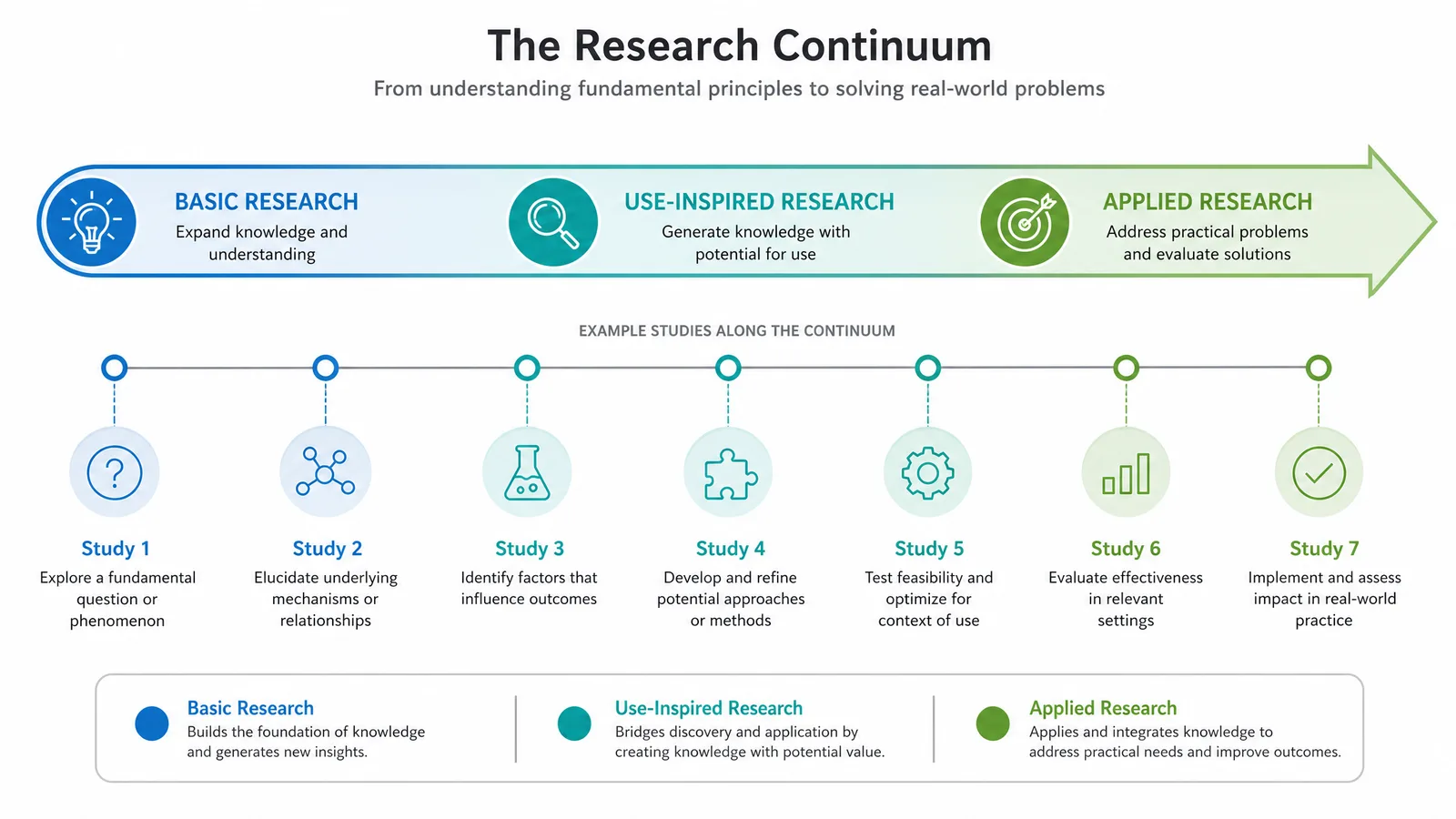
That is the textbook line, and it is a reasonable starting point. In practice the boundary is porous, and most funded work sits somewhere along a continuum rather than at either pole. Knowing where your study sits matters mainly because it determines how you justify it.
A continuum diagram from basic through use-inspired to applied research, with example studies placed along it (Figure generated with SciFig)
The Core Differences
Basic research
Applied research
Primary aim
Extend understanding
Solve a defined problem
Question form
Why does X happen?
How do we achieve Y?
Success measured by
Explanatory power, generality
Effectiveness in context
Typical timeline
Long, uncertain
Shorter, deadline-bound
Typical funder
Research councils, foundations
Industry, government agencies, health services
Main output
Publications, theory
Interventions, products, policy, guidelines
Generalizability
High, that is the point
Often deliberately local
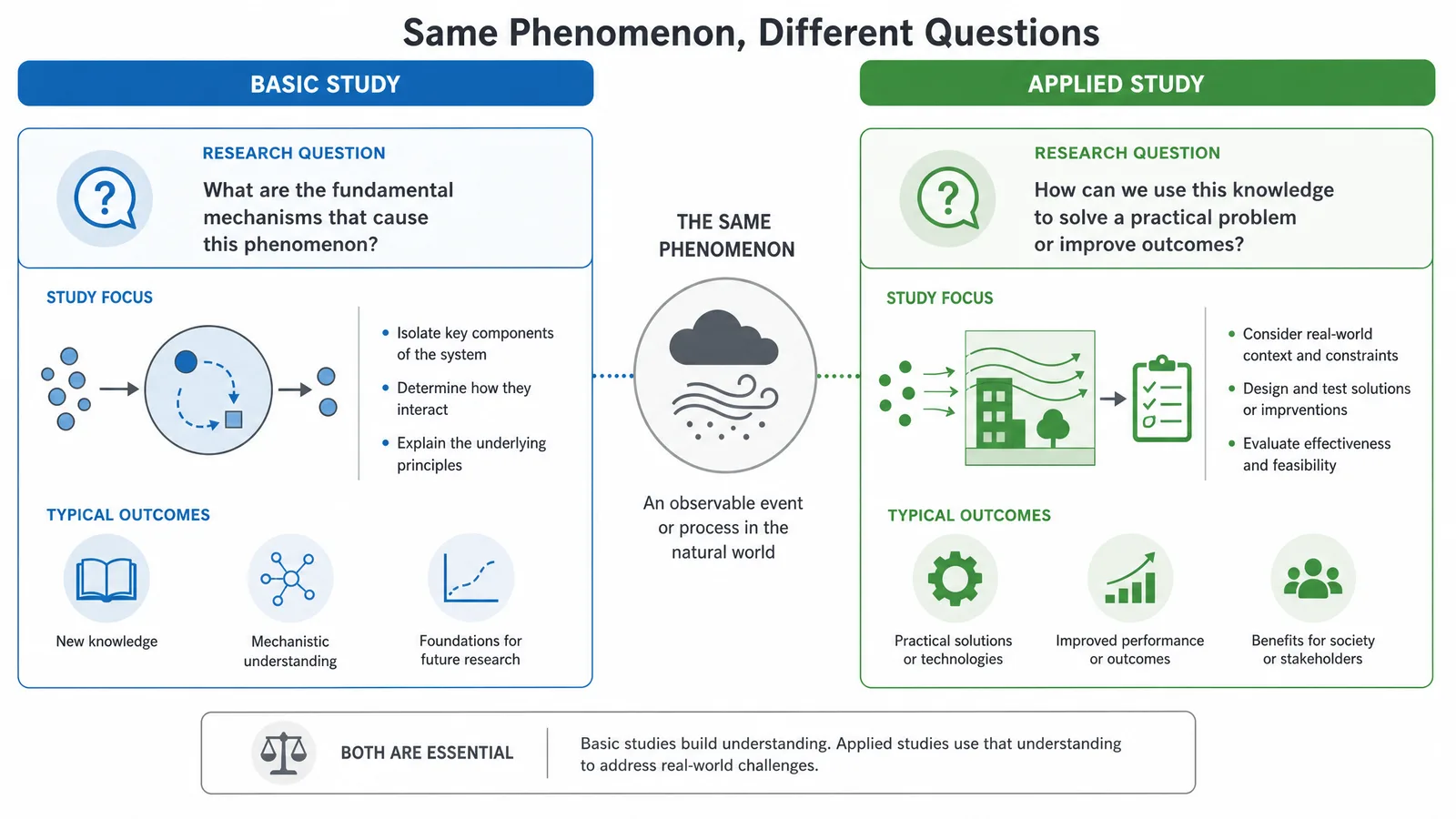
Two studies of the same phenomenon can sit on opposite sides. Characterizing the binding kinetics of a receptor is basic. Testing whether a compound targeting that receptor reduces symptoms in a specific patient group is applied.
See AI Scientific Figure Generation in Action
Watch how researchers create publication-ready scientific figures from text descriptions.
A side-by-side comparison of a basic and an applied study on the same phenomenon, showing how the research question differs (Figure generated with SciFig)
Why the Boundary Is Blurry
The strict dichotomy comes from a mid-twentieth-century model in which basic research produced knowledge that applied research later exploited — a one-way pipeline. That model describes some fields poorly.
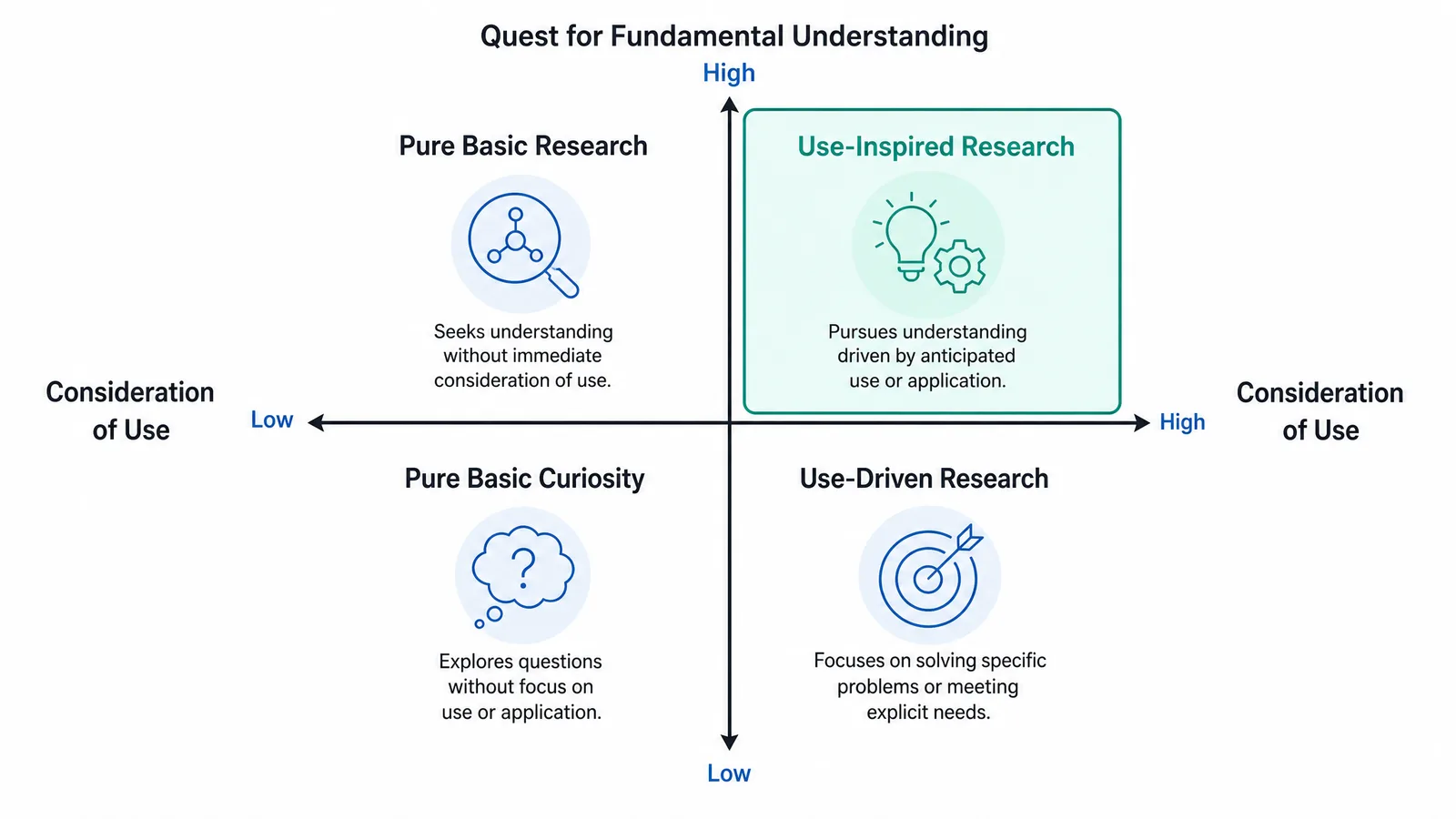
A more useful framing distinguishes two independent questions: does the work seek fundamental understanding, and is it inspired by practical use? Answering yes to both gives use-inspired basic research, which is where a great deal of modern science actually lives. Work on semiconductors, vaccines, and machine learning routinely advances fundamental understanding because it is pursued for practical ends.
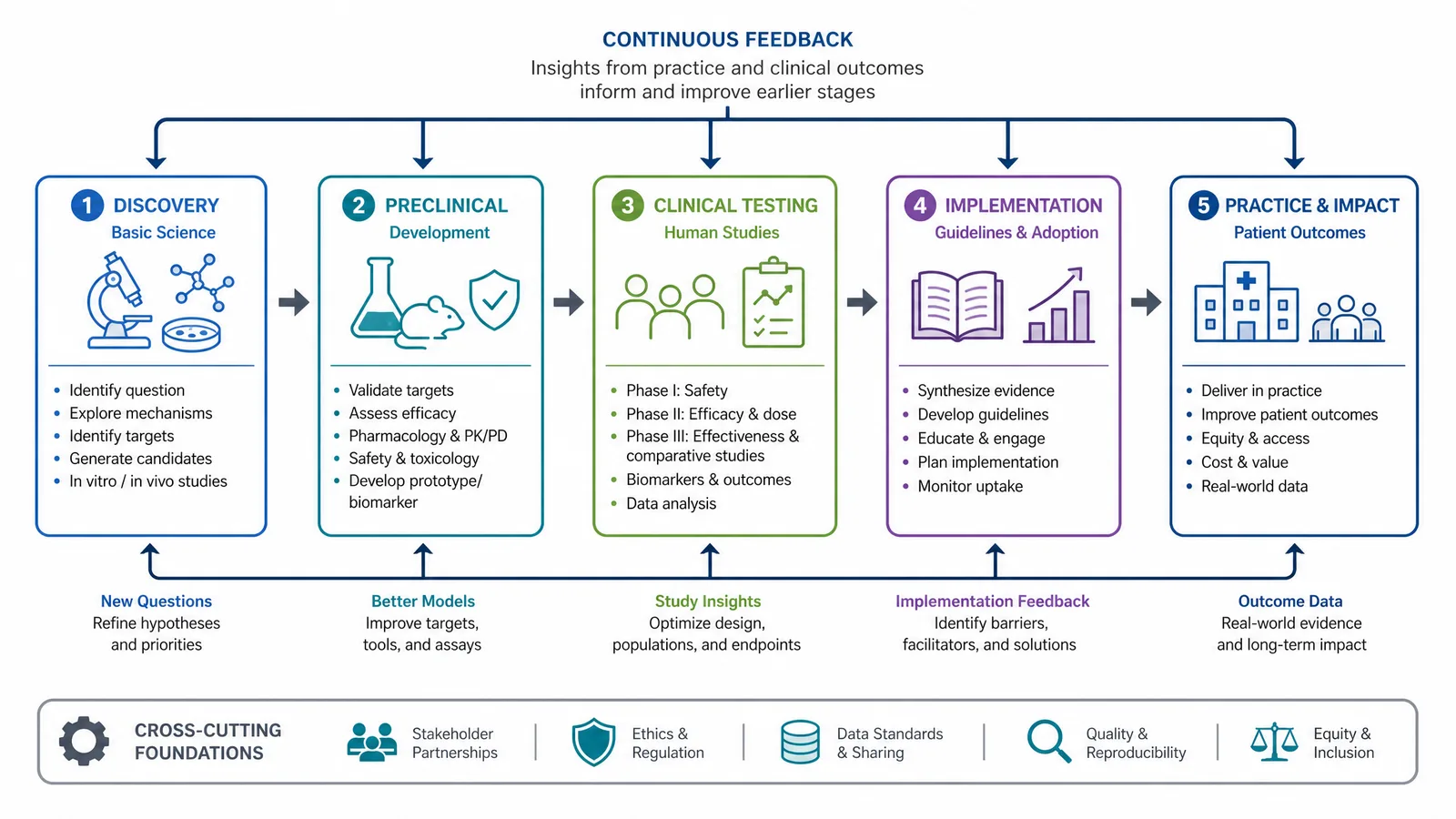
Translational research makes the porousness explicit. Its stages run from laboratory discovery through clinical testing to practice and population outcomes, and each stage feeds back to the ones before it.
A two-axis quadrant chart plotting quest for fundamental understanding against consideration of use, with the use-inspired quadrant highlighted (Figure generated with SciFig)
A translational research pipeline from laboratory discovery through clinical testing to practice, with feedback arrows (Figure generated with SciFig)
Where This Matters in Practice
Framing a funding application. Basic proposals are judged on significance to the field and on rigour; applied proposals are judged additionally on impact pathway, stakeholder engagement, and feasibility within the funding period. Writing an applied proposal in the register of a basic one is a common reason for a low impact score.
Choosing a design. Basic work prioritizes internal validity — tight control, minimal confounds. Applied work often deliberately trades some internal validity for external validity, because an effect that vanishes outside laboratory conditions does not solve the problem.
Writing the introduction. A basic paper builds to a knowledge gap. An applied paper builds to a problem and its cost. Getting this backwards makes the contribution look misjudged even when the science is sound.
Tip
Do not claim both framings at once. Proposals that promise fundamental breakthroughs and immediate practical deployment tend to be read as unrealistic on both counts. Pick the primary contribution, make it well, and mention the other as a secondary benefit.
Create Scientific Figures Now
Describe your scientific figure in natural language — get publication-ready illustrations in minutes.
If you are mapping how your study's constructs connect to an intended outcome, the conceptual framework generator turns that description into a diagram, and text to figure handles study design and workflow figures. Both traditions publish, and at submission both need the same thing: a scientific figure that makes the claim legible in seconds.
Basic research aims to extend understanding of how something works, while applied research aims to solve a specific practical problem. The difference is one of primary purpose rather than of method or rigour.
Yes. Work that seeks fundamental understanding while being motivated by practical use is often called use-inspired basic research, and much of modern science in medicine, materials, and computing falls into this category.
It depends on the funder. Research councils and foundations typically favour basic work, while industry, government agencies, and health services fund applied work. Many national schemes now explicitly fund translational research spanning both.
No. Both demand the same methodological rigour. Applied research often accepts lower internal validity in exchange for higher external validity, which is a deliberate design trade-off rather than a weakness.
Ask what would count as success. If it is a better explanation of a phenomenon, the work is basic. If it is a measurable improvement in a defined situation, it is applied. If both, describe it as use-inspired and pick a primary framing.
Translational research deliberately bridges basic and applied work, moving findings from laboratory discovery through clinical testing to practice and population outcomes, with feedback from each stage informing the earlier ones.
Keep going
Recommended resources
Templates, tools, and further reading for your research