How to write the definition of terms section in a thesis or paper, with conceptual versus operational definitions, placement rules, and worked examples.
SciFig Team
Scientific Illustration Experts
The definition of terms states exactly what each key concept means in your study.
It exists because words such as engagement, severity, and performance mean different things in different fields and different studies. Defining them turns a vague claim into a testable one, and it is usually the difference between a reader agreeing with your conclusion and arguing with your vocabulary.
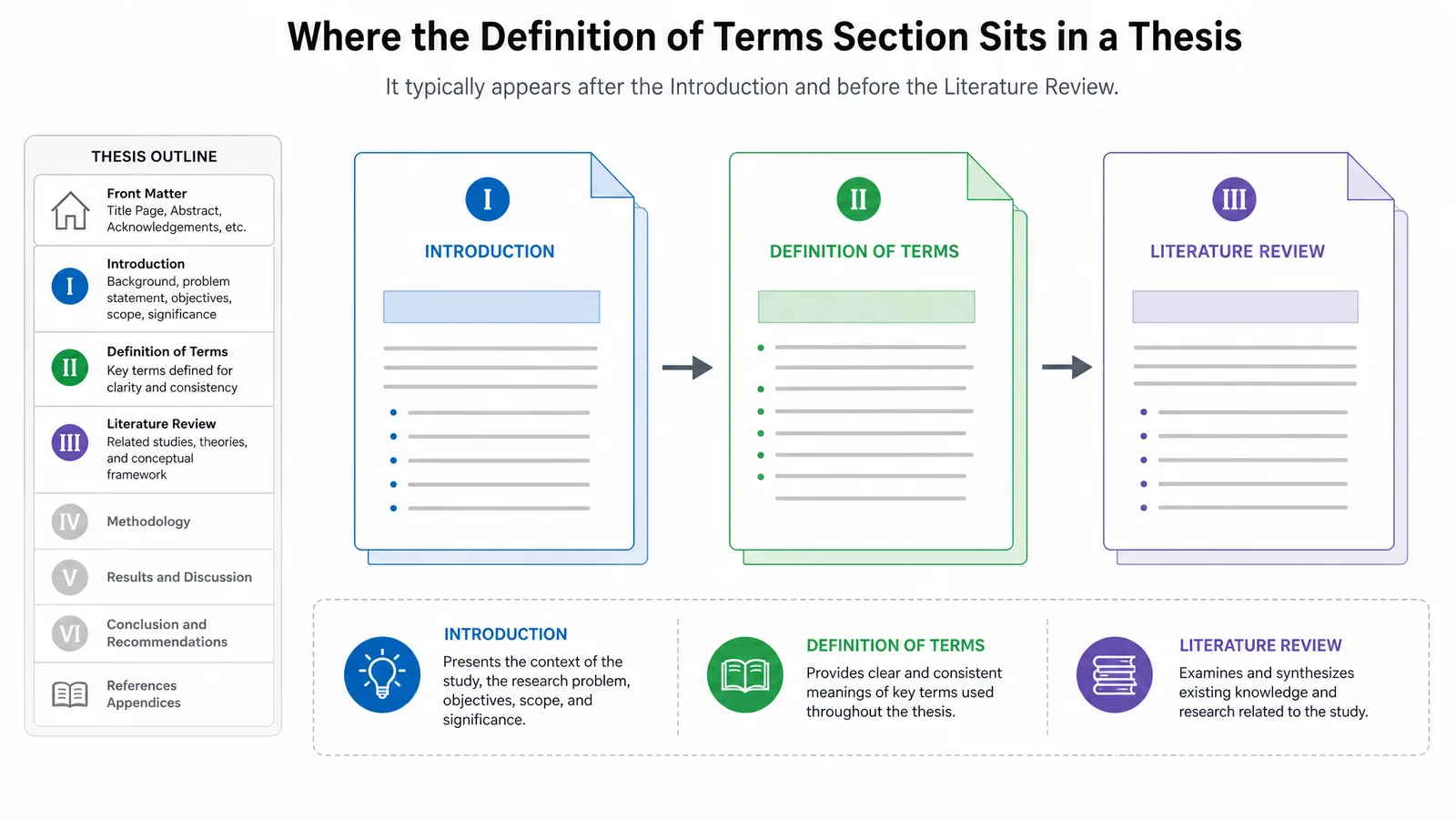
A thesis page layout highlighting where the definition of terms section sits relative to the introduction and literature review (Figure generated with SciFig)
What the Section Is For
A definition of terms section lists the concepts your study depends on and fixes their meaning for the duration of the document. It does three jobs:
Removes ambiguity. Readers stop guessing which sense of a word you mean.
Makes claims falsifiable. A defined variable can be measured, and a measured variable can be argued about with evidence rather than intuition.
Bounds the scope. Defining adolescent as ages 13 to 17 tells reviewers what you are not claiming.
You do not need to define ordinary words. Define terms that are contested in your field, terms you use in a narrower sense than usual, and any term that names a variable you measure.
See AI Scientific Figure Generation in Action
Watch how researchers create publication-ready scientific figures from text descriptions.
This is the distinction most drafts get wrong, and the one reviewers notice.
Conceptual definition
Operational definition
Answers
What does this concept mean?
How is it measured in this study?
Source
Literature, theory
Your methods
Example
Burnout is prolonged exhaustion arising from chronic workplace stress
Burnout is a score of 27 or higher on the emotional exhaustion subscale of the MBI
Most key terms need both. The conceptual definition connects your study to the existing literature; the operational definition tells a reader how to reproduce your measurement. A conceptual definition alone leaves the study unreproducible. An operational definition alone disconnects it from theory.
A useful test: if another team could apply your operational definition to their own data and get a comparable number, it is specific enough. If they would have to ask you what you meant, it is not.
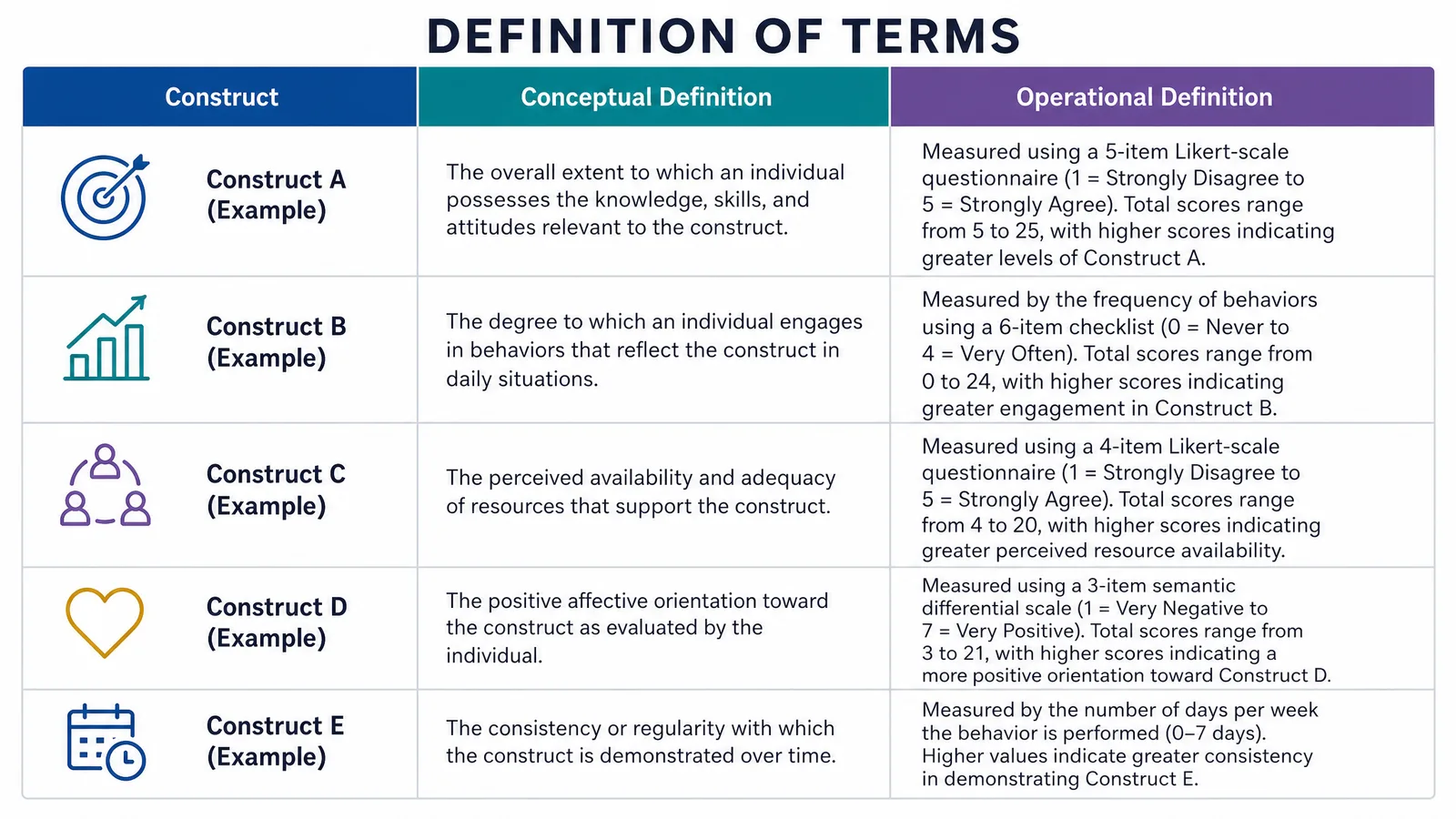
A definition of terms table listing each construct with its conceptual and operational definition side by side (Figure generated with SciFig)
Where to Put It
Placement varies by discipline and by institution, so check your own template first. The common conventions:
Thesis or dissertation. Its own subsection at the end of Chapter 1, after the scope and before the significance section.
Journal article. Usually no standalone section. Definitions appear inline at first use, and operational definitions live in the methods.
Grant proposal. Inline, kept short, with operational detail pushed to the methods.
Within the section, order terms in whichever way helps the reader most — alphabetical for a long list, or logical order following the argument for a short one. Be consistent about which you chose.
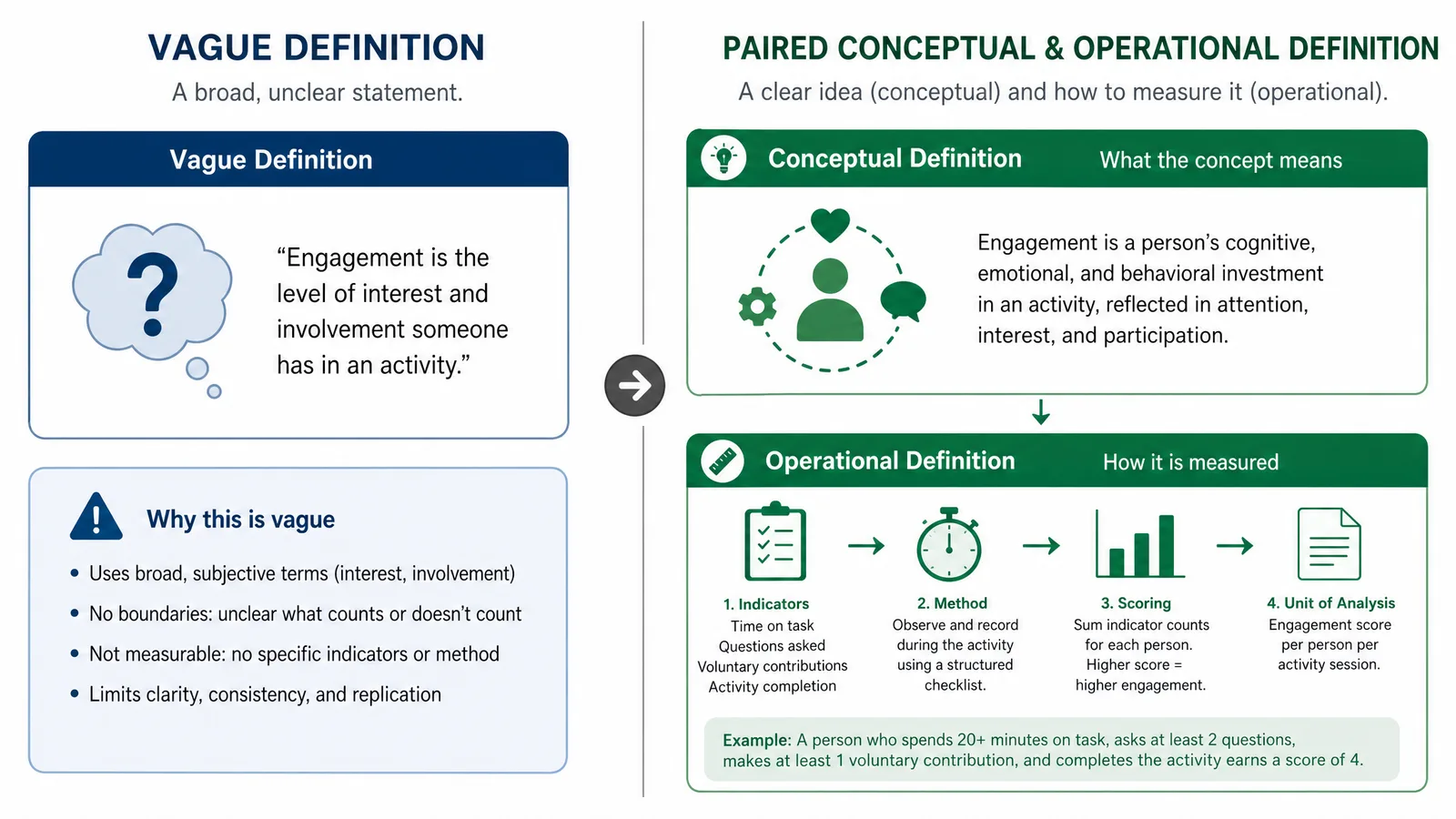
A two-column comparison showing a vague definition rewritten as a paired conceptual and operational definition (Figure generated with SciFig)
Worked Examples
Weak:Academic performance refers to how well students do in school.
The definition restates the term. Nothing is measurable and nothing is bounded.
Better:Academic performance is conceptually defined as demonstrated attainment of course learning objectives. Operationally, it is the weighted grade point average across all enrolled courses in the 2025-2026 academic year, on a 4.0 scale, as recorded in the university registry.
Now the reader knows what is meant, what was measured, over what period, and from what source.
Weak:Social media use means the use of social media platforms.
Better:Social media use is conceptually defined as voluntary engagement with platforms supporting user-generated content and social interaction. Operationally, it is self-reported average daily minutes across Instagram, TikTok, and X during the seven days preceding the survey, collected via a validated time-use questionnaire.
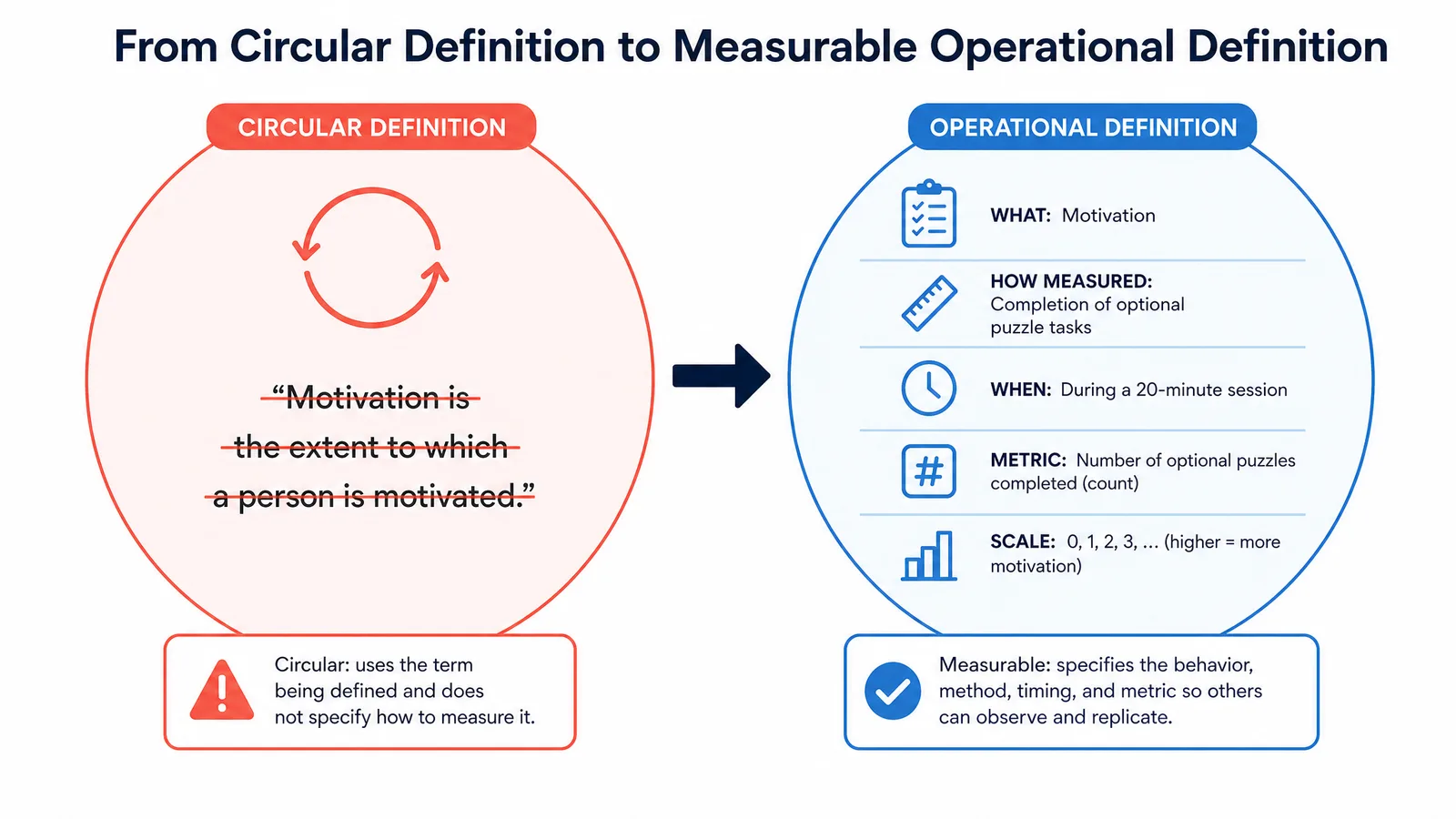
A circular definition rewritten into a measurable operational definition, with the circular phrase struck through (Figure generated with SciFig)
Common Mistakes
Circular definitions. "Reading comprehension is the ability to comprehend reading." If the term appears in its own definition, rewrite it.
Dictionary definitions for technical terms. A general dictionary reflects everyday usage, not disciplinary usage. Cite the literature instead.
Defining everything. A list of thirty terms signals that you have not identified which concepts actually carry the argument. Most studies need between three and eight.
Silent drift. Defining a term one way in Chapter 1 and using it differently in Chapter 4 is a common and costly inconsistency. Before submitting, search the document for each defined term and confirm every use matches the definition.
Tip
Write the operational definitions at the same time as your methods section, not before. Definitions written in advance tend to describe what you hoped to measure rather than what you actually measured.
Create Scientific Figures Now
Describe your scientific figure in natural language — get publication-ready illustrations in minutes.
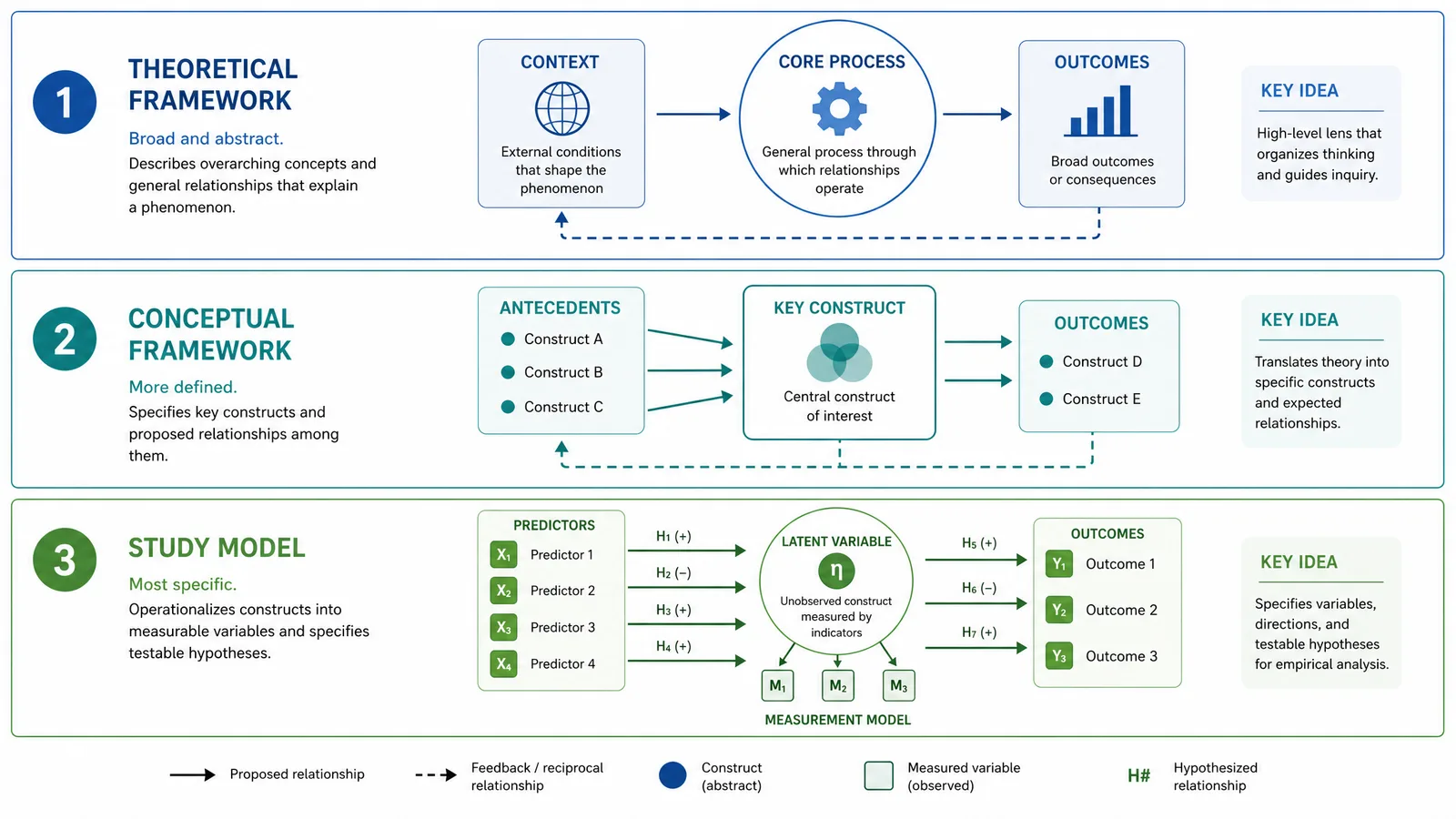
If your terms belong to a wider framework of variables and relationships, mapping them visually helps. The conceptual framework generator turns a written description into a diagram, and text to figure handles the same job for other figure types in the manuscript. A settled definition list also makes the accompanying scientific figure easier to label, because every term already has one agreed meaning.
It is a section that fixes the meaning of the key concepts a study depends on, usually giving both a conceptual definition drawn from the literature and an operational definition describing how the concept was measured in that specific study.
A conceptual definition explains what a concept means in theory and connects it to existing literature. An operational definition states exactly how it was measured in your study, such as a specific instrument, threshold, or time window.
Most templates place it as a subsection at the end of Chapter 1, after the scope and delimitations and before the significance of the study. Institutional templates vary, so confirm against your own guidelines.
Most studies need between three and eight. Define terms that are contested in your field, terms you use more narrowly than usual, and every term naming a variable you measure. Ordinary words do not need definitions.
Yes for conceptual definitions, which should be traceable to the literature. Operational definitions come from your own methods and need a citation only when you adopt an existing instrument or established threshold.
Usually not as a standalone section. Journal articles define terms inline at first use and place operational detail in the methods, because space is limited and the audience already shares much of the vocabulary.
Keep going
Recommended resources
Templates, tools, and further reading for your research