
A theoretical framework borrows existing theory; a model represents your study.
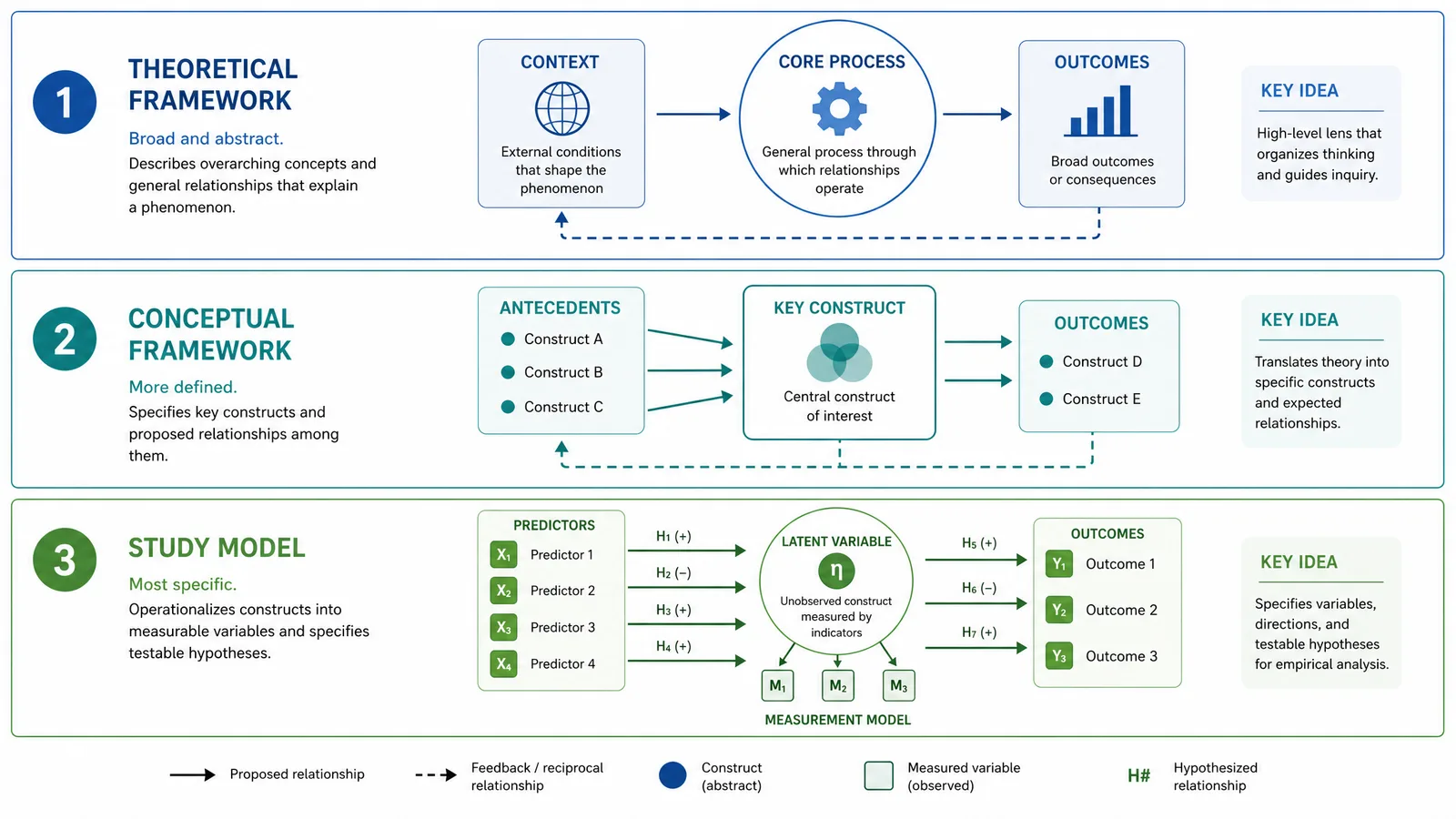
The two are confused constantly, and the confusion costs marks in a viva and clarity in a paper. The short version: a theoretical framework is the lens you look through, a conceptual framework is what you expect to see, and a model is the concrete structure you test.
The Three Terms Side by Side
| Theoretical framework | Conceptual framework | Model | |
|---|---|---|---|
| Comes from | Established theory in the literature | Your synthesis for this study | Your specific testable structure |
| Scope | General, field-wide | Study-specific | Study-specific, often formal |
| Contains | Named theories and their constructs | Variables and expected relationships | Variables, directions, sometimes parameters |
| Changes between studies | Rarely | Usually | Usually |
| Typical form | Prose with citations | Diagram plus prose | Diagram, equations, or both |
A worked illustration. Suppose you study why clinicians adopt a new diagnostic tool.
- Theoretical framework: the Technology Acceptance Model as a body of theory — perceived usefulness and perceived ease of use drive intention to adopt. You did not invent this; you cite it.
- Conceptual framework: your adaptation for this setting — you add perceived diagnostic risk and workload as constructs relevant to clinicians, and you show how you expect them to relate.
- Model: the structure you actually test — five measured variables, hypothesized paths with directions, ready to be estimated.
See AI Scientific Figure Generation in Action
Watch how researchers create publication-ready scientific figures from text descriptions.
Explore the Tool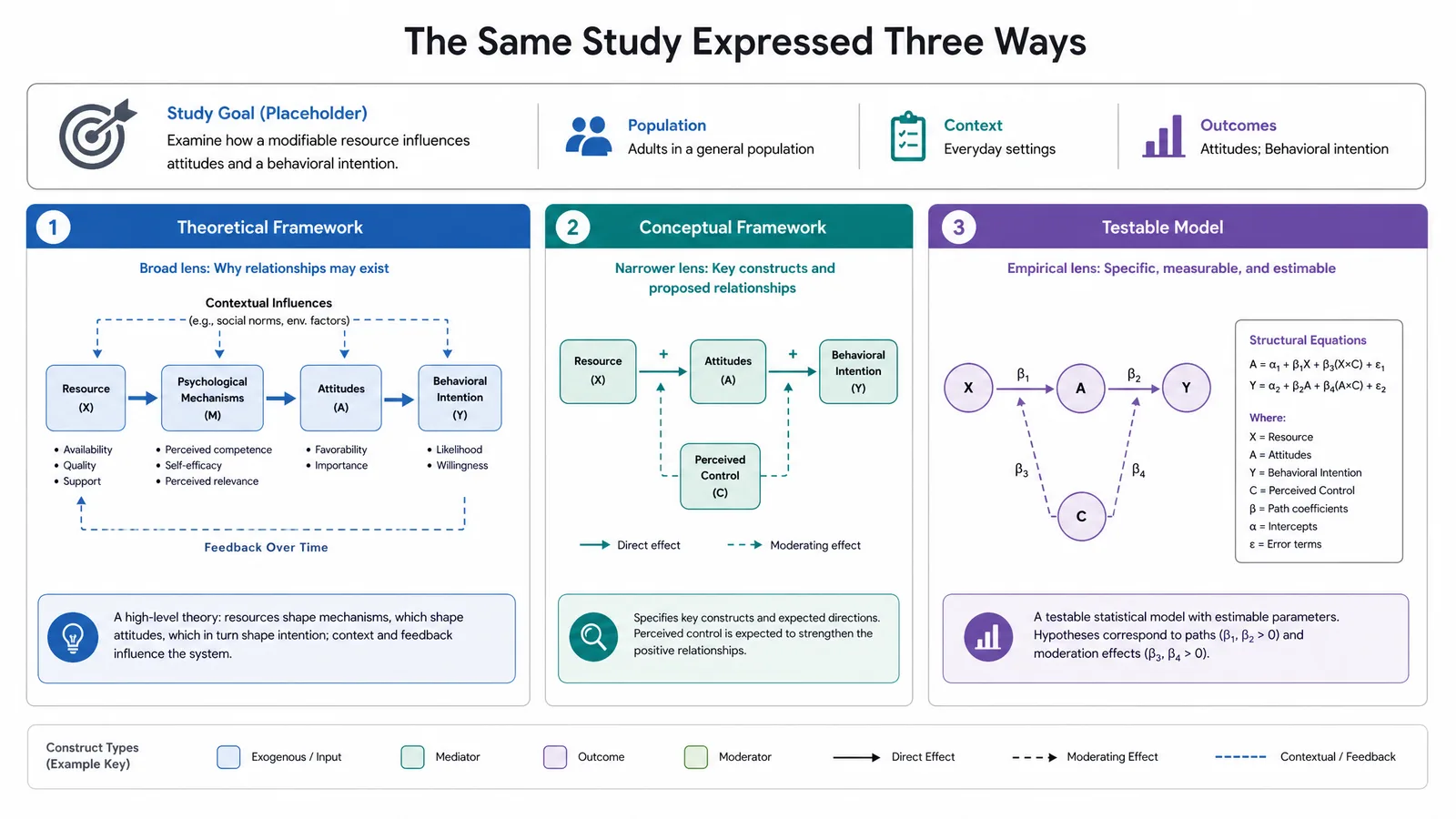
Which One Does Your Thesis Need?
- Theoretical framework only. Common in purely qualitative work where the theory guides interpretation but you are not positing specific relationships in advance.
- Theoretical plus conceptual. The most common pattern. Theory justifies the choice of constructs; the conceptual framework shows how they combine for your question.
- All three. Quantitative work testing specific hypotheses, where the model is the formal version of the conceptual framework.
If your supervisor asks "what is your theoretical framework?" they are asking which body of existing theory you are working within. Answering with a diagram of your own variables is the classic mismatch.
Diagramming Them Well
Reviewers read these diagrams quickly, and a few conventions prevent misreading:
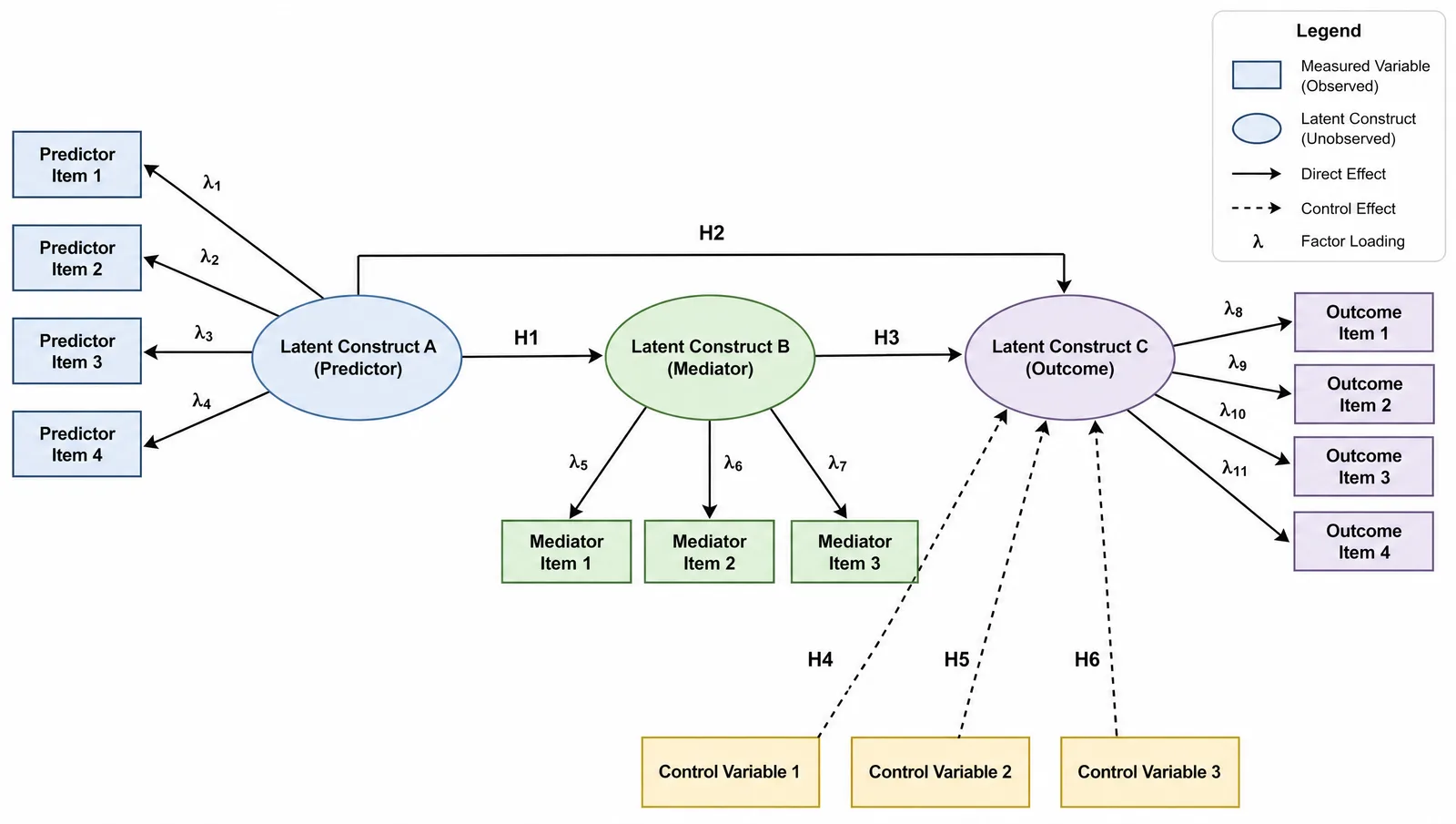
- Direction carries meaning. An arrow should mean "influences" or "predicts", not merely "is related to". If you mean association without direction, use a line, not an arrow.
- Distinguish measured from latent. The common convention is rectangles for measured variables and ellipses for latent constructs. Follow it even if your software does not default to it.
- Do not mix levels. A diagram that shows both an abstract theory construct and a specific questionnaire item is showing two different frameworks at once.
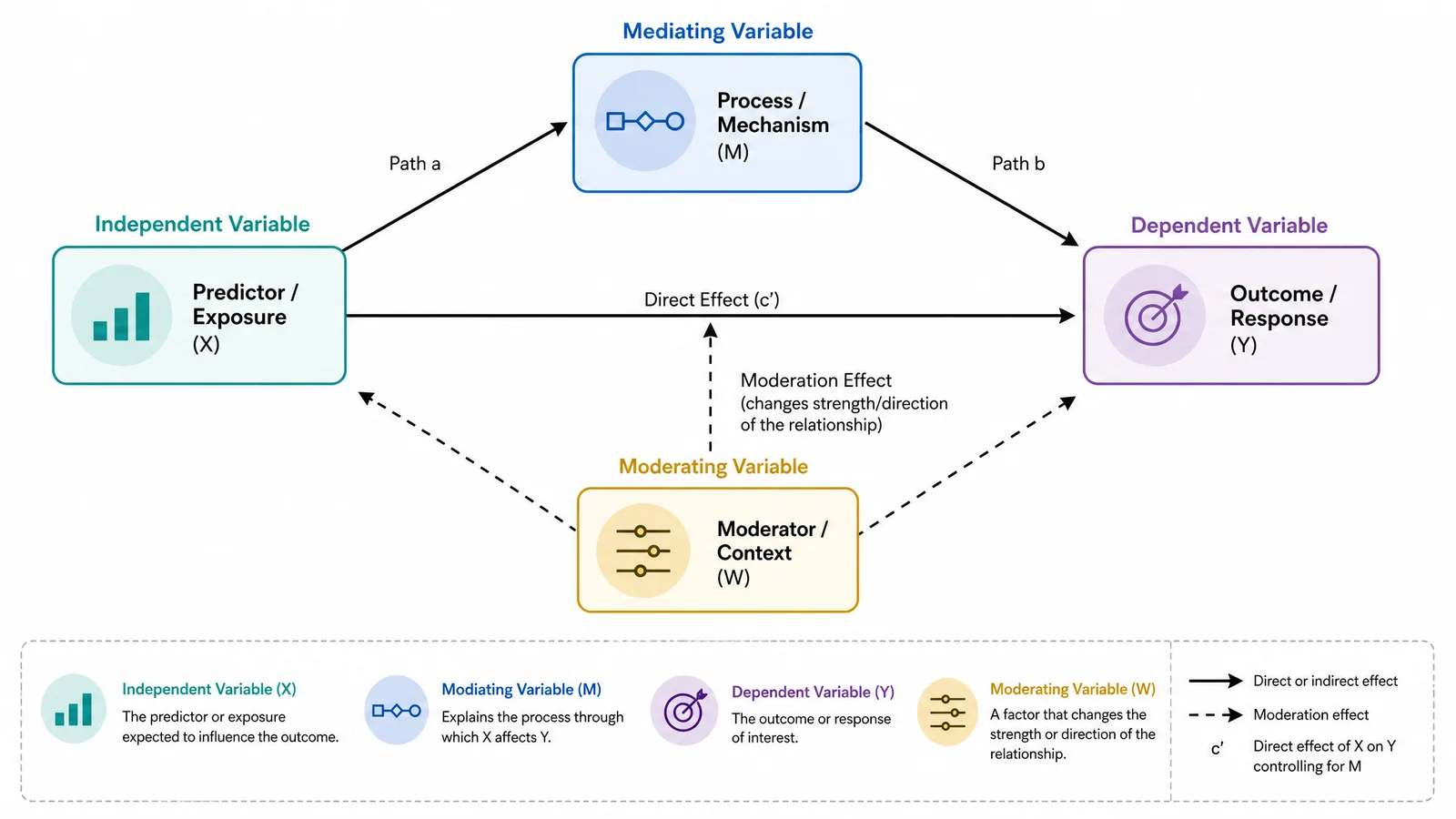
- Label the relationships, not just the boxes. "Positive", "moderates", "mediates" tell the reader what you are claiming.
Tip
Write the framework section before you collect data, and do not silently revise it afterwards to match what you found. If the data changes your thinking, say so explicitly in the discussion. A framework quietly rewritten to fit results is a serious credibility problem if a reviewer notices the mismatch with your preregistration or proposal.
Create Scientific Figures Now
Describe your scientific figure in natural language — get publication-ready illustrations in minutes.
Try FreeRelated Reading
Related reading: Definition of Terms in Research: How to Write It, How to Add Figures to a Research Paper.