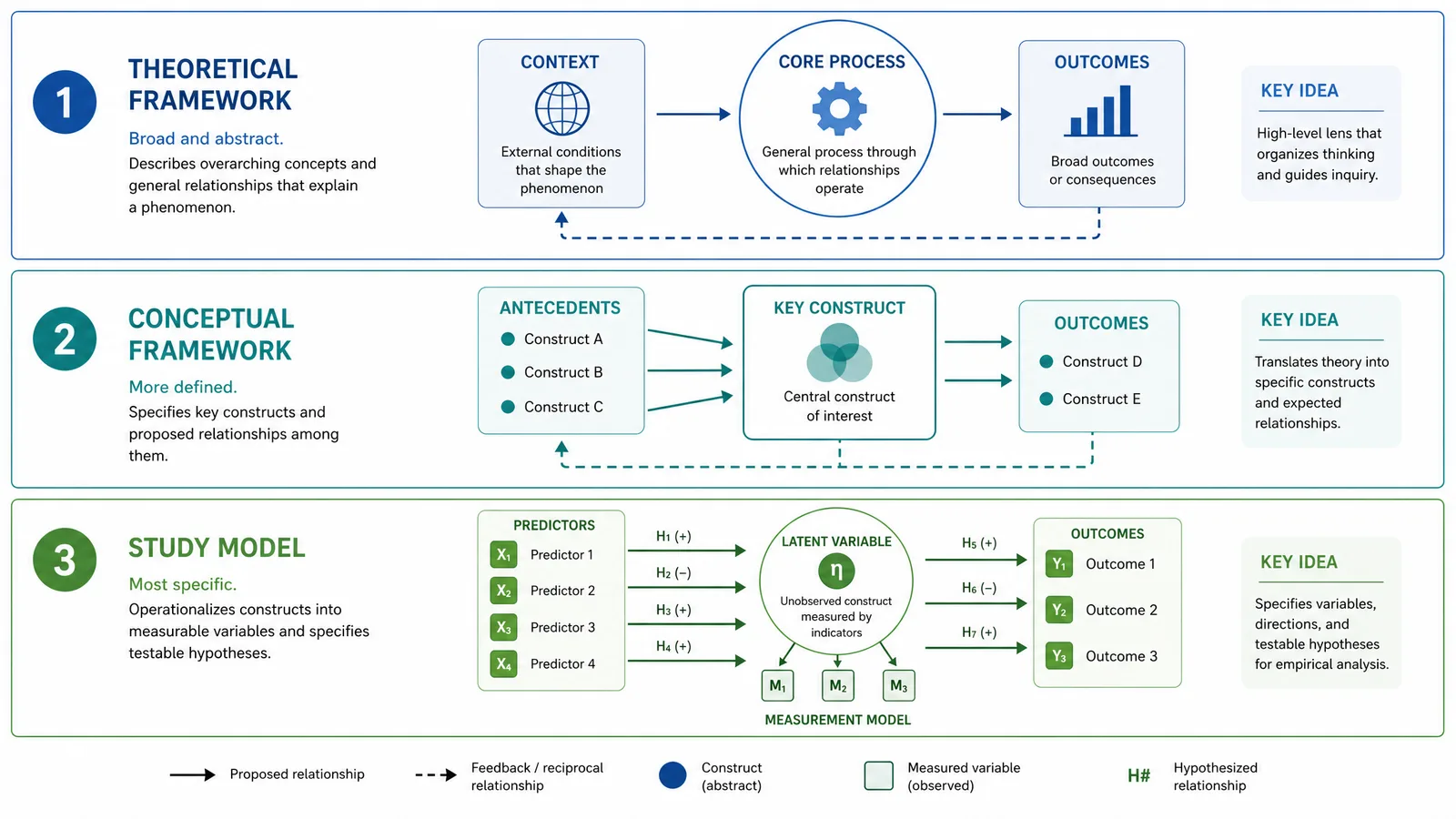
How to write a conceptual framework for a thesis or paper, from identifying variables to diagramming relationships, with a worked example and common mistakes.
SciFig Team
Scientific Illustration Experts
A conceptual framework shows which variables you study and how they relate.
It is the bridge between the literature and your methods: theory tells you which constructs matter, and the framework commits to how you think they connect in your specific study. Writing it well forces decisions that are otherwise deferred until the analysis, when they are far more expensive to change.
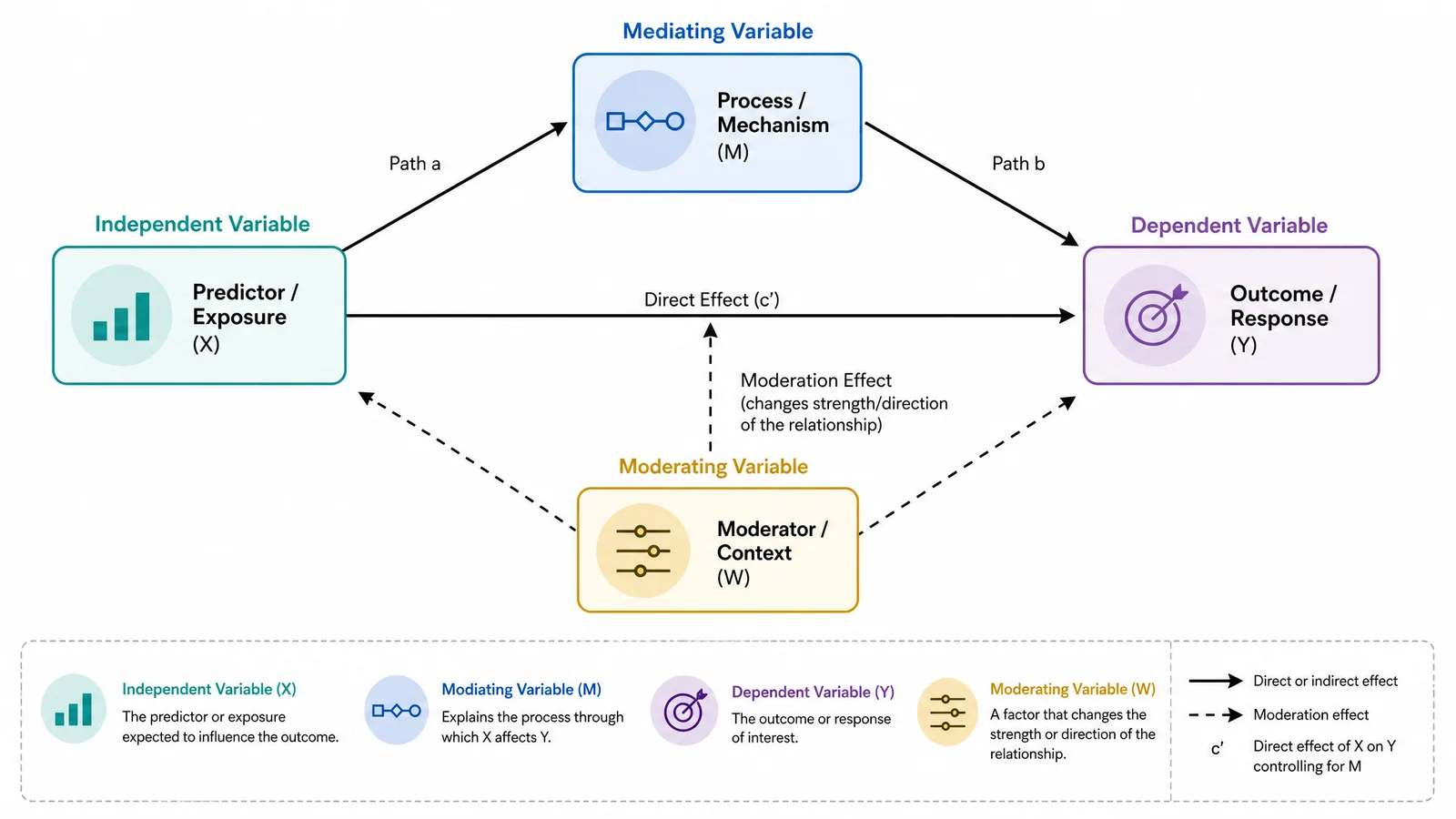
A conceptual framework diagram with independent, dependent, mediating, and moderating variables arranged with labeled arrows (Figure generated with SciFig)
Five Steps
1. State the research question precisely
Everything downstream follows from it. "Does X affect Y, and under what conditions?" already implies an independent variable, a dependent variable, and a moderator.
2. Identify the variables
Sort every construct into a role:
Role
Definition
Example
Independent
What you manipulate or observe as a cause
Teaching method
Dependent
The outcome you measure
Exam performance
Mediating
Explains how the effect happens
Study engagement
Moderating
Changes the strength of the effect
Prior knowledge
Control
Held constant or adjusted for
Class size
A variable with no role does not belong in the framework.
3. Ground each relationship in literature
Every arrow needs a reason. If you cannot cite a study, a theory, or a stated logical argument for a relationship, either find one or remove the arrow. Unsupported arrows are where reviewers concentrate.
See AI Scientific Figure Generation in Action
Watch how researchers create publication-ready scientific figures from text descriptions.
Boxes for measured variables, ellipses for latent constructs
Arrows only for directional claims; plain lines for association without direction
Left to right or top to bottom, matching causal order
Label the arrows with the nature of the relationship, not just its existence
One level of abstraction throughout
5. Write the accompanying prose
The diagram does not stand alone. The text should state each relationship, its justification, and the hypothesis it generates. A reader should be able to reconstruct the diagram from the prose and vice versa.
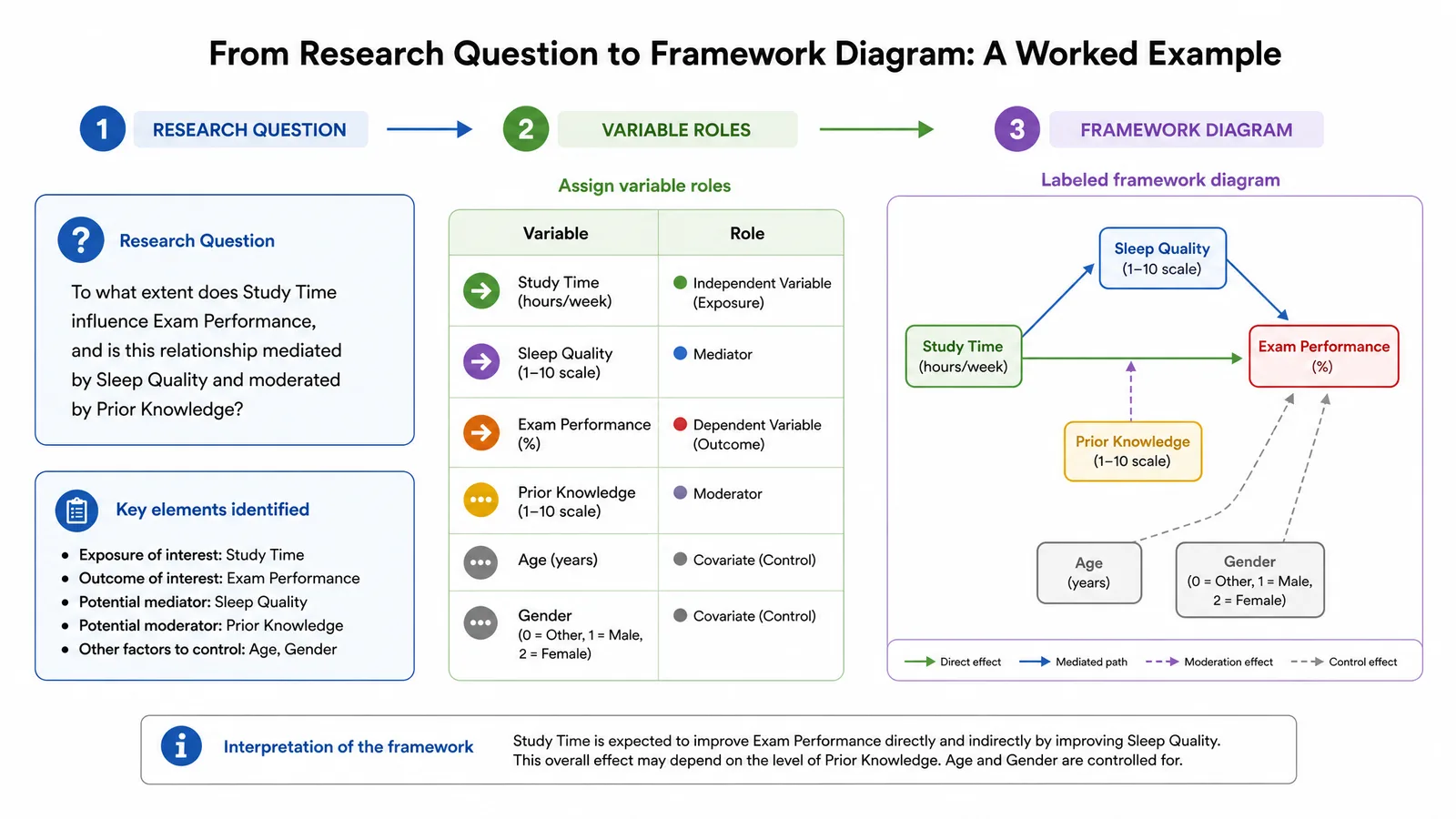
A worked example showing a research question converted into variable roles and then into a labeled framework diagram (Figure generated with SciFig)
Worked Example
Question. Does collaborative learning improve exam performance, and does prior knowledge change the effect?
Independent: teaching method (collaborative vs lecture)
Dependent: exam performance
Mediating: study engagement — collaboration increases engagement, which improves performance
Moderating: prior knowledge — the benefit is expected to be larger for students with lower prior knowledge
Control: class size, instructor
Framework prose. "Collaborative learning is expected to increase exam performance, mediated by study engagement. Prior knowledge is expected to moderate the direct path, with larger effects among students with lower prior knowledge."
That paragraph generates three testable hypotheses and tells the reader exactly what the analysis must estimate.
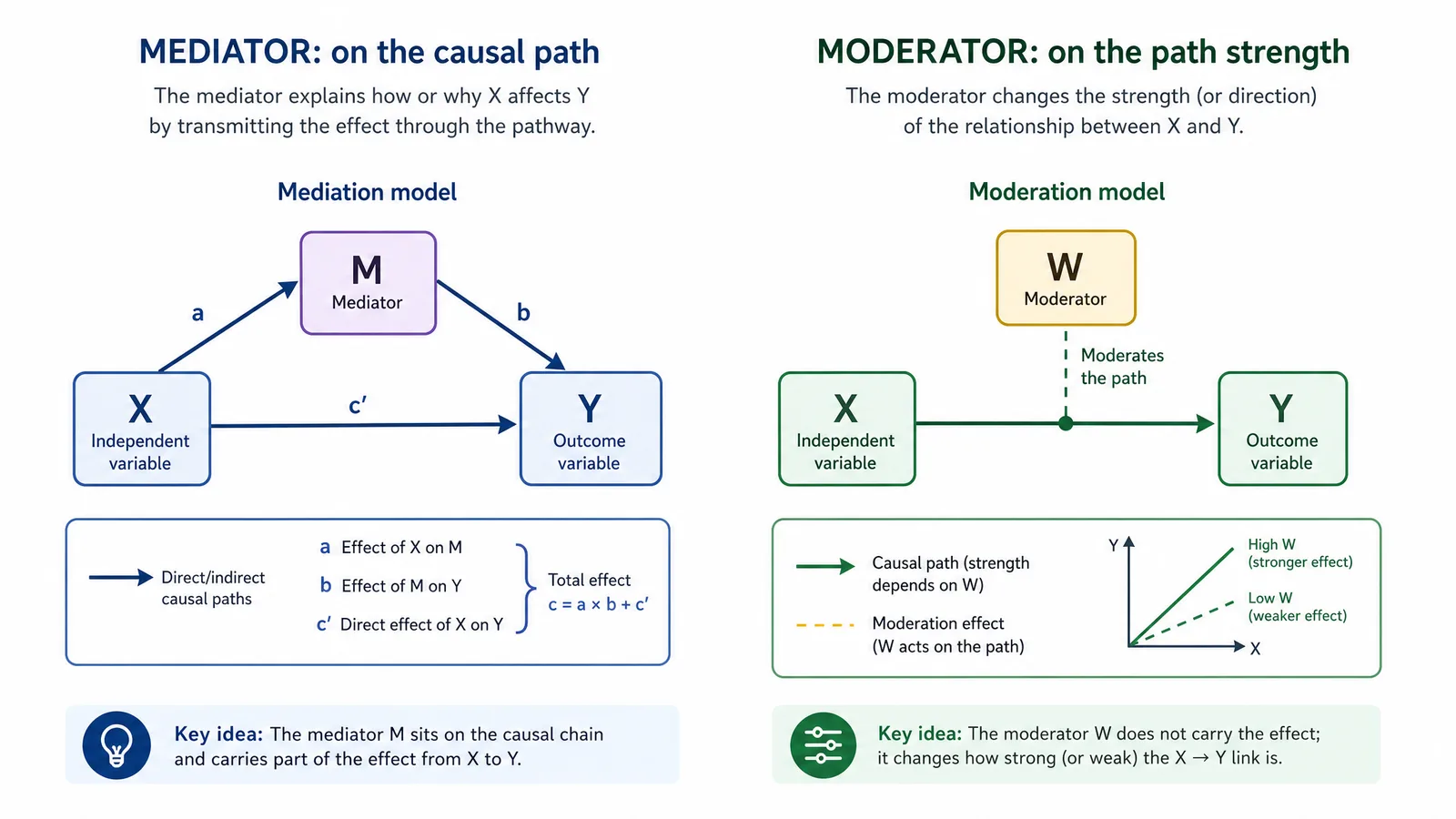
A diagram contrasting a mediator on the causal path with a moderator acting on the path strength (Figure generated with SciFig)
Common Mistakes
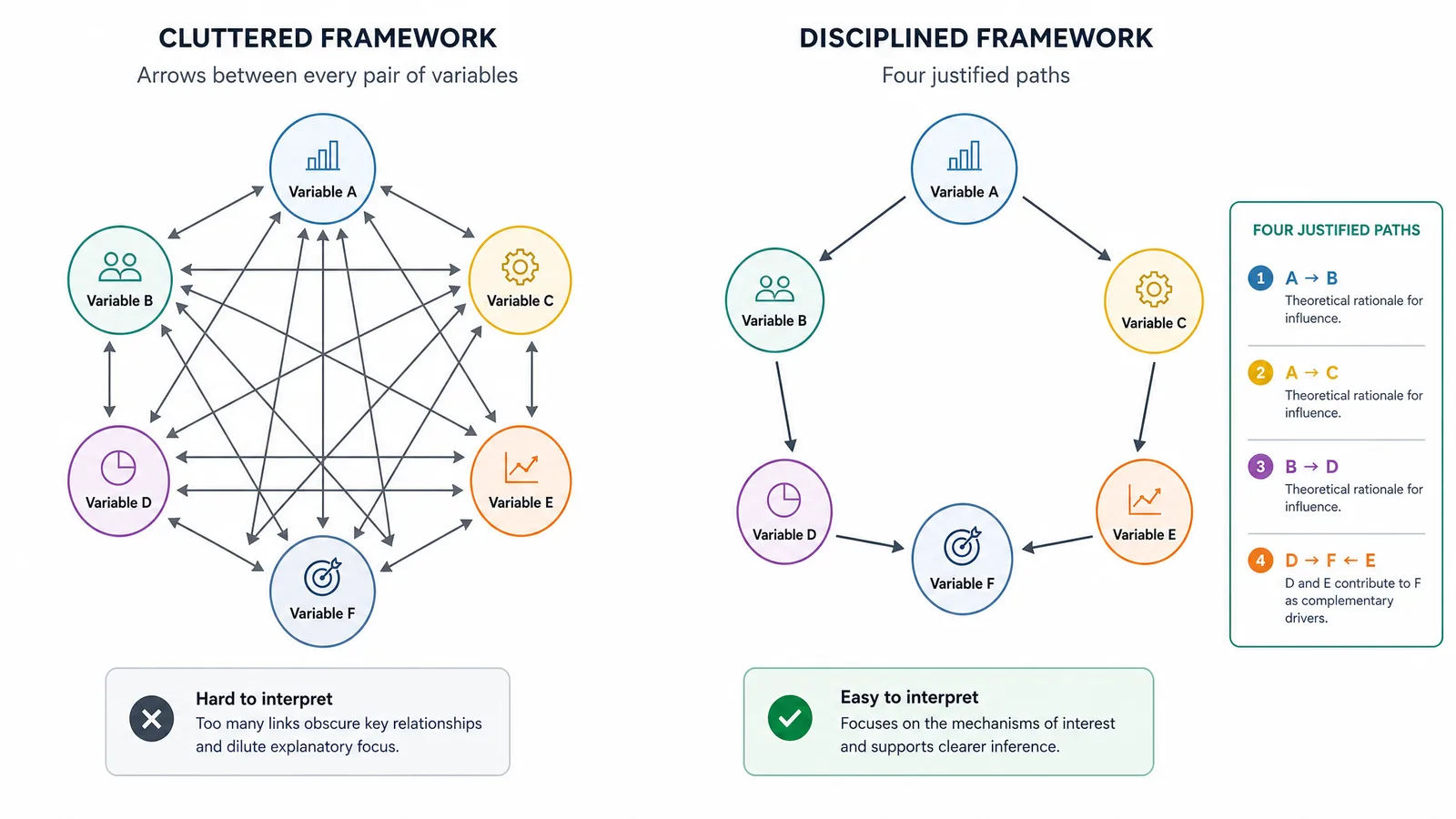
Arrows everywhere. A framework where everything points at everything commits to nothing and cannot be falsified.
Confusing mediators and moderators. A mediator is on the causal path and explains the mechanism. A moderator sits beside it and changes the strength. Getting this wrong changes the entire analysis.
Mixing abstraction levels. A diagram containing both "socioeconomic status" and "household income in the 2025 survey" is showing a construct and its measurement as if they were peers.
Writing it after the analysis. A framework reverse-engineered from results is not a framework, and reviewers who compare it against your proposal will notice.
A cluttered framework with arrows between every pair of variables beside a disciplined version with four justified paths (Figure generated with SciFig)
Tip
Draft the framework before collecting data and keep the dated version. If your thinking changes afterwards, say so explicitly in the discussion rather than quietly revising the diagram. The revision is defensible; the silence is not.
Create Scientific Figures Now
Describe your scientific figure in natural language — get publication-ready illustrations in minutes.
The conceptual framework generator turns a written description of variables and relationships into a diagram following these conventions, and text to figure covers the rest of the methods figure set. See also our guide to writing the definition of terms, which pairs closely with this section. Once the variables and their relations are settled, the framework translates directly into a scientific figure.
A conceptual framework identifies the variables in your study and states how you expect them to relate. It bridges the literature and your methods by committing to specific, testable relationships.
A mediator lies on the causal path and explains how an effect occurs. A moderator sits beside the path and changes the strength or direction of the effect. Confusing them changes what your analysis must estimate.
Only those with a defined role and a justified relationship. Most frameworks work with four to eight. A variable with no role, or an arrow with no supporting literature, should be removed.
Do both. The diagram makes structure visible at a glance, and the prose supplies justification and hypotheses. A reader should be able to reconstruct one from the other.
Before collecting data. Writing it early forces decisions about variables and relationships that are far more expensive to change during analysis, and it protects you from appearing to reverse-engineer it from results.
Yes, provided you disclose it. State in the discussion how and why your thinking changed. A revised framework is defensible; a silently rewritten one is a credibility problem.
Keep going
Recommended resources
Templates, tools, and further reading for your research