How to draw Lewis dot structures step by step: count electrons, connect atoms, fill octets, check charges.
A Lewis structure shows how the valence electrons of a molecule or ion are arranged: shared pairs as bonds between atoms and unshared pairs as dots. Once you can count electrons reliably, every structure follows the same six steps. This guide walks through those steps, works through water, carbon dioxide, ammonia and nitrate by hand, and covers formal charge, resonance and the molecules that break the octet rule.

What is a Lewis structure?
A Lewis structure, also called a Lewis dot structure or electron dot diagram, is a drawing of a molecule's valence electrons. Each line between two atoms is a bond made of two shared electrons, a double line is four shared electrons, and a triple line is six. Pairs of dots on a single atom are lone pairs that belong to that atom only.
How do you draw Lewis dot structures? The 6 steps
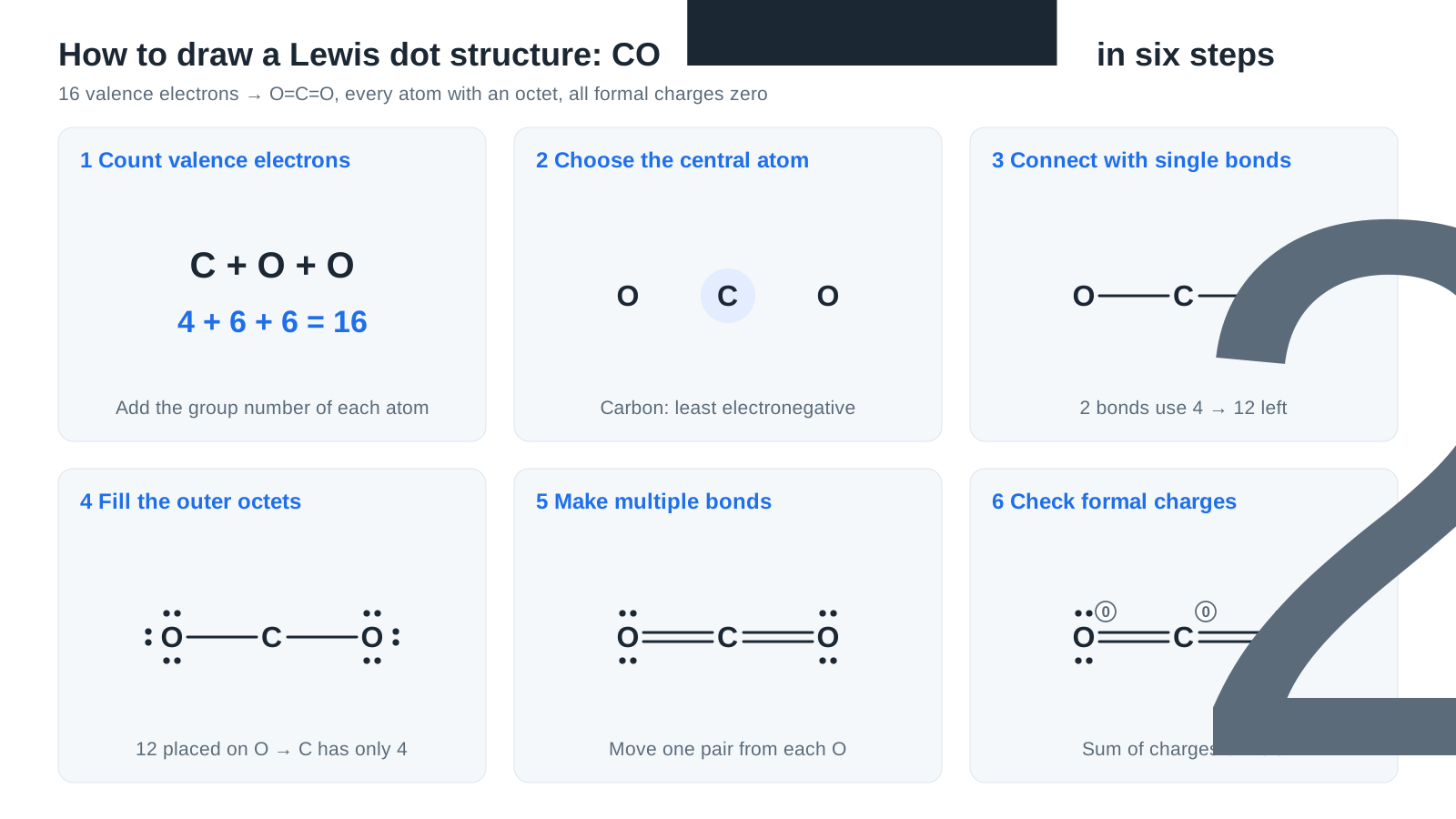
These six steps work for almost every molecule and polyatomic ion you meet in general chemistry.
Step 1: Count the total valence electrons
| Element | Group | Valence electrons |
|---|---|---|
| H | 1 | 1 |
| B | 13 | 3 |
| C | 14 | 4 |
| N, P | 15 | 5 |
| O, S | 16 | 6 |
| F, Cl, Br, I | 17 | 7 |
Step 2: Choose the central atom
Step 3: Draw the skeleton with single bonds
Connect each outer atom to the central atom with a single bond. Every single bond uses two electrons, so subtract two from your total for each bond you draw.
Step 4: Complete the octets of the outer atoms
Place the remaining electrons as lone pairs on the outer atoms until each has eight electrons, counting the bond it already shares. Hydrogen stops at two.
Step 5: Place leftover electrons on the central atom, then form multiple bonds
Step 6: Check the formal charges
Calculate the formal charge on each atom (the formula is in the next section). The formal charges must add up to the overall charge of the molecule or ion. If you can draw more than one valid structure, choose the one whose formal charges are closest to zero, with any negative charge on the more electronegative atom.
Finally, count every electron in your drawing. The number must equal the total from Step 1.
Worked examples: H₂O, CO₂, NH₃ and NO₃⁻
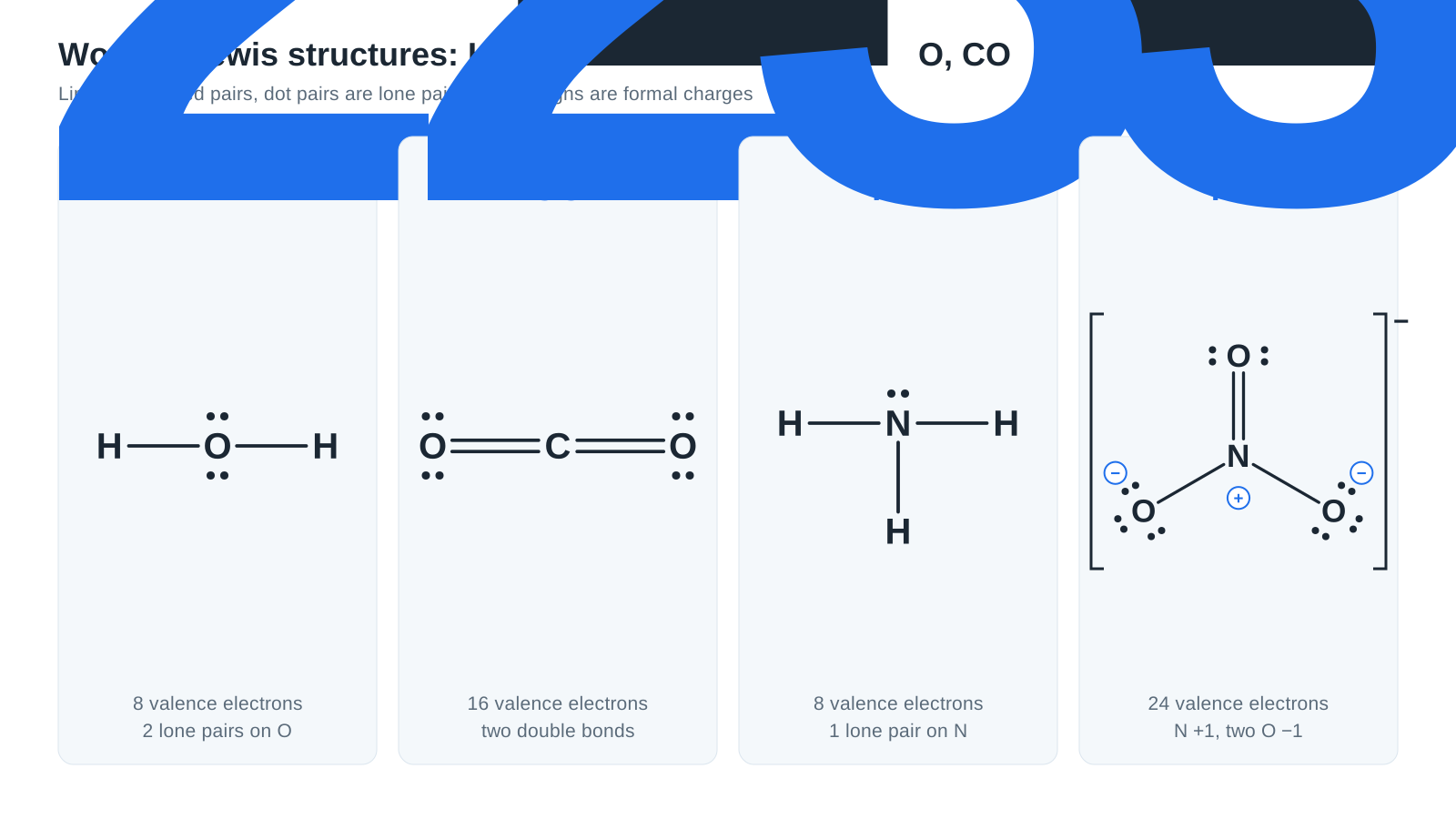
Water (H₂O)
- Valence electrons: (2 × 1) + 6 = 8.
- Oxygen is central; hydrogen can only be terminal.
- Two O–H single bonds use 4 electrons, leaving 4.
- Each hydrogen already has its two electrons.
- The remaining 4 electrons go on oxygen as two lone pairs, giving oxygen an octet.
- Formal charges: all zero.
Carbon dioxide (CO₂)
- Valence electrons: 4 + (2 × 6) = 16.
- Carbon is central.
- Two C–O single bonds use 4 electrons, leaving 12.
- Six electrons go on each oxygen, which completes both oxygen octets and uses all 12.
- Carbon now has only 4 electrons, so move one lone pair from each oxygen into a bond. The result is O=C=O, with two lone pairs on each oxygen.
- Formal charges: all zero.
Ammonia (NH₃)
- Valence electrons: 5 + (3 × 1) = 8.
- Nitrogen is central.
- Three N–H bonds use 6 electrons, leaving 2.
- The hydrogens are complete.
- The last 2 electrons form one lone pair on nitrogen, giving it an octet.
- Formal charges: all zero.
Nitrate ion (NO₃⁻)
- Valence electrons: 5 + (3 × 6) + 1 = 24.
- Nitrogen is central.
- Three N–O single bonds use 6 electrons, leaving 18.
- Six electrons go on each oxygen, which uses all 18.
- Nitrogen has only 6 electrons, so one oxygen shares a lone pair to make an N=O double bond.
- Formal charges: nitrogen +1, the double-bonded oxygen 0, and each single-bonded oxygen −1, for a total of −1. Write the structure in square brackets with the charge outside: [NO₃]⁻.
How do you calculate formal charge in a Lewis structure?
Formal charge tells you how an atom's electrons in the drawing compare with the electrons it brings as a neutral atom:
Nonbonding electrons are the dots on that atom; bonding electrons are all the electrons in the bonds it forms. In the nitrate structure above:
| Atom | Valence electrons | Nonbonding electrons | Bonding electrons | Formal charge |
|---|---|---|---|---|
| N | 5 | 0 | 8 | 5 − 0 − 4 = +1 |
| O (double bond) | 6 | 4 | 4 | 6 − 4 − 2 = 0 |
| O (single bond) | 6 | 6 | 2 | 6 − 6 − 1 = −1 |
The sum, +1 + 0 + (−1) + (−1) = −1, matches the ion's charge. A structure with formal charges of zero on every atom, like H₂O or CO₂, is usually the best one you can draw.
What are resonance structures?
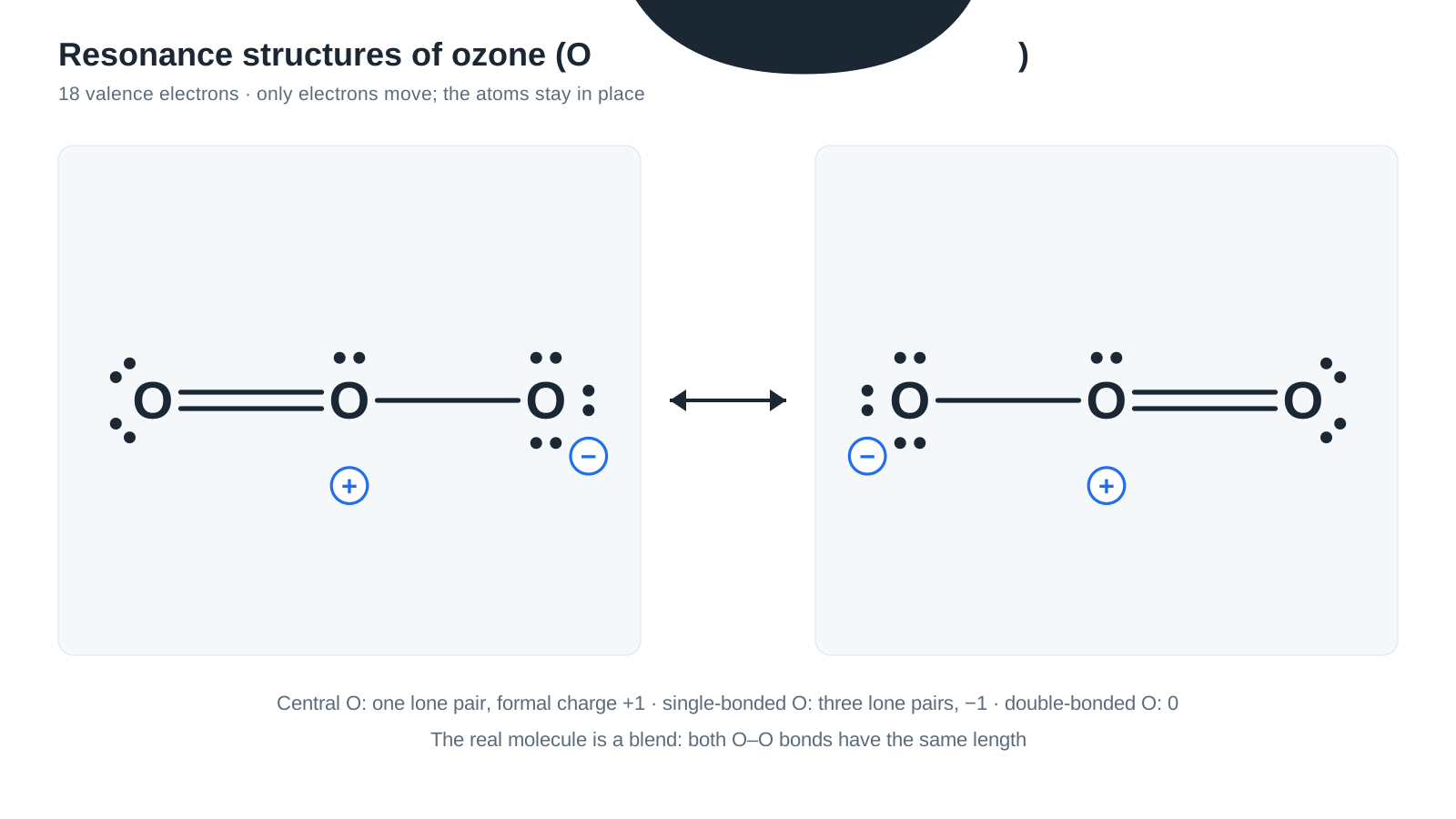
Exceptions to the octet rule
Some molecules cannot give every atom eight electrons. Recognizing them saves you from forcing a wrong structure.
| Exception | Example | Valence electrons | What the central atom has |
|---|---|---|---|
| Odd number of electrons | NO, NO₂ | 11, 17 | One unpaired electron, so one atom stays short of an octet |
| Incomplete octet | BF₃, BeCl₂ | 24, 16 | Boron has 6 electrons, beryllium has 4 |
| Expanded octet | PCl₅, SF₆ | 40, 48 | Phosphorus has 10 electrons, sulfur has 12 |
- Odd-electron molecules (radicals) have an odd total, so at least one electron stays unpaired. Put it on the less electronegative atom, which is nitrogen in NO.
- Incomplete octets occur mainly with boron and beryllium, which are stable with fewer than eight electrons in these compounds.
- Expanded octets are only possible for elements in period 3 and below, such as phosphorus, sulfur, chlorine and xenon. Carbon, nitrogen, oxygen and fluorine never exceed eight electrons.
How do you draw Lewis structures for ionic compounds?
Ionic compounds transfer electrons instead of sharing them, so there is no bond line. Draw each ion separately with its own brackets and charge. For sodium chloride, sodium gives up its one valence electron and becomes Na⁺ with no dots, while chlorine gains it and becomes [Cl]⁻ with eight dots. For polyatomic ions such as NO₃⁻ or NH₄⁺ (8 valence electrons, nitrogen formal charge +1), draw the covalent structure inside the brackets and write the charge outside.
Common mistakes and quick checks
- Forgetting the charge in the electron count. NO₃⁻ has 24 electrons, not 23.
- Putting hydrogen in the center. Hydrogen forms one bond and is always terminal.
- Giving carbon, nitrogen or oxygen more than eight electrons. Second-period atoms cannot expand their octet.
- Using double bonds too early. Fill outer atoms first; only make a multiple bond when the central atom is short of an octet.
- Losing electrons along the way. The dots and bond electrons in the finished drawing must add up to the Step 1 total.
- Skipping formal charges. They tell you which of several valid structures is the best one and are needed for resonance.
Quick reference: common molecules
| Molecule or ion | Valence electrons | Central atom | Bonds to central atom | Lone pairs on central atom | Shape |
|---|---|---|---|---|---|
| H₂O | 8 | O | 2 single | 2 | Bent (about 104.5°) |
| NH₃ | 8 | N | 3 single | 1 | Trigonal pyramidal (about 107°) |
| CH₄ | 8 | C | 4 single | 0 | Tetrahedral (109.5°) |
| CO₂ | 16 | C | 2 double | 0 | Linear (180°) |
| HCN | 10 | C | 1 single, 1 triple | 0 | Linear |
| SO₂ | 18 | S | 1 single, 1 double (resonance) | 1 | Bent |
| NO₃⁻ | 24 | N | 2 single, 1 double (resonance) | 0 | Trigonal planar |
| CO₃²⁻ | 24 | C | 2 single, 1 double (resonance) | 0 | Trigonal planar |
The last two columns connect a Lewis structure to molecular shape: count the bonding groups and lone pairs around the central atom, and VSEPR theory predicts the geometry.
Draw clean Lewis structures for slides, worksheets and papers
Create Scientific Figures Now
Describe your scientific figure in natural language — get publication-ready illustrations in minutes.
Try Free