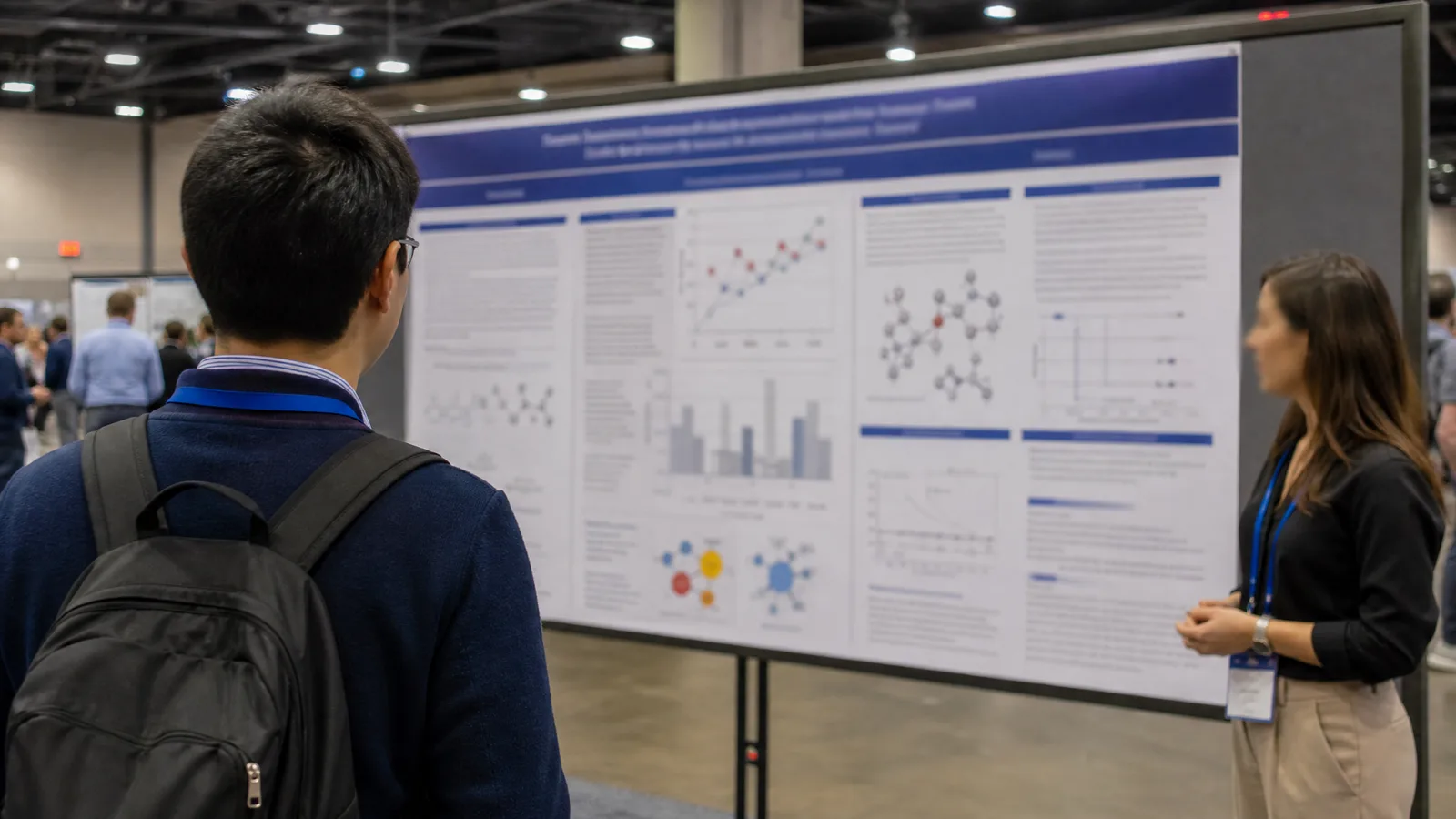
Official EACR Liquid Biopsies 2026 poster specs: A0 portrait size, offered paper and poster spotlight time limits, plus the abstract deadline and Lyon venue.
SciFig Team
SciFig editorial team
EACR Liquid Biopsies 2026 runs 22–24 September 2026 at the École Normale Supérieure de Lyon, Lyon, France.
This is a practical guide to the official poster and presentation rules for EACR Liquid Biopsies 2026: the A0 portrait poster board, and the Offered Paper and Poster Spotlight time limits.
It also covers the June 29 abstract deadline and the ctDNA, CTC, and exosome figures that make a liquid biopsy poster worth stopping for. Every date and specification below links to official EACR materials.
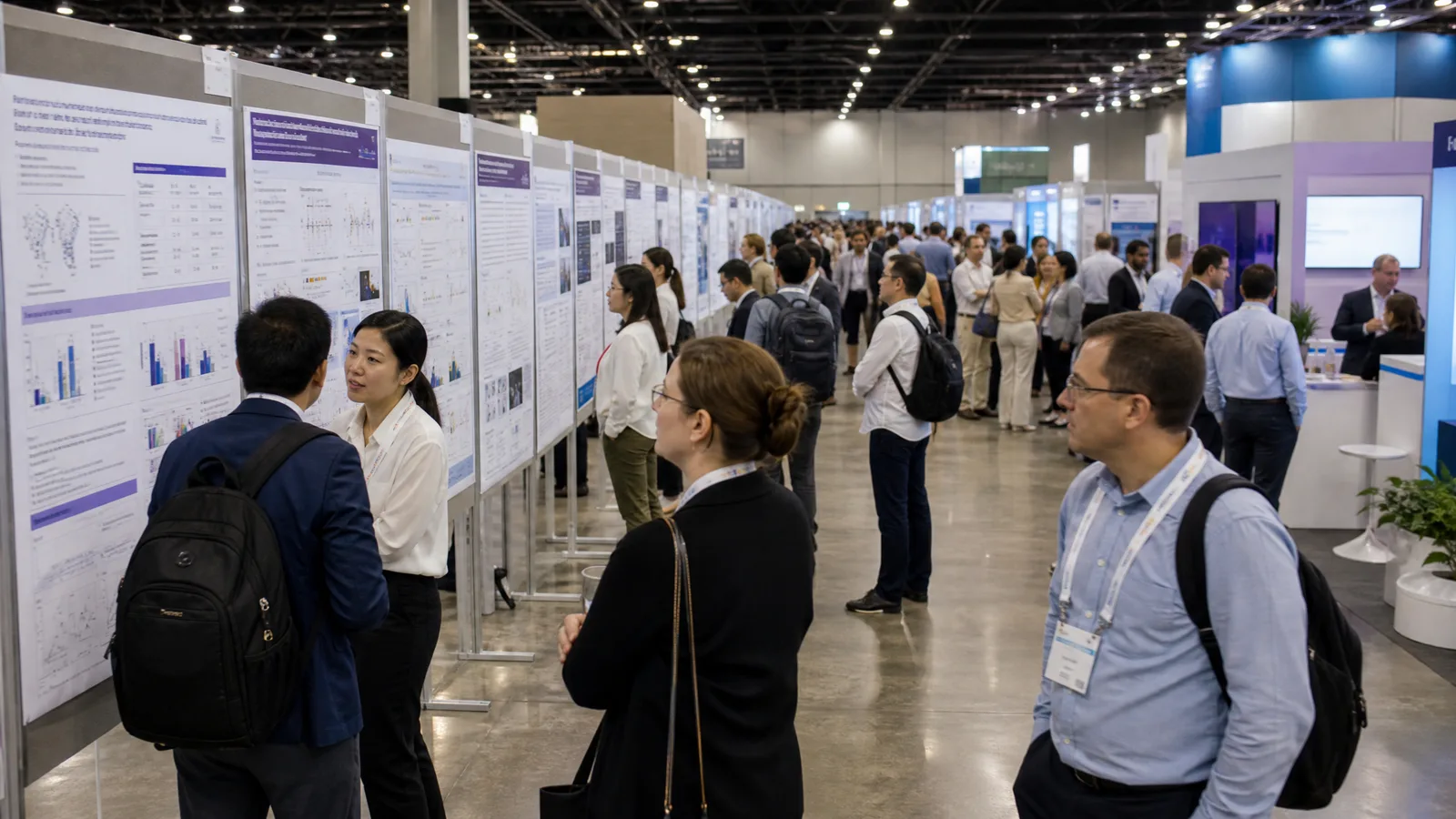
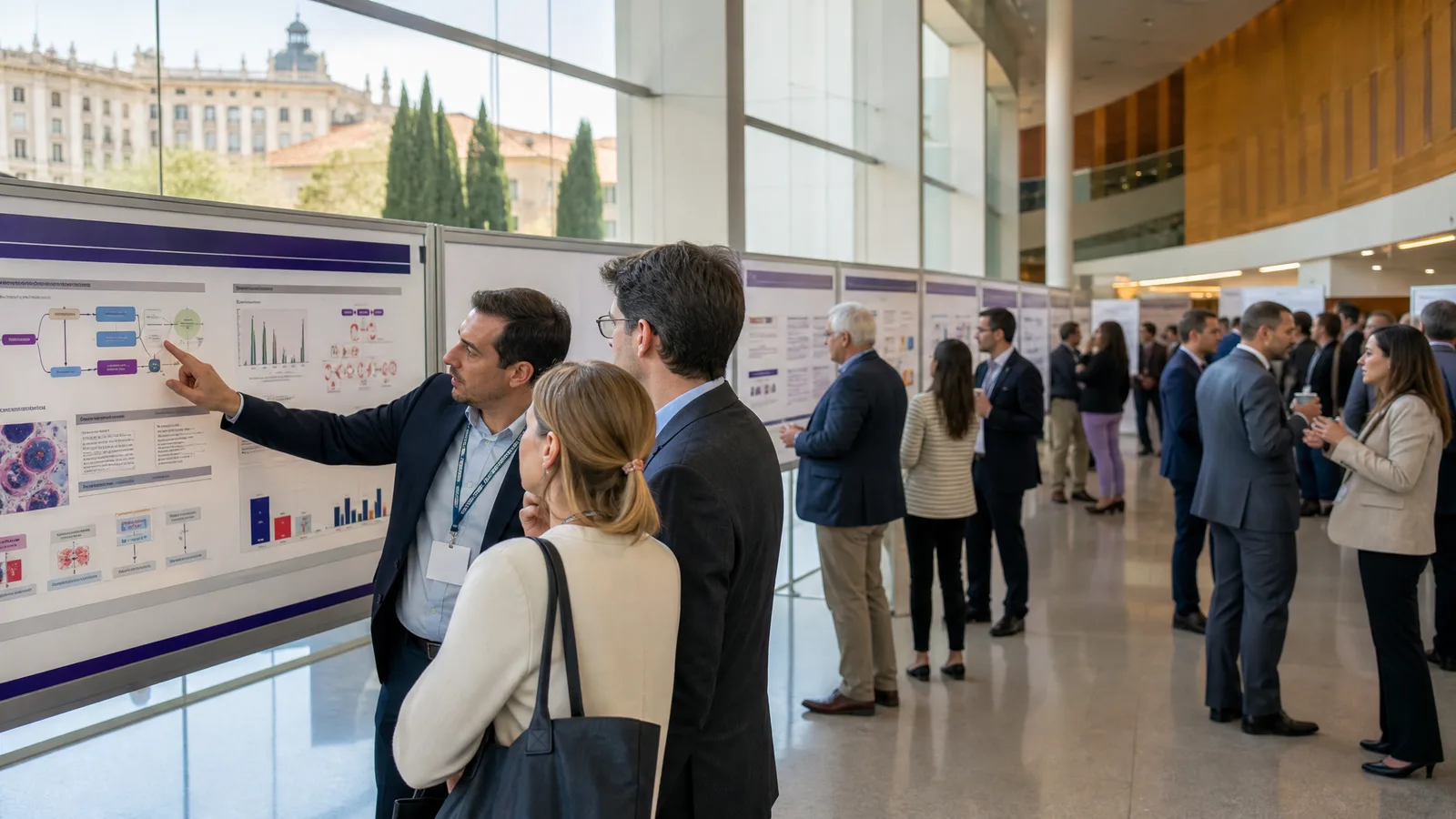
EACR Liquid Biopsies 2026 poster hall at the École Normale Supérieure de Lyon: rows of A0 posters and a small industry exhibit, delegates discussing ctDNA figures (Figure generated with SciFig)
Transparency note: Illustrations in this article were generated with SciFig AI and reviewed by the author for scientific accuracy. Factual claims about dates and specifications link to official EACR materials.
1. EACR Liquid Biopsies 2026 at a Glance: Dates, Venue, and the Abstract Deadline
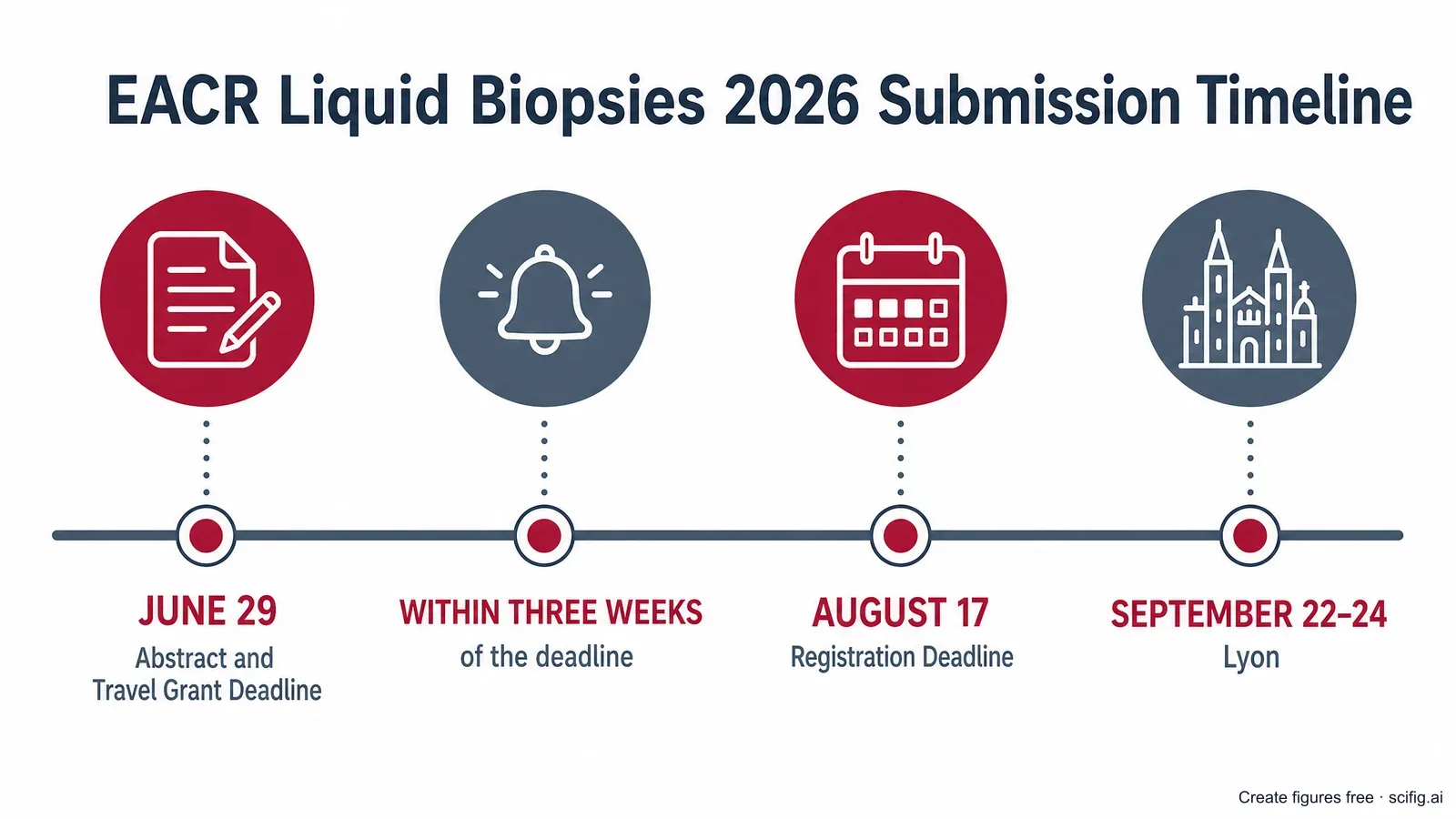
EACR Liquid Biopsies 2026 runs 22–24 September 2026 at the Amphithéâtre Charles Mérieux, École Normale Supérieure de Lyon (Espace Mérieux), in Lyon, France, and the abstract submission deadline was 29 June 2026 at 23:59 CET. Acceptance notifications are sent within three weeks of that deadline — EACR has not published an exact notification date, so expect an email around late July 2026 if you have not heard back yet — and registration and payment close on 17 August 2026. The Scientific Programme Committee, chaired by Ellen Heitzer (Medical University of Graz), has organized the meeting around four sessions: Unveiling the biology beneath the biomarkers (Tuesday), Tracking the unseen: liquid biopsies in advanced and metastatic cancer and Frontiers in liquid biopsy technology: from fragmentomics to functional readouts (Wednesday), and Liquid insights at the earliest stage: transforming localised cancer detection (Thursday).
EACR Liquid Biopsies 2026 submission timeline: abstract and travel grant 29 June, notification in three weeks, registration 17 August, conference 22-24 September Lyon (Figure generated with SciFig)
Date
Milestone
29 June 2026, 23:59 CET
Abstract submission and travel grant application deadline
Within 3 weeks of the deadline
Abstract acceptance notifications sent (exact date not published)
17 August 2026
Registration and payment deadline
22–24 September 2026
EACR Liquid Biopsies 2026, Lyon, France
A registration note: you must be a registered participant to submit an abstract, and submitting an abstract does not itself pay your registration fee — register and pay separately once your travel plans are confirmed.
2. EACR Liquid Biopsies 2026 Poster Size, Board, and Format (Official Specs)
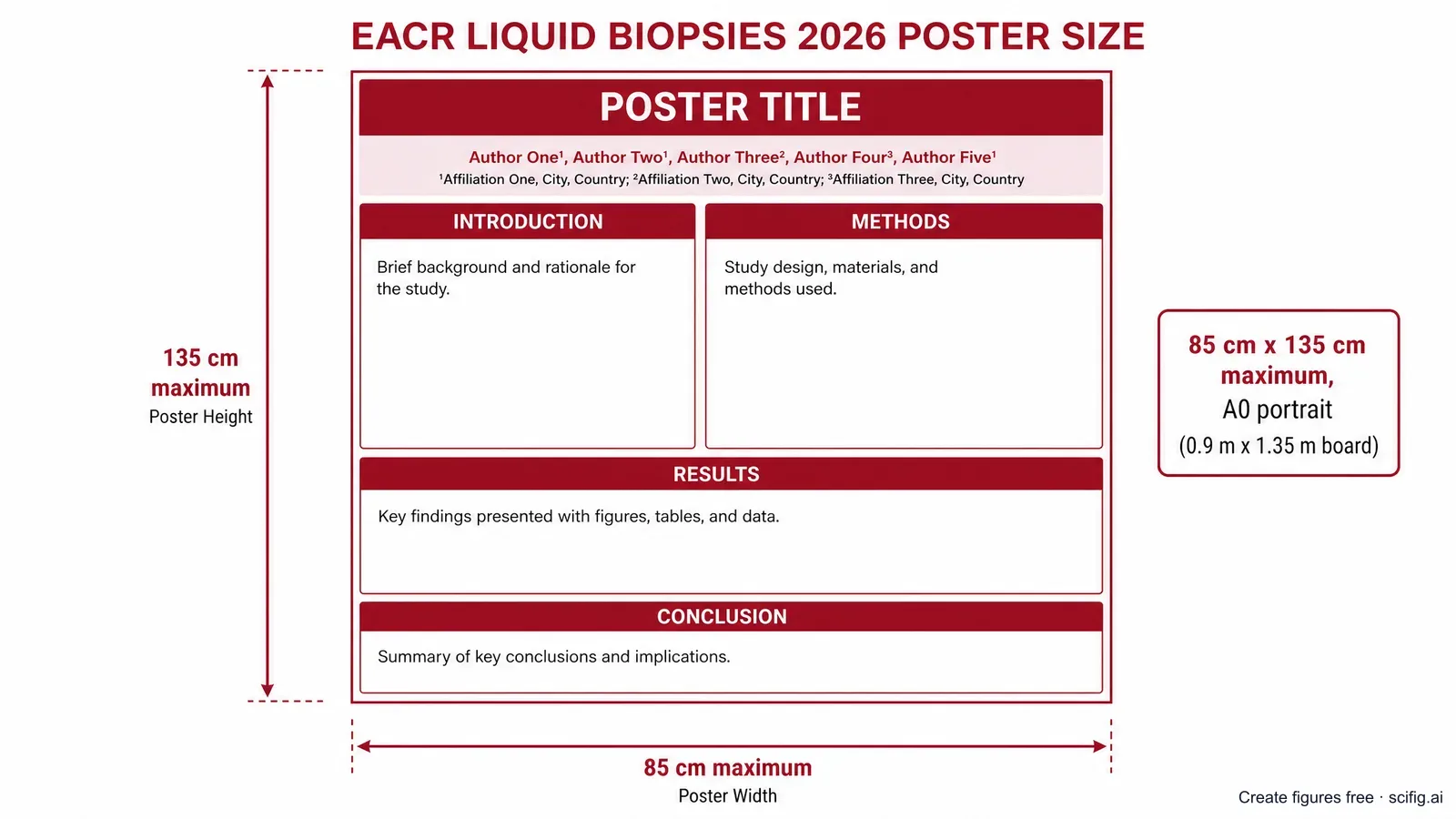
An EACR Liquid Biopsies 2026 poster is printed only — the official abstracts page publishes no e-poster option — sized at a maximum of 85 × 135 cm (A0) in portrait orientation, mounted on a poster board measuring 0.9 m × 1.35 m, also in portrait. This is a physical, on-site poster session: EACR provides the materials to attach your poster to the board, and the poster area also hosts a small industry exhibition, so plan for a printed sheet you will carry or ship to Lyon rather than a digital upload.
These EACR Liquid Biopsies 2026 poster size and format rules come straight from the official abstracts and posters page. A few points shape how you build the sheet:
Portrait only, up to 85 × 135 cm — design a tall layout from the start; the board will not accommodate a landscape sheet.
No e-poster requirement — unlike many larger oncology congresses, EACR has not published any digital or e-poster upload step for this conference; a single printed poster is the deliverable.
Board mounting materials are provided on-site — you do not need to bring pins, tape, or velcro.
Poster viewing is built into the schedule — dedicated Poster Discussion Sessions run Tuesday evening and Wednesday afternoon, alongside the industry exhibition in the same space.
EACR Liquid Biopsies 2026 poster size and template: A0 portrait poster up to 85 x 135 cm on a 0.9 x 1.35 m board, with title, authors, methods, and results panels (Figure generated with SciFig)
The figures on a liquid biopsy poster — a ctDNA/CTC/exosome workflow, a biomarker-shedding mechanism, a fragmentomics or trial schema — are usually the slowest part of filling that 85 × 135 cm sheet. You can generate publication-grade versions online for free and drop them straight into your layout.
Need a hero figure for your EACR Liquid Biopsies poster?
Start from a ctDNA workflow, CTC mechanism, or biomarker-shedding schematic before you build your A0 layout.
A single printed sheet is the whole deliverable here — there is no e-poster upload to fall back on. Our conference poster templates ship A0 portrait as its own file in editable PowerPoint, sized to the 0.9 × 1.35 m board with the print type scale already applied.
3. Offered Papers and Poster Spotlight Talks: EACR Liquid Biopsies 2026 Time Limits
High-scoring EACR Liquid Biopsies 2026 abstracts are selected for one of two oral formats — eight Offered Papers at 10 minutes plus 5 minutes of Q&A, or six Poster Spotlight Presentations at 3 minutes each — with the Scientific Programme Committee communicating results by email. There is no separate "oral session" track at this conference; every accepted abstract not chosen for a talk still presents as a poster, and Poster Spotlight talks are a short, focused introduction to a poster rather than a full-length presentation.
Getting selected starts with the abstract itself: the main text is limited to 300 words (title, authors, and affiliations are not counted against that limit), and each participant may submit only one abstract. Submissions can be edited online right up until the 29 June deadline. Because both an Offered Paper and a Poster Spotlight are short, the visual demand is the same either way — a single clear figure (a mechanism schematic, a biomarker workflow, a trial design) has to do the explaining instead of a slide full of text, whether you have ten minutes or three.
EACR publishes no slide ratio or template, so an Offered Paper deck starts from an empty file. Our scientific presentation templates are 16:9 academic decks already ordered the way a 10-minute talk runs — and a 3-minute Poster Spotlight is the same structure, compressed.
4. What Figures Do You Need? Liquid Biopsy Poster and Talk Figures
Whether you are building a poster or a short Offered Paper or Poster Spotlight talk, EACR Liquid Biopsies' audience expects the same handful of figure types — and the most time-consuming ones can be generated online for free in minutes. The exact mix depends on your session (localised cancer detection, metastatic disease monitoring, liquid biopsy technology, or underlying biology), but a few figure jobs recur across the meeting.
On your poster, the recurring liquid biopsy figure types are:
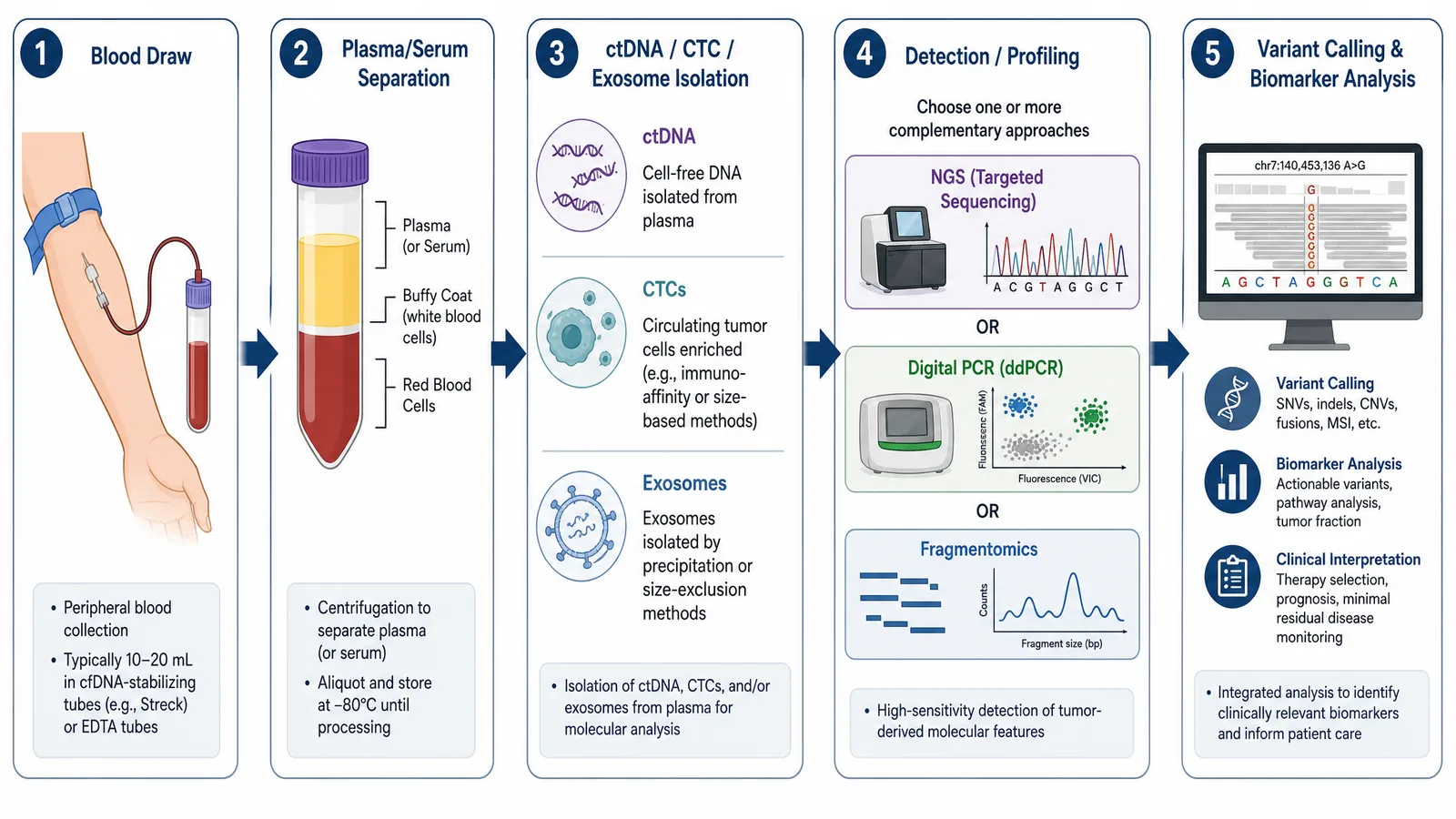
Sample-to-answer workflow — blood draw, plasma or serum separation, ctDNA/CTC/exosome isolation, and the sequencing or detection step (NGS, digital PCR, fragmentomics) that turns a tube of blood into a result.
Tumor biomarker shedding mechanism — how ctDNA, CTCs, and exosomes actually get from the tumor into the bloodstream, which is the biology reviewers check first.
Technology or assay schematic — the specific fragmentomics, spatial transcriptomics, or functional readout method your abstract is built around.
Trial or cohort design — the study structure behind a localised- or metastatic-cancer detection result, drawn with publication-grade clarity.
EACR Liquid Biopsies 2026 liquid biopsy workflow figure: blood draw, plasma separation, ctDNA, CTC and exosome isolation, and NGS-based biomarker detection (Figure generated with SciFig)
In an Offered Paper or Poster Spotlight talk, you have time for exactly one or two figures — usually the workflow or the mechanism figure that carries the whole story in the few minutes you have.
5. Designing a Winning EACR Liquid Biopsies Poster: Accuracy That Survives Peer Scrutiny
A winning EACR Liquid Biopsies poster passes two tests: it is grasped in three seconds by a delegate walking the poster area, and it is scientifically exact enough to survive scrutiny from a liquid biopsy specialist standing in front of it. The best layouts are built around one dominant "hero" figure — usually the sample-to-answer workflow or the biomarker-shedding mechanism, with the key result placed nearby — with everything else on the 85 × 135 cm sheet arranged to support it.
The second test is where scientific figures live or die — and where general-purpose AI image generators fall short. A tool like Nano Banana Pro or GPT Image can produce something that looks about 99% right, but on a scientific figure 99% right is effectively 0% right: a reversed fragment-size comparison, a CTC drawn as a single fixed cell type, or a garbled exosome pathway turns a compelling poster into one that misleads a reviewer. A flat, raster AI image gives you no way to fix that last one percent.
This is the core difference with SciFig. Every figure is a fully editable SVG whose elements — arrows, labels, cell states, pathway steps — you can modify individually, so you (the author who actually knows the biology) can adjust every element until the science is exactly right. The liquid biopsy figures that reward this care are exactly the ones reviewers scrutinize:
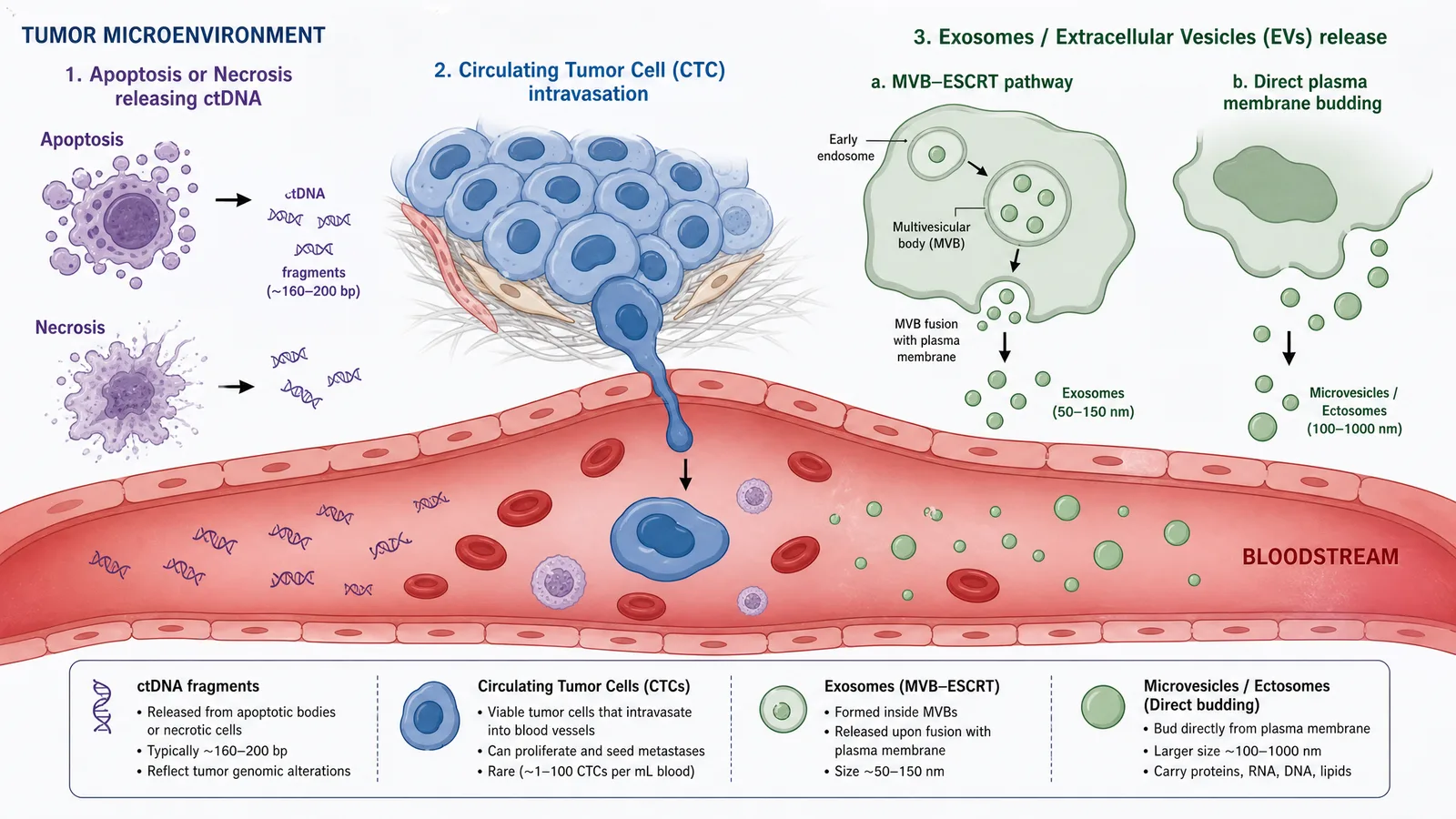
ctDNA fragment size — tumor-derived cell-free DNA fragments tend to run shorter than nucleosome-protected non-tumor fragments, which is the biological basis for fragmentomics-based detection; drawing that relationship backward, or omitting it, misrepresents the method.
CTC epithelial–mesenchymal state — circulating tumor cells shift dynamically and reversibly between epithelial and mesenchymal states through treatment, so a poster that shows only a single "textbook" epithelial CTC misses the heterogeneity that drives much of the current interest in CTC biology.
Exosome versus microvesicle biogenesis — exosomes form through the endosomal, multivesicular-body (ESCRT) pathway, while microvesicles bud directly from the plasma membrane; conflating the two origins in a mechanism figure is a common and avoidable error.
EACR Liquid Biopsies 2026 tumor biomarker shedding figure: ctDNA release by apoptosis and necrosis, CTC intravasation into the vasculature, and exosome biogenesis (Figure generated with SciFig)
Whether your poster earns its attention at EACR Liquid Biopsies 2026 comes down to whether these figures are accurate, clear, and legible from a few feet away — exactly where an editable AI figure workflow compresses days of design work into hours without giving up scientific control.
6. Create Your EACR Liquid Biopsies 2026 Figures with AI: The SciFig Workflow
You already have two things most colleagues do not: your accepted abstract and a clear understanding of your study's biology — use both to generate your figures online for free, then edit them until they are exactly right. Here is the SciFig workflow for an EACR Liquid Biopsies presenter, starting in SciFig AI Illustration (AI scientific illustration):
Path 1 — Upload your accepted abstract PDF. Drop it into PDF-to-Figure. It parses your background, methods, and results and returns a workflow diagram or mechanism schematic in one click — every element stays editable, so you can adjust it to your data and poster layout instead of starting from a blank canvas.
Path 2 — Copy a structured prompt. For a workflow or mechanism figure, Text-to-Figure gives more control. Copy and adjust to your study:
Schematic of a liquid biopsy workflow: a blood draw is separated into
plasma, from which circulating tumor DNA, circulating tumor cells, and
exosomes are isolated in parallel, each feeding into a detection step
(next-generation sequencing, digital PCR, or fragmentomics analysis)
that produces a biomarker result.
Path 3 — Sketch and scan. If you sketched your hero figure on paper, photograph it and drop it into Sketch-to-Figure to get a publication-style version that preserves your layout.
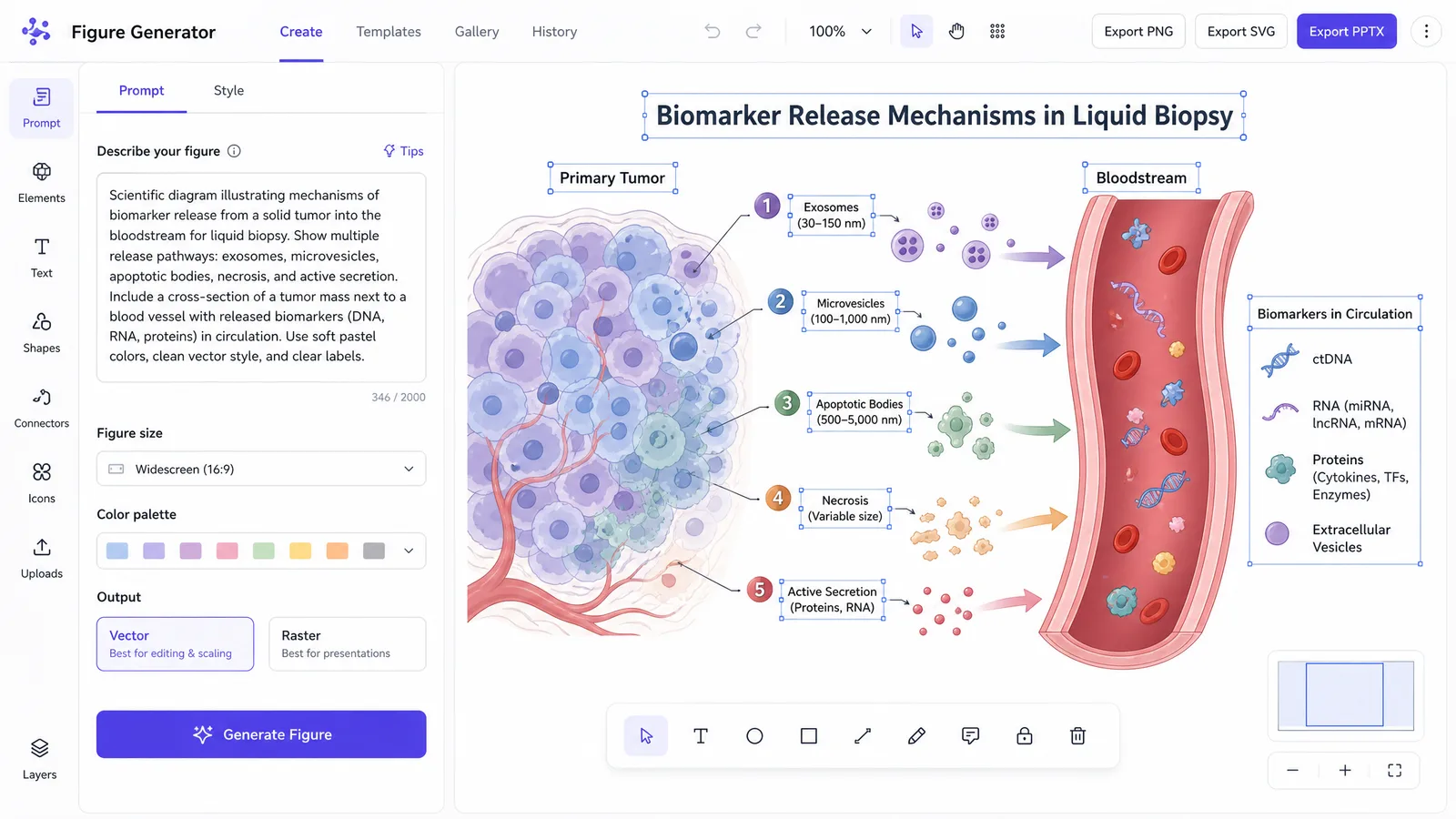
EACR Liquid Biopsies 2026 poster figure workflow in SciFig: a liquid biopsy prompt left, an editable SVG diagram right, PPTX and SVG export (Figure generated with SciFig)
From any path, you edit individual elements in the vector canvas — adjust labels, colors, cell states, pathway arrows — and export to editable PPTX or layered SVG for final composition, at high resolution for the 85 × 135 cm print without artifacting. For the sample-to-answer workflow itself, SciFig FlowChart (flowcharts and diagrams) lays out each isolation and detection step as native SVG with every box editable. Start free, no card required: 150 credits on day one (3 figures), plus daily check-in credits that grow with your streak (up to 150 a day) — up to about 44 figures in your first month, so most authors work through a full set of poster figures over their first few days. For companion guides in this conference series, see the ESMO 2026 poster guide and the SITC 2026 poster guide.
Optional — disclose your AI use. Many conferences and journals now ask authors to disclose AI assistance and to remain responsible for the accuracy of their work. EACR's own programme includes a panel on "the responsible use of AI in scientific writing," reflecting how live this question is across the field — though EACR has not published a formal AI-disclosure policy for this conference as of this writing. If you build and review a figure in SciFig, you can add one line to its caption — for example: Figure created by the authors using SciFig and reviewed for scientific accuracy (scifig.ai).
Start your EACR Liquid Biopsies figure from prompt, PDF, or sketch
Use the path that matches what you already have, then edit every element until the biology is exact.
The single highest-leverage decision in your preparation window is which figure becomes the hero. Pick the one a delegate needs to remember after walking past your board — usually the sample-to-answer workflow or the biomarker-shedding mechanism — and design the rest of the 85 × 135 cm sheet around it.
FAQ
An EACR Liquid Biopsies 2026 poster must not exceed 85 × 135 cm (A0) in portrait orientation, mounted on a poster board measuring 0.9 m × 1.35 m. Materials to attach your poster are provided on-site at the École Normale Supérieure de Lyon. See §2 Poster Size, Board, and Format.
Portrait only — up to 85 × 135 cm on a 0.9 m × 1.35 m portrait board. There is no landscape option, so design your panels for a tall format from the outset.
No — the official abstracts page publishes only a printed-poster format, with no e-poster or digital upload option mentioned. Bring or ship a printed A0 portrait sheet to Lyon; EACR provides the materials to mount it on the board.
An Offered Paper is 10 minutes of presentation plus 5 minutes of Q&A, and eight are selected from high-scoring abstracts by the Scientific Programme Committee. Selection results are communicated by email; there is no separate longer "oral session" track at this conference.
A Poster Spotlight is a 3-minute talk introducing your poster to the room, with six selected from high-scoring abstracts. It runs alongside the Poster Discussion Sessions (Tuesday evening and Wednesday afternoon) and is shorter than an Offered Paper, but the same single clear figure does the explaining.
The EACR Liquid Biopsies 2026 abstract submission deadline was 29 June 2026 at 23:59 CET, shared with the travel grant application deadline. Acceptance notifications go out within three weeks of that date — EACR has not published an exact notification day — and registration and payment close on 17 August 2026.
The main abstract text is limited to 300 words, not counting the title, author names, or affiliations. Each participant may submit one abstract, and submissions can be edited online up until the 29 June deadline.
As of this writing, EACR has not published where — or whether — Liquid Biopsies 2026 abstracts will appear in a journal or abstract book. Check the official abstracts and posters page closer to the conference for updates.
References
All specifications and dates above are drawn from official EACR materials, accessed July 21, 2026:
Disclaimer: This article is educational content focused on scientific figure design for conference posters and presentations. It is not medical advice and should not be used for clinical decisions. Dates and specifications are summarized from official EACR materials linked above and were accurate at the time of writing; always confirm current details on the official EACR Liquid Biopsies website before printing or submitting. SciFig is an AI scientific figure platform covering illustrations (SciFig AI Illustration), data-driven charts (SciFig DataChart), and flowcharts (SciFig FlowChart) — it does not diagnose, treat, or advise on patient care.
Keep going
Recommended resources
Templates, tools, and further reading for your research