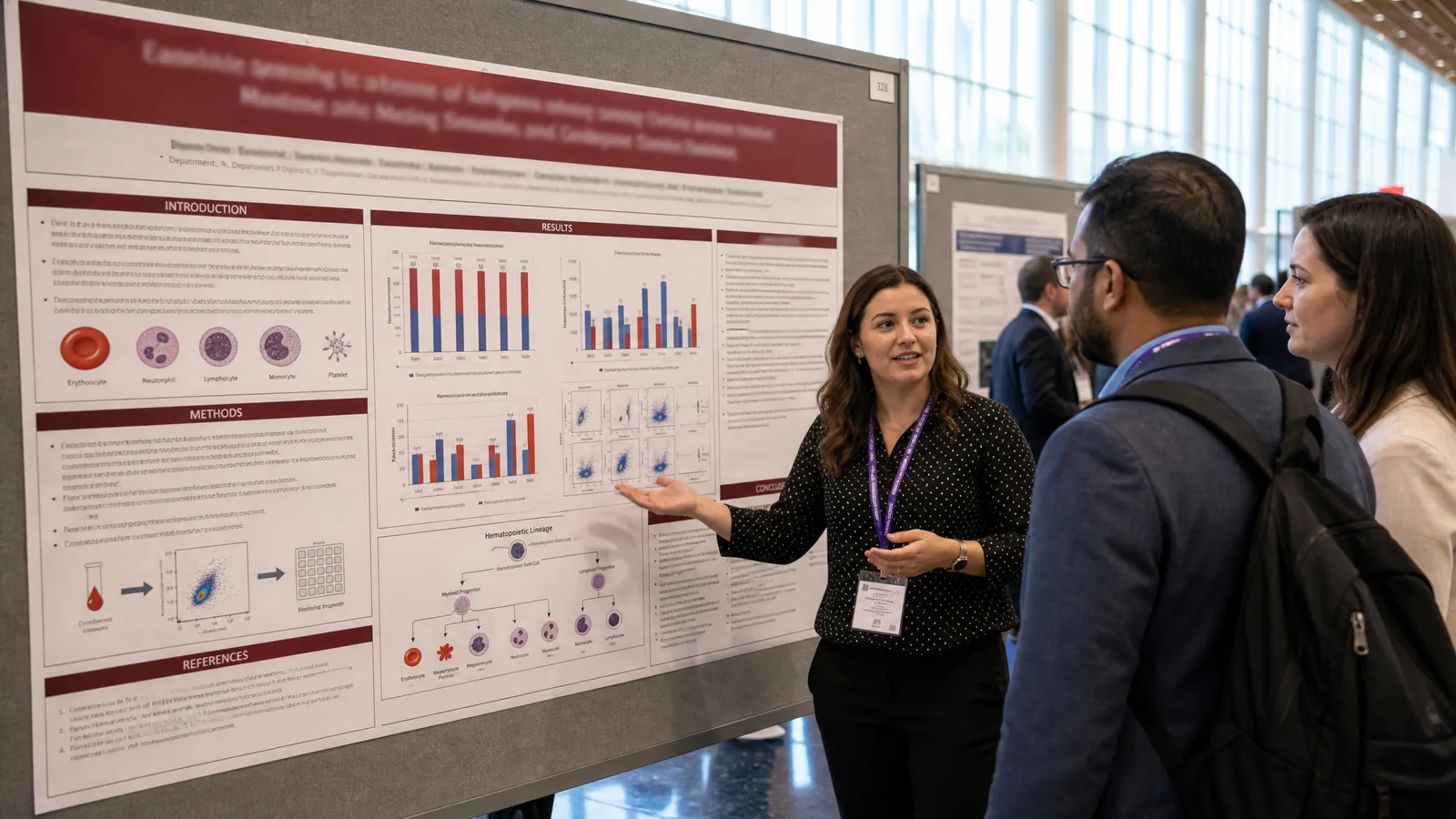
Official AAPS PharmSci 360 2026 e-poster guidelines: Oct 25-28 New Orleans dates, 100% electronic posters, 8 templates, and the Oct 14 upload deadline.
SciFig Team
SciFig editorial team
AAPS PharmSci 360 2026 runs October 25–28, 2026 at the Ernest N. Morial Convention Center in New Orleans.
This is a practical guide to the official poster rules for the American Association of Pharmaceutical Scientists' PharmSci 360 2026 Annual Meeting: why every poster is 100% electronic, the eight official PowerPoint templates and optional audio narration, the abstract submission timeline and format, and the pharmaceutical science figures — drug mechanism of action, PK/ADME, and drug-delivery schematics — that make a poster worth stopping for. Every date and specification below links to official AAPS materials.
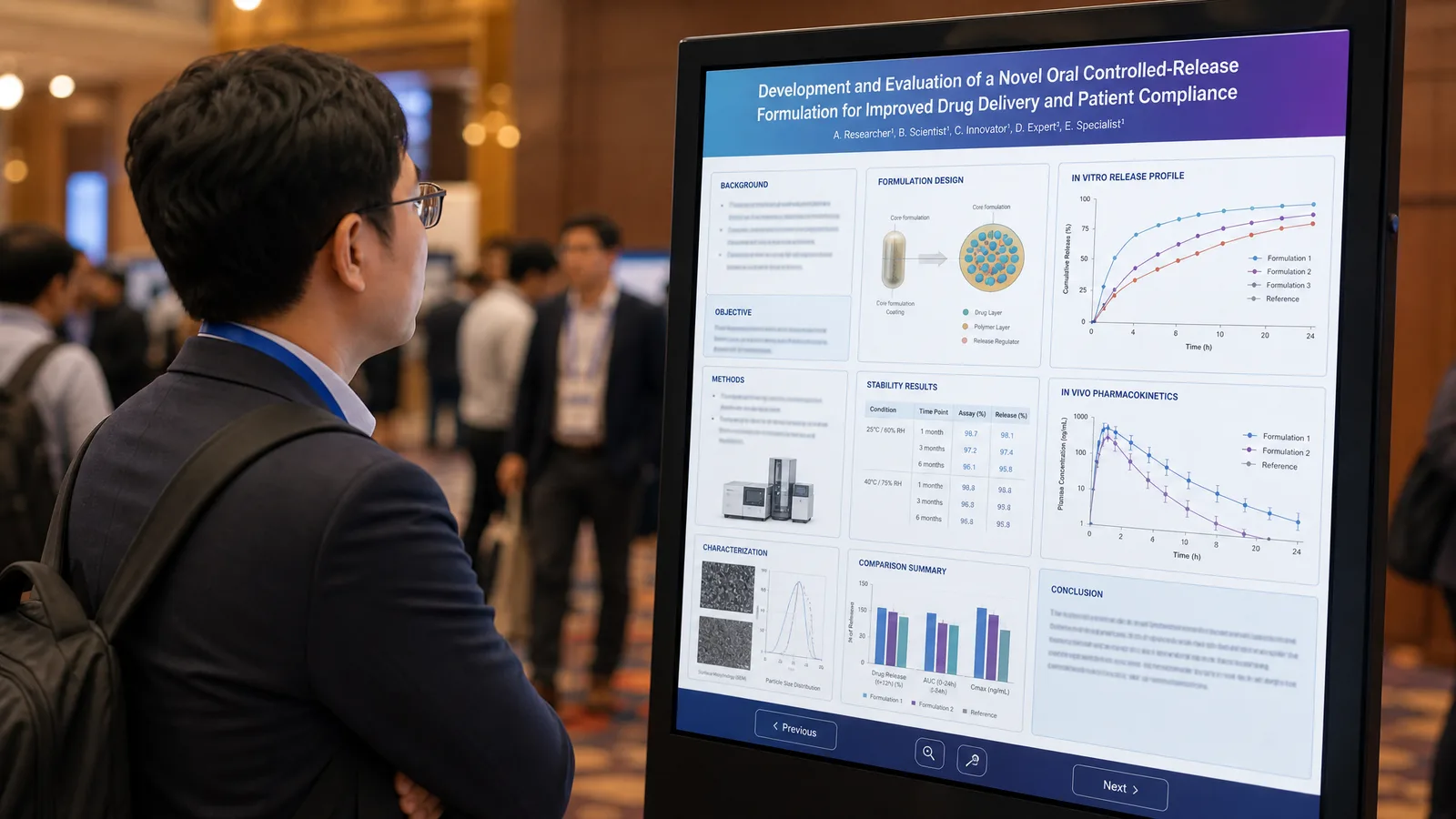
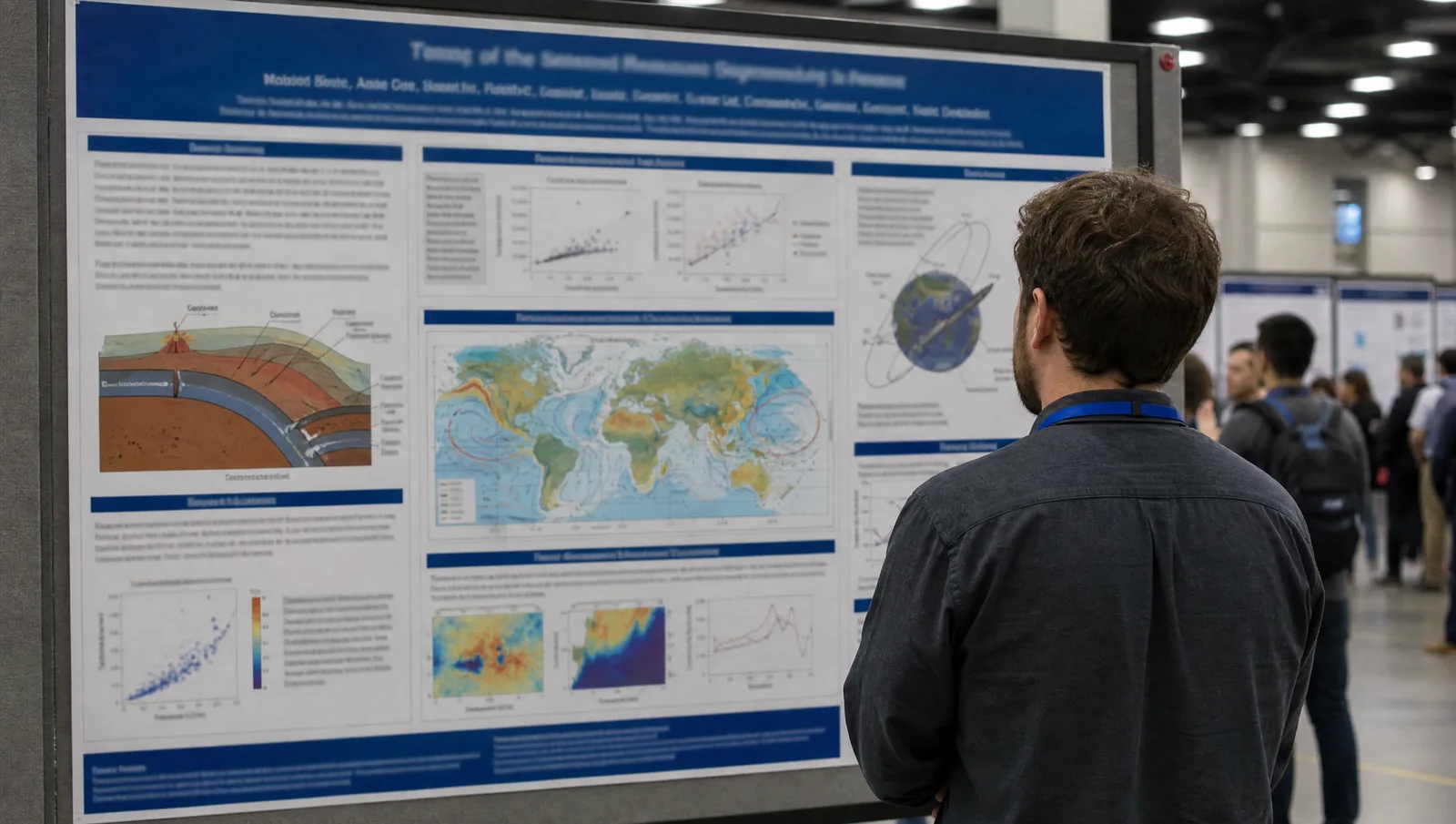
AAPS PharmSci 360 2026 e-poster kiosk session: an attendee viewing an electronic poster on a large digital screen with a title bar, author row, and figure panels (Figure generated with SciFig)
Transparency note: Illustrations in this article were generated with SciFig AI and reviewed by the author for scientific accuracy. Factual claims about dates and specifications link to official AAPS materials.
1. AAPS PharmSci 360 2026 at a Glance: Dates, Venue, and Key Deadlines
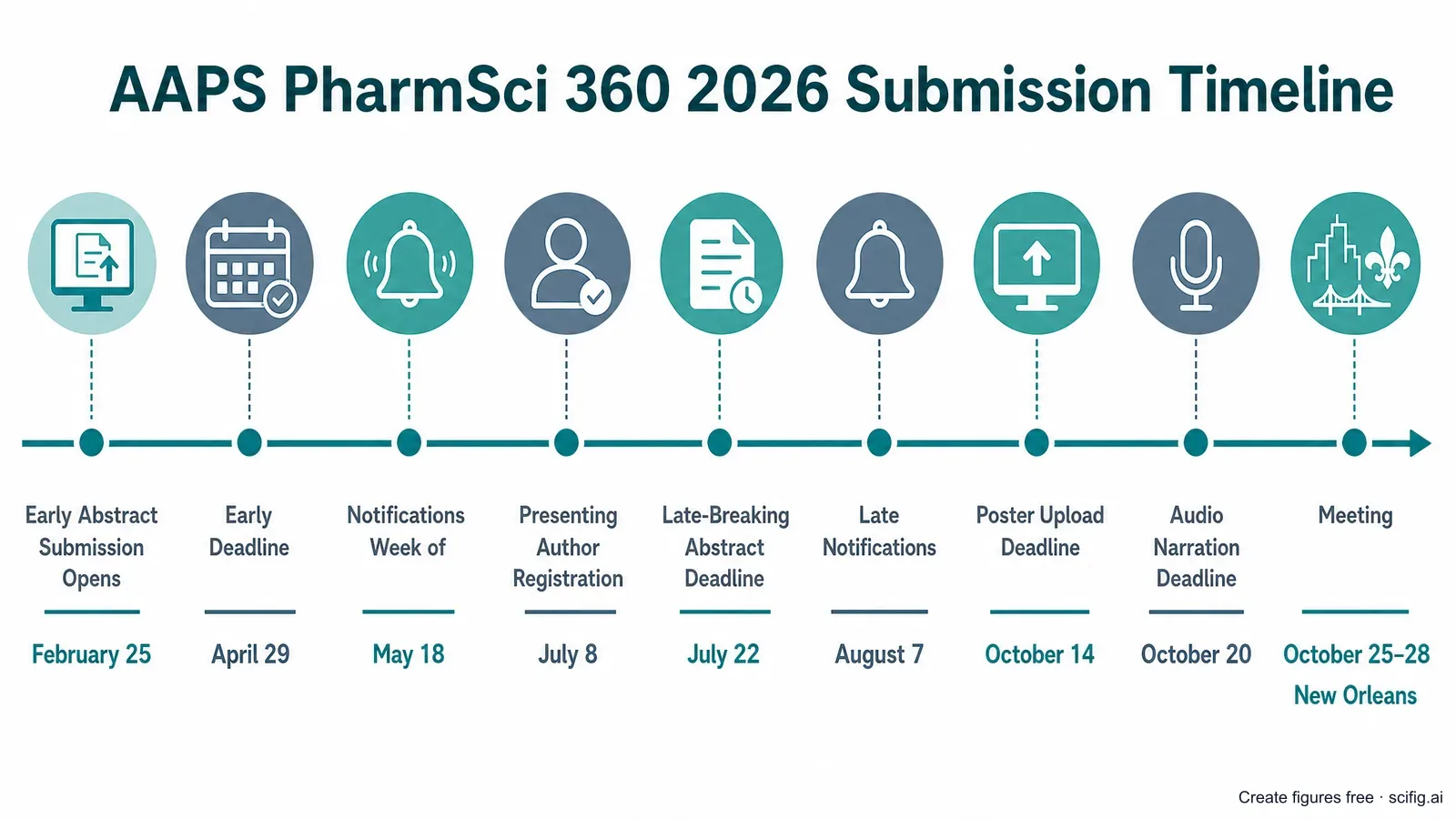
AAPS PharmSci 360 2026 runs October 25–28, 2026 at the Ernest N. Morial Convention Center in New Orleans, Louisiana, and the poster deadlines that matter most are the July 22 late-breaking abstract cutoff and the October 14 poster upload deadline. The meeting is organized around four scientific tracks — Preclinical and Translational Sciences, Bioanalytics, Manufacturing and Analytical Characterization, and Formulation and Delivery — and every accepted poster abstract is presented electronically rather than printed (more on that in §3).
AAPS PharmSci 360 2026 submission timeline: early submission April 29, notifications May 18, late-breaking July 22, upload October 14, meeting October 25-28 New Orleans (Figure generated with SciFig)
AAPS PharmSci 360 2026 Annual Meeting, New Orleans
A registration note: submitting an abstract does not register you for the meeting. The presenting author must register separately by the deadline above, so check the AAPS PharmSci 360 2026 registration rates once your abstract is accepted.
2. AAPS PharmSci 360 2026 Abstract Submission: Format, Tracks, and Timeline
An AAPS PharmSci 360 2026 poster abstract is a data-driven submission of up to 800 words across four fixed sections — Purpose, Methods, Results, and Conclusions — with a title of up to 200 characters, up to 13 authors, and 1 to 3 images in JPG format. Unlike some clinical-society meetings that ban figures from the abstract itself, AAPS explicitly wants your data: your abstract is scored by peer reviewers on the strength of its data and conclusions, so a clean chart or mechanism figure in your abstract JPGs is part of how you make that case. Abstracts must fall into one of four tracks: Preclinical and Translational Sciences, Bioanalytics, Manufacturing and Analytical Characterization, or Formulation and Delivery.
There is no separate oral or podium presentation track that individual poster abstracts get sorted into. AAPS runs a distinct "Programming" call — Symposia, Hot Topics, Rapid Fire, and Professional Advancement sessions — submitted separately by session organizers (2026 deadlines: April 8 for Symposia/Hot Topics/Professional Advancement, June 12 for Rapid Fire) rather than assigned to accepted poster abstracts. If you submit a poster abstract, the poster itself — described in §3 — is where your figures live.
Submission fees are per abstract and non-refundable: $50 (students/postdocs) or $100 (professionals) for early submissions, rising to $75 or $150 for late-breaking submissions. Full requirements are in the official AAPS PharmSci 360 call for poster abstracts.
3. AAPS PharmSci 360 2026 e-Poster: 100% Electronic, 8 PowerPoint Templates, and the Oct 14 Deadline
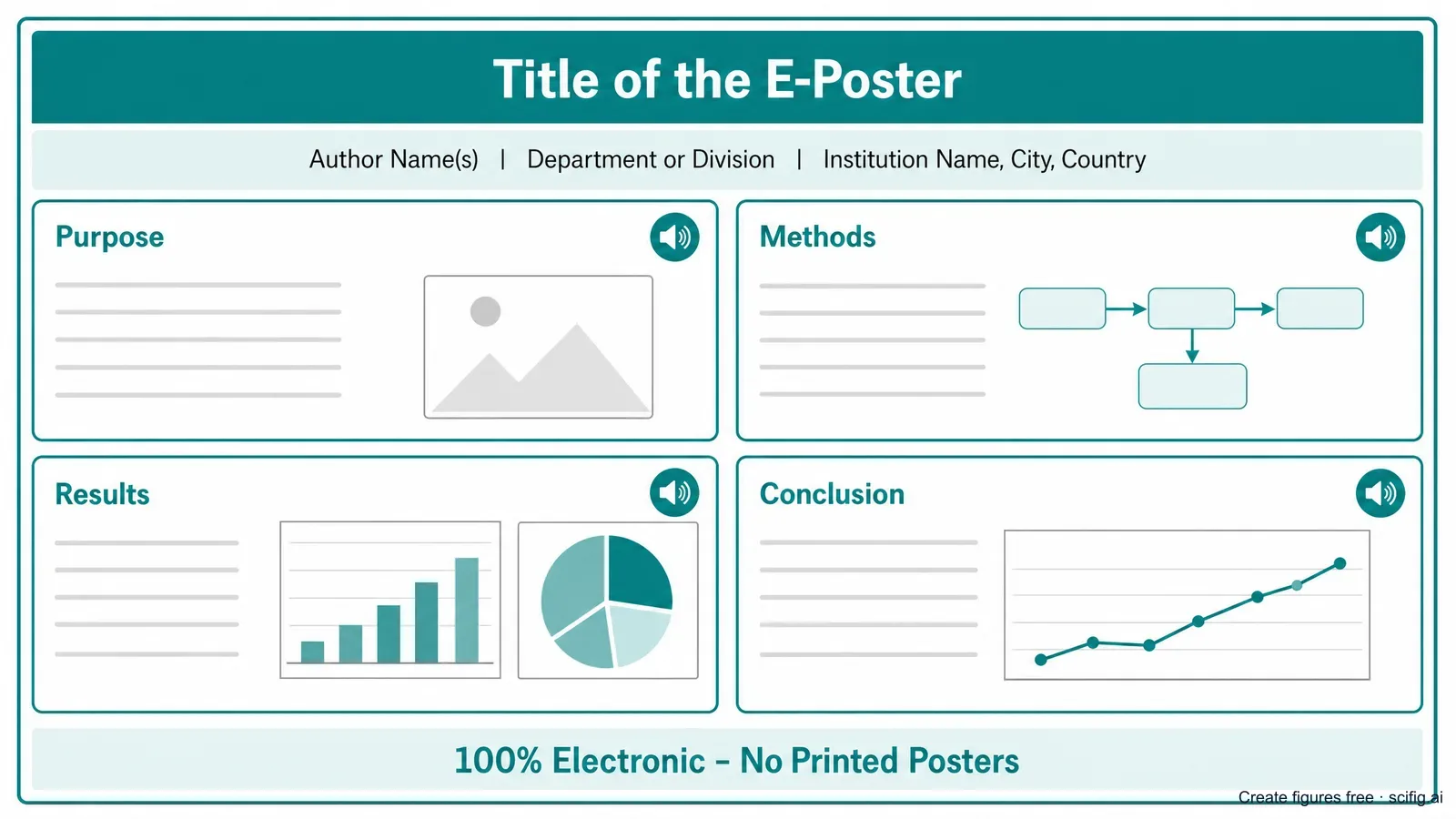
Every AAPS PharmSci 360 2026 poster is an electronic poster — there is no printed poster session, and authors must build their e-poster in one of eight official AAPS PowerPoint templates, uploaded by October 14, 2026. This is the single most important thing to know before you plan your submission: there is no board to print, ship, or mount. Instead, your finished PowerPoint file is processed into a viewable e-poster on AAPS' digital poster monitors and virtual platform.
Once your e-poster is processed, you can optionally add audio narration to each section — Purpose, Methods, Results, Conclusion, Title, Acknowledgements — recorded live through an online microphone tool (pre-recorded files are not accepted). Each section's narration is capped at 4 minutes, with one narration per section, and all narrations must be completed by October 20, 2026. These rules come from the official AAPS 2026 Abstracts & Posters page and the ePoster upload and audio narration FAQ.
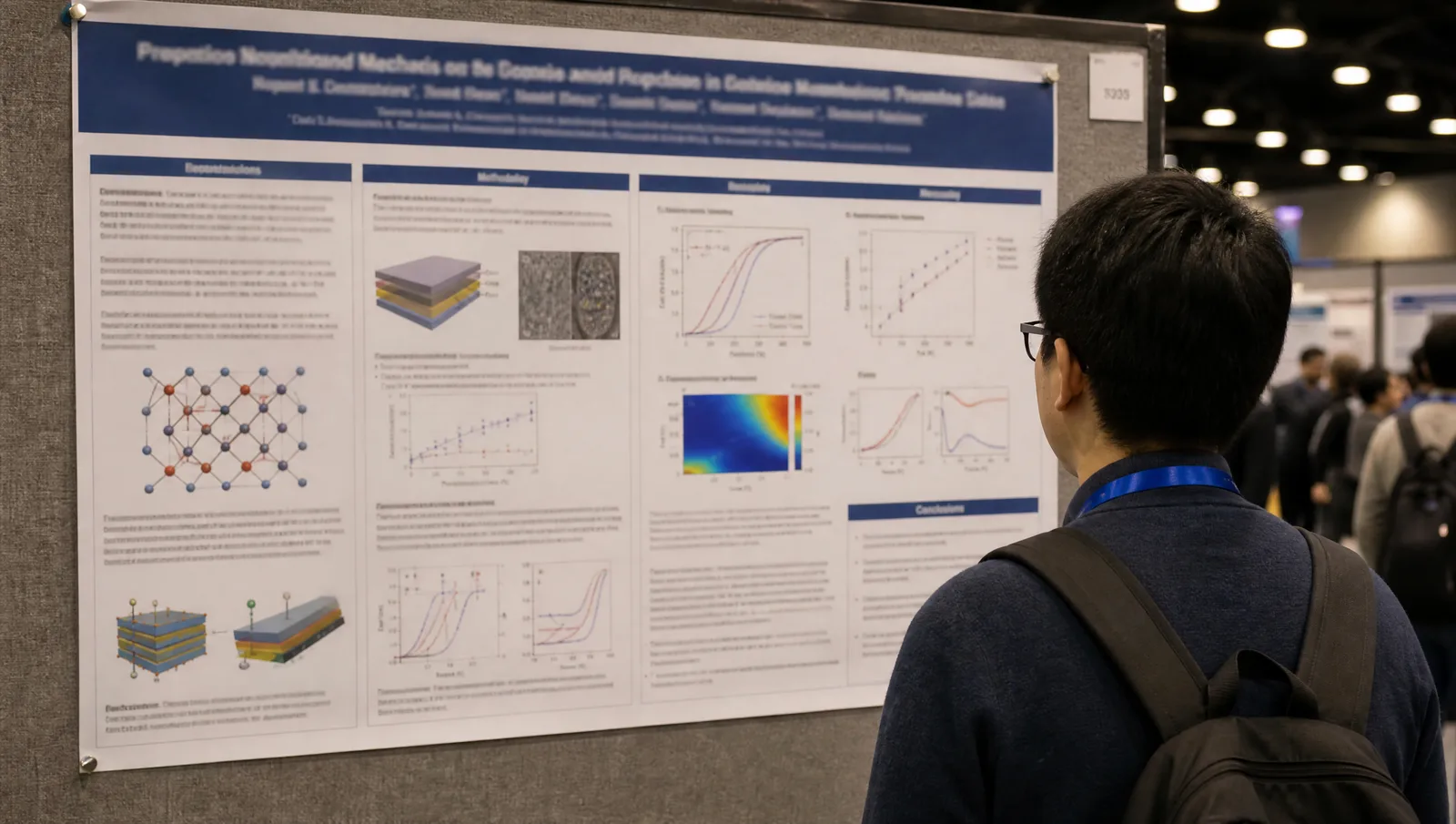
AAPS PharmSci 360 2026 e-poster template: title bar, author row, Purpose/Methods/Results/Conclusion panels, labeled '100% Electronic - No Printed Posters' (Figure generated with SciFig)
A few points shape how you build the file inside AAPS' template:
Design for a screen, not a hallway — e-poster viewers zoom in on a monitor or laptop rather than standing a meter from a printed board, so vector-style figures stay legible in a way that low-resolution photos or scans do not.
Build your figures before you touch the template — since the template locks the layout, the fastest path is to generate your mechanism or drug-delivery figure first, then drop it into the panel.
Plan the narration script alongside the figure — a 4-minute audio limit per section forces you to explain the figure in the same order you built it, so scripting narration and finalizing the figure together saves rework.
Need a hero figure for your AAPS e-poster?
Start from a drug mechanism, PK/ADME schematic, or drug-delivery diagram before you open your PowerPoint template.
4. What Figures Do You Need? Poster and Abstract Figures for PharmSci 360
Whether you are filling out your abstract's 1-to-3 image allowance or building the results panel of your e-poster, AAPS' pharmaceutical science audience expects a handful of recurring figure types — and the most time-consuming ones can be generated online for free in minutes. The exact mix depends on your track, but two figure types recur across Preclinical/Translational, Bioanalytics, Manufacturing, and Formulation and Delivery submissions alike.
In your abstract, remember that AAPS explicitly wants data, charts, and graphs — up to three JPG images are part of the submission, not an afterthought. A clean mechanism or schematic figure here helps a screener judge novelty and rigor at a glance, before they reach your results text.
On your e-poster, the recurring pharmaceutical science figure types are:
Drug mechanism of action (MOA) — how a small molecule or biologic engages its receptor or enzyme target and what downstream effect follows. The figure that carries a Preclinical, Clinical, and Translational Sciences poster.
PK/ADME schematic — the absorption, distribution, metabolism, and excretion pathway your data actually measured, drawn so the route of administration and the step your study focuses on are unambiguous.
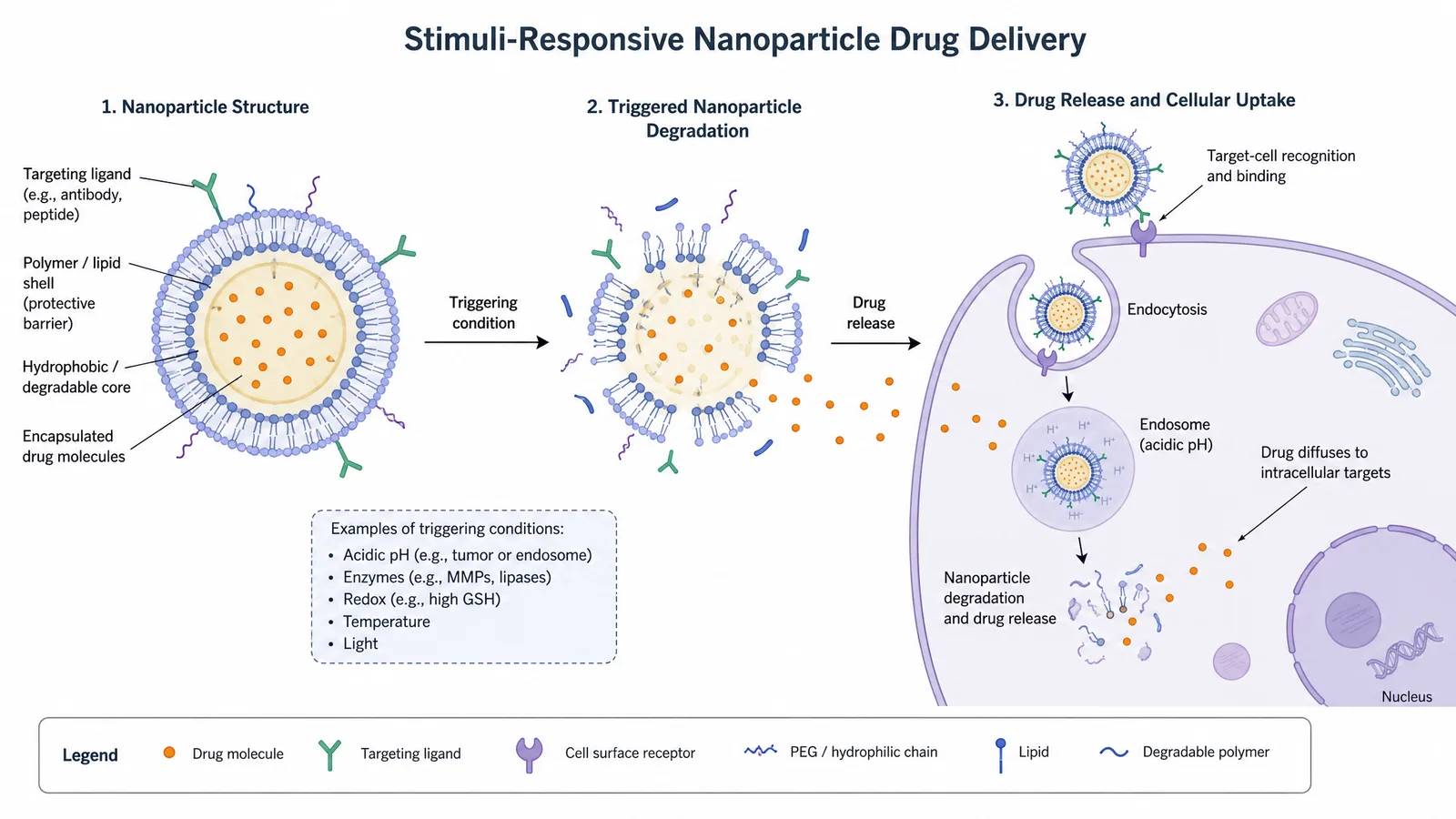
Drug-delivery system mechanism — a nanoparticle, liposome, or sustained-release matrix, with its core-shell structure and release trigger (diffusion, erosion, or a stimulus like pH or enzyme activity) shown clearly. Central to Formulation and Delivery submissions.
Bioanalytical assay or manufacturing process schematic — the analytical workflow or unit-operation sequence behind your data, drawn with the same clarity you'd want in a methods figure.
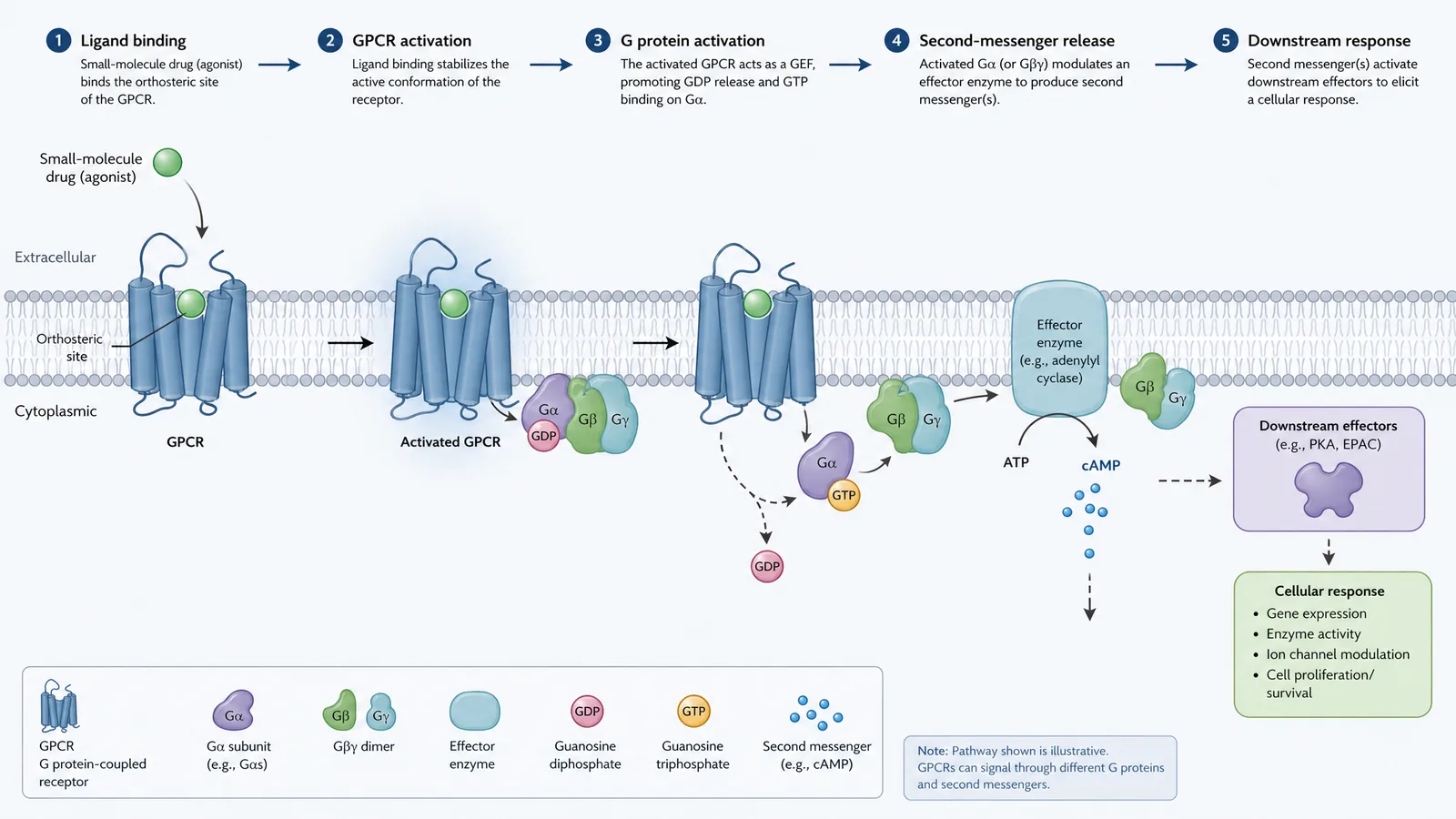
AAPS PharmSci 360 2026 drug receptor mechanism figure: a small-molecule drug binding the orthosteric site of a cell-membrane receptor, triggering a signaling cascade (Figure generated with SciFig)
5. Designing a Winning AAPS Poster: Accuracy That Survives Peer Scrutiny
A winning AAPS PharmSci 360 poster passes two tests: a screener grasps its novelty in seconds while scoring your abstract, and the mechanism figure is scientifically exact enough to survive scrutiny from a pharmaceutical scientist standing in front of the screen. AAPS abstracts are scored by peer reviewers on the strength of their data and conclusions — a mechanism figure that is technically wrong actively works against that scoring, because it makes your science look less rigorous than your data actually is.
This is where general-purpose AI image generators fall short. A tool like Nano Banana Pro or GPT Image can produce something that looks about 99% right, but on a pharmaceutical science figure 99% right is effectively 0% right: a reversed receptor interaction, an omitted metabolism step, or a mislabeled release trigger turns a compelling poster into one that misleads a reviewer. And a flat, raster AI image gives you no way to fix that last one percent.
This is the core difference with SciFig. Every figure is a fully editable SVG whose elements — arrows, labels, receptors, particles — you can modify individually, so every element stays editable and you (the author who actually knows the pharmacology) can adjust it until the science is exactly right. The pharmaceutical science figures that reward this care most are exactly the ones a screener or reviewer scrutinizes:
Drug receptor MOA — put the ligand at the correct binding site (orthosteric vs. allosteric), and show an antagonist blocking activation rather than triggering it — a commonly reversed pairing.
PK/ADME pathway — don't drop first-pass metabolism from an oral-route schematic when your data depends on it; the administration route must match the pathway you draw (NCBI StatPearls: Pharmacokinetics covers the ADME framework this figure type is built on).
Drug-delivery release mechanism — match the release trigger to your actual data: a pH- or enzyme-triggered release should not be drawn as simple passive diffusion, and the drug's location (encapsulated core vs. surface-adsorbed) needs to match your formulation (NIH/PMC: Nanomaterials in controlled drug release reviews how nanoparticle release mechanisms actually work).
AAPS PharmSci 360 2026 nanoparticle drug-delivery figure: a polymeric nanoparticle with an encapsulated drug core degrading under pH-triggered release into a target cell (Figure generated with SciFig)
Whether your AAPS PharmSci 360 2026 poster earns attention — and a Best Abstract or Best Poster Award consideration (see §7) — comes down to whether these figures are accurate, clear, and legible on a screen, which is exactly where an editable AI figure workflow compresses days of design work into hours without giving up scientific control.
6. Create Your AAPS 2026 Figures with AI: The SciFig Workflow
You already have two things most colleagues do not: your data and a clear understanding of your study's mechanism — use both to generate your scientific figures online for free, then edit them to exactly right. Here is the SciFig workflow for an AAPS PharmSci 360 presenter, starting in SciFig AI Illustration (AI scientific illustration):
Path 1 — Upload your accepted abstract PDF. Drop it into PDF-to-Figure. It parses your Purpose, Methods, and Results and returns a mechanism diagram in one click — every element stays editable, so you can adjust it to your data and poster layout instead of starting from a blank canvas.
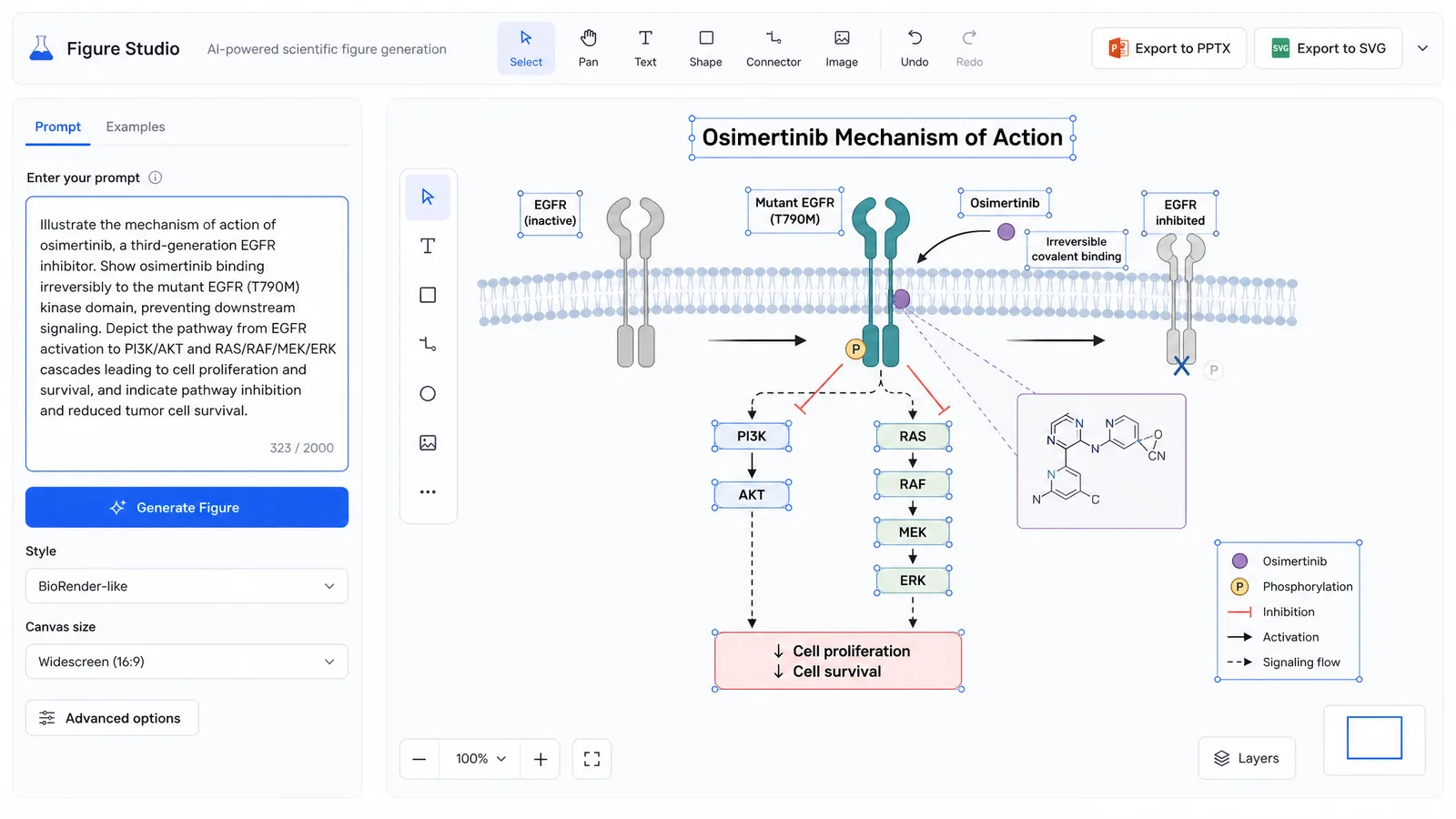
Path 2 — Copy a structured prompt. For a mechanism or delivery figure, Text-to-Figure gives more control. Copy and adjust to your study:
Schematic of the mechanism of action of osimertinib, a third-
generation EGFR inhibitor: osimertinib binding irreversibly to the
mutant EGFR (T790M) kinase domain, blocking downstream PI3K/AKT and
RAS/RAF/MEK/ERK signaling and reducing tumor-cell proliferation.
Path 3 — Sketch and scan. If you sketched your hero figure on paper, photograph it and drop it into Sketch-to-Figure to get a publication-style version that preserves your topology.
AAPS PharmSci 360 2026 poster figure workflow in SciFig: an osimertinib EGFR-inhibitor prompt left, editable SVG diagram right, PPTX and SVG export (Figure generated with SciFig)
From any path, you edit individual elements in the vector canvas — adjust labels, colors, receptor or particle placement — and export to editable PPTX or layered SVG, ready to drop directly into your AAPS PowerPoint e-poster template. For the charts in your abstract (AAPS allows up to three images), SciFig DataChart (data-driven charts) plots them precisely from your data table, with every axis, label, and colour editable. Start free, no card required: 150 credits on day one (3 figures), plus daily check-in credits that grow with your streak (up to 150 a day) — up to about 44 figures in your first month, so most authors work through a full set of poster and abstract figures over their first few days. For companion guides on other translational and mechanism-heavy meetings, see the ASH 2026 poster guide and the SITC 2026 poster guide.
Optional — disclose your AI use. If your institution, journal, or a future submission requires it, you can add one line to your figure caption — for example: Figure created by the authors using SciFig and reviewed for scientific accuracy (scifig.ai).
Start your AAPS figure from prompt, PDF, or sketch
Use the path that matches what you already have, then edit every element until the science is exact.
7. AAPS PharmSci 360 2026 Best Abstract & Best Poster Awards
Only early poster abstract submissions are eligible for AAPS' Best Abstract Award, which recognizes the top 10% of abstracts within a presenting author's category — graduate student, postdoctoral candidate, early-career academic or industrial scientist, or general AAPS member — as scored by the blind screening panel. To qualify, the presenting author must be an AAPS member at the time of submission and the single lead author of the abstract; late-breaking submissions are not eligible. A subset of Best Abstract Award recipients are then selected for the Best Poster Award, with both recognized via ribbons and signage during the meeting.
Because eligibility is decided at the abstract-screening stage — before you have even built your e-poster — the highest-leverage move is making sure your abstract's data, novelty, and conclusion read clearly in the same 800 words the screeners score. The figure you choose for your 1-to-3 image allowance is part of that first impression.
Tip
The single highest-leverage decision in your preparation window is which figure becomes the hero of your e-poster's results panel. Pick the one that best shows your mechanism or delivery system at a glance, and design the rest of your PowerPoint template around it.
8. Where to Find AAPS PharmSci 360 2026 Abstracts
As of July 21, 2026, AAPS has not published a dedicated abstract-book or journal supplement page for PharmSci 360 2026 — accepted abstracts are accessible through the official conference program platform rather than a standalone publication. This differs from societies like SITC or ASTRO, which publish accepted abstracts in a specific journal supplement; check the official AAPS PharmSci 360 program directly for the current abstract listing, and confirm any publication details there rather than assuming a journal supplement exists.
If a dedicated abstract publication page is announced closer to the meeting, this guide will be updated with the specific citation details.
Frequently Asked Questions
Every AAPS PharmSci 360 2026 poster is electronic — there is no printed poster session. Authors build their poster in one of eight official AAPS PowerPoint templates, which AAPS then processes into a viewable e-poster shown on digital poster monitors and the virtual platform. See §3.
AAPS provides eight official PowerPoint templates for the 2026 e-poster format. Authors must build their poster inside one of these templates rather than a freeform layout, per the official AAPS 2026 Abstracts & Posters page. See §3.
No — audio narration is encouraged but optional. If you add it, each poster section (Purpose, Methods, Results, Conclusion, Title, Acknowledgements) gets one narration, capped at 4 minutes, recorded live through an online microphone tool rather than uploaded as a pre-recorded file. All narrations must be completed by October 20, 2026. See §3.
The poster upload deadline for all accepted posters — both early and late-breaking submissions — is October 14, 2026. AAPS recommends uploading as soon as your file is complete, since e-poster processing takes time before optional narration can be added. See §3.
Yes — AAPS allows 1 to 3 images in JPG format in your abstract, and unlike some clinical-society meetings, AAPS explicitly wants data-driven charts and figures as part of the submission. See §2.
The late-breaking abstract (LBA) submission deadline is July 22, 2026 at 5pm ET, with notifications sent August 7, 2026 and presenting author registration due August 27, 2026 — all ahead of the October 14 poster upload deadline. See §1.
Only early poster abstract submissions qualify, and the presenting author must be an AAPS member at submission and the single lead author. Abstracts are ranked by the blind screening panel, with the top 10% in each presenter category recognized. See §7.
References
All specifications and dates above are drawn from official AAPS materials, accessed July 21, 2026:
Disclaimer: This article is educational content focused on scientific figure design for conference posters and presentations. It is not medical or clinical advice and should not be used to guide drug development, dosing, or regulatory decisions. Dates and specifications are summarized from official AAPS materials linked above and were accurate at the time of writing; always confirm current details on the official AAPS website before submitting or uploading. SciFig is an AI scientific figure platform covering illustrations (SciFig AI Illustration), data-driven charts (SciFig DataChart), and flowcharts (SciFig FlowChart) — it does not generate, validate, or interpret research data.
Keep going
Recommended resources
Templates, tools, and further reading for your research