
Biology Slides Template
A 23-slide biology research deck at 16:9 that comes with pathway and mechanism figures already in the file.
Reviewed by SciFig TeamUpdated
Each preview below is a separate PowerPoint file — click one to jump straight to its download.
What is a Biology Slides Template?
A biology slides template is a research talk deck for the life sciences.
Most of what is sold under that name is a color scheme — green slides with a helix in the corner — while the figures, which are what a biology talk lives or dies on, are left to you. This deck ships the other way round: the same five-section research structure as the rest of the range, plus cell signaling and pathway figures, lab icons and data figures already in the file.
Biology slides template structure, section by section
The biology deck ships in five sections — background, hypothesis, methods, results, discussion — plus front matter.
This is the order the file ships in — the same five-section research spine as the conference deck, with biology example copy in the placeholders.
| Section | Slides in the file | What it is for |
|---|---|---|
| Front matter | Title, color-change tip, table of contents, funding and disclosures | Identity and the compliance slides many societies check |
| I · Research background | Introduction, one figure one message, knowledge gap | Where the pathway or system sits in the field |
| II · Hypothesis and objectives | The testable claim, research objectives | The question, stated in one sentence |
| III · Methodology | Study design and methods, experiment timeline | Model system, sample size, and what ran when |
| IV · Results | Result 1, result 2, summary of findings table | The core of the talk |
| V · Discussion and next steps | What the results mean, troubleshooting, remaining questions | What it changes, and what is still open |
| Back matter | References, acknowledgements, a resource section (one index slide plus three slides of ready-made figures) | Credit, sources, and the figure set below |
Biology research presentation template: the figures are the point
The reason a biology deck is worth having separately is not the color.
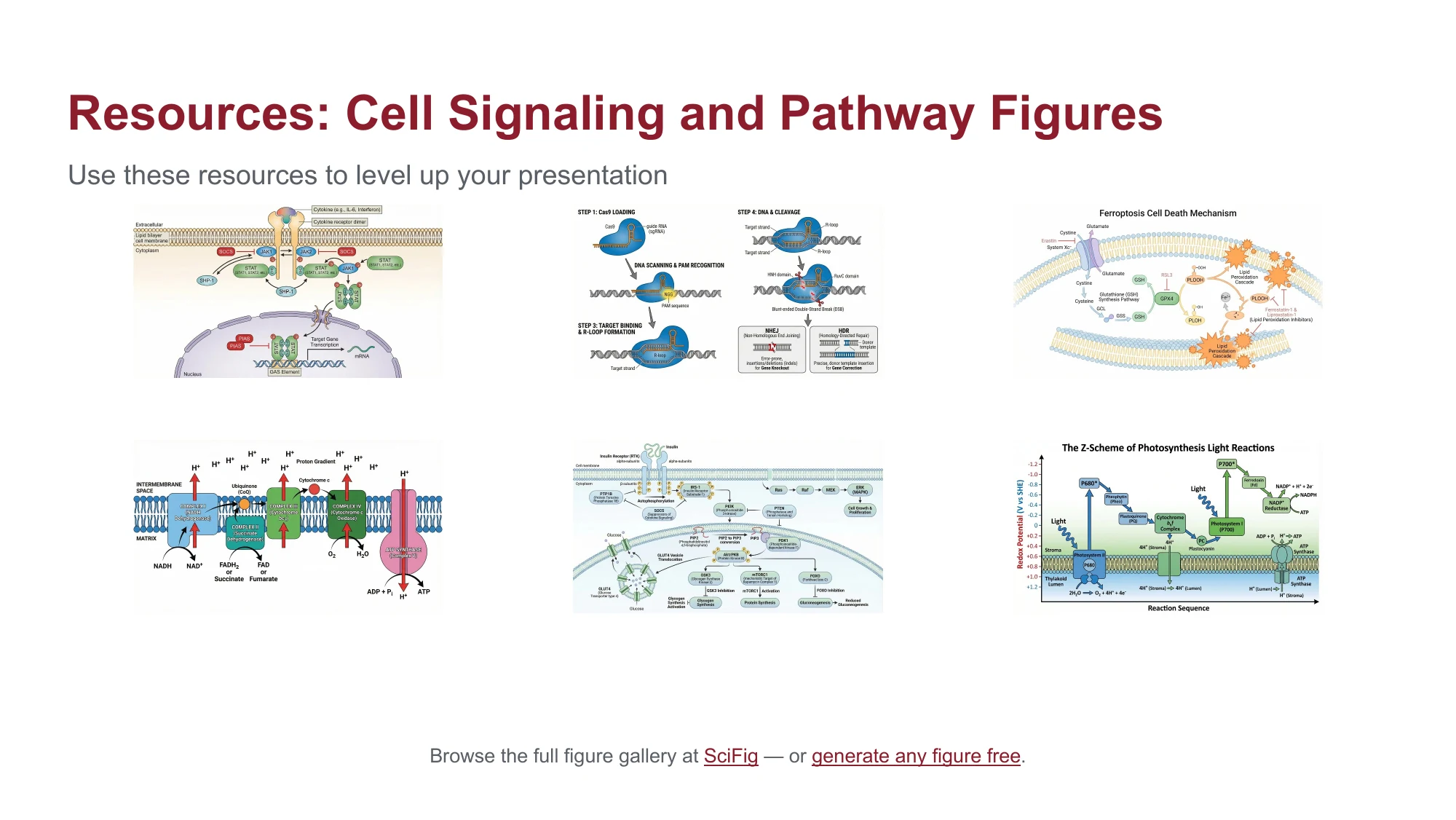
It is that a life science talk is carried by three or four figures, and building those is where the evening goes. This deck ends with three resource slides you can pull from directly: lab equipment and consumables, data and analysis figures, and a cell signaling and pathway set. They are editable objects in the file, not flattened images.
Pathway and mechanism diagrams
the single most common figure in a molecular or cell biology talk, and the one that takes longest to draw by hand.
Experimental schematics
what was done to what, in what order. A schematic answers the methods question faster than the methods slide does.
Lab equipment and consumables
plates, gels, columns and instruments, for showing a workflow without photographing your bench.
Data and analysis figures
the chart forms that recur across life science results, already styled to match the deck.
Anything missing you can generate: the figure placeholders are sized for SciFig output, so a described pathway comes back at the right proportions and drops into the slot.
How to level up your biology presentation with figures
Seven of the 23 slides carry a figure, and in a life science talk the figures are most of the talk.
The template already lays out where the figures go: each section has a slide built to carry its point visually. A picture lands where a paragraph does not — it is what the room remembers, and the only thing people can point back at during questions. Decide what kind of figure belongs in each slot, and for anything you do not have yet, describe it to the Scientific Figure Generator and drop the result in.
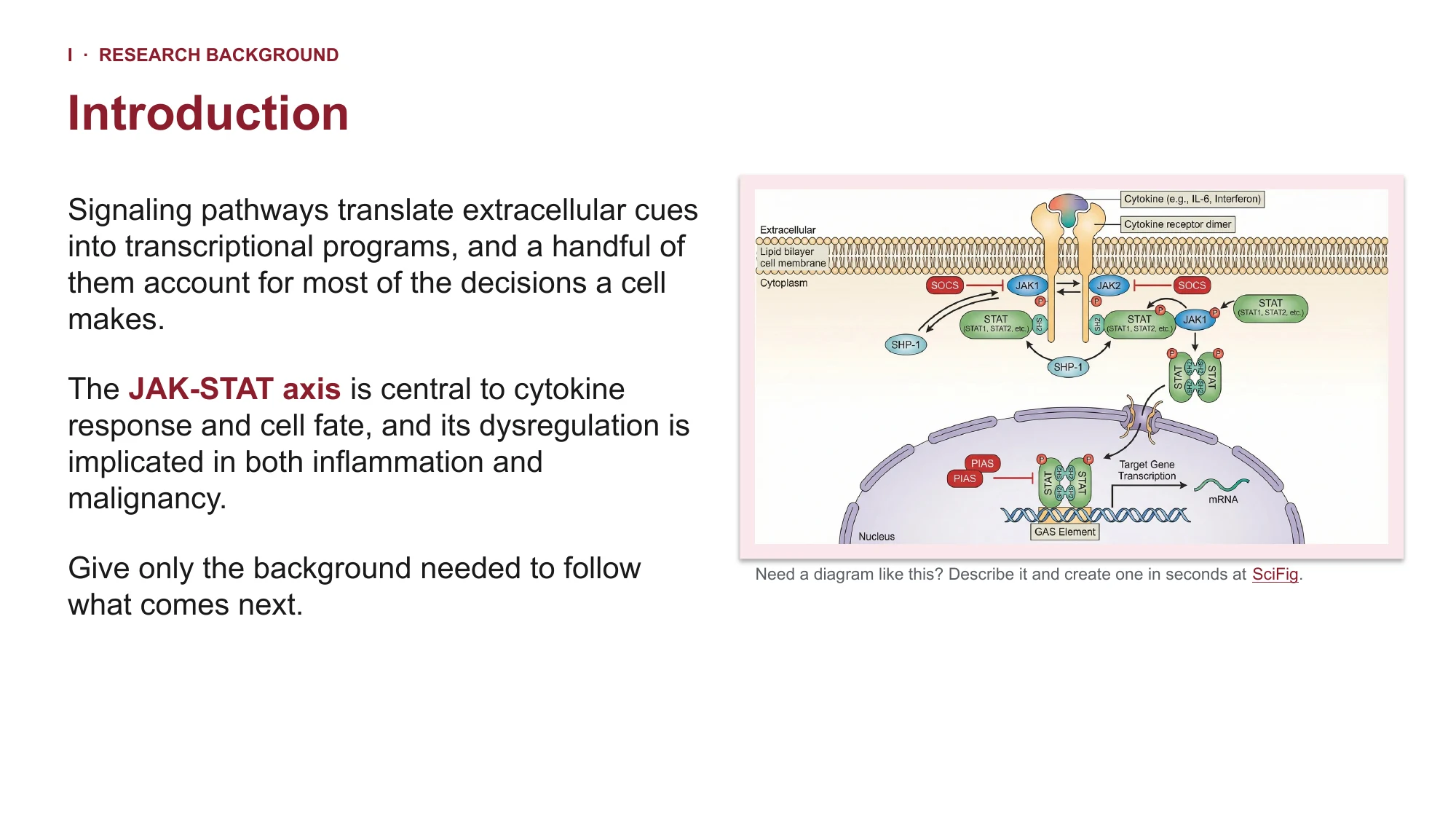
Introduction
a pathway or signaling diagram. It is the most common figure in a molecular or cell biology talk, and the one that takes longest to draw by hand.
One Figure, One Message
the template leaves this slide as an empty frame on purpose. Its prompt reads "Drop your key figure here. One slide, one message — if it needs two, make two slides." This is the slide people photograph.
Experimental schematic
what was done to what, in what order. A schematic answers the methods question faster than the methods slide does.
Your results
the Result slides hold your own data. The template deliberately does not offer to generate these; that line is left for your figure caption.
Biology powerpoint template downloads
A 16:9 .pptx with the five numbered sections and a cell signaling and pathway figure set at the end.
Bold and Minimal are the same deck at two levels of contrast.
 hover to preview
Biology deck — Minimal
16:9 · 13.333 x 7.5 in · 23 slides
 hover to preview
Biology deck — Bold
16:9 · 13.333 x 7.5 in · 23 slides
Biology slides template: what the slides look like
Two styles of the same deck, and two of the slide types you will spend the most time on.
Bold and Minimal differ only in how much color the title and section dividers carry — the structure, the speaker notes and the cell signaling and pathway figure set are identical.
Minimal style — the same deck, white cover
Bold puts a full-bleed color panel behind the title and every section divider; Minimal keeps them white with the accent on the rule and headings only. Pick Bold for a large hall where contrast helps from the back, Minimal when your institution template is already restrained.
A biology talk slide — one figure, one message
The figure placeholder is sized for SciFig output, so a generated pathway or mechanism drops in at the right proportions instead of needing to be rescaled. The body text on the left is where the plain-language finding goes — lead with what you found, not with what you measured.

The testable claim — the hypothesis slide
One sentence on a colored band, with a worked example underneath. It is the slide people skip and the slide reviewers remember: a claim phrased so that it could have come out false is what separates a research talk from a progress report.
Cell biology presentation template, or one deck for the whole discipline
Splitting decks by subfield sounds helpful and is not.
A cell biology talk, a microbiology talk and a genetics talk share the same narrative order — background, claim, method, result, meaning — because that order comes from how research is judged, not from what organism it is about. What actually differs between subfields is the figures, which is why this deck varies the figure set rather than the structure. If you want the same spine without the biology figures, the conference deck is the neutral version.
Conferences and departments write this size in different ways — you may also see it listed as: biology slides template · biology research presentation template · biology powerpoint template · cell biology presentation template · molecular biology presentation template · life science presentation template · biology research slide deck template
Related pages
Presentation Templates
Editable 16:9 slide decks for research talks
Text-to-Figure
Describe a figure in words and generate it with AI
PDF-to-Figure
Draft diagrams from the content of a paper PDF
Conference Presentation Template
A 23-slide conference talk deck at 16:9, with the five sections an audience expects already ordered.
Journal Club Presentation Template
A 22-slide journal club deck at 16:9: why this paper, what it claims, three figure slides, then critique.
Lab Meeting Presentation Template
A 20-slide lab meeting deck at 16:9 — the shortest of the four, with a Troubleshooting slide for what is not working.
Thesis Defense Presentation Template
A 22-slide thesis defense deck at 16:9, organized around your contributions and the chapters behind them.
Scientific Poster Generator
Design a conference research poster
AI Scientific Image Generator
Generate research figures from text
Frequently Asked Questions
Common questions about Biology Slides Template.

Ready to publish?
Make your own Biology Slides Template in minutes.
Start for freeFree to start · No credit card required · Built for researchers