
Drosophila GAL4/GAL80ts System Diagram
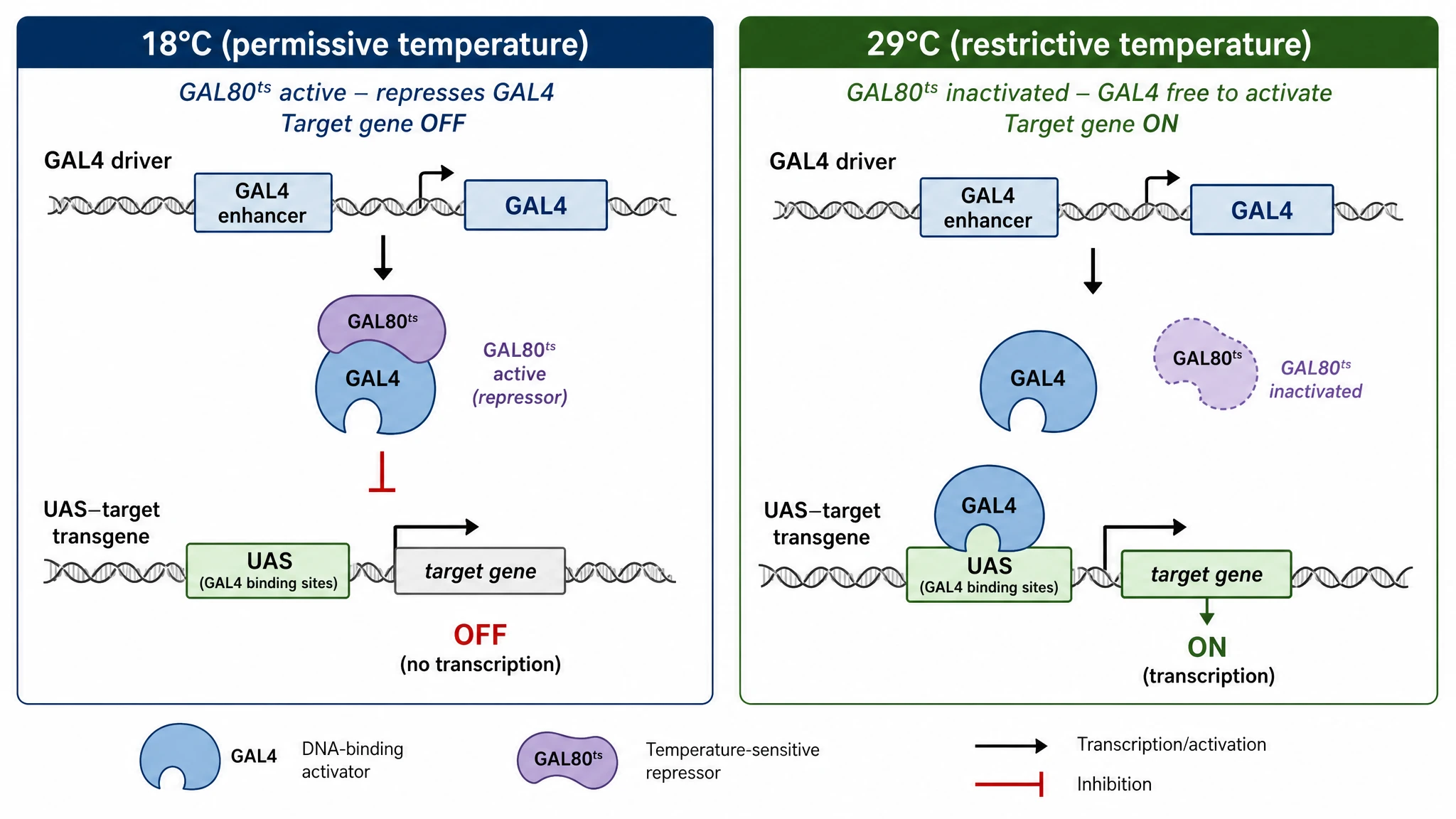
An editable diagram of the Drosophila GAL4/UAS/GAL80ts system showing how temperature switches GAL80ts repression on and off to control targeted gene expression.
Updated

Start with up to 150 free credits|No credit card required
Get up to 350 free credits on day one when you join through an invite.
What is Drosophila GAL4/GAL80ts System Diagram?
The Drosophila GAL4/GAL80ts system is a temperature-controlled binary expression system. A GAL4 driver activates a UAS-linked target gene, while a temperature-sensitive GAL80ts protein binds and represses GAL4 at the permissive temperature (18°C) and releases it at the restrictive temperature (29°C), giving precise temporal control of gene expression. With SciFig you describe the GAL4/UAS/GAL80ts setup in plain language and generate a clean, editable diagram you can relabel and export.
Why Researchers Draw This Figure
- It separates spatial control (which cells, set by the enhancer) from temporal control (when, set by temperature) — the one feature that distinguishes this design from a plain two-component binary cross.
- Reviewers routinely ask whether a phenotype is developmental or acute; a shift timeline in the figure answers that before the question is asked.
- Rearing and shift schedules are the largest source of irreproducibility between labs using identical stocks, and they are usually buried in prose rather than shown.
- The repression mechanism is protein-level, not transcriptional, and a text description almost always blurs this — the diagram forces the distinction.
- Genotypes in this design run to three or four transgenes plus balancers; a schematic communicates the cross faster than a genotype string.
- Temperature itself is a variable: GAL4 activity rises with temperature, so a figure that annotates both arms at 18 °C and 29 °C signals that the right controls exist.
Components to Label
- Driver line — a tissue- or cell-type-specific enhancer or promoter fragment placed upstream of the yeast GAL4 coding sequence; this alone sets the spatial pattern of expression.
- UAS effector line — tandem upstream activating sequence sites (typically 5×UAS, or 10×UAS in the pJFRC/20×UAS-IVS series) in front of the cargo: an RNAi hairpin, a cDNA, a reporter such as GFP, or an effector such as Kir2.1, TrpA1 or GtACR.
- tubP-GAL80ts — the temperature-sensitive GAL80 repressor expressed from the ubiquitous α-tubulin promoter, so repression is present in every cell where the driver is active.
- Permissive temperature (18–19 °C) — repressor is folded and bound, effector expression is suppressed; note the ~2× slower development on the figure.
- Restrictive temperature (29–31 °C) — repressor is nonfunctional, the driver is derepressed; above 31 °C flies suffer heat stress, which is why 29 °C is the working standard.
- Cross scheme — combining the repressor with either the driver or the effector chromosome to build a single stable stock, with balancers marked; this is what turns a three-way cross into a routine two-way cross.
- Controls — driver-only and effector-only siblings raised through the identical temperature regime, so that any effect of 29 °C on behavior, lifespan or physiology is subtracted rather than attributed to the transgene.
Where This Diagram Is Used
- Adult-restricted RNAi, where constitutive knockdown of an essential gene would be lethal during embryogenesis or larval development.
- Circuit neuroscience: acute neuronal activation or silencing in adults with TrpA1, Kir2.1, shibire-ts or channelrhodopsin variants, so that a behavioral deficit cannot be dismissed as a wiring defect.
- Learning, memory and circadian work, where the effector must be induced only during a training or entrainment window and then switched off.
- Developmental timing experiments in imaginal discs — inducing a growth regulator, tumor driver or apoptotic gene at a defined larval stage rather than throughout the lineage.
- Pulse–chase style expression for measuring protein turnover, aggregate clearance, or the persistence of a labeled clone after the driver has been re-repressed.
- Aging and metabolism studies that need onset control: expression begins only after eclosion, so lifespan effects are not confounded by developmental burden.
What This Template Gives You
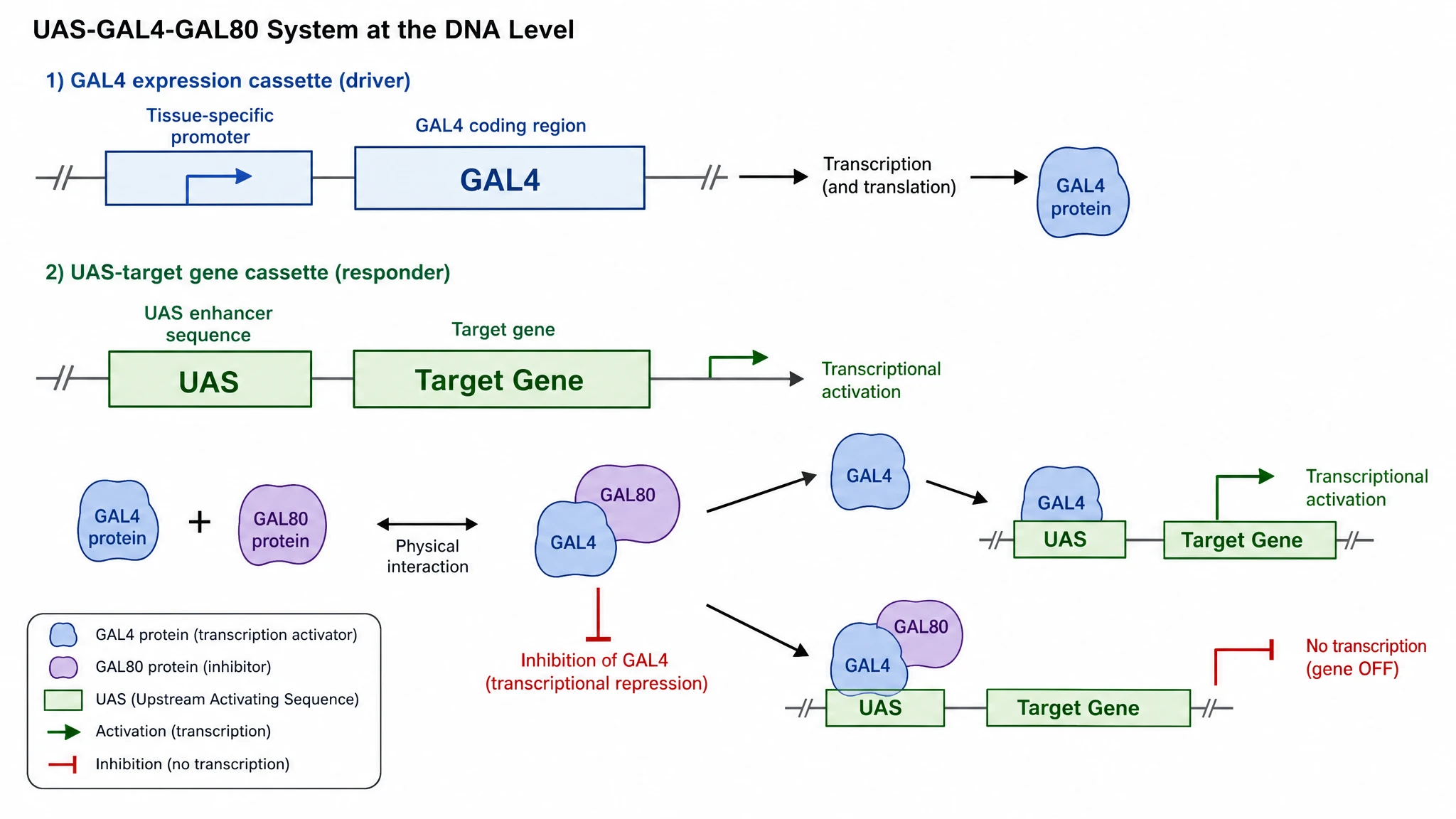
Driver, effector and repressor in one panel
The layout places all three transgenes on the same plane: a tissue-specific enhancer fragment driving yeast GAL4, a UAS-linked effector, and a ubiquitously expressed tubP-GAL80ts allele. Arrows distinguish transcriptional activation at the UAS array from protein-level inhibition, since GAL80ts binds the GAL4 activation domain rather than blocking DNA occupancy. A reader can trace which molecule acts on DNA and which acts on protein without consulting the legend.
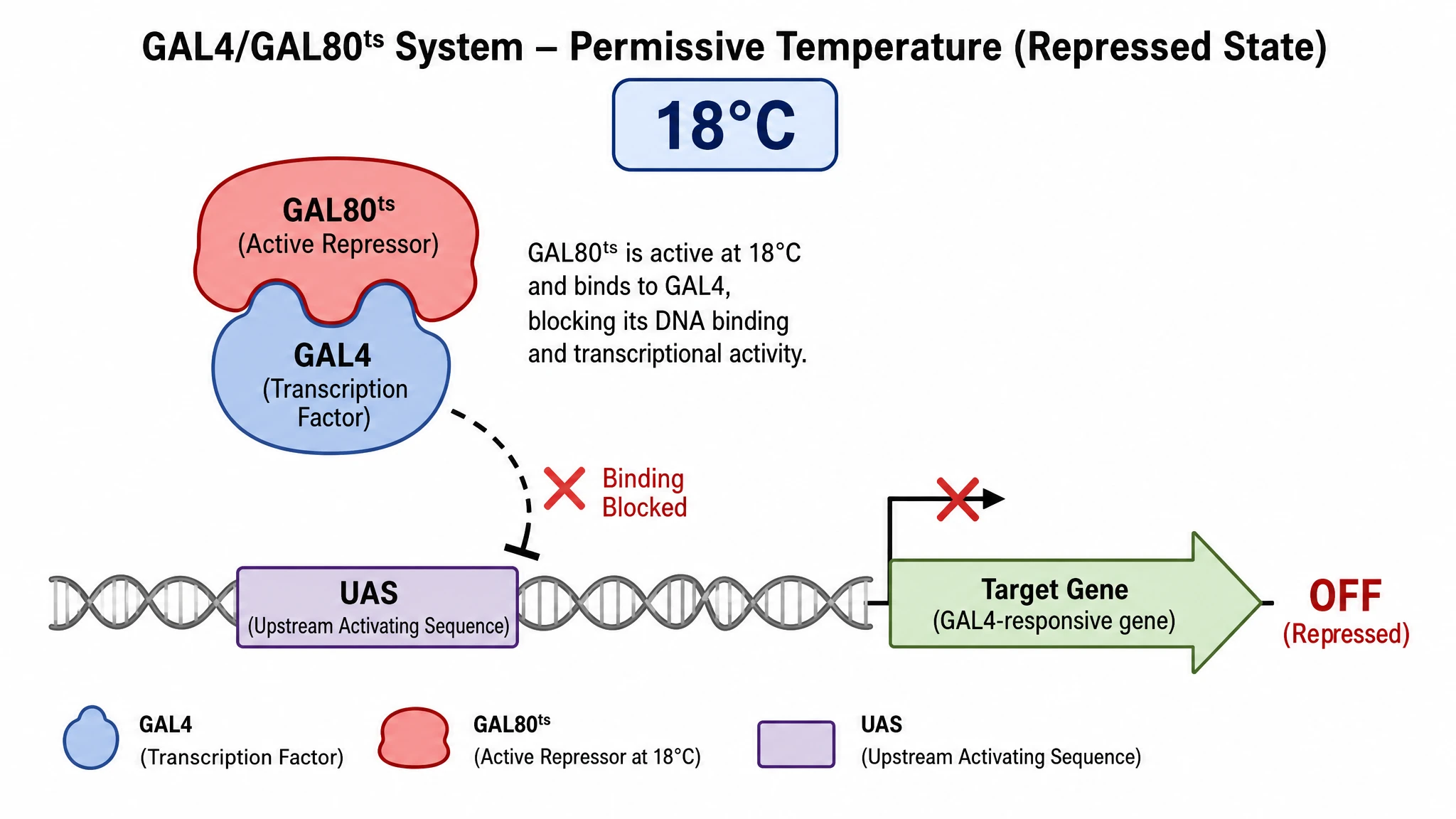
Permissive 18 °C state with repression intact
At the permissive temperature the repressor folds correctly, binds the C-terminal activation domain, and leaves the effector silent even though driver protein is present and occupying its binding sites. Drawing this as its own panel makes the key point explicit: the off state is not absence of driver expression but active, reversible inhibition of a driver that is already there. Rearing at 18 °C roughly doubles development time, which the panel notes.
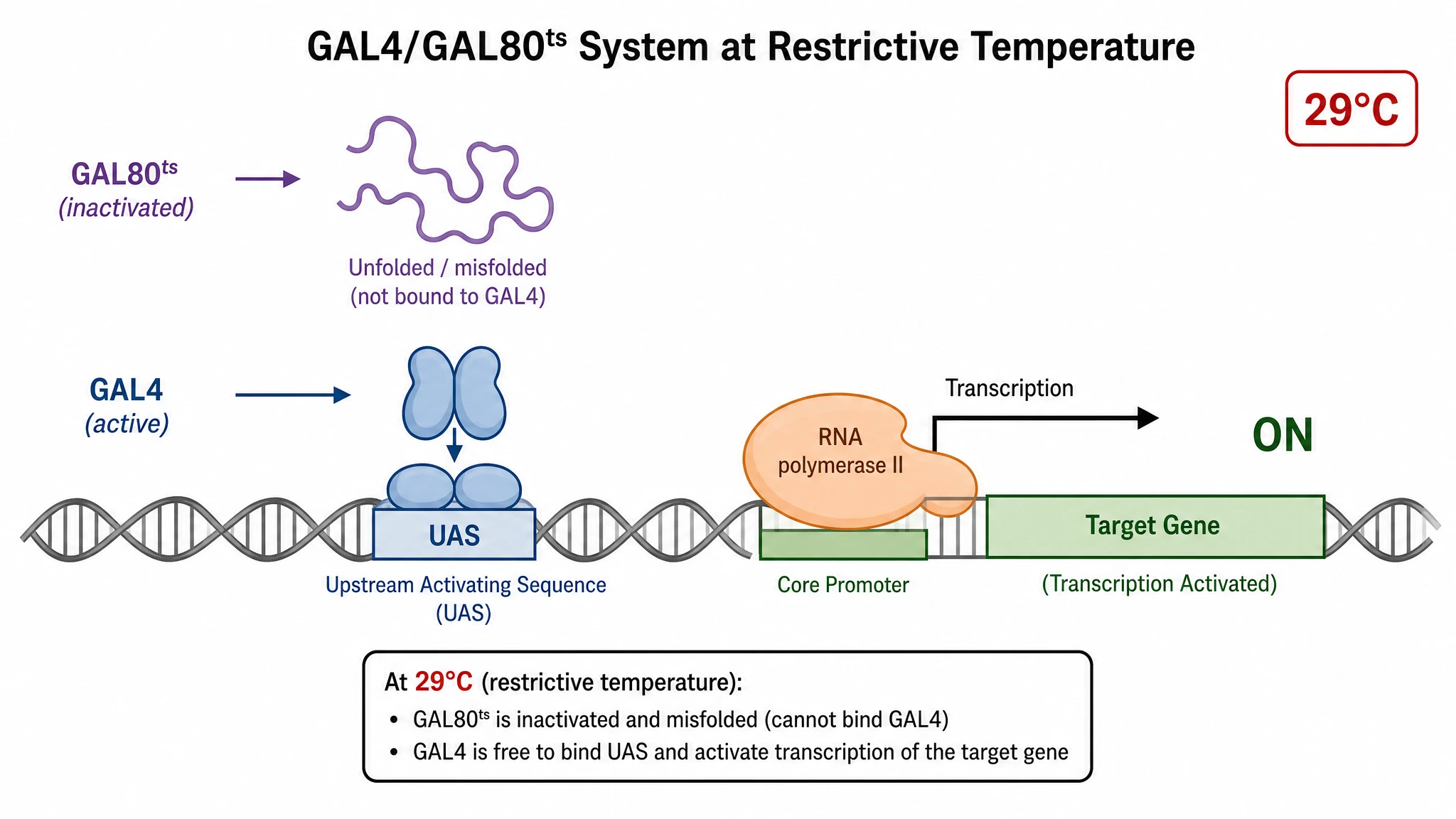
Restrictive 29 °C state releasing the driver
Shifting animals to 29 °C inactivates the repressor, the activation domain is freed, and UAS transcription resumes within hours. The panel pairs the molecular event with the phenotypic readout so the temporal offset stays visible: derepression is fast, but accumulation of an encoded protein, of RNAi-mediated knockdown, or of a toxin effect lags behind by an interval that has to be calibrated for each effector.
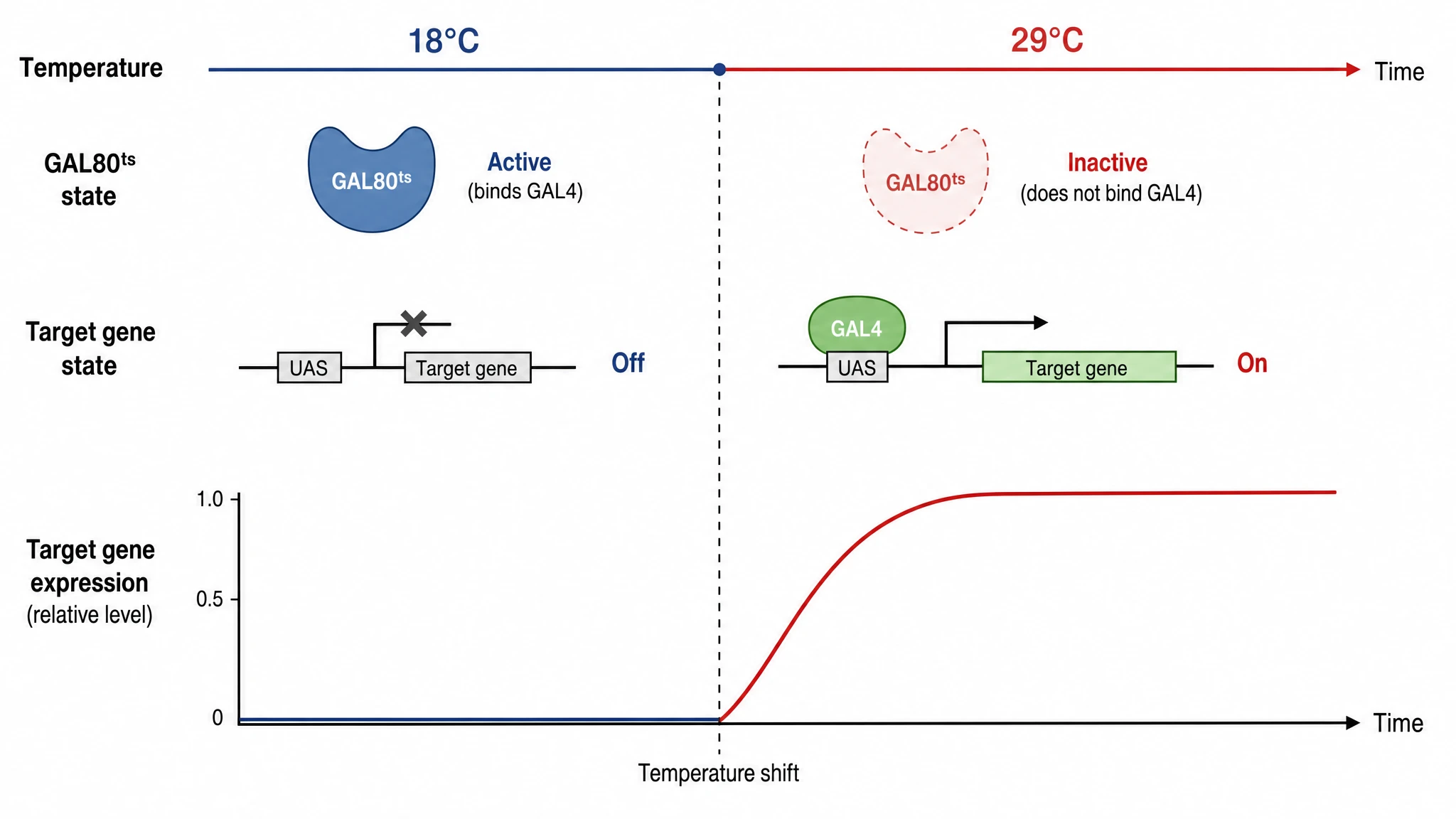
Shift protocol timeline for temporal control
The timeline maps rearing temperature, the shift itself, the induction window, and any return to permissive conditions onto developmental stages — the way TARGET experiments are actually reported in methods sections. Annotating animal age at shift, shift duration, and dissection or assay point makes the design reproducible and separates a genuinely adult-restricted manipulation from one that also perturbs larval or pupal stages.
Drosophila GAL4/GAL80ts System Diagram— templates & examples
How to make Drosophila GAL4/GAL80ts System Diagram
Describe your figure
Tell SciFig what to draw in plain language — no design tools required.
Generate with SciFig
Get a clean, publication-ready figure that matches your description in seconds.
Edit & export
Vectorize it into editable SVG, relabel everything, and export for your paper, poster, or slides.
Related searches
- uas gal 4 gal 80 ts
- uas gal4 gal80
- gal80ts
- gal80 ts
- gal4 uas system
- gal80ts what does it do
- drosophila binary expression system
- temperature sensitive gal80
- gal4 driver diagram
- gal4 gal80ts system
Make figures for
Related pages
Genetics Templates
Browse more Genetics templates in SciFig's library.
All Templates
Browse every template page in SciFig's library.
Graphical Abstract Maker
Summarize your study in one panel
Scientific Poster Generator
Design a conference research poster
AI Scientific Image Generator
Generate research figures from text
Conceptual Framework Generator
Map variables and their relationships
Frequently Asked Questions
Common questions about Drosophila GAL4/GAL80ts System Diagram.

Ready to publish?
Make your own Drosophila GAL4/GAL80ts System Diagram in minutes.
Start for freeFree to start · No credit card required · Built for researchers