
Zoonotic Transmission of Salmonella
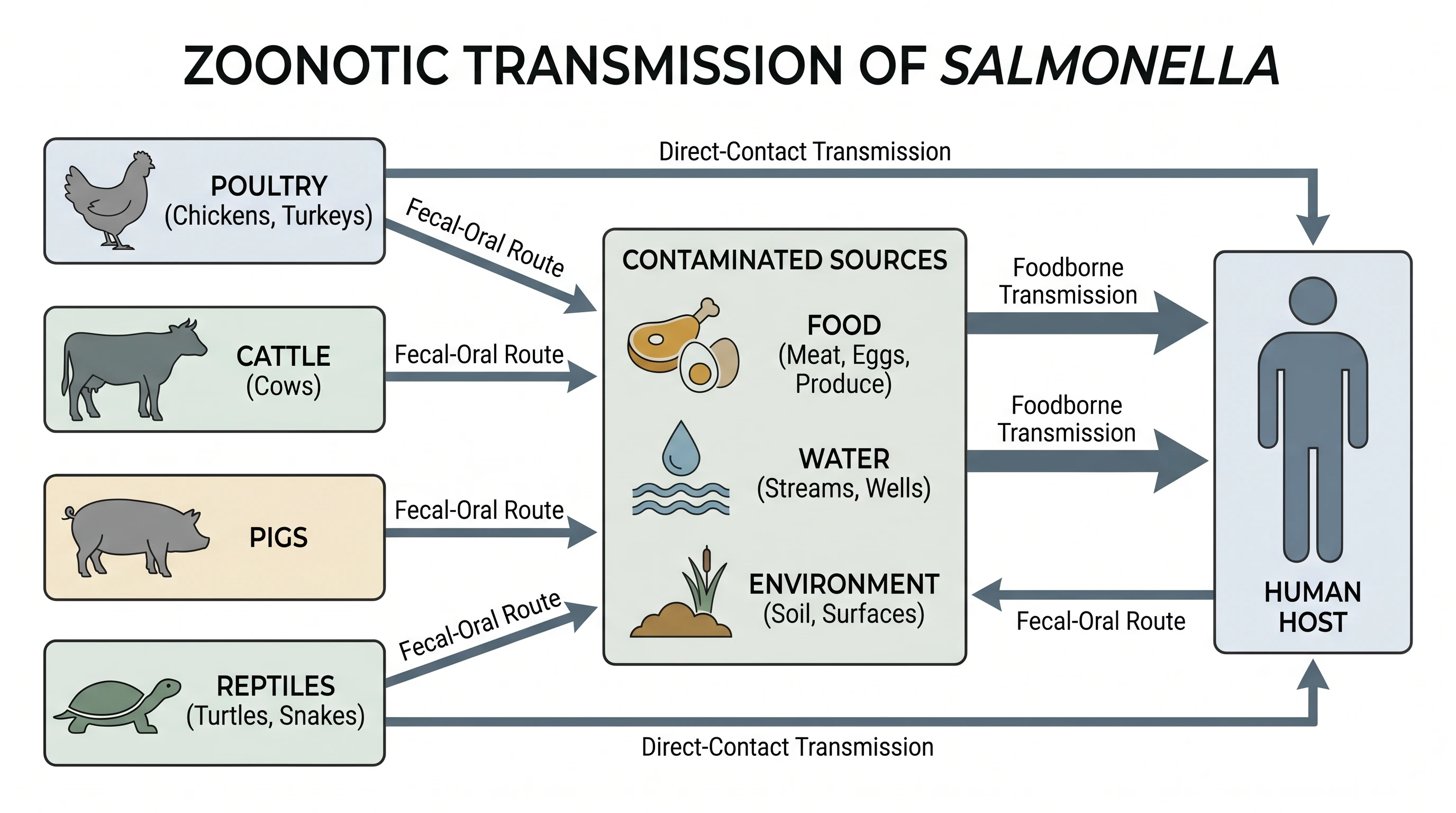
A publication-ready figure mapping how Salmonella moves from animal reservoirs through food, water, and the environment to infect humans.
Updated

Start with up to 150 free credits|No credit card required
Get up to 350 free credits on day one when you join through an invite.
What is Zoonotic Transmission of Salmonella?
A zoonotic transmission of Salmonella diagram shows how Salmonella bacteria spread from animal reservoirs — poultry, cattle, pigs, and reptiles — to humans through contaminated food, water, and the environment. It traces the fecal–oral route, the role of carrier animals, and the key points of foodborne and direct-contact transmission. With SciFig you describe the pathway in plain language and generate a clean, labeled figure for your paper, poster, or public-health report.
Why a route map belongs in the paper
- Route assumptions drive conclusions. A paper that attributes an outbreak to eggs is making a claim, and the figure is where that claim becomes explicit and falsifiable.
- Food-safety and One Health reviewers expect hypothesised routes to be visually distinguishable from routes backed by genotyping or epidemiological evidence.
- Control measures only make sense against a route map: HACCP steps, flock vaccination, chilling, and kitchen hygiene each act on a different arrow.
- The work crosses veterinary, food-science, clinical, and environmental groups, so the figure becomes the shared reference that keeps a multi-sector project using one vocabulary.
- Public-health communication reuses it directly; a route a non-specialist can follow is worth more than three paragraphs of prose.
- Teaching: students reliably confuse the zoonotic non-typhoidal serovars with the human-restricted typhoidal ones, and the reservoir row settles it in one look.
Key components to label
- Animal reservoirs — poultry, cattle, pigs, and reptiles, with asymptomatic carriers marked explicitly as shedders
- Shedding and environmental load — faeces, slurry, bedding, dust, and biofilms on farm surfaces and equipment
- Water and soil compartments — surface and irrigation water, manure-amended soil, and contaminated feed
- Food vehicles — eggs (including transovarian contamination by S. Enteritidis), poultry and meat carcasses, raw milk, fresh produce, and cross-contamination during processing
- Direct-contact routes — reptile and pet handling, farm and petting-zoo visits, occupational exposure in abattoirs
- Host entry — the ingested dose against the gastric acid barrier, then invasion of the ileal and colonic epithelium
- Outcomes and onward spread — self-limiting gastroenteritis, invasive non-typhoidal disease in vulnerable hosts, secondary person-to-person faecal–oral spread, and antimicrobial-resistant clones tracked back along the same arrows
Where researchers use this figure
- Introduction or graphical abstract of an outbreak investigation or source-attribution study
- Public-health surveillance reports written for a mixed specialist and lay audience
- Farm biosecurity and HACCP documentation, with control points annotated directly on the arrows
- One Health grant applications that must show the veterinary, food, and clinical arms as a single system
- Veterinary microbiology and food-safety teaching slides
- Thesis and review chapters on antimicrobial resistance moving from livestock into human medicine
Everything you need in a publication-ready Salmonella transmission figure
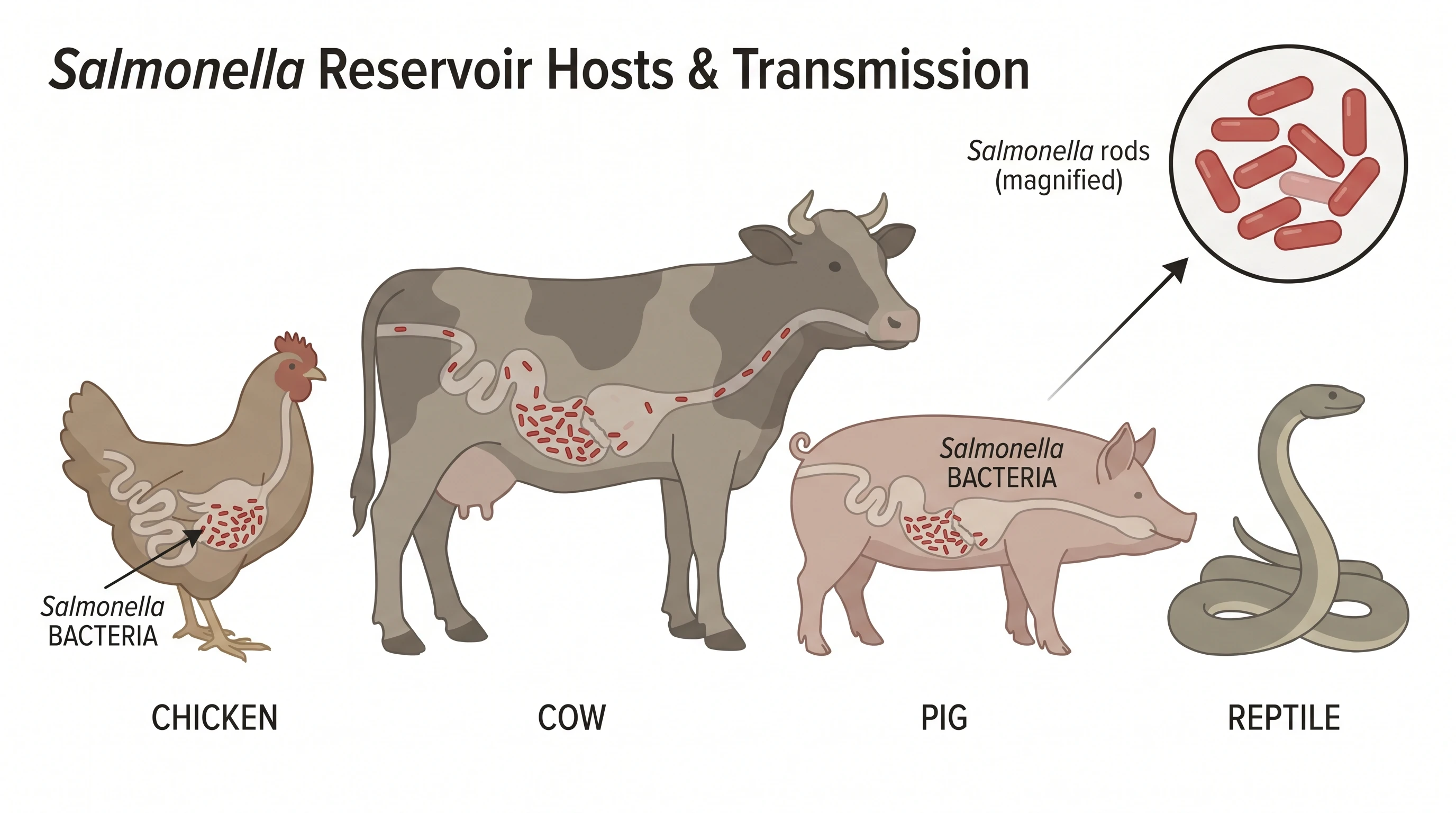
Show which animal reservoirs feed each route
Non-typhoidal serovars such as Typhimurium and Enteritidis persist in poultry, cattle, pigs, and reptiles, usually in animals that shed the organism in faeces without appearing sick. Reptile and amphibian pets are worth drawing separately: they account for a distinct direct-contact route that food-safety figures often omit. Typhi and Paratyphi belong in a different figure — they are human-restricted and have no animal reservoir.
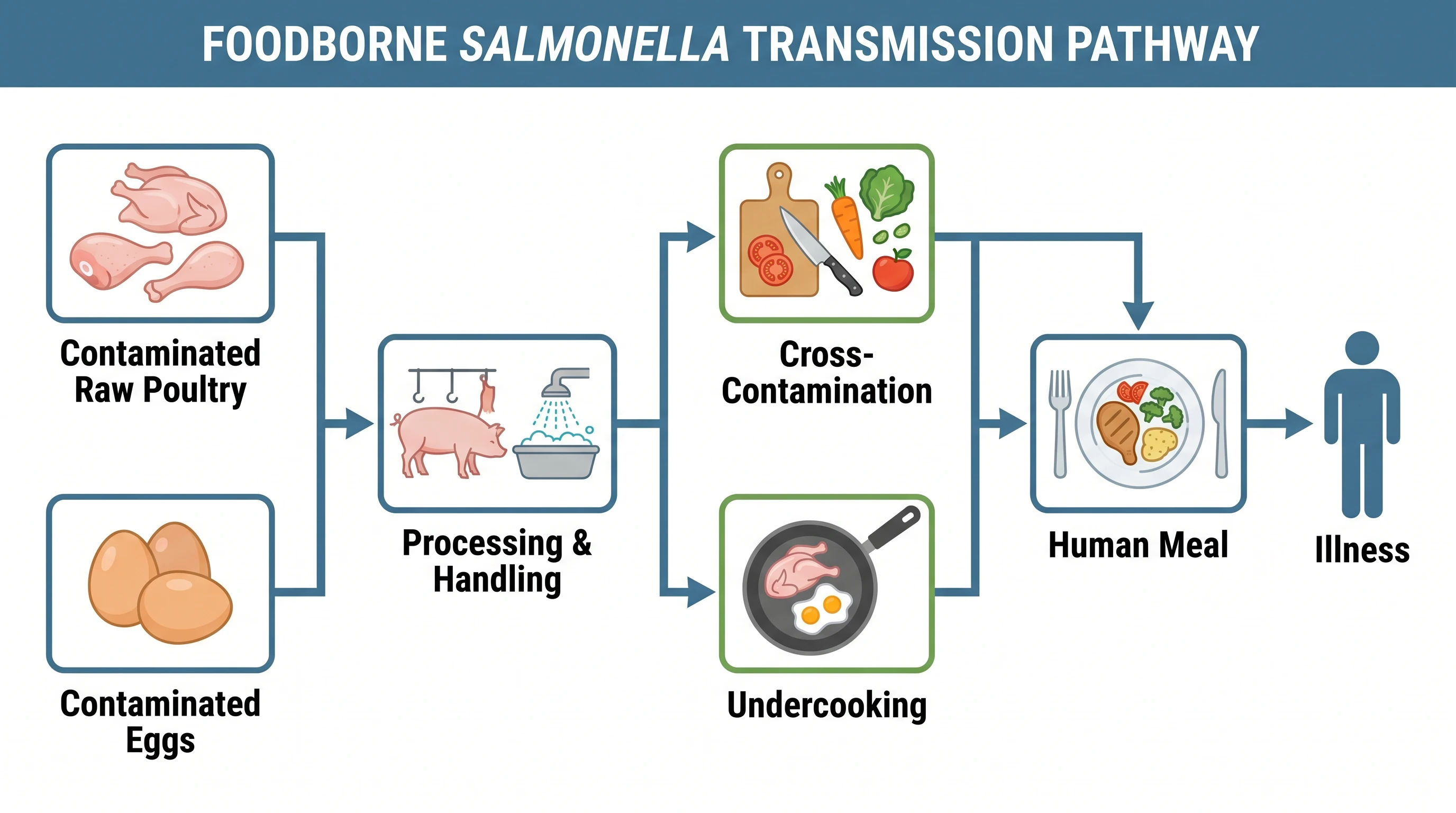
Trace the farm-to-fork pathway with its control points
The food route runs from contaminated feed and colonised flocks through slaughter and carcass contamination, into eggs, meat, raw milk, and produce irrigated with contaminated water or grown on manure-amended soil, then to cross-contamination in the kitchen and undercooking. Marking where each control point acts — vaccination, slaughter hygiene, chilling, cooking to a core temperature — turns a descriptive route map into something an intervention paper can cite.
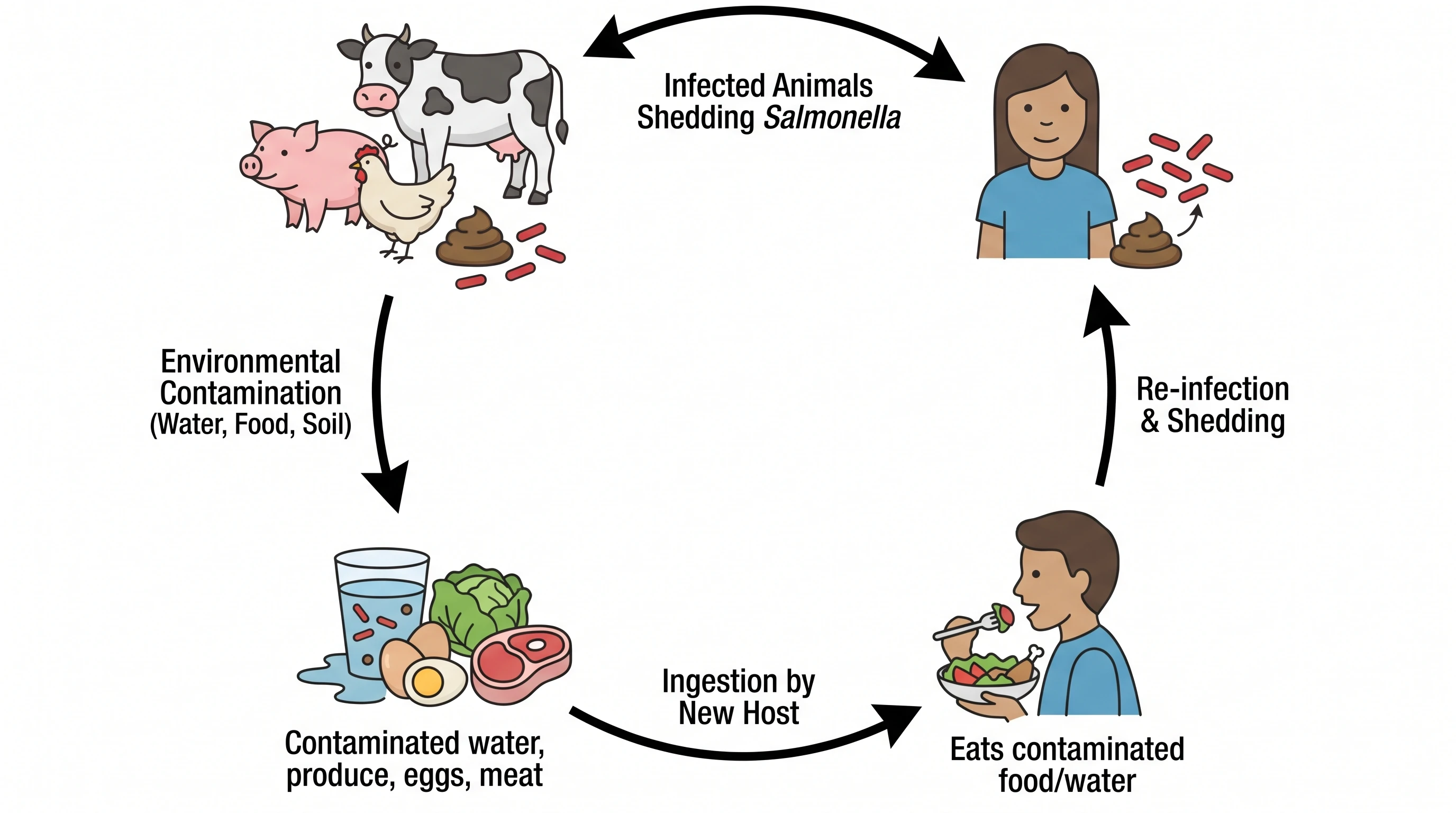
Close the faecal–oral loop through the environment
Shed bacteria do not simply disappear. They persist in slurry, bedding, dust, and biofilms on farm surfaces, move into surface and irrigation water, and re-enter livestock through feed and water troughs. Drawing the loop as a cycle rather than a one-way arrow is what distinguishes a reservoir figure from a transmission chain, and it is where farm-level interventions are usually placed.
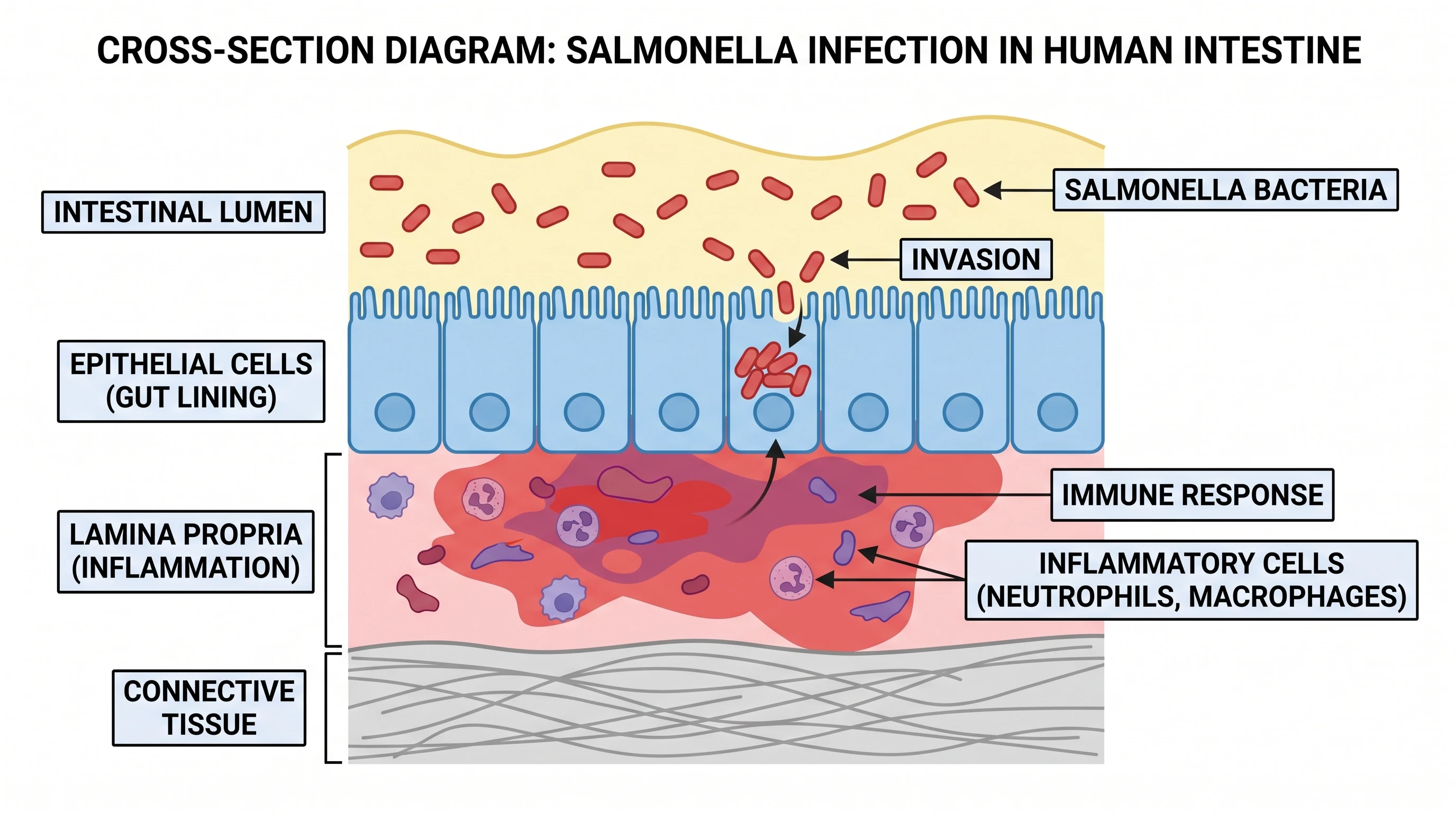
End the route at the intestinal epithelium
The human end of the figure is a mechanism panel: an ingested dose survives the gastric acid barrier, reaches the distal ileum and colon, and invades through M cells and enterocytes using the SPI-1 type III secretion system, producing neutrophil influx and gastroenteritis. In immunocompromised hosts the same organism turns invasive. An inset like this lets one figure carry both the epidemiology and the cell biology.
Zoonotic Transmission of Salmonella— templates & examples
How to make Zoonotic Transmission of Salmonella
Describe your figure
Tell SciFig what to draw in plain language — no design tools required.
Generate with SciFig
Get a clean, publication-ready figure that matches your description in seconds.
Edit & export
Vectorize it into editable SVG, relabel everything, and export for your paper, poster, or slides.
Related searches
- salmonella transmission diagram
- salmonella transmission
- zoonotic salmonella
- salmonella infection cycle
- salmonella fecal oral route
- salmonella reservoir hosts
- salmonella foodborne transmission
Make figures for
Related pages
Microbiology Templates
Browse more Microbiology templates in SciFig's library.
All Templates
Browse every template page in SciFig's library.
Conjugation Transformation Transduction
One clear figure comparing the three mechanisms of bacterial horizontal gene transfer: conjugation, transformation, and transduction.
Pseudomonas Aeruginosa
A labeled, publication-ready figure of the Pseudomonas aeruginosa cell — its gram-negative envelope, flagellum, pili, and key virulence factors.
Graphical Abstract Maker
Summarize your study in one panel
Scientific Poster Generator
Design a conference research poster
AI Scientific Image Generator
Generate research figures from text
Conceptual Framework Generator
Map variables and their relationships
Frequently Asked Questions
Common questions about Zoonotic Transmission of Salmonella.

Ready to publish?
Make your own Zoonotic Transmission of Salmonella in minutes.
Start for freeFree to start · No credit card required · Built for researchers