
Chemotherapeutic Agents Can Classify According to the Mechanism of Action
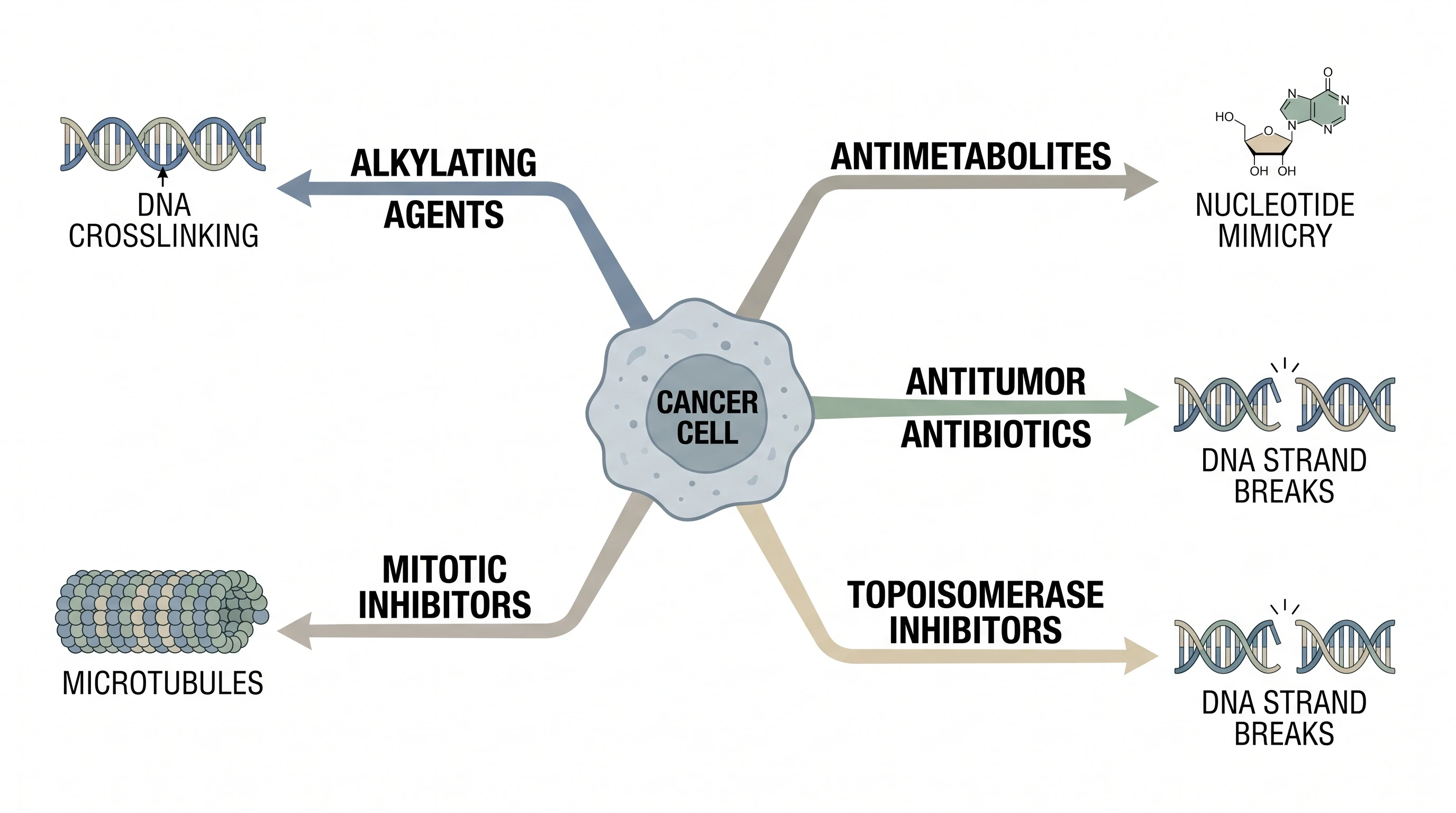
A publication-ready figure classifying chemotherapeutic agents by mechanism of action and where they act on the cell cycle.
Updated

Start with up to 150 free credits|No credit card required
Get up to 350 free credits on day one when you join through an invite.
What is Chemotherapeutic Agents Can Classify According to the Mechanism of Action?
Chemotherapeutic agents can be classified by their mechanism of action: alkylating agents crosslink DNA, antimetabolites mimic nucleotides, antitumor antibiotics and topoisomerase inhibitors disrupt DNA replication, and mitotic inhibitors block spindle formation. Mapping each class to its target and cell-cycle phase makes the differences clear. With SciFig you describe the drug classes and generate a clean, editable classification diagram for your paper, lecture, or poster.
Why group these drugs by how they act rather than by tumour type
- Toxicity travels with the target: DNA-damaging agents produce myelosuppression, tubulin binders produce peripheral neuropathy, antimetabolites produce mucositis. A mechanistic grouping is therefore also a toxicity grouping.
- Combination regimens such as FOLFOX, ABVD and CHOP deliberately pair agents from different mechanistic classes so that a tumour cannot escape through a single repair or efflux route, and so that dose-limiting toxicities do not overlap.
- Phase specificity dictates schedule. S-phase-specific agents benefit from prolonged infusion or fractionation that exposes more cells as they cycle; phase-nonspecific alkylators are broadly dose-dependent and given as boluses.
- Resistance maps onto the target: nucleotide excision repair against platinum adducts, thymidylate synthase upregulation against 5-fluorouracil, tubulin isotype switching and P-glycoprotein efflux against taxanes.
- Five or six mechanistic buckets keep a figure readable where a list of forty drug names does not; readers retain the target, not the trade name.
- Newer targeted and immuno-oncology agents are easier to position once the cytotoxic backbone is already organised by molecular target.
The drug classes the figure has to carry
- Alkylating agents — nitrogen mustards (cyclophosphamide, chlorambucil), nitrosoureas (carmustine, lipophilic enough to cross the blood-brain barrier) and alkyl sulfonates (busulfan), all forming covalent DNA adducts and crosslinks.
- Platinum coordination complexes — cisplatin, carboplatin and oxaliplatin, forming intrastrand adducts; grouped with the alkylators functionally, but with a distinct toxicity profile (nephrotoxicity and ototoxicity for cisplatin, cold-triggered neuropathy for oxaliplatin).
- Antimetabolites — folate antagonists (methotrexate, pemetrexed), pyrimidine analogues (5-fluorouracil, capecitabine, cytarabine, gemcitabine) and purine analogues (6-mercaptopurine, fludarabine).
- Topoisomerase inhibitors — topoisomerase I poisons (irinotecan, topotecan) and topoisomerase II poisons (etoposide, teniposide), both acting by trapping the cleavage complex rather than by inhibiting catalysis outright.
- Antitumour antibiotics — anthracyclines (doxorubicin, daunorubicin) with cumulative cardiotoxicity, bleomycin (iron-dependent free-radical strand scission, pulmonary fibrosis), dactinomycin (intercalation blocking RNA polymerase) and mitomycin C (bioreductive alkylation).
- Microtubule-targeting agents — vinca alkaloids (vincristine, vinblastine) bind the vinca domain of tubulin and block polymerisation; taxanes (paclitaxel, docetaxel) stabilise microtubules and prevent depolymerisation. Both trip the spindle assembly checkpoint and arrest cells in M.
- The cell-cycle axis itself — G1, S, G2 and M lanes with arrows from each class to the phase it acts on, plus a clearly marked phase-nonspecific band for the DNA-damaging agents.
Where this figure gets used
- Pharmacology and oncology lectures, where the classification is the organising spine of the entire cytotoxic module.
- Review articles and thesis introductions that need one figure to orient the reader before discussing a single agent in depth.
- Grant applications and protocol rationales, to justify why a proposed combination pairs non-overlapping targets and toxicities.
- Resistance-mechanism papers, where the figure anchors each escape route (repair, efflux, target amplification) to the class it defeats.
- Clinical and nursing education, linking each class to the adverse effects the team should be monitoring for.
- Drug-development positioning slides, showing where a new agent sits relative to the established cytotoxic classes.
How each class of chemotherapy drug attacks the dividing cell, and where on the cell cycle it lands.
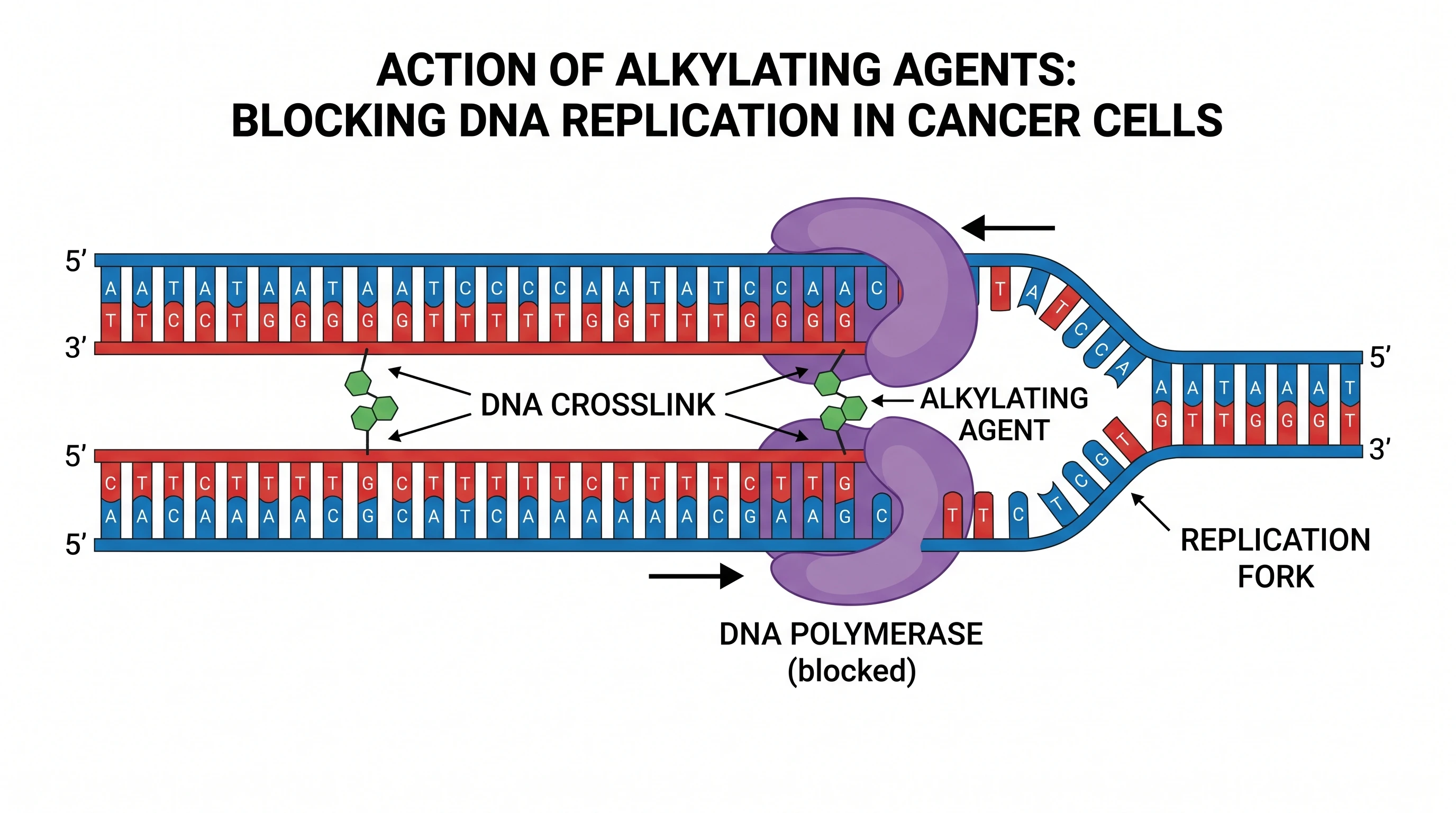
Alkylating agents crosslink DNA at guanine N7
Nitrogen mustards such as cyclophosphamide and ifosfamide transfer alkyl groups to the N7 position of guanine, producing intrastrand and interstrand crosslinks that stall replication forks. Platinum compounds — cisplatin, carboplatin, oxaliplatin — reach a similar endpoint by forming 1,2-intrastrand d(GpG) adducts. Because the damage lands on DNA in any phase, these drugs are largely cell-cycle nonspecific, though cells that enter S phase with unrepaired lesions die first.
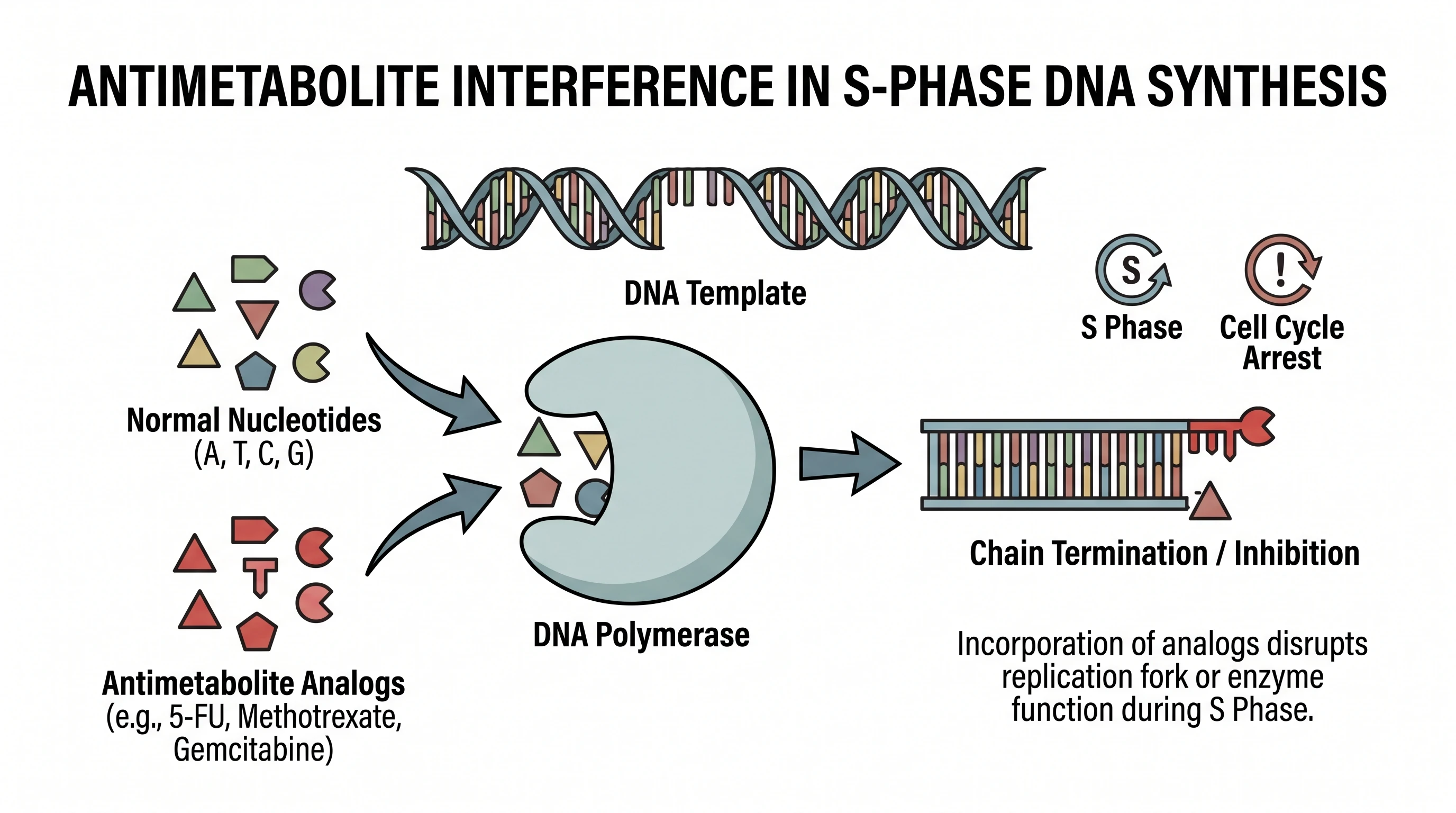
Antimetabolites mimic nucleotides and stall S phase
Methotrexate inhibits dihydrofolate reductase, draining the reduced folate pool needed for thymidylate synthesis. 5-fluorouracil is converted to FdUMP, which forms a covalent ternary complex with thymidylate synthase and starves the cell of dTMP. Nucleoside analogues such as cytarabine and gemcitabine are phosphorylated and incorporated into the growing strand, where they terminate elongation. All of them act only on cells actively synthesising DNA, making this class strictly S-phase specific.
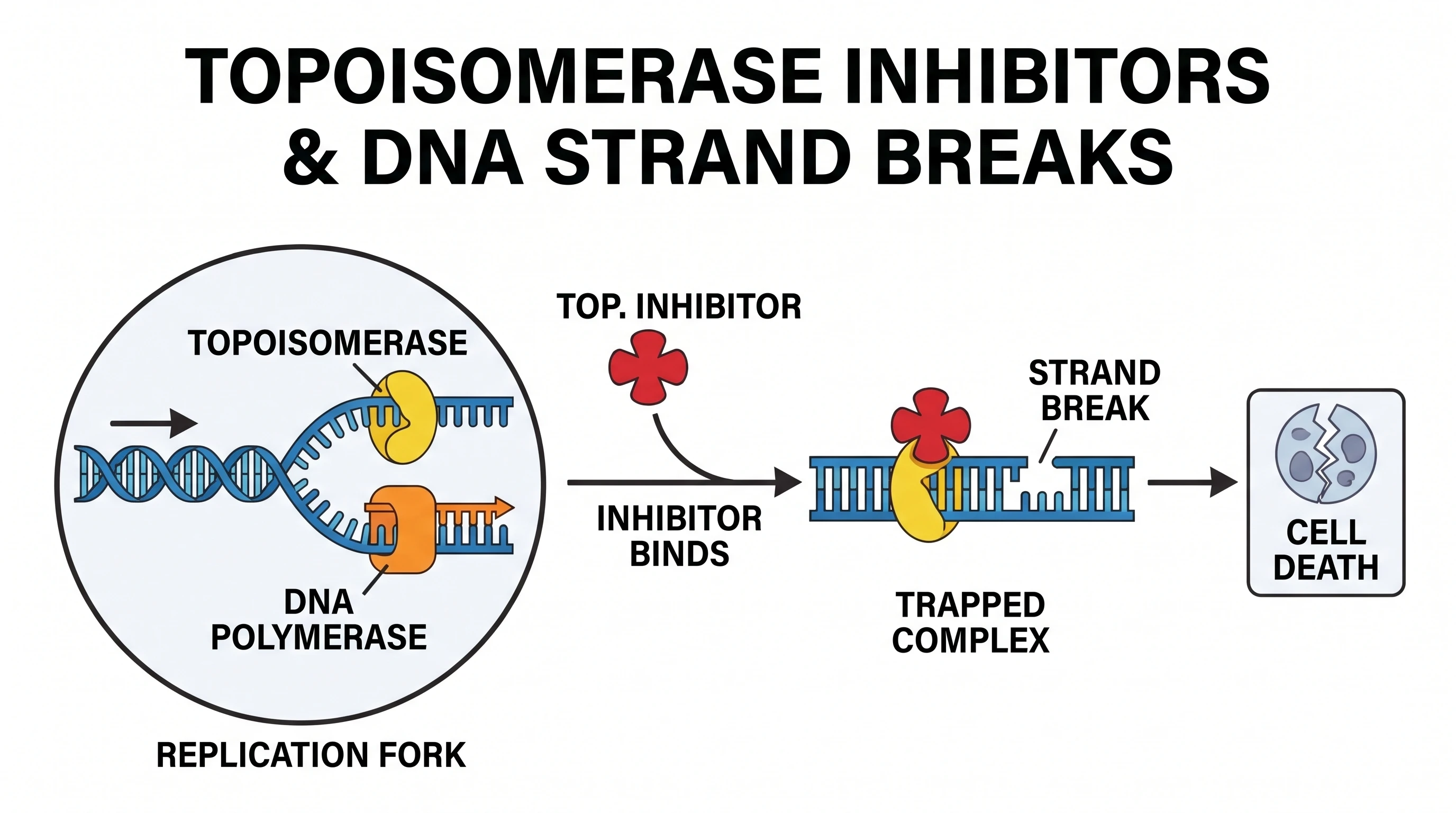
Topoisomerase inhibitors trap the DNA cleavage complex
Camptothecins (irinotecan, topotecan) bind the topoisomerase I–DNA covalent intermediate and prevent religation, so an advancing replication fork converts the nick into a lethal double-strand break. Etoposide poisons topoisomerase II the same way, stabilising the enzyme-bridged cleavage complex directly as a double-strand break. Anthracyclines such as doxorubicin add intercalation and free-radical generation. Activity peaks in S and G2, when topoisomerase levels and replication demand are highest.
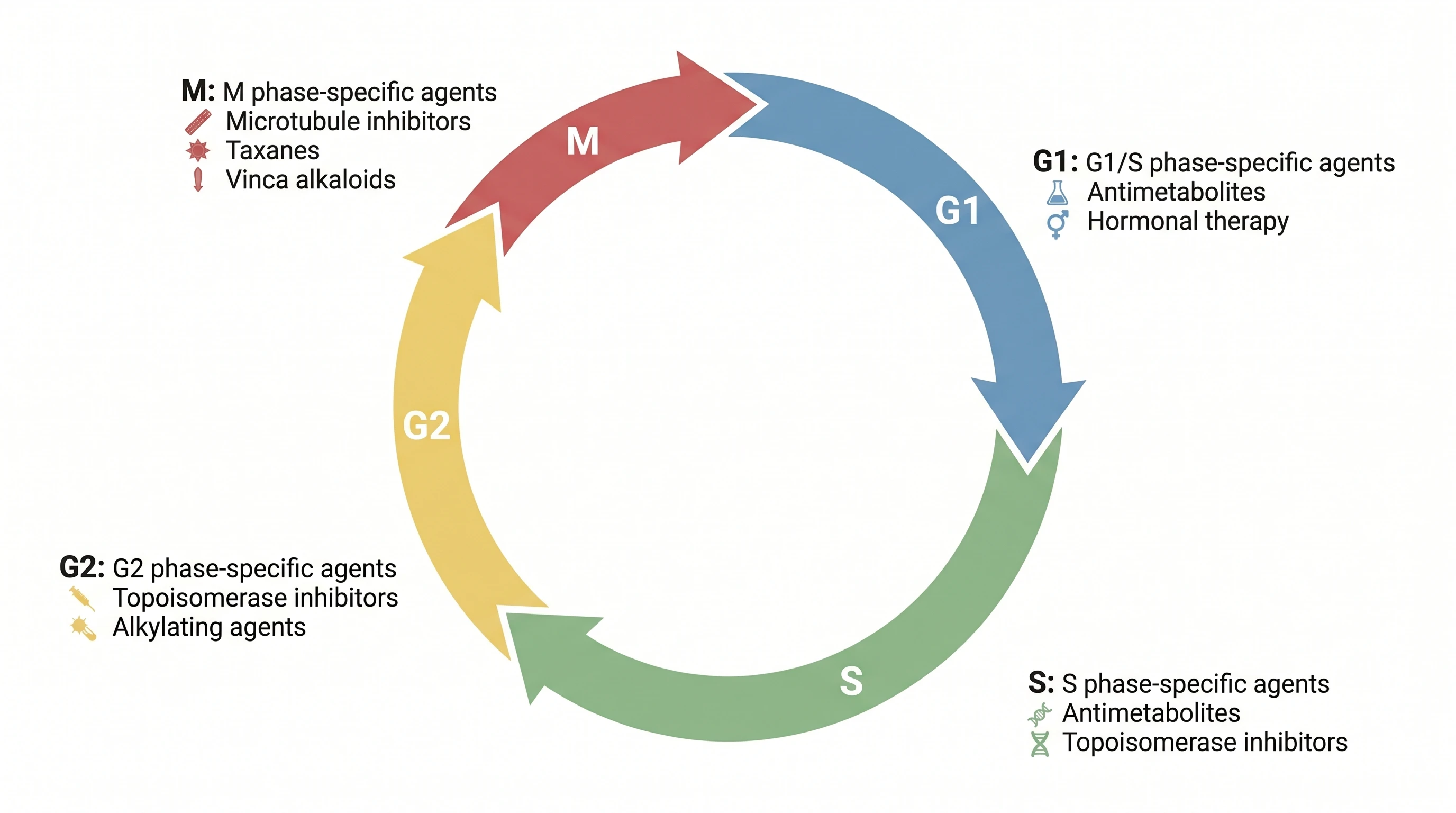
Mapping every class onto the cell cycle
A phase map separates phase-specific drugs from phase-nonspecific ones and explains the dosing logic. Antimetabolites hit S phase; vinca alkaloids and taxanes arrest cells in M by blocking or over-stabilising the mitotic spindle; bleomycin acts mainly in G2. Alkylators and platinum agents damage DNA irrespective of phase, so they stay active against slowly cycling tumours. Combination regimens deliberately span several phases to catch cells a single agent would miss.
Chemotherapeutic Agents Can Classify According to the Mechanism of Action— templates & examples
How to make Chemotherapeutic Agents Can Classify According to the Mechanism of Action
Describe your figure
Tell SciFig what to draw in plain language — no design tools required.
Generate with SciFig
Get a clean, publication-ready figure that matches your description in seconds.
Edit & export
Vectorize it into editable SVG, relabel everything, and export for your paper, poster, or slides.
Related searches
- classes of chemotherapy drugs
- chemotherapy classification
- chemotherapy drug classes diagram
- chemotherapy mechanism of action
- alkylating agents antimetabolites
- anticancer drug classification
Make figures for
Related pages
Pharmacology Templates
Browse more Pharmacology templates in SciFig's library.
All Templates
Browse every template page in SciFig's library.
Drugs Acting on Various Pathophysiological Pathways in Ulcerative Colitis
A publication-ready figure showing where each class of ulcerative colitis drug acts on the inflamed colon's pathophysiological pathways.
Graphical Abstract Maker
Summarize your study in one panel
Scientific Poster Generator
Design a conference research poster
AI Scientific Image Generator
Generate research figures from text
Conceptual Framework Generator
Map variables and their relationships
Frequently Asked Questions
Common questions about Chemotherapeutic Agents Can Classify According to the Mechanism of Action.

Ready to publish?
Make your own Chemotherapeutic Agents Can Classify According to the Mechanism of Action in minutes.
Start for freeFree to start · No credit card required · Built for researchers