Design a winning EHA 2026 poster: 3-second test, visual hierarchy, hero figure, 5 bad-vs-winning examples, and the 1-hour AI workflow to upgrade any draft.
SciFig Team
Scientific Illustration Experts
The two posters are on the same board, two meters apart, in the same Stockholm conference hall. They cover similar science — different cohorts, similar question, comparable rigor. One has a steady cluster of delegates engaging with the presenter throughout the viewing hour. The other has a single person glancing at it on their way to the coffee break. The science is not what separates them. The visual design is.
This is the practical question every EHA-accepted poster author faces in Week 3 of preparation: not what to put on the poster (your abstract decided that) but how to compose it so it earns attention in a hall of two thousand competitors.
This guide walks through the 3-second test that separates posters that get read from posters that get walked past, the visual hierarchy principles that make a single hero figure work, five side-by-side bad-versus-winning examples drawn from real hematology poster patterns, and the AI-assisted workflow that turns a mediocre figure into a winning one in under an hour.
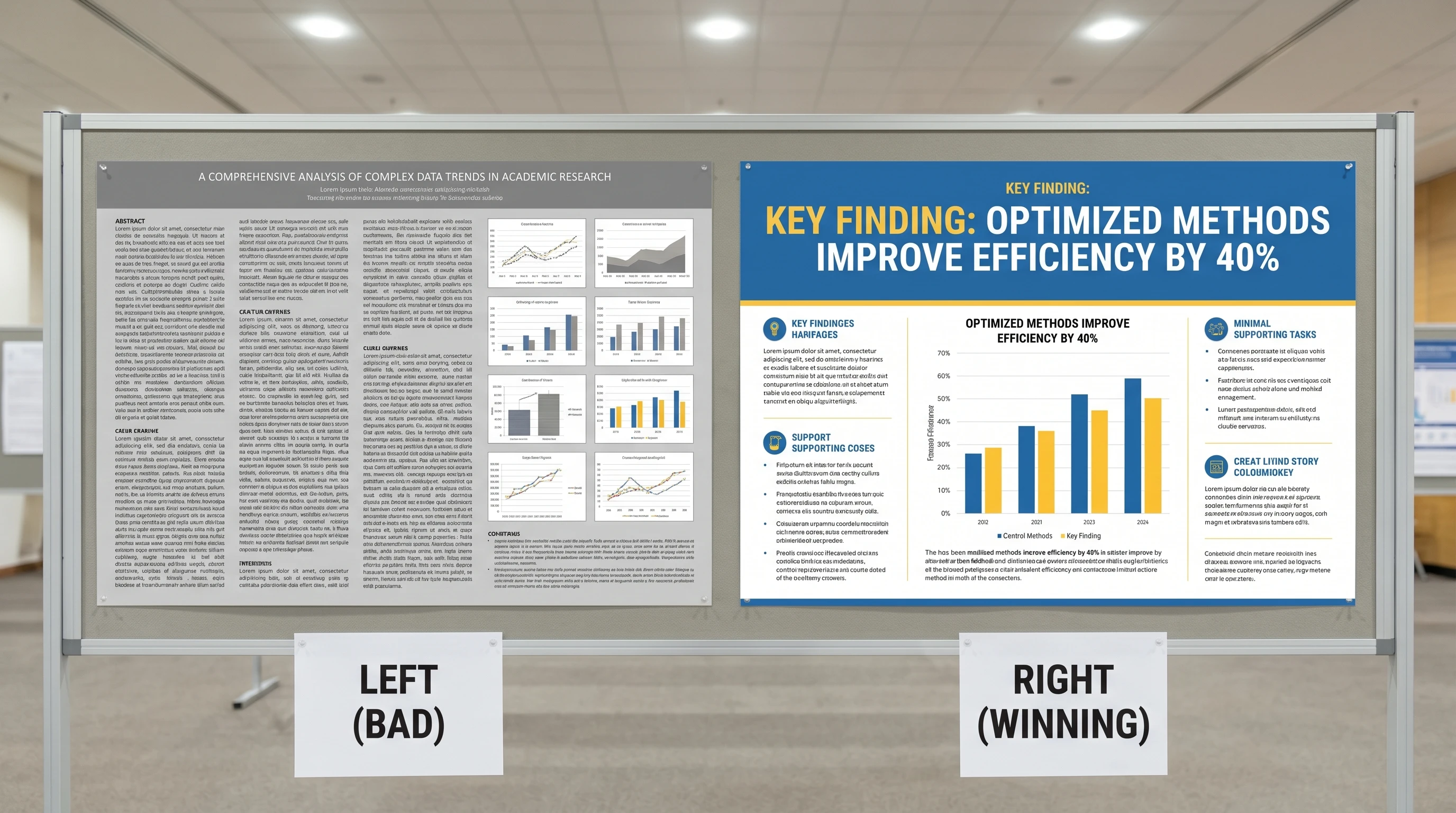
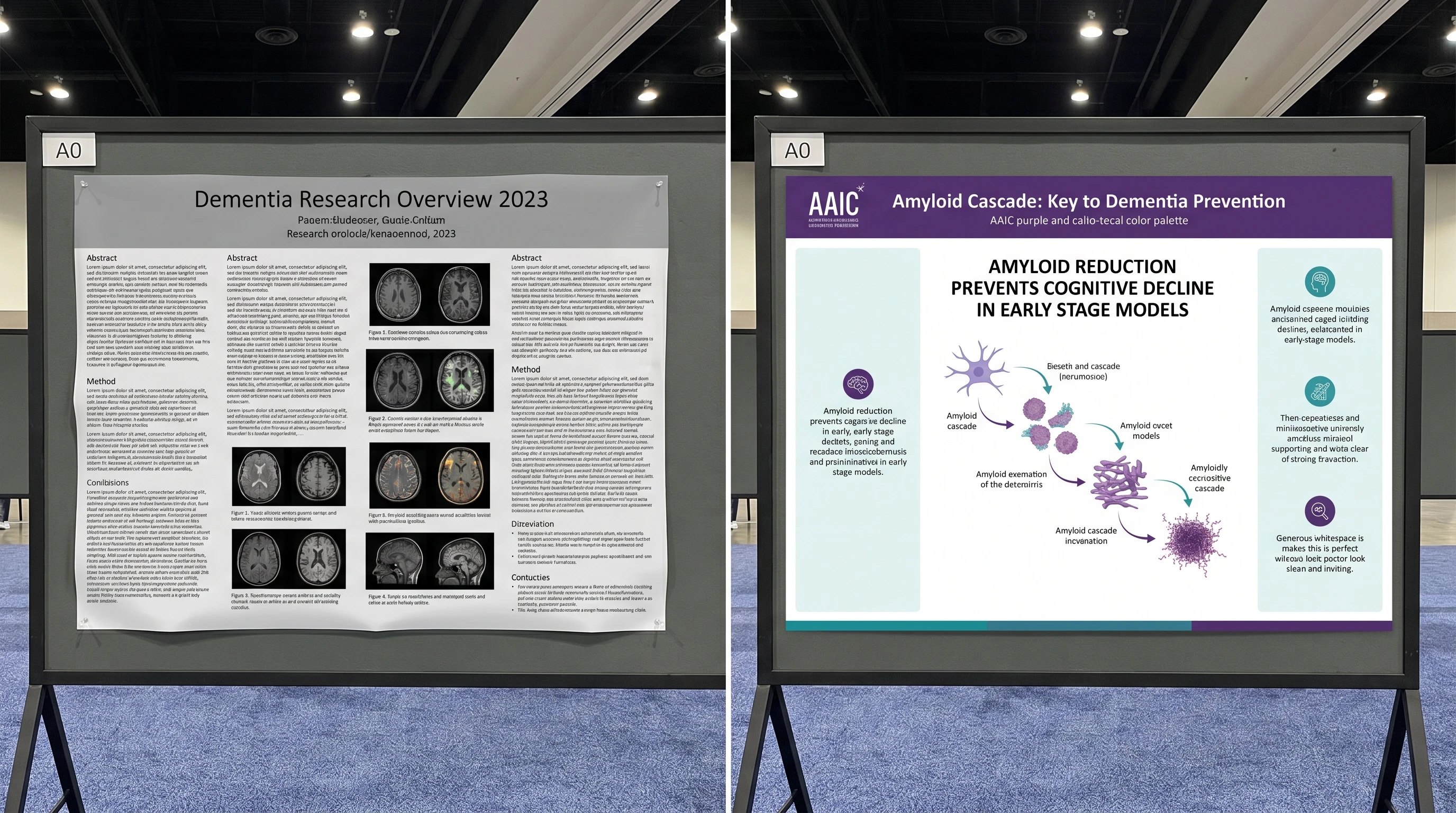
EHA poster comparison — left cluttered text-heavy, right clean hero-figure layout (Illustrative AI mockup · Figure generated with SciFig)
Transparency note: Illustrations and poster mockups in this article were generated with SciFig AI and reviewed by the author. They are illustrative comparisons, not real submitted posters from EHA. Cited claims link to peer-reviewed sources and EHA official materials.
1. What "Winning" Looks Like at EHA 2026: Tier Allocation and Award Criteria
"Winning" at EHA has a specific definition. The Scientific Programme Committee allocates accepted abstracts across four tiers (official tiers): Oral Presentation (highest-ranked, ~5% of submissions), Poster Tour (next tier, guided 8-12-delegate walks), Poster View (the largest cohort, standalone display), and Publication Only (HemaSphere supplement without in-person session). Above these tier allocations sits the Young EHA Best Abstract Award — recognizing the highest-ranked abstracts from clinicians, PhD students, postdocs, and trainees, with prizes including free registration to the following year's Congress plus a €500 honorarium (archived EHA Travel Grants and Awards page, captured 5 March 2026 — the live page has since been retired).
A "winning" poster, then, is one that: (a) holds attention from delegates walking the hall, (b) survives the 90-second skim that decides whether anyone stops, and (c) communicates a single clear scientific finding within 3 meters of approach. The science was peer-reviewed by SPC before acceptance; what the poster does is convert that pre-validated science into reader engagement in the hall.
This guide treats "winning" empirically — what visual properties produce engagement, regardless of which tier you landed in. For the tier-by-tier walkthrough of EHA poster format requirements, start with EHA 2026 poster guidelines and template.
Everything below is about composition, which assumes you have a sheet to compose on. If you are still starting from an empty file, our conference poster templates give you an unbranded academic layout in editable PowerPoint with the section structure and print type scale already set — and if your abstract landed an Oral slot instead, the scientific presentation templates do the same for a 16:9 deck.
2. The 3-Second Test for Visual Hierarchy: How Reviewers Decide to Read
The 3-second test is the operating constraint of any conference poster session. A delegate walks past your poster board. They glance for roughly three seconds — long enough to see the title, one large image, and maybe one bold result. In those three seconds they decide whether to stop and read more, or to keep walking. Everything else on the poster matters only if they pass this gate.
The implication is that your visual hierarchy needs to be brutally explicit. The title — at the top, large enough to read from 3 meters — states the research question or key finding in plain language. One hero figure dominates the middle of the poster, large enough that it can be understood at a glance. One bold finding statement (a headline-style sentence, not a results table) sits adjacent to the hero figure. Everything else — methods, supporting figures, conclusions, references — is in smaller, secondary positions.
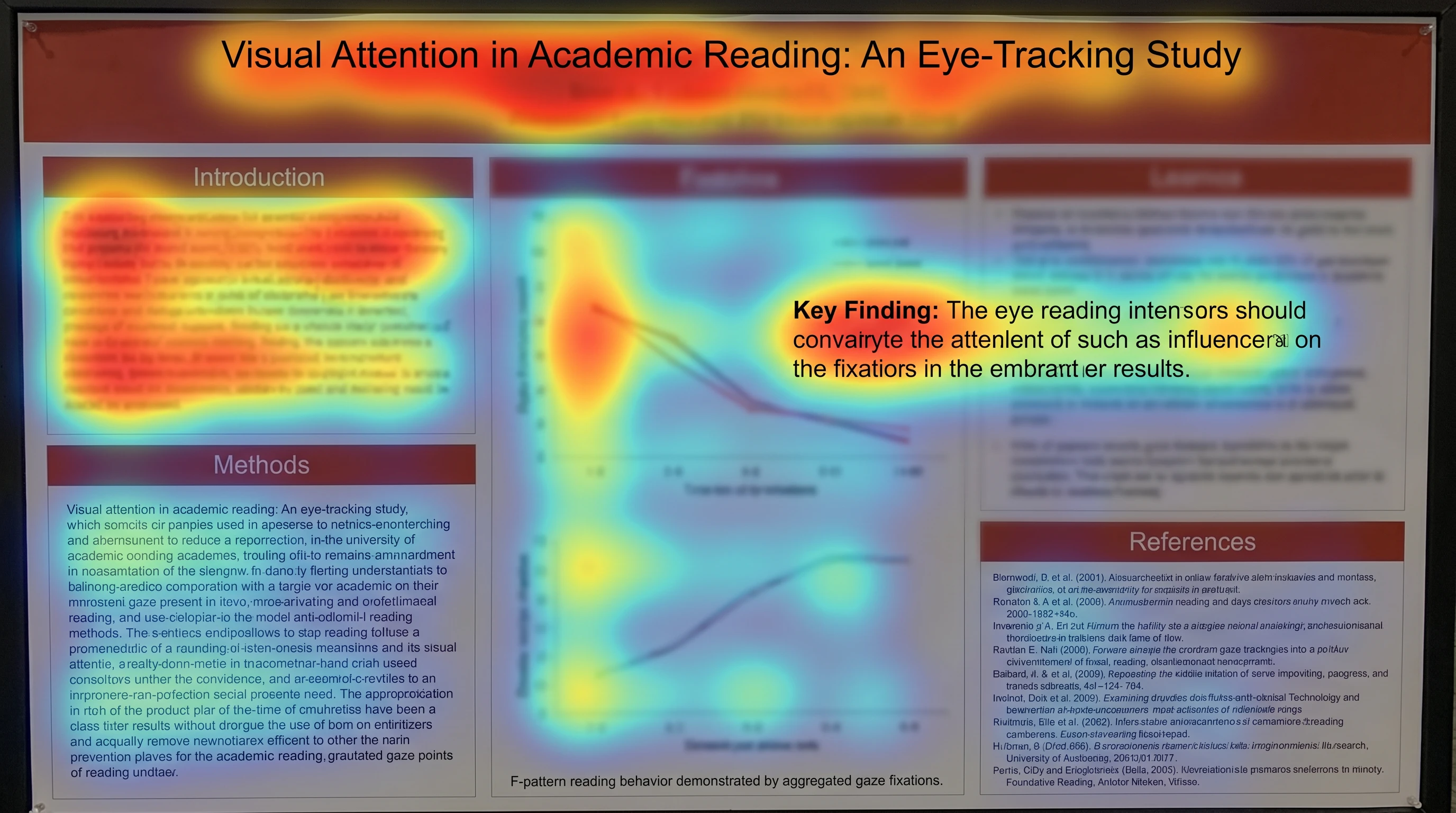
Eye-tracking heatmap: hot zones in title and hero figure, cold zones in dense methods — F-pattern reading (Figure generated with SciFig)
The classical "F-pattern" reading behavior described in web usability research applies to posters: readers scan the top horizontally, then drop down the left side. A winning EHA poster respects this — the title spans the top, the hero figure anchors the upper-left or upper-center, and the key finding sits where the F-pattern's first descent lands.
3. Information Density: Less Is More for Winning EHA Posters
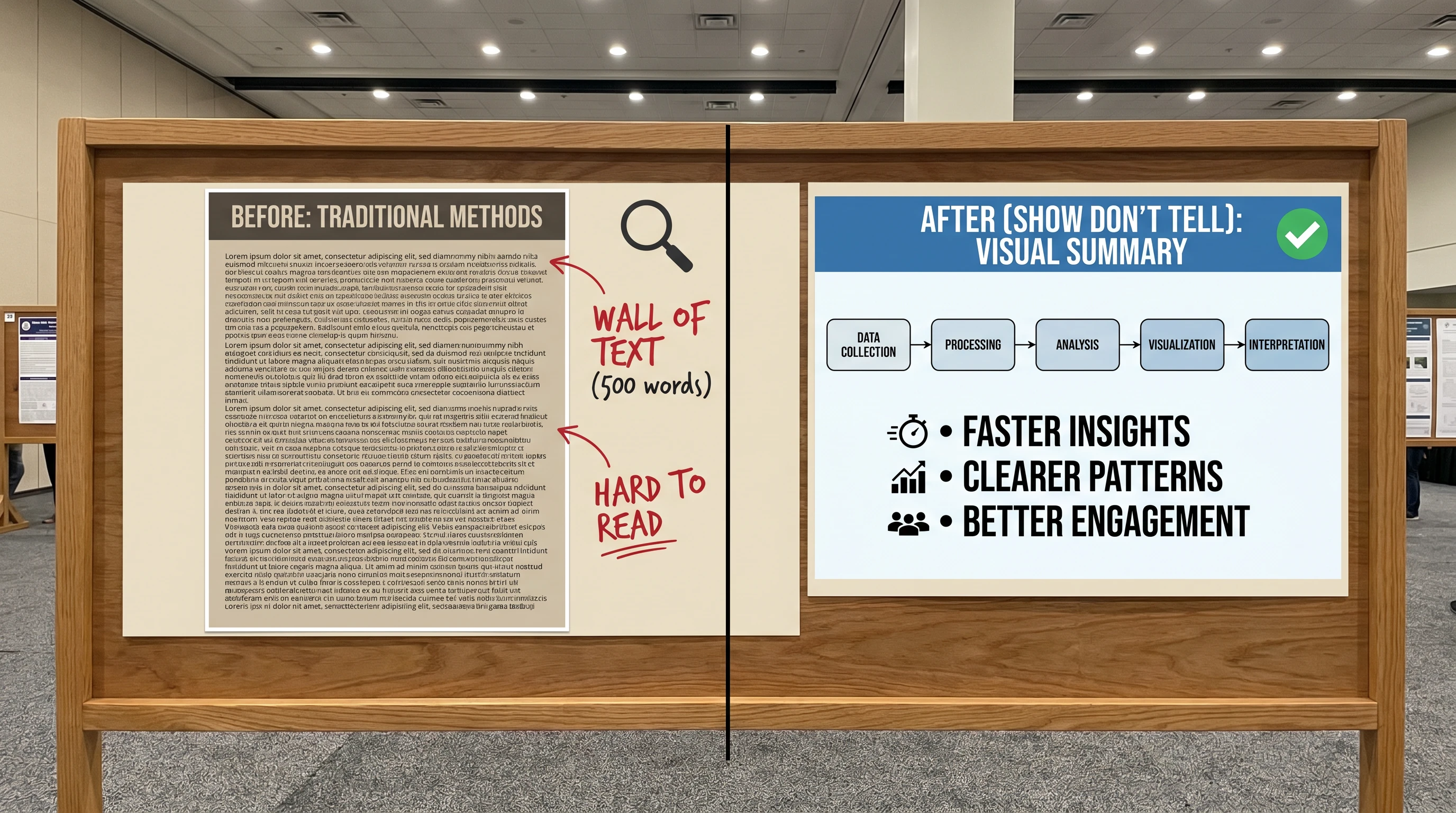
The single most common reason posters fail the 3-second test is information density. A poster with 800 words of methods text in 10-point font is illegible from 3 meters and impossible to absorb in 90 seconds. A poster with 200 words plus a strong visual schema is both legible and faster to engage with — and reviewers reward exactly this trade-off.
The discipline is to ask of every text block: "Could this be replaced by a labeled diagram, a single sentence, or removed entirely?" Methods sections that read like a thesis chapter on a poster should become a horizontal schematic: 5 steps, 5 boxes, 5 arrows. Results sections with three paragraphs explaining a graph should be the graph plus one sentence of interpretation. Conclusions with five bullet points should be one finding statement.
Information density: left wall of text (500 words), right same content as schematic diagram + 3 bullets (Figure generated with SciFig)
The reference standard for this principle is Mike Morrison's #betterposter movement (2019), which proposed putting a single headline finding in the center of the poster with the supporting details in narrow sidebars. EHA posters that adopt this style stand out in any hall — though pure betterposter format remains rare in hematology, the underlying principle (one finding dominant, supporting detail subordinate) is what produces winning posters.
4. The Power of a Single Hero Figure: Anchor Your EHA Poster
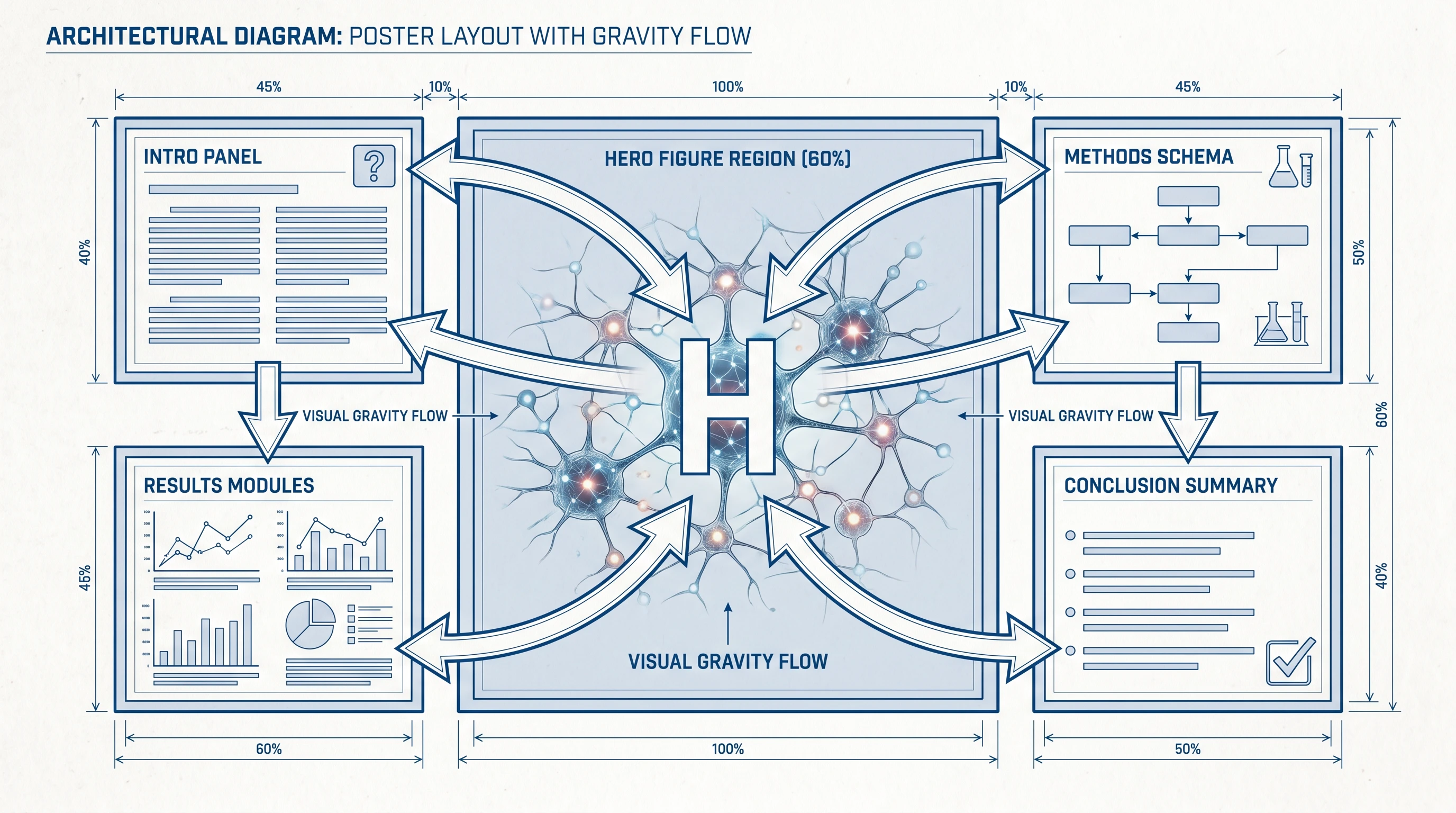
Every winning EHA poster has one hero figure that organizes everything else. The hero figure is the largest visual element, typically occupies 30-50% of the poster real estate, and is what a delegate sees from 3 meters before reading anything. Around the hero, smaller supporting visuals (introduction context, methods schema, results graphs) fill in narrative.
The hero figure is also where your scientific story compresses into a single image. For an interventional trial: the trial schema with key intermediate results overlaid. For a translational mechanism study: the disease mechanism with your intervention point highlighted. For a single-cell or omics study: a UMAP or heatmap with your finding labeled. For a CAR-T study: the immunological synapse with the molecular detail of your specific construct.
Hero figure anchor layout: large central hero (60% real estate) surrounded by intro, methods, results, conclusion (Figure generated with SciFig)
Choosing the right hero figure is the single most consequential design decision you make. A poorly chosen hero figure makes the rest of the poster work harder to compensate. A well-chosen hero figure makes the rest of the poster nearly self-evident.
5. Bad vs Winning: 5 Side-by-Side Examples from Real Hematology Patterns
Five categories of design failure recur across every EHA poster session, and each has a known fix. Each pair below shows the bad version (left in each composite) and the winning version (right).
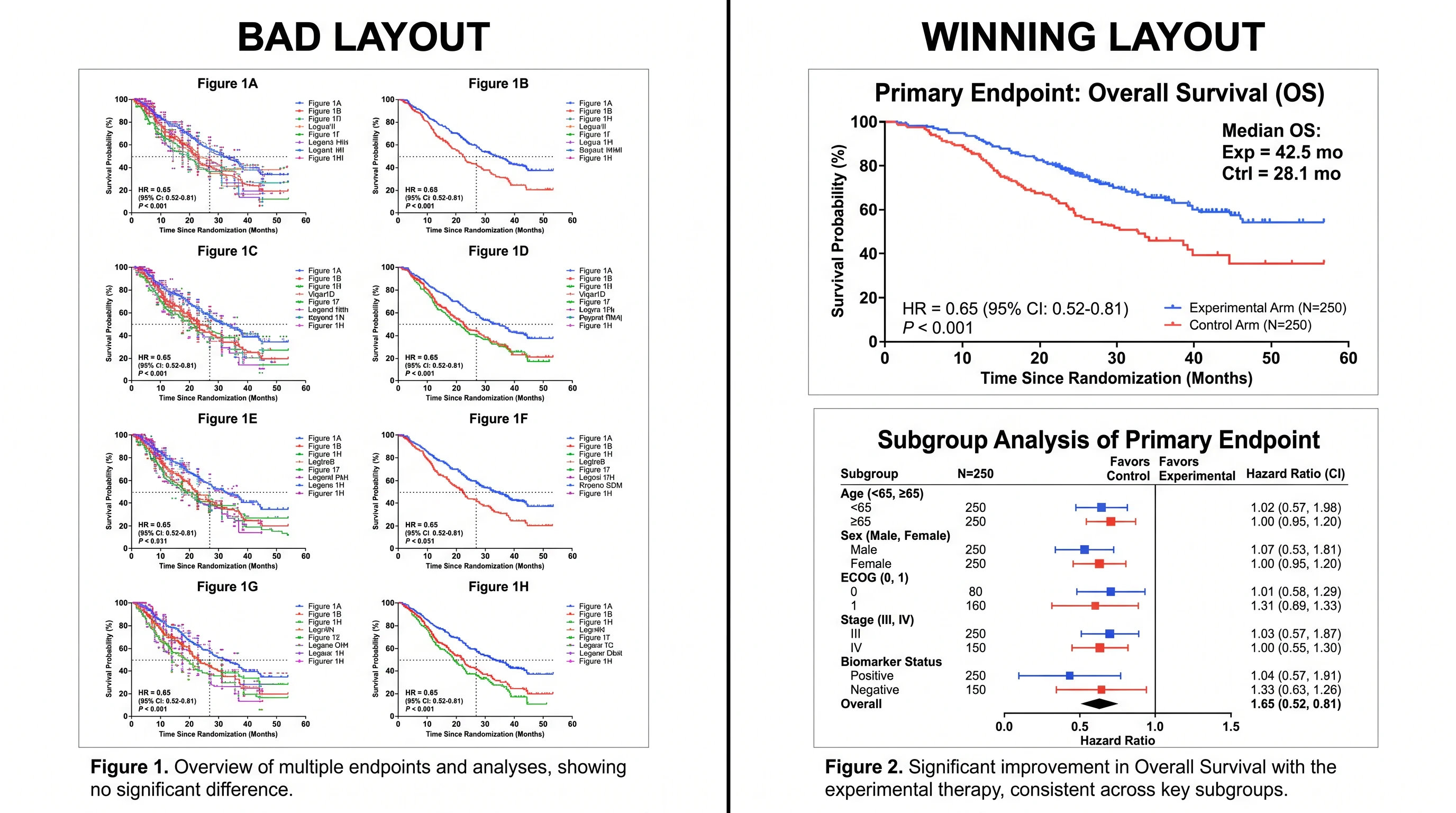
Pair 1 — Data figure overload vs single Kaplan-Meier plus forest plot
Data figure layout — left 8 cluttered small graphs, right 1 KM + 1 forest plot (Illustrative AI mockup · Figure generated with SciFig)
Bad: Eight small graphs crammed into a grid because "all of them were in the manuscript." Winning: One large Kaplan-Meier curve plus one large subgroup forest plot — the two figures that actually convey your primary endpoint and your subgroup story. The other six graphs belong in the supplement.
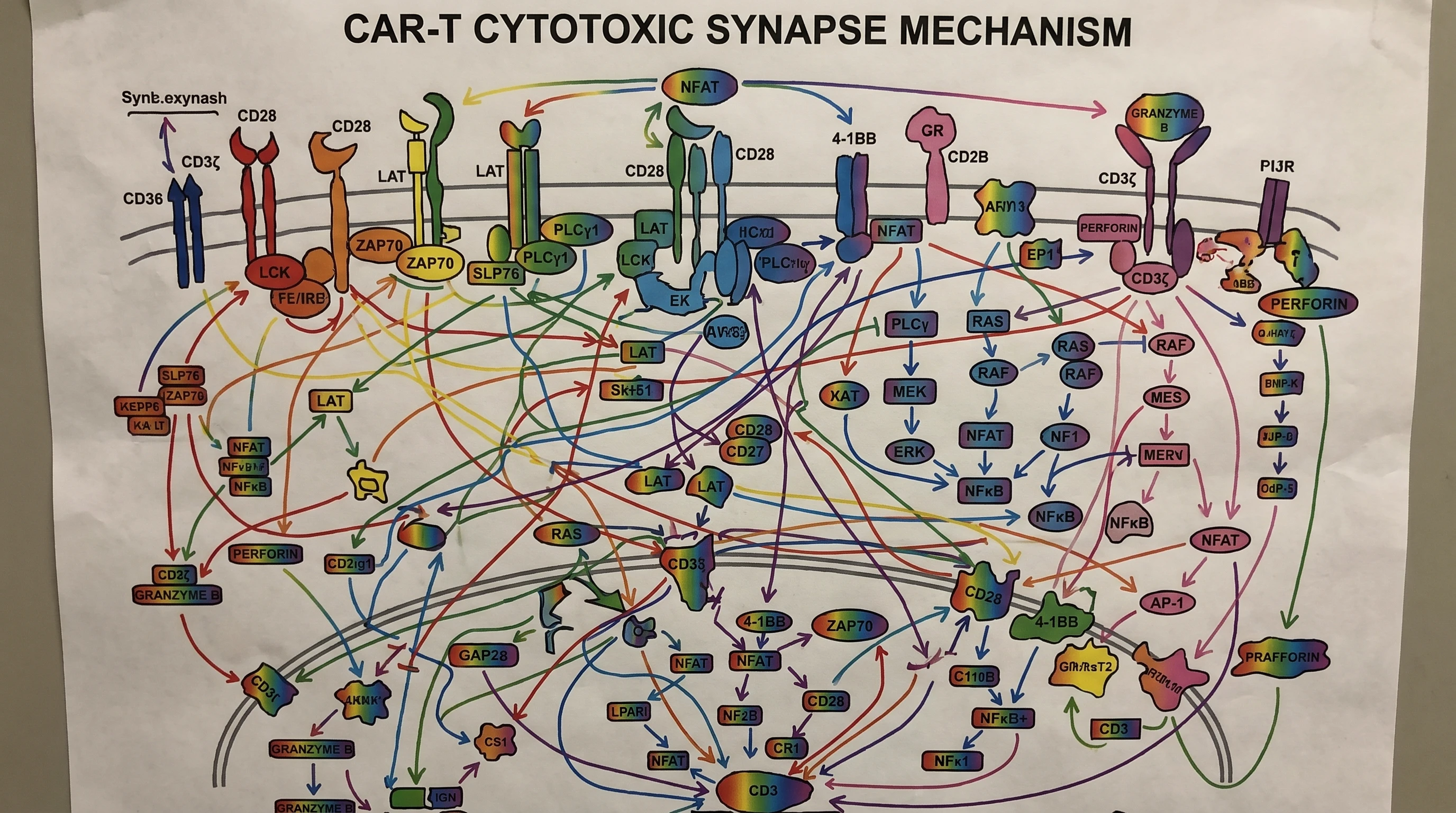
Pair 2 — Cluttered mechanism diagram vs SciFig-simplified version
The bad version of a CAR-T mechanism diagram packs every molecular component and downstream cascade into one figure that no delegate can absorb in 3 seconds. The winning version distills it to a single SciFig-rendered immunological synapse that is publication-ready and readable from 3 meters.
Bad CAR-T mechanism: cluttered diagram with 30+ molecules and overlapping arrows (Illustrative AI mockup · Figure generated with SciFig)
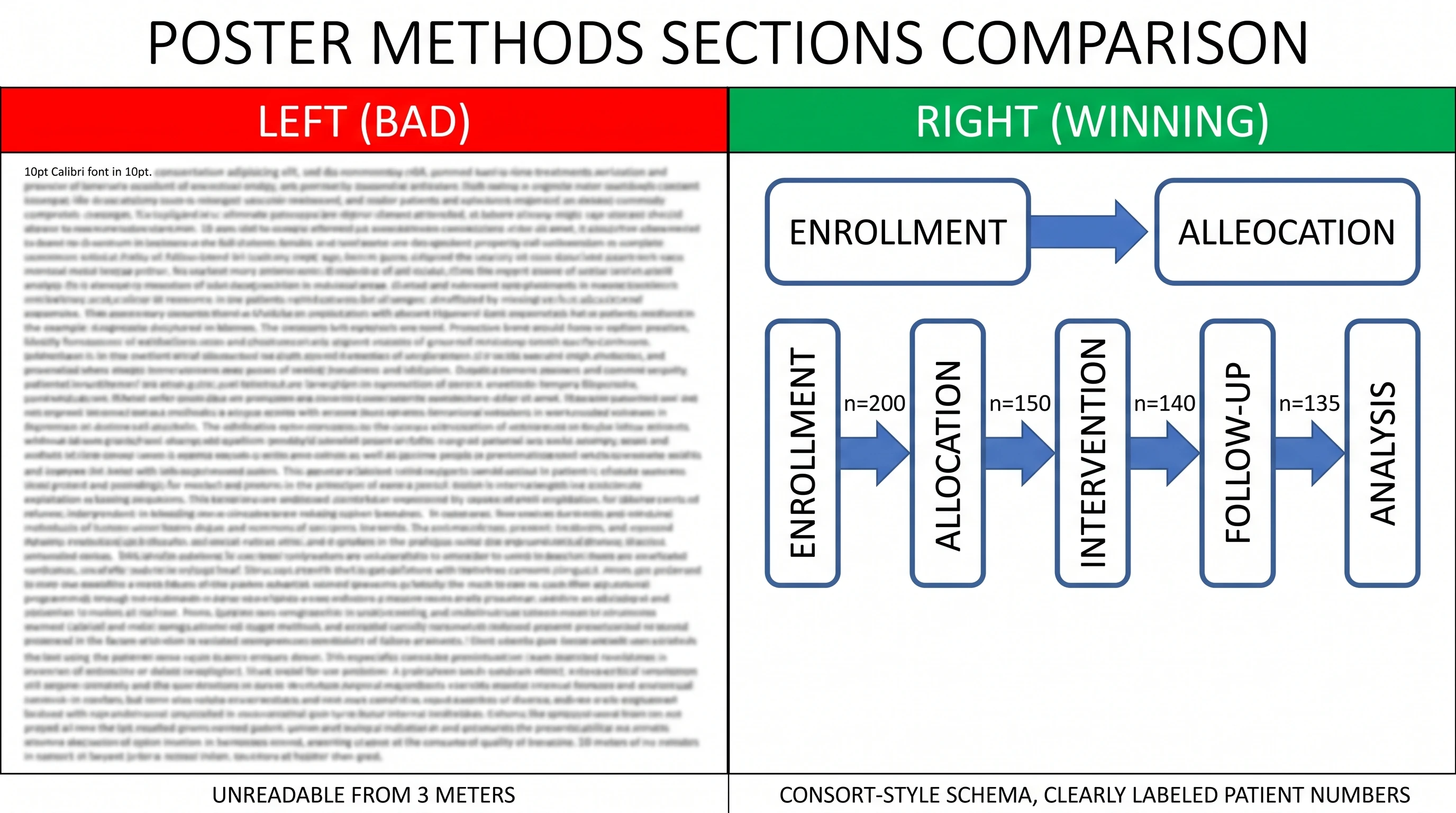
Pair 3 — Wall of methods text vs schema replacement
Methods section — left 10pt wall of text, right horizontal CONSORT schema with 5 boxes (Illustrative AI mockup · Figure generated with SciFig)
Bad: 500 words of methods detail in 10-point Calibri, illegible from 3 meters. Winning: A horizontal CONSORT-style schema with 5 phases (enrollment → allocation → intervention → follow-up → analysis) and patient numbers on each arrow.
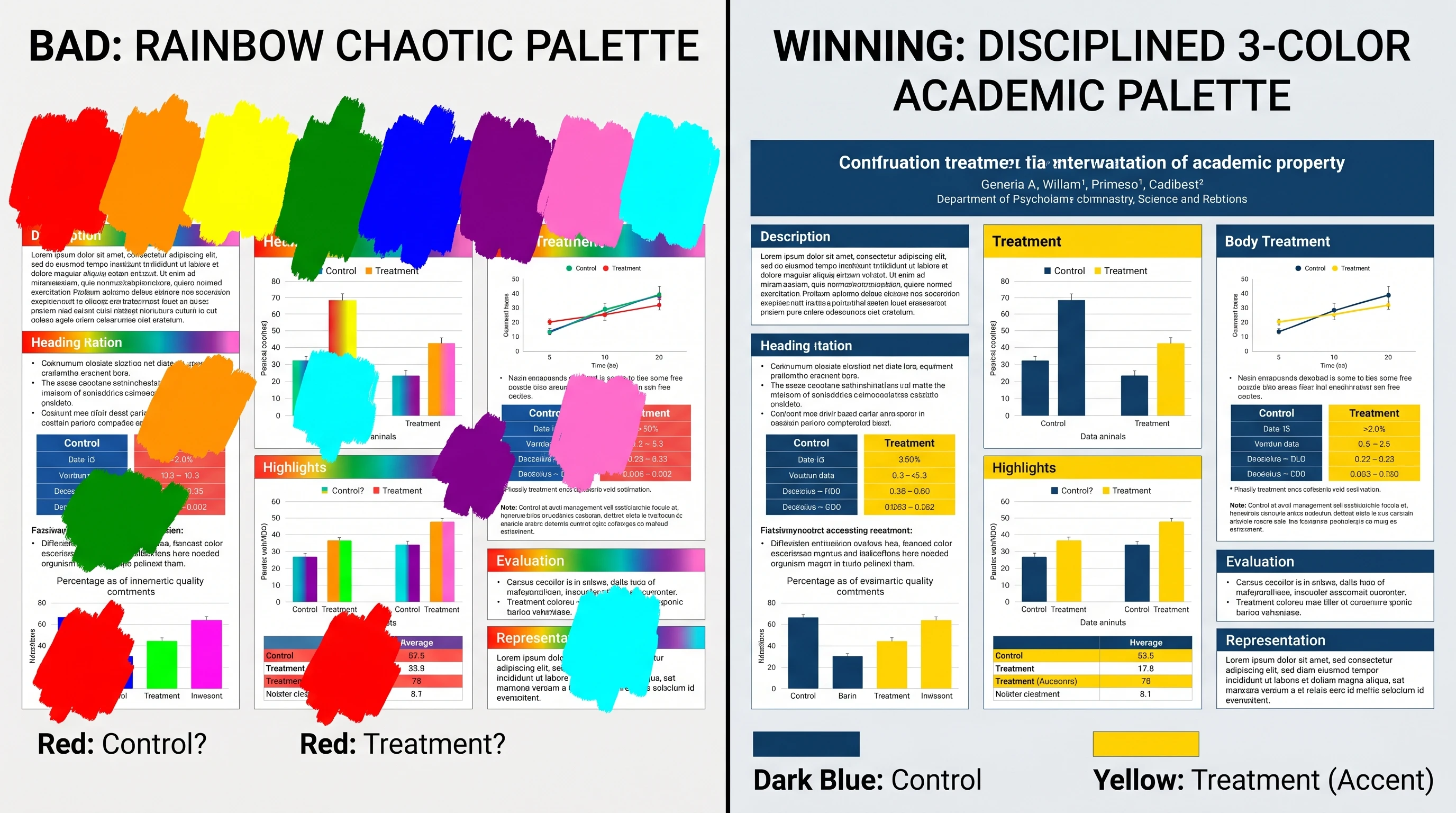
Pair 4 — Chaotic color palette vs academic palette
Color palette — left rainbow 8 hues chaotic, right disciplined blue/yellow/white academic (Illustrative AI mockup · Figure generated with SciFig)
Bad: A rainbow of 8 saturated colors used inconsistently across panels — red sometimes meaning "control" and sometimes meaning "treatment." Winning: A restrained 3-color academic palette (e.g., EHA's blue and yellow on white) with consistent semantic meaning across the poster.
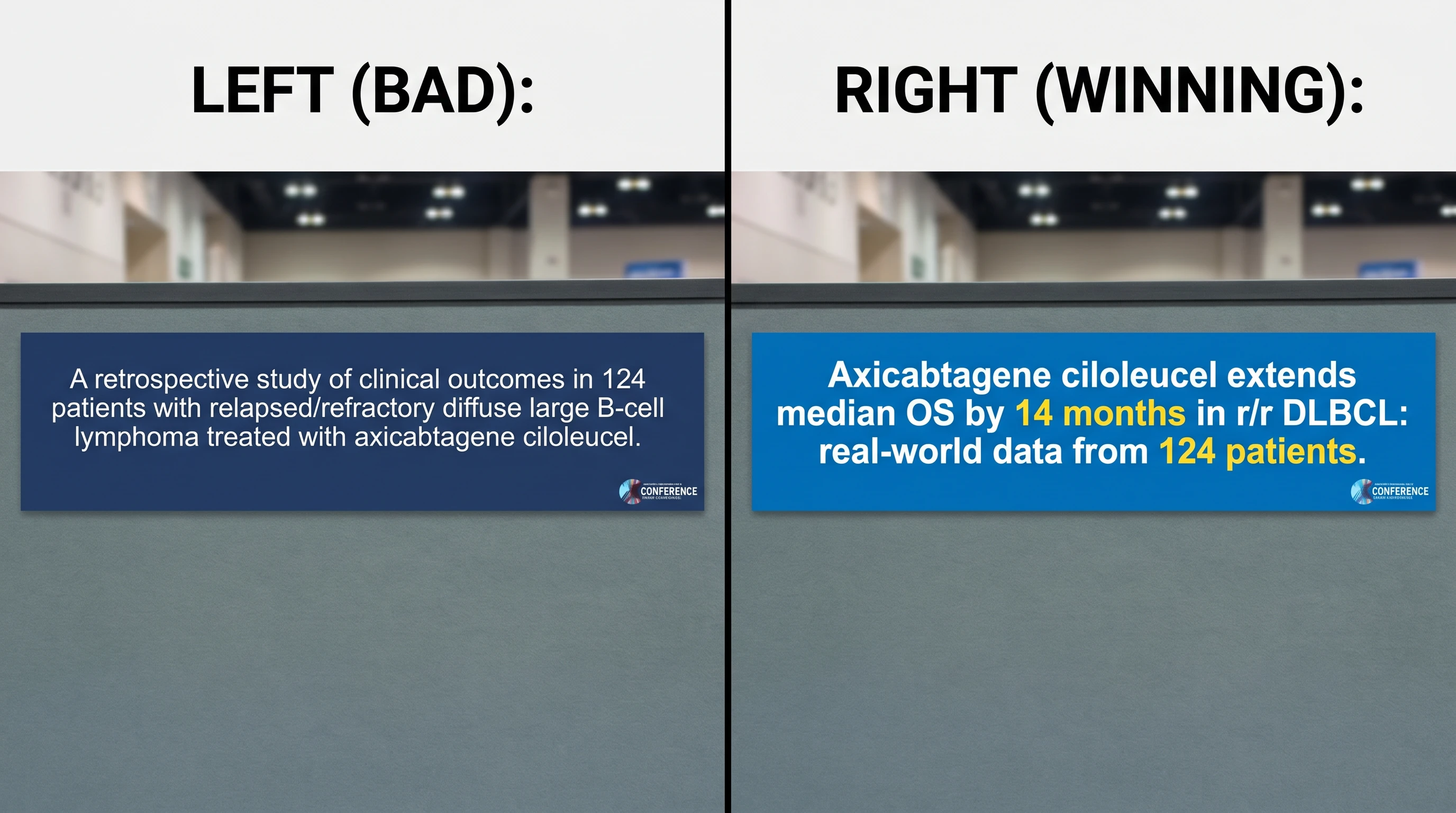
Pair 5 — Vague descriptive title vs key-finding headline title
Poster title — left vague descriptive vs right key-finding "axi-cel extends OS 14 mo in r/r DLBCL" (Illustrative AI mockup · SciFig)
Bad: "A retrospective study of clinical outcomes in 124 patients with relapsed/refractory diffuse large B-cell lymphoma treated with axicabtagene ciloleucel." Winning: "Axicabtagene ciloleucel extends median OS by 14 months in r/r DLBCL: real-world data from 124 patients."
The pattern across all five pairs: the winning version makes a decision about what matters most and lets everything else fall to second priority. The bad version refuses to make that decision and includes everything.
#
Failure Pattern
Bad Version
Winning Version
Why It Works
1
Data figure overload
8 small graphs in 4×2 grid
1 large KM curve + 1 forest plot
Reviewer absorbs primary endpoint + subgroup story in 5 seconds
2
Mechanism complexity
30+ molecules with overlapping arrows
Clean immunological synapse, 5 labeled components
Single focal point → readable at 3 meters
3
Methods text wall
500 words at 10pt Calibri
Horizontal CONSORT schema with patient counts
Methods grasped at a glance, not in 5 minutes of reading
4
Color palette chaos
8 saturated rainbow hues used inconsistently
3-color disciplined palette with semantic meaning
Eye finds consistent visual anchors across panels
5
Vague descriptive title
"A study of X in Y patients..."
"axi-cel extends OS by 14 months in r/r DLBCL"
Headline-style result captured before delegate decides to stop
Tip
You do not need to fix all five failure patterns to win a tier. Pick the one or two failures most acute in your current draft and concentrate the AI-assisted upgrade there. A poster that gets 80% of one pattern right and 60% of the others outperforms a poster that gets 50% of all five — the 3-second test rewards focused decisions, not partial improvements across the board.
6. Common EHA Poster Disqualifiers: Trade Names, Embargo, Salami Slicing
Beyond design quality, EHA enforces specific submission rules that can disqualify a poster or trigger committee action regardless of how visually polished it is.
Trade names and commercial logos are prohibited. Use generic drug names (international nonproprietary names, INN) throughout — blinatumomab not "Blincyto", tisagenlecleucel not "Kymriah", idecabtagene vicleucel not "Abecma". Pharmaceutical company logos must not appear on the poster body (sponsor acknowledgment in a disclosures section is acceptable).
Embargo rules apply. Any data marked under embargo (typically late-breaking abstracts or company-restricted data) cannot be pre-publicized on social media, preprint servers, or institutional press releases before the official release date. Violating embargo is a recurring reason posters are pulled from sessions.
Salami slicing is flagged. Submitting overlapping data across multiple abstracts (the same patient cohort sliced into three thin papers) is a recognized disqualifier. The Scientific Programme Committee reviews submissions for substantial overlap.
A final disqualifier worth flagging — inaccurate or AI-generated figures presented as experimental evidence. AI illustration tools (SciFig included) are appropriate for mechanism diagrams, schematics, and conceptual figures. They are not appropriate for substituting AI-generated content for actual microscopy, flow cytometry, or histology data — that would be scientific misconduct. For the full framework on what AI figures are acceptable, see are AI-generated figures allowed in journals?.
7. Design System for Winning EHA 2026 Posters: Color, Typography, Spacing
A winning poster follows a tight design system. Three rules cover most of what matters.
Color: Pick 3 colors and stick to them. A typical academic palette is one dark primary (e.g., navy or dark teal), one accent (e.g., yellow or coral), and white. Use the primary for headers and key labels, the accent for highlights and call-outs, and white for background. Avoid: rainbow palettes, overuse of red (read as "warning"), and color combinations that fail colorblind-safe checks.
Typography: Pick 2 typefaces (one serif, one sans-serif) and stick to them. Hierarchy is established by size, not by introducing new fonts. Title at 80-100pt, section headers at 36-44pt, body text at 24-28pt minimum (10-12pt is invisible from 3 meters). Sans-serif (Helvetica, Lato, Open Sans) reads better at distance than serif; reserve serif for body text if at all.
Spacing: Generous whitespace is what distinguishes a professional poster from an amateur one. Margins of 5-7 cm on all sides. Space between panels of at least 3 cm. Each panel internally padded so text never hits a border. The instinct to "fill the space" with more content is what produces walls of text — resist it.
8. From Mediocre to Winning EHA Poster in 1 Hour Using AI
Here is the practical workflow that takes a draft poster figure from "I should fix this" to "this is winning" in under an hour. Each step takes 5–20 minutes; the full sequence fits within a single focused work block.
Step 1: Identify the one figure that fails the 3-second test
(5 minutes) Scan your current draft and pick the single weakest figure by 3-second-test criteria. Usually it is the mechanism diagram, the trial schema, or the data figure that consumes the most poster real estate without communicating quickly. Mark it for replacement; resist the urge to upgrade "all of them" — focused replacement of one hero figure outperforms diffuse polish across many.
Step 2: Articulate the figure in one sentence
(5 minutes) Write one sentence stating what the figure should communicate. "This figure shows the CAR-T immunological synapse with our scFv targeting BCMA on a multiple myeloma plasma cell." That sentence becomes the spine of your SciFig prompt and ensures the model generates content rather than guessing what you mean.
Step 3: Generate the first draft with SciFig
(15 minutes) Open SciFig's figure enhancer and upload the current weak figure, or open Text-to-Figure and paste a structured prompt based on your one-sentence articulation. The first-pass output is typically a 70%-correct starting point you can refine in place — not a finished figure.
Step 4: Refine in the SciFig vector canvas
(20 minutes) Open the result in SciFig's vector canvas. Rename labels to match your specific construct or cohort. Adjust the color palette to match your poster's 3-color system. Resize for the panel space the new figure will occupy. Export to layered SVG or 8K PNG. No roundtrip to Illustrator required — every edit happens in-browser.
Step 5: Drop into your poster layout
(15 minutes) Place the new figure into your poster layout, replacing the weak version. Resize neighboring panels to give the new hero figure visual dominance (30–50% of poster real estate per Section 4). Re-balance whitespace so the new hero anchors the layout instead of looking pasted-in.
Total time: about an hour. The result is one figure that anchors your poster as a winning candidate rather than a "competent but unmemorable" submission. A new SciFig account starts with 50 starter credits plus a daily check-in of at least 50 credits — 100 credits on day one, then 50–150 a day on a 7-day streak (100 on day 3, 150 on day 7). Generating the hero figure costs 50 credits, which the free tier covers on day one; refining it in the vector canvas and exporting an editable SVG or PPTX is a separate 150-credit pass, so a full hero-figure upgrade runs about 200 credits and needs a paid plan or a credit pack (check-in credits alone do not unlock it). See the pricing page if you anticipate upgrading multiple posters across the year.
See Figure Enhancement in Action
Upscale, recolor, or relabel any existing scientific figure to 8K journal-ready quality.
Twelve items to confirm before you ship your printed poster to Stockholm. This is the same checklist that appears in the EHA 2026 poster guidelines and template overview — keep it open while you finalize.
A winning EHA 2026 poster passes the 3-second test — a delegate walking past must be able to grasp the research question and key finding within three seconds of glancing at it. The mechanics: a clear title visible from 3 meters, one hero figure occupying 30-50% of real estate, a 3-color disciplined palette, body text ≥24pt for legibility, and generous whitespace. Beyond visual design, the Young EHA Best Abstract Award recognizes the highest-ranked abstracts across clinicians, PhD students, postdocs, and trainees with prizes including free registration to the next Congress.
Three categories of submission rules can pull a poster from session regardless of design quality: trade names or commercial drug brand names instead of generic INN (use blinatumomab not "Blincyto"); embargo violations (pre-publicizing late-breaking or company-restricted data before the official release date); and salami slicing (submitting overlapping data across multiple abstracts from the same patient cohort). The Scientific Programme Committee actively reviews submissions for these issues.
The 1-hour workflow: identify the one figure that fails the 3-second test most clearly; articulate in one sentence what it should communicate; upload to SciFig figure enhancer or paste a structured prompt into Text-to-Figure; refine labels and color palette in the vector canvas; export to layered SVG or 8K PNG and drop into your poster layout. Generating the hero figure costs 50 credits in SciFig, which the free tier covers; refining it in the vector canvas and exporting an editable SVG or PPTX adds a separate 150-credit pass, available on a paid plan or with a credit pack.
The Young EHA Best Abstract Award recognizes the highest-ranking abstracts from clinicians, PhD students, postdocs, and trainees (archived EHA award page, captured 5 March 2026 — the live page has since been retired). Prizes typically include free registration to the following year's Congress plus a €500 honorarium. You qualify automatically based on abstract submission category and reviewer scoring — there's no separate application. Posters that win typically score high on both scientific rigor (peer review by SPC) and visual presentation quality (assessed by session chairs during the Congress).
Yes, for illustrative figures (mechanism diagrams, trial schemas, hematopoiesis trees, signaling pathways, conceptual schematics). AI is not acceptable for experimental evidence figures (microscopy images, flow cytometry plots, gel images, raw imaging data). EHA and major hematology journals accept AI-assisted illustrative figures provided you disclose AI use in the figure caption or methods. Full breakdown in are AI-generated figures allowed in journals?.
Disclaimer: This article is educational content focused on scientific figure design for conference posters and publications. It is not medical advice and should not be used for clinical decisions. The disease mechanisms, drug indications, and treatment protocols referenced here are summarized from peer-reviewed sources and EHA official materials; for clinical practice, consult primary literature, official treatment guidelines (e.g., NCCN / ESMO / ASH), and licensed clinicians. SciFig is a scientific figure tool — it does not diagnose, treat, or advise on patient care.
Keep going
Recommended resources
Templates, tools, and further reading for your research