
Soybean Aphid Life Cycle
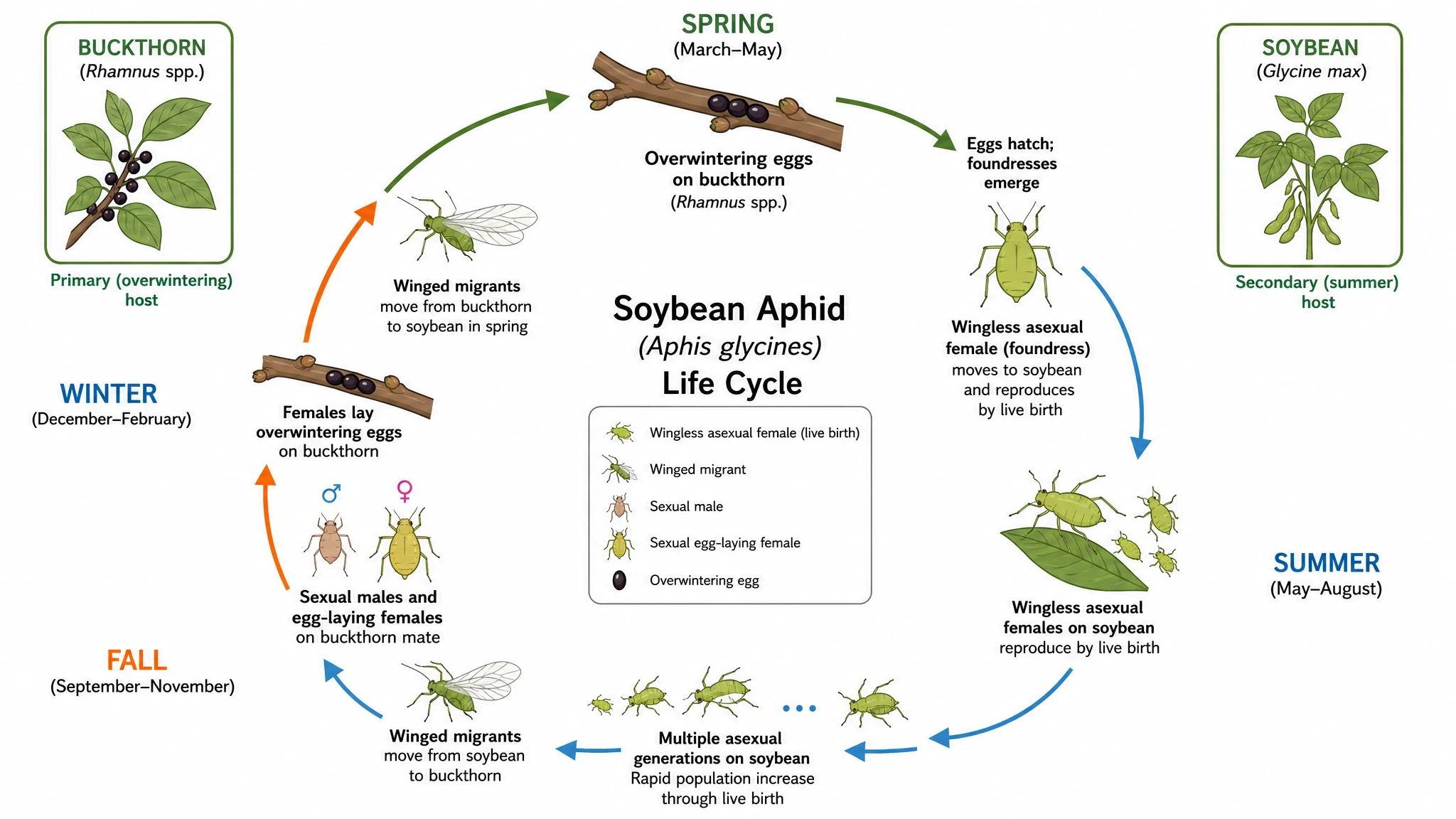
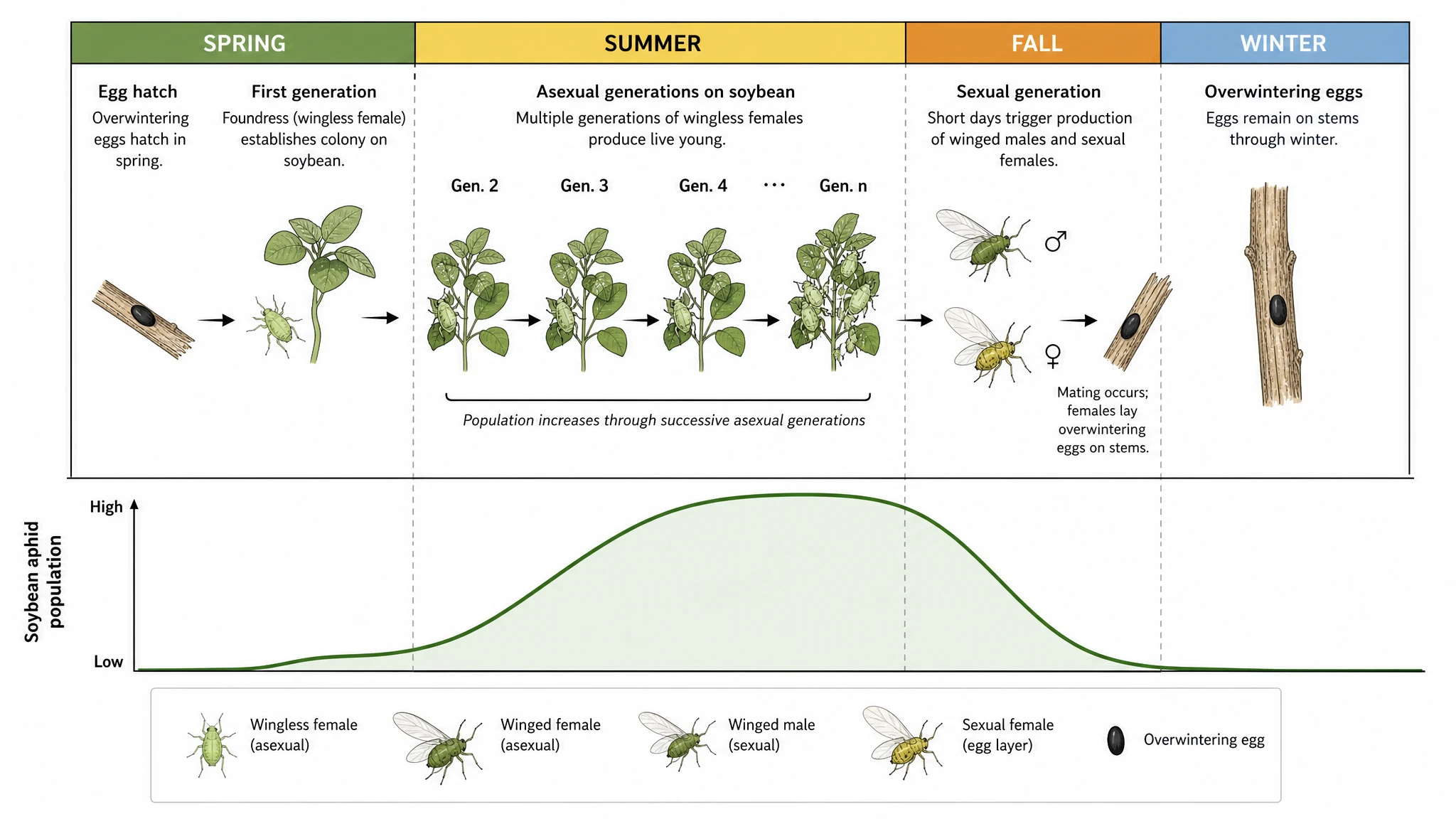
An editable life-cycle diagram of the soybean aphid showing the alternation between asexual summer generations and the sexual fall generation across its host plants.
Updated

Start with up to 150 free credits|No credit card required
Get up to 350 free credits on day one when you join through an invite.
What is Soybean Aphid Life Cycle?
A soybean aphid life cycle diagram shows the alternation of generations across seasons and host plants. Overwintering eggs on the primary host (buckthorn) hatch into wingless females that reproduce asexually through several summer generations on soybean, producing winged migrants; in fall, sexual males and females return to buckthorn to mate and lay overwintering eggs. With SciFig you describe the aphid life cycle and generate a clean, editable diagram you can relabel and export.
Why Researchers Draw This Figure
- The species is holocyclic and host-alternating; a diagram that omits either the sexual phase or the woody winter host misrepresents where the population actually persists between seasons.
- Clonal summer reproduction with telescoping embryos explains field doubling times of a few days — the mechanism only becomes intuitive when drawn.
- Management decisions are keyed to specific morphs and specific windows, so extension material needs the phenology, not just a list of stages.
- Winged morph production is condition-dependent (crowding, declining host quality, natural enemies), and a static stage list gives no place to show that branch point.
- The overwintering host is an invasive shrub whose removal is an actual control lever, which the figure makes arguable rather than assertable.
- Resistance-breaking biotypes and virus transmission both depend on which generation is present when, so the timeline doubles as a reference for experimental scheduling.
Stages and Morphs to Label
- Overwintering egg — laid at buds and in bark crevices of common and glossy buckthorn; the only cold-hardy stage and the sole overwintering reservoir in temperate production regions.
- Fundatrix (stem mother) — the wingless foundress hatching in spring, parthenogenetic and viviparous, initiating one to several generations on the woody host.
- Winged spring migrants — alate females produced on buckthorn that colonize seedling soybean, usually a small founding population relative to what follows.
- Apterous viviparae — the wingless clonal summer females on soybean; four nymphal instars, roughly a week per generation under warm conditions, and up to fifteen or more generations per season.
- Alate viviparae — winged clonal females triggered by crowding and declining host quality, responsible for within- and between-field spread.
- Gynoparae and males — the autumn winged morphs, cued by shortening photoperiod and cooler temperatures, that fly back to the woody host.
- Oviparae — the sexual, egg-laying females produced on buckthorn by the gynoparae; they mate with the arriving males and close the cycle.
Where This Figure Is Used
- Integrated pest management extension bulletins that tie scouting and the economic threshold to a specific window in crop development.
- Host-plant resistance research on Rag genes, where virulent biotypes must be described against the generation structure they arose in.
- Plant virology: this insect vectors Soybean mosaic virus and Alfalfa mosaic virus non-persistently, so transmission risk tracks the migrant flights rather than peak density.
- Landscape-scale studies of buckthorn removal and its effect on spring colonization pressure.
- Degree-day and population models that need explicit developmental thresholds and generation times per morph.
- Biological control work on parasitoids and predators, where natural-enemy pressure is one of the cues that pushes the population toward winged morphs.
What This Template Gives You
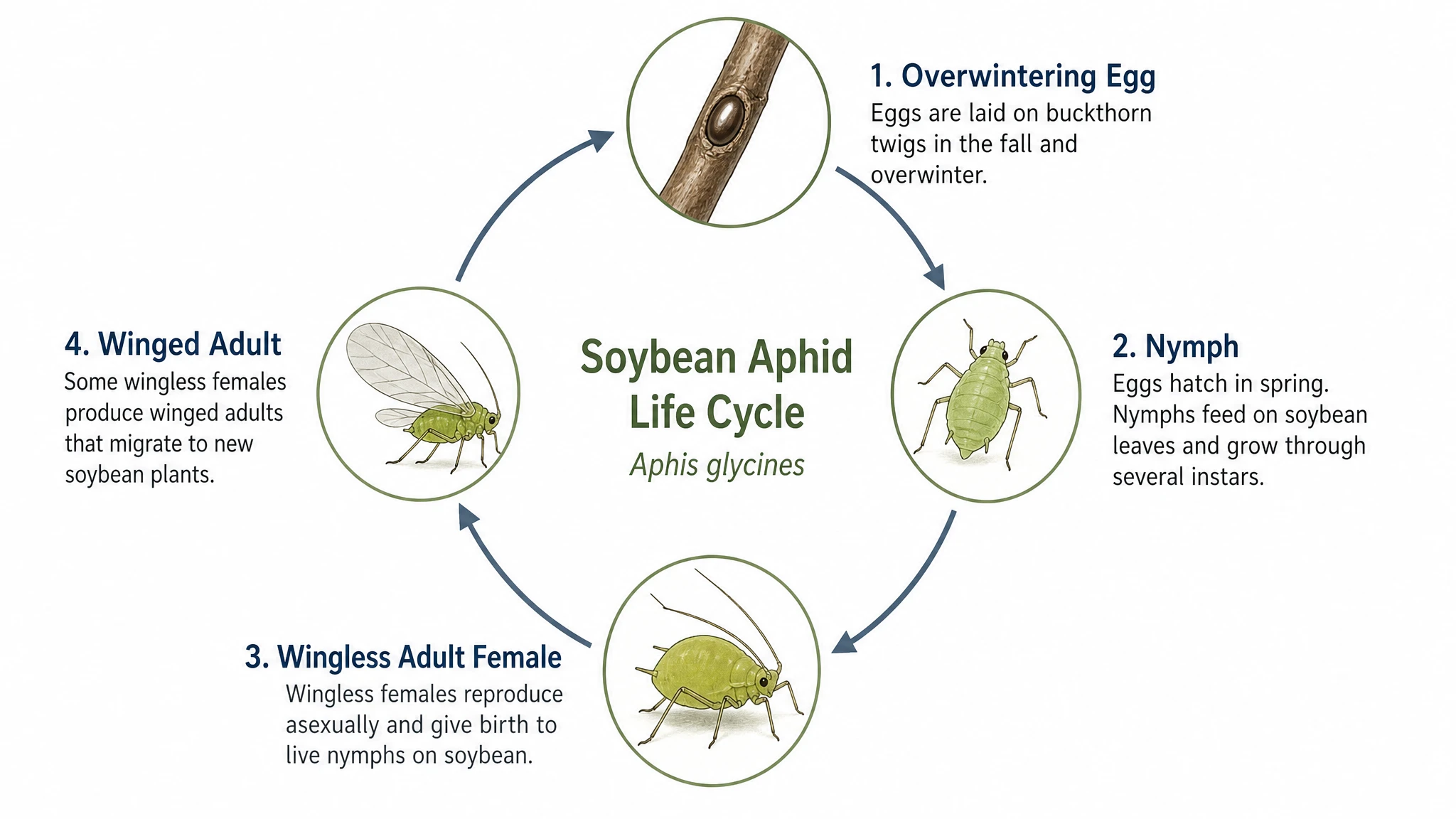
Closed annual cycle with both hosts on one ring
The circular layout closes the year from overwintering egg back to overwintering egg, with buckthorn (Rhamnus cathartica) and soybean placed on opposite arcs of the ring. Because the insect is heteroecious, migration is not an incidental arrow but a structural feature of the diagram: the two host arcs are separated visually, and the spring and autumn flights are the only paths between them.
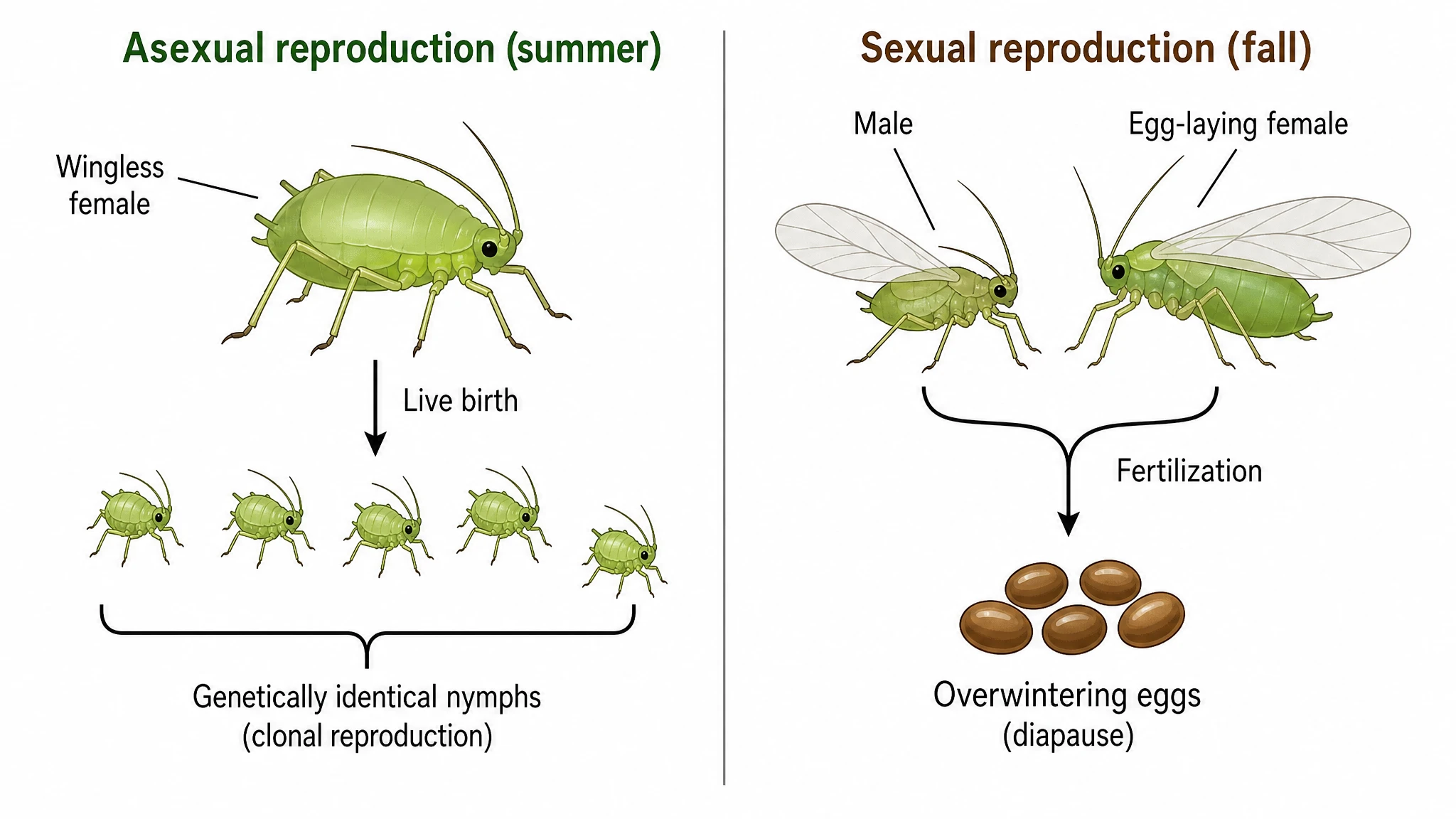
Parthenogenetic and sexual phases shown as distinct arcs
The asexual summer arc shows viviparous, clonally reproducing females — offspring emerge live and already carry developing embryos, the telescoping of generations that produces explosive field growth. The autumn arc shows the return to sexual reproduction: gynoparae, then oviparae mating with males and depositing eggs. Marking the ploidy and reproductive mode on each arc keeps readers from reading the whole ring as one uniform mode.
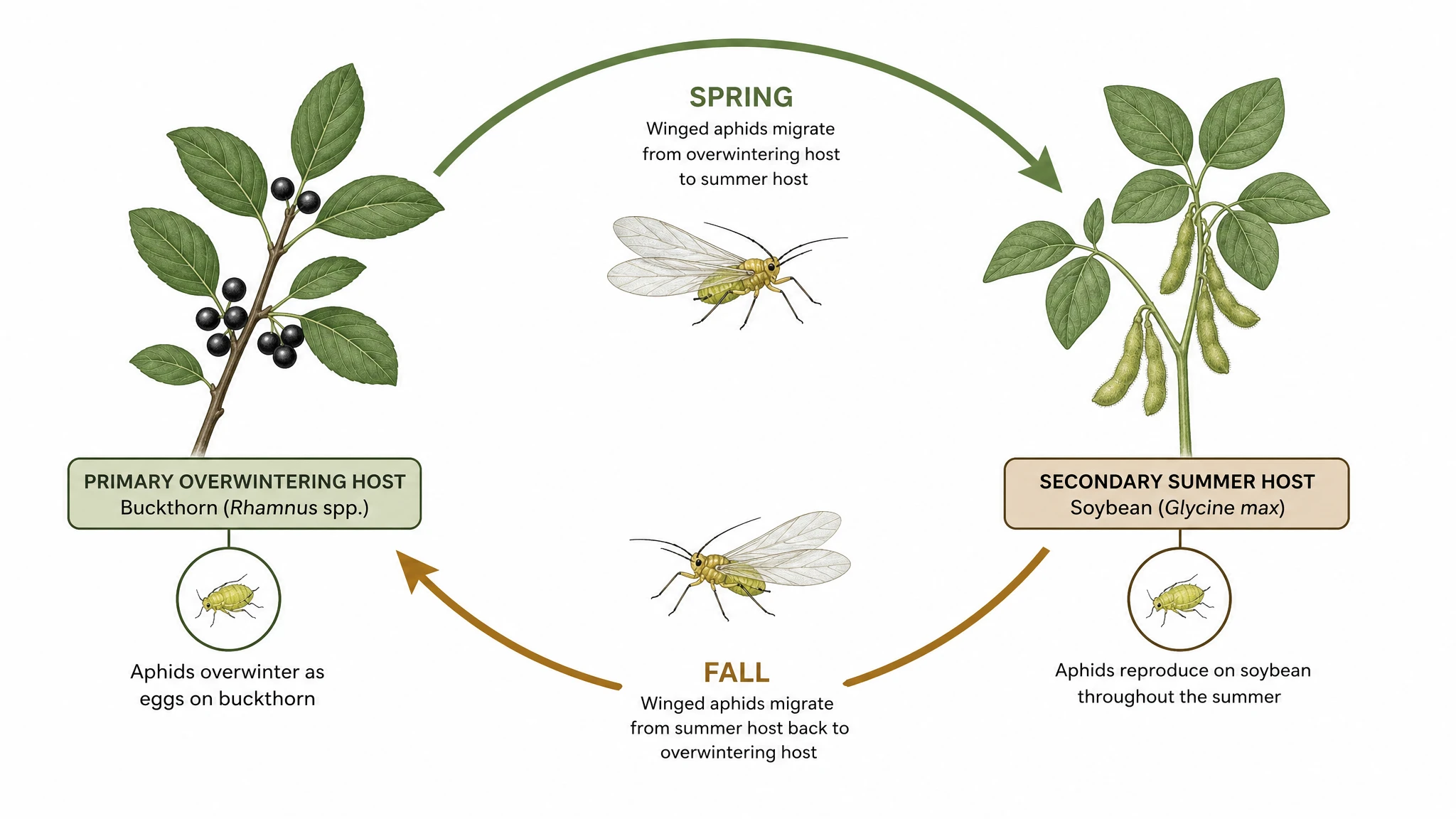
Host alternation between buckthorn and soybean
The primary woody host carries the egg and the spring foundress generations; the secondary herbaceous host carries the many summer generations that cause economic damage. The panel labels which morphs make each flight — winged spring migrants outbound, gynoparae and males inbound — and notes that the overwintering host is a naturalized invasive shrub, which is why local buckthorn density partly predicts spring colonization pressure.
Seasonal timeline aligned to the crop calendar
The linear timeline maps egg hatch, spring migration, the summer build-up, alate production under crowding, and the autumn return onto months and crop growth stages. This is the version scouting and extension documents need, because a threshold such as 250 aphids per plant during late vegetative to early reproductive stages only means something when it sits on the phenological axis rather than on an abstract wheel.
Soybean Aphid Life Cycle— templates & examples
How to make Soybean Aphid Life Cycle
Describe your figure
Tell SciFig what to draw in plain language — no design tools required.
Generate with SciFig
Get a clean, publication-ready figure that matches your description in seconds.
Edit & export
Vectorize it into editable SVG, relabel everything, and export for your paper, poster, or slides.
Related searches
- aphid life cycle
- soybean aphid life cycle
- aphid sexual and asexual reproduction
- aphid life cycle stages
- soybean aphid host plants
- aphid host alternation
- aphid reproduction diagram
- aphid life cycle stages diagram
- soybean aphid generations
- aphid life cycle chart
Make figures for
Related pages
Entomology Templates
Browse more Entomology templates in SciFig's library.
All Templates
Browse every template page in SciFig's library.
Graphical Abstract Maker
Summarize your study in one panel
Scientific Poster Generator
Design a conference research poster
AI Scientific Image Generator
Generate research figures from text
Conceptual Framework Generator
Map variables and their relationships
Frequently Asked Questions
Common questions about Soybean Aphid Life Cycle.

Ready to publish?
Make your own Soybean Aphid Life Cycle in minutes.
Start for freeFree to start · No credit card required · Built for researchers