
Triacylglycerol (TAG) Biosynthesis in Plant Cells
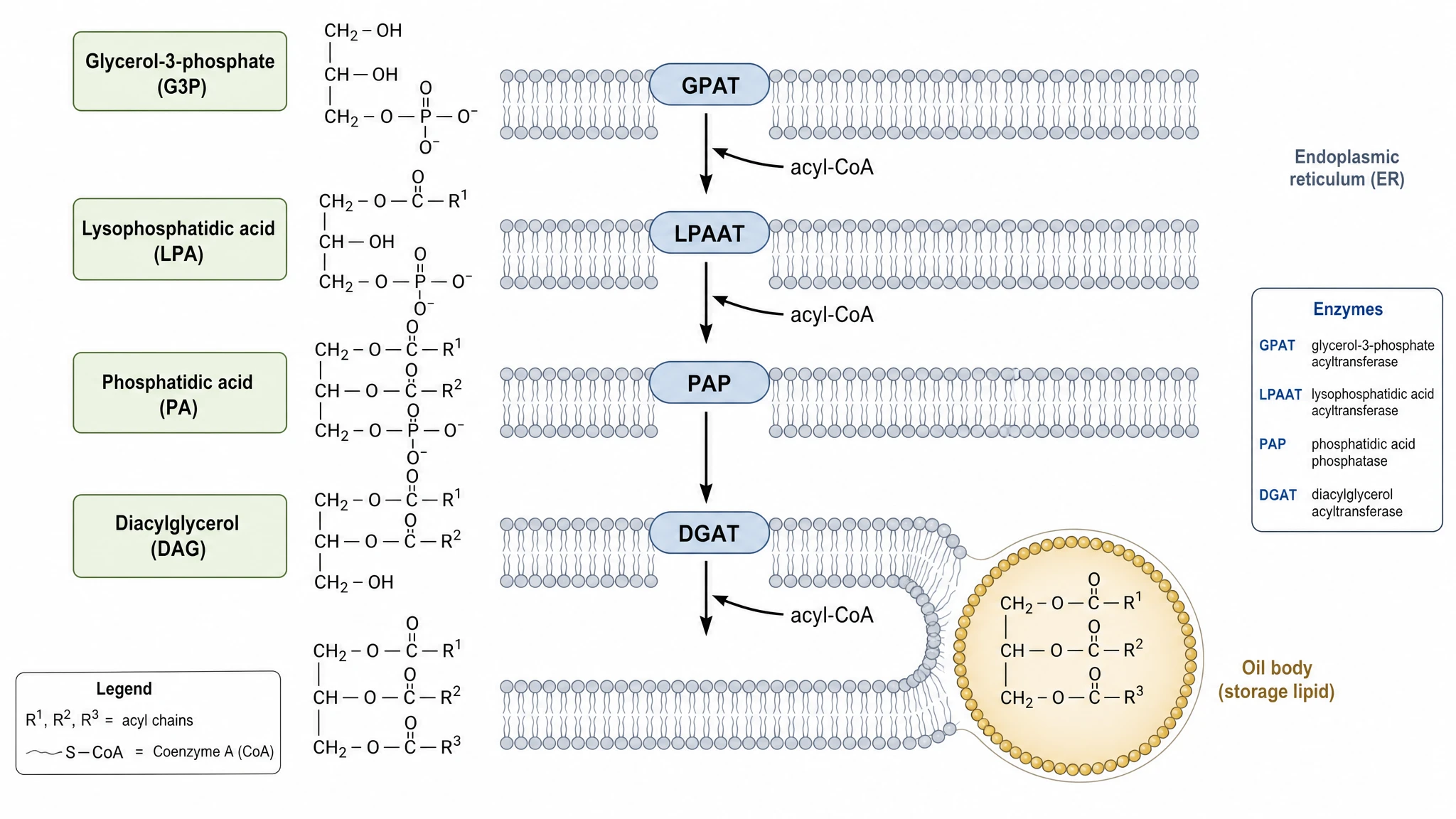
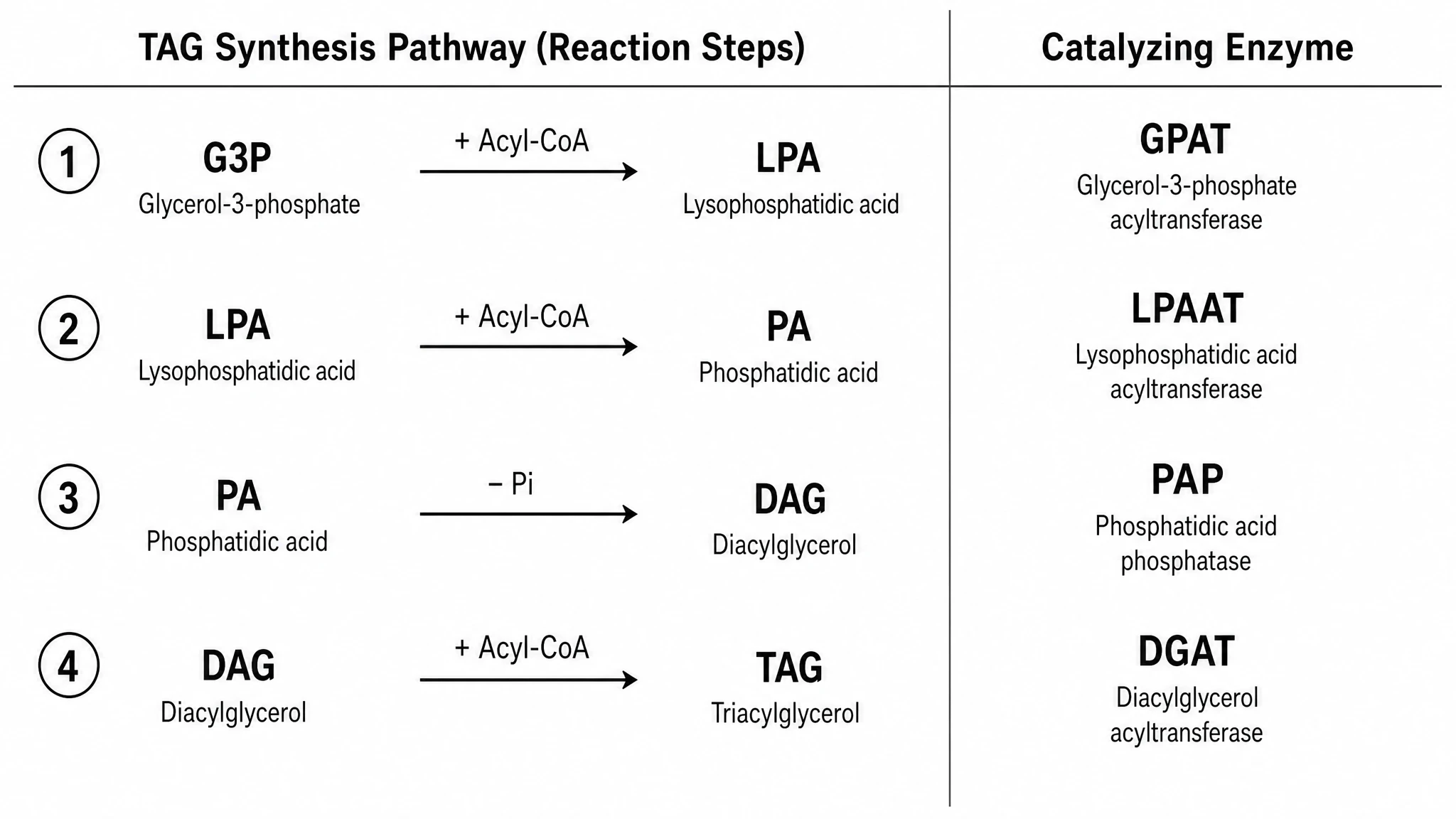
A labeled triacylglycerol (TAG) biosynthesis pathway in plant cells, tracing the Kennedy pathway from glycerol-3-phosphate to TAG — ready to relabel and export.
Updated

Start with up to 150 free credits|No credit card required
Get up to 350 free credits on day one when you join through an invite.
What is Triacylglycerol (TAG) Biosynthesis in Plant Cells?
A triacylglycerol (TAG) biosynthesis diagram for plant cells maps how plant cells build storage lipids from glycerol and fatty acids. It traces the Kennedy pathway in the endoplasmic reticulum: glycerol-3-phosphate (G3P) is acylated to lysophosphatidic acid (LPA), then to phosphatidic acid (PA), which is dephosphorylated to diacylglycerol (DAG); a final DGAT acylation produces triacylglycerol (TAG). With SciFig you generate a publication-ready pathway figure you can relabel and export.
Why This Pathway Gets Drawn
- Storage-lipid assembly spans two compartments — plastid and ER — so a figure is the only compact way to show where each acyl group originates and where it is esterified.
- Seed-oil engineering papers must state which step they perturbed; the reader needs the wiring diagram before the phenotype makes sense.
- The acyl-CoA-dependent and acyl-CoA-independent routes to TAG are easily confused in prose and trivially separated in a diagram.
- Acyl editing and the DAG–phosphatidylcholine cycle are cyclic, not linear, and resist description in a numbered list.
- Comparative work needs the plant route drawn beside the animal one, where the compartmental logic differs.
- Teaching lipid metabolism depends on students seeing the glycerol backbone acylated position by position.
Elements to Include
- Glycerol-3-phosphate — the backbone, supplied by cytosolic GPDH reduction of dihydroxyacetone phosphate.
- Acyl-CoA pool — 16:0, 18:0, 18:1 and downstream desaturation products, sourced from plastidial fatty acid synthase and activated by LACS.
- GPAT9 — sn-1 acylation of G3P to lysophosphatidic acid.
- LPAAT — sn-2 acylation of LPA to phosphatidic acid, the branch point shared with membrane phospholipid synthesis.
- Phosphatidic acid phosphatase (PAH/LPP) — dephosphorylation of PA to diacylglycerol.
- DGAT1/DGAT2 and PDAT — the two competing sn-3 acylation routes, one using acyl-CoA and one using phosphatidylcholine as acyl donor.
- Oil body formation — TAG accumulating between the ER bilayer leaflets, budding as a droplet coated by oleosin, caleosin, and steroleosin.
Where This Figure Is Used
- Seed-oil engineering papers showing which acylation step was over- or under-expressed to raise oil content.
- Biofuel and oleochemical feedstock work targeting DGAT flux or acyl-chain composition.
- Characterisation of Arabidopsis, camelina, or Brassica mutants where a pathway figure marks the lesion.
- Lipidomics studies that need a route map to interpret shifts in the DAG, PA, and phosphatidylcholine pools.
- Metabolic flux analysis and kinetic modelling papers, where the diagram defines the reaction network.
- Plant biochemistry lectures and textbook chapters covering storage-lipid assembly.
What the Pathway Figure Has to Get Right
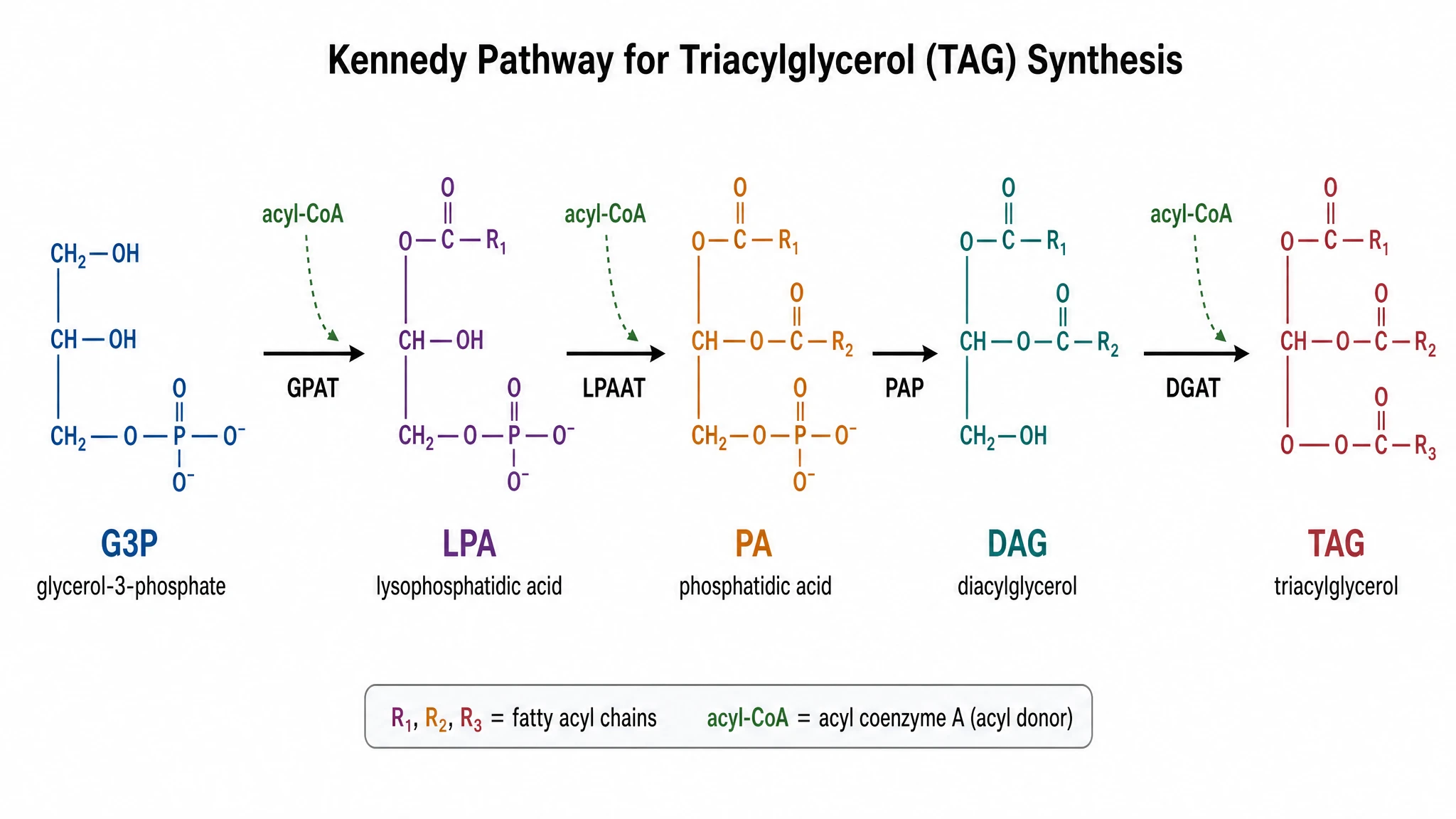
The Kennedy Pathway, Step by Step
Four acylation and dephosphorylation steps on the ER membrane: glycerol-3-phosphate is acylated at sn-1 by GPAT9 to give lysophosphatidic acid (LPA); LPAAT acylates sn-2 to give phosphatidic acid (PA); a phosphatidic acid phosphatase (PAH1/PAH2) removes the phosphate to yield diacylglycerol (DAG); DGAT then acylates sn-3. Every arrow needs its acyl-CoA donor and its enzyme named, or the figure is a cartoon rather than a pathway.
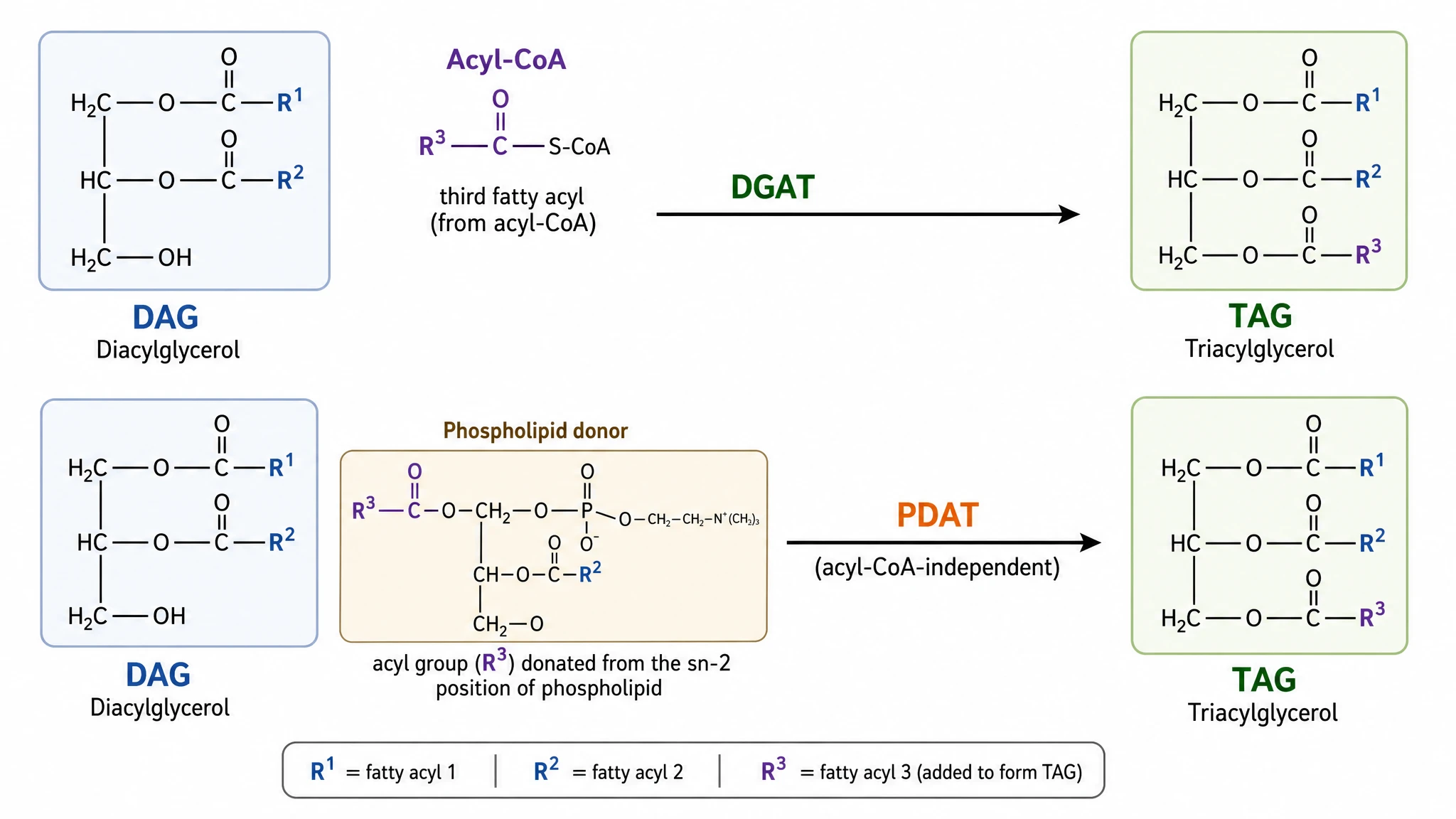
Two Routes From DAG, Not One
The final acylation runs by two mechanisms. DGAT1 and DGAT2 use acyl-CoA as donor. PDAT works acyl-CoA-independently, transferring an acyl group from the sn-2 position of phosphatidylcholine directly to DAG. Neither is dispensable: an Arabidopsis dgat1 pdat1 double mutant is almost devoid of seed oil, whereas either single mutant retains substantial deposition. A figure showing only DGAT misrepresents the flux.
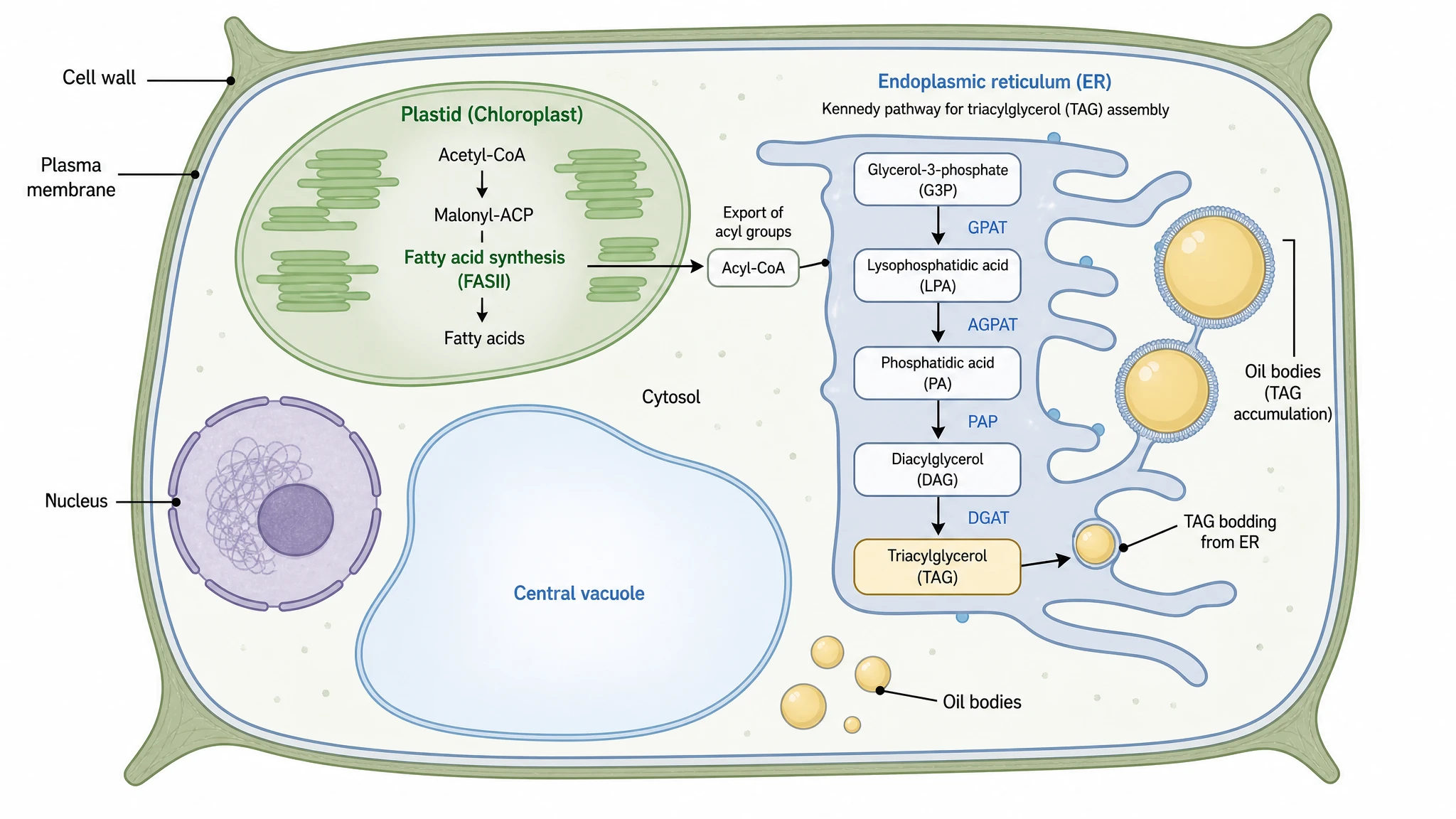
Acyl Chains Come From the Plastid
De novo fatty acid synthesis is plastidial, not cytosolic. Acetyl-CoA carboxylase makes malonyl-CoA, KAS enzymes elongate to 16:0- and 18:0-ACP, stearoyl-ACP desaturase introduces the first double bond, and FATA/FATB thioesterases release free fatty acids for export. LACS enzymes at the plastid envelope re-esterify them to acyl-CoA for the ER. TAG then accumulates between the ER leaflets and buds off as an oleosin-coated oil body.
Enzymes, Isoforms, and Localisation
Readers of a pathway figure want the gene names. GPAT9 (ER, sn-1), LPAAT2/LPAAT3 (sn-2), PAH1/PAH2 plus the LPP family, DGAT1 and DGAT2 with distinct substrate preferences, and PDAT1. Acyl editing through LPCAT and the DAG–phosphatidylcholine interconversion by PDCT and CPT feed unusual and polyunsaturated acyl groups back into the assembly pool — the step most often left out of textbook versions.
Triacylglycerol (TAG) Biosynthesis in Plant Cells— templates & examples
How to make Triacylglycerol (TAG) Biosynthesis in Plant Cells
Describe your figure
Tell SciFig what to draw in plain language — no design tools required.
Generate with SciFig
Get a clean, publication-ready figure that matches your description in seconds.
Edit & export
Vectorize it into editable SVG, relabel everything, and export for your paper, poster, or slides.
Related searches
- tag cycle
- triacylglycerol biosynthesis
- tag synthesis pathway
- kennedy pathway
- triglyceride synthesis in plants
- tag biosynthesis diagram
- dag to tag conversion
- g3p lpa pa dag tag
- dgat enzyme pathway
- storage lipid biosynthesis plant
Make figures for
Related pages
Biochemistry Templates
Browse more Biochemistry templates in SciFig's library.
All Templates
Browse every template page in SciFig's library.
Graphical Abstract Maker
Summarize your study in one panel
Scientific Poster Generator
Design a conference research poster
AI Scientific Image Generator
Generate research figures from text
Conceptual Framework Generator
Map variables and their relationships
Frequently Asked Questions
Common questions about Triacylglycerol (TAG) Biosynthesis in Plant Cells.

Ready to publish?
Make your own Triacylglycerol (TAG) Biosynthesis in Plant Cells in minutes.
Start for freeFree to start · No credit card required · Built for researchers