
Mouse Pup Young
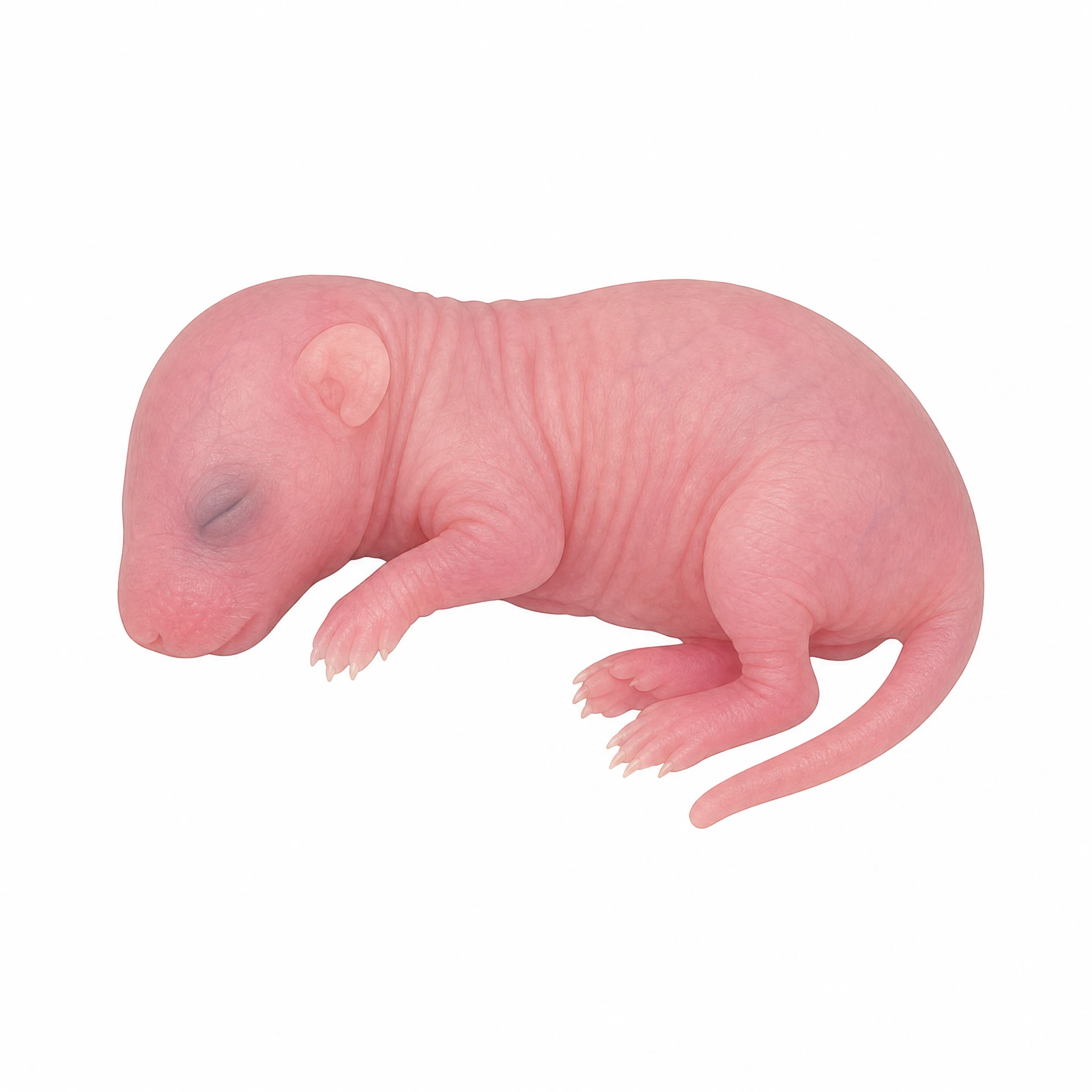
A clean, editable mouse pup icon for developmental biology and lab-animal figures — a hairless neonatal mouse, ready to relabel and export in any format.
Updated

Start with up to 150 free credits|No credit card required
Get up to 350 free credits on day one when you join through an invite.
What is Mouse Pup Young?
A mouse pup is a young, neonatal laboratory mouse, typically pink and hairless in the first days after birth before fur and full pigmentation develop. The icon is used in developmental biology, neuroscience, and lab-animal figures to mark early postnatal time points, litters, breeding schemes, and experimental timelines. With SciFig you describe the pup you need in plain language and generate a clean, editable mouse pup icon, ready to relabel and export.
Why the neonate is drawn distinctly from the adult
- Developmental figures are built on age, and a generic adult silhouette placed at P2 destroys the timeline's meaning. The pink, hairless, closed-eye neonate encodes the stage in the drawing itself.
- Postnatal day is the experimental variable in most of these studies: cortical synaptogenesis, myelination, retinal wave activity, and cerebellar granule cell migration all have narrow windows, and the figure must show which one was hit.
- The developmental milestones are visible externally and therefore drawable — fur appears around P4–P7, ears unfurl in the first days, eyes open around P12–P14, and weaning is around P21. A drawing that shows an open-eyed, furred animal is implicitly claiming an age past two weeks.
- Breeding and colony figures need to distinguish dam, sire, litter, and weanling at a glance; using one animal icon for all four makes a crossing scheme unreadable.
- Ethics and welfare documentation (licence applications, ARRIVE-compliant reporting) turns on age and procedure, so schematics that state age visually reduce ambiguity in review.
What the drawing should show
- Body proportions specific to the neonate: a disproportionately large head relative to trunk, short limbs held tucked, and an overall curled posture — not a scaled-down adult.
- Skin and coat state: translucent pink, hairless skin in the first days, through which the milk spot (a white patch of milk visible in the stomach) is often visible — that milk spot is a genuine viability and nursing indicator worth drawing when the figure concerns pup health.
- Eyes and ears in stage-appropriate state: fused eyelids and closed, unfurled pinnae early on; opening ears and then eyes as the animal is drawn nearer P14.
- A tail that is short relative to the body compared with the adult, and unpigmented in albino strains.
- Age or stage annotation directly on or next to the animal — P0, P7, P14 — plus a size cue, since a newborn is roughly 1–2 g and a weanling is 8–12 g and the difference is not conveyable by drawing alone.
- Litter and identification cues where relevant: toe/ear-mark or tattoo for genotyping, sex determination by anogenital distance, and dam presence for cross-fostering figures.
Where the icon is used
- Developmental neuroscience timelines: neonatal injection or viral delivery, hypoxia-ischaemia models, and critical-period manipulations placed on a postnatal-day axis.
- Breeding scheme and colony-management diagrams: crossing strategies, Cre-lox and conditional knockout genotyping timelines, weaning and genotyping schedules.
- Perinatal and maternal-exposure studies, where prenatal treatment of the dam is followed by offspring readouts and both animals must appear in the same schematic.
- Behavioural and reflex-development panels — righting reflex, negative geotaxis, ultrasonic vocalisation — each keyed to a specific postnatal day.
- Tissue-harvest and primary-culture protocol figures, where neonatal tissue (hippocampal, cortical, cardiomyocyte, cerebellar granule cell) is the standard source.
- Animal-welfare, husbandry, and training material where handling of neonates and the dam is the subject.
Mouse Pup Young— templates & examples
How to make Mouse Pup Young
Describe your figure
Tell SciFig what to draw in plain language — no design tools required.
Generate with SciFig
Get a clean, publication-ready figure that matches your description in seconds.
Edit & export
Vectorize it into editable SVG, relabel everything, and export for your paper, poster, or slides.
Related searches
- mouse pup
- mouse pup icon
- neonatal mouse
- baby mouse icon
- newborn mouse png
- mouse pup illustration
- young mouse clipart
- postnatal mouse icon
- lab mouse pup diagram
- rodent pup icon
Make figures for
Related pages
Lab Animals Icons
Browse more Lab Animals icons in SciFig's library.
All Icons
Browse every icon page in SciFig's library.
AI Scientific Image Generator
Generate research figures from text
Graphical Abstract Maker
Summarize your study in one panel
Text to Diagram Generator
Turn text into a diagram
Scientific Poster Generator
Design a conference research poster
Frequently Asked Questions
Common questions about Mouse Pup Young.

Ready to publish?
Make your own Mouse Pup Young in minutes.
Start for freeFree to start · No credit card required · Built for researchers