
Lemna Minor
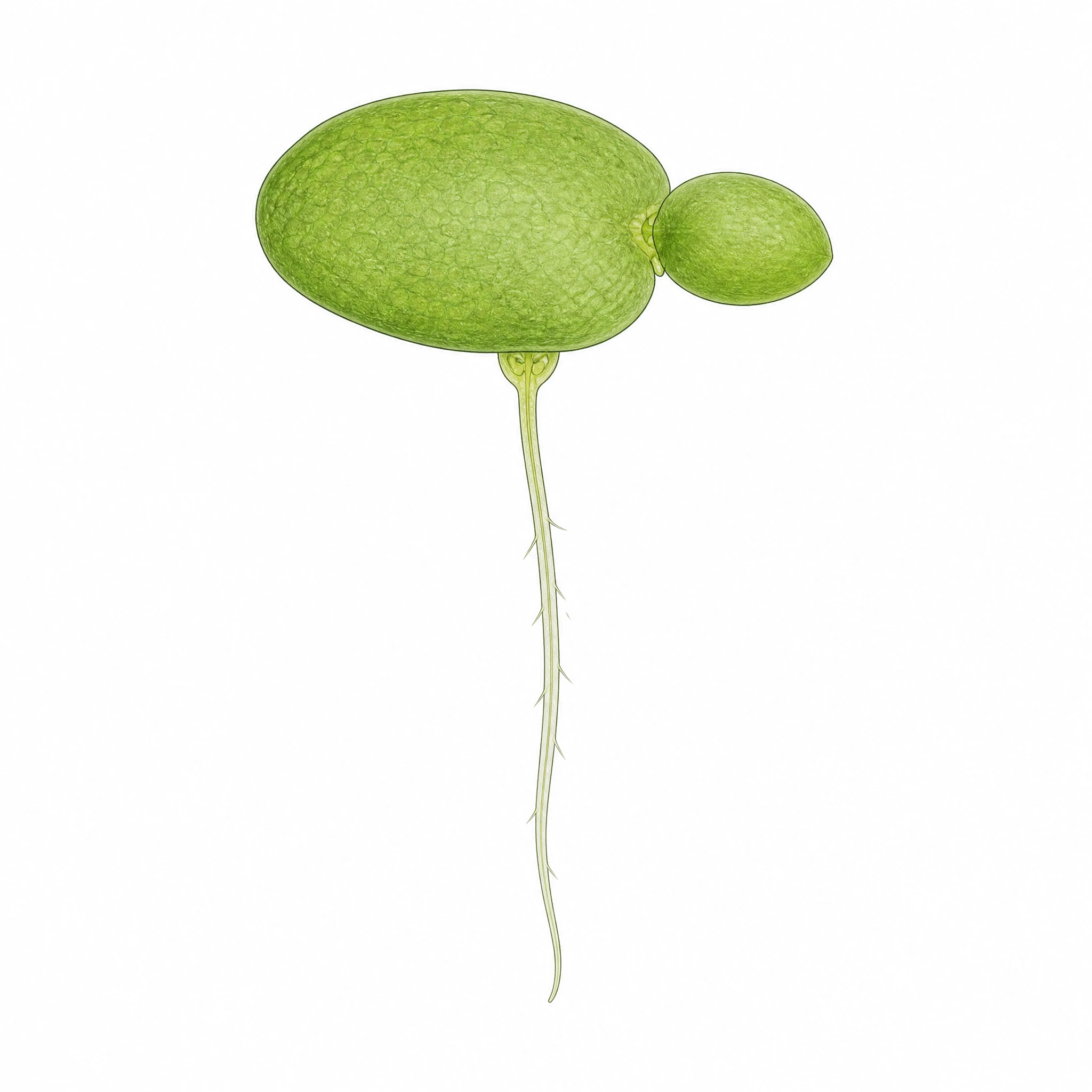
A clean, editable Lemna minor (common duckweed) frond with its single hanging root — ready for plant-biology and ecotoxicology figures, posters, and slides.
Updated

Start with up to 150 free credits|No credit card required
Get up to 350 free credits on day one when you join through an invite.
What is Lemna Minor?
Lemna minor, common duckweed, is a tiny free-floating aquatic plant made of small oval green fronds, each with a single thin root hanging into the water below. It is widely used as a model organism in plant biology, ecotoxicology, and water-quality assays, and appears in figures showing growth, toxicity testing, and aquatic ecosystems. With SciFig you describe the frond you need in plain language and generate a clean, editable Lemna minor duckweed, ready to relabel and export.
Why the plant is drawn rather than photographed
- The organism is a few millimeters across, so photographs of a culture vessel show a green film, not a plant. Only a drawing can show the individual frond, its root, and a daughter frond emerging from the mother — the structures the endpoints are actually counted on.
- It is a regulatory test species. OECD Test Guideline 221 (Lemna growth inhibition) makes frond number and frond area the measured endpoints over a 7-day exposure, so a figure that shows those structures is showing the readout.
- Its body plan is genuinely reduced — no distinct stem or leaf, a single unbranched root — and a generic aquatic-plant clipart misrepresents that morphology in a way anyone in the field will spot immediately.
- Clonal, vegetative reproduction is the whole basis of its use as a model: a colony descends from budding, not seed, which is why growth rate is measured as frond doubling and why the drawing needs to show the budding pouch.
- Doubling times of roughly 1.5–3 days under standard conditions make it a fast growth-inhibition assay, and workflow schematics need a compact glyph to place at each time point.
Structures to draw and label
- The frond — a small, flat, oval to obovate green body, typically 2–5 mm long, with 3 (occasionally 1–5) faint veins radiating from the node. It is a fused leaf-stem structure, not a leaf.
- The single unbranched root hanging beneath, with a root cap or sheath at its base and a distinct root tip. One root per frond is diagnostic: the closely related Spirodela bears several, and Wolffia bears none.
- The reproductive (budding) pouches — two lateral cavities at the base of the frond from which daughter fronds emerge. Drawing a daughter frond still attached to the mother at the pouch is what shows vegetative propagation.
- The colony state: mother plus 2–4 attached daughters is the typical unit counted in an assay, and a top-down view of a mat is how a test vessel actually looks.
- The air/water interface, since the plant is free-floating with the upper frond surface hydrophobic and emergent and the root submerged — this orientation matters in any uptake or toxicity figure.
- Endpoint cues where the figure is about a bioassay: chlorosis (yellowing), necrosis, frond breakup, and root shortening, all standard scored responses to a toxicant.
Where the plant appears in figures
- Ecotoxicology: OECD 221 growth-inhibition assays, EC50 dose–response panels for herbicides, metals, pharmaceuticals, and effluents.
- Phytoremediation and water-treatment schematics — nutrient (N, P) stripping from wastewater, heavy-metal uptake, and constructed-wetland diagrams.
- Plant biology and physiology figures using it as a fast-cycling model: nutrient limitation, photosynthesis, circadian and flowering studies.
- Bioeconomy and feed/biomass papers, where the plant's high protein content and rapid biomass accumulation are the subject.
- Freshwater ecology diagrams: floating-macrophyte cover, light attenuation of the water column below, and eutrophication dynamics.
- Method panels for culture and assay setup — sterile stock culture, Steinberg or SIS medium, frond transfer, and the multi-well or beaker layout of the exposure.
Lemna Minor— templates & examples
How to make Lemna Minor
Describe your figure
Tell SciFig what to draw in plain language — no design tools required.
Generate with SciFig
Get a clean, publication-ready figure that matches your description in seconds.
Edit & export
Vectorize it into editable SVG, relabel everything, and export for your paper, poster, or slides.
Related searches
- lemna minor
- duckweed frond png
- duckweed png
- duckweed illustration
- common duckweed icon
- duckweed frond and root
- aquatic plant duckweed clipart
- floating duckweed diagram
- water lentil icon
- duckweed model organism figure
Make figures for
Related pages
Botany Icons
Browse more Botany icons in SciFig's library.
All Icons
Browse every icon page in SciFig's library.
AI Scientific Image Generator
Generate research figures from text
Graphical Abstract Maker
Summarize your study in one panel
Text to Diagram Generator
Turn text into a diagram
Scientific Poster Generator
Design a conference research poster
Frequently Asked Questions
Common questions about Lemna Minor.

Ready to publish?
Make your own Lemna Minor in minutes.
Start for freeFree to start · No credit card required · Built for researchers